2 557 résultats
1922réf. R5312Berlin: Slovo 1922. Third edition. Paperback. Good. Original wraps; pp. 152 with frontispiece portrait of the author and his preface to the Russian edition. Front cover and endpaper detached but present; cheap paper tanned along the edges and a bit brittle. Slovo paperback books
1948réf. 2327Princeton NJ: np 1948. framed. Fine. ONE OF THE MOST CELEBRATED IMAGES OF EINSTEIN SIGNED BY MASTER PHOTOGRAPHER YOUSUF KARSH. On February 11 1948 Yousuf Karsh perhaps the most accomplished portrait photographer of his generation visited The Institute for Advanced Study in Princeton to fulfill a dream of his: to photograph Albert Einstein. As he later explained: "Among the tasks that life as a photographer had set me a portrait of Albert Einstein had always seemed a 'must' - not only because this greatest refugee of our century has been accounted by all the world as the most outstanding scientist since Newton but because his face in all its rough grandeur invited and challenged the camera." Karsh: Beyond the Camera David Travis ed. "At Princeton's Institute for Advanced Study I found Einstein a simple kindly almost childlike man too great for any of the postures of eminence. One did not have to understand his science to feel the power of his mind or the force of his personality" official Karsh website. "Awed before this unique intellect I yet ventured to ask Einstein his views on human immortality. He mused for a moment and then replied 'What I believe of immortality There are two kinds. The first lives in the imagination of people and is thus an illusion. There is a relative immortality which may conserve the memory of an individual for some generations. But there is only one true immortality on a cosmic scale ant that is the immortality of the cosmos itself. There is no other.' "He spoke of these ultimate mysteries as calmly as he might a student's question about mathematics - with such an air of quiet confidence indeed that I found his answer profoundly disturbing to one who held other views. Knowing him to be an accomplished violinist I turned the conversation and asked if there were any connection between music and mathematics. 'In art he said 'and in the higher ranges of science there is a feeling of harmony which underlies all endeavour. There is no true greatness in art or science without that sense of harmony. He who lacks it can never be more than a great technician in either field.' "Was he optimistic about the future harmony of mankind itself He appeared to ponder deeply and remarked in graver tones: 'Optimistic No. But if mankind fails to find a harmonious solution than there will be disaster on a dimension beyond anyone's imagination.' To what source should we look for the hope of the world's future 'To ourselves' said Einstein. He spoke sadly yet serenely as one who had looked into the universe far past mankind's small affairs. In this humor my camera caught him. the portrait of a man who had traveled beyond hope or despair." Yousuf Karsh Regarding Heroes. Opening quote from: Colin Naylor ed. Contemporary Photographers. Silver print. Photo taken Princeton 1948. Printed later. Signed by Karsh in full beneath the image on photographer's mount. With Karsh's original calling "card" - a 4x10 inch cardboard slip - included. Image: 8x9 inches. Framed to an overall size of 12x15 inches. Fine condition. np unknown books
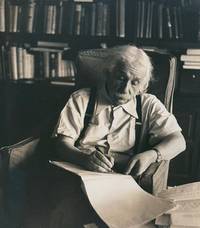
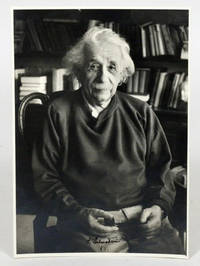
1950réf. 2896Princeton: np 1950. Very Good. A beautiful photo of Einstein at work in his study seemingly absorbed with his thoughts. The photographer Hermann Landshoff like Einstein was a German-Jewish émigré who settled in the United States in the 1930s. His large body of work encompasses portraits of some of the most influential figures of the century. Landshoff was highly respected by his peers with his work prompting the American photographer Richard Avedon to claim "I owe everything to Landshoff." Landshoff visited Einstein to photograph him several times in the 1940s and early 1950s showing Einstein in quieter moments at his home or study in Princeton. With Landshoff's copyright stamp on verso marking this as a "Sample copy" and "Not for sale or reproduction." Also with Landshoff's signature on the original matte board. The original non-archival matte was removed during framing to better preserve the photo but the signature was preserved and is now displayed on verso. Gelatin silver print with sepia tones. Taken c.1950 likely a contemporary or early printing. Approx. 9.25 x 10.5 in 235 x 263 mm. Archivally framed under museum glass to a size of 16 x 17.5 in. A few tiny spots to image generally in fine condition handsomely framed. np unknown books
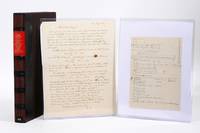
1932réf. 3054Caputh Germany: np 1932. First edition. Very Good. AN IMPORTANT SCIENTIFIC LETTER FROM EINSTEIN TO HIS CLOSEST MATHEMATICAL COLLABORATOR ACCOMPANIED BY A MANUSCRIPT LEAF OF CALCULATIONS IN EINSTEIN'S HAND ON THE SAME LINE OF RESEARCH. Although the original association of the letter and the leaf of calculations cannot be confirmed the two pieces clearly emerge from the same scientific context and have been preserved together. A superb pair from the final months of Einstein's German period. The Letter: In this intense and intellectually urgent letter Einstein writes to Walther Mayer his indispensable mathematical collaborator often referred to as "Einstein's Calculator" describing a newly conceived approach to the technical obstacles in their unified-field theory involving semi-vectors spinors and modified Dirac-type equations. Einstein tells Mayer he believes he "sees a new possibility" one that determines key constants in the system without resorting to the semi-vector construction. He then sketches the structure of the revised scheme points to the condition under which the full set of field equations reduces to a single one and warns that if this same collapse occurs in the general case "the whole thing would be useless." With his imminent departure from Germany he urges Mayer to examine the issue quickly and gives instructions for where a reply will reach him while en route. Dirac and De Broglie - Significance of the Scientific References: Of particular importance is Einstein's explicit engagement in this letter with the work of Paul Dirac and Louis de Broglie two of the central figures in early quantum theory. Einstein refers directly to the Dirac equations introduced only a few years earlier which provided a relativistic formulation of the electron and played a foundational role in quantum mechanics. He also invokes the De Broglie equations for matter waves reflecting his continued effort to reconcile quantum ideas with relativistic field theory. These references place the letter squarely at the intersection of Einstein's unified-field program and the emerging quantum framework he famously regarded with both fascination and skepticism. The letter thus documents Einstein actively testing whether concepts originating in quantum mechanics-Dirac's relativistic wave equation and De Broglie's wave-particle duality-could be absorbed into a geometrically unified classical field theory. Letters in which Einstein explicitly grapples with Dirac and De Broglie at this technical level are rare and represent an important record of his engagement with the central theoretical developments of the early twentieth century. Historical Context: Einstein's collaboration with Walther Mayer beginning around 1930 produced some of the most technically sophisticated papers of Einstein's later career. Together they developed new mathematical structures-semi-vectors spinors and higher-dimensional tangent-space formulations-used in their unified-field attempts. This letter dates from December 1932 only weeks before Einstein left Germany permanently and belongs to the final phase of their joint work published in the Sitzungsberichte of the Prussian Academy. Einstein valued Mayer so highly that he later persuaded the Institute for Advanced Study to create a permanent position for him the only such appointment ever granted for one of Einstein's collaborators. The Manuscript Calculations: Accompanying the letter is a two-page manuscript leaf containing Einstein's working calculations: trial expressions constraint conditions and variant formulations of the same type of semi-vector and spinor problems addressed in the letter. While we cannot confirm that these pages were originally enclosed with the letter they concern the same scientific material and have been preserved alongside it. Einstein manuscript leaves of this depth and technical significance-especially when tied to a known collaborative problem-are scarce. Significance: Whether or not originally sent together the letter and the calculations form a powerful and coherent scientific pair offering a rare view of Einstein actively working through equations testing ideas and relying on Mayer to verify mathematical structure. They capture Einstein at a critical inflection point in both his scientific life and personal circumstances as he prepared to leave Germany forever. --------- The letter from Einstein to Mayer reads in full translated from the original German: Dear Mr. Mayer! I believe I see a new possibility which promises success. It is along the lines of the recently devised way according to which one places zero on the right side of the Dirac-Equations. The novelty is in the fact that the constants a1 . a4 aside from a totally irrelevant factor are completely known without passing on to the specific Semi-Vectors. After omission of the _-terms the equations read Ee st ys = s 1 xe Or for De-Broglie-Equations of the restless particle E4 st ys = s 1a x4 Here is what's new: How does one choose the ay so that the De Broglie - Choices stay largely undetermined Result: The four equations 1a reduce themselves into a single one when and only when if one lets a1 = 1 a2 = 1 a3 = 1 a4 = 1 I believe that with this selection ay is for the equation describing the _-terms 1 the fitting substitute for the DeBroglie-Equation. These equations are already supplied by the simplest Hamilton function. See if the general equations 1 degenerate with this placing for a as well. If this were the case the whole thing would be useless. I leave on Saturday. A letter that is sent to Antwerp to the `Oakland' Hapag Antwerp harbor will reach me until December 13. Cordial greetings from your A. E. Autograph Letter Signed Written in German. One page 8.5 x 11 in.; 216 x 279 mm. probably Caputh near Potsdam Germany the location of Einstein's country home Sunday 4 December 1932. Scattered spotting affecting four words; usual folds. WITH: Two-page leaf of mathematical calculations. Housed together in decorated half-leather box by noted book artist Sjoerd Hofstra. np unknown books
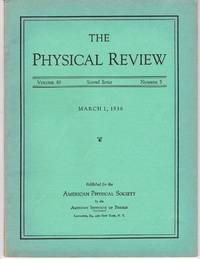
1936réf. 6550Lancaster PA: American Physical Society 1 March 1936. Second series volume 49 number 5. Very Good. ppl 341-422. Original green wraps. Slight nick at bottom edge of lower wrap else better than very good. Includes the retort by Einstein and Rosen originators of speculation on the existence of "worm-holes" in spacetime to objections made to the general theory of relativity. According to Galina Weinstein: "Between 1935 and 1936 Einstein was occupied with the Schwarzschild solution and the singularity within it while working in Princeton on the unified field theory and with his assistant Nathan Rosen on the theory of the Einstein-Rosen bridges. He was also occupied with quantum theory. He believed that quantum theory was an incomplete representation of real things. Together with Rosen and Boris Podolsky he invented the EPR paradox. I demonstrate that the two-body problem in general relativity was a heuristic guide in Einstein's and collaborators' 1935 work on the Einstein-Rosen bridge and EPR paradox." Also articles by notable physicists on radioactivity electron mobility quantum-mechanical measurement and so on. American Physical Society paperback books
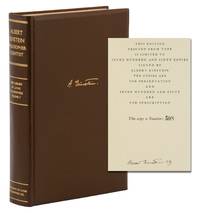
1949réf. 140948474Evanston Illinois: The Library of Living Philosophers Inc 1949. Signed Limited First Edition. Near Fine. First edition. Number 508 of a limited 760 copies signed and dated by Albert Einstein. 777 pp. Bound in publisher's brown leatherette stamped in gilt; top edge gilt; lacking the glassine dust jacket and slipcase. Text in English and German. Near Fine with very faint tidemark to edge of half-title frontisportrait and title page. A collection of critical essays devoted to the theoretical physicist by twenty-five eminent scholars and scientists with Einstein's remarks. Published on Einstein's 70th birthday the work has contributions by noted contemporaries such as Max Born Kurt Godel and Wolfgang Pauli. The Library of Living Philosophers, Inc unknown books
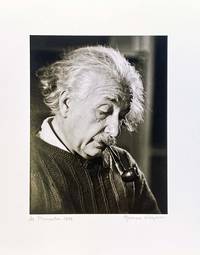
1954réf. 2832Princeton NJ: np 1954. First edition. nb. Fine. EXTREMELY RARE AND BEAUTIFUL SIGNED PHOTOGRAPH OF EINSTEIN BY FREDERICK PLAUT. SIGNED ON THE IMAGE BY EINSTEIN: "A. Einstein 54". A fine photograph of Einstein in 1954 a year before his death sitting in his Princeton home surrounded by books and holding his pipe gazing slightly away from the camera. In his 1964 collection of photographs The Unguarded Moment the photographer Frederick Plaut explains the circumstances of his evocative photo of the elderly Einstein: "There must be a moment in every professional photographer's life when he is so in awe of his subject that he can scarcely focus his camera. That moment for me was when I met Albert Einstein at his home in Princeton. Certainly the great man was not formidable; he greeted my wife and me graciously and proceeded to chat with her while I went to work. I remember that she asked him about his music and when he told her that he no longer played his violin she murmured 'That's too bad.' He smiled 'Ah no. It would have been too bad if I went on.' In the final moments of our visit Einstein looked at me very seriously. 'I hope' he said 'you can sell these pictures for a good price.' Astounded I blurted out: 'Oh no Sir. I have nothing to sell. I just wanted to photograph you.' His face clouded. 'Not sell them If I had known that I never would have let you take them.' After we left I realized the significant of a delightful remark attributed to Mrs. Einstein. Someone once asked Mrs. Einstein whether she understood Professor Einstein's theory of relativity. She answered without hesitation 'No but I understand Professor Einstein'" Frederick Plaut The Unguarded Moment A Photographic Interpretation. The photographer Frederick Plaut moved to the United States from Europe in 1940. After being "discovered" by the legendary photographer Edward Steichen Plaut soon was invited to exhibit in numerous exhibitions. "At the Museum of Modern Art his photographs have been shown in many exhibitions including: 'The Family of Man' 'Music and Musicians' 'The Exact Instant' and others. Plaut's work has appeared in Time Life Esquire Look Saturday Review Vogue U.S. Camera Modern and Popular Photography andRealities et al" The Unguarded Moment. Provenance: Acquired directly from the family of the original recipient Arthur Klein with the original mailing envelope stamped "Jan 27 '54" from The Institute for Advanced Study in Princeton where Einstein was working at the time. Arthur Klein is primarily known for founding with his wife Luce Spoken Arts a highly influential company formed in the 1950s that created and distributed recordings of the works of famous writers and artists usually reading from their own works. Princeton NJ: 1954. Silver gelatin print approximately 4.75 x 6.75 inches. With Plaut's studio stamp on verso. Fine condition with Einstein signature - nicely centered at the base of the photograph - particularly strong. As Plaut mentioned in his account of the photographic session he never intended to sell this photograph and it is likely very few of these photos were printed and distributed. EXTREMELY RARE: WE CAN FIND NO OTHER EXAMPLE OF THIS PHOTOGRAPH SIGNED BY EINSTEIN. np unknown books
1931[8] 9-94 pages. Select Bibliography. First published in London in 1930. "Professor Einstein is better known as a physicist than as a Zionist. Yet for many years he has given abundant proof both of a keen interest in Zionism and of a penetrating insight into its underlying ideas. He is impelled to Zionism by his acute consciousness of the excessive price at which the blessings of assimilation are bought by the Jewish communities of the Western world, which for him are mainly represented by that of Germany. The price is a loss of solidarity, of moral independence and self-respect. These, in his view, can be regained only if assimilated Jews find some common task, of absolute human value, to which they can bend their corporate energies as Jews. Such a task is to be found in the restoration of Jewish national life in Palestine." - Introduction. Unmarked with average wear. Backstrip lettering faded. Binding tight. A sound copy of this important compilation. Emanuel p.51. Boni, Russ & Laurence 306. Book
1979réf. 228499Beijing: Ke xue chu ban she 1979. v 111p. slender paperback very good. Translation of the fifth edition of "The meaning of Relativity. Ke xue chu ban she unknown books
1980réf. 2611New York: np 1980. First edition. Clamshell box. Fine. EXTREMELY RARE COMPLETE SUITE OF SEVEN LARGE SILVER PRINTS FROM EINSTEIN'S FAMOUS PHOTO SHOOT AT PRINCETON WITH ROMAN VISHNIAC. Each print is signed by Vishniac and dated "At Princeton 1942" in his hand below the image and numbered on the back. "One day Vishniac decided to visit Albert Einstein at Princeton to offer greetings from mutual friends in Berlin. Uninvited he hoped Einstein would pose for a portrait but Einstein had little interest. Vishniac recalled: It was a singular experience. An idea had suddenly come to him and the room was filled with the movement of the great man's thought. I waited several minutes and then when I saw that he did not intend to say anything more to me and that he was off in a world of his own I started taking pictures. Einstein later admitted that a Vishniac photograph taken that day was his favorite portrait" Encyclopedia of Twentieth-Century Photography. Vishniac provided details about this portolfio in a letter to an original recipient the letter is not included here explaining: The size of the edition's limitation is uncertain due to my age and only spare time to make them. The most expensive portfolios - Ansel Adams Kertesz - are limited in large numbers I can never measure up - 999 1001 and similar. The originality of Portfolio "Einstein" consists of its special character. It is made not to get images but the feeling that you are present during the creativity by the Great Man. All pictures are made with "hidden camera" method. The value of this portfolio is great and can hardly be estimated today. Princeton/New York: 1942 negatives; 1980 silver prints. Elephant folio clamshell box approx. 17x21 in. housing seven silver prints. Image size: approx. 10.25 x 13.25 in.; with matte 16x20 in. A few minor blemishes to box. Photos in fine condition. RARE. np unknown books
1947réf. 222250New York: Dorset Press 1947. Hardcover. Near Fine/Very Good. Second edition. Near fine in very good dust jacket. Slight spine lean. Dorset Press hardcover books
1956réf. 37750New York: Norton 1956. Hardcover. Very Good. Octavo. Boards. 265 pp. In dustjacket. Norton hardcover books
1934réf. 137344Germany: Sijthoff 1934. Hardcover. Very Good. Very good Browned. In German. Light fading to spine. Sijthoff hardcover books
1941réf. 44121NY: Oxford 1941. First Edition. 8vo pp. vii 288. Translated from the German by Cesar Saerchinger. Blue cloth stamped in gilt. A VG tight copy. Oxford unknown books
réf. Z30447SLWGallimard Broché bon état .Contenu propre .Couverture jaunie . 1992.628 pages .PHOTOS SUR DEMANDE
1962réf. 439676New York: Oxford University Press 1962. Softcover. Very Good. Later printing. Trade paperback. 492pp. Translated by Arthur Mendel and Nathan Broder. Pages lightly age-toned edges rubbed very good. Oxford University Press unknown books
1947réf. 33821New York: Norton 1947. Hardcover. Very Good. Octavo. Boards. 371 pp. Norton hardcover books
1947réf. 226469New York: Norton 1947. Hardcover. Very Good. First edition. Very good minus hardcover. First edition. Pages light brown clean text. Corners on cover slightly bent. Some water stains on cover. Cover soiled. Norton hardcover books
1947réf. 88267New York: Norton 1947. First. hardcover. very good. Illustrated. xii 371pp. 8vo cloth. New York: Norton and Co. 1947. First Edition. A very good copy. Norton unknown books
1971réf. 212282Princeton N.J.: Princeton University Press 1971. Hardcover. VG. Jackets and volumes are clean and unmarked. Jackets in mylar. Quarto Hardcover. Three volumes bound in burgundy cloth with gilt spine lettering; tan dust jackets with mylar covers. Illustrated title pages bw illustrations throughout each volume. Text in English songs in Italian with English text translations. Vol. 3 contains "Texts of songs revised and translated by Antonio Illiano and Howard E. Smither" and scores of 97 madrigals. Princeton University Press hardcover books
1971réf. 186152Princeton N.J.: Princeton University Press 1971. Hardcover. Good/Good Ex-library with stamps and labels on spine inside front and rear covers ffep and block. Overall light shelfwear to boards and block. Binding is tight and pages are otherwise clear. Three volumes bound in burgundy cloth with gilt spine lettering; tan dust jackets with mylar covers. Illustrated title pages bw illustrations throughout each volume. Text in English songs in Italian with English text translations. Vol. 3 contains "Texts of songs revised and translated by Antonio Illiano and Howard E. Smither" and scores of 97 madrigals. Princeton University Press hardcover books
réf. B34915-SCCambridge University Press. Collectible - Good. Great Britain: Cambridge at the Univ Press 1938. 1st UK 1st issue with gold lettering on spine and both endpapers present. Hardcover 12mo 319 pgs. Medium blue cloth gold gilt on spine. B/w plates and illustrations. Near very good book in a fair dust jacket. Corners and spine ends lightly bumped and worn. Contents clean and binding sound. Bookplate to front endpaper with writing in Latin name of Andrzei Falkiewicz written in and Alberto H R Ball Rectore at bottom edge. Jacket is edgeworn chipped and torn. Rear panel and spine are toned. Orig price 8s 6d on front flap. stem science physics Inquire if you need further information. Cambridge University Press hardcover books
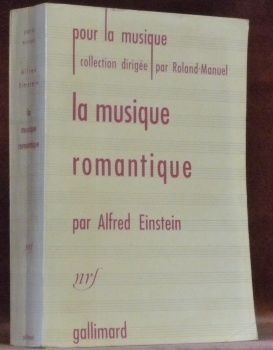
réf. 11309Paris, Gallimard 1959, 195x135mm, 478pages, broché. Bel exemplaire.
réf. 10168Paris, Gallimard 1958, 207x114mm, 449pages, broché. Bon état.
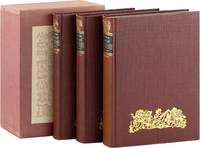
1949réf. 88051Princeton: Princeton University Press 1949. First English Language Edition. Three quarto volumes. Burgundy cloth hardcovers in publisher's slipcase; xvi1-476; 477-8773; x333pp. A fine set in the original cloth bindings; slipcase is mildly rubbed and sunned with small paper loss to open edge still Very Good. Einstein's monumental study was the first scholarly treatise of its kind in any language and remains one of the essential works on early Italian secular music. Volumes I & II provide scholarly background on the history and evolution of madrigal form while the third volume compiles nearly 100 compositions produced between 1470 and 1650 including works by Tromboncino Verdalot De Rare Gabrielli and others. An uncommonly well-preserved set. Princeton University Press unknown books