EINSTEIN, ALBERTABAA
3003 risultati
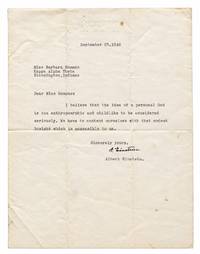
1948rif. 3094Princeton: np 1948. first edition. Very Good. ONE OF EINSTEIN'S MOST DIRECT STATEMENTS ON GOD: A POWERFUL AND CONCISE PRECURSOR TO HIS CELEBRATED "GOD LETTER". In the letter dated September 25 1948 and addressed to the Indiana University student Barbara Homans Einstein writes: "I believe that the idea of a personal God is too anthropomrphic sic and childlike to be considered seriously. We have to content ourselves with that modest insight which is accessible to us." The letter is a strikingly concentrated statement of Einstein's religious philosophy. In two sentences he rejects the notion of an anthropomorphic personal deity while setting against it a characteristically modest view of human knowledge: rather than claiming access to metaphysical certainty "we have to content ourselves" with the limited understanding available to us. That formulation places the letter squarely within one of the most important recurring themes of Einstein's later correspondence: his distinction between conventional belief in a personal God and his own sense of awe before the rational order of the universe. Six years later in his famous letter to the philosopher Eric Gutkind of 3 January 1954 Einstein would return to the same subject in far greater detail describing the word "God" as an expression of human weakness and rejecting traditional religious conceptions with exceptional directness. Christie's described the Gutkind letter as Einstein's most fully articulated statement of his religious and philosophical views; it sold in 2018 for $2892500 at Christie's. The present letter is remarkable because the essential position of the later "God Letter" is already present here in distilled form. The shared target is the anthropomorphic personal God: a conception Einstein repeatedly rejected while maintaining that a profound sense of wonder before the structure of nature could still be called religious. It is a direct statement of Einstein's mature religious philosophy anticipating the central argument of the 1954 "God Letter" by more than five years. Typed letter signed "A. Einstein" to Barbara Homans. Princeton 25 September 1948. One page 8 1/2 x 11 in typed on Einstein's Princeton stationery with embossed address at head; signed "A. Einstein" in ink. Folded for mailing with light toning and a few small stains. np unknown books
1953rif. 2270Princeton NJ: np 1953. First edition. custom folder. Very Good. TOWARDS THE END OF HIS LIFE EINSTEIN WRITES TO ONE OF HIS FRIENDS FROM THE PATENT OFFICE CONCERNING ONE OF THE CENTRAL STRUGGLES OF HIS SCIENTIFIC LIFE. COMMENTING ON THE WORK OF DIRAC EINSTEIN ADMITS THAT ALTHOUGH HE "CAN'T TAKE A STATISTICAL FOUNDATION OF PHYSICS SERIOUSLY" HE FINDS IT "DIFFICULT TO MOVE BEYOND IT". Background: Einstein's struggle with accepting a strictly statistical quantum theory has been one of the most discussed and debated topics of twentieth-century physics. When introduced to the statistically-based quantum mechanics of Heisenberg Born and Jordan in 1926 Einstein famously wrote to Max Born that "Quantum mechanics is certainly imposing. But an inner voice tells me that it is not yet the real thing. The theory says a lot but does not really bring us any closer to the secret of the 'old one.' I at any rare am convinced that He is not playing at dice." Einstein letter to Born from 4 December 1926. From the onset "Einstein regarded the quantum theory as descriptively incomplete. What he meant was that in typical cases the probabilistic assertions provided by the theory for an individual quantum system do not exhaust all the relevant and true physical assertions about the system. Put briefly according to Einstein the typical statistical story told by quantum theory is not the whole story." Arthur Fine "What is Einstein's Statistical Interpretation or Is It Einstein for Whom Bell's Theorem Tolls". Einstein's discomfort with the new theory haunted him for the next three decades and his challenges to the theory were the cause of some of the most fertile and defining moments of modern science notably the celebrated "Bohr-Einstein debates" begun at the Fifth Solvay Conference 1927 and his monumentally influential "EPR" paper of 1935 "Can Quantum-Mechanical Description of Physical Reality Be Considered Complete" written with Boris Podolsky and Nathan Rosen. As late as 1949 in his "Reply to Criticisms" published in Albert Einstein: Philosopher-Scientist Einstein notes that Born and Wolfgang Pauli in their contributions to the volume "deprecate the fact that I reject the basic idea of contemporary statistical quantum theory insofar as I do not believe that this fundamental concept will provide a useful basis for the whole of physics" and spends the majority of the essay explaining his position and distinguishing between his acceptance of the model for "ensembles of systems" while still rejecting it for an "individual physical system". The letter: Dated September 12 1953 and written to his old colleague at the patent office in Bern Joseph Sauter the letter translated from the original German reads in full: Dear Mr. Sauter If I am able to I will gladly assist Mr. Keberle. I have heard of you often from my old friend Besso and I have also received a manuscript which deals critically with handwritten Dirac's presentation of the statistical approach to quantum theory. I have not been able to judge it myself because it is simply impossible for me to take a statistical foundation of physics seriously. But I have to admit that it is difficult to move beyond it. Yours sincerely signed A. Einstein. Albert Einstein. The recipient Joseph Sauter worked with Einstein at the Bern Patent office during the years he was developing the ideas for his revolutionary papers of 1905. "Among his colleagues at the Patent Office Einstein discovered one with similar scientific interests-Dr. Josef Sauter a French-Swiss who had also studied at the Polytechnic and who had been Professor Weber's chief assistant for a while. Sauter like Einstein tried to fill the gaps in the Polytechnic's syllabus by private study so that Einstein was able to discuss with him Maxwell's thermodynamics and Helmholtz's and Hertz's theoretical concepts. The two also discussed Einstein's publications on thermodynamics with the result that Sauter discovered a mistake in them which Einstein accepted 'without being the least upset.' Fifty years later Einstein recalled 'that I had a lot of discussions with Sauter about. my thermal-statistical papers'. At least as important as his help with the 'rewriting and amending' were Sauter's connections with scientific circles in Bern to which he soon introduced his new colleague." Albrecht Fölsing Albert Einstein. Edouard Keberle mentioned in the first line by Einstein was a Bulgarian physicist who at the time of the letter had just left the Institute of Theoretical Physics in Bern over a publication dispute. Not long after this letter - in early 1954 - Keberle accepted a post at the Midwest Research Institute in Kansas City. It is unclear if Einstein helped him in any way to get this position. Michele Besso - also mentioned in this letter - was Einstein's close lifelong friend. What prompts Einstein to declare that "it is simply impossible for me to take a statistical foundation of physics seriously" is the mention of a manuscript on the work of Paul Dirac. Philosophically Dirac was almost the opposite of Einstein - he had no interest in probing the interpretations of quantum theory wryly noting in his paper "The Inadequacies of Quantum Field Theory" that "The interpretation of quantum mechanics has been dealt with by many authors and I do not want to discuss it here. I want to deal with more fundamental things." It is revealing in this letter that although Einstein re-states his objection to a statistical basis of quantum theory he has doubts about his position admitting - less than two years before his death - that he still has difficulty moving beyond it. Typed Letter Signed. Princeton NJ: September 12 1953. One 8.5x11 inch sheet with Einstein's embossed Mercer Street address at top. Custom silk presentation folder. With original mailing envelope with postmarks. A few small smudges usual folds; fine condition. ONE OF EINSTEIN'S FINAL STATEMENTS ON ONE OF THE CENTRAL TENETS OF HIS SCIENTIFIC PHILOSOPHY. np unknown books
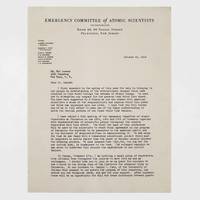
1946rif. 376560Princeton New Jersey 1946. 1 1/2 pages on recto and verso of quarto sheet of letterhead for the Emergency Committee of Atomic Scientists. Folded for mailing else Fine. Folding green cloth slipcase. 1 1/2 pages on recto and verso of quarto sheet of letterhead for the Emergency Committee of Atomic Scientists. An invitation written in Einstein's capacity as Chairman of the Trustees of the Committee to Lesser to attend a three day conference in Princeton the following month and asking him to be his special guest at a luncheon on the 17th of November. Einstein writes Lesser "as one who shares with American scientists a sense of the responsibility and urgency with which this great new force has impressed upon our lives ." and notes that one of the chief aims of the conference will be for "the scientists to reach final agreement on our program of education for survival ." Perhaps it was in his capacity as film producer that Lesser was considered a potential contributor beyond simple monetary help. The letter is addressed to Lesser at the Paramount Building 1501 Broadway NYC. Lesser 1890-1980 was a successful film producer a career that spanned the silent era up through such productions as THUNDER OVER MEXICO 1939 and OUR TOWN 1940 to the long string of post 1943 Tarzan films when he once again reacquired the rights after having produced the Buster Crabbe serial of 1933. He received the 1960 Jean Hersholt Humanitarian Award. unknown books
1926rif. 374131926. Weil 153. Offprint from S. preuss. Akad. Wiss. unknown books
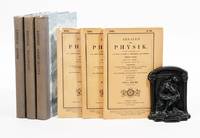
1906rif. 504131906. Einstein Albert 1879-1955. Über eine Methode zur Bestimmung des Verhältnisses der transversalen und longitudinalen Masse des Elektrons. In Annalen der Physik 21 1906. 583-586pp. Figs. Text-illust. 214 x 140 mm. Laid-in item: notecard with penciled notes probably in the hand of Lord Rayleigh. Red cloth gilt spine. Frontis portrait of P. Curie d. 1906. Whole volume: viii 1056pp. 9 plates 5 b/w silver photos 4 folding. Small cut on spine starting approximately two inches from the head and is about three inches in length -very thin- otherwise Very Good. First Edition Whole Volume. In his landmark 1905 paper on special relativity Einstein used the velocity-dependent concepts of transverse and longitudinal mass for the moving electron these terms have now been replaced with the concept of relativistic mass first defined by Lewis and Tolman in 1909. In the present paper Einstein proposed an experimental method for determining the ratio of the transverse to the longitudinal mass and invited experimentalists to verify his special theory of relativity. Einstein later abandoned velocity-dependent mass concepts stating in 1948 that "it is better to introduce no other mass concept than the rest mass" quoted in L. B. Okun "The concept of mass" Physics Today 1989: 31-36. Lavenda A New Perspective on Relativity pp. 7-8. Weil's Einstein Bibliography no. 14. Boni's Einstein Checklist no. 14 John William Strutt third Baron Rayleigh Lord Rayleigh 1842-1919 was a british mathematician and physicist; he was one of the very few members of higher nobility who won fame as an outstanding scientist. Rayleigh was born as the son of John James Strutt second Baron and his wife Clara Elizabeth La Touche eldest daughter of Captain Richard Vicars R.E. Lord Rayleigh was awarded the 1904 Nobel Prize in Physics "for his investigations of the densities of the most important gases for his discovery of argon in connection with these studies." Rayleigh provided the first theoretical treatment of the elastic scattering of light by particles much smaller than the light's wavelength now known as "Rayleigh scattering" - a process which notably explains why the sky is blue. He also made extensive contributions to fluid dynamics e.g. the Rayleigh number critereon for the stability of the Taylor-Couette flow etc. Rayleigh also formulated the circulation theory of aerodynamic lift. His derivation of the Rayleigh-Jeans law for classical black body radiation played an important role in the birth of quantum mechanics i.e. the Ultraviolet catastrophe. During the first World War he was president of the United Kingdom government's Advisory Committee for Aeronautics. Notable students of the 3rd Lord Rayleigh include J.J. Thomson 1856-1940 and Sir William Ramsay 1852-1916 who was awarded the Nobel Prize in Chemistry in 1904 "in recognition of his services in the discovery of the elements in air." In 1871 he married Evelyn Balfour sister of the future prime minister the Earl of Balfour and daughter of James Maitland Balfour and his wide Blanche the daughter of the second Marquis of Salisbury. They had three sons the eldest of whom Robert John Strutt 1875-1946 was to become Professor of Physics at Imperial College of Science and Technology London. Strutt inherited the title of fourth Baron Rayleigh after his father's death in 1919. nobelprize.org. Also in this volume: Einthoven Willem 1860-1927. Weitere mitteilungen ueber das saitengalvanometer. Analyse der saitengalvanometrischen kurven. Masse und spannung des quarzfadens und widerstand gegen die fadenbewengung. Erster teil. In Annalen der Physik ser. 4 21 1906. 483-514 pp. Willem Einthoven 1860-1927 was a Dutch doctor and physiologist who won the Nobel Prize in Physiology or Medicine in 1924 "for his discovery of the mechanism of the electrocardiogram" nobelprize.org. . unknown books
1922rif. 37429Braunschweig: F. Vieweg & Sohn 1922. Weil 124. F. Vieweg & Sohn unknown books
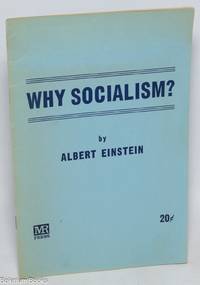
1958rif. 325801New York: Monthly Review Press 1958. 12p. staplebound pamphlet very good. Reprinted from the May 1949 issue of Monthly Review. Monthly Review Press unknown books
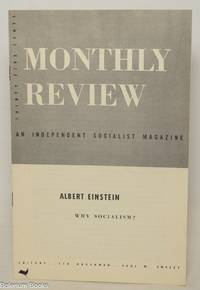
rif. 74322New York: Monthly Review n.d. 9p. staplebound pamphlet small ink mark at lower left corner crease otherwise very good. Reprinted from the May 1949 issue of Monthly Review. Monthly Review unknown books
1931rif. 37423Berlin: Akad. Wiss 1931. Akad. Wiss unknown books
1923rif. 374071923. Einstein Albert 1879-1955. Zur affinen Feldtheorie. Offprint from Sitzungsberichte der preussischen Akademie der Wissenschaften 17 1923. 137-140pp. 256 x 185 mm. Original printed wrappers. Fine. First Edition Offprint Issue. In 1923 Einstein published four short papers of which "Zur affinen Feldtheorie" is the third on Eddington's attempt at a unified field theory marking the beginning of a scientific passion that would dominate the remainder of his career. In 1921 British physicist Arthur Eddington had proposed a unified field theory inspired by the work of Hermann Weyl. "Einstein's own initial reaction was that Eddington had created a beautiful framework without content. Nevertheless he began to examine what would be made of these ideas and finally decided that 'I must absolutely publish since Eddington's idea must be thought through to the end.' That was what he wrote to Weyl. Three days later he wrote to him again about unified field theories: 'Above stands the marble smile of implacable Nature which has endowed us more with longing than with intellectual capacity.' Thus romantically began Einstein's adventures with general connections adventures that were to continue until his final hours" Pais Subtle is the Lord p. 343. This paper is included on Shields's list of Einstein's most significant papers; see Albert Einstein Philosopher-Scientist 1949 p. 758. Shields 175. Weil 132. . unknown books
1923rif. 374061923. unknown books
1929rif. 374191929. Einstein Albert 1879-1955. Zur einheitlichen Feldtheorie. Offprint from Sitzungsberichten der preussischen Akademie der Wissenschaften 1 1929. 8vo. 8pp. Berlin: Verlag der Akademie der Wissenschaft 1929. 256 x 183 mm. Original printed wrappers slightly soiled and creased. Very good. First Separate Edition. "In 1928 Einstein embarked on a new approach to a unified field theory . . . involving what he called 'distant parallelism'. . . . By early 1929 he had solved the main problems involved in writing down field equations for his unified theory. On the day of official publication of the third of a formidably technical series of nine articles on the theory . . . excited headlines appeared in foreign newspapers throughout the world. . . . In this frenzied unscientific atmosphere Einstein's new theory was hailed in the press as an outstanding scientific advance. Yet Einstein had stated in his article that it was still tentative; and soon he found he had to abandon it Hoffman Einstein pp. 225-26. This paper is included on Shields's list of Einstein's most significant papers; see Albert Einstein Philosopher-Scientist 1949 p. 758. Weil 165. Pais Subtle is the Lord pp. 344-46. . unknown books
1905rif. 2895Leipzig: Johann Ambrosius Barth 1905. First edition. original wrappers. Very Good. FIRST PRINTINGS WITH EXTREMELY RARE ORIGINAL WRAPPERS of Einstein's revolutionary papers of 1905 including the first edition of the initial paper on special relativity; three of the most important papers in the history of science. Beautiful clean copies without any institutional stamps. In the first paper "On a Heuristic Viewpoint Concerning the Production and Transformation of Light" published in March "Einstein postulated that light is composed of individual quanta later called photons that in addition to wavelike behaviour demonstrate certain properties unique to particles. In a single stroke he thus revolutionized the theory of light and provided an explanation for among other phenomena the emission of electrons from some solids when struck by light called the photoelectric effect" Britannica. It was for this paper on the photoelectric effect that Einstein was granted the Nobel Prize in physics in 1921. The next paper "On the Motion-Required by the Molecular Kinetic Theory of Heat-of Small Particles Suspended in a Stationary Liquid" published in May provided a theoretical explanation of Brownian motion. It is generally regarded as the first proof that molecules exist. Although the first two papers were of astonishing originality and importance it was the third paper introducing what would be later known as Einstein's special theory of relativity that would make him famous. "Toward the end of June it was all written up and on June 30 receipt of the manuscript was recorded at the editorial office of Annalen in Berlin. The thirty-page article published three months later was titled 'On the Electrodynamics of Moving Bodies'. It was a treatise beyond compare and without precedent one of the greatest scientific achievements in content and one of the most brilliant in style. Of course there were later additions some from Einstein himself and some from others but these were mere addenda to a theory which had appeared before all the world ready and complete valid for all time" Folsing Albert Einstein. Einstein's theory with the premise that "if for all frames of reference the speed of light is constant and if all natural laws are the same then both time and motion are found to be relative to the observer" "involved a complete rethinking of the entire conceptual tradition of modern physics from its beginning" Britannica; Folsing. Weil 6. Weil 8. Weil 9. Grolier/Horblit 26b. Zur Elektrodynamik bewegter Korper in Annalen der Physik Vierte Folge Volume 17 part 10 pp. 891-921; WITH: Über einen die Erzeugung und Verwandlung des Lichtes betreffenden heuristischen Gesichtspunkt ibid part 6 pp. 132-148. WITH: Über die von der molekularkinetischen Theorie der Warme geforderte Bewegung von in ruhenden Flussigkeiten suspendierten Teilchen ibid part 8 pp. 549-560. Leipzig: Johann Ambrosius Barth 1905. Octavo three issues in original wrappers rebacked; three custom boxes. Note: The issues are slightly trimmed indicating that it is likely they were originally bound with the wrappers and then re-assembled. With general title page volume half-title and index included in part 6. Some chipping to exceedingly rare and brittle original wrappers; otherwise fine. Extremely rare in such outstanding condition. Johann Ambrosius Barth books
1922rif. 374051922. unknown books
1930rif. 433141930. Offprint from Sitzungsberichte der preussischen Akademie der Wissenschaften 1930. Single sheet pp. 1-2. 256 x 184 mm. Upper edge a bit creased light toning but very good. First edition offprint issue. One of Einstein's last papers on Riemann metrics and distant parallelism written the year before he abandonded this approach to constructing a unified field theory. Pais Subtle is the Lord p. 347. Weil Albert Einstein Bibliography 173. unknown books
1930rif. 37422Berlin: Akad. Wiss 1930. Weil 170. Offprint from S. preuss. Akad. Wiss. Akad. Wiss unknown books
1917rif. 19286Leipzig: S. Hirzel 1917. FIRST EDITION. Contemporary half cloth and marbled boards preserved in a morocco slipcase. An excellent clean copy. First edition of this classic work on the quantum theory of radiation by Einstein in which he predicts the existence of the phenomenon of stimulated emission of radiation. He here analyzes the properties of photons and demonsrtrtes that Planck’s law is directly deducible from quantum theory and the concept of transition probabilities. Four decades later MASER and LASER devices are operated to prove him right. Boni 95; Weil 91. S. Hirzel unknown books
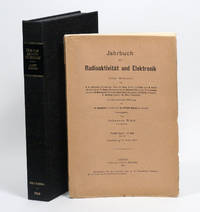
1908rif. 2507Leipzig: S. Hirzel 1908. First edition. original wrappers. Very Good. THE BIRTH OF GENERAL RELATIVITY: FIRST PRINTING IN RARE ORIGINAL WRAPPERS OF ONE ONE EINSTEIN'S MOST IMPORTANT PAPERS; containing the beginning of general relativity the derivations of the equivalence principle gravitational redshift and the gravitational bending of light. "Einstein's road to general relativity began in November 1907 when he was struggling against a deadline to finish an article for a science yearbook explaining his special theory of relativity. Two limitations of that theory still bothered him: it applied only to uniform constant-velocity motion. and it did not incorporate Newton's theory of gravity. "'I was sitting in a chair in the patent office at Bern when all of a sudden a thought occurred to me' he recalled. 'If a person falls freely he will not feel his own weight.' That realization which 'startled' him launched him on an arduous eight-year effort to generalize his special theory of relativity and 'impelled me toward a theory of gravitation.' Later he would call it 'the happiest though in my life.' "The tale of the falling man has become an iconic one and in some accounts it actually involves a painter who fell from the roof of an apartment building near the patent office. Einstein refined his thought experiment so that the falling man was in an enclosed chamber such as an elevator in free fall above the earth. In this falling chamber at least until it crashed the man would feel weightless. Any objects he emptied from his pocket and let loose would float alongside him. "Looking at it another way Einstein imagined a man in an enclosed chamber floating in deep space 'far removed from stars and other appreciable masses.' He would experience the same perceptions of weightlessness. 'Gravitation naturally does not exist for this observer. He must fasten himself with strings to the floor otherwise the slightest impact against the floor will cause him to rise slowly towards the ceiling.' "Then Einstein imagined that a rope was hooked onto the roof of the chamber and pulled up with a constant force. 'The chamber together with the observer then begin to move "upwards" with a uniformly accelerated motion.' The man inside will feel himself pressed to the floor. 'He is then standing in the chest in exactly the same way as anyone stands in a room of a house on our earth. The man in the chamber will come to the conclusion that he and the chest are in a gravitational field. Just then however he discovers the hook in the middle of the lid of the chest and the rope which is attached to it and he consequently comes to the conclusion that the chamber is suspended at rest in the gravitational field.' Einstein observed that inertial mass always equals gravitational mass and through his thought experiments concluded that "From this correspondence it follows that it is impossible to discover by experiment whether a given system of coordinates is accelerated or whether. the observed effects are due to a gravitational field." "Einstein called this 'the equivalence principle.' The local effects of gravity and of acceleration are equivalent. "In 1907 working against the deadline imposed by the Yearbook of Radioactivity and Electronics Einstein tacked on a fifth section to his article on relativity that sketched out his new ideas. He also came up with many predictions that could be tested including that light should be bent by gravity and that the wavelength of light emitted from a source with a large mass such as the sun should increase slightly in what has become known as the gravitational redshift. "It would take Einstein another eight years until November 1915 to work out the fundamentals of this theory and find the math to express it. Then it would take another four years before the most vivid of his predictions the extent to which gravity would bend light was verified by dramatic observations. But at least Einstein now had a vision one that started him on the road toward one of the most elegant and impressive achievements in the history of physics: the general theory of relativity" Isaacson Einstein 145-49. Weil in his bibliography also notes that "On p.443 are probably the first explicit statements both of the equivalence of inertial and gravitational mass and of the equation for mass in terms of energy now regarded as the theoretical basis for the release of atomic energy." Weil 21. Although Einstein submitted the paper on 4 December 1907 it wasn't published until the January 22 issue of the Jarbuch. Note: There was a very short "Correction" in a subsequent issue not included here. IN: Jahrbuch der Radioactivität under Electronik Vierter Band - 4. Heft No. 16 pp. 411-462. Leipzig: S. Hirzel 1908. Octavo original wrappers; handsome custom box. Light wear to wrappers and split to spine; text fine with Einstein paper largely unopened. AN EXTREMELY RARE COPY IN ORIGINAL WRAPPERS OF ONE OF EINSTEIN'S MOST IMPORTANT PAPERS. S. Hirzel unknown books
1911rif. 50424Leipzig: Johann Ambrosius Barth 1911. The Genesis of General Relativity Einstein Albert 1879-1955. 1 Elementare betrachtungen über die thermische molekularbewengung in festen Körpern. In Annalen der Physik 35 9: 679-94 pp. Weil 42. 2 Über den Einfluß der Schwerkraft auf die Ausbreitung des lichtes. In Annalen der Physik 35 10: 898-908 pp. Weil 43. Red cloth gilt spine lettering. Figs. Text-illust. 214 x 140 mm. Whole volume: viii 1040 pp. 6 plates 3 b/w silver photos 1 colorized 2 folding. Very good. Approximate English translations of titles: 1 "Elementary considerations about thermal molecular motion in solid bodies" and 2 "On the influence of gravity on the propagation of light." "Einstein returns to his thoughts on gravitation and discusses his ideas on the static gravitational field no. 1 above advancing the "half-shift" prediction of the deflection of light by a massive body such as the Sun. In his early papers on the subject . . . he used two important features: the principle of equivalence and the role of the speed of light. In this paper he takes a broader perspective saying that if a light beam is bent in an accelerating frame of reference then if the theory is correct it must also be besnt by gravity by exactly the equivalent amount." Calaprice An Einstein Encyclopedia. "An important conclusion of this paper is that the velocity of light in a gravitational field is a function of the place. The equation: c = c01 / c2 signifies that there exists a relationship between the velocity of light and the gravitational potential; the latter influences the first." Weinstein Einstein's 1912-1913 struggles with Gravitation Theory: Importance of Static Gravitational Fields Theory. "Here no. 2 above Einstein continues the work he had begun in 1907 on the specific heat of solids where the heat agitation of solids was reduced to a monochromatic oscillation of the atom and the specific heat was determined based on the quantum treatment of an oscillator in a radiation field. He explains the discrepencies between his formula and the measurements at low temperatures" Calaprice An Einstein Encyclopedia. Weil's Einstein Bibliography nos. 42 and 43. Boni's Einstein Checklist nos. 38 39. . Johann Ambrosius Barth unknown books
1907rif. 50420Leipzig: Johann Ambrosius Barth 1907. Einstein explicitly establishes E=mc2. Einstein Albert 1879-1955. 1 Über die Möglichkeit einer neuen Prüfung des Relativitätsprinzips. In Annalen der Physik 23 6: pp. 197-8. 2 Bemerkungen zu der Notiz von Hrn. Paul Ehrenfest: "Die translation deformierbarer Elektronen und der Flächensatz." In Annalen der Physik 23 6: pp. 206-8. 3 Über die vom relativitätsprinzip geforderte Trägheit der Energie. In Annalen der Physik 23 7: pp. 371-384. 8vo. Red cloth gilt lettering on spine. 214 x 140 mm. Whole volume: viii 1000 pp. 4 plates numbered Taf. I - IV. Tafs. I II and IV are folding Taf. III is b/w silver photograph tipped to sheet. Foot of the spine is repaired. Very good. Approximate English translations of titles: 1 "On the possibility of a new test of the principle of relativity." 2 "Remarks on Mr. Paul Ehrenfest's note: 'The translation of deformable electrons and the surface theorem.'" 3 "On the inertia of energy required by the principle of relativity." In "On the inertia of energy required by the relativity principle" May 1907 "Using rather than m V rather than c and 0 rather than E0 Einstein wrote his famous equation for the first time as V2= 0 and he did it in a footnote. At the end of that paper he introduced the symbol E0 to denote energy in the rest frame and wrote the famous expression again this time as =E0/V2." -Eugene Hecht How Einstein confirmed E0 = mc2 In the third paper Einstein explicitly establishes his famous equation E=mc2 although with different symbols. In this paper Einstein discussed the relationship between inertial mass and energy arguing for their complete equivalence namely that every mass has an equivalent energy just as every form of energy has an equivalent mass. This relation says that a photon can convert for the equivalence of mass and energy his celebrated equation E = mc2 Calaprice The Einstein Almanac. Weil's Einstein Bibliography nos. 17 18 and 19 respectively. Boni's Einstein Checklist nos. 17 18 and 19 respectively. . Johann Ambrosius Barth unknown books
1917rif. 6547Braunschweig: Friedrich Vieweg 1917. Ninth printing. Acceptable. 23 cm; iv. 79 pages. Three figures in text along with numerous equations. In original printed wraps. Acceptable only with paper peeling from the spine and sewing tender. Paper cover is completely detached in front and hanging by a thread in back. The pages are yellowed. There is an ownership autograph of one E. Bodländer. That said a clean unmarked copy in original state. The original German edition of Einstein's epoch-making "On the Special and General Theory of Relativity. Friedrich Vieweg paperback books
1921rif. 433161921. Offprint from Sitzungsberichte der preussischen Akademie der Wissenschaften 1921. Single sheet pp. 882-883. 256 x 184 mm. Minor marginal tears one corner chipped but very good. First ediiton offprint issue. "Since after 1917 Einstein firmly believed that light-quanta were here to stay it is not surprising that he would look for new ways in which the existence of photons might lead to observable devations from the classical picture. In this he did not succeed. At one point in 1921 he thought he had found a new quantum criterion published in the present paper but it soon turned out to be a false lead" Pais Subtle is the Lord pp. 412-413. Weil Albert Einstein Bibliography 118. unknown books
1906rif. 432891906. Einstein Albert 1879-1955. Über eine Methode zur Bestimmung des Verhältnisses der transversalen und longitudinalen Masse des Elektrons. Offprint from Annalen der Physik 21 1906. 583-586pp. 223 x 145 mm. Original printed wrappers chipped spine splitting minor spotting. Light toning but very good. First Edition Rare Offprint Issue. In his landmark 1905 paper on special relativity Einstein used the velocity-dependent concepts of transverse and longitudinal mass for the moving electron these terms have now been replaced with the concept of relativistic mass first defined by Lewis and Tolman in 1909. In the present paper Einstein proposed an experimental method for determining the ratio of the transverse to the longitudinal mass and invited experimentalists to verify his special theory of relativity. Einstein later abandoned velocity-dependent mass concepts stating in 1948 that "it is better to introduce no other mass concept than the 'rest mass' m" quoted in L. B. Okun "The concept of mass" Physics Today 1989: 31-36. Lavenda A New Perspective on Relativity pp. 7-8. Weil Albert Einstein Bibliography 14. . unknown books
1910rif. 50336Leipzig: Johann Ambrosius Barth 1910. Einstein Albert 1879-1955. 1 Uber einen Satz der Wahrscheinlichkeitsrechnung und seine Anwendung in der Strahlungstheorie with L. Hopf. pp. 1096-1104. Weil 34 Boni 29. 2 Statistiche Untersuchung der Bewegung eines Resonators in einem Strahlungsfeld with L. Hopf. pp. 1105-1115. Weil 35 Boni 30. 3 Theorie der Opaleszens von homogenen Flüssigkeiten und Flüssigkeitsgemischen in der Nähe des kritischen Zustandes. pp. 1275-1298. Weil 36. In Annalen der Physik und Chemie 33. Red cloth with gilt lettering on the spine. Whole volume: viii 1584 pp. 6 plates. Text-figs. 210 x 130 mm. Very good copy. Approximate English translations of titles and brief explanations of papers: 1 "On a theorem of probability calculus and its application in the radiation theory." "Einstein and Hopf wrote this paper to show that the failure of statistical mechanics vis-a-vis the radiation law cannot be ameliorated by proposing that individual statistical events in the emission of light from different points on the surface of a luminous body are not actually independent but instead are interdependent with each other. Even if one assumes a failure to be statistically independent one derives the same usual form of the radiation law as Fourier sum." p. 290. Calaprice Kennefick & Shulmann. An Einstein Encyclopedia. 2015. 2 "Statistical investigation of the movement of a resonator in a radiation field." With: L. Hopf. "The authors make use of the results in no. 1 above demonstrating that the Rayleigh-Jeans law of radiation is an unavoidable consequence of statistics even if we avoid assumptions that we may think need correction. In other words we cannot blame statistics for a faulty result." p. 290. Calaprice Kennefick & Shulmann. An Einstein Encyclopedia. 2015. 3 "Theory of the opalescence of homogenous liquids and liquid mixtures near the critical state"."Einstein explains the optical effects that occur near the critical point of a fluid at which liquid gas phases can coexist and of a binary mixture of liquids that can also explain the blue color of the sky. It adds to earlier stuidies that provided evidence for the atomistic constitution of matter and is one of the most difficult papers to understand." p. 290. Calaprice Kennefick & Shulmann. An Einstein Encyclopedia. 2015. "October 1910. E. completes a paper on critical opalescence his last major work in classical statistical physics." Pais Subtle is the Lord. 523. Weil's Einstein Bibliography nos. 34 35 and 36 respectively. Boni's Einstein Checklist nos. 29 30 and 31 respectively. . Johann Ambrosius Barth unknown books
1916rif. 50341Leipzig: Johann Ambrosius Barth 1916. Einstein Albert 1879-1955. Über Friedrich Kottlers Abhandlung "Über Einsteins Äquivalenzhypothese und die Gravitation." In Annalen der Physik 51 638-642 pp. Red cloth with gilt lettering on the spine. Whole volume: 883 pp. 4 plates. Figs. Text-illust. 210 x 130 mm. A very good copy. Weil's Einstein Bibliography no. 81. Boni's Einstein Checklist no. 79. . Johann Ambrosius Barth unknown books