EINSTEIN ALBERT - FLORENT PETITPAS- SOLOVINE MAURILivre Rare Book

3 003 résultats
2009réf. RO20272203LE MONDE - FLAMMARION - LES LIVRES QUI ONT CHANGE LE MONDE. 2009. In-12. Broché. Bon état, Couv. convenable, Dos satisfaisant, Intérieur frais. 243 PAGES. . . . Classification Dewey : 830-Littératures des langues germaniques
2010Milano, RCS Quotidiani, 2010, 8vo brossura editoriale, pp. 11 (I classici del pensiero libero, 11; supplemento a Sette Corriere della Sera) .
1974réf. R100072245Payot. 1974. In-12. Broché. Bon état, Couv. convenable, Dos satisfaisant, Papier jauni. 280 pages - nombreuses figures en noir et blanc dans le texte.. . . . Classification Dewey : 530-Physique
1979réf. R100067671Hermann. 1979. In-8. Broché. Bon état, Couv. convenable, Dos satisfaisant, Intérieur frais. LXIII+327 pages.. . . . Classification Dewey : 830-Littératures des langues germaniques
1981In-16 (cm. 19.20), brossura illustrata, pp. 267, (5). Con interventi di Wolfgang Pauli, Max Born, Walter Heitler, Niels Bohr, Henry Margenau, Hans Reichenbach e Kurt Godel. Traduzione di Augusto Gamba. Piccola etichetta al piatto posteriore e prima carta parzialmente scollata; peraltro, testo in buono stato (text in good condition).
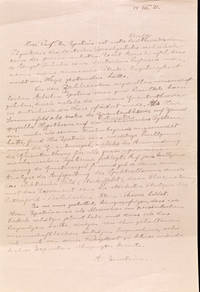
1921réf. 1206201921. Signed. EINSTEIN Albert. Autograph letter signed. No place August 14 1921. Single sheet of cream lined paper measuring 7-1/2 by 11 inches; p. 1. $35000.Rare heartfelt autograph letter of recommendation written and signed by Einstein in German enthusiastically recommending his friend and colleague physicist Prof. Dr. Paul Epstein for an academic position.The autograph letter dated ""14 VIII 21"" written entirely in Einstein's hand reads translated from the original German: ""Prof. Dr. Epstein is certainly one of the most prominent living theoretical physicists of the German-speaking world. Without a doubt he would have been appointed to a German professorship a long time ago had his Russian nationality not stood in the way. Among Epstein's numerous original scientific papers two findings which advanced the modern quantum theory in crucial ways should be noted. After Mr. Sommerfeld as the first physicist who on the basis of special hypotheses had applied the quantum theory to a certain mechanical system of more than one degree of freedom Mr. Epstein discovered an important generalization of the quantum principle which established the application of the quantum theory for all quasi-periodic mechanical systems. Based on that general application of the quantum principle he then provided an analysis of the splitting of spectral lines in the electrical field Stark effect the accordance of which with the experiment provides one of the strongest supports for the Rutherford-Bohr atomic theory. I would like to add that I have also come to appreciate Mr. Epstein in personal interactions as a human being and that I had the pleasure of attending several scientific lectures given by him which enabled me to convince myself of his competence in delivering clearly understandable oral exposition. / A. Einstein.""Einstein and Epstein were friends and longtime correspondents who shared an interest in physics Judaism and the founding of Israel. Paul Epstein was a Russian-American mathematical physicist. He remains best known for his contributions to the development of quantum mechanics. Indeed he was one of a select group that included Lorentz Einstein Minkowski Thomson Rutherford Sommerfeld Rntgen von Laue Bohr de Broglie Ehrenfest and Schwarzschild. Born in Warsaw then part of Imperial Russia Epstein was brought up solidly middle class. He later stated that his mother recognized his potential at the age of four and predicted his future as a mathematician. Epstein studied mathematics and physics for his entire university career eventually earning a degree from the Imperial University of Moscow. He then went on to earn a Ph.D. at the Technical University of Munich in 1914 concentrating on a problem in the theory of diffraction of electromagnetic waves. However the outbreak of World War I rendered Epstein an enemy alien in Germany. Sommerfeld intervened on his behalf and he was allowed to stay as a private citizen and continue his research. In 1916 Epstein published an important paper explaining the Stark Effect using the Bohr-Sommerfeld quantum theory. After the war Epstein went to Leiden and worked as an assistant for Lorentz and Ehrenfest. In 1921Ñthe year this letter was writtenÑEpstein was recruited by Robert Millikan to join the physicists at the California Institute of Technology. Epstein accepted the position and stayed there for the rest of his career publishing extensively on quantum theory. Epstein was something of polymath and worked in numerous areas outside of quantum theory including work on air resistance the settling of gasses the theory of vibration and the absorption of sound. He was an avid supported of Freudian psychoanalysis including as one of the founding members of the Psychoanalytic Study Group that later merged with the Los Angeles Institute for Psychoanalysis. Epstein was also notably anti-communist and worried about the threat of nationalism.The areas of study mentioned in Einstein's letter of recommendation all came together to help form the science behind atomic and hydrogen bombs though neither Einstein nor Epstein anticipated quite where the science was headed in 1921. The letter mentions the Stark effect which is the shifting and splitting of spectral lines of atoms and molecules due to the presence of an external electric field. It is analogous to the Zeeman effect in which a magnetic field is the influence. The Rutherford-Bohr model presented in 1913 is a system consisting of a small dense nucleus surrounded by orbiting electronsÑsomewhat like the Solar System but with electrostatic forces instead of gravity. The Bohr model came to be recognized as a relatively primitive model of the hydrogen atom compared to the valence shell atom model. However because of its simplicity and the correct results it generates for certain systems it is still commonly used to introduce students to quantum mechanics.Overall this letter provides valuable insight into the scientific world during the height of Einstein's international career right when he first began traveling abroad and meeting fellow scientists internationally. The letter reflects Einstein's importance in the community and is a testament to Epstein's ability as a physicist. Original mailing creases. Fine condition. unknown books
réf. 16775,Paris, Hachette Collection 'Génies et Réalités' 1966, 295 pp., 1 vol. in 8 relié
réf. 33600Paris Le Club Français du Livre 1969 in 8 (21,5x14) 1 volume reliure toilée beige de l'éditeur, 241 pages [1]. Traduit de l'allemand par Maurice Solovine. Edition numérotée hors-commerce. Bel exemplaire ( Photographies sur demande / We can send pictures of this book on simple request )
réf. 5104Paris Flammarion In-12 258 pp, Bibliothèque de philosophie scientifique, exemplaire non coupé, dos abîmé
1999réf. R240090652FLAMMARION. 1999. In-12. Broché. Bon état, Couv. convenable, Dos satisfaisant, Intérieur frais. 189 pages - illustration en noir et blanc sur le 1er plat.. . . . Classification Dewey : 500-SCIENCES DE LA NATURE ET MATHEMATIQUES
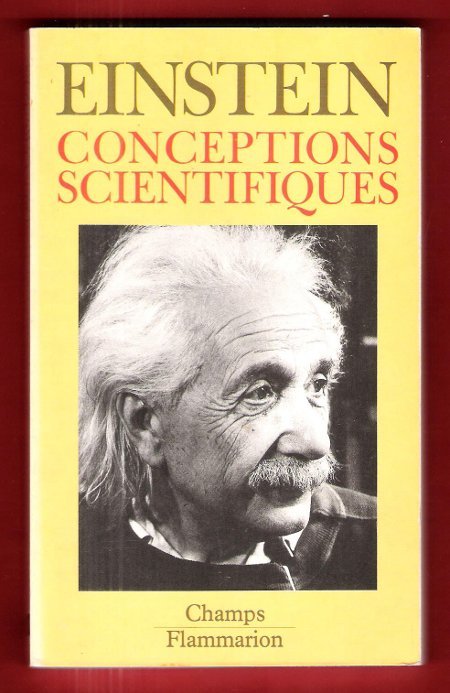
1990réf. 016758Paris Flammarion 1990 In 12 Collection " Champs Flammarion " Intérieur comme neuf , couverture avec de légers défauts . - 188 p. , 300 gr.
1992réf. R100062454Flammarion. 1992. In-12. Broché. Bon état, Couv. convenable, Dos satisfaisant, Intérieur frais. 188 pages.. . . . Classification Dewey : 500-SCIENCES DE LA NATURE ET MATHEMATIQUES
1952réf. R160220221Flammarion. 1952. In-12. Broché. Etat d'usage, Couv. convenable, Dos satisfaisant, Papier jauni. 316 pages.. . . . Classification Dewey : 500-SCIENCES DE LA NATURE ET MATHEMATIQUES
réf. 75299Paris, Flammarion, 1990. 11 x 18, 188 pp., broché, très bon état (sauf dos insolé).
1984Mm 120x195 Brossura editoriale di pp. 111. Opera in buonissime condizioni. SPEDIZIONE IN 24 ORE DALLA CONFERMA DELL'ORDINE. WORLDWIDE DELIVERY
1965In-8 (cm. 21.90), cartonato editoriale, sovracoperta editoriale illustrata, pp. 349, (3). A cura di Carl Seelig. Traduzione di Franco Fortini. Consulenza di Camillo Losurdo. Macchie di polvere e minime mancanze alla sovracoperta; macchie, sempre di polvere, al taglio superiore; peraltro, testo in buono stato (text in good condition).
1959In-8 (cm. 20.50), tela editoriale, pp. (8), 219. Traduzione di Luigi A. Radicati di Bròzolo. In buono stato di conservazione (good copy).
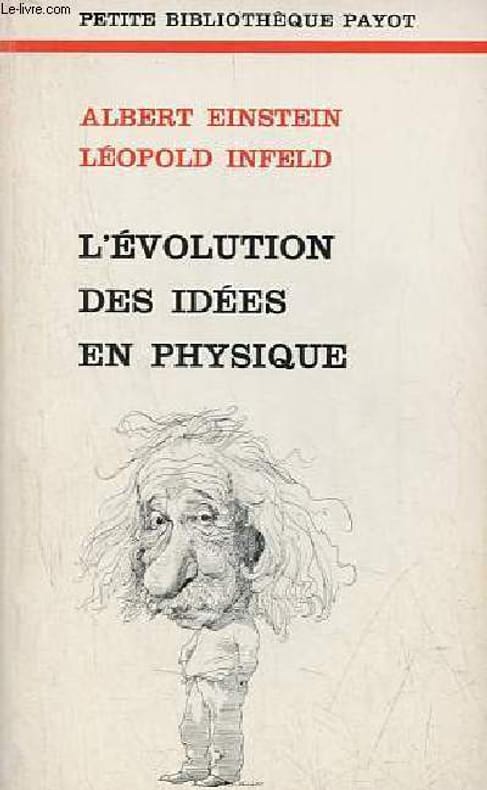
1964réf. ROD0137273PETITE BIBLIOTHEQUE PAYOT. 1964. In-12. Broché. Etat d'usage, Plats abîmés, Dos abîmé, Intérieur acceptable. 184 pages - coiffes et coins frottés - mors fendus - plats pliés.. . . . Classification Dewey : 530-Physique
réf. CXI49AP
1986réf. R160156849PAYOT. 1986. In-12. Broché. Bon état, Couv. convenable, Dos satisfaisant, Intérieur frais. 184 Pages - Quelques formules de calculs dans le texte. . . . Classification Dewey : 500-SCIENCES DE LA NATURE ET MATHEMATIQUES
1965réf. R160157242PAYOT. 1965. In-12. Broché. Bon état, Couv. convenable, Dos satisfaisant, Intérieur frais. 184 Pages. . . . Classification Dewey : 530-Physique
1981réf. R160156848PAYOT. 1981. In-12. Broché. Etat passable, Couv. légèrement pliée, Dos satisfaisant, Mouillures. 184 Pages - traces de mouillures sans conséquences pour la lecture. . . . Classification Dewey : 500-SCIENCES DE LA NATURE ET MATHEMATIQUES
1964réf. R160157244PAYOT. 1964. In-12. Broché. Bon état, Couv. convenable, Dos satisfaisant, Intérieur frais. 184 Pages. . . . Classification Dewey : 530-Physique
réf. AJ16713POCHE BON ETAT PLIS SUR COUV
réf. A5067PHOTOS SUR DEMANDE