2 534 résultats
2010réf. 042673London: The Folio Society 2010. 1st Thus. Hardcover. As New/No Dust Jacket. Octavo. pp XVIII 370. 1st printing. An unread book in a fine condition slipcase showing slight use. The Folio Society hardcover
1988réf. 124910New York: Bonanza Books 1988. Hardcover. Very Good in a Very Good dust jacket.; 8.1 X 5.6 X 1.3 inches; 384 pages. Bonanza Books hardcover
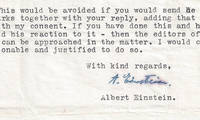
1702réf. 1536217/02/1953. In this letter from Einstein to David Bohm Einstein discusses the importance of connecting a key principle of the relatively new theory of quantum mechanics the “Born interpretation” to physical quantities that can be measured in the real world. To him it is essential that mathematical theories be connected to measurable quantities. In this letter Einstein’s uneasiness with quantum mechanics is apparent saying that validation of the seemingly random quantum mechanics “…can only be done on the basis of classical mechanics.” Without this validation quantum theory has essentially “no controllable meaning.” <img class=""alignnone wp-image-22637 size-post-window"" src=""https://cdn.raabcollection.com/wp-content/uploads/20231204163327/Einstein-born-2-e1639117238988-1600x656.jpg"" alt="""" width=""1600"" height=""656"" /> Max Born was a renowned physicist who was crucial for the development of quantum mechanics and also the Ph.D. supervisor of many important physicists including J. Robert Oppenheimer. Quantum mechanics describes the weird behavior of tiny subatomic particles. It’s also the guiding theory that led to critical technologies like nuclear power MRI machines and transistors in computers and phones. One of Born’s biggest contributions to quantum mechanics was the interpretation of the probability density which is a mathematical operation performed on the “psi-function” in Einstein’s words to predict the most probable physical quantities of a quantum particle. Einstein believed that probabilities only make sense if you can determine the values that they predict independently by measurement. This is easy to do in classical Newtonian mechanics the physics of big things in everyday life. But Einstein said we can’t measure it for something like a “bound electron” i.e. an electron in an atom. In order to interpret Born’s probability density function you need to connect the mathematics to real values. Einstein’s correspondence with Born on this subject is published and famous. To Einstein the universe is observable and measurable. When confronted with one of the principle tenets of Quantum Mechanics Einstein remarked now famously “Quantum mechanics is very imposing. But an inner voice tells me that it is not the real McCoy. The theory delivers a lot but hardly brings us closer to the secret of the Old One God. I for one am convinced that He does not throw dice.” This statement was made in one of those significant letters to Born. What he meant here is that rules of science cannot be random and in the rolling of dice we would have to accept unknown variables and therefore be unable to predict precisely via objective measurements. Therefore in Quantum Mechanics as in gambling an uncertainty of measurement exists. And to Einstein the universe is observable and measurable. He did not object to Quantum Mechanics per se; indeed he made notable contributions. But he eschewed any reliance on what was not observable and knowable. <img class=""alignnone wp-image-22634 size-post-window"" src=""https://cdn.raabcollection.com/wp-content/uploads/20231204163356/Einstein-born-5-e1639117103621-1600x616.jpg"" alt="""" width=""1600"" height=""616"" /> David Joseph Bohm was an American scientist who has been described as one of the most significant theoretical physicists of the 20th century and who contributed unorthodox ideas to quantum theory neuropsychology and the philosophy of mind. His first book Quantum Theory published in 1951 was well received by Einstein among others. But Bohm became dissatisfied with the orthodox interpretation of quantum theory he had written about in that book.Bohm’s aim was not to set out a deterministic mechanical viewpoint but to show that it was possible to attribute properties to an underlying reality in contrast to the conventional approach. He began to develop his own interpretation the De Broglie–Bohm theory also called the Pilot wave theory the predictions of which agreed perfectly with the non-deterministic quantum theory. He initially referred to his approach as a hidden variable theory. Bohm originally hoped that hidden variables could provide a local causal objective description that would resolve or eliminate many of the paradoxes of Quantum Mechanics the measurement problem and the collapse of the wavefunction. However Bell’s theorem complicates this hope as it demonstrates that there can be no local hidden variable theory that is compatible with the predictions of Quantum Mechanics. The Bohmian interpretation is causal but not local. Albert Einstein who had suggested that Bohm search for a realist alternative to the prevailing Copenhagen approach did not consider Bohm’s interpretation to be a satisfactory answer to the quantum question. The Copenhagen interpretation is an expression of the meaning of Quantum Mechanics that was largely devised in the years 1925 to 1927 by Niels Bohr and Werner Heisenberg. It remains one of the most commonly taught interpretations of Quantum Mechanics. According to the Copenhagen interpretation physical systems generally do not have definite properties prior to being measured and Quantum Mechanics can only predict the probabilities that measurements will produce certain results. The act of measurement affects the system causing the set of probabilities to reduce to only one of the possible values immediately after the measurement. In classical mechanics a particle has at every moment an exact position and an exact momentum. These values change deterministically as the particle moves according to Newton’s laws. Under the Copenhagen interpretation of Quantum Mechanics particles do not have exactly determined properties and when they are measured the result is randomly drawn from a probability distribution. The Schrödinger equation predicts what the probability distributions are but fundamentally cannot predict the exact result of each measurement. <img class=""alignnone wp-image-22633 size-post-window"" src=""https://cdn.raabcollection.com/wp-content/uploads/20231204163406/Einstein-born-e1639117155596-1600x360.jpg"" alt="""" width=""1600"" height=""360"" /> Typed letter signed on his blind embossed letterhead February 17 1953 Professor Bohm. “Dear Bohm: I thank you very much for the prompt reaction to my little article. I did of course not expect that you would agree with me. For scarcely anyone is inclined to abandon an enterprise in which le has invested a great deal of work. “I do not want to answer your letter in detail although it deserves it very much. Only a short remark concerning the interpretation of Born’s standpoint: “According to Born the physical meaning of the psi-function follows: it determines probabilities f.i. for the value of impulses. this makes sense only if the impulse is defined independently of the mathematical theory by some feasible measurement. This can only be done on the basis of classical mechanics. F.i. if one has calculated the impulse of a bound electron on the basis of a psi-function then this result has no controllable meaning. For there is no possibility to measure such a thing not even approximately. However if one has to do with a makro-object which is at least temporarily approximately free then one is able to determine experimentally at least approximately its impulsef.i. through two successive snapshots or through radar. If it is at all possible to attribute meaning to Born’s interpretation then the impulse the probability of which appears in the theory has to be put equal to the impulse thus measured. Classical approxi_mate measurement of the impulse is however in my example very well feasible without first removing the walls and then waiting some time. Born’s probability therefore has to be interpreted as relative to the impulse thus measured if this probability is to have any meaning at all. “The vanishing of position-probability for the nodes offers no difficulty though it is true that this fact excludes the interpretation of the process as a motion in the strict sense of the word. For the factual process will only approximately be describable as a motion as f.i. the action of a gas upon a small part of the wall is describable only approximately by the concept of pressure. “With regard to the publication of your remarks in the Born volume I have some scruples the reason for which you will readily understand. I have sent a copy of my article to you but not to de Broglie because this would have seemed to me somewhat pretentious. If therefore your answer would be published together with my remarks without de Broglie having had the possibility to do the same he might feel it as an unkindness from my side. “This would be avoided if you would send De Broglie my remarks together with your reply adding that you do this with my consent. If you have done this and have received his reaction to it – then the editors of the Born volume can be approached in the matter. I would consider it as reasonable and justified to do so.” <img class=""alignnone wp-image-22636 size-post-window"" src=""https://cdn.raabcollection.com/wp-content/uploads/20231204163341/Einstein-born-3-1-e1639117201589-1600x672.jpg"" alt="""" width=""1600"" height=""672"" /> This is a remarkably detailed scientific letter mentioning numerous significant physicists containing a hand-drawn symbol and directly relating to his important theories. It is also in a sense his defense of his own work including relativity. unknown
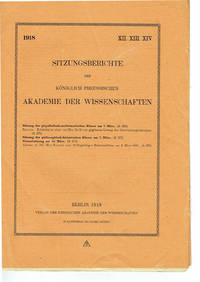
1918réf. 5720KBerlin: Verlag der Königlichen Akademie der Wissenschaften in commission at Georg Reimer Reichsdruckerei 21st March 1918. Near Fine. Imperial 8vo 26 5: 19 cm. 3 pages numbered 269-272. Letterpress on machine paper in original publisher’s brochure on orange-coloured stock with black title printing. First journal issue in the original printed wrappers of Einstein's early paper on the cosmological implications of general relativity. – Contents: Einstein here criticizes De Sitter's equations for gravitational fields and provides the first proper definition of a space-time singularity. „Einstein never said so explicitly but it seems reasonable to assume that he had in mind that the correct equations should have no solutions at all in the absence of matter. However right after his Einstein's paper »Kosmologische Betrachtungen zur allgemeinen Relativitätstheorie“ mid February 2017 note WoP paper appeared de Sitter did find a solution . Einstein must have been disappointed. In 1918 he looked for ways to rule out the de Sitter solution but soon realized that there is nothing wrong with it.“ Paise Despite Einstein's critique the De Sitter model was the dominant cosmological model until the 1930s at which time Einstein and de Sitter together proposed a ""just right"" cosmological model. The great cosmological debate between Einstein and De Sitter marks the beginning of the modern scientific understanding of the origins of the universe. The Academy's publishing list on the rear cover also announces an offprint of this paper for Reichsmark 0 50. – Condition: Wrappers at margins minimally torn sheet with Einstein's contribution opened and thus cut slighly perforated some pages minimally creased otherwise well preserved partly unopened copy. – Rarity: RBH records 3 copies of this paper at auction 2019 2011 2002 none of them the first separate printing. – Reference: Alicke W. Albert Einstein. An Almost Complete Collection of his Publications and Two Original Manuscripts 91; Boni N.: A bibliographical checklist and index to the published writings of Albert Einstein 108; The Collected Papers of Albert Einstein. Volume 7 5; Shields M. C.: Bibliography der Schriften Einsteins. In: Schilpp P. A.: Albert Einstein als Philosoph und Naturforscher 117; Weil E.: Albert Einstein. A bibliography of his scientific papers 1901-1930 98; Pais A.: Subtle is the Lord. The Science and Life of Albert Einstein 2005 ed. p. 288. Verlag der Königlichen Akademie der Wissenschaften (in commission at Georg Reimer [Reichsdruckerei]) unknown
1998réf. I-660-456Agora 1998. Paperback. Very Good. Ammareal gives back up to 15% of this item's net price to charity organizations. Agora paperback
1998réf. BN672171Agora 1998. 1998. Softcover. La theorie de la relativite restreinte et generale La theorie de la relativite restreinte et generale Albert Einstein Agora paperback
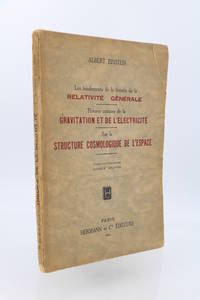
1933réf. 91965Paris: Hermann & Cie 1933. Fine. Hermann & Cie Paris 1933 16 x 25 cm Broché First edition of the French translation illustrated with a photographic portrait of Albert Einstein as frontispiece. A small loss at the foot of the spine which also shows rubbing along the joints upper right corner of the front board starting to come loose a slight marginal tear just below pleasant internal condition manuscript bookplate at the head of a flyleaf. Annotations and markings in red pen on pages 8 and 9. Work illustrated with figures in the text. Hermann & Cie unknown
1967réf. ZB1352269Philosophical Library 1967. 75 pp. Hardcover near fine in a rubbed dust jacket. - If you are reading this this item is actually physically in our stock and ready for shipment once ordered. We are not bookjackers. Buyer is responsible for any additional duties taxes or fees required by recipient's country. Photos available upon request. Philosophical Library hardcover
2005réf. H-744-354Jacques Gabay 2005. Paperback. Good. Former library book. Different cover. Edition 2005. Ammareal gives back up to 15% of this item's net price to charity organizations. Jacques Gabay paperback
réf. ria9781006727146_inpHardcover. New. New Book; Fast Shipping from UK; Not signed; Not First Edition; The theory which is sketched in the following pages forms the most wide-going generalization conceivable of what is at present known as "the theory of Relativity;" this latter theory I differentiate from the former "Special Relativity t hardcover
réf. 47003244-nnew. unknown
réf. 47003244like new. unknown
réf. ria9781020098475_inpHardcover. New. New Book; Fast Shipping from UK; Not signed; Not First Edition; A groundbreaking mathematical journal edited by some of the greatest minds in the field including Albert Einstein David Hilbert and Felix Klein. With articles on a wide range of topics from number theory to topology this journal re hardcover
réf. ria9781020352256_inpHardcover. New. New Book; Fast Shipping from UK; Not signed; Not First Edition; This book is a collection of research papers published in the prestigious journal Mathematische Annalen. It features groundbreaking work by prominent mathematicians such as David Hilbert and Albert Einstein spanning topics from geometr hardcover
réf. ria9781021110886_inpHardcover. New. New Book; Fast Shipping from UK; Not signed; Not First Edition; Mathematische Annalen is a seminal mathematics journal that has published many groundbreaking papers and provided a venue for the most important mathematical discoveries of the past century. This anthology contains some of the most impo hardcover
réf. ria9781020331084_inpHardcover. New. New Book; Fast Shipping from UK; Not signed; Not First Edition; Mathematische Annalen is a scientific journal dedicated to mathematics published by Springer-Verlag. This book is a compilation of articles published in Mathematische Annalen from the years 1869 to 1949 written by some of the most prom hardcover
réf. B9781020098475Hardback. New. hardcover
réf. B9781020331084Hardback. New. hardcover
réf. B9781020352256Hardback. New. hardcover
réf. B9781021110886Hardback. New. hardcover
réf. A9781345227048Hardback. New. hardcover
réf. A9781345247725Hardback. New. hardcover
réf. I4-4WQM-FTTZEditora Nova Fronteira. New. Editora Nova Fronteira unknown
1941réf. 3262211/9/41. A generous demonstration by Einstein of his loyalty to friends and belief in the importance of music Dr. Theodor Rosenheim was a physician at the famed Medical University Clinic of the Charité in Germany in the 1880s. He was primarily concerned with the physiology and pathology of the digestive tract. He published an early textbook on the “Pathologie und Therapie der Krankheiten des Verdauungsapparates”. Rosenheim was one of the first in Germany to describe and publish on ulcerative colitis. He was intensively involved in the technical development of esophagoscopy and gastroscopy which at that time were only possible with rigid instruments. The Rosenheim line which was named after him described the largest diagonal diameter of the gastric percussion figure. Rosenheim was appointed professor extraordinarius at Berlin University in 1921. He also founded a polyclinic and a private sanatorium for stomach and intestinal patients. He was well respected in Berlin and his private practice developed successfully with a large circle of patients including Albert Einstein. Theodor’s wife was Hedwig Rosenheim and their daughter Kate was a hero of the Holocaust. She helped several thousand children from Jewish families to escape from Germany. She personally accompanied the legendary Kindertransporte to England among other places. She travelled to the USA in 1936 to negotiate directly with the aid organizations there. She then returned to Germany to actively continue the aid campaigns. Theodor died in 1939. Käte Rosenheim was able to flee Berlin together with her 72-year-old mother Hedwig Rosenheim on January 23 1941. They reached Havana Cuba via France Spain and Portugal. From there they were able to continue to New York where they arrived on April 1 1941. Albert Einstein was an accomplished violinist and music lover who was inspired by music in his scientific work. He often said that he would have been a musician if he hadn't pursued science. Another music lover was Hedwig Rosenheim. She had escaped Germany without her possessions especially her precious musical instruments. Upon arrival in the United States she contacted the old family friend Albert Einstein hoping he could help her get a flute either for herself or another escapee one who may have agreed to look for her. Einstein was sympathetic and rose to the occasion. He even contributed some of his personal funds to secure the flute. Typed letter signed his vacation house in Knollwood at Saranac Lake N.Y. September 11 1941 to his old friend Mrs. Hedwig Rosenheim in New York City. “ The matter of i.e. the quest for the flute shall not fail. First one should know what the committee is giving out – or loaning. Second there is the Hebrew Free Loan Society 108 Second Ave. New York which in such cases provides interest-free loans in exchange for the backing of two guarantors. I will serve as a guarantor and contribute 20 dollars on top of that. The man should visit both institutions and can show this letter. In the hope of receiving a positive report soon I remain with warm greetings your A. Einstein.” “PS. Starting next week my address will again be in Princeton.” The committee he referred may have been the American Jewish Joint Distribution Committee though there were others as well. It shows a lot about Einstein - his generosity his continued concern for old friends who had escaped from Germany and love for music - that he volunteered to make a personal financial contribution to obtaining the flute. <img class=""alignnone wp-image-25018 size-post-window"" src=""https://cdn.raabcollection.com/wp-content/uploads/20231204144051/Folder-site-11-1600x1327.jpg"" alt="""" width=""1600"" height=""1327"" /> unknown
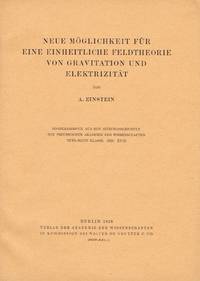
1928réf. 5738KBerlin: Verlag der Akademie der Wissenschaften in commission at Georg Reimer Reichsdruckerei 10th July 1928. Near Fine. Imperial 8vo 25 4: 18 2 cm. 5 1 pages. Letterpress on machine paper in original publisher’s brochure on salmon-coloured stock with black title printing. First offprint in the original wrappers and new pagination of Einstein's upgraded attempt toward creating a unified field theory. - Condition: Mint. - Reference: Boni-Russ-L. 171; Schilpp-Shields 218; Weil 162 quotes the pagination of the first separate printing p. 224-227. Verlag der Akademie der Wissenschaften (in commission at Georg Reimer [Reichsdruckerei]) unknown