3033 resultados
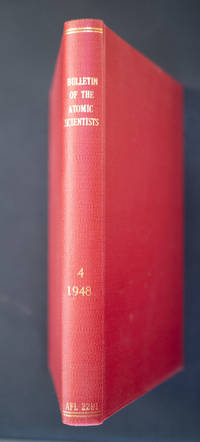
1948ref. 6625Chicago: The Atomic Scientists of Chicago 1948. Original edition. Ex-library. Very Good. 28 cm; 384 pages. Cloth-bound volume of 12 issues. Duplicate surplus stamp of Library of Congress on front free endpaper. Later owner's stamp on free endleaves blacked out. Lively forum of discussion of various scientific social and political implications of atomic energy as the post-war radioactive dust settled over the Pacific and wherever else open-air tests of atomic weaponry took place. Opens with Einstein's "Plea for International Understanding." Issue #2 features a written debate between Einstein and four Soviet scientists Semyonov Vavilov Frumkin and Ioffe. A scenario describes the potential effect of an atomic bomb on Washington DC. Justice William O. Douglas contributes "Democracy and Communism." Harry Truman presents a "Message to the Atomic Scientists." Other contributors include Cardinal Cushing Thomas E. Dewey Max von Laue and many other scientists and statesmen involved in the post-war debates The Atomic Scientists of Chicago hardcover books
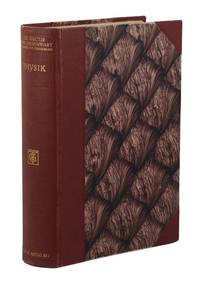
1915ref. 140945614Leipzig & Berlin: B.G. Teubner 1915. First edition. First edition. iv viii 762 8 pp. Bound in publisher's three quarter maroon cloth with marbled paper sides gilt spine lettering. Near Fine with rubbing along edges; a few marks to prelims text otherwise free of markings; hint of foxing to edges. Bookplate on paste down. A German-language physics review with the first book publication of two articles by Albert Einstein as well as work by a number of famous physicists of the early 20th century. B.G. Teubner unknown books
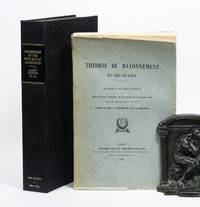
1912ref. 2508Paris: Gauthier-Villars 1912. First edition. Original wrappers custom box. Very Good. RARE FIRST EDITION IN ORIGINAL WRAPPERS OF THE REPORTS FROM THE HISTORIC FIRST SOLVAY CONFERENCE "THE FIRST INTERNATIONAL CONFERENCE IN PHYSICS EVER ORGANIZED" AND A CRITICAL MOMENT IN THE BIRTH OF QUANTUM PHYSICS. In the short time that followed Planck's hypothesis of the universal constant that would bear his name the greatest minds in physics were largely at a loss about how to deal with the bizarre theoretical results that followed let alone the experimental results which confirmed them!. Much of the focus at the time was on black-body radiation including work by Planck himself as well as Lorentz Rayleigh and Jeans. However shortly before the first Solvay conference a young Einstein had also started investigating the related question of materials' specific heat. Kuhn. "The purpose of the first Solvay Conference was thus two-fold: first there was the need to examine whether classical theories molecular-kinetic theory and electrodynamics could in some undiscovered ways provide an explanation of the problem of black-body radiation and of the specific heat of polyatomic substances at low temperatures; secondly to consider phenomena in which the theory of quanta could be successfully used." Mehra. Underlying these questions was the more fundamental mystery of how to interpret the existence of the Planck constant. There were two camps both of which were represented at the conference. Planck's took the constant to indicate some fundamental constraint on the radiative processes of emission and absorption. For example "Sommerfeld introduced a version of the quantum hypothesis which he considered to be compatible with classical electrodynamics. He postulated that in 'every purely molecular process' a quantized quantity of action is exchanged." Staumann. Einstein's camp on the other hand took the quantum of action to represent the physicality of a perhaps pseudo-corpuscular theory of energy exchange - his photons of light. Although the debates that followed the lectures included in the proceedings did not rise to the famous heated exchange that Einstein would have with Bohr at the 1927 Solvay conference we do see some of the young Einstein's hotheadedness as he opens the debate following Planck's plenary lecture: "What I find strange about the way Mr. Planck applies Boltzmann's equation is that he introduces a state probability W without giving this quantity a physical definition. If one proceeds in such a way then to begin with Boltzmann's equation does not have a physical meaning." As translated by Straumann. It would take another 14 years for quantum mechanics to be fully formalized but the first Solvay conference represents a pivotal point in quantum history: "During 1911 the situation changed quickly. Articles that applied the quantum to other topics then outnumbered those on blackbody radiation for the first time and some were backed by impressive experimental evidence. In part because of that evidence physicists like Planck and Lorentz who had previously taken the constant h to be characteristic only of the radiation problem began to consider additional areas in which others had earlier staked quantum claims." Kuhn. Albert Einstein and the Solvay Conference: Among the most renown scientists of the day - including Ernest Rutherford Marie Curie and Max Planck - Einstein made quite an impression. At age 32 he was the second youngest participant in the conference. The youngest was British physicist Frederick Lindemann later to become scientific adviser to Winston Churchill. Although "Einstein had already published so many masterpieces none had actually been put to the test and his theories were looked on rather as tours de force than as definitive additions to knowledge. But his pre-eminence among the twelve greatest theoretical physicists of the day was clear to any unprejudiced observer." Frederick Lindemann quoted in Brian. References: Headline quote from the Solvay Institute website. Kuhn T. 1978 Black Body Theory and the Quantum Discontinuity 1894-1912. University of Chicago Press. Mehra J. 1975 The Solvay Conferences on Physics: Aspects of the Development of Physics Since 1911. Straumann N. 2011. On the first Solvay Congress in 1911. The European Physical Journal H 363 379-399. Denis Brian Einstein: A Life p.82. Paris: Gauthier-Villars 1912. Octavo original wrappers; custom box. Splits to top and bottom joint of upper wrapper two creases to front wrapper. Text in fine condition largely unopened. FIRST PRINTINGS IN ORIGINAL WRAPPERS ARE EXTREMELY SCARCE. Gauthier-Villars unknown books
1972ref. 133380Seuil 1972 In-8 broché 20,6 cm sur 14,1. 255 pages. État correct d’occasion.
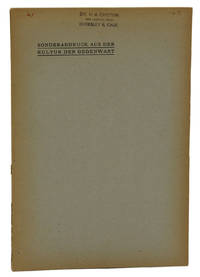
1925ref. 140941837Berlin: No Publisher 1925. Revised edition. 783-797 pp. Publisher's original printed wrappers. About Very Good with thin tear along front wrap fold near head a little chipping to wraps at spine front wrap hinge fragile contents toned with age. This copy belonged to Hans Albert Einstein Albert Einstein's oldest son with his inkstamp at top of front wrapper; likely a presentation copy from his father. Neatly written at top of front wrapper are "41" and 163." Very rare author's offprint from Die Kulture der Gegenwart of an essay on relativity theory which was first published in 1914 revised to incorporate Einstein's later research. OCLC/WorldCat locates no physical copies. Weil 71. [No Publisher] unknown books
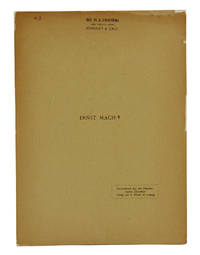
1916ref. 140941831Leipzig Germany: S. Hirzel 1916. First separate edition. First separate edition. 4 pp. Illustrated with portrait of August Mach from photograph. Publisher's original printed wrappers. Very Good with some small chips to fragile wrappers faint crease to top of front wrap contents toned with age. This copy belonged to Hans Albert Einstein Albert Einstein's oldest son with his inkstamp at top of front wrapper; likely a presentation copy from his father. Neatly written at top of front wrapper is "43" and date "14.III.16." OCLC/WorldCat locates four copies two at the University of Toronto one at the Smithsonian Institution and one at the American Philosophical Society. Weil 89. Very rare author's offprint stating "Uberreicht vom Verfasser" of the eulogy by Albert Einstein for fellow physicist Ernst Mach as first published in Physikalischen Zeitschrift. A noted scientist in his own right Mach is best known for the concept of "Mach's principle" which asserts that an entity's inertial mass is determined by all the other masses in the universe. Einstein in fact coined the phrase "Mach's principle" and his application of it had major ramifications for the development of his theory of general relativity Einstein in 1918 labeling it one of the "three pillars" of general relativity. S. Hirzel unknown books
1934ref. 58250ABAmsterdam Querido Verlag. 1934. 269 S. Originalleinwand.
ref. 128800aaf(Braunschweig, Vieweg), 1916, in-8vo, 18 S. (315-332 aus Verhandl.). Mit Abbildung, Rckn.-Broschüre.
1906ref. 38794Leipzig, Johann Ambrosius Barth, 1906. Bound together in one contemp. hcloth. Small tears to spine ends. (=) ""Annalen der Physik. Vierte Folge. Band 20. Herausgegeben von Paul Drude."" , Portrait (Paul Drude), VIII,1048 pp. and 6 plates. Einstein papers: pp. 199-206 and 627-33. Internally fine and clean. The whole volume offered.
1906ref. 46962Leipzig, Johann Ambrosius Barth, 1906. Bound together in one contemp. halfcalf. Spine gilt. Minor scratches to spine. A stamp to titlepage and htitle. ""Annalen der Physik. Vierte Folge. Band 20. Herausgegeben von Paul Drude."" , Portrait (Paul Drude), VIII,1048 pp. and 6 plates. Einstein papers: pp. 199-206 and 627-33. The entire volume offered.
1906ref. 59121Leipzig, Johann Ambrosius Barth, 1906. Full cloth. Spine with gilt lettering. In: ""Annalen der Physik. Vierte Folge. Band 20. Herausgegeben von Paul Drude."" , Portrait (Paul Drude), VIII,1048 pp. and 6 plates. Einstein papers: pp. 199-206 and 627-33. Internally fine and clean. The entire volume offered. Broad margins.
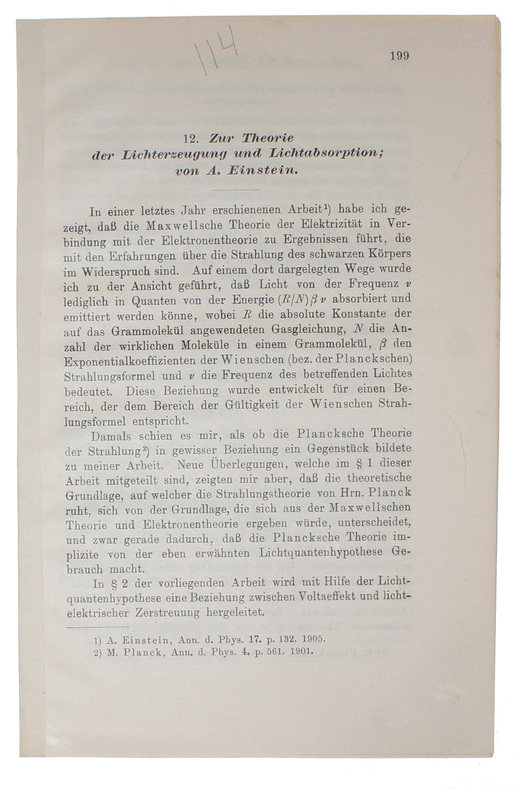
1906ref. 46956(Leipzig, Johann Ambrosius Barth, 1906). No wrappers. Extracted from ""Annalen der Physik"" Vierte Folge. Bd. 20. Pp. 199-206. Clean and fine.
1912ref. 49779(Leipzig, Barth),1912. 8vo. No wrappers. In: ""Annalen der Physik IV, Bd. 38"", No 7. Pp.249-472 a. 3 plates. (Entire issue offered). Einstein's papers: pp. 355-369 and pp. 443-458. Clean and fine.
1914ref. 48163Braunschweig, Vieweg & Sohn, 1914. No wrappers. ""Verhandlungen der Deutschen Physikalischen Gesellschaft im Jahre 1914. Hrsg. von Karl Scheel."", 16. Jahrgang, Nr. 16. Pp. (765-) 834. (Entire issue offered). With the general titlepage to 16. Jahrg. Titlepage stamped at foot. Einstein paper pp. 820-828.
ref. 31089aafBern, Paul Haupt, 1961, in-8°, 155 S., reich illustriert, Original-Pappband.
1907ref. 38817Leipzig, J.A. Barth, 1907. Contep. hcloth. Both hinges with a tear at upper part. ""Annalen der Physik, Vierte Folge. Band 23. Herausgegeben von W.Wien und M. Planck"", VIII,1000 pp. and 4 plates. Einstein's papers pp. 197-98 a. 206-209 a. 371-384. Internally fine and clean. The whole volume offered.
1903ref. 47072Leipzig, Johann Ambrosius Barth, 1903. Contemp. hcloth. Handwritten paperlabel on spine. In: ""Annalen der Physik. Vierte Folge. Band 11. Herausgegeben von Paul Drude."". VIII,1144pp. and 6 plates. (Entire volume offered). The Einstein paper: pp. 170-187. Faint signs of dampstains in outer margins on a few leaves.
1903ref. 38800Leipzig, Johann Ambrosius Barth, 1903. Contemp. hcloth. Some small nicks to spine. (=) Annalen der Physik. Vierte Folge. Band 11. Herausgegeben von Paul Drude."". VIII,1144pp. and 6 plates. The Einstein paper: pp. 170-187. Internally fine and clean.
1902ref. 38834Berlin, J.A. Barth, 1902. Contemp. hcloth. Top of spine with light wear, bottom of spine with small nicks. ""Annalen der Physik. Vierte Folge. Band 8. Hrsg. von Paul Drude."" VIII,928 pp. and 7 plates. Einstein paper: pp. 798-814. Internally fine and clean. The whole volume offered.
1902ref. 49829Berlin, J.A. Barth, 1902. Contemp. hcalf. Gilt spine. Some scratches along edges. Stamp on halftitle and title-page. ""Annalen der Physik. Vierte Folge. Band 8. Hrsg. von Paul Drude."" VIII,928 pp. and 7 plates. Einstein paper: pp. 798-814. Internally fine and clean. The entire volume offered.
1907ref. 38828Berlin, J.A. Barth, 1907. Contemp. hcloth. Light wear to top of spine. ""Annalen der Physik. Vierte Folge. Band 22"", Engraved portrait of Pierre Curie. VIII,1016 pp. and 4 plates. Einstein papers. pp. 180-190, pp. 569-572 and p.800. Internally clean and fine. The whole volume offered.
1949ref. 38876London, Dennis Dobson, 1949. Orig. cloth. 324 pp. Illustr. by Hugh Gray Lieber.
1914ref. 38840Braunschweig, Vieweg & Sohn, 1914. Later full cloth. A stamp to the general titlepage. IX,1072"414 pp., textillustrations. ""Verhandlungen der Deutschen Physikalischen Gesellschaft im Jahre 1914. Sechzehnter Jahrgang. Hrsg. von Karl Scheel."" Einstein paper pp. 820-828. Internally clean and fine. The whole volume offered
1911ref. 38841Leipzig, J.A. Barth, 1911. Contemp. hcalf, spine gilt. ""Annalen der Physik. Vierte Folge. Band 34. Hrsg. von W.Wien und Max Planck."" VIII,1032 pp., 6 plates. Einstein papers: pp. 165-169" pp. 170-174 pp. 175-176 p. 590" pp. 591-592. Fine and clean. The whole volume offered.