Einstein, AlbertBiblio.com
1.463 Ergebnisse
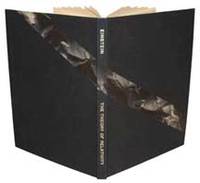
2005Best.-Nr. CNAP071San Francisco: The Arion Press 2005. Hardcover. New. 10-1/2 by 8 inches eighty pages. Printed by letterpress from lead-alloy type cast in the Mackenzie & Harris typefoundry the formulas were set by hand as was the display type while the prose was composed and cast in Monotype. The types are Modern for the text with special characters as needed for mathematical symbols; Egyptian for the interspersed annotations printed in blue; and Lining Gothic for display. The paper is Schiller a German mouldmade sheet. A pixelated portrait of Einstein is the frontispiece. This image is based on a photograph taken about 1910 rendered as a coarse halftone for reference then handset in units of six-point type: three sizes of solid squares and one centered dot. Over 4000 pieces of type make up the picture. The portrait is printed in gray as is the famous equation: E=mc2 which appears on the flyleaves. The binding is dark blue cloth over boards with a band of tie-dyed Thai paper to create an unusual spatial effect spanning the cover diagonally. The titling on the spine is stamped in silver foil. The edition is limited to 400 numbered copies for sale. One of the great achievements in science Albert Einstein's Theory of Relativity was set forth in two papers published in the Leipzig physics journal Annalen der Physik in 1905. The German text was translated into English in 1923 by W. Perrett and G. B. Jeffrey and this is the version with some later corrections that is presented in this book. The Einstein papers are annotated by Richard Muller who has also provided a foreword and afterword. The foreword gives a general overview of the problems Einstein addressed against the background of nineteenth-century physics. The afterword carries the story from the miraculous year of 1905 when Einstein was only twenty-six through the effects of the theory on twentieth-century science. Muller conjectures on the progress of physics had Einstein not appeared and considers his career as a whole its last thirty-five years devoted mainly to an unsuccessful attempt to create a unified field theory. ___POSTAGE: International customers please note that additional postage may apply as the standard does not always cover costs; please inquire for details. ___Swan's Fine Books is pleased to be a member of the ABAA ILAB and IOBA and we stand behind every book we sell. Please contact us with any questions you may have we are here to help. The Arion Press hardcover
Best.-Nr. 72537Braunschweig Friedrich Vierweg & Sohn; Berlin J. Springer 1924. 8vo 22.8 x 15.4 cm. 10 pp. Original printed wrappers. = First paper by the Indian physicist Satyendra Nath Bose 1894-1974 on thermal equilibrium in the radiation field in the presence of matter and second paper sent to Albert Einstein with the request to translate and publish it in a German physics journal. Einstein saw the importance of the paper but he disagreed with its contents and decided to add a lengthy comment. Subsequently Bose saw a way to circumvent Einstein's critique but never published this rebuttal. Nearly 50 years later Bose stated that he was disappointed by Einstein's remarks ".Bose had his own approach to quantum theory based on his views about the interconnectedness of spontaneous and induced emissions which formed the subject matter of his second and third papers. He did not agree with Einstein's proposal to treat them as independent physical processes. Stationary states in atoms have zero widths both in the old and the new quantum theories and therefore have infinite life-times whereas in reality they do decay and jump down to lower energy states with a finite life-time. What is the origin of these finite widths In Bose's view they are the consequence of the interaction between atom and environment as he attempted to show in his second and third papers. But Einstein did not agree and dismissed his views with the remark that in a world consisting of a single excited hydrogen atom and nothing else the atom would obviously emit a photon and come down to its ground-state! Einstein did not explain what would excite an atom in such a world. Bose was very disappointed by this simply because the world does have much more than a single hydrogen atom and inevitably every atom has an environment" Wali. Contained in: Zeitschrift für Physik volume 275-6. The complete issue in its original wrappers. Upper right corner somewhat bumped throughout. Rear wrapper slightly frayed at edges; minimal spotting at the fore and bottom edges. Volume number written on spine; otherwise a very good clean copy. Schilpp 188; Wali K. C. 2009. Satyendra Nath Bose: His Life and Times: Selected Works with Commentary p. xxvi. unknown
Best.-Nr. H3991Berlin Akademie der Wissenschaften 1919 In: Sitzungsberichte der Königl.Preuss. Akademie der Wissenschaften Band 1919/1. 4to. S.349-356; S.433.438. Halbleinenband der Zeit leicht berieben Bibl.-Nr.am Rücken Original-Broschur miteingebunden unaufgeschnitten gutes Exemplar. unknown
Best.-Nr. 344930Methuen & Co Ltd 36 Essex Street W.C. London 1920. FIRST EDITION octavo red buckram boards black lettering to spine blind lettering to front board frontispiece xiii 138pp 8pp to rear G moderate fading to spine moderate scuffing & fraying to spine extrems & board corners moderate to heavy soiling to boards light to moderate tanning & foxing to page edges heavy loss to front pastedown with 2x ownership ink markings also prev. owner's name in pencil & newspaper clipping & moderate tanning to ffep v heavy crack to front gutter- board shaky multiple library ink stamps to rear pastedown- no others detected elsewhere in book moderate cracking to rear gutter light tanning to rear eps occasional moderate to heavy cracking to gutters & pencil markings to margins & spots of soiling throughout Methuen & Co Ltd, 36 Essex Street W.C., London 1920 hardcover
1910Best.-Nr. 49714Leipzig Barth 1910. 8vo. Bound in contemporary half cloth with gilt lettering to spine. In "Annalen der Physik" Bd. 33 1910. Entire volume offered. Library stamp to verso of title page light wear to extremities. Otherwise fine and clean. pp. 1096-1104 and pp. 1105-1115; Pp. 1275-1298 Entire volume: VIII 1584 pp. 6 plates. First appearance of all three papers. The purpose of "A theorem in probability and its application in the Theory of radiation" is to demonstrate that the failure of statistical mechanics with respect to the radiation law Rayleigh - Jeans law contradicted by experience cannot be removed by the conjecture that perhaps the individual statistical events should not follow the usual law of independence product of probabilities instead of assuming a certain interdependence between them. Lanczos. The second paper "Statistical investigation on of the motion of an oscillator in a radiation field" makes use of the results of the previous investigation. Einstein's aim is to demonstrate that the Rayleigh-jeans law of radiation contracdicted by the physical facts is an unavoidable consequence of statistics even if we avoid any kind of assumption which may be suspected of needing correction. Lanczos. The third paper "Theory of the opalescence of homogenous fluids and fluid mixtures near the critical state" is an importent investigation and one of the most difficult of all his papers to understand. The aim of the paper is to complement the work of Smoluchovski Ann. d. Physik25 1908 who gave a general explanation of the strong density fluctuations - and the opalescence thus generated - of two fluids near the critical state of mixture or a single fluid near the critical state of condensation on the basis of the kinetic theory of heat. he did notgive howeverthe quantitative details concerning the scattered light associated with this phenomenon. Lanczos. - Weil Nos 34 35 and 36 with an asterix denoting major work.Weil No. 34 35 & 36. hardcover
1915Best.-Nr. 1200Braunschweig: Friedr. Vieweg & Sohn 1915. 1st Edition. FIRST EDITION FULL BOUND VOLUME OF THE EINSTEIN-DE HAAS EFFECT -- an experimental observation that illustrates the relationship between magnetism and angular momentum and in which a change in the magnetic moment causes the rotation of a free body. In this 1915 paper Albert Einstein and Wander de Haas report that changing the magnetization of a suspended iron rod by applying an external magnetic field leads to mechanical rotation of the rod - a result that still stands as a textbook illustration of the relationship between magnetism and angular momentum. Papers by Planck The Quantum Hypothesis for Molecules with Multiple Degrees of Freedom von Laue Warburg Siegbahn and Born are also present. Einstein had long contemplated Ampère's 1820 conjecture that magnetism is caused by the microscopic circular motions of electric charges. In light of this Einstein and de Haas devised an experiment to test not just Ampère's hypothesis but also "Lorentz's theory that the rotating particles are electrons. The aim of the experiment was to measure the torque generated by a reversal of the magnetization of an iron cylinder" Calaprice Einstein Almanac 52. In the experiment Einstein and de Haas designed "a magnetic material was suspended with the aid of a thin string inside a magnetic field coil. When the magnetic field was increased by the application of an electric current through the field coil the magnetic material is magnetized. In order to keep the total magnetic moment of the magnetic material constant the latter rotates. This classical Einstein-de Haas effect demonstrates that the spin angular momentum is of the same nature as the angular momentum of rotating bodies as conceived in classical mechanics" Ganzhorn Nature Communications 7 11443 2016. Einstein spoke enthusiastically of the experimental results he and de Haas has achieved stating that they had "given firm proof of the existence of Ampère's molecular currents" Pais Subtle is the Lord 245. ALSO INCLUDED: Papers by Planck "Die Quantenhypotese für Molekeln mit mehreren Freiheitsgraden" and "Bemerkung über die Entropiekonstante zweiatomiger Gase" as well as a paper by von Laue "Die Einsteinischen Energieschwankungen" CONDITION & DETAILS: Braunschweig: Friedr. Vieweg & Sohn. 8vo. Unobtrusive stamp on front paste down and title page. In-text figures throughout. Tightly bound in leather over marbled paper boards; gilt-lettered and tooled at the slightly faded spine. Unusually beautiful marbled paper edges. Bright and very clean throughout. Near fine. Friedr. Vieweg & Sohn hardcover
1922Best.-Nr. 32430Berlin: Sitzungsberichten der Preussischen Akademie der Wissenschaften 1922. First Thus. First Thus. Einstein Albert 1879-1955. Zur Theorie der Lichtfortpflanzung in dispergierenden Medien. Complete. Quarto. Offprint from Sitzungsberichten der Preussischen Akademie der Wissenschaften. Berlin: 1922. First edition in very fine condition. This superb offprint is a separate printing of the Prussian Academy's session reports here with independent pagination. A small number of such off prints were presented to the author by the publisher as voucher copies. References: Schilpp-Shields 162; Weil 120. This paper gives evidence that Einsteins ideas on the photon were not able to contradict classical theory. "Since after 1917 Einstein firmly believed that light-quanta were here to stay it is not surprising that he would look for new ways in which the existence of photons might lead to observable deviation from the classical picture. In this he did not succeed. At one point in 1921 he thought he had found a new quantum criterion but it soon turned out to be a false lead as demonstrated in this paper". An excellent example. "The early Offprints from "Sitzungsberichten." are called "Sonderabdruck" up to Weil No.165 including this. From Weil 166 they are called "Sonderausgabe.". - Before 161 up to 160 the Offprints do not have separate title and pagination the pagination follows the numbering in the periodical. From 166 the Offprint has both separate printed title and pagination. - So Weil Nos 161-165 is still "Abdruck" but with separate title and pagination. Sitzungsberichten der Preussischen Akademie der Wissenschaften unknown
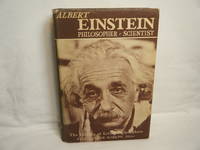
1949Best.-Nr. 38664The Library of Living Philosophers. Very Good in Very Good dust jacket. 1949. First Edition. Hardcover. First edition of Einstein's autobiography. Blue cloth. Bookplate to ffep. Glue darkening along hinges. Book is tight and square. Gilt unfaded. The clipped jacket shows wear along edges and shows general toning. ; The Library of Living Philosophers; Vol. 7; 8vo 8" - 9" tall . The Library of Living Philosophers hardcover
Best.-Nr. 315800The Easton Press. Hardcover. Fine. Typical Easton binding. All four books have unused bookplates laid in. Trivial gilt nicks. A Fine copy. The Easton Press hardcover
1920Best.-Nr. 504910Toronto: The Ryerson Press 1920. Book. Very Good. Hardcover. Binding sturdy. Text clean. A well-preserved copy of the first Canadian edition with previous owner's inscription on front free end page. Modest stunning to spine cover else in very good condition indeed. The Ryerson Press Hardcover
1968Best.-Nr. 019130Crown Publishers. First Printing. No Statement Of Printing DJ Price Clipped But Exactly Same As First And Came With This Book Publisher's Address As 419 Fourth Avenue On Front And Rear Flaps.Clipped DJ in archival cover edge wear small chips. . Fine. Hardcover. 1st Edition. 1968. Crown Publishers hardcover
1932Best.-Nr. 433001932. Offprint from Sitzungsberichte der Preussischen Akademie der Wissenschaften 32 1932. 31pp. 256 x 183 mm. Original printed wrappers a little chipped and darkened small splits in spine. Very good. First edition offprint issue. Einstein's work on semivectors "was stimulated by Ehrenfest's insistence on a better understanding of the relation between single-valued and double-valued representations of the Lorentz group . . . Einstein and Mayer went on to relate semivectors to the Dirac equation and to generalize the formalism to general relativity" Pais Subtle is the Lord pp. 451-452. Weil Albert Einstein Bibliography 186. unknown
1930Best.-Nr. 433141930. Offprint from Sitzungsberichte der preussischen Akademie der Wissenschaften 1930. Single sheet pp. 1-2. 256 x 184 mm. Upper edge a bit creased light toning but very good. First edition offprint issue. One of Einstein's last papers on Riemann metrics and distant parallelism written the year before he abandonded this approach to constructing a unified field theory. Pais Subtle is the Lord p. 347. Weil Albert Einstein Bibliography 173. unknown
1911Best.-Nr. 50604Leipzig J.A. Barth 1911. 8vo. In Contemporary half calf with gilt lettering to spine. In "Annalen der Physik. Vierte Folge. Band 34. Hrsg. von W.Wien und Max Planck.". The whole volume offered. A tear to lower part of spine and small stamp to title page otherwise fine. Einstein papers: pp. 165-169; pp. 170-174; pp.; 175-176; p. 590; pp. 591-592. Entire volume: VIII1032 pp. 6 plates. First edition of all 5 papers. In "Relation between elastic behaviour and specific heat of solid bodies with monatomic molecules" Einstein comments Sutherlands importent paper in Philosophical Magazine from 1910. Sutherland made the importent remark that the infrared eigenfrequencies of solid bodies have their origin possibly in the elastic vibrations of these bodies. Einstein impressed by this remark adds that electrically charged ions are the sources of optical vibrations whreas elastic vibrations are caused by the mutual motion of the entire molecule. Hence he prefers to test the hypothesis of Sutherland by solid bodies which are composed of monatomic molecules."Lanczos. - Weil Nos 38 39 this with an asterix denoting major work40 1-2 and 41. unknown
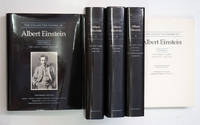
Best.-Nr. 108243Princeton University Press 1987–1995. 4° XXIII 433 S.; XXII 655 S.; XXXII 644 S.; 4: XVIII 715 S.; 460 S. OLwd. m. OU.; Bd. 6: Broschur Tadell. Sprache: engl. 010 Princeton, University Press, 1987–1995 unknown
1955Best.-Nr. 060140New York: Pantheon Books 1955. First Edition . Cloth. Very Good /Good. 86 Pp. Blue Cloth. First Edition. Book Very Good Dj First State Priced $4.00 Considerable Wear Chipping At Corners 2" Mostly Closed Tear Near Top Of Front Spine Edge No Marks. Pantheon Books hardcover
1949Best.-Nr. 057965New York: The Library Of Living Philosophers 1949. 1st Edition 1st Printing. Hardcover. Near Fine/Very Good. Xvi 781 Pp. Blue Cloth Gilt. Stated First Edition. First Printing Of Einstein's Autobiography With Text In Both German And English; First Publication Of Major Essays On Einstein And An Important Discussion With Niels Bohr. Near Fine Book Gilt Bright No Marks. Dust Jacket Priced $8.50 Wear Browning Minute Losses At Edges Dust To Rear Panel. The Library Of Living Philosophers hardcover
Best.-Nr. a94713Leipzig 1918. first edition. Hirzel. Hardcover large 4to. In German. Many important papers in the history of modern physics by scientists as Einstein articles pp. 115-116 165-166 Otto Hahn and Meitner "Die Muttersubstanz des Actiniums" pp. 208-218 Schroedinger "Notiz uber die Ordnung" pp. 218-220; "Energie komponenten des Gravitationsfeldes" pp 4-7; "Loesungssystem" pp. 20-22 Ludwig Flamm "Gegenwartiggen Stand der Quantentheorie pp. 116-128 and much more. Physikalische Zeitschrift for Jan - Dez 1918. 556p. plates line drawings. Excellent condition - Very near Fine just some toning on on pages in second half of volume to do lower paper quality no doubt due to economic problems in Germany at the time. No owner marks. 3/4 black cloth with black and grey marbled board; mounted paper spine label with title in thick black ink. Pictures available on request. Clearly 1918 was an exciting year in the world of physics. . hardcover
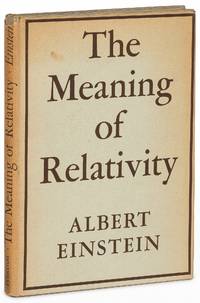
1945Best.-Nr. 617621Princeton New Jersey: Princeton University Press 1945. Hardcover. Near Fine/Very Good. Second edition with a new appendix by Einstein and translated by Ernst G. Straus. Octavo. 135pp. Tiny owner name on front fly else fine in uniformly and modestly spine-toned very good dust jacket with nominal soiling. Princeton University Press hardcover
1908Best.-Nr. 003221Leipzig: J. A. Barth 1908. First Edition. Contemporary Cloth. Very Good. J. A. Barth Hardcover
1906Best.-Nr. 003218Leipzig: J. A. Barth 1906. Several small dents in cover edges. First Edition. Contemporary Cloth. Very Good. J. A. Barth Hardcover
1914Best.-Nr. 1199Braunschweig: Friedr. Vieweg & Sohn 1914. 1st Edition. FIRST EDITION FULL VOLUME OF THE FRANCK-HERTZ EXPERIMENT: THE FIRST ELECTRICAL MEASUREMENT TO CLEARLY SHOW THE QUANTUM NATURE OF ATOMS - PROOF OF THE QUANTIZED MODEL OF THE BOHR ATOM & OF PLANCK'S QUANTUM THEORY. Note that this volume includes both the first and second Franck-Hertz experiment. In the first they demonstrate that atoms can only absorb and be excited by specific amounts of energy; in the second experiment performed the same year they demonstrate that the frequency of the light emitted following the collision of electrons with mercury atoms corresponds precisely with the energy lost by the electrons in the collision. Franck and Hertz received the Nobel Prize for this work specifically "for their discovery of the laws governing the impact of an electron upon an atom" Nobel Prize Committee. Of equal import this volume also contains a paper by Einstein in which he uses the light quantum hypothesis to give new derivations of Planck's radiation law and Nernst's third law of thermodynamics. His "proofs introduced the quantum hypothesis" Calaprice The Einstein Almanac 40. In 1914 James Franck and Gustav Hertz were working together in the Physics Institute of Berlin and were "particularly interested in ionization i.e. in the process in which an electron is removed from an atom" The Harvest of a Century" p. 102-103. The experiment they devised now known commonly as the Franck-Hertz experiment is "a vivid illustration of the quantization of energy" that relied on methodology so simple "that it is now carried out regularly by undergraduates. They accelerated electrons through a low-pressure gas of mercury. When the electrons' energy reach the energy of a stationary state of mercury they gave up a quantum of energy to the mercury resulting in a stepwise shape to the curve of current through the apparatus. This demonstrated that atoms could absorb energy only in discrete amounts" Peacock The Quantum Revolution 40. "Franck and Hertz had not only shown for the first time that electrons lose their kinetic energy to mercury atoms in energy quanta but also that these energy quanta are equal to the energy of the light emitted by the same atoms if interpreted with Einstein's light-quantum hypothesis.This was the first experimental determination of Planck's constant not using blackbody radiation" Brandt 103. CONDITION & DETAILS: Braunschweig: Friedr. Vieweg & Sohn. 8vo. Unobtrusive stamp on front paste down and title page. In-text figures throughout. Tightly bound in leather over marbled paper boards; gilt-lettered and tooled at the slightly faded and spotted spine which looks worse in the image due to the bright light than it does to the eye. Unusually beautiful marbled paper edges. Bright and very clean throughout. Near fine. Friedr. Vieweg & Sohn hardcover
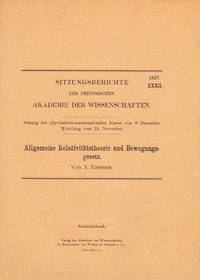
1927Best.-Nr. 5736KBerlin: Verlag der Akademie der Wissenschaften in commission at Georg Reimer Reichsdruckerei 24th February 1927; 14th February 1928. Near Fine. Imperial 8vo 25 4: 18 2 cm. 12 pages numbered 2-13; 12 pages numbered 235-245 1. Letterpress on machine paper in original publisher’s brochures on orange stock with black title printing. First offprints in the original wrappers of two of Einstein's papers about the interrelations of the General Theory of Relativity and the Law of Motion the 2nd paper conducted with his assistant Jakob Grommer. - Condition: Mint. - Reference: Boni-Russ-L. 171; Schilpp-Shields 212; Weil 155 and 160. Verlag der Akademie der Wissenschaften (in commission at Georg Reimer [Reichsdruckerei]) unknown
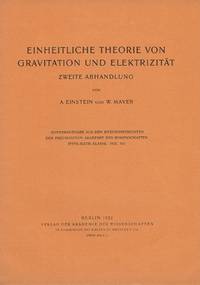
1931Best.-Nr. 5745KBerlin: Verlag der Akademie der Wissenschaften in commission at Georg Reimer Reichsdruckerei 2nd December 1931; 30th April 1932. Near Fine. Imperial 8vo 25 4: 18 2 cm. 19 1 pages; 12 pages numbered 235-245 1. Letterpress on machine paper in original publisher’s brochures on salmon-coloured and orange stock with black title printing. First offprints in the original wrappers and new pagination of this important two-part paper by Einstein formulating new developments towards Unified Field Theories. - Content: Einstein made several attempts at a five-dimensional unified field theory including this two-part collaboration with Austrian mathematician Walther Mayer nicknamed „Einstein's calculator“ ""in which a new unified field theory was proposed one based on a four-dimensional space-time continuum with a five-dimensional tangent space attached at each point"" Pais Subtle is the Lord p. 492. - Condition: Very well preserved. - Reference: Boni-Russ-L. 207; Printing and the Mind of Man 416 „Principal Work“; Schilpp-Shields 251 and 261; Weil 182 and 185 quotes the paginations of the first separate printings p. 541-557 and 130-137. Verlag der Akademie der Wissenschaften (in commission at Georg Reimer [Reichsdruckerei]) unknown
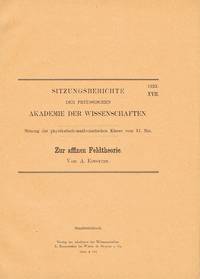
1923Best.-Nr. 5730KBerlin: Verlag der Akademie der Wissenschaften in commission at Walter de Gruyter Reichsdruckerei 28th June 1923. Near Fine. Imperial 8vo 25 4: 18 2 cm. 4 pages numbered 137-140. Letterpress on machine paper in original publisher’s brochure on orange stock with black title printing. First offprint in the original wrappers of this first attempt of Einstein to formulate a unified field theory. - Content: In this important paper Einstein gives his first investigation of ""Affine geometries"" and introduces the notion of ""Distant parallelism"" thus for the first time attempting to formulate a unified field theory based on the research of the German mathematician theoretical physicist and philosopher Hermann Weyl. - Condition: Mint. - Reference: Alicke 113; Norman Library 698; Schilpp-Shields 175; Weil 132. Verlag der Akademie der Wissenschaften (in commission at Walter de Gruyter [Reichsdruckerei]) unknown