Einstein, AlbertABAA

214 results
1920ref. 43308Berlin: Springer 1920. 15pp. 221 x 146 mm. Original printed wrappers foxed. Minor internal foxing but very good. First edition cover title does not include the date Einstein delivered his lecture; see Weil. "By royal decree of June 24 1920 a special chair in Leiden University was created for Einstein enabling him to come to that university for short periods of his choosing. On October 27 1920 Einstein began his new position with an inaugural address on aether and relativity theory" Pais Subtle is the Lord p. 313. Weil Albert Einstein Bibliography 111. Springer unknown books
1930ref. 433061930. Offprint from Mathematische Annalen 102 1930. 685-697pp. Original printed self-wrappers. 233 x 157 mm. Very good apart from small split in lower spine. Weil Albert Einstein Bibliography 171. unknown books
1923ref. 374081923. Offprint from S. preuss. Akad. Wiss. Weil 137. unknown books
1923ref. 433181923. Offprint from Zeitschrift für Physik 16 1923. Single sheet unpaginated. 230 x 155 mm. One corner creased but very good. First edition offprint issue. Einstein's second response to Friedmann's groudbreaking paper on equations governing the expansion of space which made a valuable contribution to Einstein's theory of relativity and admitted the possibility of an expanding universe. Einstein at first believed that Friedmann's reasoning was incorrect then corrected his own objection in the present brief "Notiz" and called Friedmann's results "clarifying." Pais Subtle is the Lord p. 288. Weil Albert Einstein Bibliography 130. unknown books
1923ref. 374071923. Einstein Albert 1879-1955. Zur affinen Feldtheorie. Offprint from Sitzungsberichte der preussischen Akademie der Wissenschaften 17 1923. 137-140pp. 256 x 185 mm. Original printed wrappers. Fine. First Edition Offprint Issue. In 1923 Einstein published four short papers of which "Zur affinen Feldtheorie" is the third on Eddington's attempt at a unified field theory marking the beginning of a scientific passion that would dominate the remainder of his career. In 1921 British physicist Arthur Eddington had proposed a unified field theory inspired by the work of Hermann Weyl. "Einstein's own initial reaction was that Eddington had created a beautiful framework without content. Nevertheless he began to examine what would be made of these ideas and finally decided that 'I must absolutely publish since Eddington's idea must be thought through to the end.' That was what he wrote to Weyl. Three days later he wrote to him again about unified field theories: 'Above stands the marble smile of implacable Nature which has endowed us more with longing than with intellectual capacity.' Thus romantically began Einstein's adventures with general connections adventures that were to continue until his final hours" Pais Subtle is the Lord p. 343. This paper is included on Shields's list of Einstein's most significant papers; see Albert Einstein Philosopher-Scientist 1949 p. 758. Shields 175. Weil 132. . unknown books
1929ref. 374191929. Einstein Albert 1879-1955. Zur einheitlichen Feldtheorie. Offprint from Sitzungsberichten der preussischen Akademie der Wissenschaften 1 1929. 8vo. 8pp. Berlin: Verlag der Akademie der Wissenschaft 1929. 256 x 183 mm. Original printed wrappers slightly soiled and creased. Very good. First Separate Edition. "In 1928 Einstein embarked on a new approach to a unified field theory . . . involving what he called 'distant parallelism'. . . . By early 1929 he had solved the main problems involved in writing down field equations for his unified theory. On the day of official publication of the third of a formidably technical series of nine articles on the theory . . . excited headlines appeared in foreign newspapers throughout the world. . . . In this frenzied unscientific atmosphere Einstein's new theory was hailed in the press as an outstanding scientific advance. Yet Einstein had stated in his article that it was still tentative; and soon he found he had to abandon it Hoffman Einstein pp. 225-26. This paper is included on Shields's list of Einstein's most significant papers; see Albert Einstein Philosopher-Scientist 1949 p. 758. Weil 165. Pais Subtle is the Lord pp. 344-46. . unknown books
1907ref. 50420Leipzig: Johann Ambrosius Barth 1907. Einstein explicitly establishes E=mc2. Einstein Albert 1879-1955. 1 Über die Möglichkeit einer neuen Prüfung des Relativitätsprinzips. In Annalen der Physik 23 6: pp. 197-8. 2 Bemerkungen zu der Notiz von Hrn. Paul Ehrenfest: "Die translation deformierbarer Elektronen und der Flächensatz." In Annalen der Physik 23 6: pp. 206-8. 3 Über die vom relativitätsprinzip geforderte Trägheit der Energie. In Annalen der Physik 23 7: pp. 371-384. 8vo. Red cloth gilt lettering on spine. 214 x 140 mm. Whole volume: viii 1000 pp. 4 plates numbered Taf. I - IV. Tafs. I II and IV are folding Taf. III is b/w silver photograph tipped to sheet. Foot of the spine is repaired. Very good. Approximate English translations of titles: 1 "On the possibility of a new test of the principle of relativity." 2 "Remarks on Mr. Paul Ehrenfest's note: 'The translation of deformable electrons and the surface theorem.'" 3 "On the inertia of energy required by the principle of relativity." In "On the inertia of energy required by the relativity principle" May 1907 "Using rather than m V rather than c and 0 rather than E0 Einstein wrote his famous equation for the first time as V2= 0 and he did it in a footnote. At the end of that paper he introduced the symbol E0 to denote energy in the rest frame and wrote the famous expression again this time as =E0/V2." -Eugene Hecht How Einstein confirmed E0 = mc2 In the third paper Einstein explicitly establishes his famous equation E=mc2 although with different symbols. In this paper Einstein discussed the relationship between inertial mass and energy arguing for their complete equivalence namely that every mass has an equivalent energy just as every form of energy has an equivalent mass. This relation says that a photon can convert for the equivalence of mass and energy his celebrated equation E = mc2 Calaprice The Einstein Almanac. Weil's Einstein Bibliography nos. 17 18 and 19 respectively. Boni's Einstein Checklist nos. 17 18 and 19 respectively. . Johann Ambrosius Barth unknown books
1921ref. 433161921. Offprint from Sitzungsberichte der preussischen Akademie der Wissenschaften 1921. Single sheet pp. 882-883. 256 x 184 mm. Minor marginal tears one corner chipped but very good. First ediiton offprint issue. "Since after 1917 Einstein firmly believed that light-quanta were here to stay it is not surprising that he would look for new ways in which the existence of photons might lead to observable devations from the classical picture. In this he did not succeed. At one point in 1921 he thought he had found a new quantum criterion published in the present paper but it soon turned out to be a false lead" Pais Subtle is the Lord pp. 412-413. Weil Albert Einstein Bibliography 118. unknown books
1930ref. 510131930. Einstein Albert 1879-1955. Théorie unitaire du champ physique. In Annales de l'Institut Henri Poincaré 1 fasc. 1 1930: 1-24. With: Fermi Enrico 1901-54. La théorie du rayonnement. In ibid.: 25-52. Whole number. 2 74 2pp. 285 x 197 mm. uncut and unopened. Original printed wrappers a bit sunned lower corner of front wrapper chipped and creased. Very good. First Edition. This issue of the Annales de l'Institut Henri Poincaré contains the texts of Einstein's lecture on unified field theory and Fermi's lecture on the theory of radiation both delivered at the Institut in 1929. Weil Albert Einstein Bibliography 174. Not in Fermi Collected Papers. . unknown books
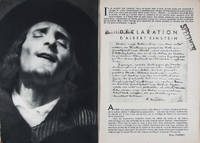
1933ref. 45000Paris: Société Anonyme Les Illustrés Français 1933. First edition. Softcover. g- to vg. Large quarto 11 1/2 x 8". 105 3pp. Original photo-illustrated wrappers with white lettering to front cover. This scarce issue of "Témoignages de Notre Temps" Witness to our Time is a loving and moving tribute to Jewish life and culture that spans ancient times to the early 1930s with the spectre of Hitler and the early persecutions of Jews in Nazi Germany Hitler became chancellor a few months prior on January 30th. Includes texts by Albert Einstein Dr. Chaïm Weizmann and others along with hundreds of splendid black-and-white photogravures many full page including Helmar Lerski's impressive series on Jews in Palestine. "Témoignages de Notre Temps" was edited by noted French photographer and publisher Lucien Vogel. Wrappers partly creased along edges. Page 5 with four "Spécimen" stamps not affecting lettering. Lower corner of the first 18 pages slightly creased. Lower front corner bumped thus slightly affecting pages throughout. Text in French. Wrappers in overall good- to good interior in good to very good condition. Société Anonyme Les Illustrés Français unknown books
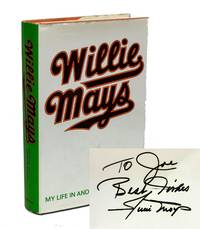
1966ref. WMCE001New York: E. P. Dutton & Co. 1966 First edition first printing. Signed and inscribed by Mays on front free endpaper: "To Joe / Best Wishes / Willie Mays." Publisher's green and orange cloth with "Willie Mays" in blind to front board and spine lettered in black and orange; in its original unclipped dust jacket designed by Bob Korn with white front panel lettered in brown orange and green and a green spine. About fine book with light fading to spine and a hint of rubbing to foot of spine; very good price-clipped dust jacket with light wear to spine ends and some edgewear. With Beckett Letter of Authenticity. Overall a great boldly inscribed copy. Presentation copies from Mays are exceedingly scarce. In this book Willie Mays tells his life story with the help of prolific sportswriter Charles Einstein. Mays started playing professional baseball at 16 in the Negro Leagues and was soon drafted by the New York Giants. He went on to play 21 seasons with the Giants winning a World Series with the team in 1954. His over-the-shoulder catch in that World Series is one of the most iconic moments in sports history. A 24x All-Star and a 12x Gold Glove award winner Mays was inducted into the Hall of Fame in 1979 and was voted to the Major League Baseball All-Century Team in 1999. . Signed. First Edition. Hard Cover. Fine/Dust Jacket Included. New York: E. P. Dutton & Co. hardcover books
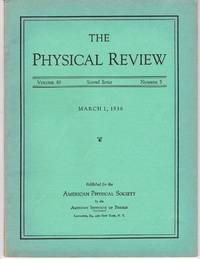
1936ref. 6550Lancaster PA: American Physical Society 1 March 1936. Second series volume 49 number 5. Very Good. ppl 341-422. Original green wraps. Slight nick at bottom edge of lower wrap else better than very good. Includes the retort by Einstein and Rosen originators of speculation on the existence of "worm-holes" in spacetime to objections made to the general theory of relativity. According to Galina Weinstein: "Between 1935 and 1936 Einstein was occupied with the Schwarzschild solution and the singularity within it while working in Princeton on the unified field theory and with his assistant Nathan Rosen on the theory of the Einstein-Rosen bridges. He was also occupied with quantum theory. He believed that quantum theory was an incomplete representation of real things. Together with Rosen and Boris Podolsky he invented the EPR paradox. I demonstrate that the two-body problem in general relativity was a heuristic guide in Einstein's and collaborators' 1935 work on the Einstein-Rosen bridge and EPR paradox." Also articles by notable physicists on radioactivity electron mobility quantum-mechanical measurement and so on. American Physical Society paperback books
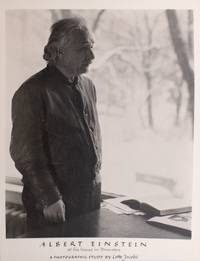
1940ref. 3293321940. Black and white photographic print. 6 1/2 x 4 7/8 in. Fine. Black and white photographic print. 6 1/2 x 4 7/8 in. unknown books
1949ref. 140941039Evanston IL: The Library of Living Philosophers Inc 1949. First Edition. Near Fine/Very Good. First edition first printing. Bound in publisher's original dark blue cloth stamped in gilt. Near Fine with toning to pages offsetting to endsheets former owner name to front free endpaper and small sticker ghost to front paste down. In a Very Good dust jacket with fraying and chip at bottom spine end and short closed tear at head light edge wear toning and soiling to rear panel. The Library of Living Philosophers, Inc unknown books
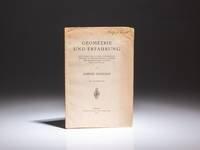
1921ref. 17649Berlin: Verlag Von Julius Springer 1921. First Trade Edition. Wraps. Very good. The first trade edition of Geometrie Und Erfahrung Geometry and Experience by Albert Einstein from the collection of Einstein's English translator Dr. Wilfrid Perrett. Octavo 20pp. Publisher's original wraps bound with two staples. Light soiling and wear on wraps internally clean. Includes two illustrations advertisements on verso of rear flap. Staples showing rust some wear to edges of original wraps. Weil 115 Schlipp-Shields 143 This copy is signed by Wilfrid Perrett on the front cover. This work first appeared in the Sitzungsberichte der Preussischen Akademie der Wissenschaften accompanied by an "author's offprint" which was bound in orange wrappers. Weil 114. This work is the first separate trade edition. The recipient of this copy Dr. Wilfrid Perrett worked with Dr. George Barker Jeffery to translate many of Einstein's most notable works into English. Perrett was a "distinguished German scholar" and would "overlook the literary side of the work" while Jeffery would oversee the mathematical translations. The two worked together on Das Relativitätsprinzip On the Relativity Principle beginning in 1922 and numerous other works by Einstein over his career. Jammer 113-114. Verlag Von Julius Springer unknown books
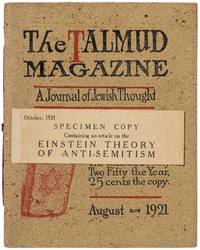
1921ref. 553355Boston: Talmud Society 1921. Softcover. Fine. First edition. 12mo. 64pp. Original cord-tied wrappers printed in red and black. The first and last leaf toned from interaction with the wrappers else about fine. An August issue of the magazine apparently used in October to promote the short-lived magazine this copy with a printed slip affixed to the front wrap: “October 1921. Specimen Copy. Containing an article on the Einstein Theory of Anti-Semitism.” Photographic portrait of Einstein on page 14; along with an English translation of his essay: "Jewish Nationalism and Anti-Semitism: Their Relativity" which originally appeared in the London Jewish Chronicle. Talmud Society unknown books
1929ref. 19299Berlin: Verlag der Akademia der Wissenschaften in Kommission bei Walter de Gruyter 1929. FIRST EDITION. Original printed orange wrappers; a fine copy unopened and bound into morocco-backed cloth boards spine labeled in gilt. First edition first issue in the rare author’s offprint form with a newly set title-page. One of Einstein’s last important scientific works this publication of the unified field theory caused quite a sensation. It was the first separate printing of one of a series of five papers published between 1925 and 1929 in which Einstein attempted to develop a unified field theory reconciling in a single formula the laws of electromagnetism and gravitation. Weil 165; Printing & the Mind of Man 418. Verlag der Akademia der Wissenschaften in Kommission bei Walter de Gruyter unknown books
ref. 504141 First Edition journal issue. The brilliant follow-up to Einstein's landmark 1905 paper on the photoelectric effect. In the 1905 paper Einstein had explained the photoelectric effect-the emission of electrons from a metal when irradiated by light-by making the revolutionary proposal that light rather than consisting of continuous waves was instead made up of discrete particles of energy "light quanta" which transferred their entire payload of energy to an electron on impact. In the 1905 paper Einstein made use of Planck's mathematical formula for blackbody radiation which had introduced the concept of energy quanta but he was only able to derive part of the formula. In his 1906 paper Einstein "used his statistical mechanics to demonstrate that when light interacts with matter Planck's entire formula can arise only from the existence of light quanta-not from waves" Cassidy; emphasis ours. Einstein had realized as he stated in the present paper that "'Planck's theory makes implicit use of the . . . light-quantum hypothesis' . . . his acceptance of Planck's formula albeit as a hypothesis led to a major advance in his own work" Pais Subtle is the Lord p. 378. In 1921 Einstein was awarded the Nobel Prize in physics for his work on the photoelectric effect. Cassidy David "Einstein on the Photoelectric Effect." Einstein: Image and Impact. American Institute of Physics n.d. Web. Accessed 09 July 2014. Shields "Writings of Albert Einstein" in Albert Einstein: Philosopher-Scientist 1948 pp. 689-758 no. 13; also included in Shields' "Chronological list of principal works" on p. 757. Weil Albert Einstein: A Bibliography no. 12. 2 First Edition journal issue of Einstein's second paper on the inertia of energy following his 1905 paper "Ist die Trägheit eines Körpers von seinem Energieinhalt abhängig" Is the inertia of a body dependent on its energy content. In the present paper Einstein presented another argument in support of the proposition that a body's energy depends on its energy content. "About a year after he first introduced the inertia of energy Einstein published a paper entitled "The Principle of the Conservation of the Center of Gravity and the Inertia of Energy" in which he showed that E = mc2 is necessary and sufficient to ensure that the center-of-mass theorem holds for systems in which 'not only mechanical but also electromagnetic processes take place' . . . As Einstein acknowledges his paper is similar to Poincaré's contribution to the Lorentz Festschrift 1900. Einstein showed that in order to avoid the kind of violations of the center-of-mass theorem discussed by Poincaré one has to assume that energy has inertia" Janssen pp. 39-40. Janssen "The Trouton experiment E = mc2 and a slice of Minkowski space-time" in Revisiting the Foundations of Relativistic Physics: Festschrift in Honor of John Stachel 2003 pp. 27-54. Weil Albert Einstein Bibliography 13. . unknown books
1907ref. 432971907. Einstein Albert 1879-1955. Berichtigung zu meiner Arbeit: "Die Plancksche Theorie der Strahlung etc." Offprint from Annalen der Physik 22 1907. Single sheet p. 800. Unbound as issued. 223 x 145 mm. Lower corner lightly creased but very good. First Edition Rare Offprint Issue. Einstein's important correction to his paper on specific heats "Die Plancksche Theorie der Strahlung und die Theorie der spezifischen Wärme" 1907; see Weil 15 which "made clear for the first time that quantum concepts have a far more general applicability" Pais p. 394. "Einstein initially believed that his oscillating lattice points in a three-dimensional crystal lattice were electrically charged ions. A few months later he published a correction to his paper in which he observed that this was an unnecessary assumption . . . Einstein's correction freed the quantum rules in passing one might say from any specific dependence on electromagnetism" Pais p. 396. Pais Subtle is the Lord pp. 394-396. Weil 15n. . unknown books
1906ref. 38892Leipzig 1906. Einstein Albert 1879-1955. 1 Eine neue Bestimmung der Molekuldimensionen. In Ann. d. Physik 4th series 19 1906: 289-306. 2 Zur Theorie der Brownschen Bewegung. In ibid.:371-381. Whole volume 8vo. viii 1080pp. 5 plates. 213 x 143 mm. Original cloth spine faded split in upper half of spine inner hinge cracking. Very good. 1 First Edition in Journal Form Revised of Einstein's doctoral thesis ranked by his biographer as being on the same level as his 1905 papers on relativity the light quanta and Brownian motion. In his thesis Einstein presented a new theoretical method for determining molecular radii and Avogadro's number the number of atoms or molecules needed to make up a mass equal to a substance's atomic or molecular weight in grams. The thesis appeared in print in the spring of 1905; in the journal version published at the beginning of 1906 Einstein added a brief appendix containing an improved value of Avogadro's number. Einstein's biographer Abraham Pais wrote of Einstein's thesis as follows: "It is not sufficiently realized that Einstein's thesis is one of his most fundamental papers. Histories and biographies invariably refer to 1905 as the miraculous year because of his article on relativity the light-quantum and Brownian motion. In my opinion the thesis is on a par with the Brownian motion article. In fact in some-not all-respects his results on Brownian motion are by-products of his thesis work emphasis ours. This goes a long way toward explaining why the paper on Brownian motion was received by the Annalen der Physik on May 11 1905 only eleven days after the thesis had been completed. "Three weeks after the thesis was accepted this same journal received a copy of the thesis for publication. It was published only after Einstein supplied a brief addendum in January 1906. . . . As a result of these various delays the thesis appeared as a paper in the Annalen der Physik only after the Brownian motion article had come out in the same journal. This may have helped create the impression in some quarters that the relation between diffusion and viscosity-a very important equation due to Einstein and Sutherland-was first obtained in Einstein's paper on Brownian motion. Actually it first appeared in his thesis . . . ." "Quite apart from the fundamental nature of some results obtained in the thesis there is another reason why this paper is of uncommon interest: it has had more widespread practical applications than any other paper Einstein ever wrote . . . . The thesis dealing with bulk rheological properties of particle suspensions contains results which have an extraordinarily wide range of applications. They are relevant to the construction industry the motion of sand particles in cement mixes to the dairy industry the motion of casein micelles in cow's milk and to ecology the motion of aerosol particles in clouds to mention but a few scattered examples. Einstein might have enjoyed hearing this since he was quite fond of applying physics to practical situations" Pais Subtle is the Lord pp. 89-90. Pais notes that during the period 1970-1974 the 1906 journal version of Einstein's thesis was cited four times more often than his 1916 paper on general relativity and eight times more often than his 1905 paper on light quanta. 2 First Edition of Einstein's second paper on Brownian motion containing two further methods for finding Avogadro's number. This was the first of his papers on the subject to include the term "Brownian motion" in the title. Pais pp. 95 98. . unknown books
1907ref. 433121907. Offprint from "Zeitschrift für Elektrochemie" 1907. Single sheet pp. 41-42. 287 x 206 mm. Chipped several marginal tears some toning. Fair. First edition offprint issue. "In 1907 Einstein published a paper entitled 'Theoretical Observations on the Brownian Motion' in which he considered the instantaneous velocity of a Brownian particle. Einstein showed that by measuring this quantity one could prove that 'the kinetic energy of the motion of the center of gravity of a particle is independent of the size and nature of the particle and independent of the nature of its environment.' This is one of the basic tenets of statistical mechanics known as the equipartition theorem. However Einstein concluded that due to the very rapid randomization of the motion the instantaneous velocity of a Brownian particle would be impossible to measure in practice. "Einstein: The Formative Years. unknown books
1906ref. 504131906. Einstein Albert 1879-1955. Über eine Methode zur Bestimmung des Verhältnisses der transversalen und longitudinalen Masse des Elektrons. In Annalen der Physik 21 1906. 583-586pp. Figs. Text-illust. 214 x 140 mm. Laid-in item: notecard with penciled notes probably in the hand of Lord Rayleigh. Red cloth gilt spine. Frontis portrait of P. Curie d. 1906. Whole volume: viii 1056pp. 9 plates 5 b/w silver photos 4 folding. Small cut on spine starting approximately two inches from the head and is about three inches in length -very thin- otherwise Very Good. First Edition Whole Volume. In his landmark 1905 paper on special relativity Einstein used the velocity-dependent concepts of transverse and longitudinal mass for the moving electron these terms have now been replaced with the concept of relativistic mass first defined by Lewis and Tolman in 1909. In the present paper Einstein proposed an experimental method for determining the ratio of the transverse to the longitudinal mass and invited experimentalists to verify his special theory of relativity. Einstein later abandoned velocity-dependent mass concepts stating in 1948 that "it is better to introduce no other mass concept than the rest mass" quoted in L. B. Okun "The concept of mass" Physics Today 1989: 31-36. Lavenda A New Perspective on Relativity pp. 7-8. Weil's Einstein Bibliography no. 14. Boni's Einstein Checklist no. 14 John William Strutt third Baron Rayleigh Lord Rayleigh 1842-1919 was a british mathematician and physicist; he was one of the very few members of higher nobility who won fame as an outstanding scientist. Rayleigh was born as the son of John James Strutt second Baron and his wife Clara Elizabeth La Touche eldest daughter of Captain Richard Vicars R.E. Lord Rayleigh was awarded the 1904 Nobel Prize in Physics "for his investigations of the densities of the most important gases for his discovery of argon in connection with these studies." Rayleigh provided the first theoretical treatment of the elastic scattering of light by particles much smaller than the light's wavelength now known as "Rayleigh scattering" - a process which notably explains why the sky is blue. He also made extensive contributions to fluid dynamics e.g. the Rayleigh number critereon for the stability of the Taylor-Couette flow etc. Rayleigh also formulated the circulation theory of aerodynamic lift. His derivation of the Rayleigh-Jeans law for classical black body radiation played an important role in the birth of quantum mechanics i.e. the Ultraviolet catastrophe. During the first World War he was president of the United Kingdom government's Advisory Committee for Aeronautics. Notable students of the 3rd Lord Rayleigh include J.J. Thomson 1856-1940 and Sir William Ramsay 1852-1916 who was awarded the Nobel Prize in Chemistry in 1904 "in recognition of his services in the discovery of the elements in air." In 1871 he married Evelyn Balfour sister of the future prime minister the Earl of Balfour and daughter of James Maitland Balfour and his wide Blanche the daughter of the second Marquis of Salisbury. They had three sons the eldest of whom Robert John Strutt 1875-1946 was to become Professor of Physics at Imperial College of Science and Technology London. Strutt inherited the title of fourth Baron Rayleigh after his father's death in 1919. nobelprize.org. Also in this volume: Einthoven Willem 1860-1927. Weitere mitteilungen ueber das saitengalvanometer. Analyse der saitengalvanometrischen kurven. Masse und spannung des quarzfadens und widerstand gegen die fadenbewengung. Erster teil. In Annalen der Physik ser. 4 21 1906. 483-514 pp. Willem Einthoven 1860-1927 was a Dutch doctor and physiologist who won the Nobel Prize in Physiology or Medicine in 1924 "for his discovery of the mechanism of the electrocardiogram" nobelprize.org. . unknown books
1923ref. 432881923. Einstein Albert 1879-1955 and Paul Ehrenfest 1880-1933. Zur Quantentheorie des Strahlungsgleichgewichts. Offprint from Zeitschrift für Physik 19 1923. 301-306pp. Original printed self-wrappers. 230 x 157 mm. Light toning but very good. First Edition Offprint Issue. In 1916 after publishing his great work on general relativity Einstein returned to the question of blackbody radiation. In November 1916 he wrote to his friend Besso that "a splendid light has dawned on me about the absorption and emission of radiation" quoted in Pais p. 405 one that led him to a new derivation of Planck's radiation law and convinced him of the reality of light-quanta photons. After publishing these results in three papers culminating with the famous "Zur Quantentheorie der Strahlung" 1917 Einstein kept looking for "new ways in which the existence of photons might lead to observable derivations from the classical picture" Pais p. 413. He found none until 1923 when Arthur Compton and Peter Debye independently derived the relativistic kinematics for the scattering of a photon off an electron at rest. The work of Compton and Debye led Wolfgang Pauli to extend Einstein's work of 1917 to the case of radiation in equilibrium with free electrons see Pais p. 414n. "Pauli examined the requirements of detailed balance under Lorentz transformations and found that scattering of light by free electrons must include a term of a form which we would now call stimulated emission . . . Einstein and Ehrenfest then showed that Pauli's results could be obtained by an extension of Einstein's 1917 paper with the unnecessary specialization to discrete energy levels removed . . . The core of Einstein's argument is that the scattering process should be broken into two parts: the absorption of energy from radiation of frequency 1 and the emission of energy as radiation of frequency 2" Lewis p. 42. Lewis "Einstein's derivation of Planck's radiation law" American Journal of Physics 41 1973: 38-44. Pais Subtle is the Lord ch. 21. Weil Albert Einstein Bibliography 138. . unknown books
1915ref. 140945614Leipzig & Berlin: B.G. Teubner 1915. First edition. First edition. iv viii 762 8 pp. Bound in publisher's three quarter maroon cloth with marbled paper sides gilt spine lettering. Near Fine with rubbing along edges; a few marks to prelims text otherwise free of markings; hint of foxing to edges. Bookplate on paste down. A German-language physics review with the first book publication of two articles by Albert Einstein as well as work by a number of famous physicists of the early 20th century. B.G. Teubner unknown books
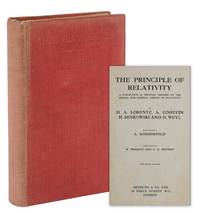
1923ref. 140949178London: Methuen & Co 1923. First Edition. Very Good. First British edition first printing. viii 216 8 ads pp. Bound in publisher's red cloth lettered in blind on front board and in gilt on spine; lacking the dust jacket. Very Good with fading light wear and soiling to covers. Evidence of bookplate removal to front pastedown offsetting to free endpapers rear hinge starting. Contents lightly toned with foxing to first and last few pages and textblock edges. An influential collection of eleven papers on relativity. Seven are authored by Einstein two by Henrik Lorentz and one each by Hermann Minkowski and Hermann Weyl. The first edition of this translation of Das Relativitaetsprinzip taken from the fourth German edition. Methuen & Co unknown books