Albert EINSTEINBiblio.com
1803 risultati
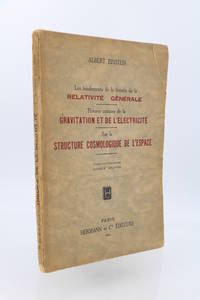
1933rif. 91965Paris: Hermann & Cie 1933. Fine. Hermann & Cie Paris 1933 16 x 25 cm Broché First edition of the French translation illustrated with a photographic portrait of Albert Einstein as frontispiece. A small loss at the foot of the spine which also shows rubbing along the joints upper right corner of the front board starting to come loose a slight marginal tear just below pleasant internal condition manuscript bookplate at the head of a flyleaf. Annotations and markings in red pen on pages 8 and 9. Work illustrated with figures in the text. Hermann & Cie unknown
1996rif. x-0805815368Lawrence Erlbaum Assoc Inc 1996. Hardcover. New. 1st edition. 440 pages. 9.50x6.50x1.25 inches. Lawrence Erlbaum Assoc Inc hardcover
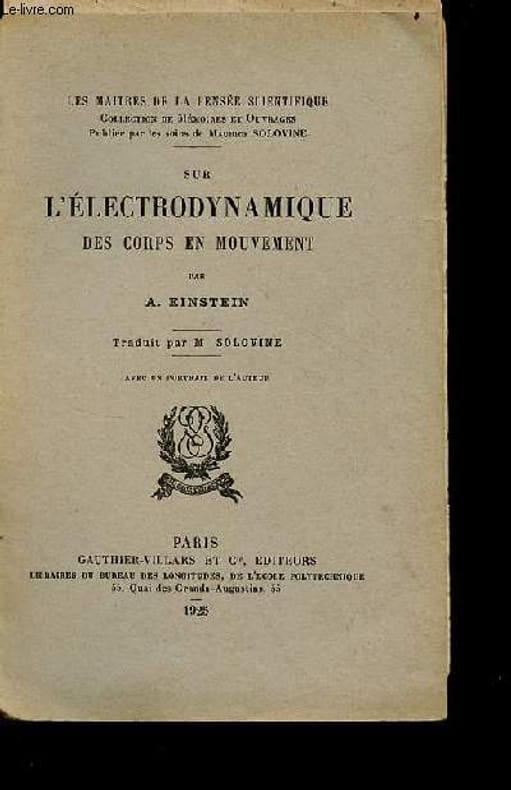
1925rif. R160222037Gauthier-villars et cie. 1925. In-12. Broché. Etat d'usage, 1er plat abîmé, Coiffe en pied abîmée, Papier jauni. 56 pages - portrait en noir et blanc de l'auteur en frontispice - coiffes abîmées - 1er plat désolidarisé - tampon sur la page de faux titre.. . . . Classification Dewey : 530-Physique
rif. 72535Braunschweig Friedrich Vierweg & Sohn; Berlin J. Springer 1924. 8vo 22.8 x 15.4 cm. 6 pp. Original printed wrappers. = On the theory of radiometer forces. "The Crookes radiometer also known as a light mill consists of an airtight glass bulb containing a partial vacuum with a set of vanes which are mounted on a spindle inside. The vanes rotate when exposed to light with faster rotation for more intense light providing a quantitative measurement of electromagnetic radiation intensity. The reason for the rotation was a cause of much scientific debate in the ten years following the invention of the device" Wikipedia. James Clerk Maxwell first gave a wrong then a correct explanation. However some subtleties still needed to be solved and in 1924 Albert Einstein had a crack at it "A partial explanation is that gas molecules hitting the warmer side of the vane will pick up some of the heat bouncing off the vane with increased speed. Giving the molecule this extra boost effectively means that a minute pressure is exerted on the vane. The imbalance of this effect between the warmer black side and the cooler silver side means the net pressure on the vane is equivalent to a push on the black side and as a result the vanes spin round with the black side trailing. The problem with this idea is that while the faster moving molecules produce more force they also do a better job of stopping other molecules from reaching the vane so the net force on the vane should be the same. The greater temperature causes a decrease in local density which results in the same force on both sides. Years after this explanation was dismissed Albert Einstein showed that the two pressures do not cancel out exactly at the edges of the vanes because of the temperature difference there. The force predicted by Einstein would be enough to move the vanes but not fast enough" Wikipedia. Contained first paper in: Zeitschrift für Physik volume 271. The complete issue in its original wrappers. Front wrapper slightly spotted at the fore and bottom edges. Volume number written on spine. A very good clean copy. Weil 139. unknown
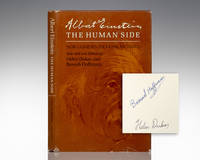
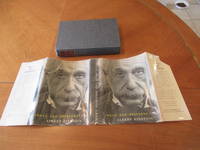
1979rif. 148235New Jersey: Princeton University Press 1979. First edition early printing of this curated collection of Einstein’s writings. Octavo original leather frontispiece. Boldly signed by Helen Dukas and Banesh Hoffman on the front free endpaper. Helen Dukas 1896–1982 was Albert Einstein’s longtime secretary and trusted confidante serving in that role from 1928 until his death in 1955. Deeply involved in preserving and organizing Einstein’s legacy she co-edited several collections of his writings and letters and played a key role in curating the Einstein Archives at the Institute for Advanced Study in Princeton. Banesh Hoffmann 1906–1986 was a physicist and mathematician who collaborated with Albert Einstein and made significant contributions to relativity and quantum mechanics. Near fine in a near fine price-clipped dust jacket. Uncommon signed by both contributors. Albert Einstein: The Human Side 1979 edited by Helen Dukas and Banesh Hoffmann offers a unique perspective on Einstein beyond his scientific achievements by compiling his personal letters reflections and anecdotes. Unlike traditional biographies that focus on his contributions to physics this collection highlights Einstein’s thoughts on philosophy politics ethics and personal relationships revealing his wit humility and deep moral convictions. Through carefully selected writings the book presents Einstein as both a brilliant scientist and a deeply introspective individual who grappled with the social and ethical implications of his work. Princeton University Press hardcover
1915rif. 14657Leipzig and Berlin: B.G. Teubner 1915. With frontispiece portrait of Minkowski and text figures. Boards spine and corners frayed and cracking. Sammelband containing the original papers on the special and general theories of relativity with a foreword by O. Blumenthal. It is in Minkowski's famous paper Raum und Zeit Space and time that he proposes the concept of time as the fourth dimension and initiates a mathematical study that became the basis of the later development of the theory. Included here is the re-issue of that work by Einstein and Lorentz with notes by A. Sommerfeld published after Minkowski's untimely death along with other papers by the two scientists whose works led to the abandonment of space and time as separate entities. Weil 59; see Printing & the Mind of Man 401. B.G. Teubner unknown
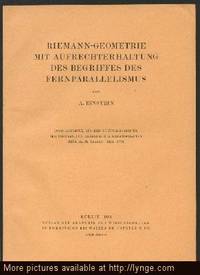
1928rif. 33903Berlin: Verlag der Akademie der Wissenschaften 1928. First Thus. Soft cover. First Thus. Soft cover. Einstein Albert 1879-1955. Riemann-Geometrie mit Aufrechterhaltung des Begriffes des Fernparallelismus. Berlin: Verlag der Akademie der Wissenschaften 1928. 4to. 7pp. Orange wrappers. A very fine copy of this uncommon offprint. First Edition; the rare off-print from the "Sitzungsberichten". 'The general relativity theory splendidly justified his work. In this mathematical apparatus developed from Riemann's address Einstein found the frame to fit his physicals ideas his cosmology and cosmogeny; and the spirit of Riemann's address was just what physics needed: the metric structure determined by physical data'. -cf. DSB XI 447-456 RiemannWeil No.161; Schilpp-Shields No. 217; Alicke No. 139. The early Offprints from "Sitzungsberichten." are called "Sonderabdruck" up to Weil No.165 including this. From Weil 166 they are called "Sonderausgabe.". - Before 161 up to 160 the Offprints do not have separate title and pagination the pagination follows the numbering in the periodical. From 166 the Offprint has both separate printed title and pagination. - So Weil Nos 161-165 is still "Abdruck" but with separate title and pagination. Verlag der Akademie der Wissenschaften unknown
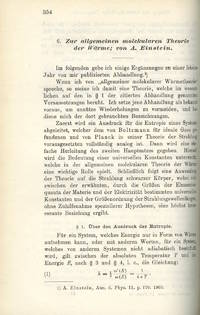
1904rif. 32820371Brown buckram. Library markings. FIRST EDITION of Einstein's fifth published paper "On the General Molecular Theory of Heat" pp. 354-362. Annalen der Physik
1915rif. 14657Leipzig and Berlin: B.G. Teubner 1915. With frontispiece portrait of Minkowski and text figures. Boards spine and corners frayed and cracking. Sammelband containing the original papers on the special and general theories of relativity with a foreword by O. Blumenthal. It is in Minkowski's famous paper Raum und Zeit Space and time that he proposes the concept of time as the fourth dimension and initiates a mathematical study that became the basis of the later development of the theory. Included here is the re-issue of that work by Einstein and Lorentz with notes by A. Sommerfeld published after Minkowski's untimely death along with other papers by the two scientists whose works led to the abandonment of space and time as separate entities. Weil 59; see Printing & the Mind of Man 401. B.G. Teubner unknown books
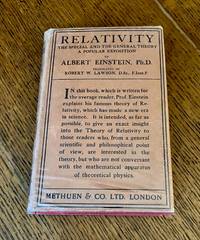
1939rif. 11847Methuen & Co. Ltd. London. 1939. TWELFTH ENGLISH EDITION. Octavo. 7.6 x 5.2 inches. Portrait frontis and five line diagrams within the text. A little foxing to the first couple of pages but overall a very good copy in the publishers red cloth with gilt lettering and ruled lines to the spine. Front board ruled and lettered in blind. Gilt stamped school coat of arms to the front panel and school prize label dated July 1939 on front pastedown endpaper. In the original dustwrapper which has some chipping to the edges but is generally clean and bright. ----- Contains a bibliography of selected works on Relativity. Methuen & Co. Ltd. London. 1939 hardcover
1954rif. 215859New York: Crown Publishers 1954. First Edition; First Printing. Hardcover. Very Good in boards. Crown Publishers hardcover
1921rif. 35419London: Methuen 1921. Fourth edition. Cloth bound in very good condition; Spine somewhat faded. Translation by Robert W. Lawson; Frontis portrait of the author and five diagrams; xiii 138 8 publisher's catalogue; Bookplate of Hugh Ripman. Methuen unknown
1954rif. 044237New York: Crown Publishers 1954. 1st Edition 1st Printing. Hardcover. Near Fine/Very Good. Vii 377 Pp. Grey Cloth Spine Lettered In Gilt On Maroon Background. First Edition 1954 First Printing No Statement Of Printing Dj Price Clipped But Exactly Same As First And Came With This Book Publisher's Address As 419 Fourth Avenue On Front And Rear Flaps. Book Near Fine Spine Edges Bumped No Marks. Dj Good Rubbing At Corners With Small Losses 2 1/2" Closed Tear At Bottom Of Front Spine Edge 3 1/2" Tear Across Top Left Corner Of Rear Panel 1 1/4" Closed Tear Bottom Of Rear Panel No Loss Of Lettering Slight Fading Of Yellow Lettering On Spine Panel. Crown Publishers hardcover
2019rif. x-0691655928Princeton Univ Pr 2019. Hardcover. New. 512 pages. 10.00x8.00x1.25 inches. Princeton Univ Pr hardcover
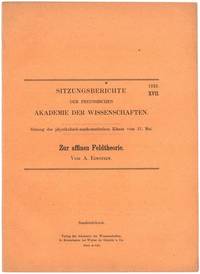
1923rif. 317401923. S.Ber. Akad. Wiss. Berl. 1923/ 8. - Berlin Verlag der Akademie der Wissenschaften 1923 8° 4 S. orig. Broschur. First edition. A fine fresh copy in the rare off-print form. Marked with an asterisk by Weil denoting a major paper. "Einstein's attempts to formulate a unified field theory stemmed from his dissatisfaction with the general relativity theory which did not adequately incorporate the electromagnetic field into the geometry of space-time. In 1918 Hermann Weyl had begun investigating the possibility of constructing a unified field theory preserving the dimensionality of space-time while formally altering its geometry making it a special case of the class known as affine geometries. Einstein's first investigation of Weyl's ideas published in the present paper introduced the notion of distant parallelism; however Einstein later rejected Weyl's theory." Weil No. 132; Schilpp--Shields No. 171; Alicke No.113; Norman Library 698; Boni 141 unknown
1928rif. 28361Berlin Gruyter & Co. 1928. 4to. Orig. printed orange wrappers. Offprint/Sonderabruck aus Sitzungsberichten.pp. 1-7. Fine fresh copy. First edition of the rare Offprint still called "Abdruck" but now having separate pagination and separate printed title see Weil No. 161 where this is not mentioned.The early Offprints from "Sitzungsberichten." are called "Sonderabdruck" up to Weil No.165 including this. From Weil 166 they are called "Sonderausgabe.". - Before 161 up to 160 the Offprints do not have separate title and pagination the pagination follows the numbering in the periodical. From 166 the Offprint has both separate printed title and pagination. - So Weil Nos 161-165 is still "Abdruck" but with separate title and pagination. These facts are not mentioned in the bibliographies. unknown
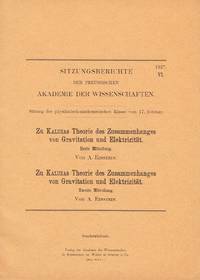
1419rif. 5735KBerlin: Verlag der Akademie der Wissenschaften in commission at Georg Reimer Reichsdruckerei 14th March 1927. Near Fine. Imperial 8vo 25 4: 18 2 cm. 8 pages numbered 23-30. Letterpress on machine paper in original publisher’s brochure on orange stock with black title printing. First offprint in the original wrappers of Einstein's paper on the important findings of German mathematician and physicist Theodor Kaluza about gravitation and electricity. - Content: Kaluza ""attempted to unify Einstein's theory of gravity with Maxwell's theory of light by mixing them in a fifth dimension"". Together with the Swedish theoretical physicist Oskar Klein Kaluza produced the „Kaluza-Klein field equations"" Calaprice Einstein Almanac 135. Their insights however were ""neglected for many years as attention was directed towards quantum mechanics. Their idea that fundamental forces can be explained by additional dimensions did not re-emerge until string theory was developed"" Wikipedia. - Condition: Mint. - Reference: Boni-Russ-L. 170; Schilpp-Shields 212; Weil 156. Verlag der Akademie der Wissenschaften (in commission at Georg Reimer [Reichsdruckerei]) unknown
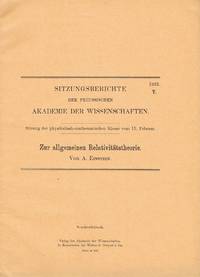
1923rif. 5729KBerlin: Verlag der Akademie der Wissenschaften in commission at Walter de Gruyter Reichsdruckerei 12th March 1923. Near Fine. Imperial 8vo 25 4: 18 2 cm. 8 pages numbered 34-38 1. Letterpress on machine paper in original publisher’s brochure on orange stock with black title printing. First offprint in the original wrappers. - Content: In this paper Einstein accepted that his introduction of the 'cosmological constant' in 1917 in order to allow for the possibility of a static universe may have been a mistake. - Condition: Very fine. - Rarity: ABPC 1973ff. and APO 1988ff. record 4 copies of this edition at auction 2012 2x 2011 1994. - Reference: Boni-Russ-L. 140; Schilpp-Shields 174; Weil 131. Verlag der Akademie der Wissenschaften (in commission at Walter de Gruyter [Reichsdruckerei]) unknown
1929rif. 5739K-2Berlin: Verlag der Akademie der Wissenschaften in commission at Georg Reimer Reichsdruckerei 30th January 1929. Near Fine. Imperial 8vo 25 4: 18 2 cm. 8 pages. Letterpress on machine paper in original publisher’s brochure on orange stock with black title printing. First offprint in the original wrappers of this important paper by Einstein formulating groundbreaking developments towards a unified field theory. - Content: »On The Unified Field Theory« is one of Einstein's last scientific core works. According to Weil ""This paper represents a new development which was immediate news. A translation by L. L. Whyte appeared in the London Times of Feb. 4 1929. It was quoted in full in ""Observatory"" vol. 52 under the title ""New Field Theory"" pp.82-87 and 1930 pp.11-118."" In 1928 Einstein embarked on a new approach to a unified field theory involving what he called „distant parallelism“. By early 1929 he had solved the main problems involved in writing down field equations for his unified field theory. On the day of offical publication of the third of a formidably technical series of 9 articles on the theory excited headlines appeared in newspapers around the world. - cf. Parkinson Breakthroughs p.279. - Condition State: Mint uncut thus unread. - The list of academy offprints on the rear side of the cover states present offprint not in last place. All offprints listed later were printed in 1929 though. The typeset of all pages is identical to other authentified offprints of this papers. This indicates that our copy is indeed a first offprint but presumably with a later cover. - Reference: Alicke 141; Boni-Russ-L. 183; Norman Collection I 700; Printing and the Mind of Man 416 „Principal Work“; Schilpp-Shields 226; Weil 165. Verlag der Akademie der Wissenschaften (in commission at Georg Reimer [Reichsdruckerei]) unknown
1913rif. 47060Leipzig, S. Hirzel, 1913. Royal8vo. Uncut, unopened in the original wrappers. In ""Physikalische Zeitschrift"", Vol. 14, 1913. Entire issue offered. Front wrapper detached and lower right corner is missing. Extremities with nicks, otherwise very fine and clean. Rare unopened. Pp. 1249-1266. Discussion"" Pp. 1262-66. [Entire volume: XXXI, (1), 1312 pp. + LVI plates].
1913rif. 47060Leipzig S. Hirzel 1913. Royal8vo. Uncut unopened in the original wrappers. In "Physikalische Zeitschrift" Vol. 14 1913. Entire issue offered. Front wrapper detached and lower right corner is missing. Extremities with nicks otherwise very fine and clean. Rare unopened. Pp. 1249-1266. Discussion; Pp. 1262-66. Entire volume: XXXI 1 1312 pp. LVI plates. First printing the famous address that Einstein gave on the occasion on the 85th Congress "Versammlung Deutscher Naturforscher und Aerzte zu Wien" in their meeting September 23 1913 together with the ensuing discussion. In it he compared the development of the various theories of gravitation with the development of successive concepts of electricity.Weil No. 54. unknown
1927rif. 433031927. Offprint from Sitzungsberichte der preussischen Akademie der Wissenschaften 1927. 235-245pp. 255 x 183 mm. Original printed wrappers. Fine. On the problem of motion in general relativity theory; a follow-up to his and Grommer's paper of the same title published earlier in 1927. Weil Albert Einstein Bibliography 160. unknown
1945rif. 1292Princeton: Princeton University Press 1945. Second edition first printing. 1945 LANDMARK SUMMARY OF NOBELIST ALBERT EINSTEIN'S THEORIES THAT ESTABLISHED MODERN PHYSICS--COPY OF NOBELIST CARLETON GAJDUSEK WHO DISCOVERED KURU THE FIRST PRION DISEASE. 8 inches tall hardcover gray cloth binding gilt title to spine decorative bookplate of D. Carleton Gajdusek to front paste-down signature of D. Carleton Gajdusek to front free endpaper vi 135 pp near fine in very good unclipped jacket with faint splash mark to cover light wear to spine ends and corners in protective mylar sleeve. This first printing of the second edition contains an appendix added by the author discussing advances in the theory of relativity since the first edition in 1921. ALBERT EINSTEIN 1879 – 1955 was a German-born theoretical physicist widely acknowledged to be one of the greatest and most influential physicists of all time. Einstein is best known for developing the theory of relativity but he also made important contributions to the development of the theory of quantum mechanics. Relativity and quantum mechanics are together the two pillars of modern physics. In 1922 he was awarded the 1921 Nobel Prize in Physics "for his services to Theoretical Physics and especially for his discovery of the law of the photoelectric effect". The Meaning of Relativity: Four Lectures Delivered at Princeton University May 1921 is a book published by Princeton University Press in 1922 that compiled the 1921 Stafford Little Lectures at Princeton University given by Albert Einstein. The lectures were translated into English by Edwin Plimpton Adams. The lectures and the subsequent book were Einstein's last attempt to provide a comprehensive overview of his theory of relativity and is his only book that provides an accessible overview of the physics and mathematics of general relativity. The book is made of four lectures. The first is titled "Space and Time in Pre-Relativity Physics". The second lecture is titled The Theory of Special Relativity and discusses the special theory of relativity. The third and fourth lectures cover the general theory of relativity in two parts. Einstein added an appendix to update the book for its second edition published in 1945 offered here. PROVENANCE: DANIEL CARLTON GAJDUSEK 1923-2008 was an American medical doctor and researcher who was co-recipient of the Nobel Prize in Physiology or Medicine in 1976 for his work in Kuru the first prion disease. Gajdusek graduated from Harvard Medical school at age 23 served as head of virological and neurological research at the National Institute for Health in 1958; and inducted into the National Academy of sciences in 1974. Gajdusek's best-known work focused on kuru. This disease was rampant among the South Fore people of New Guinea in the 1950s and 1960s. Gajdusek connected the spread of the disease to the practice of funerary cannibalism by the South Fore. With elimination of cannibalism kuru disappeared among the South Fore within a generation. He proved his hypothesis by successfully transmitting the disease to primates and demonstrating that it had an unusually long incubation period of several years. This was the first demonstration of the infectious spread of a noninflammatory degenerative disease in humans. Subsequently additional human agents belonging to the same group were discovered. They include sporadic familial and variant Creutzfeldt–Jakob disease. Gajdusek recognized that diseases like Kuru and Creutzfeldt–Jakob disease were caused by a new infectious agent that had not yet been identified. Princeton University Press hardcover
rif. 08777Np; 1923. First Edition. Fine. offprint from Sitzungsberichten der Presussichen Akademie der Wissenschaften Sitzung der physikalishch-mahematischen klasse vom 31 mai XVII. p. 137-140 bound in original orange printied wraps; quarto 254 x 184mm. Einstein's first investigation of Weyl's ideas published in the present work introduced the notion of distant parallelism; however Einstein later rejected Weyl's theory. Housed in a custom quarter-leather clamshell box. A fine copy. unknown
1927rif. 433031927. Offprint from Sitzungsberichte der preussischen Akademie der Wissenschaften 1927. 235-245pp. 255 x 183 mm. Original printed wrappers. Fine. On the problem of motion in general relativity theory; a follow-up to his and Grommer's paper of the same title published earlier in 1927. Weil Albert Einstein Bibliography 160. unknown books