Einstein A[lbert]Biblio.com

1900 risultati
1929rif. 17857Berlin: Verlag Der Akademie der Wissenschaften 1929. An important offprint first edition. With mathematical formulas in text. Small folio in the original orange off-print paper wrappers printed in black on both covers. 8 pp. Very fine nearly as new. A RARE AND IMPORTANT OFFPRINT. EINHEITLICHEN FELDTHEORIE which means "A Coherent Theory of the Electro-Magnetic Field" and is the title of a five-page paper of highest mathematical formulae which Relativist Albert Einstein worked on for ten years. His report is a purely mathematical extension of the general theory of relativity to include gravitational and electromagnetic phenomena. His relativity theory which he phrased within only three printed pages made time & space the creator of matter. When this paper on the Unified Field Theory was published it was a headline story in the newspapers. Few if any people understood the complex mathematics but many were fascinated by the thought that Einstein had possibly came up with a new theory expanding on "General Relativity" and unifying the fundamental forces of nature. It is considered Einstein's last important scientific work Weil #165. "In 1928 Einstein embarked on a new approach to a unified field theory. involving what he called 'distant parallelism'. By early 1929 he had solved the main problems involved in writing down field equations for his unified field theory. On the day of official publication of the third of a formidably technical series of nine articles on the theory. excited headlines appeared in foreign newspapers throughout the world. In this frenzied unscientific atmosphere Einstein's new theory was hailed in the press as an outstanding scientific advance. Yet Einstein had stated in his article that this was still tentative; and soon he found he had to abandon it" Hoffmann/Dukas ''Albert Einstein: Creator and Rebel'' 1972 pp. 225-226 Verlag Der Akademie der Wissenschaften unknown
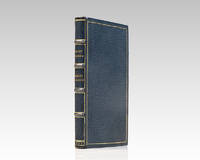
1931rif. 153158New York: The Macmillan Company 1931. First American edition of this volume of Einstein's speeches and letters concerning his views on Zionism. Octavo bound in full morocco by the Harcourt Bindery with gilt titles and tooling to the spine in five compartments within raised gilt bands gilt ruling to the front and rear panel gilt inner dentelles stamp-signed by the Harcourt Bindery marbled endpapers all edges gilt. In fine condition. Translated and edited with an introduction by Leon Simon. An exceptional presentation. Einstein was a prominent supporter of both Labor Zionism and efforts to encourage Jewish-Arab cooperation. He supported the creation of a Jewish national homeland in the British mandate of Palestine but was opposed to the idea of a Jewish state "with borders an army and a measure of temporal power." In a letter to Jawaharlal Nehru dated June 13 1947 he asserted "Long before the emergence of Hitler I made the cause of Zionism mine because through it I saw a means of correcting a flagrant wrong.The Jewish people alone has for centuries been in the anomalous position of being victimized and hounded as a people though bereft of all the rights and protections which even the smallest people normally has.Zionism offered the means of ending this discrimination." Einstein's speeches lectures and letters concerning Zionism were first published in 1930 by The Soncino Press and eleven of these essays were later collected in The World as I See It published in 1933 which Einstein dedicated "to the Jews of Germany". The Macmillan Company unknown
1907rif. 38817Leipzig J.A. Barth 1907. Contep. hcloth. Both hinges with a tear at upper part. "Annalen der Physik Vierte Folge. Band 23. Herausgegeben von W.Wien und M. Planck" VIII1000 pp. and 4 plates. Einstein's papers pp. 197-98 a. 206-209 a. 371-384. Internally fine and clean. The whole volume offered. All 3 papers in first edition. - The first paper "New possibility of testing the relativity principle" deals with the shift of canal rays in the Dobbler effect as a possible confirmation of the Principle of Relativity - the confirmation became actual only in 1938 when new improved instrumentation made it possible. - The second paper "remarks concerning Paul Ehrenfest's note: 'Translation of the deformable electron and the momentum law' Einstein gives his answer by relating it to his Theory of Relativity. - The third paper "The inertia of energy as demanded by the principle of relativity" which is a importen paper as it i is the first to state E=mc2 in its general form. general form. This new relation which was adumbrated already in his paper of 1906 Das prinzip von der Erhaltung der Schwerpunktsbewegung brings about the complete unification of mass and energy into a single concept. In natural units which make c=1 we have E=m i.e. mass and energy are one and the same quantity. Every form of energy also has a mass value just as every mass represents a definite amount of energy. - Weil Nos 1718 a. 19 hardcover
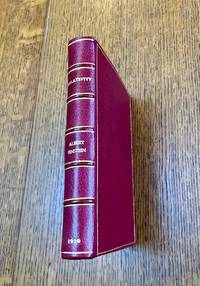
1920rif. 11566Methuen & Co. Ltd. London. 1920. FIRST ENGLISH EDITION. 8vo. 7.7 x 5.2 inches. Portrait frontis and five line diagrams within the text. Complete with the 8pp publishers adverts at back of book. Overall a clean bright copy in recent fine binding of full red morocco. Spine with raised bands compartments ruled decorated and lettered in gilt. Single gilt ruled border on boards. Top edge gilt others untrimmed with rough edges. ------ This important translation apart from being the first English edition also contains new text written by Einstein specially for this edition-- Appendix III The Experimental Confirmation of the General Theory of Relativity. Methuen & Co. Ltd. London. 1920 hardcover
1918rif. 74743The Laryngoscope Press. Very Good. Hardcover. FREE UPGRADE to Courier/Priority Shipping Upon Request - IN STOCK AND IMMEDIATELY AVAILABLE FOR SHIPMENT - AS NEW THE TEXT BLOCK IS PRISTINE CLEAN UNMARKED AND IN EXCELLENT CONDITION - - 14 128 56 viii 88 pp. 48 ills. 4to. -- with a bonus offer-- . 1918. The Laryngoscope Press hardcover
rif. 59014Crown Publishers. As New. Hardcover. FREE UPGRADE to Courier/Priority Shipping Upon Request – – IN STOCK AND IMMEDIATELY AVAILABLE FOR SHIPMENT - AS NEW THE TEXT BLOCK IS PRISTINE CLEAN UNMARKED AND IN EXCELLENT CONDITION - - ND; copyright 1961. 164 pages. -- with a bonus offer-- . N.D. Crown Publishers hardcover
1927rif. 32327Berlin: Verlag Bruno Cassirer. As New. Paperback. FREE UPGRADE to Courier/Priority Shipping Upon Request - IN STOCK AND IMMEDIATELY AVAILABLE FOR SHIPMENT - Pages 365 - 404 text of entire issue; in German. Many lovely black and white illustrations of the artist's works. Includes essays and commentary by Thomas Mann Heinrich Mann Th. Heine H. Woelfflin; A. Stix and many others. -- with a bonus offer--; T-Kulieber; Kunst Und Kunstler: Monatsschrift Fur Bildende Kunst & Kunstgewerbe; Luther Hans; Becker C. H.; Einstein A.; Friedlander M. J.; Et al Max Liebermann Kunst Und Kunstler: Monatsschrift Fur Bildende Kunst & Kunstgewerbe - Heft X; Jahrgang XXV / Max Liebermann Issue of Art & Artists a Monthly Review of the Arts Devoted to Liebermann essays and commentary by Thomas Mann Heinrich Mann Th. Heine H. Woelfflin; A. Stix and many Others . 1927. Verlag Bruno Cassirer paperback
rif. a94365Leipzig 1900 to 1913 first edition. Hirzel. 16 volumes. Vol 2 3 4 5 6 7 8 9 lacks volume 10 11 part I and II 12 pts I and II 13 pts I and II and 14 parts I and II. Matching bindings - Attractive dark green cloth on spine and tips with gilt spine trim and yellow orange and tan marbled boards. No owner marks. Text Fine clean and bright. No hinges cracked; no foxing no tears no chips no soiling. VG plus. Great looking set. Includes major work by Einstein Born Angstrom Hess Hahn Meitner Max Planck and many more. Impressive collection of 16 volumes of landmarks in modern physics - definitely would enhance any office or library. . hardcover
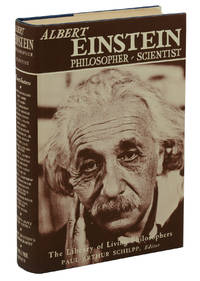
1949rif. 140941891Evanston IL: The Library of Living Philosophers Inc 1949. First Edition. Fine/Fine. First edition trade issue. xvi 781 pp. Bound in publisher's navy cloth with gilt spine lettering. Fine with offsetting to endpapers in a Fine dust jacket unfaded and unworn. A very sharp copy of a collectible volume all about the famous theoretical physicist. The Library of Living Philosophers, Inc unknown
1955rif. 9355New York: G. P. Putnam 1955. First Edition. Hardcover. Near fine/very good. Small octavo 168pp. A crisp clean copy near fine with a touch of pinpoint rubbing to the spine ends and corners. in a very good dust jacket with a few short tears and the spine sunned but no notable chips. This copy SIGNED by Willie Mays on the half-title page: "Best Wishes Willie Mays N. Y. Giants." On the same leaf is another seemingly later inscription which just reads "To J. B. Hennesey." This also looks to be in Mays's hand. We suppose that Hennesey owned this book which had been signed around the time of publication and he took it to a signing sometime later in the 1970s or 80s where he had it personalized by Mays. Mays wrote another autobiography in 1988 which is typically more easily obtainable. We could find no signed copies of this mid-career autobiography in auction records. Copies signed near the time of publication are decidedly uncommon. A significant Willie Mays autograph signed while Mays was still on the New York not San Francisco Giants. G. P. Putnam hardcover
rif. Z1-T-004-02093Charles C Thomas Pub Ltd. Used - Good. Ships from UK in 48 hours or less usually same day. Your purchase helps support Sri Lankan Children's Charity 'The Rainbow Centre'. Ex-library so some stamps and wear but in good overall condition. 100% money back guarantee. We are a world class secondhand bookstore based in Hertfordshire United Kingdom and specialize in high quality textbooks across an enormous variety of subjects. We aim to provide a vast range of textbooks rare and collectible books at a great price. Our donations to The Rainbow Centre have helped provide an education and a safe haven to hundreds of children who live in appalling conditions. We provide a 100% money back guarantee and are dedicated to providing our customers with the highest standards of service in the bookselling industry. Charles C Thomas Pub Ltd unknown
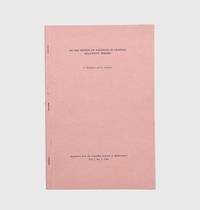
1949rif. 180348Ottowa: Canadian Mathematical Society 1949. Their final collaboration First edition offprint issue. Einstein and Infeld demonstrate that "field equations alone suffice as a basis for solving the problem of motion in general relativistic theory since the Einstein equations not only determine how particles must respond to gravitational forces but also contain the information necessary to describe those forces" Calaprice p. 323. Octavo pp. 34. Original orange wrappers wire-stitched as issued front cover lettered in black. Front wrapper lightly marked: a near-fine copy. Boni 259; Weil 223. Alice Calaprice An Einstein Encyclopedia 2015. unknown
1907rif. 53408Leibzig Johann Ambrosius Barth 1907. 8vo. Contemp. hcalf. Spine gilt and with gilt lettering. Slightly rubbed and light wear to spineends. In "Annalen der Physik" Vierte Folge Band 23. VIII1000 pp. a. 4 plates. The entire volume offered. Einstein's paper: pp.371-384. Stamps on titlepage Allgemeine Electricitäts-Gesellschaft a. AEG Forschungsinstitut. Internally clean. First edition of the first explicit statement of Einstein's energy-mass equation E=mc2.Nearly all descriptions of Einstein's scientific work state that the mass-energy equivalence E=mc2 was first formulated in Einstein's 1907 review paper 'Über das Relativitätsprinzip und die aus demselben gezogenen.' published in 'Jahrbuch der Radioaktivität und Elektronik' see Weil no. 21 and Dictionary of Scientific Biography vol. 4 pp.323 for examples. However in his paper 'Über die von Relativitätsprincip geforderte Trägheit der Energie' the offered paper which predates the former mentioned by six months Einstein gave a clear statement of the mass-energy equivalence E=mc2. See Lanczos: The Einstein Decade pp.149-150 and 153 as well as Volume 2 of 'The Collected Papers of Albert Einstein' pp. 428.Einstein's first paper regarding the relation E=mc2 is his fourth 1905 paper 'Ist die Trägheit eines Körpers von seinem Energieinhalt abhängig'. In this short paper Einstein showed that a body releasing the energy E in the form of radiation will have its mass decreased by E/c2 and concluded that the mass of a body is a measure of its energy content e.g. that all energy has mass. The next time Einstein returns to the subject is in his 1906 paper 'Das Prinzip von der Erhaltung der Schwerpunkts Bewegung und die Trägheit der Energie.'. Here Einstein concluded that one must either ascribe the inertial mass E/c2 to any form of energy E or else give up the fundamental law mechanics regarding conservation of the motion of the center of gravity. Then finally in the 1907 paper 'Über die von Relativitätsprincip geforderte Trägheit der Energie.' the offered paper Einstein makes the decisive step of assuming that all mass has energy. On page 382 Einstein considers the total energy of a moving mass point as the sum of its kinetic energy and its rest energy. In classical mechanics it is most convenient to set the second term to zero but in relativistic mechanics one obtains the simplest expression by setting the rest energy equal to mc2. Einstein then continues to show that this stipulation cannot lead to a contradiction in any relativistic argument. In a footnote on page 382 Einstein states for the first time the equation E=mc2 and mentions that this equation is the expression of the principle of the equivalence of mass and energy - see Volume 2 of 'The Collected Papers of Albert Einstein' pp. 428.The volume contains another paper by Einstein "Bemerkungen zu der Notiz von Hrn. Paul Ehrenfest: "Die Translation deformierbarer Elektronen und der Flächensatz"" pp.206-208. - Weil No. 18. Further with 2 importent papers by Max v. Laue.Collected Works Doc. 45. Weil 19. Boni 19. unknown
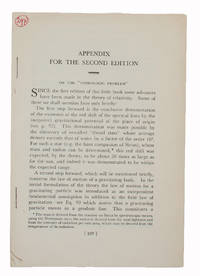
1950rif. 465431950. 8vo. Original proof-copy of the latest stage presumably final proof in the same format as the printed version and with no corrections printed on rectos and versos. Stapled twice in left margin. A few marginal creases. A proof- number to upper left corner in red ink 297. Pp. 109-148 tipped-in errata slip at p. 147. Very rare original proof-copy of the two highly important appendices for Einstein's "The Meaning of Relativity" third edition 1950 the second appendix being one of the most important pieces Einstein ever wrote namely the appendix "in which he described his most recent work on unification" Pais and the work which was hailed by The New York Times under the heading "New Einstein theory gives a master key to the universe". The first appendix which appeared for the second edition of the work remained unchanged throughout the history of "the Meaning of Relativity" and was written because "Since the first edition of this little book some advances have been made in the theory of relativity. . The first step forward is the conclusive demonstration of the existence of the red shift of the spectral lines by the negative gravitational potential of the place of origin" . A second step forward which will be mentioned briefly concerns the law of motion of a gravitating body." . A third step forward concerning the so-called "cosmologic problem" wiil be considered here in detail." pp. 109-10. The present 40 pages constitute the final proof-copy of the entire appendices I and II to the Generalized Theory of Gravitation exactly as they appeared in the third edition Princeton in 1950. Einstein's "The Meaning of Relativity" was originally published in 1922 on the basis of his "Vier Vorlesungen ueber Relativitetstheorie" given at Princeton in 1921. A second edition with an appendix appendix I appeared in 1945 several issues and editions of this appeared also and in 1949 the third edition with the seminal Appendix II printed for the first time appears also appeared in 1950 in Princeton. In 1950 a revised edition of the third edition appears having Appendix II slightly revised and in 1953 the heavily revised fourth edition appears. THIS IS THE PROOF-COPY OF APPENDICES I AND II FOR THE "THIRD EDITION INCLUDING THE GENERALIZED THEORY OF GRAVITATION" PRINCETON 1950. The main focus of the work throughout all these editions of the work since 1949 is Appendix II which deals with Einstein's main interest the generalization of the Gravitation Theory which was to unite the general theory of relativity with electromagnetism recovering an approximation for quantum theory and presenting us with a theory to explain the universe as a unified entity the ultimate goal for the greatest physicist that ever lived. "This was Einstein's ultimate response to the mechanical-electromagnetic crisis in physical theory he had first talked about in the opening of his 1905 light quantum-paper." Nandor in D.S.B. p. 330. It was indeed Einstein's aim to provide an explanation of the universe through his unified field theory although he was well aware that his sort of field theory might not exist. However even the establishing of the non-existence of it could bring us closer to an explanation than we had ever been before. There is no topic of greater importance to Einstein than his theory of unification. "In 1949 Einstein wrote a new appendix for the third edition of his "The Meaning of Relativity" in which he described his most recent work on unification. It was none of his doing that a page of his manuscript appeared on the front page of "The New York Times" under the heading "New Einstein theory gives a master key to the universe". He refused to see reporters and asked Helen Dukas to relay this message to them: "Come back and see me in twenty years"." Pais p. 350. unknown
1907rif. 50595Leibzig Johann Ambrosius Barth 1907. 8vo. In contemporary full cloth with gilt lettering to spine. In "Annalen der Physik" Vierte Folge Band 23. Entire volume offered. Ex-libris pasted on to top right corner of pasted down front free end-paper. Light rubbing to extremities a very fine and clean copy not an ex-library copy. Pp.371-384. Entire volume: VIII 1000 pp. 4 plates. First edition of the first explicit statement of Einstein's landmark energy-mass equation E=mc2.Nearly all descriptions of Einstein's scientific work state that the mass-energy equivalence E=mc2 was first formulated in Einstein's 1907 review paper 'Über das Relativitätsprinzip und die aus demselben gezogenen.' published in 'Jahrbuch der Radioaktivität und Elektronik' see Weil no. 21 and Dictionary of Scientific Biography vol. 4 pp.323 for examples. However in his paper 'Über die von Relativitätsprincip geforderte Trägheit der Energie' the offered paper which predates the former mentioned by six months Einstein gave a clear statement of the mass-energy equivalence E=mc2. See Lanczos: The Einstein Decade pp.149-150 and 153 as well as Volume 2 of 'The Collected Papers of Albert Einstein' pp. 428.Einstein's first paper regarding the relation E=mc2 is his fourth 1905 paper 'Ist die Trägheit eines Körpers von seinem Energieinhalt abhängig'. In this short paper Einstein showed that a body releasing the energy E in the form of radiation will have its mass decreased by E/c2 and concluded that the mass of a body is a measure of its energy content e.g. that all energy has mass. The next time Einstein returns to the subject is in his 1906 paper 'Das Prinzip von der Erhaltung der Schwerpunkts Bewegung und die Trägheit der Energie.'. Here Einstein concluded that one must either ascribe the inertial mass E/c2 to any form of energy E or else give up the fundamental law mechanics regarding conservation of the motion of the center of gravity. Then finally in the 1907 paper 'Über die von Relativitätsprincip geforderte Trägheit der Energie.' the offered paper Einstein makes the decisive step of assuming that all mass has energy. On page 382 Einstein considers the total energy of a moving mass point as the sum of its kinetic energy and its rest energy. In classical mechanics it is most convenient to set the second term to zero but in relativistic mechanics one obtains the simplest expression by setting the rest energy equal to mc2. Einstein then continues to show that this stipulation cannot lead to a contradiction in any relativistic argument. In a footnote on page 382 Einstein states for the first time the equation E=mc2 and mentions that this equation is the expression of the principle of the equivalence of mass and energy - see Volume 2 of 'The Collected Papers of Albert Einstein' pp. 428.The volume contains another paper by Einstein "Bemerkungen zu der Notiz von Hrn. Paul Ehrenfest: "Die Translation deformierbarer Elektronen und der Flächensatz"" pp.206-208. - Weil No. 18.Collected Works Doc. 45. Weil 19. Boni 19. hardcover
1907rif. 47457Leibzig Johann Ambrosius Barth 1907. 8vo. Contemp. hcalf. Spine gilt. Title-and tomelabels with gilt lettering. Slightly rubbed. In "Annalen der Physik" Vierte Folge Band 23. VIII1000 pp. a. 4 plates. The entire volume offered. Einstein's paper: pp.371-384. A small stamp on titlepage Gmelin.Institut. Internally clean and fine. First edition of the first explicit statement of Einstein's energy-mass equation E=mc2.Nearly all descriptions of Einstein's scientific work state that the mass-energy equivalence E=mc2 was first formulated in Einstein's 1907 review paper 'Über das Relativitätsprinzip und die aus demselben gezogenen.' published in 'Jahrbuch der Radioaktivität und Elektronik' see Weil no. 21 and Dictionary of Scientific Biography vol. 4 pp.323 for examples. However in his paper 'Über die von Relativitätsprincip geforderte Trägheit der Energie' the offered paper which predates the former mentioned by six months Einstein gave a clear statement of the mass-energy equivalence E=mc2. See Lanczos: The Einstein Decade pp.149-150 and 153 as well as Volume 2 of 'The Collected Papers of Albert Einstein' pp. 428.Einstein's first paper regarding the relation E=mc2 is his fourth 1905 paper 'Ist die Trägheit eines Körpers von seinem Energieinhalt abhängig'. In this short paper Einstein showed that a body releasing the energy E in the form of radiation will have its mass decreased by E/c2 and concluded that the mass of a body is a measure of its energy content e.g. that all energy has mass. The next time Einstein returns to the subject is in his 1906 paper 'Das Prinzip von der Erhaltung der Schwerpunkts Bewegung und die Trägheit der Energie.'. Here Einstein concluded that one must either ascribe the inertial mass E/c2 to any form of energy E or else give up the fundamental law mechanics regarding conservation of the motion of the center of gravity. Then finally in the 1907 paper 'Über die von Relativitätsprincip geforderte Trägheit der Energie.' the offered paper Einstein makes the decisive step of assuming that all mass has energy. On page 382 Einstein considers the total energy of a moving mass point as the sum of its kinetic energy and its rest energy. In classical mechanics it is most convenient to set the second term to zero but in relativistic mechanics one obtains the simplest expression by setting the rest energy equal to mc2. Einstein then continues to show that this stipulation cannot lead to a contradiction in any relativistic argument. In a footnote on page 382 Einstein states for the first time the equation E=mc2 and mentions that this equation is the expression of the principle of the equivalence of mass and energy - see Volume 2 of 'The Collected Papers of Albert Einstein' pp. 428.The volume contains another paper by Einstein "Bemerkungen zu der Notiz von Hrn. Paul Ehrenfest: "Die Translation deformierbarer Elektronen und der Flächensatz"" pp.206-208. - Weil No. 18.Collected Works Doc. 45. Weil 19. Boni 19. unknown
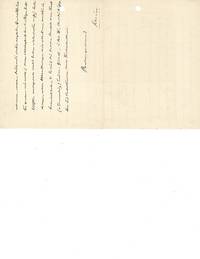
1918rif. 135751918. Mathematics Klein Felix. Autograph Letter Signed 10 November 1918 written in German to a former student and colleague directly references Einstein's recently published General Theory of Relativity and comments on the work of the International Mathematical Education Commission. Composed in the closing days of the First World War the letter places Klein within active scholarly exchange concerning the mathematical implications of relativity which had been formally presented in 1915 and widely disseminated by 1918. Klein long established for his foundational contributions to group theory non-Euclidean geometry and mathematical physics addresses questions raised by "Einstein's theory" noting that he required further reflection to clarify its implications for his own work. The document supports research in the history of relativity German mathematical networks scientific communication during wartime and the institutional organization of mathematics in the early twentieth century. Klein Felix. Autograph Letter Signed 10 November 1918. Two pages written on both sides of a single leaf. In German with accompanying English translation. Addressed to a former student the letter discusses the circulation of lecture manuscripts difficulties in securing copyists during wartime conditions and the intellectual demands posed by Einstein's theory: "A further exploration of my work does not exist yet as I had and still have more thinking to do about questions raised by Einstein's theory to clarify it for myself." Klein also comments critically on the IMUK observing that its published statements are "a display of wasted paper" while acknowledging the commission's broader social significance. He singles out contemporary educational treatises including studies by W. Trost Heinrich Emil Timerding and M. Girndt indicating his sustained engagement with mathematical pedagogy alongside theoretical research. The letter was written days before the November Revolution in Germany and at a moment when academic institutions faced political upheaval and material shortages. Klein's remarks regarding limited copyists and uncertainty about the coming months provide contemporaneous evidence of scholarly life under strained postwar conditions. His reference to Einstein situates the correspondence within the earliest phase of professional reception of general relativity among leading mathematicians while his comments on the International Mathematical Education Commission underscore his longstanding commitment to mathematical instruction and institutional reform. Clean and well preserved with strong legibility and a clear signature. Overall near fine condition. A substantive document of early relativity discourse and mathematical research at the end of the First World War. unknown
1922rif. 34667Berlin Julius Springer 1922-24. 8vo. In: "Zeitschrift für Physik" Vol. 10 pp. 377 ff.Vol.11 pp.326 vol.16 pp.228 vol.21 pp.326-332. The entire four volumes offered here. Contemporary half cloth bindings. Two landmark papers in the history of cosmology: All first editions. In 'Über die Krümmung des Raumes' Friedman derived the non-stationary solutions to Einstein's field equations. Einstein quickly responded in a short comment 'Bemerkung' in which he expressed his suspicion of such a model of the Universe and apparently pointed out an error in Friedman's calculations. However Friedman now wrote a letter to Einstein in which he enclosed his full calculations. Shortly after this Einstein submitted a short notice Notiz in which he admitted that he himself had performed a calculation error and that Friedman's solutions which shed new light on the matter were valid. Friedman's expanding universe model was corroborated by Edwin Hubble's red-shift observations in 1929. In 'Über die Möglichkeit einer Welt mit konstanter negativer Krümmung des Raumes' Friedman derived the Friedman-equations and demonstrated that he had command of all three Friedman-models describing positive zero and negative curvature respectively nearly a decade before the independent discoveries of the same models by Lemaître Robertson and Walker. hardcover
1922rif. 49429Berlin Julius Springer 1922-24. 8vo. 4 contemporary half cloth binding: two in uniform half green cloth and two en uniform grey/blue half cloth. In "Zeitschrift für Physik" Bd. 10 11 16 & 21. Entire volumes offered. All volumes with stamp to title page and front free end paper otherwise a fine and clean set. Friedmann: Bd. 10: Pp. 377-386; Bd. 21: P.p. 326-332. Einstein: Bd. 11:P. 326; Bd. 16: P. 228. First printing of these four landmark paper in which Friedman "introduced into cosmology two concepts of revolutionary importance the age og the world and the creation of the world" Kragh Cosmology and Controversy. "In his paper of 1922 Friedmann offered a complete analysis of the solutions of Einstein's cosmological field equations that went beyond the earlier solutions of Einstein and de Sitter as it also included nonstatic solutions. Friedmann did so clearly and explicitly: "The purpose of this note" he wrote "is firstly to show that the cylindrical Einsteinand spherical de Sitter worlds are special cases of more general assumptions and secondly to demonstrate the possibility of a world in which the curvature of space is independent of the three spatial coordinates but does on time".Ibid.In 'Über die Krümmung des Raumes' Friedman derived the non-stationary solutions to Einstein's field equations. Einstein quickly responded in a short comment 'Bemerkung' in which he expressed his suspicion of such a model of the Universe and apparently pointed out an error in Friedman's calculations. However Friedman now wrote a letter to Einstein in which he enclosed his full calculations. Shortly after this Einstein submitted a short notice Notiz in which he admitted that he himself had performed a calculation error and that Friedman's solutions which shed new light on the matter were valid. Friedman's expanding universe model was corroborated by Edwin Hubble's red-shift observations in 1929. In 'Über die Möglichkeit einer Welt mit konstanter negativer Krümmung des Raumes' Friedman derived the Friedman-equations and demonstrated that he had command of all three Friedman-models describing positive zero and negative curvature respectively nearly a decade before the independent discoveries of the same models by Lemaître Robertson and Walker. "Friedmann made a valuable contribution to Einstein's general theory of relativity. As always his interest was not limited simply to familiarizing himself with this new field of science but led to his own remarkable investigations. Friedmann's work on the theory of relativity dealt with one of its most difficult questions the cosmological problem. In his paper "Über die Krümmung des Raumes" 1922 he outlined the fundamental ideas of his cosmology: the supposition concerning the homogeneity of the distribution of matter in space and the consequent homogence of "world" time for which at any moment in time the metrics of space will be identical at all points and in all directions. This theory is especially important because it leads to a sufficiently correct explanation of the fundamental phenomenon known as the "red shift." This solution of the Einstein field equations obtained from the above propositions is the model for any homogeneous and isotropic cosmological theory. It is interesting to note that Einstein thought that the cosmological solution to the equations of a field had to be static and had to lead to a closed model of the universe. Friedmann discarded both conditions and arrived at an independent solution. Einstein welcomed Friedmann's results because they showed the dispensability of the ad hoc cosmological term Einstein had been forced to introduce into the basic field equation of general relativity". DSB. Weil 122 & 130. hardcover
1950rif. 32820550This photograph shows a reunion of friends. The Sternbergers and Einstein had known one other in Europe and met again in Princeton. Ilse was Sternberger's wife collaborator and perennial foil. She was a constant source of warmth during sometimes-contentious sittings. She also helped document their life publishing several articles on Sternberger's work and their sessions with famous sitters after his death. Gelatin silver print 20 x 30 in. Archivally framed. Estate Edition a limited edition of 10 copies embossed and numbered. $2500 unframed; framed: $3000
1917rif. 19286Leipzig: S. Hirzel 1917. FIRST EDITION. Contemporary half cloth and marbled boards preserved in a morocco slipcase. An excellent clean copy. First edition of this classic work on the quantum theory of radiation by Einstein in which he predicts the existence of the phenomenon of stimulated emission of radiation. He here analyzes the properties of photons and demonsrtrtes that Planck’s law is directly deducible from quantum theory and the concept of transition probabilities. Four decades later MASER and LASER devices are operated to prove him right. Boni 95; Weil 91. S. Hirzel unknown
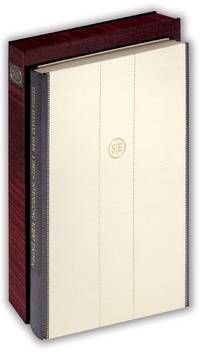
rif. 35452Rockport ME: Two Ponds Press 2015. Fine. Number 35 of 75 copies signed and numbered by Joseph Goldyne. Joseph Goldyne was born in 1942 in Chicago IL. He came to prominence as an artist on the West Coast. He has been credited as one of the artists responsible for the rebirth of monotype and monoprint as valuable approaches to art. He is also known for his artist's books often done in collaboration with printer Peter Rutledge Koch. From the Prospectus: "Joseph Goldyne brought this project to our attention and the Press was convinced that this little-known oratory by George Bernard Shaw deserved wider recognition one that Goldyne thought a most unexpectedly wondrous and humorous introduction to Albert Einstein perhaps the most transformative and towering figure of the twentieth century. Goldyne's own introduction " An Introduction to an Introduction" speaks to his discovery of Shaw's speech its presentation Shaw's record of condemning anti-Semitism and his public support for Einstein. The full text of Shaw's speech is reprinted together with Einstein's response delivered in German and printed here in English translation. Goldyne illustrates the volume with five drypoint etchings created especially for this publication. They pay tribute to the featured speakers as well as to the sense of the event." Beautifully bound in cream paper covered boards with gilt dotted rulings and ornament on front cover of circle with initials "SE" in its center. Gray leather spine and trim along front edges with gilt titling on spine. Printed in Monotype Bembo and Gill Sans types on paper handmade at the Velké Losiny mill in the Czech Republic. Letterpress printing by Arthur Larson at Horton Tank Graphics with additional hand composition by Rose Ku'ulealoha Wisotzky. Design and typography planned by Michael Russem Housed in a slipcase covered in dark red cloth with "SE" symbol on spine. Accompanied by prospectus. A lovely book in fine condition. Measures 6.5 x 10 inches. 39 pages. PRI/112321. Two Ponds Press unknown
1923rif. 4609Praze Prague: Fr. Borový 1923 1923. First and only edition of the Czech translation of Einstein's Über die spezielle und die allgemeine Relativitätstheorie first published in German in 1916 with the English translation appearing in 1920. It was intended by Einstein as a brief popular introduction to his theory of relativity. This Czech edition has a special preface by Einstein written for this translation. Einstein worked in Prague for seventeen months in 1911-12 and retained a fondness for the city. 8vo. 210x135mmpp. 103 21bl. Original Blue card wrappers with striking design. Some toning and creasing to edges of wrappers but otherwise in very good condition and excellent internally. Title page has ownership inscription of Robert Knuwehil . This Czech translation is rare OCLC recording only five copies worldwide. Praze [Prague]: Fr. Borový, 1923 unknown
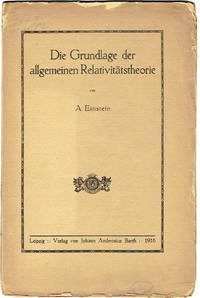
1619rif. 5711KLeipzig: Johann Ambrosius Barth Omnitypie-Ges. Nachfl. L. Zechnall Stuttgart; Metzger & Wittig Leipzig Wrappers 1916 but c. 1919. Near Fine. 8vo. 16: 24 3 cm. 64 pages. Letterpress on machine paper in original publisher’s wrappers on cream stock with black title printing on covers and spine incorporating publisher's emblem and ornamental framing on front cover as well as publisher's advertisements on rear cover. Particularly rare early anastatic reprint of the first separate edition of Einstein's first and most important synopsis of his general theory of relativity. – Edition Contents: „In mid-January 1916 Einstein had still expressed doubts about his ability to write such a paper calling his writings ""correct but quite indigestible"" ""zwar richtig aber reichlich unverdaulich."" Einstein to H. A. Lorentz 17 January 1916“. But a „few months after the final papers had appeared 4 papers of Nov. and Dec. 1915 where he finally had completed the theory of general relativity as a logical structure note WoP Einstein was ready to spend some time writing a review paper in which the whole theory was presented and explained in a consistent and accessible way . It gives an excellent overview of the theory.“ cf. Einstein Papers. For present synopsis Einstein also made substantial additions published here for the first time. „Einstein’s paper of March 1916 concludes with a brief section on the three new predictions: the red shift the bending of light and the precession of the perihelion of Mercury. In the final paragraph of that section is recorded the single major experimental confirmation which at that time could be claimed for the theory: the Mercury anomaly. In 1916 next to nothing was known about the red shift; the bending of light was first observed in 1919.“ cf. Paise – The paper was first printed on May 11th 1916 in the special interest journal »Annalen der Physik« series 4 vol. XLIX issue no. 7 pp. 769-822 and probably simultaneously as separate printing in book form by the Leipzig editor Barth titled »Sonderdruck« enlarged with an introduction by Einstein and a table of content. Edited in this way and therefore more accessible for a broader audience of interested lay people the Barth book edition of Einstein's probably most important achievement in the history of science became popular and was reprinted several times until 1929. According to Weil present first reprint from 1919 is of better printing quality than others and is bound in the original paper wrappers of the 1916 edition with an updated publisher's ads list of 5 available titles appearing between 1911 and 1918. – Condition: Former faults and tears at margins of front and rear cover skilfully restored front cover with shelf wear paper time-stained otherwise clean copy. – Rarity: Scarce in trade. RHB ABPC 1973ff. and JBP/JAP/APO record 4 copies of this particular reprint in the original wrappers and comparable condition at auction 2016 2014 former copy of Karl Malmkvist 2006 2004. – Reference: Boni N.: A bibliographical checklist and index to the published writings of Albert Einstein 78 for the journals issue 78.1 for the separate edition; Carter/Muir Bücher die die Welt verändern 725; Norman 696 for the journal issue; Shields M. C.: Bibliography der Schriften Einsteins. In: Schilpp P. A.: Albert Einstein als Philosoph und Naturforscher 84 for the separate edition 86 for the journal issue; The Collected Papers of Albert Einstein. Volume 6 30 cit. p. XIX and p. 238 fn 1; Weil E.: Albert Einstein. A bibliography of his scientific papers 1901-1930 80a; Pais A.: Subtle is the Lord. The Science and Life of Albert Einstein 2005 ed. p. 273; Sauer T. „Albert Einstein review paper on general relativity theory“. In: Grattan-Guinness I. et al. ed.: Landmark Writings in Western Mathematics 2015 pp. 802-22. Johann Ambrosius Barth (Omnitypie-Ges., Nachfl. L. Zechnall, Stuttgart; Metzger & Wittig, Leipzig [Wrappers]) unknown
1911rif. 432921911. Einstein Albert 1879-1955. Berichtigung zu meiner Arbeit: "Eine neue Bestimmung der Moleküldimensionen." Offprint from Annalen der Physik 34 1911. 591-592pp. 224 x 146 mm. Original printed wrappers a little chipped splint in lower spine. Light toning but very good. First Edition Offprint Issue. Einstein's correction to his formula for the viscosity coefficient = 1 a key equation in his 1905 doctoral thesis in which he had presented a new theoretical method for determining molecular radii and Avogadro's number. In 1910 Jacques Bacelin a pupil of French physicist Jean-Baptiste Perrin obtained experimental results indicating a possible error in Einstein's formula. "That prompted Einstein after an unsuccessful attempt to find an error to ask his student and collaborator Ludwig Hopf to check his calculations and arguments . . . Hopf did find an error in the dissertation namely in the derivatives of some velocity components and obtained for a corrected coefficient 2.5 . . .In early 1911 Einstein submitted his correction for publication and recalculated Avogadro's number. He obtained a value of 6.56 x 10²³ per mole a value that is close to those derived from kinetic theory and Planck's black-body radiation theory" Duplantier pp. 216-217. Duplantier "Brownian motion 'diverse and undulating'" in Einstein 1905-2005: Poincaré Seminar 2005 pp. 201-293. Pais Subtle is the Lord p. 92. Weil Albert Einstein Bibliography 41. . unknown