2 375 résultats
1949réf. 140941460Evanston IL: The Library of Living Philosophers Inc 1949. First Edition; Signed Limited Issue. Near Fine. First edition signed limited issue; copy #362 of a 760 signed by Albert Einstein. Bound in publisher's brown morocco-grain cloth over bevel-edged boards stamped in gilt. Near Fine with slight darkening to spine and trivial rubbing to crown. Endsheets faintly browned. In a Near Fine publisher's original slipcase with light sunning and wear at edges. A fantastic copy signed by the iconic physicist whose name in synonymous with genius. The Library of Living Philosophers, Inc unknown books
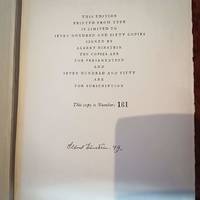
1949réf. 250705Evanston: Library Of Living Philosophers 1949. First Limited edition. Hardcover. fine /no glassine. Karsh frontis photos facs. Octavo publisher's green cloth bevelled edges in a custom-made clamshell cloth box with morocco spine labels Numbered copy 161 of only 760 numbered copies. Autographed: "Albert Einstein 49." Contains Einstein's own "Autobiographical Notes bi-lingual text German & English" and "Remarks to the Essays Appearing in this Collective Volume". Includes a Bibliography of Einstein's writings to 1949. At least 6 of the 25 contributors to this volume were awarded the Nobel Prize in Science. The contributors include Niels Bohr "Discussion with Einstein on Epistemological Problems in Atomic Physics" Kurt Godel F.S.C. Northrop Wolfgang Pauli etc. Illustrated with Yousuf Karsh's frontispiece portrait of Einstein photos facsimiles. Boni BIBLIOGRAPHICAL CHECKLIST 512. Library Of Living Philosophers hardcover
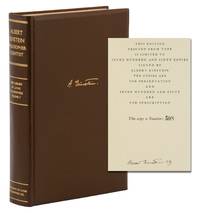
1949réf. 140948474Evanston Illinois: The Library of Living Philosophers Inc 1949. Signed Limited First Edition. Near Fine. First edition. Number 508 of a limited 760 copies signed and dated by Albert Einstein. 777 pp. Bound in publisher's brown leatherette stamped in gilt; top edge gilt; lacking the glassine dust jacket and slipcase. Text in English and German. Near Fine with very faint tidemark to edge of half-title frontisportrait and title page. A collection of critical essays devoted to the theoretical physicist by twenty-five eminent scholars and scientists with Einstein's remarks. Published on Einstein's 70th birthday the work has contributions by noted contemporaries such as Max Born Kurt Godel and Wolfgang Pauli. The Library of Living Philosophers, Inc unknown
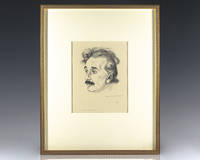
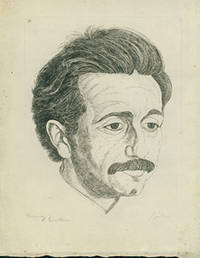
1923réf. 1272041923. Lithograph portrait of "the father of modern physics" Albert Einstein by well-known artist Hermann Struck. Signed by Einstein "Albert Einstein 1923" and Struck "Herman Struck 138/150". In fine condition. Matted and framed the entire piece measures 19.75 inches by 15.5 inches. An exceptional piece. Hermann Struck was a German Jewish artist known for his etchings. In 1908 Struck published "Die Kunst des Radierens" "The Art of Etching" which became a seminal work on the subject. His students included Marc Chagall Lovis Corinth Jacob Steinhardt Lesser Ury and Max Liebermann. Struck did commissioned portraits of Albert Einstein Ibsen Nietzsche Freud Herzl Oscar Wilde among others. unknown
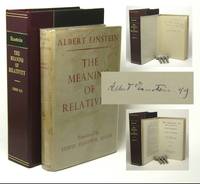
1924réf. 33984London: Methuen & Co. Ltd 1924. Second Edition. Second Edition. Signed by Author. SIGNED Copy. The uncommon second UK edition. 8vo. 123pp. A near fine copy in a very good or better dustwrapper showing a few small chips at the extremities. Nicely signed by Einstein on the front free endpaper in blue fountain pen in full: "Albert Einstein. 1949". Neat prize inscription dated 1942 Liverpool University just above the signature. Very rarely seen signed. Weil 124a for the 1st edition - no mention of the 1924 2nd. Custom slipcase in fine condition. Methuen & Co. Ltd unknown
1930réf. 90431New York: Albert & Charles Boni 1930. First edition of this Einstein biography written by Rudolf Kayser a German literary historian and husband to Albert Einstein's stepdaughter Ilse under the pseudonym Anton Reiser. Octavo original cloth frontispiece of Einstein. Inscribed by Albert Einstein with an original poem on the front free endpaper in German which translates as "It is a curious fate to be objectified alive. Think with humor while reading. A. Einstein." From the library of Alexandre and Catherine Barjansky with her ownership signature to the verso of the front panel and notation below Einstein's inscription "S.S. 'Belgenland' New-York 14/XII/30." Russian sculptress Catherine Barjansky her celebrated cellist husband and Einstein were all close friends of King Albert I and Queen Elisabeth of Belgium. Barjansky described her experiences creating the now famed and very intimate sculptural portraits of Elizabeth and Albert in her 1947 joint memoir with her husband Portraits with Backgrounds. Catherine had an international career living at times in Rome Berlin New York Vienna Paris and Brussels. Einstein was in New York at the time he inscribed the present volume having arrived aboard the Belgenland three days earlier. Einstein travelled aboard the Belgenland several times. He was on the ship in March 1933 intending to return home to Germany when he learned the alarming news that the Nazis had ransacked his summer cottage in Caputh. He soon decided it was too dangerous to return to Germany and when the ship docked in Antwerp Belgium he immediately reported to the German consulate in Brussels where he turned in his German passport and renounced his citizenship. Einstein returned to America in October beginning a new life as a member of the faculty of Princeton University's Institute for Advanced Study. In near fine condition. A complex and desirable association. Albert Einstein developed the general theory of relativity one of the two pillars of modern physics alongside quantum mechanics. Einstein's work is also known for its influence on the philosophy of science. Einstein is best known in popular culture for his mass-energy equivalence formula E = mc2 which has been dubbed "the world's most famous equation". He received the 1921 Nobel Prize in Physics for his "services to theoretical physics" in particular his discovery of the law of the photoelectric effect a pivotal step in the evolution of quantum theory David Bodanis. Albert & Charles Boni hardcover books
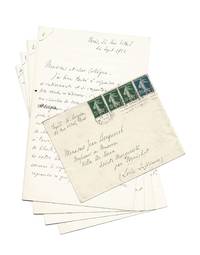
1922réf. Bergson2EINSTEIN BERGSON Henri 1859-1941 Autograph letter signed " Henri Bergson " to Jean Becquerel Paris 24 September 1922 16 pages in-8° with envelope Some typographic pencil notes A highly significant letter on the issues and interpretation of the theory of relativity This intervention of the philosopher continues up to this day to create multiple controversies We transcribe here only a few fragments of this letter which although known in its substance has remained unpublished to this day " Monsieur et cher collègue J'ai bien tardé à répondre à la lettre si intéressante et si importante que vous avez bien voulu m'adresser. C'est qu'elle est allée me chercher de divers côtés et m'a atteint en Suisse à un moment où j'étais pris à Genève par le travail de " Coopération intellectuelle " qui nous avait été confié par la Société des nations. Me voici de retour à Paris ; je profite de mes premiers instants de liberté pour vous écrire. Le passage essentiel de votre lettre est naturellement celui qui concerne le voyage en boulet. Laissez-moi reprendre ce que j'ai dit dans mon livre Durée et simultanéité paru à l'été 1922 en y joignant quelques explications complémentaires. Il y a d'abord deux remarques importantes à faire. 1° Si l'on se place en dehors de la Théorie de la Relativité on conçoit un mouvement absolu et par là même une immobilité absolue ; il y aura dans l'univers des systèmes réellement immobiles. Mais si l'on pose que tout mouvement est relatif que devient l'immobilité Ce sera l'état du système de référence je veux dire du système où le physicien se suppose placé à l'intérieur duquel il se voit prenant des mesures et auquel il rapporte tous les points de l'univers. … 2° Si l'on se place en dehors de la Théorie de la Relativité on conçoit très bien un personnage Pierre absolument immobile au point A à côté d'un canon absolument immobile ; on conçoit aussi un personnage Paul intérieur à un boulet qui est lancé loin de Pierre se mouvant en ligne droite d'un mouvement uniforme absolu vers le point B et revenant ensuite en ligne droite et d'un mouvement uniforme absolu encore au point A. Mais du point de vue de la Théorie de la Relativité il n'y a plus de mouvement absolu ni d'immobilité absolue … Paul une fois lancé dans l'espace n'est plus qu'une représentation de l'esprit une image — ce que j'ai appelé un " fantôme " ou encore une " marionnette vide ". C'est ce Paul en route ni vivant ni conscient n'existant plus que comme image qui est dans un Temps plus lent que celui de Pierre. … Le Paul qui sort du boulet au retour du voyage le Paul qui fait de nouveau partie alors du système de Pierre est quelque chose comme un personnage qui sortirait en chair et en os de la toile où il était représenté en peinture : c'était à la peinture et non pas au personnage c'était à Paul référé et non pas à Paul référant que s'appliquaient les raisonnements et les calculs de Pierre pendant que Paul était en voyage. … Je ne voudrais pas clore sans saisir l'occasion qui s'offre à moi de vous dire combien m'a intéressé et instruit votre beau livre sur " Le principe de relativité " et la " Théorie de la gravitation " – livre indispensable à tous ceux qui ont le souci d'approfondir la théorie d'Einstein. Veuillez Monsieur et cher collègue agréer l'expression de mes sentiments les plus distingués et dévoués H. Bergson " In publishing Durée et simultanéité published by Alcan in the summer of 1922 Bergson was taking a risk that he probably did not measure himself. The purpose of this essay was to discuss the philosophical issues of the theory of relativity. The criticism of his scientific colleagues was not long in coming. Those of Einstein in the first place deploring the "blunders" or "dumplings" of the philosopher. In France it was Jean Becquerel who opened fire with a letter addressed directly to the author and of which this document constitutes the reply. At the time Becquerel held a chair of applied physics at the Museum of Natural History. He wrote a textbook entitled Le Principe de relativité et la théorie de la gravitation Gauthier-Villars 1922 which made him one of the first introducers of Einsteinian theory in the French context. Two sources give an idea of the content of Becrerel's letter: his article published the following year "Critique de l'ouvrage durée et Simultaneity de M. Bergson" Bulletin scientifique des étudiants de Paris 10 2 March-April 1923 and the extract given by Bergson himself in the first of three appendices added to the 1923 edition of Durée et simultanéité – appendix which also contains with a few lines the entirety of his answer. Bergson then chose to preserve the anonymity of his correspondent in order to avoid giving the impression of a "polemic" according to the interview of December 30 1923 with Jacques Chevalier. He merely evokes "a letter very interesting which was addressed to us by a most distinguished physicist." The discussion crystallizes on a specific point: the interpretation of the slowdown of moving clocks predicted by the theory. The famous "twin paradox" attributed to Paul Langevin provides a pictorial version of the problem as part of a Jules Verne-style narrative: an astronaut here "Paul" embarked on a "ball journey" would find himself on his return younger than his twin brother who remained on Earth here "Pierre" as if time had passed less quickly for him! In his letter Becquerel insists on the fact that the theory of relativity speaks of time actually measured on both sides by observers in relative motion. Bergson repeats by clarifying it the argument developed in his book namely that the differences relate less to real times than to fictitious times that is to say times attributed to other observers who acquire at the same time the status of simple images or "ghosts". Thus the "dilation" of durations associated with the slowing down of moving clocks is only a "perspective effect". Bergson is led to this conclusion by a strict interpretation of the principle of relativity: between two observers in relative motion there is a "perfect symmetry" each can consider itself motionless or mobile with respect to the other. Multiple empirical confirmations have since objectively proved the philosopher wrong but the question of the status of time in relativity as well as that of the relevance of the arguments exchanged continues to fuel contemporary philosophical debates. In that sense that letter constitutes a key part of the case. We thank Mr. Elie During for the information he kindly communicated to us
1910réf. 83637Zurich 21 juin 1910 | 9 x 14 cm | une carte postale
1934réf. 1478Princeton: np 1934. 1st Edition. No Binding. Very Good. AN IMPORTANT SIGNED LETTER in English by Einstein revealing his reservations of associating with communism even in the fight against fascism. Written from Princeton NJ to Professor Albert Sprague Coolidge of Harvard University and dated February 16 1934 the letter reads: My dear Professor Coolidge: I had an opportunity of meeting personally Lord Marley and has sic very favorably impressed by his personality. It became known to me that he sympathizes with the Russian Government i.g. with the Russian communist party and that the committee for which he is active is influenced by communists. The problem as to the attitude which is advisable to be taken towards this committee is rather complicated. On the one hand the world-wide danger of fascism makes it necessary that all enemies of fascism cooperate; on the other hand an action which has communist leanings might endanger that fight since the important task undertaken in defense of culture and civilization may be linked up with interests of a political party. I myself have severed my connections with the committee which with my permission had used my name up to the end of last year. It seems to me advisable to take an attitude as follows: to help their action against fascism but not to identify oneself with the committee. Very truly yours signed A. Einstein P.S. I wish you would be good enough to use this strictly confidentially. In 1934 Lord Baron Marley Dudley Leigh Aman toured the United States to raise funds for his association the World Committee for the Victims of German Fascism. Marley through his committee was "passionately advocating a scheme for which he was to become an international figurehead - resettlement of oppressed German and Polish Jews in the Jewish Autonomous Region" in Siberia. He published a book "The Brown Book of the Hitler Terror and the Burning of the Reichstag sponsored by the World Committee and with an Introduction written by Lord Marley himself which was the first popular exposé of what was happening in Hitler's Germany. It documented the destruction of political parties trade unions and universities book-burning and the building of concentration camps. "At a fundraising dinner held in his honour in New York in February 1934 where Einstein presumably met him just before writing this letter Marley opened the Brown Book and 'speaking quietly declaring that he did not intend to harrow' read aloud to his audience of 600 American Jews some of the collected evidence of Nazi repressions. Here were documentary records of what was happening in Germany - a substantiation of the brutality that hitherto had had no distinct form in the mind of the American Jewish public. What before had been the subject of a growing fear mingled with disbelief was now being presented as hard fact and supported with detailed evidence. The New York Times 8 February 2005 reports the audience being 'startled' by the disclosures and the night ending with $3500 raised for the World Committee" The Jewish Quarterly No. 198. Einstein was correct to be suspicious of Marley's activities for it was later determined that the "World Committee" was indeed a Communist front; Einstein writing here to Coolidge in 1934 was prescient about the motives of the committee. This letter in addition to underscoring Einstein's passionate stance against fascism is particularly important as documentary evidence of Einstein's caution about having any dealings with communism especially considering that the U.S. FBI worried about Einstein's political leanings kept a file on Einstein that grew to 1427 pages. Princeton NJ: February 16 1934. One 8.5 x 11 in. page. Envelope folds minor spotting. An outstanding letter with important and revealing content. np unknown books
1934réf. 1478Princeton: np 1934. 1st Edition. No Binding. Very Good. AN IMPORTANT SIGNED LETTER in English by Einstein revealing his reservations of associating with communism even in the fight against fascism. Written from Princeton NJ to Professor Albert Sprague Coolidge of Harvard University and dated February 16 1934 the letter reads: My dear Professor Coolidge: I had an opportunity of meeting personally Lord Marley and has sic very favorably impressed by his personality. It became known to me that he sympathizes with the Russian Government i.g. with the Russian communist party and that the committee for which he is active is influenced by communists. The problem as to the attitude which is advisable to be taken towards this committee is rather complicated. On the one hand the world-wide danger of fascism makes it necessary that all enemies of fascism cooperate; on the other hand an action which has communist leanings might endanger that fight since the important task undertaken in defense of culture and civilization may be linked up with interests of a political party. I myself have severed my connections with the committee which with my permission had used my name up to the end of last year. It seems to me advisable to take an attitude as follows: to help their action against fascism but not to identify oneself with the committee. Very truly yours signed A. Einstein P.S. I wish you would be good enough to use this strictly confidentially. In 1934 Lord Baron Marley Dudley Leigh Aman toured the United States to raise funds for his association the World Committee for the Victims of German Fascism. Marley through his committee was "passionately advocating a scheme for which he was to become an international figurehead - resettlement of oppressed German and Polish Jews in the Jewish Autonomous Region" in Siberia. He published a book "The Brown Book of the Hitler Terror and the Burning of the Reichstag sponsored by the World Committee and with an Introduction written by Lord Marley himself which was the first popular exposé of what was happening in Hitler's Germany. It documented the destruction of political parties trade unions and universities book-burning and the building of concentration camps. "At a fundraising dinner held in his honour in New York in February 1934 where Einstein presumably met him just before writing this letter Marley opened the Brown Book and 'speaking quietly declaring that he did not intend to harrow' read aloud to his audience of 600 American Jews some of the collected evidence of Nazi repressions. Here were documentary records of what was happening in Germany - a substantiation of the brutality that hitherto had had no distinct form in the mind of the American Jewish public. What before had been the subject of a growing fear mingled with disbelief was now being presented as hard fact and supported with detailed evidence. The New York Times 8 February 2005 reports the audience being 'startled' by the disclosures and the night ending with $3500 raised for the World Committee" The Jewish Quarterly No. 198. Einstein was correct to be suspicious of Marley's activities for it was later determined that the "World Committee" was indeed a Communist front; Einstein writing here to Coolidge in 1934 was prescient about the motives of the committee. This letter in addition to underscoring Einstein's passionate stance against fascism is particularly important as documentary evidence of Einstein's caution about having any dealings with communism especially considering that the U.S. FBI worried about Einstein's political leanings kept a file on Einstein that grew to 1427 pages. Princeton NJ: February 16 1934. One 8.5 x 11 in. page. Envelope folds minor spotting. An outstanding letter with important and revealing content. np unknown
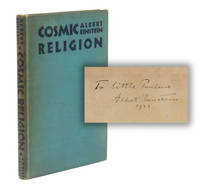
1931réf. 021909New York: Covici Friede 1931. First Edition. hardcover. Some pencil markings in text title page and endpapers darkened not really affecting Einstein's inscription; covers a little soiled. Good to Very Good and quite scarce. With a long biographical note and an appreciation by George Bernard Shaw. Subjects include Disarmament Pacifism the Jewish Homeland and more. This copy INSCRIBED and SIGNED by the author with his scarcer full signature on the front endpaper: "To little Pauline/Albert Einstein/1933." An uncommon title to find signed by the man of the century. With a letter of authenticity from James Spence if you need that kind of security blanket. Covici Friede hardcover
1949réf. 125016Evanston: Library of Living Philosophers 1949. Signed limited edition of Einstein's singular autobiography. Octavo original brown cloth top edge gilt original glassine and slipcase. One of 760 numbered copies signed and dated "Albert Einstein '49" this is number 458. Fine in the rare original glassine which is in near fine condition and in the original slipcase which is in fine condition. Housed in the original publisher's cardboard. An absolute pristine example which has been stored in the original cardboard box since publication. Edited by Paul Arthur Schilpp. Frontispiece portrait of Einstein by Yousuf Karsh. Rare and desirable in this condition particularly scarce in the original glassine and original box. Written by the man considered the "Person of the Century" by Time magazine this is not a glimpse into Einstein's personal life but an extension and elaboration into his thinking on science. Two of the great theories of the physical world were created in the early 20th century: the theory of relativity and quantum mechanics. Einstein created the theory of relativity and was also one of the founders of quantum theory. Here Einstein describes the failure of classical mechanics and the rise of the electromagnetic field the theory of relativity and of the quanta. "The greatest physicist of the 20th century" PMM 408. Library of Living Philosophers hardcover books
1950réf. 2131Princeton: np 1950. First edition. Very Good. EINSTEIN RESPONDS TO A STUDENT EXPLAINING A CENTRAL TENET OF RELATIVITY. The schoolboy David Cumberland had answered a test question saying that vertical lines are parallel; his answer however was marked as incorrect by his teacher on the grounds that the lines would converge at the earth's center. After Cumberland insisted he was correct the teacher made a deal with him: if he could find an authority that would support his claim his grade would be changed. Cumberland apparently quite an enterprising young student wrote to Einstein asking if vertical lines are indeed parallel and Einstein in the present letter responded using relativity theory to provide support for the student's test answer: October 28 1950 Mr. David Cumberland 924 S.E. 2nd Str. Fort Lauderdale FL Dear Sir: The concept "vertical" has meaning only with respect to the earth and cannot be used beyond that context. But there is the other concept lines vertical to an euclidian plane. Those lines are parallel. Sincerely yours signed A. Einstein Albert Einstein. One of the central components of relativity is that our understanding of space and time is subject to the relevant frame of reference. In this letter Einstein uses relativity - namely a shift in the frame of reference - to prove that boy's answer can be interpreted to be correct. Upon showing his teacher Einstein's letter the boy's grade was indeed raised. One 8.5x11 inch sheet of Institute for Advanced Study letterhead. Usual folds; some water spots to page not affecting text. A WONDERFUL LETTER SHOWING A VERY HUMAN SIDE OF EINSTEIN AND EXPLAINING A BASIC CONCEPT OF RELATIVITY. np unknown books
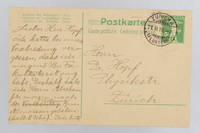
1910réf. 83637Zurich Zurich 1910. Fine. Einstein writes to a friend who introduced him to Carl Jung Zurich Zurich 21 juin 1910 9 x 14 cm une carte postale Autograph postcard signed by Albert Einstein to Ludwig Hopf. 18 lines written verso and recto address also in Einstein's handwriting. Postmarked June 21 1910. Published in The Collected Papers of Albert Einstein Volume 5: The Swiss Years: Correspondence 1902-1914 Princeton University Press 1993 n°218 p. 242. An exceptional and highly aesthetic card from Albert Einstein to ""the friend of the greatest geniuses of his time"" - according to Schrödinger - mathematician and physicist Ludwig Hopf who introduced Einstein to another 20th-century genius: Carl Jung. The master invites his pupil Hopf to a dinner party whose guests include scientist Max Abraham future great rival during Einstein's Zurich years and a fervent opponent of his theory of relativity. The recipient Ludwig Hopf joined Einstein in 1910 as an assistant and student at his physics and kinetic theory seminars at the University of Zürich. They signed two fundamental papers on the statistical aspects of radiation and gave their names to the ""Einstein-Hopf"" velocity-dependent drag force. Their letter exchanges retrace the complex path of Einstein's work on relativity and gravitation bearing witness to their great complicity and Hopf's invaluable contribution to the Master's research. A few months after writing the postcard Hopf even found an error in Einstein's calculations of the derivatives of certain velocity components which Einstein corrected in a paper the following year. They also formed a musical duo Hopf accompanied on the piano the Master's violin performing pieces by great musical geniuses like Bach and Mozart. With this card Einstein invited his pupil and friend Hopf to dinner with Max Abraham at the dawn of a major scientific controversy that would pit them against each other from 1911 onwards. Abraham's theory of special relativity failed to convince Einstein who criticized its lack of observational verification and its failure to predict the gravitational curvature of light. In 1912 their dispute became public through scientific articles. Abraham never acknowledged the validity of Einstein's theory. During their brilliant artistic and intellectual exchanges Hopf undoubtedly succeeded where Freud had failed as he declared to him in a letter: ""I shall break with you if you boast of having converted Einstein to psychoanalysis. A long conversation I had with him a few years ago showed me that analysis was as hermetic to him as the theory of relativity can be to me"" Vienna September 27 1931. As a fervent supporter of psychoanalysis Hopf is known to have introduced the famous psychoanalyst Carl Jung to Einstein. Hopf and his teacher both left for Prague's Karl-Ferdinand University in 1911 where they met writer Franz Kafka and his friend Max Brod in Madame Fanta's salon. With the rise of the Nazi regime the fates of the two theoreticians were plagued by persecution and exile. Einstein first took refuge in Belgium Hopf in Great Britain after his dismissal in 1934 from the University of Aachen because of his Jewish origins. They continued their prolific correspondence in the midst of the turmoil Einstein suggesting to Hopf the opening of a university abroad for exiled German students. Hopf died shortly after his appointment as chair of Mathematics studies at Trinity College Dublin in July 1939. A precious invitation from the great physicist to one of the final dinner gatherings of the ""old school"" of science embodied by Max Abraham on the eve of the publication of the theory of general relativity which would overturn classical conceptions of space and time and propel Science into the 20th century. unknown
1941réf. 2142520/12/1941. Brigitte Kaufmann was born in Germany but when the Nazis came to power in 1933 she fled to Paris. In France Kaufmann worked as an actress under the name of Brigitte Châtel and translated documents. She met her future husband Alfred Alexander-Katz in Paris and they married in 1939; the following day her husband was taken to an internment camp. He was given the choice of being interned in a labor camp or joining the Foreign Legion and chose the latter. Alexander was then sent to Clermont in Vichy France and the family relocated there. Dr. Walter Rudlin was a social science professor at Sarah Lawrence College in New York and actively involved in anti-fascist activities. He was the author of “The Growth of Fascism in Great Britain”. In September 1942 he left his position and joined the U.S. Board of Economic Welfare whose chair was Vice President Henry Wallace. His wife Eryl was interested in bringing Jews in Europe out of harm’s way and she knew the Alexander-Katz family. So Eryl sought to get Brigitte and her family safely out of Europe to Mexico and sought Einstein’s help. On March 12 1941 Einstein responded noting that Brigitte is his relative. “Thank you very much for your letter of March 11th. I am very gratified indeed to learn that our mutual friends Fred and Brigitte Alexander-Katz have some prospect to receive a visa into Mexico. I am certainly willing to vouch for their reliability and integrity both personal and political. I have known Mrs. Brigitte Alexander-Katz - whose family is related to mine - since she was a little girl. Her husband a very able engineer will certainly be useful to any country which receives him. If you will send me the address of the proper Mexican authority I shall gladly send any letter of recommendation desired.” This was a warm letter indeed expressing true concern and friendship for the Alexander-Katz family. On April 3 1941 Einstein again wrote Rudlin noting “Enclosed I am sending you the requested letters in the hope that they may be successful.” But there were delays and no visa so Rudlin wrote Einstein seven months later asking him to take the matter up with the Mexican government. Typed letter signed on his blind-embossed letterhead Princeton December 20 1941 to Mrs. Eryl Rudlin saying that he expects the visa to be granted but does not feel he ought to approach the Mexican government directly. “The Mexican authorities know that I am interested in the case of the Alexander-Katz family; they have kept me informed about the whole development of the matter. I have no doubt that admission to Mexico will be granted as it has been granted to hundreds of people in the same situation. I can give Mr. Alexander-Katz a recommendation but it is out of the question that I ask the Minister of Education to send him an official invitation. I have already done what could be done without intrusion.” Despite what he writes here to calm Mrs. Rudlin Einstein might have exerted some gentle pressure on Mexico by contacting the Mexican ambassador to the U.S. Gilberto Bosques; or the Alexander-Katz visas may have already being granted at that moment. The Einstein Archives is silent on this subject. But soon after Einstein soon wrote this letter in 1942 a telegram to the young Alexander-Katz family arrived stating that Einstein and Rudolph Uhlman a lawyer in New York had secured visas through Ambassador Bosques for them to escape to Veracruz Mexico aboard the ship San Thomé. In Mexico Brigitte she became a noted author actress director and translator. She became the first woman in Mexico to produce and direct television programs. Speaking five languages she also worked as a translator for UNESCO and Amnesty International. Her daughter Susana and granddaughter Sophie also became actors. unknown
1931réf. 4675JHollywood 1931. An unusually large image 11” x 14” taken on January 8 1931 when Einstein and his wife visited Hollywood. The image shows Albert Einstein and Film Mogul Carl Laemmle Senior Founder of Universal Pictures. The photograph is a striking informal image of these two noted Jewish leaders and fellow German emigres chatting on a studio sound stage at Universal City with Mrs. Einstein visible in the background. The photograph is inscribed and signed by Albert Einstein to the head of Universal’s publicity department John LeRoy Johnston who had sent this photograph of Einstein with his boss Laemmle to Einstein to sign. Einstein has written in white ink: “Fur Kohn Johnston - Albert Einstein”. Tipped to the verso is a typed note written in German from Johnston on his printed Universal Pictures stationery to Professor Einstein asking him to inscribe the photograph. Many photograph portraits of Einstein are rather stuffy affairs and a number look like police lineups when he appeared in public and met famous people and dignitaries. This is a striking image of the two men conversing. A historic and excellent photograph and the finest piece from his visit to Hollywood to ever appear on the market. unknown books
1905réf. 19259Leipzig: Johann Ambrosius Barth 1905. FIRST EDITION. Line-block and halftone text illustrations one folding table 3 halftone plates 1 collotype plate. Contemporary cloth-backed marbled boards title and date in gilt on spine; an excellent copy with the small stamp of the University of Basel on the fly-leaf preserved in a clamshell box. First edition journal issues of three important early papers by Einstein. In the first paper “Einstein suggested that light be considered a collection of independent particles of energy which he called ‘light quanta.’ Such a hypothesis he argued would provide an answer to the problem of black-body radiation where classical theories had failed and would also explain several puzzling properties of fluorescence photoionization and the photoelectric effect” Norman. It was for this paper together with one of the photoelectric effect “Zur theorie der Lichterzeugung und Lichtabsorption” published in 1906 that Einstein was awarded the Nobel Prize in Physics in 1921. The second paper proved according to Einstein himself that “according to the molecular theory of heat bodies of dimensions of the order of 1/1000 mm. suspended in liquid experience apparent random movement due to the thermal Brownian molecular movement quoted by R.W. Clark Einstein New York 1984 p. 87. Experimental verification of the predictions made in this paper contributed to proving the physical reality of molecules. The third paper on the electodynamics of moving bodies was Einstein’s first statement of the special theory of relativity. In it he argued that all motion is relative to the inertial system in which it is measured and that matter and energy are equivalent. As he himself remarked “it modifies the theory of space and time.” I: Weil 6; Norman 689; II: Weil 8 Norman 690; III: Weil 9 Dibner Heralds of Science 167; Grolier/Horblit 26b Norman 691A. Johann Ambrosius Barth unknown
réf. 51-1799Berlin: Circa 1917. Etching on Old Japanese Paper. 30 x 23 cm. on sheet size 40 x 32 cm.Light foxing and folds in the margins.Signed in pencil by Büttner lower right and by Einstein lower left. Indistinct pencil annotations above Einstein’s’ signature.Provenance: A Berkeley academic family.Porträt von Albert Einstein. Radierung auf Bütten. Rechts unten von Erich Büttner links unten von Albert Einstein signiert.At the beginning of the years Einstein suffers from various illnesses among other things from a liver disease and a stomach ulcer. His cousin Elsa takes care of him. It will last several years until he recovers completely. He writes a work on cosmology with the cosmologic term which shall guarantee a limited universe. He will refer to this cosmologic term later as his “biggest idiocy”. He takes over the management of the Kaiser Wilhelm Institute for Physics on October 1. Berlin: Circa 1917. unknown
1953réf. 2270Princeton NJ: np 1953. First edition. custom folder. Very Good. TOWARDS THE END OF HIS LIFE EINSTEIN WRITES TO ONE OF HIS FRIENDS FROM THE PATENT OFFICE CONCERNING ONE OF THE CENTRAL STRUGGLES OF HIS SCIENTIFIC LIFE. COMMENTING ON THE WORK OF DIRAC EINSTEIN ADMITS THAT ALTHOUGH HE "CAN'T TAKE A STATISTICAL FOUNDATION OF PHYSICS SERIOUSLY" HE FINDS IT "DIFFICULT TO MOVE BEYOND IT". Background: Einstein's struggle with accepting a strictly statistical quantum theory has been one of the most discussed and debated topics of twentieth-century physics. When introduced to the statistically-based quantum mechanics of Heisenberg Born and Jordan in 1926 Einstein famously wrote to Max Born that "Quantum mechanics is certainly imposing. But an inner voice tells me that it is not yet the real thing. The theory says a lot but does not really bring us any closer to the secret of the 'old one.' I at any rare am convinced that He is not playing at dice." Einstein letter to Born from 4 December 1926. From the onset "Einstein regarded the quantum theory as descriptively incomplete. What he meant was that in typical cases the probabilistic assertions provided by the theory for an individual quantum system do not exhaust all the relevant and true physical assertions about the system. Put briefly according to Einstein the typical statistical story told by quantum theory is not the whole story." Arthur Fine "What is Einstein's Statistical Interpretation or Is It Einstein for Whom Bell's Theorem Tolls". Einstein's discomfort with the new theory haunted him for the next three decades and his challenges to the theory were the cause of some of the most fertile and defining moments of modern science notably the celebrated "Bohr-Einstein debates" begun at the Fifth Solvay Conference 1927 and his monumentally influential "EPR" paper of 1935 "Can Quantum-Mechanical Description of Physical Reality Be Considered Complete" written with Boris Podolsky and Nathan Rosen. As late as 1949 in his "Reply to Criticisms" published in Albert Einstein: Philosopher-Scientist Einstein notes that Born and Wolfgang Pauli in their contributions to the volume "deprecate the fact that I reject the basic idea of contemporary statistical quantum theory insofar as I do not believe that this fundamental concept will provide a useful basis for the whole of physics" and spends the majority of the essay explaining his position and distinguishing between his acceptance of the model for "ensembles of systems" while still rejecting it for an "individual physical system". The letter: Dated September 12 1953 and written to his old colleague at the patent office in Bern Joseph Sauter the letter translated from the original German reads in full: Dear Mr. Sauter If I am able to I will gladly assist Mr. Keberle. I have heard of you often from my old friend Besso and I have also received a manuscript which deals critically with handwritten Dirac's presentation of the statistical approach to quantum theory. I have not been able to judge it myself because it is simply impossible for me to take a statistical foundation of physics seriously. But I have to admit that it is difficult to move beyond it. Yours sincerely signed A. Einstein. Albert Einstein. The recipient Joseph Sauter worked with Einstein at the Bern Patent office during the years he was developing the ideas for his revolutionary papers of 1905. "Among his colleagues at the Patent Office Einstein discovered one with similar scientific interests-Dr. Josef Sauter a French-Swiss who had also studied at the Polytechnic and who had been Professor Weber's chief assistant for a while. Sauter like Einstein tried to fill the gaps in the Polytechnic's syllabus by private study so that Einstein was able to discuss with him Maxwell's thermodynamics and Helmholtz's and Hertz's theoretical concepts. The two also discussed Einstein's publications on thermodynamics with the result that Sauter discovered a mistake in them which Einstein accepted 'without being the least upset.' Fifty years later Einstein recalled 'that I had a lot of discussions with Sauter about. my thermal-statistical papers'. At least as important as his help with the 'rewriting and amending' were Sauter's connections with scientific circles in Bern to which he soon introduced his new colleague." Albrecht Fölsing Albert Einstein. Edouard Keberle mentioned in the first line by Einstein was a Bulgarian physicist who at the time of the letter had just left the Institute of Theoretical Physics in Bern over a publication dispute. Not long after this letter - in early 1954 - Keberle accepted a post at the Midwest Research Institute in Kansas City. It is unclear if Einstein helped him in any way to get this position. Michele Besso - also mentioned in this letter - was Einstein's close lifelong friend. What prompts Einstein to declare that "it is simply impossible for me to take a statistical foundation of physics seriously" is the mention of a manuscript on the work of Paul Dirac. Philosophically Dirac was almost the opposite of Einstein - he had no interest in probing the interpretations of quantum theory wryly noting in his paper "The Inadequacies of Quantum Field Theory" that "The interpretation of quantum mechanics has been dealt with by many authors and I do not want to discuss it here. I want to deal with more fundamental things." It is revealing in this letter that although Einstein re-states his objection to a statistical basis of quantum theory he has doubts about his position admitting - less than two years before his death - that he still has difficulty moving beyond it. Typed Letter Signed. Princeton NJ: September 12 1953. One 8.5x11 inch sheet with Einstein's embossed Mercer Street address at top. Custom silk presentation folder. With original mailing envelope with postmarks. A few small smudges usual folds; fine condition. ONE OF EINSTEIN'S FINAL STATEMENTS ON ONE OF THE CENTRAL TENETS OF HIS SCIENTIFIC PHILOSOPHY. np unknown books
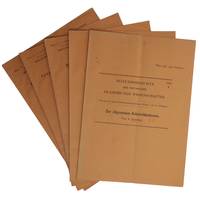
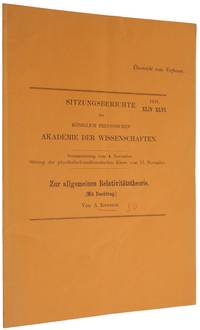
1923réf. 6416Berlin: Akademie der Wissenschaften 1923. First edition. First edition extremely rare author's presentation offprints "Überreicht vom Verfasser" from the library of the great German physicist Arnold Sommerfeld of Einstein's most important early publications on unified field theory. Einstein's work on unified field theory was inspired by James Clerk Maxwell's success in finding a unified theory of electricity and magnetism one of the greatest achievements of nineteenth-century physics. Einstein's contributions in this area represent about a quarter of his entire research output and half his scientific production after 1920. Such presentation offprints were issued in very small numbers unlike the commercially available separate printings which are common on the market. . UNIFIED FIELD THEORY. First edition extremely rare author's presentation offprints "Überreicht vom Verfasser" not to be confused with the much more common trade separates - see below from the library of the great German physicist Arnold Sommerfeld of Einstein's most important early publications on unified field theory. Einstein's work on unified field theory was inspired by James Clerk Maxwell's success in finding a unified theory of electricity and magnetism one of the greatest achievements of nineteenth-century physics which showed that light was a form of electromagnetic wave and made possible modern inventions such as radio television and the telephone. Einstein's contributions in this area represent about a quarter of his entire research output and half his scientific production after 1920. Although he was ultimately unsuccessful a similar vision was realized in the decades after his death in the construction of the 'standard model' a unified theory of electromagnetism with the weak and strong nuclear forces which were unknown in Einstein's time and efforts to incorporate gravity into the model continue to this day. 'Zur allgemeinen Relativitätstheorie' written on board ship during his return journey from Japan "gives us insight into the workings of Einstein's mind as it searched for a unified theory of gravitation and electromagnetism a search that would dominate his thinking for the rest of his life" Collected Papers 13 p. lxxvii. 'Einheitliche Feldtheorie von Gravitation und Elektrizität' was the first paper to use the term 'Unified Field Theory' in its title. In its opening paragraph Einstein wrote: "After incessant search during the last two years I now believe I have found the true solution" Pais Subtle is the Lord p. 343. The half-dozen papers Einstein had already written on unified field theory were reactions to the ideas of others such as Eddington Kaluza and Weyl; it was in this paper that Einstein put forward the first original approach of his own. "His theory rested in major part on the following arithmetical coincidence. In one of the customary ways of describing electromagnetism 6 field quantities are used. The metrical tensor of general relativity has a certain symmetry. Remove that symmetry and it will automatically contain not 10 but 16 field quantities. Use 10 combinations of these for gravitation and there will be 6 left over - just the number of field quantities with which to represent electromagnetism" Hoffmann Einstein p. 225. In 1928 Einstein embarked upon a new approach to a unified field theory involving what he called 'distant parallelism.' This was introduced in 'Riemann-Geometrie mit Aufrechterhaltung des Begriffes des Fernparallelismus' and 'Neue Möglichkeit für eine einheitliche Feldtheorie von Gravitation und Elektrizität.' By early 1929 he had solved the main problems involved in writing down field equations for his unified theory and presented his solution in 'Zur einheitlichen Feldtheorie'. "Einstein did propose in this last paper a set of field equations but added that 'further investigations will have to show whether these will give an interpretation of the physical qualities of space'. His attempt to derive his equations from a variational principle had to be withdrawn. Nevertheless in 1929 he had 'hardly any doubt' that he was on the right track" Pais p. 346. "Within three days the first printing of the journal offprint i.e. the commercial separate-a thousand copies-sold out and another thousand copies were soon printed. Soon thereafter Nature's News and Views section published a more accessible account of the work including a quote by Einstein: 'Now but only now we know that the force which moves electrons in their ellipses about the nuclei of atoms is the same force which moves our earth in its annual course about the sun and is the same force which brings to us the rays of light and heat which make life possible upon this planet.' With Einstein's 50th birthday approaching his new idea rapidly caught fire at least in the popular press. The New York Times published almost a dozen articles that year about distant parallelism rivaling its coverage of the 1919 eclipse results" Halpern. "In this frenzied unscientific atmosphere Einstein's new theory was hailed in the press as an outstanding scientific advance. Yet Einstein had stated in his article that it was still tentative; and soon he found he had to abandon it" Hoffman p. 226. Only paper III was present in the collection of presentation offprints of Einstein's son Hans Albert Christie's 2006 and in Einstein's own collection Christie's 2008; and no other copies of any of the offprints with "Überreicht vom Verfasser" can be identified on RBH. Similarly although several copies of each offprint can be found in institutional collections it is unclear how many are presentation offprints as the library records do not mention "Überreicht vom Verfasser". Provenance: Arnold Sommerfeld 1868-1951 his ink stamp on the front cover of III-V and characteristic numbering in red pencil on each - 40 45 47 48 49. "The son of a physician Sommerfeld was educated at the University of Königsberg. After teaching briefly at the universities of Göttingen Clausthal and Aachen he was appointed professor of physics at the University of Münich in 1906. Sommerfeld should have retired in 1936 in favour of his pupil Werner Heisenberg. Opposition from the Nazi party to Heisenberg's appointment prolonged Sommerfeld's tenure and it was not in fact until late 1939 that he finally retired to be succeeded not by Heisenberg but by Wilhelm Müller a Nazi aerodynamicist without a single publication in physics to his credit. Although Sommerfeld and Heisenberg were not Jewish they were regarded by the Nazis as Jewish sympathizers. Sommerfeld however survived the war and returned to his Münich chair in 1945 continuing to work at physics until he died in a car accident in 1951" Oxford Reference. "Arnold Sommerfeld was one of the most distinguished representatives of the transition period between classical and modern theoretical physics. The work of his youth was still firmly anchored in the conceptions of the nineteenth century; but when in the first decennium of the century the flood of new discoveries experimental and theoretical broke the dams of tradition he became a leader of the new movement and in combining the two ways of thinking he exerted a powerful influence on the younger generation. This combination of a classical mind to whom clarity of conception and mathematical rigour are essential with the adventurous spirit of a pioneer are the roots of his scientific success while his exceptional gift of communicating his ideas by spoken and written word made him a great teacher" Max Born p. 275. "Einstein's early work on the unification program after the completion of the theory of general relativity was by and large a reaction to approaches advanced by others. This is the case for the first geometrization of the electromagnetic field proposed in 1918 by Hermann Weyl; for the first exploration of a five-dimensional theory suggested by Theodor Kaluza in 1919; and for the first attempt to base a unified field theory on the concept of the affine connection rather than on the metric field as advanced by Arthur Eddington in 1921" Sauer pp. 289-90. Weyl 1885-1955 had introduced a new geometrical object into the theory that he called a "length connection" and he used it to establish a link between the geometrical structure given by the length connection and the electromagnetic field. Einstein was initially enthusiastic about Weyl's idea calling it "a first-class stroke of genius" but quickly found a serious objection to it showing that it implied that the wavelength of light emitted by a radiating atom would depend on the prehistory of that atom contrary to observation. Nevertheless in March 1921 Einstein elaborated on Weyl's theory in his paper 'Uber eine naheliegende Ergänzung des Fundamentes der allgemeinen Relativitätstheorie.' Another idea to which Einstein responded was put forward as early as 1919 by Theodor Kaluza 1885-1954 at the time Privatdozent in mathematics at the University of Königsberg; he introduced the concept of a fifth dimension to the underlying space-time manifold of general relativity and attempted to represent the electromagnetic field in terms of the additional components of the metric tensor. Einstein showed that for the equation of motion of an electron Kaluza's theory predicted that the influence of the gravitational field was larger by many orders of magnitude than any reasonable physical interpretation would allow for. Nevertheless Einstein later encouraged Kaluza to publish his idea and Einstein and Jakob Grommer 1879-1933 published a response to it in 1923 'Beweis der Nichtexistenz eines überall regulären zentrisch symmetrischen Feldes nach der Feld-Theorie von Kaluza'. A third approach toward a unified field theory was advanced most notably by Eddington 1882-1944 in the early twenties and was also taken up by Einstein. The idea was to base the theory on the concept of an affine connection as the fundamental mathematical quantity rather than on the metric tensor. The associated Ricci curvature of spacetime is not then in general a symmetric tensor and Eddington suggested that the anti-symmetric part of the curvature could be identified with the electromagnetic field the symmetric part being the usual metric. Eddington did not however provide the field equations that would determine the affine connection a problem Einstein addressed in 'Zur allgemeinen Relativitätstheorie' paper I. Einstein identified the symmetrized part of the Ricci tensor with the 'natural' metric of the theory and like Eddington he linked the antisymmetrized Ricci tensor to the electromagnetic field. Einstein's criticism of Eddington's approach focused on Eddington's failure to provide field equations that determine all forty connection coefficients and the derivation of such field equations became the focal point of the published paper. Lastly Einstein explicitly introduced a scale factor λ that mediates between the scale of the 'natural' metric defined by the Ricci tensor and that of the physical metric. "With Einstein's response to Weyl Kaluza and Eddington in the early twenties we find him reacting to approaches that had been advanced by others . The first original approach put forward by Einstein himself was published in a paper of 1925 paper II in which also the term 'unified field theory' appeared for the first time in a title. In that paper he explored a metric-affine approach i.e. he took both a metric tensor field and a linear affine connection at the same time as fundamental variables. Both connection and metric were assumed to be asymmetric. Parallel transport then again defines a Ricci tensor and a Riemann curvature scalar and Einstein defined tentative field equations in terms of a variational principle taking the Riemann scalar as a Lagrangian just as in standard general relativity. As regards the interpretation of the mathematical objects he tried to associate the gravitational and electromagnetic fields with the symmetric and anti-symmetric parts of the metric field. In his attempt to recover the known cases he could show that the metric was symmetric for the purely gravitational case and the usual compatibility condition for the Levi-Civita connection can be recovered. Maxwell's equations could be recovered in the limit of weak gravitational fields but only in a slightly different form that is not entirely equivalent to the original equations. "The basic problem of this approach seems to have been that Einstein did not know how to go on from here. Dealing with both an asymmetric metric tensor and an asymmetric connection opened up a vast field of possibilities inherent in the mathematical framework and many familiar results of the theory of Riemannian geometry no longer held. In particular verifying the existence of non-singular spherically symmetric charge distributions posed a formidable challenge. It was also unclear how to explicitly investigate the non-vacuum case beyond the first order approximation of weak gravitational fields. Einstein did not pursue this approach any longer in print but he did take it up once more twenty years later as his final approach toward a unified field theory working on it until his death" Sauer pp. 293-5. "At some point in May 1928 while convalescing at home in Berlin Einstein had an idea for what he thought was 'an entirely new way of realizing the general theory of relativity and that may be groundbreaking.' Key to this new approach was the notion of a field of mutually orthogonal normal vectors defined on the space-time manifold. This was a so-called n-Bein-Feld or in more modern terminology for n = 4 a field of tetrads. Such a theory admits the definition of a natural notion of distant parallelism by identifying vectors on this orthonormal frame field. Two vectors at distant points of the manifold are parallel by definition if they are represented by the same vector of the orthonormal frames at the respective points. The manifold also carries a Riemannian metric which can be expressed in terms of the tetrad field. Since the tetrad field determines the metric field but not the other way around the tetrads provide more degrees of freedom which Einstein hoped could be put to use to provide a representation of the electromagnetic field. "At Einstein's request on 7 June 1928 Max Planck presented a brief note on this 'Riemannian Geometry Retaining the Concept of Distant Parallelism' paper III to the Prussian Academy for publication in its Proceedings. Since Einstein was not sure at the time whether the notion of Fernparallelismus that is distant parallelism or teleparallelism and its associated geometric concepts were known in the mathematical literature he asked Planck to inquire among his mathematician colleagues whether any of this was known before submitting the paper for publication. Planck did not find the occasion to do as requested but nevertheless submitted the paper. "Only a week later Einstein realized how to put the geometry of distant parallelism to use for his project of a unified theory of both the gravitational and the electromagnetic fields. The idea was to postulate a variational principle for an invariant action integral that depended on the tetrad field as the dynamical variable. "From this perspective the problem presented itself as a fairly well-defined mathematical problem but posed difficulties of interpretation in terms of physical concepts. From the mathematical side the required invariance of the variational integral created a clearly defined problem. One needed to identify all possible invariants that can be constructed from the tetrads as well as a combination of these invariants that would be suitable as a Lagrangian for the variational integral. Second variation with respect to the tetrad field would produce differential equations that had to be associated with the known field equations of gravitation and electromagnetism in certain limiting cases. Third solutions for the differential equations had to be found. Finally Einstein later would become interested in finding identities that would be satisfied by the tetrads by virtue of general covariance or that might be postulated to derive field equations. As far as the physical interpretation was concerned the metric field would take on its old role as in the general theory namely corresponding to the gravitational field. But the electromagnetic field also had to be identified with quantities occurring in the geometric framework. "As a first step Einstein identified the relevant possible invariants to be constructed from the tetrads. He also realized that in addition to the possibility of constructing a metric-compatible Levi-Civita connection from the metric as well as the associated notion of parallel transport the tetrad field allowed the definition of another connection with its notion of parallelism. In contrast to the Levi-Civita connection the teleparallel connection is asymmetric and describes a geometry that has vanishing Riemann curvature. Instead it is characterized by the nonvanishing of a tensorial quantity constructed from the teleparallel connection that is now known as the torsion tensor. Taking the mathematical expression of torsion a third-rank tensor Einstein tentatively identified its contraction with the electromagnetic four-potential. And settling on what seemed to be the simplest invariant to be taken as a basis for a tentative field theory Einstein succeeded in deriving to first approximation in the field components both the gravitational field equations of general relativity as well as an equivalent version of the Maxwell equations. "Again a brief note on this work was presented by Planck to the Academy on 14 June 1928 and was published in July under the title 'New Possibility for a Unified Field Theory of Gravitation and Electricity' paper IV. These two notes mark the beginning of a search for a unified field theory in this teleparallel framework that would preoccupy Einstein for the next two or three years . "The new approach to unified field theory opened the possibility of finding solutions to long-standing problems and work along these lines continued with intense phases of calculation and collaboration partly done when Einstein withdrew from public life and spent extended periods of time in secluded residences in Scharbeutz and Gatow or later in Caputh. However in mid-December 1928 difficulties in working out the consequences of the new differential equations had piled up to such a point that Einstein reconsidered the basis of their derivation by means of Hamilton's principle. On 13 December he wrote to his collaborator Chaim Herman Müntz that he had a 'simple bold idea that will throw Hamilton's principle overboard'. Instead of trying to recover the Maxwell equations in some acceptable limit he would now 'put the cart before the horse' and 'choose the field equations in such a way that I can be certain that they will lead to the Maxwell equations'. But yet again things turned out to be more difficult and for a few days in late December he reverted to the 'old Hamilton method once again'. But over the New Year's break on another retreat in Gatow Einstein gave up again on the variational approach and derived field equations based instead on some identities. On 27 December he wrote to Müntz: 'EUREKA!' convinced that he had found a solution that was 'so splendid nothing nicer could be imagined'. "The new progress was written up in a brief paper completed by 5 January 1929. Einstein was exhausted but happy about this new paper 'lying finished in front of me compressed into seven pages under the title 'Unified Field Theory'.' To his son Eduard he wrote on the same day that he was 'very happy' because he had 'more or less completed my life's work'. The paper was submitted on 10 January 1929 for publication in the Prussian Academy's Proceedings and appeared under the somewhat less assertive title 'On Unified Field Theory' paper V. "When published the paper made a big splash in the press and received much public attention. A press release appeared in the New York Times on 11 January and reports followed on 12 January in the German and international press. The paper was reprinted in a record number of copies and Einstein wrote a popular exposition English translations of which appeared in the London Times and the New York Times as well as in the Observatory. In Britain Nature contacted Einstein for a copy in order to report on it a request that Einstein diverted to Eddington. The latter informed Einstein a little later about the craze that his latest publication had stirred in London where 'one of our great Department Stores in London Selfridges has pasted up in its window your paper six pages pasted up side-by-side so that passers-by can read it all through. Large crowds gather round to read it!'. "The paper is indeed a rather technical brief note as Einstein soon pointed out and 'no occasion for anybody to be excited about it' as there will be 'only a few mathematicians who will be inclined to read it'. In a letter to Karl Kerkhof he admitted that he himself might carry some responsibility for the excitement since he 'may have alluded to it in speaking with one or another of my friends'. Among them was Hans Reichenbach who reported on the new approach in a column in the Vossische Zeitung before Einstein's printed paper was actually issued and thereby caused a deep rift between them. In any case it soon became clear that the brief paper would not be the last word on the theory. Already the published version carried an addendum in which Einstein indicated a simpler way of looking at things" Collected Papers 16 pp. lxiv-lxix. "Einstein soon was to learn that the mathematical concept of distant parallelism was by no means new and had already been explored by mathematicians notably by Roland Weitzenböck and Élie Cartan. While immediately acknowledging the priority of others as far as the mathematics was concerned Einstein nevertheless held high hopes for his idea of formulating a unified field theory within this structure. For him the critical question was to find a field equation for the components of the dynamical tetrad fields. Each field of tetrads defines a metric tensor field. But the converse is not true since the metric tensor components can only fix ten of the sixteen components of a tetrad. The additional six degrees of freedom are just what would be needed so he thought to accommodate the six degrees of freedom of the Maxwell field in a unified description of gravitation and electromagnetism. "The story of the distant parallelism approach can be told largely as a story of attempts to find and justify a uniquely determined set of field equations for the tetrad components with the demand that solutions of those field equations be given a sensible physical interpretation. The distant parallelism approach in this respect shows a number of marked similarities with Einstein's search for general relativistic field equations of gravitation in the years 1912-15. In 1912 it had been the introduction of the metric tensor into the theory that had started Einstein's research and existing mathematical theorems had to be adapted to the theory. In 1928 it was the tetrad fields that allowed the investigation of a non-Euclidean geometry of vanishing curvature and similarly Einstein was made aware of existing mathematical results by mathematician colleagues. In both cases Einstein's research quickly focussed on finding a set of field equations for the dynamical variables and in both cases it was difficult to satisfy all heuristic requirements. In response to these difficulties Einstein changed back and forth between two different and complementary strategies each starting from one particular set of heuristic postulates. In both episodes Einstein at one point settled on a set of field equations that was justified more by physical considerations rather than by mathematical soundness. In both cases Einstein continued to work out consequences of the field equations as well as continued to find a satisfactory mathematical justification for these equations. And finally the demise of both theories came about by a combination of realizing more and more shortcomings of the theory and by discovering that an alternative approach promised to be more successful. However while in 1915 the more successful theory that Einstein substituted for his earlier so-called Entwurf theory was the final version of general relativity the successor approach to the distant parallelism episode turned out to be yet another attempt at a unified field theory" Sauer pp. 296-7. These author's presentation offprints are of extreme rarity and must be distinguished from other so-called 'offprints' of papers from the Berlin Sitzungsberichte many of which are commonly available on the market. The celebrated bookseller Ernst Weil 1919-1981 in the introduction to his Einstein bibliography wrote: "I have often been asked about the number of those offprints. It seems to be certain that there were few before 1914. They were given only to the author and mostly 'Überreicht vom Verfasser' Presented by the Author is printed on the wrapper. Later on I have no doubt many more offprints were made and also sold as such especially by the Berlin Academy." If the term 'offprint' means as we believe it should a separate printing of a journal article given only to the author for distribution to colleagues then 'offprints' were not commercially available. Although there is certainly some truth in Weil's remark in our view it requires clarification and explanation. Until about 1916 most of Einstein's papers were published in Annalen der Physik; from 1916 until he left Germany for the United States in 1933 most were published in the Berlin Sitzungsberichte. The Sitzungsberichte differed from other journals in which Einstein published in that it made separate printings of its papers commercially available. These separate printings have 'Sonderabdruck' printed on the front wrapper the usual German term for offprint but they are not offprints according to our definition. They were available to anyone; indeed a price list of these 'trade offprints' is printed on the rear wrapper. True author's presentation offprints can be distinguished from these trade separates by the presence of 'Überreicht vom Verfasser' on the front wrapper. In the period 1916 to 1919 or 1920 the Sitzungsberichte trade separates are themselves rare. After 1919 or 1920 however the trade separates become much more common although the author's presentation offprints are still very rare. The reason for this change is that it was only in 1919 that Einstein became famous among the general public. It might seem obvious that Einstein's fame dates from 1905 his 'annus mirabilis' in which he published his epoch-making papers on special relativity and the light quantum. However these works did not make him immediately well known even in the physics community - many physicists did not understand or accept his work and it was two or three years before his genius was fully accepted even by his colleagues. Einstein did not secure an academic position until 1908. Among the general public Einstein became well known only in late 1919 following the success of Eddington's expedition to observe the bending of light by the Sun which confirmed Einstein's general theory of relativity. This was front-page news and made Einstein universally famous. See Chapter 16 'The suddenly famous Doctor Einstein' in Pais Subtle is the Lord for an account of these events. Before 1919 the trade separates of Einstein's papers would probably only have been purchased by professional physicists; after 1919 everyone wanted a memento of the famous Dr. Einstein whether or not they understood anything of theoretical physics and the trade separates of his papers were printed and sold in far greater numbers than before to meet the demand. It is telling that when these post-1919 trade separates appear on the market they are often in mint condition - they were never read simply because their owners were unable to understand them. I. BRL 140; Weil 131. II. BRL 155; Weil 147. III. BRL 174; Weil 161. IV. BRL 175; Weil 162. V. BRL 183; Weil 165 cf. PMM 416. Born 'Arnold Johannes Wilhelm Sommerfeld 1868-1951' Obituary Notices of Fellows of the Royal Society 8 1952 pp. 275-296. Halpern 'Albert Einstein celebrity physicist' Physics Today 1 April 2019 pp. 38-45. Sauer 'Einstein's unified field theory program' Chapter 9 in: The Cambridge Companion to Einstein Janssen & Lehner eds. 2014. 8vo 252 x 180 mm pp. 334-340; 341-351. Original printed wrappers portion of ink postmark stamp on lower cover just into text of publisher's advertisements light vertical crease for posting. Akademie der Wissenschaften unknown
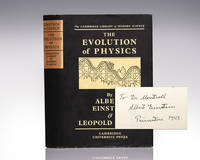
1938réf. 150250Cambridge: Cambridge University Press 1938. First edition of this classic work which traces the development of ideas in physics. Octavo original blue cloth. Presentation copy inscribed by Albert Einstein on the half-title page "To Dr. Montrell Albert Einstein Princeton 1943." Near fine in a near fine price-clipped dust jacket. On publication The Saturday Review of Literature praised Evolution of Physics as "masterly Einstein and Infelds book should do much to spread an understanding and appreciation one of the great dramas in the evolution of human thought." Cambridge University Press hardcover
1915réf. 6406Berlin: Königlichen Akademie der Wissenschaften 1915. First edition. First editions very rare offprint issue of the first two papers published in November 1915 that document Einstein's final formulation of the general theory of relativity - the culmination of nearly a decade of theoretical work. These papers represent a turning point not only in Einstein's career but in the history of modern physics. Delivered to the Prussian Academy on 4 and 11 November 1915 they contain the essential framework and mathematical formalism of the completed theory preceding the famous final paper of 25 November by just days. Collectively the November papers form the core of Einstein's definitive breakthrough. "In the half century and more of Einstein's work in science one discovery stands above all as his greatest achievement. It is his general theory of relativity" Norton. . EINSTEIN'S COMPLETION OF THE GENERAL THEORY OF RELATIVITY . First editions extremely rare author's presentation offprint not to be confused with the much more common trade separate - see below from the library of the great German physicist Arnold Sommerfeld of the first two of the papers published in November 1915 that document Einstein's final version of the general theory of relativity. "In the half century and more of Einstein's work in science one discovery stands above all as his greatest achievement. It is his general theory of relativity" Norton. "There was difficulty reconciling the Newtonian theory of gravitation with its instantaneous propagation of forces with the requirements of special relativity; and Einstein working on this difficulty was led to a generalization of relativity - which was probably the greatest scientific discovery that was ever made" Dirac quoted in Chandrasekhar p. 3. Einstein's special theory of relativity 1905 showed that the laws of physics are the same in all inertial i.e. non-accelerating frames of reference. It was then natural to ask whether it was possible to extend this principle of relativity to the more general case of frames of reference in arbitrary states of motion. This problem became linked to a theory of gravitation with Einstein's 'equivalence principle' of 1907 according to which the effects of gravity are locally equivalent to those of accelerated motion. Einstein's first steps towards a geometrical theory of gravitation were taken in August 1912 when his friend Marcel Grossmann provided the necessary mathematical tools. "Some time between August 10 and August 16 it became clear to Einstein that Riemannian geometry is the correct mathematical tool for what we now call general relativity theory. The impact of this abrupt realization was to change his outlook on physics and physical theory for the rest of his life" Pais p. 210. The resulting 'Entwurf' theory 1913 had much in common with the final theory of 1915 but based on a fallacious argument Einstein abandoned the requirement that the theory should be 'generally-covariant' i.e. that arbitrary frames of reference should be allowed. "After three years of fruitless peregrinations the revelation came to Einstein that he had been constantly on the wrong track although in 1913 he had been so near to the right solution" Lanczos p. 211. On November 4 1915 he presented to a plenary session of the Prussian Academy a new version of general relativity 'Zur allgemeinen Relativitätstheorie' "based on the postulate of covariance with respect to transformations with determinant 1" and stated that he had "completely lost confidence" in the 'Entwurf' equations. On November 18 he published his calculation of the precession of the perihelion of Mercury based on the new theory: its agreement with observation confirmed that the theory was correct the Entwurf theory predicted half the observed value of the precession. Provenance: Arnold Sommerfeld 1868-1951 his characteristic numbering in red pencil '30' on front cover. "The son of a physician Sommerfeld was educated at the University of Königsberg. After teaching briefly at the universities of Göttingen Clausthal and Aachen he was appointed professor of physics at the University of Münich in 1906. Sommerfeld should have retired in 1936 in favour of his pupil Werner Heisenberg. Opposition from the Nazi party to Heisenberg's appointment prolonged Sommerfeld's tenure and it was not in fact until late 1939 that he finally retired to be succeeded not by Heisenberg but by Wilhelm Müller a Nazi aerodynamicist without a single publication in physics to his credit. Although Sommerfeld and Heisenberg were not Jewish they were regarded by the Nazis as Jewish sympathizers. Sommerfeld however survived the war and returned to his Münich chair in 1945 continuing to work at physics until he died in a car accident in 1951" Oxford Reference. "Arnold Sommerfeld was one of the most distinguished representatives of the transition period between classical and modern theoretical physics. The work of his youth was still firmly anchored in the conceptions of the nineteenth century; but when in the first decennium of the century the flood of new discoveries experimental and theoretical broke the dams of tradition he became a leader of the new movement and in combining the two ways of thinking he exerted a powerful influence on the younger generation. This combination of a classical mind to whom clarity of conception and mathematical rigour are essential with the adventurous spirit of a pioneer are the roots of his scientific success while his exceptional gift of communicating his ideas by spoken and written word made him a great teacher" Max Born p. 275. "In June 1905 while still a patent examiner in Bern Einstein submitted his famous work on the electrodynamics of moving bodies to the Annalen der Physik. This work contained his special theory of relativity in which he asserted the equivalence of all inertial frames of reference as a fundamental postulate of physics. The question which then naturally arose was whether it was possible to extend this principle of relativity to the more general case of frames of reference in arbitrary states of motion. But he could find no workable basis for such an extension until he tried to incorporate gravitation into his new special theory of relativity for a review article in 1907 'Uber das Relativitätsprinzip und die ausdemselben gezogenen Folgerungen' Jahrbuch der Radioaktivitat und Elektronik 4 1907 411-62. The difficulties of this task led him to a new principle later to be called the 'principle of equivalence.' "On the basis of the fact that all bodies fall alike in a gravitational field Einstein postulated the complete physical equivalence of a homogeneous gravitational field and a uniform acceleration of the frame of reference. This extended the principle of relativity to the case of uniform acceleration. It also foreshadowed the problem whose complete solution would lead him to his general theory of relativity: the construction of a relativistically acceptable theory of gravitation based on the principle of equivalence" Norton p. 258. One application of the equivalence principle proved crucial to the subsequent development of his ideas on general relativity. Einstein considered an observer standing on a rotating disc - a non-inertial accelerating reference frame. According to special relativity measuring rods aligned with the circumference of the disc will contract due to their motion whereas measuring rods positioned along the radius of the disc will not. Hence the ratio of the circumference of the disc to its diameter will be less than π. "The spatial geometry for the rotating observer is therefore non-euclidean. Invoking the equivalence principle Einstein concluded that this will be true for an observer in a gravitational field as well. This then is what first suggested to Einstein that gravity should be represented by curved space-time. "To describe curved space-time Einstein turned to Gauss's theory of curved surfaces a subject he vaguely remembered from his student days at the ETH in Zürich. He had learned it from the notes of his classmate Marcel Grossmann. Upon his return to his alma mater as a full professor of physics in 1912 Einstein learned from Grossmann now a colleague in the mathematics department of the ETH about the extension of Gauss's theory to spaces of higher dimension by Riemann and others. Riemann's theory provided Einstein with the mathematical object with which he could unify the effects of gravity and acceleration: the metric field" Janssen p. 65. The first product of this collaboration was the Entwurf einer verallgemeinerten Relativitätstheorie und einer Theorie der Gravitation published before the end of June 1913 which contained many of the essential features of the final general theory of relativity; most importantly it introduced the 'metric' of space-time. In Minkowski's formulation of special relativity 1908 the most important quantity is the 'world function' of two events which determines the metric and causal structure of space-time. If these events have coordinates x y z t and x' y' z' t' in some inertial reference frame the world function is: c2t' - t2 - x' - x2 - y' - y2 - z' - z2 where c is the speed of light. Its crucial property is that it depends only on the two events and not on the choice of inertial reference frame - in other words it is unchanged 'invariant' when x y z t and x' y' z' t' are both subjected to any Lorentz transformation. Einstein and Grossmann began with the world function in differential form: ds2 = c2dt2 - dx2 - dy2 - dz2 If we now subject x y z t to an arbitrary coordinate transformation not necessarily a Lorentz transformation this takes the general form ds2 = g11dx12 g12dx1dx2 . ; the collection of quantities gμν which in general depend on the coordinates x1 x2 x3 x4 is called the metric. Based on analogy with Newton's theory Einstein expected that the gravitational equations should be of the form Gμν = Tμν where Gμν is a purely geometric quantity constructed solely from the metric gμν and its derivatives up to the second order and the 'stress-energy tensor' Tμν contains the information about the matter that is producing the gravitational field including energy density momentum fluxes and stresses. The question was: what exactly should Gμνbe Einstein and Grossmann found that generally covariant equations did not seem to be compatible with energy-momentum conservation or reduce to the equations of Newtonian gravitational theory for weak static fields both essential requirements of the correct theory. Einstein therefore decided to settle in the 'Entwurf' for equations with very limited covariance - instead of arbitrary changes in coordinates only linear ones were allowed. The restricted covariance of the 'Entwurf' field equations continued to bother him until in late August 1913 he convinced himself that such restrictions are unavoidable by means of the infamous "hole argument" first published as an addendum to the reprint of the 'Entwurf' article in Zeitschrift für Physik in January 1914. This ingenious argument showed correctly that if the gravitational equations were generally covariant the metric gμν would not be uniquely determined by the matter distribution i.e. by Tμν. He concluded incorrectly that this implied that general covariance must be ruled out the hole argument does not work if only linear coordinate transformations are allowed. The appropriate analogy is with electromagnetism: the metric is analogous to the scalar and vector potentials of electromagnetism and it was well known certainly to Einstein that these potentials are not uniquely determined by the charges and currents producing the electromagnetic field. That the 'Entwurf' theory was incorrect was made clear by Einstein's attempt in collaboration with Michele Besso another former classmate to explain the motion of the perihelion of Mercury. In 1859 Urbain Jean Joseph Le Verrier had observed the 'precession' of Mercury's orbit: this orbit is an ellipse but the ellipse is not fixed in space but slowly rotates. From early on in his search for a new relativistic theory of gravitation Einstein had been interested in the problem of Mercury's perihelion. In a letter to his friend Conrad Habicht in 1907 Einstein had already expressed his hope that such a theory would explain the anomalous advance of Mercury's perihelion. Besso visited Einstein in Zürich in June 1913 and the two men calculated the precession expected on the basis of the 'Entwurf' theory. Disappointingly it was only about half the observed anomaly. Einstein left Zürich in March 1914 to take up a professorship in Berlin which was to be his home until December 1932. He made no further progress on the gravitational equations until the summer of 1915 although a detailed exposition of the 'Entwurf' theory was published in October 1914 in which Einstein maintained the need for restricted covariance and even claimed that this determined the gravitational Lagrangian uniquely. "Einstein still believed in the 'old' theory as late as July 1915 between July and October he found objections to that theory and his final version was conceived and worked out between late October and November 25 . What made Einstein change his mind between July and October Letters to Sommerfeld and Lorentz show that he had found at least three objections against the old theory: 1 its restricted covariance did not include uniform rotations 2 the precession of the perihelion of Mercury came out too small by a factor of about 2 and 3 his proof of October 1914 of the uniqueness of the gravitational Lagrangian was incorrect. Einstein got rid of all these shortcomings in a series of four brief articles offered here . "On November 4 Einstein presented to the plenary session of the Prussian Academy a new version of general relativity 'based on the postulate of covariance with respect to transformations with determinant 1'. He began this paper by stating that he had 'completely lost confidence' in the equations proposed in October 1914. At that time he had given a proof of the uniqueness of the gravitational Lagrangian. He had realized meanwhile that this proof 'rested on misconception' and so he continued 'I was led back to a more general covariance of the field equations a requirement which I had abandoned only with a heavy heart in the course of my collaboration with my friend Grossmann three years earlier' . "Einstein and Grossmann had concluded that the gravitational equations could be invariant under linear transformations only and Einstein's justification for this restriction was based on the belief that the gravitational equations ought to determine the gμν uniquely a point he continued to stress in October 1914. In his new paper he finally liberated himself from this three-year-old prejudice. That is the main advance on November 4. His answers were still not entirely right. There was still one flaw a much smaller one which he eliminated three weeks later. But the road lay open. He was lyrical. 'No one who has really grasped it can escape the magic of this new theory.' "The remaining flaw was of course Einstein's unnecessary restriction to unimodular transformations. The reasons which led him to introduce this constraint were not deep I believe. He simply noted that this restricted class of transformations permits simplifications of the tensor calculus . The new equations are a vast improvement over the Einstein-Grossmann equations and cure one of the ailments he had diagnosed only recently: unimodular transformations do include rotations with arbitrarily varying angular velocities. In addition he proved that the new equations can be derived from a variational principle and that the conservation laws are satisfied" Pais pp. 250-252. On November 11 he submitted a 'Nachtrag' to his paper of a week earlier. "Einstein proposes a scheme that is even tighter than the one of a week earlier. Not only shall the theory be invariant with respect to unimodular transformations . but more strongly it shall satisfy the condition that the determinant of the matrix gμν is equal to minus one . During the next two weeks Einstein believed that this new condition had brought him closer to general covariance . One week later he remarked that 'no objections of principle' can be raised against it" ibid. pp. 252-253. Norton p. 309 points out that Einstein had in fact made a significant advance in this paper: namely he had finally found generally covariant field equations that reduced to the Newtonian equations in the weak field limit" ibid. p. 253. On November 18 still retaining the restrictions of his paper of a week earlier Einstein presented in 'Erklarung der Perihelbewegung des Merkur aus der allgemeinen Relativitätstheorie'"two of his greatest discoveries. Each of these changed his life. The first result was that his theory explains . quantitatively . the secular rotation of the orbit of Mercury discovered by Le Verrier . without the need of any special hypothesis. This discovery was I believe by far the strongest emotional experience in Einstein's scientific life perhaps in all his life. Nature had spoken to him. He had to be right. 'For a few days I was beside myself with joyous excitement'. Later he told Fokker that his discovery had given him palpitations of the heart. What he told de Haas is even more profoundly significant: when he saw that his calculations agreed with the unexplained astronomical observations he had the feeling that something actually snapped in him . "Einstein's discovery resolved a difficulty that was known for more than sixty years. Urbain Jean Joseph Le Verrier had been the first to find evidence for an anomaly in the orbit of Mercury and also the first to attempt to explain this effect . In 1859 he found that the perihelion of Mercury advances by thirty-eight seconds per century due to 'some as yet unknown action on which no light has been thrown . a grave difficulty worthy of attention by astronomers'" ibid. pp. 253-254. A more accurate measurement of 43 seconds was made by Simon Newcomb in 1882 and this was precisely the value predicted by the new theory. The prediction of the bending of light in a gravitational field was treated only briefly in 'Erklarung der Perihelbewegung des Merkur aus der allgemeinen Relativitätstheorie' probably because no accurate measurement of it had been made so this prediction could not be confirmed at the time. Einstein had realised in 1907 based on the equivalence principle that some bending of light should occur but he believed that the effect was too small to be observed. In 1911 he realized that the effect could be detected for starlight grazing the sun during a total eclipse and found that the amount of bending in that case is 0''.87 - this value could in fact have been computed by Newton from his law of gravitation and his corpuscular theory of light. In 3 Einstein discovered that general relativity implies a bending of light by the sun equal to 1".74 twice the Newtonian value. This factor of 2 set the stage for a confrontation between Newton and Einstein. "It was not until May 1919 that two British expeditions obtained the first useful photographs and not until November 1919 that their results were formally announced . In March 1917 the Astronomer Royal Sir Frank Watson Dyson drew attention to the excellence of the star configuration on May 29 1919 an eclipse date for measuring the alleged deflection . Two expeditions were mounted one to Sobral in Brazil led by Andrew Crommelin from the Greenwich Observatory and one to Principe Island off the coast of Spanish Guinea led by Eddington. Before departing Eddington wrote 'The present eclipse expeditions may for the first time demonstrate the weight of light i.e. the Newton value; or they may confirm Einstein's weird theory of non-Euclidean space; or they may lead to a result of yet more far-reaching consequences - no deflection' . The expeditions returned. Data analysis began. According to a preliminary report by Eddington to the meeting of the British Association held in Bournemouth on September 9-13 the bending of light lay between 0''.87 and double that value. Word reached Lorentz. Lorentz cabled Einstein . Then came November 6 1919 the day on which Einstein was canonized" Pais 304-305. At a joint meeting of the Royal Society and the Royal Astronomical Society on that date Dyson concluded his remarks with the statement "'After a careful study of the plates I am prepared to say that they confirm Einstein's prediction. A very definite result has been obtained that light is deflected in accordance with Einstein's law of gravitation'" ibid. p. 305. Three remarks may be made on the speed with which after eight years of struggle Einstein completed these final papers on his theory. The first is that Einstein had come very close to the correct gravitational equations in the second half of 1912 - they are recorded in his 'Zurich notebook' - but he discarded them because of his arguments against general covariance as we have seen. Once he no longer believed in these arguments he could return to the work carried out in the Zurich notebook and complete it. The second is that the detailed calculations in 3 relating to Mercury's perihelion were in fact very similar to those he had carried out with Besso in 1913 and so required relatively little extra effort. The final point is that Einstein was in competition with the great Göttingen mathematician David Hilbert. This author's presentation offprint is of extreme rarity and must be distinguished from other so-called 'offprints' of papers from the Berlin Sitzungsberichte many of which are commonly available on the market. The celebrated bookseller Ernst Weil 1919-1981 in the introduction to his Einstein bibliography wrote: "I have often been asked about the number of those offprints. It seems to be certain that there were few before 1914. They were given only to the author and mostly 'Überreicht vom Verfasser' Presented by the Author is printed on the wrapper. Later on I have no doubt many more offprints were made and also sold as such especially by the Berlin Academy." If the term 'offprint' means as we believe it should a separate printing of a journal article given only to the author for distribution to colleagues then 'offprints' were not commercially available. Although there is certainly some truth in Weil's remark in our view it requires clarification and explanation. Until about 1916 most of Einstein's papers were published in Annalen der Physik; from 1916 until he left Germany for the United States in 1933 most were published in the Berlin Sitzungsberichte. The Sitzungsberichte differed from other journals in which Einstein published in that it made separate printings of its papers commercially available. These separate printings have 'Sonderabdruck' printed on the front wrapper the usual German term for offprint but they are not offprints according to our definition. They were available to anyone; indeed a price list of these 'trade offprints' is printed on the rear wrapper. True author's presentation offprints can be distinguished from these trade offprints by the presence of 'Überreicht vom Verfasser' on the front wrapper as in the present offprint. In the period 1916 to 1919 or 1920 the Sitzungsberichte trade offprints are themselves rare: for example RBH list only three 'offprints' of Einstein's famous 1917 Sitzungsberichte paper 'Kosmologische Betrachtungen zur allgemeinen Relativitätstheorie' the auction records do not distinguish between trade and author's presentation offprints. After 1919 or 1920 however the trade offprints become much more common although the author's presentation offprints are still very rare. The reason for this change is that it was only in 1919 that Einstein became famous among the general public. It might seem obvious that Einstein's fame dates from 1905 his 'annus mirabilis' in which he published his epoch-making papers on special relativity and the light quantum. However these works did not make him immediately well known even in the physics community - many physicists did not understand or accept his work and it was two or three years before his genius was fully accepted even by his colleagues. Among the general public Einstein became well known only in late 1919 following the success of Eddington's expedition to observe the bending of light by the Sun which confirmed Einstein's general theory of relativity. This was front-page news and made Einstein universally famous. See Chapter 16 'The suddenly famous Doctor Einstein' in Pais Subtle is the Lord for an account of these events. Before 1919 the trade offprints of Einstein's papers would probably only have been purchased by professional physicists; after 1919 everyone wanted a memento of the famous Dr. Einstein whether or not they understood anything of theoretical physics and the trade offprints of his papers were printed and sold in far greater numbers than before to meet the demand. It is telling that when these post-1919 trade offprints appear on the market they are often in mint condition - they were never read simply because their owners were unable to understand them. In our view Einstein's author's presentation offprints are rare from any journal and any period though of course some are rarer than others. Before 1919 or 1920 the Sitzungsberichte trade offprints are also rare although not are rare as the author's presentation offprints; after 1919 or 1920 the trade offprints are much more common. BRL 74; Weil 75; Born 'Arnold Johannes Wilhelm Sommerfeld 1868-1951' Obituary Notices of Fellows of the Royal Society 8 1952 pp. 275-296. Chandrasekhra 'The general theory of relativity: Why "It is probably the most beautiful of all existing theories" Journal of Astrophysics 5 1984 pp. 3-11; Eisenstaedt The Curious History of Relativity 2006; Janssen 'Of pots and holes: Einstein's bumpy road to general relativity' Annalen der Physik 14 Supplement 2005 pp. 58-85; Lanczos Einstein Decade: 1905-1915 1974; Norton 'How Einstein found his field equations: 1912-1915' Historical Studies in the Physical Sciences 14 1984 pp. 253-316; Pais Subtle is the Lord 1982. Large 8vo 252 x 180mm pp. 778-786; 799-801. Original printed wrappers light vertical crease from posting. Königlichen Akademie der Wissenschaften unknown
réf. 68215Typed Letter Signed and Annotated by Einstein Discussing Quantum Theory and the Principle of General Relativity EINSTEIN Albert 1879-1955. Typed letter signed "A. Einstein" to Mr. Daniel M Lipkin. Princeton New Jersey July 5th 1952. 1 page Quarto 11 x 8 1/2 inches; 279 x 217 mm. On stationary for the Institute for Advanced Study School of Mathematics. As well as the signature the letter contains a few ink notations including an equation. Also with the corresponding transmittal envelope. With one horizontal middle crease and two vertical creases as expected with a letter. Overall about fine. This 1952 typed letter signed and annotated by Einstein is to Daniel Lipkin an engineer and a former student of his friend David Bohm at Princeton regarding some equations he had sent to Einstein for comment. Einstein discusses that he has reason to belive that the "present quantum theory inspite sic of it's many successes is far from the truth." "Mr. Daniel M. Lipkin 4925 Rubicam Str. Philadelphia 44 Pa. Dear Mr. Lipkin: It is of course an obstacle for the testing of the theory that it is practically impossible to operate with the solution of the equations g i k. l § 0 -1 with respect to the T. Your point of view to try to operate on the basis of certain lines analogous to the geodetical line seem to me not appropriate for reasons of principles. A relativistic theory of the total field should according to my opinion cannot admit singularities. Particles concentrated in a point can therefore not be used in such theory. For this reason I do not believe that any lines should play a fundamental role. The conviction that only solutions without any singularities can claim physical meaning creates a tremendous difficulty because there are for non-linear differential equationsóas far as I knowóno methods to find them out systematically or even to find general theorems. I too have many reasons to believe that the present quantum theory inspite sic of its many successes is far from the truth. This theory reminds me a little of the system of delusion of an exceedingly intelligent paranoiac concocted of incoherent elements of thought. As you also seem to believe I believe it impossible to get a real insight without satisfying from the start the principle of general relativity. I feel however by no means sure that my own approach is the right one. I do also not believe that the de Broglie-Bohm's approach is very hopeful. It leads f.i. to the consequence that a particle belonging to a standing wave has no speed. This is contrary to the well-founded conviction that a nearly free particle should approximately behave according to classical mechanics. Sincerely yours A. Einstein Albert Einstein" "Daniel Lipkin a Bronx New York native who as a self-described "awestruck 15 year-old high school student" first wrote to Einstein in 1944 and continued his correspondence with the physicist after completing his studies at Princeton 1946-1949 under Einstein's friend David Bohm. Lipkin went on to work as an electrical engineer working for Sperry Univac designing early computers and later at American Electronic Laboratories. Lipkin letter to the editor American Journal of Physics 1981 p. 619; Obit. Philadelphia Inquirer 29 June 2009." From Christie's. HBS 68215. $35000 1952 unknown books
1921réf. 1206201921. Signed. EINSTEIN Albert. Autograph letter signed. No place August 14 1921. Single sheet of cream lined paper measuring 7-1/2 by 11 inches; p. 1. $35000.Rare heartfelt autograph letter of recommendation written and signed by Einstein in German enthusiastically recommending his friend and colleague physicist Prof. Dr. Paul Epstein for an academic position.The autograph letter dated ""14 VIII 21"" written entirely in Einstein's hand reads translated from the original German: ""Prof. Dr. Epstein is certainly one of the most prominent living theoretical physicists of the German-speaking world. Without a doubt he would have been appointed to a German professorship a long time ago had his Russian nationality not stood in the way. Among Epstein's numerous original scientific papers two findings which advanced the modern quantum theory in crucial ways should be noted. After Mr. Sommerfeld as the first physicist who on the basis of special hypotheses had applied the quantum theory to a certain mechanical system of more than one degree of freedom Mr. Epstein discovered an important generalization of the quantum principle which established the application of the quantum theory for all quasi-periodic mechanical systems. Based on that general application of the quantum principle he then provided an analysis of the splitting of spectral lines in the electrical field Stark effect the accordance of which with the experiment provides one of the strongest supports for the Rutherford-Bohr atomic theory. I would like to add that I have also come to appreciate Mr. Epstein in personal interactions as a human being and that I had the pleasure of attending several scientific lectures given by him which enabled me to convince myself of his competence in delivering clearly understandable oral exposition. / A. Einstein.""Einstein and Epstein were friends and longtime correspondents who shared an interest in physics Judaism and the founding of Israel. Paul Epstein was a Russian-American mathematical physicist. He remains best known for his contributions to the development of quantum mechanics. Indeed he was one of a select group that included Lorentz Einstein Minkowski Thomson Rutherford Sommerfeld Röntgen von Laue Bohr de Broglie Ehrenfest and Schwarzschild. Born in Warsaw then part of Imperial Russia Epstein was brought up solidly middle class. He later stated that his mother recognized his potential at the age of four and predicted his future as a mathematician. Epstein studied mathematics and physics for his entire university career eventually earning a degree from the Imperial University of Moscow. He then went on to earn a Ph.D. at the Technical University of Munich in 1914 concentrating on a problem in the theory of diffraction of electromagnetic waves. However the outbreak of World War I rendered Epstein an enemy alien in Germany. Sommerfeld intervened on his behalf and he was allowed to stay as a private citizen and continue his research. In 1916 Epstein published an important paper explaining the Stark Effect using the Bohr-Sommerfeld quantum theory. After the war Epstein went to Leiden and worked as an assistant for Lorentz and Ehrenfest. In 1921the year this letter was writtenEpstein was recruited by Robert Millikan to join the physicists at the California Institute of Technology. Epstein accepted the position and stayed there for the rest of his career publishing extensively on quantum theory. Epstein was something of polymath and worked in numerous areas outside of quantum theory including work on air resistance the settling of gasses the theory of vibration and the absorption of sound. He was an avid supported of Freudian psychoanalysis including as one of the founding members of the Psychoanalytic Study Group that later merged with the Los Angeles Institute for Psychoanalysis. Epstein was also notably anti-communist and worried about the threat of nationalism.The areas of study mentioned in Einstein's letter of recommendation all came together to help form the science behind atomic and hydrogen bombs though neither Einstein nor Epstein anticipated quite where the science was headed in 1921. The letter mentions the Stark effect which is the shifting and splitting of spectral lines of atoms and molecules due to the presence of an external electric field. It is analogous to the Zeeman effect in which a magnetic field is the influence. The Rutherford-Bohr model presented in 1913 is a system consisting of a small dense nucleus surrounded by orbiting electronssomewhat like the Solar System but with electrostatic forces instead of gravity. The Bohr model came to be recognized as a relatively primitive model of the hydrogen atom compared to the valence shell atom model. However because of its simplicity and the correct results it generates for certain systems it is still commonly used to introduce students to quantum mechanics.Overall this letter provides valuable insight into the scientific world during the height of Einstein's international career right when he first began traveling abroad and meeting fellow scientists internationally. The letter reflects Einstein's importance in the community and is a testament to Epstein's ability as a physicist. Original mailing creases. Fine condition. unknown
1910réf. 486Leipzig: Verlag von Johann Ambrosius Barth 1910. First Edition. Custom Black Pebbled Cloth/Leatherette. Very Good. ALBERT EINSTEIN - EARLY SCIENTIFIC CORPUS 1902-1910 - Six Extracted and Individually Bound Original Papers from Annalen der Physik Leipzig: Verlag von Johann Ambrosius Barth includes: Extracted from Annalen der Physik Leipzig: Verlag von Johann Ambrosius Barth 1902-1910 various issues 1902 - Annalen Der Physik Band 8 pgs. 798-814 - Ueber die thermodynamische Theorie der Potentialdifferenz zwischen Metallen und vollständig dissociirten Lösungen ihrer Salza und über eine elektrische Methode zur Erforschung der Molecularkräfte "On the Thermodynamic Theory of the Potential Difference Between Metals and Fully Dissociated Salt Solutions and on an Electrical Method for the Investigation of Molecular Forces" 1908 - Annalen Der Physik Band 26 pgs. 532-540 - Über die elektromagnetischen Grundgleichungen für bewegte Körper "On the Electromagnetic Fundamental Equations for Moving Bodies" 1908 - Annalen Der Physik Band 27 pgs. 231-232 - Berichtigung zur Abhandlung: Über die elektromagnetischen Grundgleichungen für bewegte Körper "Correction to the Treatise: On the Electromagnetic Fundamental Equations for Moving Bodies" 1909- Annalen Der Physik Band 28 pgs. 445-448 - Über die elektromagnetischen Grundgleichungen für bewegte Körper "On the Electromagnetic Fundamental Equations for Moving Bodies" 1910- Annalen Der Physik Band 33 pgs. 1096-1104 Über einen Satz der Wahrscheinlichkeitsrechnung und seine Anwendung in der Strahlentheorie "On a Theorem of Probability Theory and Its Application to Radiation Theory" 1910- Annalen Der Physik Band 33 pgs. 1105-1116 Statistische Untersuchung der Bewegung eines Resonators in einem Strahlungsfeld "Statistical Investigation of the Motion of a Resonator in a Radiation Field" Title Page and index are copies while the extract itself is original. This likely means it was extracted from the same volume as the other 1910 listing with the preceding pages. Six volumes octavo. Extracted journal papers individually rebound in institutionally appropriate black leatherette bindings likely mid-20th century archival or library rebinding. Institutional markings present consistent with deaccessioned academic holdings. German-language text throughout. Very good condition overall. Texts are clean and legible with expected light toning to paper consistent with early 20th-century scientific journal stock. Bindings are sound and uniformly presented as a cohesive institutional set. A rare and highly desirable six-volume early Einstein scientific corpus spanning 1902-1910 and documenting foundational developments in electromagnetism statistical mechanics probability theory radiation physics and thermodynamics. These papers originate from Einstein's formative scientific period in Annalen der Physik issued by Verlag von Johann Ambrosius Barth and collectively trace the intellectual evolution preceding and surrounding his Annus Mirabilis work. The included electromagnetism papers demonstrate Einstein's early engagement with moving reference frames and field equations while the statistical and probability-based works reflect his developing approach to radiation theory and molecular physics. The thermodynamic paper extends into electrochemistry and molecular force theory marking an important bridge toward later theoretical syntheses. A coherent and unusually complete early Einstein research sequence representing key stages in the development of modern theoretical physics. The set is of substantial interest to historians of physics Einstein scholars and institutional collectors focused on the evolution of electromagnetic theory and statistical mechanics in the early 20th century. . Verlag von Johann Ambrosius Barth hardcover