EINSTEIN, ALBERTBiblio.com
2.965 resultados
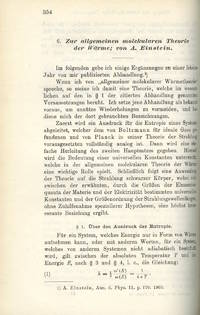
1904ref. 32820371Brown buckram. Library markings. FIRST EDITION of Einstein's fifth published paper "On the General Molecular Theory of Heat" pp. 354-362. Annalen der Physik
1915ref. 14657Leipzig and Berlin: B.G. Teubner 1915. With frontispiece portrait of Minkowski and text figures. Boards spine and corners frayed and cracking. Sammelband containing the original papers on the special and general theories of relativity with a foreword by O. Blumenthal. It is in Minkowski's famous paper Raum und Zeit Space and time that he proposes the concept of time as the fourth dimension and initiates a mathematical study that became the basis of the later development of the theory. Included here is the re-issue of that work by Einstein and Lorentz with notes by A. Sommerfeld published after Minkowski's untimely death along with other papers by the two scientists whose works led to the abandonment of space and time as separate entities. Weil 59; see Printing & the Mind of Man 401. B.G. Teubner unknown books
1911ref. 50315Leipzig: Johann Ambrosius Barth 1911. Einstein Albert 1879-1955. 1 Bemerkung zu dem Gesetz von Eötvös. In Annalen der Physik 34 1: 165-169 pp. 1910. Weil 38 Boni 35. 2 Eine beziehung zwischen dem elastischen Verhalten und der spezifischen Wärme bei festen Körpen mit einatomigem Molekül. In Annalen der Physik 34 1: 170-174 pp. 1910. Weil 39 Boni 36. 3 Bemerkungen zu den P. Hertzschen Arbeiten: "Über die mechanischen Grundlagen der Thermodynamik." In Annalen der Physik 34 1: 175-176 pp. 1910. Weil 40 Boni 37. 4 Bemerkung zu meiner Arbeit: "Eine Beziehung zwischen dem elastischen Verhalten . . ." In Annalen der Physik 34 3: p. 590. Weil 40. 5 Berichtigung zu meiner Arbeit: "Eine neue Bestimmung der Moleküldimensionen." In Annalen der Physik 34 3: p. 591. Weil 41. Leipzig: Johann Ambrosius Barth 1911. Whole volume: viii 1032 pp. 6 plates 5 folding 1 b/w/ silver photograph. Figs. Text-illust. 210 x 140 mm. Red cloth with gilt lettering on spine. First Edition. Pages are a little toned as are plates 5 and 6 otherwise Very Good. Approximate English translations of titles: 1 "Remarks on the law of Eötvös." 2 "A connection between the elastic conduct and the specific heat of solid bodies with monatomic molecule." 3 "Remarks on P. Hertz' work: 'On the mechanical foundations of thermodynamics.'" Eövtös' findings served as part of the basis of Albert Einstein's General Theory of Relativity in which the principle of equivalence acts as the keystone no. 1 above. "Einstein adds a comment on p.590 of the same journal no. 2 above. To supplement Sutherland's observation that infared eigenfrequencies of solid bodies possibly originate in the elastic vibrations of these bodies Einstein adds that electrically charged ions are the source of optical vibrations while the mututal motions of the entire molecule cause elastic vibrations." Calaprice Alice et al. An Einstein Encyclopedia. 2015. p. 291. Weil's Einstein Bibliography nos. 38 39 40 and 41. Boni's Einstein Checklist nos. 35 36 and 37. . Johann Ambrosius Barth unknown books
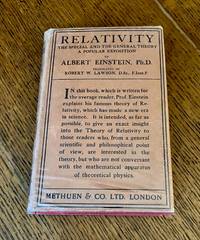
1939ref. 11847Methuen & Co. Ltd. London. 1939. TWELFTH ENGLISH EDITION. Octavo. 7.6 x 5.2 inches. Portrait frontis and five line diagrams within the text. A little foxing to the first couple of pages but overall a very good copy in the publishers red cloth with gilt lettering and ruled lines to the spine. Front board ruled and lettered in blind. Gilt stamped school coat of arms to the front panel and school prize label dated July 1939 on front pastedown endpaper. In the original dustwrapper which has some chipping to the edges but is generally clean and bright. ----- Contains a bibliography of selected works on Relativity. Methuen & Co. Ltd. London. 1939 hardcover
1954ref. 215859New York: Crown Publishers 1954. First Edition; First Printing. Hardcover. Very Good in boards. Crown Publishers hardcover
2019ref. x-0691655928Princeton Univ Pr 2019. Hardcover. New. 512 pages. 10.00x8.00x1.25 inches. Princeton Univ Pr hardcover
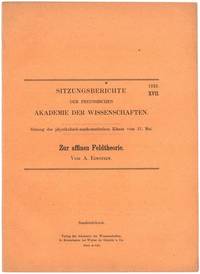
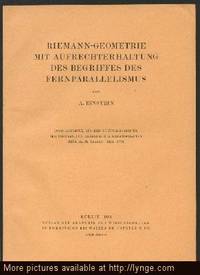
1923ref. 317401923. S.Ber. Akad. Wiss. Berl. 1923/ 8. - Berlin Verlag der Akademie der Wissenschaften 1923 8° 4 S. orig. Broschur. First edition. A fine fresh copy in the rare off-print form. Marked with an asterisk by Weil denoting a major paper. "Einstein's attempts to formulate a unified field theory stemmed from his dissatisfaction with the general relativity theory which did not adequately incorporate the electromagnetic field into the geometry of space-time. In 1918 Hermann Weyl had begun investigating the possibility of constructing a unified field theory preserving the dimensionality of space-time while formally altering its geometry making it a special case of the class known as affine geometries. Einstein's first investigation of Weyl's ideas published in the present paper introduced the notion of distant parallelism; however Einstein later rejected Weyl's theory." Weil No. 132; Schilpp--Shields No. 171; Alicke No.113; Norman Library 698; Boni 141 unknown
1928ref. 28361Berlin, Gruyter & Co., 1928. 4to. Orig. printed orange wrappers. Offprint/Sonderabruck aus Sitzungsberichten...pp. (1)-7. Fine fresh copy.
1906ref. 38833Leipzig, J. A. Barth, 1906. Contemp. hcloth. Light wear to edges. A small tear at upper part of fronthinge. ""Annalen der Physik. Vierte Folge. Band 21. Hrsg. von W.Wien und M. Planck"". VIII,1056 pp.and 9 plates. Einstein paper: pp. 583-86. Internally clean and fine. The whole volume offered.
1910ref. 29307(Leipzig, Barth, 1910). 8vo. Extracted from ""Annalen der Physik IV, Bd. 33"" pp. 1096-1104 and pp. 1105-1115. Fine and clean. Supplied with a facsimile wrapper from the offprint to the first paper.
1928ref. 28361Berlin Gruyter & Co. 1928. 4to. Orig. printed orange wrappers. Offprint/Sonderabruck aus Sitzungsberichten.pp. 1-7. Fine fresh copy. First edition of the rare Offprint still called "Abdruck" but now having separate pagination and separate printed title see Weil No. 161 where this is not mentioned.The early Offprints from "Sitzungsberichten." are called "Sonderabdruck" up to Weil No.165 including this. From Weil 166 they are called "Sonderausgabe.". - Before 161 up to 160 the Offprints do not have separate title and pagination the pagination follows the numbering in the periodical. From 166 the Offprint has both separate printed title and pagination. - So Weil Nos 161-165 is still "Abdruck" but with separate title and pagination. These facts are not mentioned in the bibliographies. unknown
1906ref. 38833Leipzig J. A. Barth 1906. Contemp. hcloth. Light wear to edges. A small tear at upper part of fronthinge. "Annalen der Physik. Vierte Folge. Band 21. Hrsg. von W.Wien und M. Planck". VIII1056 pp.and 9 plates. Einstein paper: pp. 583-86. Internally clean and fine. The whole volume offered. First edition. Einsten describes in this paper "Method for the determination of the ratio of the transversal to the longitudinal mass of the electron" an apparatus which would make it possible to determine with great accuracy the law according to which the mass of the electron changes with the velocity. - Weil No 14. hardcover
1910ref. 29307Leipzig Barth 1910. 8vo. Extracted from "Annalen der Physik IV Bd. 33" pp. 1096-1104 and pp. 1105-1115. Fine and clean. Supplied with a facsimile wrapper from the offprint to the first paper. Both works in first edition. - Weil No. 34 and 35. unknown
1918ref. 581Leipzig: Johann Ambrosius Barth 1918. 1st Edition. FIRST EDITION OF EINSTEIN'S DISCUSSION OF MACH'S PRINCIPLE a theory Einstein names and one which was historically important to the inspiration that would lead to general relativity. Mach's principle states that "local physical laws are determined by the large-scale structure of the universe" Wikipedia. To Einstein Mach's principle posited the belief that inertia originates in a kind of interaction between bodies. "So strongly did Einstein believe at that time in the relativity of inertia that in this paper he stated it as being on equal footing three principles on which a satisfactory theory of gravitation should rest: 1. The principle of relativity as expressed by general covariance. 2. The principle of equivalence. 3. Mach's principle the first time this term entered the literature" Pais The Science of Albert Einstein 287. Einstein brought Mach's principle into mainstream physics while working on general relativity. Indeed it was Einstein who first coined the phrase Mach's principle. Weil 96. Boni 100. Collected Papers 1918e. ALSO IN THIS VOLUME Max Born's Electron theory of natural optic rotation processes in isotropic and anisotropic liquids pp. 177-240. CONDITION & DETAILS: Leipzig: Johann Ambrosius Barth. 8vo. 8 x 5 inches; 200mm x 125mm; Full volume with front original wrap of each issue 1-8 is bound in the rear. Handsomely rebound in three-quarter calf over marbled paper boards; four raised bands at the spine; gilt-lettered and tooled. Very tightly bound. Ex-libris with five numbers written in a light hand on the title page and a very occasional round stamp within. Very good condition. Johann Ambrosius Barth hardcover
1921ref. 023476New York: Henry Holt and Company. Translated by Robert W. Lawson M.Sc. There is an etching of Einstein dated 1920. Ink name on flyleaf. Tiny piece of cloth at top of spine. xiii 168 pp. Some darkening on blank leaf and back of frontis. With five diagrams and with appendix III "The Experimental Confirmation of the General Theory of Relativity". 1920 on copyright page 1921 on front page. . Very Good. Hardcover. 1921. Henry Holt and Company hardcover
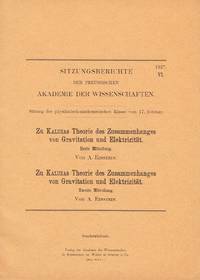
1419ref. 5735KBerlin: Verlag der Akademie der Wissenschaften in commission at Georg Reimer Reichsdruckerei 14th March 1927. Near Fine. Imperial 8vo 25 4: 18 2 cm. 8 pages numbered 23-30. Letterpress on machine paper in original publisher’s brochure on orange stock with black title printing. First offprint in the original wrappers of Einstein's paper on the important findings of German mathematician and physicist Theodor Kaluza about gravitation and electricity. - Content: Kaluza ""attempted to unify Einstein's theory of gravity with Maxwell's theory of light by mixing them in a fifth dimension"". Together with the Swedish theoretical physicist Oskar Klein Kaluza produced the „Kaluza-Klein field equations"" Calaprice Einstein Almanac 135. Their insights however were ""neglected for many years as attention was directed towards quantum mechanics. Their idea that fundamental forces can be explained by additional dimensions did not re-emerge until string theory was developed"" Wikipedia. - Condition: Mint. - Reference: Boni-Russ-L. 170; Schilpp-Shields 212; Weil 156. Verlag der Akademie der Wissenschaften (in commission at Georg Reimer [Reichsdruckerei]) unknown
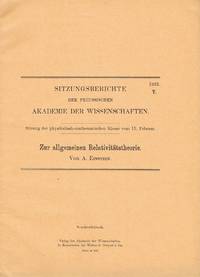
1923ref. 5729KBerlin: Verlag der Akademie der Wissenschaften in commission at Walter de Gruyter Reichsdruckerei 12th March 1923. Near Fine. Imperial 8vo 25 4: 18 2 cm. 8 pages numbered 34-38 1. Letterpress on machine paper in original publisher’s brochure on orange stock with black title printing. First offprint in the original wrappers. - Content: In this paper Einstein accepted that his introduction of the 'cosmological constant' in 1917 in order to allow for the possibility of a static universe may have been a mistake. - Condition: Very fine. - Rarity: ABPC 1973ff. and APO 1988ff. record 4 copies of this edition at auction 2012 2x 2011 1994. - Reference: Boni-Russ-L. 140; Schilpp-Shields 174; Weil 131. Verlag der Akademie der Wissenschaften (in commission at Walter de Gruyter [Reichsdruckerei]) unknown
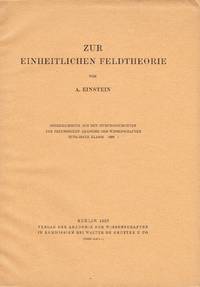
1929ref. 5739K-2Berlin: Verlag der Akademie der Wissenschaften in commission at Georg Reimer Reichsdruckerei 30th January 1929. Near Fine. Imperial 8vo 25 4: 18 2 cm. 8 pages. Letterpress on machine paper in original publisher’s brochure on orange stock with black title printing. First offprint in the original wrappers of this important paper by Einstein formulating groundbreaking developments towards a unified field theory. - Content: »On The Unified Field Theory« is one of Einstein's last scientific core works. According to Weil ""This paper represents a new development which was immediate news. A translation by L. L. Whyte appeared in the London Times of Feb. 4 1929. It was quoted in full in ""Observatory"" vol. 52 under the title ""New Field Theory"" pp.82-87 and 1930 pp.11-118."" In 1928 Einstein embarked on a new approach to a unified field theory involving what he called „distant parallelism“. By early 1929 he had solved the main problems involved in writing down field equations for his unified field theory. On the day of offical publication of the third of a formidably technical series of 9 articles on the theory excited headlines appeared in newspapers around the world. - cf. Parkinson Breakthroughs p.279. - Condition State: Mint uncut thus unread. - The list of academy offprints on the rear side of the cover states present offprint not in last place. All offprints listed later were printed in 1929 though. The typeset of all pages is identical to other authentified offprints of this papers. This indicates that our copy is indeed a first offprint but presumably with a later cover. - Reference: Alicke 141; Boni-Russ-L. 183; Norman Collection I 700; Printing and the Mind of Man 416 „Principal Work“; Schilpp-Shields 226; Weil 165. Verlag der Akademie der Wissenschaften (in commission at Georg Reimer [Reichsdruckerei]) unknown
1913ref. 38832Berlin, J.A. Barth, 1913. Later full cloth. ""Annalen der Physik. Vierte Folge. Band 40. Hrsg. von W. Wien und M. Planck."", VIII,1056 pp., 1 plate. Einstein paper: pp. 551-60. Internally fine and clean. The whole volume offered.
1913ref. 38832Berlin J.A. Barth 1913. Later full cloth. "Annalen der Physik. Vierte Folge. Band 40. Hrsg. von W. Wien und M. Planck." VIII1056 pp. 1 plate. Einstein paper: pp. 551-60. Internally fine and clean. The whole volume offered. First edition. In this paper "Some arguments for the existance of a molecular agitation at the absolute zero point" Einstein derives Planck's radiation law without the usual discontinuity assumptions.The volume contains also papers by W. Pauli Stark Nordström and others. - Weil No 53. hardcover
1909ref. 662931909. Physik. Zschr. 10. - Leipzig Verlag von S. Hirzel 1909 4° XXII 2 1040 pp. mit Textabbildungen und 26 Tafeln Halbleinenband d.Zt.; St.a.Tit. feines Expl. A LANDMARK W. PAULI FIRST EDITION "of this extensive paper given as lecture before the 81st assembly of the "Gesellschaft Deutscher Naturforscher" in Salzburg on 21st September 1909. He spoke on "The Development of Our View of the Nature and Constitution of Radiation" a topic that embraced both relativity and quanta. Among those who attended Einstein's lecture were some of the world's foremost physicists. In Einstein's austere opinion his address regarded strictly as a work of science was of little importance since as he writes to a co-worker it contained nothing new. Einstein was being overmodest. Besides to many in Einstein's audience and it should be born in mind that it was the year after Minkowski's stirring introduction of the concept of the fourth dimension this Lecture came as a revelation. The occasion was important for Einstein too. He had been working for years in a sort of scientific exile and his curiosity as to what great scientists were like in face-to-face discussion was at least as great as their curiosity about him. His confidence in himself was certainly not harmed when he found that he was able to hold his own easily in their company. Moreover at this congress Einstein first met Planck. In addition he made new'lasting friendships leading to a voluminous scientific correspondence. Amongst those attending the congress were Max von Laue Max Born. Arnold Sommerfeld Hasnohrl. Ladenburg. Max von Laue was to be the first to publish in 1911 the first text-book on relativity theory. All of them are present in this issue with scientific papers of their own." Walter Alicke Weil No. 30; Schilpp-Shields No. 30; Hoffmann Einstein p. 93; Alicke Nr. 34 unknown
ref. 9732[N° 1]. (1932). Hans Arp, Willi Baumeister, Etienne Beothy, Alexandre Calder, Robert Delaunay, Sonia Delaunay, William Einstein, Michel Seuphor, Otto Freundlich, Albert Gleizes, Jean Hélion, Auguste Herbin, Frank Kupka, Moholy-Nagy, Piet Mondrian, Antoine Pevsner, Enrico Prampolini, Kurt Seligmann, Kurt Schwitters, Henri Stazewski, Sophie Taeuber-Arp, Léon Tutundjian, Georges Valmier, Theo van Doesburg, Jacques Villon, Edward Wadsworth. // Bel exemplaire.
ref. H3992Berlin Akademie der Wissenschaften 1919 In: Sitzungsberichte der Königl.Preuss. Akademie der Wissenschaften Band 1919/2. 4to. S.710-711. Anbei: Grommer J.: Beitrag zum Energiesatz in der allgemeinen Relativitätstheorie. S.860-862. Born M. u.a. Halbleinenband der Zeit leicht berieben Bibl.-Nr.am Rücken Original-Broschur miteingebunden unaufgeschnitten gutes Exemplar. unknown
1930ref. 80796Calmann Lévy | Paris 1930 | 22 x 27.50 cm | broché
1927ref. 433031927. Offprint from Sitzungsberichte der preussischen Akademie der Wissenschaften 1927. 235-245pp. 255 x 183 mm. Original printed wrappers. Fine. On the problem of motion in general relativity theory; a follow-up to his and Grommer's paper of the same title published earlier in 1927. Weil Albert Einstein Bibliography 160. unknown