3 003 résultats
réf. H3996Berlin Akademie der Wissenschaften 1923 In: Sitzungsberichte der Königl.Preuss. Akademie der Wissenschaften Band 1923/2. 4to. S.32-38; S. 76-77; S.137-140; S. 359-364. Halbleinenband der Zeit leicht berieben Bibl.-Nr.am Rücken Original-Broschur miteingebunden unaufgeschnitten gutes Exemplar. unknown
réf. 72535Braunschweig Friedrich Vierweg & Sohn; Berlin J. Springer 1924. 8vo 22.8 x 15.4 cm. 6 pp. Original printed wrappers. = On the theory of radiometer forces. "The Crookes radiometer also known as a light mill consists of an airtight glass bulb containing a partial vacuum with a set of vanes which are mounted on a spindle inside. The vanes rotate when exposed to light with faster rotation for more intense light providing a quantitative measurement of electromagnetic radiation intensity. The reason for the rotation was a cause of much scientific debate in the ten years following the invention of the device" Wikipedia. James Clerk Maxwell first gave a wrong then a correct explanation. However some subtleties still needed to be solved and in 1924 Albert Einstein had a crack at it "A partial explanation is that gas molecules hitting the warmer side of the vane will pick up some of the heat bouncing off the vane with increased speed. Giving the molecule this extra boost effectively means that a minute pressure is exerted on the vane. The imbalance of this effect between the warmer black side and the cooler silver side means the net pressure on the vane is equivalent to a push on the black side and as a result the vanes spin round with the black side trailing. The problem with this idea is that while the faster moving molecules produce more force they also do a better job of stopping other molecules from reaching the vane so the net force on the vane should be the same. The greater temperature causes a decrease in local density which results in the same force on both sides. Years after this explanation was dismissed Albert Einstein showed that the two pressures do not cancel out exactly at the edges of the vanes because of the temperature difference there. The force predicted by Einstein would be enough to move the vanes but not fast enough" Wikipedia. Contained first paper in: Zeitschrift für Physik volume 271. The complete issue in its original wrappers. Front wrapper slightly spotted at the fore and bottom edges. Volume number written on spine. A very good clean copy. Weil 139. unknown
1930réf. 81582Calmann Lévy | Paris 1930 | 22 x 27.50 cm | broché
réf. a108418Leipzig 1917 first edition. Hirzel. One complete issue of PHYSIKALISCHE ZEITSCHRIFT for 15 Marz 1917. no 6. 18. Jahrgang. 4to. Original cover gone now in later plain wraps. In German. Issue paginated 117-152. Einstein paper pp. 121-128. One of Einstein's great achievements in quantum mechanics. Near Fine. clean no wear no owner marks. Pictures available on request. . paperback
1979réf. 148235New Jersey: Princeton University Press 1979. First edition early printing of this curated collection of Einstein’s writings. Octavo original leather frontispiece. Boldly signed by Helen Dukas and Banesh Hoffman on the front free endpaper. Helen Dukas 1896–1982 was Albert Einstein’s longtime secretary and trusted confidante serving in that role from 1928 until his death in 1955. Deeply involved in preserving and organizing Einstein’s legacy she co-edited several collections of his writings and letters and played a key role in curating the Einstein Archives at the Institute for Advanced Study in Princeton. Banesh Hoffmann 1906–1986 was a physicist and mathematician who collaborated with Albert Einstein and made significant contributions to relativity and quantum mechanics. Near fine in a near fine price-clipped dust jacket. Uncommon signed by both contributors. Albert Einstein: The Human Side 1979 edited by Helen Dukas and Banesh Hoffmann offers a unique perspective on Einstein beyond his scientific achievements by compiling his personal letters reflections and anecdotes. Unlike traditional biographies that focus on his contributions to physics this collection highlights Einstein’s thoughts on philosophy politics ethics and personal relationships revealing his wit humility and deep moral convictions. Through carefully selected writings the book presents Einstein as both a brilliant scientist and a deeply introspective individual who grappled with the social and ethical implications of his work. Princeton University Press hardcover
1911réf. 50315Leipzig: Johann Ambrosius Barth 1911. Einstein Albert 1879-1955. 1 Bemerkung zu dem Gesetz von Eötvös. In Annalen der Physik 34 1: 165-169 pp. 1910. Weil 38 Boni 35. 2 Eine beziehung zwischen dem elastischen Verhalten und der spezifischen Wärme bei festen Körpen mit einatomigem Molekül. In Annalen der Physik 34 1: 170-174 pp. 1910. Weil 39 Boni 36. 3 Bemerkungen zu den P. Hertzschen Arbeiten: "Über die mechanischen Grundlagen der Thermodynamik." In Annalen der Physik 34 1: 175-176 pp. 1910. Weil 40 Boni 37. 4 Bemerkung zu meiner Arbeit: "Eine Beziehung zwischen dem elastischen Verhalten . . ." In Annalen der Physik 34 3: p. 590. Weil 40. 5 Berichtigung zu meiner Arbeit: "Eine neue Bestimmung der Moleküldimensionen." In Annalen der Physik 34 3: p. 591. Weil 41. Leipzig: Johann Ambrosius Barth 1911. Whole volume: viii 1032 pp. 6 plates 5 folding 1 b/w/ silver photograph. Figs. Text-illust. 210 x 140 mm. Red cloth with gilt lettering on spine. First Edition. Pages are a little toned as are plates 5 and 6 otherwise Very Good. Approximate English translations of titles: 1 "Remarks on the law of Eötvös." 2 "A connection between the elastic conduct and the specific heat of solid bodies with monatomic molecule." 3 "Remarks on P. Hertz' work: 'On the mechanical foundations of thermodynamics.'" Eövtös' findings served as part of the basis of Albert Einstein's General Theory of Relativity in which the principle of equivalence acts as the keystone no. 1 above. "Einstein adds a comment on p.590 of the same journal no. 2 above. To supplement Sutherland's observation that infared eigenfrequencies of solid bodies possibly originate in the elastic vibrations of these bodies Einstein adds that electrically charged ions are the source of optical vibrations while the mututal motions of the entire molecule cause elastic vibrations." Calaprice Alice et al. An Einstein Encyclopedia. 2015. p. 291. Weil's Einstein Bibliography nos. 38 39 40 and 41. Boni's Einstein Checklist nos. 35 36 and 37. . Johann Ambrosius Barth unknown
1909réf. 003223Leipzig: J. A. Barth 1909. Only the first paper is with J. Laub. Contemporary three-quarter cloth marbled boards. First Edition. Very Good. J. A. Barth hardcover
1915réf. 14657Leipzig and Berlin: B.G. Teubner 1915. With frontispiece portrait of Minkowski and text figures. Boards spine and corners frayed and cracking. Sammelband containing the original papers on the special and general theories of relativity with a foreword by O. Blumenthal. It is in Minkowski's famous paper Raum und Zeit Space and time that he proposes the concept of time as the fourth dimension and initiates a mathematical study that became the basis of the later development of the theory. Included here is the re-issue of that work by Einstein and Lorentz with notes by A. Sommerfeld published after Minkowski's untimely death along with other papers by the two scientists whose works led to the abandonment of space and time as separate entities. Weil 59; see Printing & the Mind of Man 401. B.G. Teubner unknown
1903réf. 003206Leipzig: J.A.Barth 1903. Spine ends lightly rubbed; former owner's ink stamp on title page. First Edition. Contemporary Red Cloth. Very Good. J.A.Barth Hardcover
1902réf. 003205Leipzig: J. A. Barth 1902. Spine edges lightly rubbed; former owner's ink stamp on title page. First Edition. Contemporary Red Cloth. Very Good. J. A. Barth Hardcover
réf. a90182Leipzig 1908 Hirzel. first edition. Physikalische Zeitschrift. One full year of this semi-monthly German publication bound in one hardcover volume. Articles by many of the great names in physics and mathematics xix 928p. text illustrations 8 plates. "Eine neue Elektrostatische Methode zur Messung kleier Elektricitatsmengen" by Albert Einstein is on pp. 216-217; "Atomzerfall und Serienspektren "; Hahn and Meitner "Ueber Absorption der B-Strahlen" Planck "Theorie Dispersion" Lord Kelvin Helmoltz more. Cover tips and backstrip dark brown leather with black boards. Institute name stamp on front blank and blind stamp on titlepage but no other ownership marks no pocket no spine numbers. Binding very secure; hinges not cracked in or out. Text clean. VG plus light wear on cover spine edges and extreme tips. . hardcover
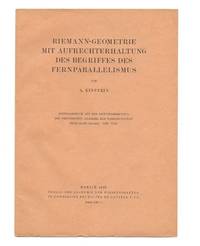
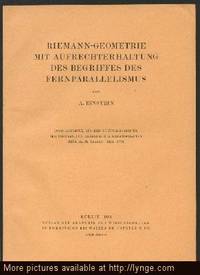
1928réf. 33903Berlin: Verlag der Akademie der Wissenschaften 1928. First Thus. Soft cover. First Thus. Soft cover. Einstein Albert 1879-1955. Riemann-Geometrie mit Aufrechterhaltung des Begriffes des Fernparallelismus. Berlin: Verlag der Akademie der Wissenschaften 1928. 4to. 7pp. Orange wrappers. A very fine copy of this uncommon offprint. First Edition; the rare off-print from the "Sitzungsberichten". 'The general relativity theory splendidly justified his work. In this mathematical apparatus developed from Riemann's address Einstein found the frame to fit his physicals ideas his cosmology and cosmogeny; and the spirit of Riemann's address was just what physics needed: the metric structure determined by physical data'. -cf. DSB XI 447-456 RiemannWeil No.161; Schilpp-Shields No. 217; Alicke No. 139. The early Offprints from "Sitzungsberichten." are called "Sonderabdruck" up to Weil No.165 including this. From Weil 166 they are called "Sonderausgabe.". - Before 161 up to 160 the Offprints do not have separate title and pagination the pagination follows the numbering in the periodical. From 166 the Offprint has both separate printed title and pagination. - So Weil Nos 161-165 is still "Abdruck" but with separate title and pagination. Verlag der Akademie der Wissenschaften unknown
réf. 031697Toronto: Ryerson Book. Good Book Condition. Hardcover. First Canadian Edition. First Canadian Edition from the Methuen British sheets; and with a "Note to the Third Edition" in the Preface. Methuen booklist in Addendum. Good only. Text in red cloth cover with slight sunning to spine and wear to head and foot of spine. Front hinge started rear hinge starting previous owner's stamp to ffep pages lightly tanned. No date possibly 1920. Text clean binding strong. Our rating system: 1. Fine; 2. Near Fine; 3. Very Good; 4. Good; 5. Fair. Ryerson Hardcover
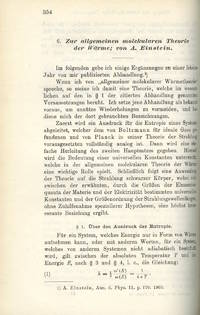
1904réf. 32820371Brown buckram. Library markings. FIRST EDITION of Einstein's fifth published paper "On the General Molecular Theory of Heat" pp. 354-362. Annalen der Physik
1915réf. 14657Leipzig and Berlin: B.G. Teubner 1915. With frontispiece portrait of Minkowski and text figures. Boards spine and corners frayed and cracking. Sammelband containing the original papers on the special and general theories of relativity with a foreword by O. Blumenthal. It is in Minkowski's famous paper Raum und Zeit Space and time that he proposes the concept of time as the fourth dimension and initiates a mathematical study that became the basis of the later development of the theory. Included here is the re-issue of that work by Einstein and Lorentz with notes by A. Sommerfeld published after Minkowski's untimely death along with other papers by the two scientists whose works led to the abandonment of space and time as separate entities. Weil 59; see Printing & the Mind of Man 401. B.G. Teubner unknown books
1911réf. 50315Leipzig: Johann Ambrosius Barth 1911. Einstein Albert 1879-1955. 1 Bemerkung zu dem Gesetz von Eötvös. In Annalen der Physik 34 1: 165-169 pp. 1910. Weil 38 Boni 35. 2 Eine beziehung zwischen dem elastischen Verhalten und der spezifischen Wärme bei festen Körpen mit einatomigem Molekül. In Annalen der Physik 34 1: 170-174 pp. 1910. Weil 39 Boni 36. 3 Bemerkungen zu den P. Hertzschen Arbeiten: "Über die mechanischen Grundlagen der Thermodynamik." In Annalen der Physik 34 1: 175-176 pp. 1910. Weil 40 Boni 37. 4 Bemerkung zu meiner Arbeit: "Eine Beziehung zwischen dem elastischen Verhalten . . ." In Annalen der Physik 34 3: p. 590. Weil 40. 5 Berichtigung zu meiner Arbeit: "Eine neue Bestimmung der Moleküldimensionen." In Annalen der Physik 34 3: p. 591. Weil 41. Leipzig: Johann Ambrosius Barth 1911. Whole volume: viii 1032 pp. 6 plates 5 folding 1 b/w/ silver photograph. Figs. Text-illust. 210 x 140 mm. Red cloth with gilt lettering on spine. First Edition. Pages are a little toned as are plates 5 and 6 otherwise Very Good. Approximate English translations of titles: 1 "Remarks on the law of Eötvös." 2 "A connection between the elastic conduct and the specific heat of solid bodies with monatomic molecule." 3 "Remarks on P. Hertz' work: 'On the mechanical foundations of thermodynamics.'" Eövtös' findings served as part of the basis of Albert Einstein's General Theory of Relativity in which the principle of equivalence acts as the keystone no. 1 above. "Einstein adds a comment on p.590 of the same journal no. 2 above. To supplement Sutherland's observation that infared eigenfrequencies of solid bodies possibly originate in the elastic vibrations of these bodies Einstein adds that electrically charged ions are the source of optical vibrations while the mututal motions of the entire molecule cause elastic vibrations." Calaprice Alice et al. An Einstein Encyclopedia. 2015. p. 291. Weil's Einstein Bibliography nos. 38 39 40 and 41. Boni's Einstein Checklist nos. 35 36 and 37. . Johann Ambrosius Barth unknown books
1954réf. 215859New York: Crown Publishers 1954. First Edition; First Printing. Hardcover. Very Good in boards. Crown Publishers hardcover
2019réf. x-0691655928Princeton Univ Pr 2019. Hardcover. New. 512 pages. 10.00x8.00x1.25 inches. Princeton Univ Pr hardcover
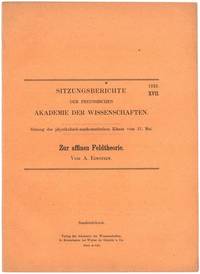
1923réf. 317401923. S.Ber. Akad. Wiss. Berl. 1923/ 8. - Berlin Verlag der Akademie der Wissenschaften 1923 8° 4 S. orig. Broschur. First edition. A fine fresh copy in the rare off-print form. Marked with an asterisk by Weil denoting a major paper. "Einstein's attempts to formulate a unified field theory stemmed from his dissatisfaction with the general relativity theory which did not adequately incorporate the electromagnetic field into the geometry of space-time. In 1918 Hermann Weyl had begun investigating the possibility of constructing a unified field theory preserving the dimensionality of space-time while formally altering its geometry making it a special case of the class known as affine geometries. Einstein's first investigation of Weyl's ideas published in the present paper introduced the notion of distant parallelism; however Einstein later rejected Weyl's theory." Weil No. 132; Schilpp--Shields No. 171; Alicke No.113; Norman Library 698; Boni 141 unknown
1928réf. 28361Berlin, Gruyter & Co., 1928. 4to. Orig. printed orange wrappers. Offprint/Sonderabruck aus Sitzungsberichten...pp. (1)-7. Fine fresh copy.
1906réf. 38833Leipzig, J. A. Barth, 1906. Contemp. hcloth. Light wear to edges. A small tear at upper part of fronthinge. ""Annalen der Physik. Vierte Folge. Band 21. Hrsg. von W.Wien und M. Planck"". VIII,1056 pp.and 9 plates. Einstein paper: pp. 583-86. Internally clean and fine. The whole volume offered.
1928réf. 28361Berlin Gruyter & Co. 1928. 4to. Orig. printed orange wrappers. Offprint/Sonderabruck aus Sitzungsberichten.pp. 1-7. Fine fresh copy. First edition of the rare Offprint still called "Abdruck" but now having separate pagination and separate printed title see Weil No. 161 where this is not mentioned.The early Offprints from "Sitzungsberichten." are called "Sonderabdruck" up to Weil No.165 including this. From Weil 166 they are called "Sonderausgabe.". - Before 161 up to 160 the Offprints do not have separate title and pagination the pagination follows the numbering in the periodical. From 166 the Offprint has both separate printed title and pagination. - So Weil Nos 161-165 is still "Abdruck" but with separate title and pagination. These facts are not mentioned in the bibliographies. unknown
1906réf. 38833Leipzig J. A. Barth 1906. Contemp. hcloth. Light wear to edges. A small tear at upper part of fronthinge. "Annalen der Physik. Vierte Folge. Band 21. Hrsg. von W.Wien und M. Planck". VIII1056 pp.and 9 plates. Einstein paper: pp. 583-86. Internally clean and fine. The whole volume offered. First edition. Einsten describes in this paper "Method for the determination of the ratio of the transversal to the longitudinal mass of the electron" an apparatus which would make it possible to determine with great accuracy the law according to which the mass of the electron changes with the velocity. - Weil No 14. hardcover
1910réf. 29307Leipzig Barth 1910. 8vo. Extracted from "Annalen der Physik IV Bd. 33" pp. 1096-1104 and pp. 1105-1115. Fine and clean. Supplied with a facsimile wrapper from the offprint to the first paper. Both works in first edition. - Weil No. 34 and 35. unknown
1910réf. 29307(Leipzig, Barth, 1910). 8vo. Extracted from ""Annalen der Physik IV, Bd. 33"" pp. 1096-1104 and pp. 1105-1115. Fine and clean. Supplied with a facsimile wrapper from the offprint to the first paper.