2 965 résultats
1918réf. 50342Leipzig 1918. Prinzipielles zur allgemeinen relativitätstheorie. In Annalen der Physik 55 241-244 pp. Red cloth with gilt lettering on the spine. Bookbinder's embossed stamp of ffep. Whole volume: 632 pp. 1 folding plate. Figs. Text-illust. 210 x 130 mm. Very good. Approximate English translation of title: "On the foundations of the general theory of relativity." "Here we are given the first new presentation of the foundations of general relativity since the developments of March 1916 when Einstein gave his first systematic exposition." p. 300. Calaprice Kennefick & Shulmann. An Einstein Encyclopedia. 2015. Weil's Einstein Bibliography no. 96. Boni's Checklist no. 100. Also in this volume: Born Max 1882-1970. Elektronentheorie des Natürlichen optischen Drehungs vermögens isotroper und anisotroper Flüssigkeiten pp. 175-240. Approximate Eng. translation of title: "Electron theory of the natural optical rotation ability of isotropic and anisotropic liquids". Max Born 1882-1970 was a German physicist and mathematician who was instrumental in the development of quantum mechanics. He also made contributions to solid-state physics and optics as well as supervised a number of notable physicists in the 1920s and 1930s. Born won the 1954 Nobel Prize in Physics "for his fundamental research in quantum mechanics especially in the statistical interpretation of the wave function." In 1919 a chance meeting with Fritz Haber 1868-1934 led to the discussion of how an ionic compound is formed when a metal reacts with a halogen - a process now known as the Born-Haber cycle Wikipedia. . unknown books
1911réf. 50424Leipzig: Johann Ambrosius Barth 1911. The Genesis of General Relativity Einstein Albert 1879-1955. 1 Elementare betrachtungen über die thermische molekularbewengung in festen Körpern. In Annalen der Physik 35 9: 679-94 pp. Weil 42. 2 Über den Einfluß der Schwerkraft auf die Ausbreitung des lichtes. In Annalen der Physik 35 10: 898-908 pp. Weil 43. Red cloth gilt spine lettering. Figs. Text-illust. 214 x 140 mm. Whole volume: viii 1040 pp. 6 plates 3 b/w silver photos 1 colorized 2 folding. Very good. Approximate English translations of titles: 1 "Elementary considerations about thermal molecular motion in solid bodies" and 2 "On the influence of gravity on the propagation of light." "Einstein returns to his thoughts on gravitation and discusses his ideas on the static gravitational field no. 1 above advancing the "half-shift" prediction of the deflection of light by a massive body such as the Sun. In his early papers on the subject . . . he used two important features: the principle of equivalence and the role of the speed of light. In this paper he takes a broader perspective saying that if a light beam is bent in an accelerating frame of reference then if the theory is correct it must also be besnt by gravity by exactly the equivalent amount." Calaprice An Einstein Encyclopedia. "An important conclusion of this paper is that the velocity of light in a gravitational field is a function of the place. The equation: c = c01 / c2 signifies that there exists a relationship between the velocity of light and the gravitational potential; the latter influences the first." Weinstein Einstein's 1912-1913 struggles with Gravitation Theory: Importance of Static Gravitational Fields Theory. "Here no. 2 above Einstein continues the work he had begun in 1907 on the specific heat of solids where the heat agitation of solids was reduced to a monochromatic oscillation of the atom and the specific heat was determined based on the quantum treatment of an oscillator in a radiation field. He explains the discrepencies between his formula and the measurements at low temperatures" Calaprice An Einstein Encyclopedia. Weil's Einstein Bibliography nos. 42 and 43. Boni's Einstein Checklist nos. 38 39. . Johann Ambrosius Barth unknown books
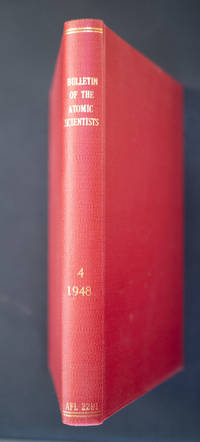
1948réf. 6625Chicago: The Atomic Scientists of Chicago 1948. Original edition. Ex-library. Very Good. 28 cm; 384 pages. Cloth-bound volume of 12 issues. Duplicate surplus stamp of Library of Congress on front free endpaper. Later owner's stamp on free endleaves blacked out. Lively forum of discussion of various scientific social and political implications of atomic energy as the post-war radioactive dust settled over the Pacific and wherever else open-air tests of atomic weaponry took place. Opens with Einstein's "Plea for International Understanding." Issue #2 features a written debate between Einstein and four Soviet scientists Semyonov Vavilov Frumkin and Ioffe. A scenario describes the potential effect of an atomic bomb on Washington DC. Justice William O. Douglas contributes "Democracy and Communism." Harry Truman presents a "Message to the Atomic Scientists." Other contributors include Cardinal Cushing Thomas E. Dewey Max von Laue and many other scientists and statesmen involved in the post-war debates The Atomic Scientists of Chicago hardcover books
1913réf. 15188Leipzig Berlin: D. G. Teubner 1913. First edition. Wraps as issued. Very Good. Leipzig: Berlin Teubner 1913. First edition in original yellow wraps. 89 pp. Very good. Small chip at heel of spine else an exceptional copy. Fortschritte der Mathematischen Wissenschaften in Monographien Heft 2 First edition of this pivotal work; 3 articles by Lorentz; the famous 2 articles by Einstein 'Zur Elektrodynamik bewegter Körper' 1905; Minkowski's article 'Raum und Zeit' 1908 in which paper he proposes "the concept of time as the fourth dimension. With new notes by A. Sommerfeld 5 pp and foreword by O. Blumenthal series editor. D. G. Teubner paperback
réf. H3995Berlin Akademie der Wissenschaften 1922 In: Sitzungsberichte der Königl.Preuss. Akademie der Wissenschaften Band 1922/2. 4to. S.18-22; S.448-449. Weitere Berichte von: Laue v. und Gordon W.: Ein Verfahren zur Bestimmung der Wärmeleitfähigkeit bei Glühtemperaturen. S.118-126. Laue von: Die Bedeutung des Nullkegels in der allgemeinen Relativitätstheorie. S.127-136 Planck Max: Über die freie Energie von Gasmolekülen mit beliebiger Geschwindigkeitsverteilung. S.63-71 u.a. Halbleinenband der Zeit leicht berieben Bibl.-Nr.am Rücken Original-Broschur miteingebunden unaufgeschnitten gutes Exemplar. unknown
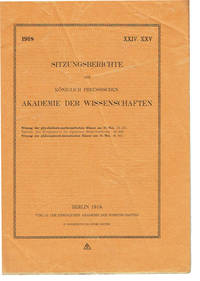
1918réf. 5721KBerlin: Verlag der Königlichen Akademie der Wissenschaften in commission at Georg Reimer Reichsdruckerei 30th May 1918. Near Fine. Imperial 8vo 26 5: 19 cm. 11 pages numbered 448-459. Letterpress on machine paper in original publisher’s brochure on orange-coloured stock with black title printing. First journal issue in the original printed wrappers of Einstein's paper about the energy of a gravitational field. – Contents: ""Einstein in this present paper answers criticisms of his conservation law in general relativity and the pseudotensor used to express it first expressed in »Hamiltonsche Prinzip und allgemeine Relativitatstheorie« 1916. He argues that an integral form of the law is appropriate and shows that the integral of a closed system's total energy is invariant and conserved and can be measured only far from the source. The pseudotensor played the key role in his analysis of gravitational waves."" Einstein Encyclopaedia – Condition: Some pages crease due to handling and reading otherwise fine uncut and therefore unread copy. – Reference: Boni N.: A bibliographical checklist and index to the published writings of Albert Einstein 109; The Collected Papers of Albert Einstein. Volume 7 9; Shields M. C.: Bibliography der Schriften Einsteins. In: Schilpp P. A.: Albert Einstein als Philosoph und Naturforscher 118; Weil E.: Albert Einstein. A bibliography of his scientific papers 1901-1930 99; Calaprice A.: An Einstein Encyclopaedia p. 300. Verlag der Königlichen Akademie der Wissenschaften (in commission at Georg Reimer [Reichsdruckerei]) unknown
1930réf. 80796Paris: Calmann Lévy 1930. Fine. Calmann Lévy Paris 1930 22 x 27.50 cm broché First edition of this issue of the important journal dealing notably with archaeology fine arts and ethnography with Georges Bataille and Carl Einstein as principal editors. Very handsome copy. Contributions by Heinrich Ehl: ""L'heure de naissance de l'art européen occidental"" Georges Bataille ""La mutilation sacrificielle et l'oreille coupée de Vincent Van Gogh"" Michel Leiris: ""Le ""caput mortuum"" ou la femme de l'alchimiste"" Jean Bourdeillette: ""Franz Xaver Messerschmidt"" Zdenko Reich: ""Le massacre des porcs"" Carl Einstein: ""L'enfance néoloithique Hans Arp"" Jacques Prévert Maurice Leenhardt. Issue illustrated with photographs by Jacques-André Boiffard Calmann Lévy unknown
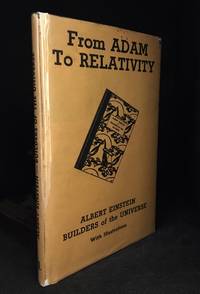
réf. 129894Los Angeles: U.S. Library Association Inc. 1932 1st edition. Hardcover 96pp. Near fine in very good dust jacket. Blue and white patterned cloth in a printed yellow dust jacket. Illustrations. The dust jacket is price-clipped and has minor edgewear. This is as nice a copy as you will ever see. From ADAM to RELATIVITY. The construction of the world and how its ideas have changed told by the great thinkers in their own words with illustrations. Science. U.S. Library Association, Inc. Hardcover
1902réf. 49501Leipzig, J. A. Barth, 1902. 8vo. Bound in contemporary half calf with five raised bands and gilt lettering to spine. In """"Annalen der Physik. Vierte Folge. Band 9."". Entire volume offered.
1923réf. 38826Berlin, Verlag der Akademie der Wissenschaften, 1923. 4to. Uncut and partly unopened in orig. wrappers to issue XXVIII-XXIV of ""Sitzungsberichte der Preussischen Akademie der Wissenschaften"". Wrappers with nicks and tears, especilly frontwrapper with marginal loss. Die Energieschwankungen...pp. 350-354. - Bemerkung zu Quantenstatistik...pp. 355-58.- Bietet die Feldtheorie...pp. 359-364. - Zur Theorie der von glühende...pp. 334-348.
1914réf. 38840Braunschweig, Vieweg & Sohn, 1914. Later full cloth. A stamp to the general titlepage. IX,1072"414 pp., textillustrations. ""Verhandlungen der Deutschen Physikalischen Gesellschaft im Jahre 1914. Sechzehnter Jahrgang. Hrsg. von Karl Scheel."" Einstein paper pp. 820-828. Internally clean and fine. The whole volume offered
1903réf. 47072Leipzig, Johann Ambrosius Barth, 1903. Contemp. hcloth. Handwritten paperlabel on spine. In: ""Annalen der Physik. Vierte Folge. Band 11. Herausgegeben von Paul Drude."". VIII,1144pp. and 6 plates. (Entire volume offered). The Einstein paper: pp. 170-187. Faint signs of dampstains in outer margins on a few leaves.
1912réf. 38839Leipzig, J.A. Barth, 1912. Bound in two contemp. hcalf, richly gilt spine and one later full cloth. A library stamp on the first volume. ""Annalen der Physik. Vierte Folge. Band 37 (und) 38. Hrsg. von W. Wien und M. Planck."" VIII,1048"VIII,1064 pp., 5+8 plates. Einstein papers: pp. 832-38 (vol.37), pp. 881-84 (Nachtrag vol. 38) pp. 443-458 (vol. 38) p. 888 (vol. 38) pp. 1059-1064 (vol. 38)" Planck: pp. 642-656. Internally fine and clean. Both volumes offered.
1906réf. 46956(Leipzig, Johann Ambrosius Barth, 1906). No wrappers. Extracted from ""Annalen der Physik"" Vierte Folge. Bd. 20. Pp. 199-206. Clean and fine.
1914réf. 38840Braunschweig Vieweg & Sohn 1914. Later full cloth. A stamp to the general titlepage. IX1072;414 pp. textillustrations. "Verhandlungen der Deutschen Physikalischen Gesellschaft im Jahre 1914. Sechzehnter Jahrgang. Hrsg. von Karl Scheel." Einstein paper pp. 820-828. Internally clean and fine. The whole volume offered First edition. In this paper "Contributions to quantum theory" two considerations are given which are interrelated by a common goal inasmuch as it is attempted to derive two of the most importent achievementss of quantum theory viz. Planck's radiation law and Nernst's third law of thermodynamics in a new manner. The proofs do not involve Boltzmann's equation and are thus based enterely on macroscopic thermodynamics. They do introduce however the quantum hupothesis. Einstein points out that the alleged 'proofs' which try to derive the theorem of Nernst from the mere fact that the heat capacity of all substances goes to zero at absolute zero temterature are not genuine. Cornelius Lanczos.- Weil No 67. hardcover
1903réf. 47072Leipzig Johann Ambrosius Barth 1903. Contemp. hcloth. Handwritten paperlabel on spine. In: "Annalen der Physik. Vierte Folge. Band 11. Herausgegeben von Paul Drude.". VIII1144pp. and 6 plates. Entire volume offered. The Einstein paper: pp. 170-187. Faint signs of dampstains in outer margins on a few leaves. First edition of Einsteins fourth paper. In his paper from 1902 Einstein "says in his introduction that nobody has yet succeeded in deriving the conditions of thermal equilibrium and of the second law of thermodynamics from probability considerations although Maxwell and Boltzmann came near to it. Willard Gibbs is not mentioned. In fact Einstein's paper was written in ignorance of Gibbs paper published 1901. In the present paper Einstein builds the theory on another basis not used by Gibbs namely on the consideration of a single system in course of time later called "Zeit-Gesamtheit" time assembly and proves that this is equivalent to a certain virtual assembly of many systems Gibb's micro-canonical assembly.Einstein at once proceeded to apply his theorems to a case of utmost importance namely to systems of a size suited for demonstrating the reality of molecules and the correctness of the kinetic theory of matter."Walter Alicke. First edition of Einsteins fourth paper. In his paper from 1902 Einstein "says in his introduction that nobody has yet succeeded in deriving the conditions of thermal equilibrium and of the second law of thermodynamics from probability considerations although Maxwell and Boltzmann came near to it. Willard Gibbs is not mentioned. In fact Einstein's paper was written in ignorance of Gibbs paper published 1901. In the present paper Einstein builds the theory on another basis not used by Gibbs namely on the consideration of a single system in course of time later called "Zeit-Gesamtheit" time assembly and proves that this is equivalent to a certain virtual assembly of many systems Gibb's micro-canonical assembly.Einstein at once proceeded to apply his theorems to a case of utmost importance namely to systems of a size suited for demonstrating the reality of molecules and the correctness of the kinetic theory of matter."Walter Alicke. - Weil No. 4 - Boni No 4. hardcover
1902réf. 49501Leipzig J. A. Barth 1902. 8vo. Bound in contemporary half calf with five raised bands and gilt lettering to spine. In ""Annalen der Physik. Vierte Folge. Band 9.". Entire volume offered. First edition of Einstein's third paper in which he deals with the definitions of temperature and entropy for thermal equilibrium conditions and with the equipartition theorem.The volume contains 2 papers by Max Planck originally published in "Jubelband für H.A. Lorentz" und Jubelband für J. Bosscha: "Ueber die von einem elliptisch schwingenden Ion emitterte und absorbierte Energie;" und "Ueber die Verteilung der Energie zwischen Aether und Materie;" pp. 619-628 und pp. 629-641.Weil No 3. hardcover
1912réf. 38839Leipzig J.A. Barth 1912. Bound in two contemp. hcalf richly gilt spine and one later full cloth. A library stamp on the first volume. "Annalen der Physik. Vierte Folge. Band 37 und 38. Hrsg. von W. Wien und M. Planck." VIII1048;VIII1064 pp. 58 plates. Einstein papers: pp. 832-38 vol.37 pp. 881-84 Nachtrag vol. 38; pp. 443-458 vol. 38; p. 888 vol. 38; pp. 1059-1064 vol. 38; Planck: pp. 642-656. Internally fine and clean. Both volumes offered. All papers first edition. In the first paper "Thermodynamical derivation of the photochemical equivalence" Einstein calls "the law of photochemical equivalence" the statement that the decomposition of one gram equivalent of any substance by a photochemical proces demands the radiation energy of 'Nhv' where N=the Avogadro number. In this paper he demonstrates how this law is deducible by purely thermodynamical arguments if certain olausible assumotions are made. Lanzos. - The second paper "Concerning the theory of a static gravitational field" states that the 'equivalence hypothesis' permits us to come to very definite conclusions about the behaviour of a static gravitational field. - The next Einstein paper gives an answer to J. Stark as Stark claimed priority to the photochemical equivalence law. - In the last paper "Relativity and Gravitation. Reply to a remark of M. Abraham" Einstein elaborates his answer to the critique of M. Abraham. - Weil Nos 46 1-2 a. 48. - Planck Akademie No 95. hardcover
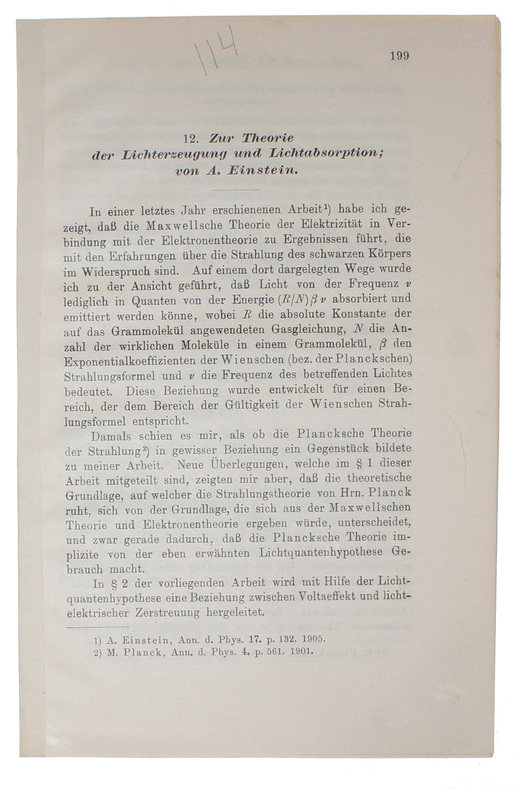
1906réf. 46956Leipzig Johann Ambrosius Barth 1906. No wrappers. Extracted from "Annalen der Physik" Vierte Folge. Bd. 20. Pp. 199-206. Clean and fine. First printing of one of the papers for which Einstein was awarded the Nobel Prize in 1921. It was for the papers "Ueber einen die Erzeugung und Verwandlung des Lichtes betreffenden heuristischen Gesichtspunkt" of 1905 and "Zur Theorie der Lichterzeugung. Theory of light emission and absorption the offered item that Einstein received the prize: "for his services to theoretical physics and especially for his discoveryof the law of the photoelectrical effect" - his reward was not based on relativity."The quantum theory has affected virtually every branch of physics. Its earliest and one of its most significant developments was Einstein's application of the theory to what is known as the 'photo-electrical effect'.Einstein explained this effext by suggesting that the classical view that light is emitted in the form of continous waves must be abandoned. The photo-electrical effect could be explained only as an example of quantum action where the waves of light or X-rays are emitted in minute particles or bullets. It is he size of the bullet the wave-lenght of the radiation which determines the number of electrons ejected. It was for this and not for the theory of relativity that Einstein was awarded the Nobel Prize in 1921. Einstein's two fundamental papers on this subject are "Ueber einem Erzeugung." 1905 and Zur Theorie der Lichterzeugung the paper offered here" PMM the note to 391.Weil: 12 with an asterix denoting a major paper - Boni:12. unknown
1923réf. 38826Berlin Verlag der Akademie der Wissenschaften 1923. 4to. Uncut and partly unopened in orig. wrappers to issue XXVIII-XXIV of "Sitzungsberichte der Preussischen Akademie der Wissenschaften". Wrappers with nicks and tears especilly frontwrapper with marginal loss. Die Energieschwankungen.pp. 350-354. - Bemerkung zu Quantenstatistik.pp. 355-58.- Bietet die Feldtheorie.pp. 359-364. - Zur Theorie der von glühende.pp. 334-348. All four papers first edition. - Planck: Akademie both :145. - Eionstein: Weil No 137. unknown
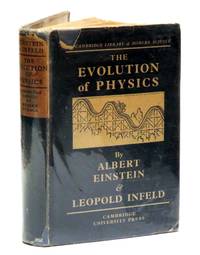
réf. B34915-SCCambridge University Press. Collectible - Good. Great Britain: Cambridge at the Univ Press 1938. 1st UK 1st issue with gold lettering on spine and both endpapers present. Hardcover 12mo 319 pgs. Medium blue cloth gold gilt on spine. B/w plates and illustrations. Near very good book in a fair dust jacket. Corners and spine ends lightly bumped and worn. Contents clean and binding sound. Bookplate to front endpaper with writing in Latin name of Andrzei Falkiewicz written in and Alberto H R Ball Rectore at bottom edge. Jacket is edgeworn chipped and torn. Rear panel and spine are toned. Orig price 8s 6d on front flap. stem science physics Inquire if you need further information. Cambridge University Press hardcover
réf. B34915-SCCambridge University Press. Collectible - Good. Great Britain: Cambridge at the Univ Press 1938. 1st UK 1st issue with gold lettering on spine and both endpapers present. Hardcover 12mo 319 pgs. Medium blue cloth gold gilt on spine. B/w plates and illustrations. Near very good book in a fair dust jacket. Corners and spine ends lightly bumped and worn. Contents clean and binding sound. Bookplate to front endpaper with writing in Latin name of Andrzei Falkiewicz written in and Alberto H R Ball Rectore at bottom edge. Jacket is edgeworn chipped and torn. Rear panel and spine are toned. Orig price 8s 6d on front flap. stem science physics Inquire if you need further information. Cambridge University Press hardcover books
1922réf. ABE-1760853436965London: Methuen @ Co. Ltd 1922 Title: Relativity: The Special and the General Theory Author: Albert Einstein Publisher: Methuen & Co. Ltd. London Publication Date: 1922 Binding: Original cloth hardcover Condition: Good see description Jacket Condition: No Jacket as issued Description: London: Methuen & Co. Ltd. 1922. Original blue-grey cloth gilt-lettered spine. Solid boards with only light shelf wear to extremities. Spine cloth a shade faded but gilt still legible. No inscriptions or ownership marks. Moderate foxing to preliminary pages otherwise clean throughout. Text remains clear and fully legible on lightly toned paper. Binding sound and secure though slightly pulled at the inner hinge no loose or missing leaves. A well-preserved early Methuen printing of Einsteins celebrated exposition of the theory of relativity first published in English in 1920. A classic scientific work explaining both the special and general theories in accessible form and among the most influential popular science books of the twentieth century. Hardcover. Good/No Jacket. Methuen @ Co. Ltd hardcover
1938réf. 3393Great Britain: Cambridge University Press 1938. First Edition. Blue cloth over boards. Very good with a few edge smudges previousl bookseller inventory number in pencil otherwise a clean firm edition/G protected by mylar which has been taped to inside flaps thumb print size chip at top edge tide mark on spine and some edgewear. 5" x 7.5" pp. vi 3 4-319. This book was first intended as an opportunity for Einstein to financially aid his friend Infeld. Though it soon became a joy for him to share physics in near layman's words as if the reader were seated before him in a classroom. "The theory of relativity deduces from its fundamental assumption an answer again of a quantitative character: all energy resists change of motion; all energy behaves like matter." p 207. Cambridge University Press unknown
1998réf. BN672171Agora 1998. 1998. Softcover. La theorie de la relativite restreinte et generale La theorie de la relativite restreinte et generale Albert Einstein Agora paperback