2 986 résultats
1903réf. 38800Leipzig Johann Ambrosius Barth 1903. Contemp. hcloth. Some small nicks to spine. = "Annalen der Physik. Vierte Folge. Band 11. Herausgegeben von Paul Drude.". VIII1144pp. and 6 plates. The Einstein paper: pp. 170-187. Internally fine and clean. First edition of Einsteins fourth paper. In his paper from 1902 Einstein "says in his introduction that nobody has yet succeeded in deriving the conditions of thermal equilibrium and of the second law of thermodynamics from probability considerations although Maxwell and Boltzmann came near to it. Willard Gibbs is not mentioned. In fact Einstein's paper was written in ignorance of Gibbs paper published 1901. In the present paper Einstein builds the theory on another basis not used by Gibbs namely on the consideration of a single system in course of time later called "Zeit-Gesamtheit" time assembly and proves that this is equivalent to a certain virtual assembly of many systems Gibb's micro-canonical assembly.Einstein at once proceeded to apply his theorems to a case of utmost importance namely to systems of a size suited for demonstrating the reality of molecules and the correctness of the kinetic theory of matter."Walter Alicke. - Weil No. 4. hardcover
1931réf. 38732Berlin Akademie der Wissenschaften 1931-32. 4to. Both papers with orig. printed orange wrappers. Offprints Sonderausgabe "Sitzungsberichten der Preussischen Akademie der Wissenschaften". 19;10 pp. Fine and clean. First edition. - Weil: 182 and 185. With asteerix denoting major paper. unknown
1915réf. 38835Braunschweig Vieweg & Sohn 1915. Contemp. hcalf gilt. Spine with a few scratches and light wear to spine ends. "Verhandlungen der Deutschen Physikalischen Gesellschaft im Jahre 1915. 17. Jahrgang. Im Auftrage der Gesellschaft herausgegeben von Karl Scheel." VI489 pp. textillustr. Einstein/Haas papers: pp. 152-170 a. p. 203 a. p. 420. - Planck paper: pp. 407-418 a. 418-19 a. 438-51. - Laue paper: pp. 198-202. Internally clean and fine. The whole volume offered. All papers first edition. - In the papers by Einstein and Haas prooved the Ampere hypothesis that permanent magnetism is caused by the microscopic circular motions of electric charges. The experimental results was very close to the theoretical value and as such they gave a brilliant proof of the soundness of the hypothesis. unknown
1925réf. 39308Paris Gauthier-Villars et Cie 1925. Small8vo. Uncut in orig. printed wrappers. Portrait. 4562 pp. Publisher's Cat. 6 pp. 2 leaves with an insignificant small loss of upper right corner. A fine copy. First French edition of the initials papers on Special Relativity. It is a translation of the 2 Einstein-papers which appeared in 1905 "Elektrodynamik bewegter Körper" and "Ist die Trägheit eines Körpers von seinem Energieinhalt abhängig ". Published in the series "Les Maitres de la Pensee scientifique". - Weil: 9 c - Schielpp-Schields: 189. - Boni-Laurence: 9 B and 10 B. unknown
1904réf. 38818Leipzig J.A. Barth 1904. Contemp. hcloth tears to hinges at upper part of spine. "Annalen der Physik. Vierte Folge. Band 14. Herausgegeben von Paul Drude". VIII1040 pp. and 3 plates. The Einstein paper: pp. 354-362. Internally clean and fine. The whole volume offered. First edition of Einstein's fifth work. "It was in this last of his early series of papers before the announcement of the theory of relativity in 1905 that Einstein introduced a new theme. Einstein asked for the physical significance of the constant now known as Boltzmann's konstant 'k'.It was already well known from the theory of the ideal gas that 'k' was simply related to the gas constant 'R' and to Avogardo's number the number of molecules in a gram-molecular weight of any substance. Einstein showed that 'k' entered into still another basic equation of the statistical theory the expression for the mean square fluctuation of the energy about its average value. This meant that 'k' determines the thermal stability of a system.the paper contains the seeds of much of his later work.Walter Alicke. - Weil No 5. hardcover
1929réf. 28362Berlin Gruyter & Co. 1929. 4to. Orig. orange printed wrappers. Offprint/Sonderabdruck aus Sitzungsberichten.pp. 1-8. Fine fresh copy. First edition in the rare Offprint still called "Abdruck" but having separate printed title and separate pagination. See Weil No. 165 where this is not mentioned.Weil No. 165 with an asterix denoting a major work. "The Unified Field-Theory is one of the last importent works by Einstein. This paper presents a new development which was immediate news; translations and abstracts of ite appeared at once besides numerous articles in general periodicals" W. Alicke.The early Offprints from "Sitzungsberichten." are called "Sonderabdruck" up to Weil No.165 including this. From Weil 166 they are called "Sonderausgabe.". - Before 161 up to 160 the Offprints do not have separate title and pagination the pagination follows the numbering in the periodical. From 166 the Offprint has both separate printed title and pagination. - So Weil Nos 161-165 is still "Abdruck" but with separate title and pagination. These facts are not mentioned in the bibliographies. unknown
1917réf. 46895Leipzig S. Hirzel 1917. Royal8vo. Bound in contemporary half calf with gilt lettering to spine and 5 raised bands with ornaments in gilt. In "Physikalische Zeitschrift" Bd. 18 1917. Spine and hinges with wear otherwise a fine and clean copy. Pp. 121-128. Entire volume: XI 1 604 pp. 14 plates. The paper was first published in 1916 in Mitteilungen der Physikalischen Gesellschaft in Zürich but here for the first time in Physikalische Zeitschrift. All subsequent research on absorption and emission of radiation and the entire discovery of the maser later the laser was based on the research presented in the present paper. The paper is also notable for introducing the concept but not the name of the photon; Einstein argues that in the interaction of matter and radiation there must be in addition to the processes of absorption and spontaneous emission a third process of stimulated emission. If stimulated emission exists then he can derive the Planck distribution for blackbody radiation and without it the same argument implies the invalid Wien-distribution theory."In this paper he derived Planck's original quantum law from a different starting point he suggested that as well as spontaneous emission and absorption there could also take place the process of stimulated emission. In 1917 this seemed mainly of theoretical interest; forty years later it was utilized to provide the maser and laser of modern technology. In 1916 "Einstein came back once more to blackbody radiation and made further progress. In November 1916 he wrote to Besso: 'A splendid light has fallen on me about the absorption and emission of radiation'. His reasoning is divided into three papers two of which appeared in 1916 and the third one early in 1917 the two papers above - note that these are the two papers of Einstein on radiation theory cited by Weil as "principal works"; a third paper from 1916 is not. In these papers Einstein proposed a statistical theory of the interaction between atoms and photons gave a new demonstration of Planck's radiation theory and introduced the concept of 'stimulated emission' providing the basis for the discovery of masers and lasers " Bertolotti The History of the Laser."When Einstein returned to the radiation problem in 1916 the quantum theory had undergone a major change. Niels Bohr's papers had opened a new and fertile domain for the application of quantum concepts-the explanation of atomic structure and atomic spectra. In addition Bohr's work and its generalizations by Arnold Sommerfeld and others constituted a fresh approach to the foundations of the quantum theory of matter. Einstein's new work showed the influence of these ideas . He had found still another derivation of Planck's black-body radiation law an "astonishingly simple and general" one which he thought mightproperly be called "the derivation" 12 of this important law. It was based on statistical assumptions about the processes of absorption and emission of radiation and on Bohr's basic quantum hypothesis that atomic systems have a discrete set of possible stationary states. The proof turned on the requirement that absorption and emission of radiation both spontaneous and stimulated suffice to keep a gas of atoms in thermodynamic equilibrium. This paper introduced the concept of stimulated emission into the quantum theory and is therefore often described as the basis of laser physics. Einstein himself considered the most important contribution of this work to be not the new derivation of the distribution law but rather the arguments he presented for the directional character of energy quanta. DSB Weil No 91 with an asterix denoting major paper. hardcover
1910réf. 38842Leipzig J.A. Barth 1910. Contemp. hcalf. Spine gilt a fs scratches to spine. VIII1584 pp. and 6 plates. Einstein papers: pp. 1096: pp. 1105-1115; pp. 1275-1298. Fine and clean. The whole volume offered. All three papers first edition. The purpose of "A theorem in probability and its application in the Theory of radiation" is to demonstrate that the failure of statistical mechanics with respect to the radiation law Rayleigh - Jeans law contradicted by experience cannot be removed by the conjecture that perhaps the individual statistical events should not follow the usual law of independence product of probabilities instead of assuming a certain interdependence between them. Lanczos. The second paper "Statistical investigation on of the motion of an oscillator in a radiation field" makes use of the results of the previous investigation. Einstein's aim is to demonstrate that the Rayleigh-jeans law of radiation contracdicted by the physical facts is an unavoidable consequence of statistics even if we avoid any kind of assumption which may be suspected of needing correction. Lanczos. The third paper "Theory of the opalescence of homogenous fluids and fluid mixtures near the critical state" is an importent investigation and one of the most difficult of all his papers to understand. The aim of the paper is to complement the work of Smoluchovski Ann. d. Physik25 1908 who gave a general explanation of the strong density fluctuations - and the opalescence thus generated - of two fluids near the critical state of mixture or a single fluid near the critical state of condensation on the basis of the kinetic theory of heat. he did notgive howeverthe quantitative details concerning the scattered light associated with this phenomenon. Lanczos. - Weil Nos 34 35 and 36 with an asterix denoting major work. unknown
1915réf. 38835Braunschweig, Vieweg & Sohn, 1915. Contemp. hcalf, gilt. Spine with a few scratches and light wear to spine ends. ""Verhandlungen der Deutschen Physikalischen Gesellschaft im Jahre 1915. 17. Jahrgang. Im Auftrage der Gesellschaft herausgegeben von Karl Scheel."" VI,489 pp. textillustr. Einstein/Haas papers: pp. 152-170 a. p. 203 a. p. 420. - Planck paper: pp. 407-418 a. 418-19 a. 438-51. - Laue paper: pp. 198-202. Internally clean and fine. The whole volume offered.
1911réf. 38841Leipzig, J.A. Barth, 1911. Contemp. hcalf, spine gilt. ""Annalen der Physik. Vierte Folge. Band 34. Hrsg. von W.Wien und Max Planck."" VIII,1032 pp., 6 plates. Einstein papers: pp. 165-169" pp. 170-174 pp. 175-176 p. 590" pp. 591-592. Fine and clean. The whole volume offered.
1906réf. 39057Leipzig, Johann Ambrosius Barth, 1906). Bound in a fine recent hmorocco. Gilt lettering on spine. ""Annalen der Physik"", Bd. 20, Heft 8, pp. 433-640. The Einstein paper pp. 627-633.
1904réf. 38818Leipzig, J.A. Barth, 1904. Contemp. hcloth, tears to hinges at upper part of spine. ""Annalen der Physik. Vierte Folge. Band 14. Herausgegeben von Paul Drude"". VIII,1040 pp. and 3 plates. The Einstein paper: pp. 354-362. Internally clean and fine. The whole volume offered.
1910réf. 38842Leipzig, J.A. Barth, 1910. Contemp. hcalf. Spine gilt, a fs scratches to spine. VIII,1584 pp. and 6 plates. Einstein papers: pp. 1096: pp. 1105-1115" pp. 1275-1298. Fine and clean. The whole volume offered.
1903réf. 38800Leipzig, Johann Ambrosius Barth, 1903. Contemp. hcloth. Some small nicks to spine. (=) Annalen der Physik. Vierte Folge. Band 11. Herausgegeben von Paul Drude."". VIII,1144pp. and 6 plates. The Einstein paper: pp. 170-187. Internally fine and clean.
réf. a106117Braunschweig 1914 first edition. Vieweg. Vol XVI of Berichte der Deutschen Physikalishchen. Original binding. hardcover thick octavo. 3/4 darkbrown cloth with matching dark brown papercovered boards. Gilt spine lettering. Illustrations. 1072p. Among many other important papers this volume includes: EINSTEIN "Beitrage zur Quantentheorie " pp. 820-828 VG. no owner marks; light foxing on end papers; just very light cover wear; hinges not cracked. Clean solid excellent condition! Pictures available on request. . hardcover
réf. a94782Lipezig 1917. first edition. 4to. hardcover. Volume 18 of Physikalische Zeitschrift volume 18 at pp. 121-128. One of Einstein's great achievements in quantum mechanics. 3/4 maroon cloth with green marbled boards. One old tiny circular stamp of German university NO other library marks no spine number no pocket no bookplate. VG. light cover wear. hinges secure; text clean. . hardcover
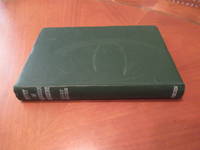
1926réf. 043474London: Methuen & Co. 1926. 1st Edition 1st Printing. Hardcover. Near Fine/No Jacket. Viii 124 Pp. Green Cloth White Spine Lettering. First Printing In Secondary Binding With White Lettering The First Binding Was Lettered In Gilt. Book Used But Still Near Fine Very Slight Rubbing Lettering Complete With Some Wear Small Areas Of Lightening Of Color On Front Cover Darkening To Lower Corner Of Page "V" First Page Of Preface. No Marks. Lacking The Very Scarce Dust Jacket. Methuen & Co. hardcover
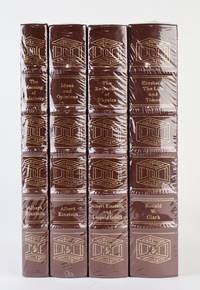
2004réf. 1393704Norwalk CT: The Easton Press 2004. Collector's Editions. Hardcover. Octavos Four Volumes. Bound in brown genuine leather with bright gilt spine titles and gilt motifs on covers. Gilt text blocks. Paper endpapers silk ribbons. In publisher's shrinkwrap. MA consignment. Shelved above Easton Press. 1393704. Shelved Dupont Bookstore. The Easton Press hardcover
1924réf. js21524London: Methuen and Co 1924. second edition. Hardcover. Very Good/Very Good. a lovely copy of the 2nd edition. the jacket is shelf worn with a little loss at the top of the spine and fraying at the bottom. there is a previous owner's signature and place name. the paper is possibly a little darkened but no real foxing to talk of. square and neat binding. appears very little used. Our orders are shipped using tracked courier delivery services. Methuen and Co hardcover
2004réf. 1393704Norwalk CT: The Easton Press 2004. Collector's Editions. Hardcover. Octavos Four Volumes. Bound in brown genuine leather with bright gilt spine titles and gilt motifs on covers. Gilt text blocks. Paper endpapers silk ribbons. In publisher's shrinkwrap. MA consignment. Shelved above Easton Press. 1393704. Shelved Dupont Bookstore. The Easton Press hardcover books
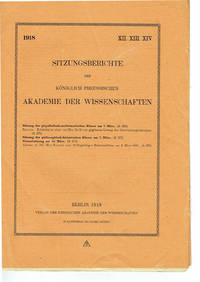
1918réf. 5720KBerlin: Verlag der Königlichen Akademie der Wissenschaften in commission at Georg Reimer Reichsdruckerei 21st March 1918. Near Fine. Imperial 8vo 26 5: 19 cm. 3 pages numbered 269-272. Letterpress on machine paper in original publisher’s brochure on orange-coloured stock with black title printing. First journal issue in the original printed wrappers of Einstein's early paper on the cosmological implications of general relativity. – Contents: Einstein here criticizes De Sitter's equations for gravitational fields and provides the first proper definition of a space-time singularity. „Einstein never said so explicitly but it seems reasonable to assume that he had in mind that the correct equations should have no solutions at all in the absence of matter. However right after his Einstein's paper »Kosmologische Betrachtungen zur allgemeinen Relativitätstheorie“ mid February 2017 note WoP paper appeared de Sitter did find a solution . Einstein must have been disappointed. In 1918 he looked for ways to rule out the de Sitter solution but soon realized that there is nothing wrong with it.“ Paise Despite Einstein's critique the De Sitter model was the dominant cosmological model until the 1930s at which time Einstein and de Sitter together proposed a ""just right"" cosmological model. The great cosmological debate between Einstein and De Sitter marks the beginning of the modern scientific understanding of the origins of the universe. The Academy's publishing list on the rear cover also announces an offprint of this paper for Reichsmark 0 50. – Condition: Wrappers at margins minimally torn sheet with Einstein's contribution opened and thus cut slighly perforated some pages minimally creased otherwise well preserved partly unopened copy. – Rarity: RBH records 3 copies of this paper at auction 2019 2011 2002 none of them the first separate printing. – Reference: Alicke W. Albert Einstein. An Almost Complete Collection of his Publications and Two Original Manuscripts 91; Boni N.: A bibliographical checklist and index to the published writings of Albert Einstein 108; The Collected Papers of Albert Einstein. Volume 7 5; Shields M. C.: Bibliography der Schriften Einsteins. In: Schilpp P. A.: Albert Einstein als Philosoph und Naturforscher 117; Weil E.: Albert Einstein. A bibliography of his scientific papers 1901-1930 98; Pais A.: Subtle is the Lord. The Science and Life of Albert Einstein 2005 ed. p. 288. Verlag der Königlichen Akademie der Wissenschaften (in commission at Georg Reimer [Reichsdruckerei]) unknown
réf. H3994Berlin Akademie der Wissenschaften 1921 In: Sitzungsberichte der Königl.Preuss. Akademie der Wissenschaften Band 1921/1. 4to. S.261-265. Weitere Berichte von: Laue Halbleinenband der Zeit leicht berieben Bibl.-Nr.am Rücken Original-Broschur miteingebunden unaufgeschnitten gutes Exemplar. unknown
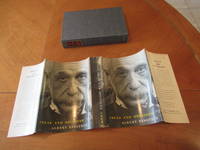
1954réf. 042205New York: Crown Publishers 1954. 1st Edition 1st Printing. Hardcover. Fine/Near Fine. Vii 377 Pp. Grey Cloth Spine Lettered In Gilt On Maroon Background. First Edition 1954 First Printing No Statement Of Printing Dj Priced $4.00 Publisher's Address As 49 Fourth Avenue On Front And Rear Flaps. Book Fine Spine Edges Crisp. Former Owner's Verified Signature With August 1954 Date No Other Marks. Dj Near Fine Touch Of Rubbing At Corners 1/4" Closed Tear At Bottom Of Front Spine Edge With Associated Rubbing And Another 1/4" Closed Tear At Top Of Rear Panel. Seldom Seen In This Condition Or Better. Crown Publishers hardcover
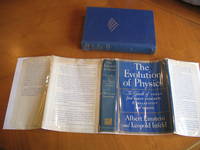
1938réf. 035775New York: Simon & Schuster 1938. First American Edition 1st Printing. Blue Cloth. Very Good/Very Good. Illustrated with Black and White Photographs Charts and Diagrams. X 319 Pp 1 Pp Ads At Rear. Blue Cloth Gilt Yellow Endpapers. One Of 6000 Copies Of The American First Printing; Publisher's Note On Dj States That The Uk Dutch And American Editions Were Being Issued Simultaneously. Book Is Very Good Gilt Very Bright Cloth Clean Rear Hinge Cracked In Upper 2 3/4" Clean Unmarked Pages; One Quarter Inch Square Area Of Fading At Upper Left Of Spine Panel. With Heraldic Bookplate On Front Pastedown Mostly Under Flap Of Dj. First Issue Dj Priced $2.50 At Bottom Of Rear Flap With Price Much Nearer The Gold Border Than The Bottom Edge; On Later Printings The Price Is Aligned Midway. Dj Clean Spine Lettering Somewhat Browned Light Wear 1/2" Triangular Chip At Top Of Rear Panel Still Present But Loose; Minute Losses At Corners; Browning To Edges Of White Rear Panel But No Browning At All To Front Panel. Simon & Schuster hardcover
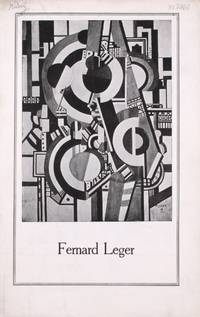
1925réf. 333269New York: Société Anonyme Inc 1925. First edition. 6 black and white illustrations 11 pp. 8vo. Side-stapled printed wrappers somewhat soiled. First edition. 6 black and white illustrations 11 pp. 8vo. Published in conjunction with an exhibition of Leger's work by the Société Anonyme from November 16th to the 28th 1925. Includes an introduction by Dreier a creative piece translated from the French of Karl Einstein and "Notations on Plastic Values" by Léger. Scarce OCLC only records a copy at Yale from the papers of Katherine S. Dreier. Collection of the Société Anonyme p. 218 Société Anonyme, Inc unknown