2,980 results
1920ref. 33265-52Berlin E. S. Mittler for Julius Springer 1920. 15 1 pp. 8vo. Orig. wrappers. Berlin E. S. Mittler for Julius Springer 1920. First edition. Einstein discusses the concept of the aether in relation to his theory of relativity. This lecture examines the historical role of the aether in physics and its transformation under relativity. His conclusion is that relativity does not bring back the classical aether but introduces a new understanding of space as an active structured entity. The text of this speech delivered at Leiden University was also translated into French in 1921. The English translation appeared in Einstein's "Sidelights of Relativity" published at London in 1922. Einstein's manuscript is now kept in the Bibliotheca Bodmeriana Geneva. - Weil 111; Boni Russ and Laurence 115; Roller/Goodman I 354; Seelig 131; Schilpp-Shields 131. SCIENCE: PHYSICS ; Berlin, (E. S. Mittler for) Julius Springer unknown
1980ref. 2610130008Dover 1980. Paperback. Good. An extremely large collection of foundational mathematical texts from a mathematical professor's library 68 volume set. Softcover. Most volumes are in good condition. Clean unmarked pages. Some volumes have reading creases down the spine various wear and are only fair condition. Various dates most volumes are from the late 1970s-1980s. Includes: 1. Handbook of Mathematical Functions: With Formulas Graphs and Mathematical Tables Milton Abramowitz; Irene A. Stegun2. Lectures on Ordinary Differential Equations Witold Hurewicz; 3. The Divine Proportion: A Study in Mathematical Beauty H E Huntley; 4. Infinite Sequences and Series Knopp Konrad; 5. Functional Analysis Frigyes Riesz; Bela Sz.-Nagy;6. Lectures on Classical Differential Geometry: 2nd Ed Struik Dirk J.;7. Advanced Number Theory Cohn Harvey; 8. Contributions to the Founding of the Theory of Transfinite Numbers Cantor Georg; 9. Geometry of Complex Numbers Hans Schwerdtfeger;10. Introduction to Partial Differential Equations with Applications Zachmanoglou E. C.; Thoe Dale W.;11. Thirty Years That Shook Physics: The Story of Quantum Theory Gamow George;12. Information Theory Robert Ash; 13. Introduction to Bessel Functions Frank Bowman; 14. Mathematical Foundations of Information Theory A Ya Khinchin; 15. Vector and Tensor Analysis with Applications Borisenko A. I. Tarapov I. E.; 16. On Formally Undecidable Propositions of Principia Mathematica and Related Systems Godel Kurt; 17. Tensor Calculus Synge J. L.; Schild A.; 18. Differential Geometry Kreyszig Erwin; 19. A Collection of Problems on Complex Analysis Volkovyskii L. I.; Lunts G. L.; Aramanovich I. G.;20. Introduction to Difference Equations Samuel Goldberg;21. Distribution Theory and Transform Analysis: An Introduction to Generalized Functions with Applications Zemanian A. H.; 22. Physics of Waves Elmore William C.; Heald Mark A.; 23. Orthogonal Functions G. Sansone; 24. Lie Algebras Jacobson Nathan; 25. Topology John G Hocking; 26. Mathematical Recreations and Essays Ball W. W. Rouse; Coxeter; 27. An Introduction to Algebraic Structures Landin Joseph28. Differential Forms with Applications to the Physical Sciences Harley Flanders;29. The Theory of Groups and Quantum Mechanics Hermann Weyl; 30. Nonlinear Mathematics Thomas L. Saaty; Joseph Bram; 31. An Introduction to Information Theory Symbols Signals and Noise John R Pierce; 32. Introduction to the Theory of Fourier's Series and Integrals Carslaw H. S.; 33. Quantum Theory David Bohm; 34. Introduction to Differentiable Manifolds Auslander Louis Mackenzie Robert E.; 35. An Introduction to Harmonic Analysis Katznelson Yitzhak; 36. Conformal Mapping on Riemann Surfaces Harvey Cohn; 37. Conformal Mapping Nehari Zeev; 38. Axiomatic Set Theory Suppes Patrick; 39. Differential Geometry Heinrich W. Guggenheimer; 40. Challenging Mathematical Problems With Elementary Solutions Vol. 1 A. M. Yaglom;41. Group Theory W. R. Scott; 42. An Introduction to the Calculus of Variations Fox Charles; 43. Tensor Analysis on Manifolds Goldberg Samuel I. Bishop Richard; 44. Non-Euclidean Geometry Bonola Roberto; 45. The Philosophy of Mathematics Korner Stephan; 46. Computational Methods of Linear Algebra Faddeeva V. N.; 47. Tensors Differential Forms and Variational Principles Lovelock David Rund Hanno;48. Metric Affine Geometry Snapper Ernst & Troyer Robert J.; 49. Fourier Series and Orthogonal Functions Harry F Davis;50. Unbounded Linear Operations Goldberg Seymour; 51. Geometry Relativity and the Fourth Dimension Rudolf Rucker; 52. Banach Spaces of Analytic Functions Hoffman Kenneth; 53. Topological Uniform Structures Page Warren; 54. The Higher Arithmetic: An Introduction to the Theory of Numbers Harold Davenport;55. The Thirteen Books of the Elements Vol. 2 Euclid; 56. The Theory of the Properties of Metals and Alloys Jones Mott Neville; 57. Asymptotic Expansions of Integrals Norman Bleistein; 58. Investigations on the Theory of the Brownian Movement Einstein Albert; 59. The Principle of Relativity Albert Einstein; 60. The Theory of Spinors Bagemihl Bagemihl; 61. Selected Papers on Quantum Electrodynamics Julian Schwinger; 62. About Vectors Banesh Hoffmann; 63. Fads and Fallacies in the Name of Science Martin Gardner; 64. Theory of Sets Kamke E.; 65. First Order Mathematical Logic Angelo Margaris; 66. Essays on the Theory of Numbers Dedekind Richard; 67. Modern Nonlinear Equations Thomas Saaty; 68. Theory of Groups of Finite Order Burnside. This is an oversized or heavy book which WILL require additional postage for Priority Mail or International delivery outside the US. Dover paperback
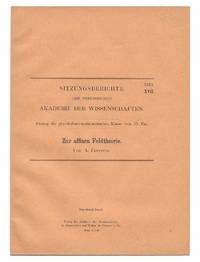
1923ref. 32429Berlin: Berlin: Sitzungsberichte der Preussischen Akademie der Wissenschaften XVIII 1923. First Thus. Soft cover. First Thus. Soft cover. Einstein Albert 1879-1955. Zur affinen Feldtheorie. Offprint from Sitzungsberichten der Preussischen Akademie der Wissenschaften 1923. XVIII. 8vo.4 137-140 First edition. Orange wrappers. A fine fresh copy in the rare off-print form marked with an asterisk by Weil denoting a major paper "Sonderabdruck" & deemed of sufficient interest that a translation was published in Nature Magazine. "Einstein's attempts to formulate a unified field theory the theoretical framework to account for the fundamental forces of nature. stemmed from his dissatisfaction with the general relativity theory which did not adequately incorporate the electromagnetic field into the geometry of space-time". Einstein's first investigation of Weyl's ideas published in the present paper which Weyl had begun working on in 1918. Weyl was investigating the possibility of constructing a unified field theory preserving the dimensionality of space-time while formally altering its geometry making it a special case of the class known as affine geometries. However Einstein later rejected Weyl's theory. "Weil No. 132; Schilpp--Shields No. 171; Alicke No.113; Norman Library 698; Boni 141. Affine Geometry is not concerned with the notions of circle angle and distance. It's a known dictum that in Affine Geometry all triangles are the same. In this context the word affine was first used by Euler affinis. In modern parlance Affine Geometry is a study of properties of geometric objects that remain invariant under affine transformations mappings. Affine transformations preserve collinearity of points: if three points belong to the same straight line their images under affine transformations also belong to the same line and in addition the middle point remains between the other two points." The early Offprints from "Sitzungsberichten." are called "Sonderabdruck" up to Weil No.165 including this. From Weil 166 they are called "Sonderausgabe.". - Before 161 up to 160 the Offprints do not have separate title and pagination the pagination follows the numbering in the periodical. From 166 the Offprint has both separate printed title and pagination. - So Weil Nos 161-165 is still "Abdruck" but with separate title and pagination. Berlin: Sitzungsberichte der Preussischen Akademie der Wissenschaften, XVIII unknown
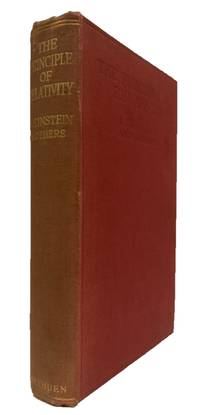
1926ref. 043474London: Methuen & Co. 1926. 1st Edition 1st Printing. Hardcover. Near Fine/No Jacket. Viii 124 Pp. Green Cloth White Spine Lettering. First Printing In Secondary Binding With White Lettering The First Binding Was Lettered In Gilt. Book Used But Still Near Fine Very Slight Rubbing Lettering Complete With Some Wear Small Areas Of Lightening Of Color On Front Cover Darkening To Lower Corner Of Page "V" First Page Of Preface. No Marks. Lacking The Very Scarce Dust Jacket. Methuen & Co. hardcover
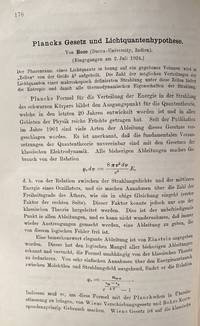
1924ref. 32820524FIRST EDITION of this classic in the history of quantum mechanics "Planck's Law and Light Quantum Hypothesis" pp. 178-181 in vol. 26. Bose sent this paper to Einstein who translated it into German for this initial publication with the comment "In my opinion Bose's derivation of the Planck formula signifies an important advance." In this paper he "succeeded in deriving the Planck blackbody radiation law without reference to classical electrodynamics. Einstein's generalization of Bose's method led to the first of two systems of quantum statistical mechanics known as the Bose-Einstein statistics. Paul Dirac later coined the term 'boson' for particles that obey these statistics" DSB. "With their work Bose and Einstein established the field of quantum statistics one year before the appearance of quantum mechanics" Brandt The Harvest of a Century This volume also contains three papers by Werner Heisenberg. Complete vols. 25-26. Contemporary half calf. Near fine without any library markings.
1966ref. WMCE001New York: E. P. Dutton & Co. 1966 First edition first printing. Signed and inscribed by Mays on front free endpaper: "To Joe / Best Wishes / Willie Mays." Publisher's green and orange cloth with "Willie Mays" in blind to front board and spine lettered in black and orange; in its original unclipped dust jacket designed by Bob Korn with white front panel lettered in brown orange and green and a green spine. About fine book with light fading to spine and a hint of rubbing to foot of spine; very good price-clipped dust jacket with light wear to spine ends and some edgewear. With Beckett Letter of Authenticity. Overall a great boldly inscribed copy. Presentation copies from Mays are exceedingly scarce. In this book Willie Mays tells his life story with the help of prolific sportswriter Charles Einstein. Mays started playing professional baseball at 16 in the Negro Leagues and was soon drafted by the New York Giants. He went on to play 21 seasons with the Giants winning a World Series with the team in 1954. His over-the-shoulder catch in that World Series is one of the most iconic moments in sports history. A 24x All-Star and a 12x Gold Glove award winner Mays was inducted into the Hall of Fame in 1979 and was voted to the Major League Baseball All-Century Team in 1999. . Signed. First Edition. Hard Cover. Fine/Dust Jacket Included. New York: E. P. Dutton & Co. hardcover
1966ref. WMCE001New York: E. P. Dutton & Co. 1966 First edition first printing. Signed and inscribed by Mays on front free endpaper: "To Joe / Best Wishes / Willie Mays." Publisher's green and orange cloth with "Willie Mays" in blind to front board and spine lettered in black and orange; in its original unclipped dust jacket designed by Bob Korn with white front panel lettered in brown orange and green and a green spine. About fine book with light fading to spine and a hint of rubbing to foot of spine; very good price-clipped dust jacket with light wear to spine ends and some edgewear. With Beckett Letter of Authenticity. Overall a great boldly inscribed copy. Presentation copies from Mays are exceedingly scarce. In this book Willie Mays tells his life story with the help of prolific sportswriter Charles Einstein. Mays started playing professional baseball at 16 in the Negro Leagues and was soon drafted by the New York Giants. He went on to play 21 seasons with the Giants winning a World Series with the team in 1954. His over-the-shoulder catch in that World Series is one of the most iconic moments in sports history. A 24x All-Star and a 12x Gold Glove award winner Mays was inducted into the Hall of Fame in 1979 and was voted to the Major League Baseball All-Century Team in 1999. . Signed. First Edition. Hard Cover. Fine/Dust Jacket Included. New York: E. P. Dutton & Co. hardcover books
1922ref. C106668London: Methuen 1922. First Edition. Hardback. Hardcover Hardcover. Very Good. First Edition. Hardback. 8vo. Original publisher's orange/brown buckram boards gilt lettering to spine blind stamp lettering to front board unpaginated prelims 123pp sound clean very good indeed copy with three ownership signatures on the first blank with addresses in Norfolk and Cyprus variously from 1929 to 1989 and on verso of the contents page a 1929 press cutting showing Einstein in Berlin offering congratulations 'over the radio phone' to Thomas Edison in New York on the 50th anniversary of the discovery of electric light. Slight offsetting to opposite page from the cutting. Apart from these slight distractions a very decent copy of what has become a rare and important book. Methuen, hardcover
ref. 84067Leipzig Breitkopf und Härtel 1918-35. 8vo. Later brown cloth up to 1932 1932-35 sewn as issued in boxes. 14 volumes and four boxes. With library stamps from Musikmuseet in Stockholm. All published. Alfred Einstein was editor up to 1933 when he had to leave Nazi Germany. Editor for the two last years was Max Schneider. hardcover
1954ref. 042205New York: Crown Publishers 1954. 1st Edition 1st Printing. Hardcover. Fine/Near Fine. Vii 377 Pp. Grey Cloth Spine Lettered In Gilt On Maroon Background. First Edition 1954 First Printing No Statement Of Printing Dj Priced $4.00 Publisher's Address As 49 Fourth Avenue On Front And Rear Flaps. Book Fine Spine Edges Crisp. Former Owner's Verified Signature With August 1954 Date No Other Marks. Dj Near Fine Touch Of Rubbing At Corners 1/4" Closed Tear At Bottom Of Front Spine Edge With Associated Rubbing And Another 1/4" Closed Tear At Top Of Rear Panel. Seldom Seen In This Condition Or Better. Crown Publishers hardcover
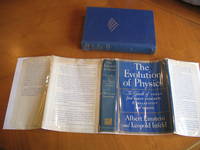
1938ref. 035775New York: Simon & Schuster 1938. First American Edition 1st Printing. Blue Cloth. Very Good/Very Good. Illustrated with Black and White Photographs Charts and Diagrams. X 319 Pp 1 Pp Ads At Rear. Blue Cloth Gilt Yellow Endpapers. One Of 6000 Copies Of The American First Printing; Publisher's Note On Dj States That The Uk Dutch And American Editions Were Being Issued Simultaneously. Book Is Very Good Gilt Very Bright Cloth Clean Rear Hinge Cracked In Upper 2 3/4" Clean Unmarked Pages; One Quarter Inch Square Area Of Fading At Upper Left Of Spine Panel. With Heraldic Bookplate On Front Pastedown Mostly Under Flap Of Dj. First Issue Dj Priced $2.50 At Bottom Of Rear Flap With Price Much Nearer The Gold Border Than The Bottom Edge; On Later Printings The Price Is Aligned Midway. Dj Clean Spine Lettering Somewhat Browned Light Wear 1/2" Triangular Chip At Top Of Rear Panel Still Present But Loose; Minute Losses At Corners; Browning To Edges Of White Rear Panel But No Browning At All To Front Panel. Simon & Schuster hardcover
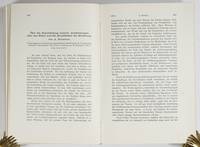
1909ref. 524241909. Verh. Dtsch. Physik. Ges. 11/ 1-24. - Hrsg. im Auftrage der Gesellschaft von Karl Scheel. - Braunschweig Druck und Verlag von Friedrich Vieweg und Sohn 1909 8° VII 749 pp. Abbildungen Halbleinenband d.Zt.; St.a.Tit.; feines Expl. First Edition! The true first printing see below of this paper which Wolfgang Pauli said "can be considered as one of the landmarks in the development of theoretical physics" Schilpp p. 154. This paper marks the introduction of the modern "photon" concept although the term itself was introduced much later in a 1926 paper by Gilbert N. Lewis. It contains "the first well-conceived promulgation of the wave-particle duality of light which had implications as profound as Einstein's earlier theoretical breakthroughs" Isaacson p.157. Einstein here anticipated the principle of complementarity one of the fundamental principles of quantum mechanics. His own proposal for a solution of the wave-particle paradox - that Maxwell's equations for electromagnetic fields be modified to allow wave solutions that are bound to singularities of the field - was never developed although it may have influenced Louis de Broglie's pilot wave hypothesis for quantum mechanics developed in his famous thesis Recherches sur la théorie des quanta 1924. The present paper was also published in Physikalische Zeitschrift Vol. 10 1909 but the Verhandlungen printing has priority: it was published on 30 October 1909 the Physikalische Zeitschrift printing appeared on 10 November. "This extensive paper given as lecture before the 81st assembly of the "Gesellschaft Deutscher Naturforscher" in Salzburg on 21st September 1909. He spoke on "The Development of Our View of the Nature and Constitution of Radiation" a topic that embraced both relativity and quanta. Among those who attended Einstein's lecture were some of the world's foremost physicists. In Einstein's austere opinion his address regarded strictly as a work of science was of little importance since as he writes to a co-worker it contained nothing new. Einstein was being overmodest. Besides to many in Einstein's audience and it should be born in mind that it was the year after Minkowski's stirring introduction of the concept of the fourth dimension this Lecture came as a revelation. The occasion was important for Einstein too. He had been working for years in a sort of scientific exile and his curiosity as to what great scientists were like in face-to-face discussion was at least as great as their curiosity about him. His confidence in himself was certainly not harmed when he found that he was able to hold his own easily in their company. Moreover at this congress Einstein first met Planck. In addition he made new'lasting friendships leading to a voluminous scientific correspondence. Amongst those attending the congress were Max von Laue Max Born. Arnold Sommerfeld Hasnohrl. Ladenburg. Max von Laue was to be the first to publish in 1911 the first text-book on relativity theory. All of them are present in this issue with scientific papers of their own." Walter Alicke 11. Jahrg. 30. Oktober 1909 Nr. 20 - Vorgetragen in der Sitzung der physiklaischen abteilung der 81. Versalung Deutscher Naturforscher und Ärzte zu Salzburg am 21. September 1909." Weil No. 30; Schilpp-Shields No. 30; Hoffmann Einstein p. 93. unknown
ref. 24258Paris, Editions de la Galerie Simon, Henry Kahnweiller, 1930, in-4, broché. Edition originale illustrée de cinq lithographies en noir à pleine page de Gaston-Louis Roux, dont l'une en frontispice. Tirage limité à 110 ex., celui-ci num. sur Hollande, signés par Carl Einstein et Gaston-Louis Roux page de justification.
1949ref. 148432Evanston: The Library of Living Philosophers Inc. 1949. First edition of Einstein's singular autobiography. Octavo original cloth with gilt titles to the spine top edge gilt frontispiece of Einstein by Yousuf Karsh. Edited by Paul Arthur Schilpp. In near fine condition. Written by the man considered the "Person of the Century" by Time magazine this is not a glimpse into Einstein's personal life but an extension and elaboration into his thinking on science. Two of the great theories of the physical world were created in the early 20th century: the theory of relativity and quantum mechanics. Einstein created the theory of relativity and was also one of the founders of quantum theory. Here Einstein describes the failure of classical mechanics and the rise of the electromagnetic field the theory of relativity and of the quanta. "The greatest physicist of the 20th century" PMM 408. The Library of Living Philosophers, Inc. hardcover
1907ref. 003219Leipzig: J. A. Barth 1907. In Annalen der Physik Vierte Folge Band 22. First Edition. Contemporary Cloth. Very Good. J. A. Barth Hardcover
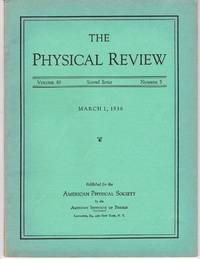
1936ref. 6550Lancaster PA: American Physical Society 1 March 1936. Second series volume 49 number 5. Very Good. ppl 341-422. Original green wraps. Slight nick at bottom edge of lower wrap else better than very good. Includes the retort by Einstein and Rosen originators of speculation on the existence of "worm-holes" in spacetime to objections made to the general theory of relativity. According to Galina Weinstein: "Between 1935 and 1936 Einstein was occupied with the Schwarzschild solution and the singularity within it while working in Princeton on the unified field theory and with his assistant Nathan Rosen on the theory of the Einstein-Rosen bridges. He was also occupied with quantum theory. He believed that quantum theory was an incomplete representation of real things. Together with Rosen and Boris Podolsky he invented the EPR paradox. I demonstrate that the two-body problem in general relativity was a heuristic guide in Einstein's and collaborators' 1935 work on the Einstein-Rosen bridge and EPR paradox." Also articles by notable physicists on radioactivity electron mobility quantum-mechanical measurement and so on. American Physical Society paperback
1906ref. 292Leipzig: Barth 1906. 1st Edition. FIRST EDITION FIRST ISSUE of two important 1906 Einstein papers. Einstein wrote two papers on the photoelectric effect his revolutionary 1905 paper and "Zur Theorie der Lichterzeugung und Lichtabsorption" his continuation of it. In them Einstein employed Planck's theory that luminous energy can be absorbed or emitted only in discrete amounts called quanta and proposed a theory of light quanta involving particles with no mass photons whose energy depended on frequency. All of Einstein's experimental results confirmed that light actually consisted of discrete energy packets. "Based on this theory Einstein wrote an equation describing how the photoelectric effect works. The energy of individual electrons emitted by a photocell is a function of the frequency of the light hitting the photocell and the rate of electron emission is a function of the light source's intensity number of photons with sufficient energy being emitted. This is contrary to what is predicted by classical physics" History of Physics: The Wenner Collection. In this Einstein's second paper on photoelectrics he revisited Planck's theory and from it developed his ideas to show that an electromagnetic wave such as light could be described as a particle photon with discrete quanta of energy that was dependent on its frequency. In the long history of quantum mechanics this would lead to a theory of unity between subatomic particles and electromagnetic waves called wave-particle duality in which particles and waves were neither one nor the other but had certain properties of both. At first Einstein believed that light-quantum hypothesis was merely 'heuristic': that it behaved only as if it consisted of discontinuous quanta. But in this paper and others to follow Einstein used his statistical mechanics to demonstrate that when light interacts with matter Planck's entire formula can arise only from the existence of light quanta -- not from waves. In other words in explaining the photoelectric effect by extending Planck's concept of quantum of energy had Einstein "demonstrated that his own 'light-quantum hypothesis' was implicit in Planck's earlier work" Honner The Description of Nature 31. ALSO included in this volume is "Daz Prinzip von der Erhaltung." The Principle of Conservation of Motion of the Center of Gravity and the Inertia of Energy. In this "ingenious thought experiment involving energy transport in a hollow cylinder Einstein returned to the relationship between inertial mass and energy giving more general arguments for their complete equivalence" Calaprice The Einstein Almanac 18. This was the first statement that the conservation of mass is a special case of the conservation of energy. CONDITION & DETAILS: Leipzig: Barth 1906. Octavo. 8.75 x 6 inches; 222 x 152mm. Ex-libris bearing minimal markings only a small stamp on the title page. Illustration: 6 plates and figures throughout. Entire volume in black cloth gilt-lettered at the spine. The cloth is a bit rubbed and scuffed and there is fading at the spine. Solidly and tightly bound. Bright and clean throughout. Barth hardcover
1936ref. 6550Lancaster PA: American Physical Society 1 March 1936. Second series volume 49 number 5. Very Good. ppl 341-422. Original green wraps. Slight nick at bottom edge of lower wrap else better than very good. Includes the retort by Einstein and Rosen originators of speculation on the existence of "worm-holes" in spacetime to objections made to the general theory of relativity. According to Galina Weinstein: "Between 1935 and 1936 Einstein was occupied with the Schwarzschild solution and the singularity within it while working in Princeton on the unified field theory and with his assistant Nathan Rosen on the theory of the Einstein-Rosen bridges. He was also occupied with quantum theory. He believed that quantum theory was an incomplete representation of real things. Together with Rosen and Boris Podolsky he invented the EPR paradox. I demonstrate that the two-body problem in general relativity was a heuristic guide in Einstein's and collaborators' 1935 work on the Einstein-Rosen bridge and EPR paradox." Also articles by notable physicists on radioactivity electron mobility quantum-mechanical measurement and so on. American Physical Society paperback books
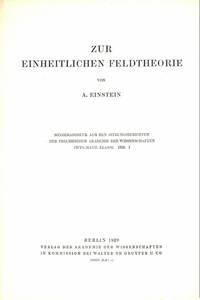
1929ref. 270931929. S.Ber. Akad. Wiss. Berl. 1929/ 1. - Berlin Verlag der Akademie der Wissenschaften 1930 8° 8 S. in schönem Pappband der Zeit. First Edition! "The unified Field Theory" is one of Einstein's last important scientific works. According to Weil "This paper represents a new development which was immediate news. A translation by L.L.Whyte appeared in the London Times of Feb. 4 1929. It was quoted in full in "Observatory" vol. 52 under the title "New Field Theory" pp.82-87 and 1930 pp.11-118." In 1928 Einstein embarked on a new approach to a unified field theory . involving what he called 'distant parallelism' . By early 1929 he had solved the main problems involved in writing down field equations for his unified field theory. On the day of offical publication of the third of a formidably technical series of 9 articles on the theory . excited headlines appeared in foreign newspapers throughout the world . In this frenzied unscientific atmosphere Einstein's new theory was hailed in the press as an outstanding scientific advance. Yet Einstein had stated in his article it was still tentative; and soon he found he had to abandon it. - cf.Parkinson Breakthroughs p.279 Weil No. 165 Schlipp Einstein No.226; Alicke No. 141; Norman Coll. I 700 unknown
1907ref. 38828Berlin J.A. Barth 1907. Contemp. hcloth. Light wear to top of spine. "Annalen der Physik. Vierte Folge. Band 22" Engraved portrait of Pierre Curie. VIII1016 pp. and 4 plates. Einstein papers. pp. 180-190 pp. 569-572 and p.800. Internally clean and fine. The whole volume offered. All papers in first edition. "From 1905 through 1909 Einstein published five major papers on the hypothesis of energy quanta its theoretical implications and its use in the explanation of various phenomena. Among these papers we have his importent paper "Die Plancksche." and in his second paper from 1906d he asserted that Planck's derivation implicitly assumes quantification of the enrgies of charged oscillators. Now in the paper offered he returned to this question showing that if the structure function in phase space he had introduced earlier is assumed to restrict the oscillators to orbits with energies that are integral mulætiples of 'hv' then the average oscillator energy in a canonical ensemble yealds Planck's law when substituted in eg. The works contains the first systematic introduction of probability factors in the mathematics of Quantum Theory.The second paper represents Einstein's third stage in dealing with brownian motion. He had previous explained the zigzag motion of suspended particles and looked as this penomenon from a more general angle. In the present investigation he extends his reults to all macroscopic parameters by giving a general principle for the calculation of theit fluctuations. Weil: nos 15 1-2 with an asterix a. 16. hardcover
1907ref. 38828Berlin, J.A. Barth, 1907. Contemp. hcloth. Light wear to top of spine. ""Annalen der Physik. Vierte Folge. Band 22"", Engraved portrait of Pierre Curie. VIII,1016 pp. and 4 plates. Einstein papers. pp. 180-190, pp. 569-572 and p.800. Internally clean and fine. The whole volume offered.
1923ref. 60195London: Metheun & Co. VG. 1923. 1st Edition. Hardcover. Hardback in Very Good condition without dust jacket. 8vo 8" - 9" tall. 216 pages. Book spine faded. Bound in original red cloth with gilt spine title lettering. 8 pages of ads at the rear. Book is solid straight and no ownership markings. Pages are clean and do not show any signs of foxing or soiling. Corners still sharp while spine ends slightly bumped . Quick shipping excellent customer service. All books carefully packaged in boxes and ship with tracking information. . Metheun & Co. hardcover
1930ref. 021309London: The Soncino Press 1930. 1st Edition . Hardcover. Fair/Fair. Hardcover book in fair condition. Dust jacket included in poor to fair condition showing toning light staining and tears. Book dampstained closer to spine crack to binding starting at middle. A few instances of marked lines in the margins not affecting text. An excellent resource copy of this scarce first edition. Questions welcome. We ship internationally from the United States and Canada every week. If buying internationally please be aware that additional charges may apply for heavier books. We guarantee a safe quick and secure transaction. 10 years in online bookselling experience. The Soncino Press hardcover
1941ref. 46476Tucuman, Argentina, 1941. Royal8vo. Orig. printed wrappers. Offprint from ""Revista. Universidad Nacional de Tucuman"", Series A Matematicas y Fisica Teorica, Vol. 2, Diciembre de 1941, Nos 1 y 2. Pp. 11-15. Fine and clean. This copy has belonged to Abraham Pais (1918-2000) - the famous Einstein scholar, theoretical physicist and Einsteins collegue at Princeton - and having his name on top of the frontwrapper ""A Pais""
1941ref. 46476Tucuman Argentina 1941. Royal8vo. Orig. printed wrappers. Offprint from "Revista. Universidad Nacional de Tucuman" Series A Matematicas y Fisica Teorica Vol. 2 Diciembre de 1941 Nos 1 y 2. Pp. 11-15. Fine and clean. This copy has belonged to Abraham Pais 1918-2000 - the famous Einstein scholar theoretical physicist and Einsteins collegue at Princeton - and having his name on top of the frontwrapper "A Pais" First edition of a scarce paper in the offprint version. The paper "represents the basis of the one written by the same author in collaboration with Wolfgang Pauli in 1943 in which by following analogous lines the proof of the non-existence of regular particle-type solutions was generalized to the case of cilyndrical geometries in Kaluza-Klein theory Einstein & Pauli 1943. Besides other generalizations were subsequently presented. The non-existence of such solutions in classical unified field theory was undoubtedly an important criterion leading Einstein's investigations."Galvagno and Giribet."In his search for a unified field theory that could undercut quantum mechanics Einstein considered five-dimensional classical Kaluza-Klein theory. He studied this theory most intensively during the years 1938-1943. One of his primary objectives was finding a non-singular particle solution. In the full theory this search got frustrated and in the x5-independent theory Einstein together with Pauli argued it would be impossible to find these structures." Jeroen van Dongen.Weil: 208. - Boni: 243. unknown