Einstein, AlbertBiblio.com
3,003 results
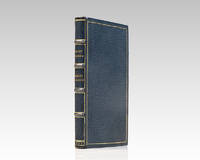
1931ref. 153158New York: The Macmillan Company 1931. First American edition of this volume of Einstein's speeches and letters concerning his views on Zionism. Octavo bound in full morocco by the Harcourt Bindery with gilt titles and tooling to the spine in five compartments within raised gilt bands gilt ruling to the front and rear panel gilt inner dentelles stamp-signed by the Harcourt Bindery marbled endpapers all edges gilt. In fine condition. Translated and edited with an introduction by Leon Simon. An exceptional presentation. Einstein was a prominent supporter of both Labor Zionism and efforts to encourage Jewish-Arab cooperation. He supported the creation of a Jewish national homeland in the British mandate of Palestine but was opposed to the idea of a Jewish state "with borders an army and a measure of temporal power." In a letter to Jawaharlal Nehru dated June 13 1947 he asserted "Long before the emergence of Hitler I made the cause of Zionism mine because through it I saw a means of correcting a flagrant wrong.The Jewish people alone has for centuries been in the anomalous position of being victimized and hounded as a people though bereft of all the rights and protections which even the smallest people normally has.Zionism offered the means of ending this discrimination." Einstein's speeches lectures and letters concerning Zionism were first published in 1930 by The Soncino Press and eleven of these essays were later collected in The World as I See It published in 1933 which Einstein dedicated "to the Jews of Germany". The Macmillan Company unknown
1907ref. 38817Leipzig J.A. Barth 1907. Contep. hcloth. Both hinges with a tear at upper part. "Annalen der Physik Vierte Folge. Band 23. Herausgegeben von W.Wien und M. Planck" VIII1000 pp. and 4 plates. Einstein's papers pp. 197-98 a. 206-209 a. 371-384. Internally fine and clean. The whole volume offered. All 3 papers in first edition. - The first paper "New possibility of testing the relativity principle" deals with the shift of canal rays in the Dobbler effect as a possible confirmation of the Principle of Relativity - the confirmation became actual only in 1938 when new improved instrumentation made it possible. - The second paper "remarks concerning Paul Ehrenfest's note: 'Translation of the deformable electron and the momentum law' Einstein gives his answer by relating it to his Theory of Relativity. - The third paper "The inertia of energy as demanded by the principle of relativity" which is a importen paper as it i is the first to state E=mc2 in its general form. general form. This new relation which was adumbrated already in his paper of 1906 Das prinzip von der Erhaltung der Schwerpunktsbewegung brings about the complete unification of mass and energy into a single concept. In natural units which make c=1 we have E=m i.e. mass and energy are one and the same quantity. Every form of energy also has a mass value just as every mass represents a definite amount of energy. - Weil Nos 1718 a. 19 hardcover
1907ref. 38817Leipzig, J.A. Barth, 1907. Contep. hcloth. Both hinges with a tear at upper part. ""Annalen der Physik, Vierte Folge. Band 23. Herausgegeben von W.Wien und M. Planck"", VIII,1000 pp. and 4 plates. Einstein's papers pp. 197-98 a. 206-209 a. 371-384. Internally fine and clean. The whole volume offered.
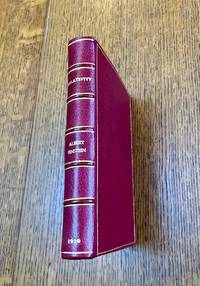
1920ref. 11566Methuen & Co. Ltd. London. 1920. FIRST ENGLISH EDITION. 8vo. 7.7 x 5.2 inches. Portrait frontis and five line diagrams within the text. Complete with the 8pp publishers adverts at back of book. Overall a clean bright copy in recent fine binding of full red morocco. Spine with raised bands compartments ruled decorated and lettered in gilt. Single gilt ruled border on boards. Top edge gilt others untrimmed with rough edges. ------ This important translation apart from being the first English edition also contains new text written by Einstein specially for this edition-- Appendix III The Experimental Confirmation of the General Theory of Relativity. Methuen & Co. Ltd. London. 1920 hardcover
1918ref. 74743The Laryngoscope Press. Very Good. Hardcover. FREE UPGRADE to Courier/Priority Shipping Upon Request - IN STOCK AND IMMEDIATELY AVAILABLE FOR SHIPMENT - AS NEW THE TEXT BLOCK IS PRISTINE CLEAN UNMARKED AND IN EXCELLENT CONDITION - - 14 128 56 viii 88 pp. 48 ills. 4to. -- with a bonus offer-- . 1918. The Laryngoscope Press hardcover
ref. 59014Crown Publishers. As New. Hardcover. FREE UPGRADE to Courier/Priority Shipping Upon Request – – IN STOCK AND IMMEDIATELY AVAILABLE FOR SHIPMENT - AS NEW THE TEXT BLOCK IS PRISTINE CLEAN UNMARKED AND IN EXCELLENT CONDITION - - ND; copyright 1961. 164 pages. -- with a bonus offer-- . N.D. Crown Publishers hardcover
1927ref. 32327Berlin: Verlag Bruno Cassirer. As New. Paperback. FREE UPGRADE to Courier/Priority Shipping Upon Request - IN STOCK AND IMMEDIATELY AVAILABLE FOR SHIPMENT - Pages 365 - 404 text of entire issue; in German. Many lovely black and white illustrations of the artist's works. Includes essays and commentary by Thomas Mann Heinrich Mann Th. Heine H. Woelfflin; A. Stix and many others. -- with a bonus offer--; T-Kulieber; Kunst Und Kunstler: Monatsschrift Fur Bildende Kunst & Kunstgewerbe; Luther Hans; Becker C. H.; Einstein A.; Friedlander M. J.; Et al Max Liebermann Kunst Und Kunstler: Monatsschrift Fur Bildende Kunst & Kunstgewerbe - Heft X; Jahrgang XXV / Max Liebermann Issue of Art & Artists a Monthly Review of the Arts Devoted to Liebermann essays and commentary by Thomas Mann Heinrich Mann Th. Heine H. Woelfflin; A. Stix and many Others . 1927. Verlag Bruno Cassirer paperback
ref. a94365Leipzig 1900 to 1913 first edition. Hirzel. 16 volumes. Vol 2 3 4 5 6 7 8 9 lacks volume 10 11 part I and II 12 pts I and II 13 pts I and II and 14 parts I and II. Matching bindings - Attractive dark green cloth on spine and tips with gilt spine trim and yellow orange and tan marbled boards. No owner marks. Text Fine clean and bright. No hinges cracked; no foxing no tears no chips no soiling. VG plus. Great looking set. Includes major work by Einstein Born Angstrom Hess Hahn Meitner Max Planck and many more. Impressive collection of 16 volumes of landmarks in modern physics - definitely would enhance any office or library. . hardcover
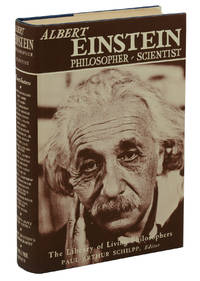
1949ref. 140941891Evanston IL: The Library of Living Philosophers Inc 1949. First Edition. Fine/Fine. First edition trade issue. xvi 781 pp. Bound in publisher's navy cloth with gilt spine lettering. Fine with offsetting to endpapers in a Fine dust jacket unfaded and unworn. A very sharp copy of a collectible volume all about the famous theoretical physicist. The Library of Living Philosophers, Inc unknown
1949ref. 140941891Evanston IL: The Library of Living Philosophers Inc 1949. First Edition. Fine/Fine. First edition trade issue. xvi 781 pp. Bound in publisher's navy cloth with gilt spine lettering. Fine with offsetting to endpapers in a Fine dust jacket unfaded and unworn. A very sharp copy of a collectible volume all about the famous theoretical physicist. The Library of Living Philosophers, Inc unknown books
1955ref. 9355New York: G. P. Putnam 1955. First Edition. Hardcover. Near fine/very good. Small octavo 168pp. A crisp clean copy near fine with a touch of pinpoint rubbing to the spine ends and corners. in a very good dust jacket with a few short tears and the spine sunned but no notable chips. This copy SIGNED by Willie Mays on the half-title page: "Best Wishes Willie Mays N. Y. Giants." On the same leaf is another seemingly later inscription which just reads "To J. B. Hennesey." This also looks to be in Mays's hand. We suppose that Hennesey owned this book which had been signed around the time of publication and he took it to a signing sometime later in the 1970s or 80s where he had it personalized by Mays. Mays wrote another autobiography in 1988 which is typically more easily obtainable. We could find no signed copies of this mid-career autobiography in auction records. Copies signed near the time of publication are decidedly uncommon. A significant Willie Mays autograph signed while Mays was still on the New York not San Francisco Giants. G. P. Putnam hardcover
ref. Z1-T-004-02093Charles C Thomas Pub Ltd. Used - Good. Ships from UK in 48 hours or less usually same day. Your purchase helps support Sri Lankan Children's Charity 'The Rainbow Centre'. Ex-library so some stamps and wear but in good overall condition. 100% money back guarantee. We are a world class secondhand bookstore based in Hertfordshire United Kingdom and specialize in high quality textbooks across an enormous variety of subjects. We aim to provide a vast range of textbooks rare and collectible books at a great price. Our donations to The Rainbow Centre have helped provide an education and a safe haven to hundreds of children who live in appalling conditions. We provide a 100% money back guarantee and are dedicated to providing our customers with the highest standards of service in the bookselling industry. Charles C Thomas Pub Ltd unknown
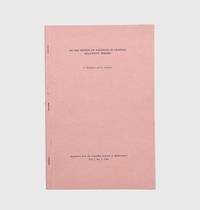
1949ref. 180348Ottowa: Canadian Mathematical Society 1949. Their final collaboration First edition offprint issue. Einstein and Infeld demonstrate that "field equations alone suffice as a basis for solving the problem of motion in general relativistic theory since the Einstein equations not only determine how particles must respond to gravitational forces but also contain the information necessary to describe those forces" Calaprice p. 323. Octavo pp. 34. Original orange wrappers wire-stitched as issued front cover lettered in black. Front wrapper lightly marked: a near-fine copy. Boni 259; Weil 223. Alice Calaprice An Einstein Encyclopedia 2015. unknown
1907ref. 53408Leibzig, Johann Ambrosius Barth, 1907. 8vo. Contemp. hcalf. Spine gilt and with gilt lettering. Slightly rubbed and light wear to spineends. In ""Annalen der Physik"", Vierte Folge, Band 23. VIII,1000 pp. a. 4 plates. (The entire volume offered). Einstein's paper: pp.371-384. Stamps on titlepage (Allgemeine Electricitäts-Gesellschaft a. AEG Forschungsinstitut). Internally clean.
1907ref. 53408Leibzig Johann Ambrosius Barth 1907. 8vo. Contemp. hcalf. Spine gilt and with gilt lettering. Slightly rubbed and light wear to spineends. In "Annalen der Physik" Vierte Folge Band 23. VIII1000 pp. a. 4 plates. The entire volume offered. Einstein's paper: pp.371-384. Stamps on titlepage Allgemeine Electricitäts-Gesellschaft a. AEG Forschungsinstitut. Internally clean. First edition of the first explicit statement of Einstein's energy-mass equation E=mc2.Nearly all descriptions of Einstein's scientific work state that the mass-energy equivalence E=mc2 was first formulated in Einstein's 1907 review paper 'Über das Relativitätsprinzip und die aus demselben gezogenen.' published in 'Jahrbuch der Radioaktivität und Elektronik' see Weil no. 21 and Dictionary of Scientific Biography vol. 4 pp.323 for examples. However in his paper 'Über die von Relativitätsprincip geforderte Trägheit der Energie' the offered paper which predates the former mentioned by six months Einstein gave a clear statement of the mass-energy equivalence E=mc2. See Lanczos: The Einstein Decade pp.149-150 and 153 as well as Volume 2 of 'The Collected Papers of Albert Einstein' pp. 428.Einstein's first paper regarding the relation E=mc2 is his fourth 1905 paper 'Ist die Trägheit eines Körpers von seinem Energieinhalt abhängig'. In this short paper Einstein showed that a body releasing the energy E in the form of radiation will have its mass decreased by E/c2 and concluded that the mass of a body is a measure of its energy content e.g. that all energy has mass. The next time Einstein returns to the subject is in his 1906 paper 'Das Prinzip von der Erhaltung der Schwerpunkts Bewegung und die Trägheit der Energie.'. Here Einstein concluded that one must either ascribe the inertial mass E/c2 to any form of energy E or else give up the fundamental law mechanics regarding conservation of the motion of the center of gravity. Then finally in the 1907 paper 'Über die von Relativitätsprincip geforderte Trägheit der Energie.' the offered paper Einstein makes the decisive step of assuming that all mass has energy. On page 382 Einstein considers the total energy of a moving mass point as the sum of its kinetic energy and its rest energy. In classical mechanics it is most convenient to set the second term to zero but in relativistic mechanics one obtains the simplest expression by setting the rest energy equal to mc2. Einstein then continues to show that this stipulation cannot lead to a contradiction in any relativistic argument. In a footnote on page 382 Einstein states for the first time the equation E=mc2 and mentions that this equation is the expression of the principle of the equivalence of mass and energy - see Volume 2 of 'The Collected Papers of Albert Einstein' pp. 428.The volume contains another paper by Einstein "Bemerkungen zu der Notiz von Hrn. Paul Ehrenfest: "Die Translation deformierbarer Elektronen und der Flächensatz"" pp.206-208. - Weil No. 18. Further with 2 importent papers by Max v. Laue.Collected Works Doc. 45. Weil 19. Boni 19. unknown
1950ref. 46543[1950]. 8vo. Original proof-copy (of the latest stage, presumably final proof, in the same format as the printed version and with no corrections), printed on rectos and versos. Stapled twice in left margin. A few marginal creases. A (proof-) number to upper left corner in red ink (297). Pp. 109-148 + tipped-in errata slip at p. 147.
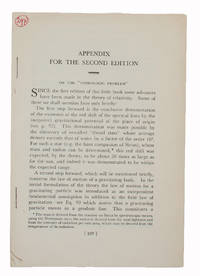
1950ref. 465431950. 8vo. Original proof-copy of the latest stage presumably final proof in the same format as the printed version and with no corrections printed on rectos and versos. Stapled twice in left margin. A few marginal creases. A proof- number to upper left corner in red ink 297. Pp. 109-148 tipped-in errata slip at p. 147. Very rare original proof-copy of the two highly important appendices for Einstein's "The Meaning of Relativity" third edition 1950 the second appendix being one of the most important pieces Einstein ever wrote namely the appendix "in which he described his most recent work on unification" Pais and the work which was hailed by The New York Times under the heading "New Einstein theory gives a master key to the universe". The first appendix which appeared for the second edition of the work remained unchanged throughout the history of "the Meaning of Relativity" and was written because "Since the first edition of this little book some advances have been made in the theory of relativity. . The first step forward is the conclusive demonstration of the existence of the red shift of the spectral lines by the negative gravitational potential of the place of origin" . A second step forward which will be mentioned briefly concerns the law of motion of a gravitating body." . A third step forward concerning the so-called "cosmologic problem" wiil be considered here in detail." pp. 109-10. The present 40 pages constitute the final proof-copy of the entire appendices I and II to the Generalized Theory of Gravitation exactly as they appeared in the third edition Princeton in 1950. Einstein's "The Meaning of Relativity" was originally published in 1922 on the basis of his "Vier Vorlesungen ueber Relativitetstheorie" given at Princeton in 1921. A second edition with an appendix appendix I appeared in 1945 several issues and editions of this appeared also and in 1949 the third edition with the seminal Appendix II printed for the first time appears also appeared in 1950 in Princeton. In 1950 a revised edition of the third edition appears having Appendix II slightly revised and in 1953 the heavily revised fourth edition appears. THIS IS THE PROOF-COPY OF APPENDICES I AND II FOR THE "THIRD EDITION INCLUDING THE GENERALIZED THEORY OF GRAVITATION" PRINCETON 1950. The main focus of the work throughout all these editions of the work since 1949 is Appendix II which deals with Einstein's main interest the generalization of the Gravitation Theory which was to unite the general theory of relativity with electromagnetism recovering an approximation for quantum theory and presenting us with a theory to explain the universe as a unified entity the ultimate goal for the greatest physicist that ever lived. "This was Einstein's ultimate response to the mechanical-electromagnetic crisis in physical theory he had first talked about in the opening of his 1905 light quantum-paper." Nandor in D.S.B. p. 330. It was indeed Einstein's aim to provide an explanation of the universe through his unified field theory although he was well aware that his sort of field theory might not exist. However even the establishing of the non-existence of it could bring us closer to an explanation than we had ever been before. There is no topic of greater importance to Einstein than his theory of unification. "In 1949 Einstein wrote a new appendix for the third edition of his "The Meaning of Relativity" in which he described his most recent work on unification. It was none of his doing that a page of his manuscript appeared on the front page of "The New York Times" under the heading "New Einstein theory gives a master key to the universe". He refused to see reporters and asked Helen Dukas to relay this message to them: "Come back and see me in twenty years"." Pais p. 350. unknown
1907ref. 50595Leibzig, Johann Ambrosius Barth, 1907. 8vo. In contemporary full cloth with gilt lettering to spine. In ""Annalen der Physik"", Vierte Folge, Band 23. Entire volume offered. Ex-libris pasted on to top right corner of pasted down front free end-paper. Light rubbing to extremities, a very fine and clean copy (not an ex-library copy). Pp.371-384. [Entire volume: VIII, 1000 pp. + 4 plates].
1907ref. 47457Leibzig, Johann Ambrosius Barth, 1907. 8vo. Contemp. hcalf. Spine gilt. Title-and tomelabels with gilt lettering. Slightly rubbed. In ""Annalen der Physik"", Vierte Folge, Band 23. VIII,1000 pp. a. 4 plates. (The entire volume offered). Einstein's paper: pp.371-384. A small stamp on titlepage (Gmelin.Institut.). Internally clean and fine.
1907ref. 50595Leibzig Johann Ambrosius Barth 1907. 8vo. In contemporary full cloth with gilt lettering to spine. In "Annalen der Physik" Vierte Folge Band 23. Entire volume offered. Ex-libris pasted on to top right corner of pasted down front free end-paper. Light rubbing to extremities a very fine and clean copy not an ex-library copy. Pp.371-384. Entire volume: VIII 1000 pp. 4 plates. First edition of the first explicit statement of Einstein's landmark energy-mass equation E=mc2.Nearly all descriptions of Einstein's scientific work state that the mass-energy equivalence E=mc2 was first formulated in Einstein's 1907 review paper 'Über das Relativitätsprinzip und die aus demselben gezogenen.' published in 'Jahrbuch der Radioaktivität und Elektronik' see Weil no. 21 and Dictionary of Scientific Biography vol. 4 pp.323 for examples. However in his paper 'Über die von Relativitätsprincip geforderte Trägheit der Energie' the offered paper which predates the former mentioned by six months Einstein gave a clear statement of the mass-energy equivalence E=mc2. See Lanczos: The Einstein Decade pp.149-150 and 153 as well as Volume 2 of 'The Collected Papers of Albert Einstein' pp. 428.Einstein's first paper regarding the relation E=mc2 is his fourth 1905 paper 'Ist die Trägheit eines Körpers von seinem Energieinhalt abhängig'. In this short paper Einstein showed that a body releasing the energy E in the form of radiation will have its mass decreased by E/c2 and concluded that the mass of a body is a measure of its energy content e.g. that all energy has mass. The next time Einstein returns to the subject is in his 1906 paper 'Das Prinzip von der Erhaltung der Schwerpunkts Bewegung und die Trägheit der Energie.'. Here Einstein concluded that one must either ascribe the inertial mass E/c2 to any form of energy E or else give up the fundamental law mechanics regarding conservation of the motion of the center of gravity. Then finally in the 1907 paper 'Über die von Relativitätsprincip geforderte Trägheit der Energie.' the offered paper Einstein makes the decisive step of assuming that all mass has energy. On page 382 Einstein considers the total energy of a moving mass point as the sum of its kinetic energy and its rest energy. In classical mechanics it is most convenient to set the second term to zero but in relativistic mechanics one obtains the simplest expression by setting the rest energy equal to mc2. Einstein then continues to show that this stipulation cannot lead to a contradiction in any relativistic argument. In a footnote on page 382 Einstein states for the first time the equation E=mc2 and mentions that this equation is the expression of the principle of the equivalence of mass and energy - see Volume 2 of 'The Collected Papers of Albert Einstein' pp. 428.The volume contains another paper by Einstein "Bemerkungen zu der Notiz von Hrn. Paul Ehrenfest: "Die Translation deformierbarer Elektronen und der Flächensatz"" pp.206-208. - Weil No. 18.Collected Works Doc. 45. Weil 19. Boni 19. hardcover
1907ref. 47457Leibzig Johann Ambrosius Barth 1907. 8vo. Contemp. hcalf. Spine gilt. Title-and tomelabels with gilt lettering. Slightly rubbed. In "Annalen der Physik" Vierte Folge Band 23. VIII1000 pp. a. 4 plates. The entire volume offered. Einstein's paper: pp.371-384. A small stamp on titlepage Gmelin.Institut. Internally clean and fine. First edition of the first explicit statement of Einstein's energy-mass equation E=mc2.Nearly all descriptions of Einstein's scientific work state that the mass-energy equivalence E=mc2 was first formulated in Einstein's 1907 review paper 'Über das Relativitätsprinzip und die aus demselben gezogenen.' published in 'Jahrbuch der Radioaktivität und Elektronik' see Weil no. 21 and Dictionary of Scientific Biography vol. 4 pp.323 for examples. However in his paper 'Über die von Relativitätsprincip geforderte Trägheit der Energie' the offered paper which predates the former mentioned by six months Einstein gave a clear statement of the mass-energy equivalence E=mc2. See Lanczos: The Einstein Decade pp.149-150 and 153 as well as Volume 2 of 'The Collected Papers of Albert Einstein' pp. 428.Einstein's first paper regarding the relation E=mc2 is his fourth 1905 paper 'Ist die Trägheit eines Körpers von seinem Energieinhalt abhängig'. In this short paper Einstein showed that a body releasing the energy E in the form of radiation will have its mass decreased by E/c2 and concluded that the mass of a body is a measure of its energy content e.g. that all energy has mass. The next time Einstein returns to the subject is in his 1906 paper 'Das Prinzip von der Erhaltung der Schwerpunkts Bewegung und die Trägheit der Energie.'. Here Einstein concluded that one must either ascribe the inertial mass E/c2 to any form of energy E or else give up the fundamental law mechanics regarding conservation of the motion of the center of gravity. Then finally in the 1907 paper 'Über die von Relativitätsprincip geforderte Trägheit der Energie.' the offered paper Einstein makes the decisive step of assuming that all mass has energy. On page 382 Einstein considers the total energy of a moving mass point as the sum of its kinetic energy and its rest energy. In classical mechanics it is most convenient to set the second term to zero but in relativistic mechanics one obtains the simplest expression by setting the rest energy equal to mc2. Einstein then continues to show that this stipulation cannot lead to a contradiction in any relativistic argument. In a footnote on page 382 Einstein states for the first time the equation E=mc2 and mentions that this equation is the expression of the principle of the equivalence of mass and energy - see Volume 2 of 'The Collected Papers of Albert Einstein' pp. 428.The volume contains another paper by Einstein "Bemerkungen zu der Notiz von Hrn. Paul Ehrenfest: "Die Translation deformierbarer Elektronen und der Flächensatz"" pp.206-208. - Weil No. 18.Collected Works Doc. 45. Weil 19. Boni 19. unknown
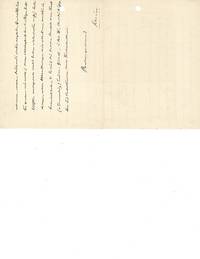
1918ref. 135751918. Mathematics Klein Felix. Autograph Letter Signed 10 November 1918 written in German to a former student and colleague directly references Einstein's recently published General Theory of Relativity and comments on the work of the International Mathematical Education Commission. Composed in the closing days of the First World War the letter places Klein within active scholarly exchange concerning the mathematical implications of relativity which had been formally presented in 1915 and widely disseminated by 1918. Klein long established for his foundational contributions to group theory non-Euclidean geometry and mathematical physics addresses questions raised by "Einstein's theory" noting that he required further reflection to clarify its implications for his own work. The document supports research in the history of relativity German mathematical networks scientific communication during wartime and the institutional organization of mathematics in the early twentieth century. Klein Felix. Autograph Letter Signed 10 November 1918. Two pages written on both sides of a single leaf. In German with accompanying English translation. Addressed to a former student the letter discusses the circulation of lecture manuscripts difficulties in securing copyists during wartime conditions and the intellectual demands posed by Einstein's theory: "A further exploration of my work does not exist yet as I had and still have more thinking to do about questions raised by Einstein's theory to clarify it for myself." Klein also comments critically on the IMUK observing that its published statements are "a display of wasted paper" while acknowledging the commission's broader social significance. He singles out contemporary educational treatises including studies by W. Trost Heinrich Emil Timerding and M. Girndt indicating his sustained engagement with mathematical pedagogy alongside theoretical research. The letter was written days before the November Revolution in Germany and at a moment when academic institutions faced political upheaval and material shortages. Klein's remarks regarding limited copyists and uncertainty about the coming months provide contemporaneous evidence of scholarly life under strained postwar conditions. His reference to Einstein situates the correspondence within the earliest phase of professional reception of general relativity among leading mathematicians while his comments on the International Mathematical Education Commission underscore his longstanding commitment to mathematical instruction and institutional reform. Clean and well preserved with strong legibility and a clear signature. Overall near fine condition. A substantive document of early relativity discourse and mathematical research at the end of the First World War. unknown
1918ref. 135751918. Mathematics Klein Felix. Autograph Letter Signed 10 November 1918 written in German to a former student and colleague directly references Einstein's recently published General Theory of Relativity and comments on the work of the International Mathematical Education Commission. Composed in the closing days of the First World War the letter places Klein within active scholarly exchange concerning the mathematical implications of relativity which had been formally presented in 1915 and widely disseminated by 1918. Klein long established for his foundational contributions to group theory non-Euclidean geometry and mathematical physics addresses questions raised by "Einstein's theory" noting that he required further reflection to clarify its implications for his own work. The document supports research in the history of relativity German mathematical networks scientific communication during wartime and the institutional organization of mathematics in the early twentieth century. Klein Felix. Autograph Letter Signed 10 November 1918. Two pages written on both sides of a single leaf. In German with accompanying English translation. Addressed to a former student the letter discusses the circulation of lecture manuscripts difficulties in securing copyists during wartime conditions and the intellectual demands posed by Einstein's theory: "A further exploration of my work does not exist yet as I had and still have more thinking to do about questions raised by Einstein's theory to clarify it for myself." Klein also comments critically on the IMUK observing that its published statements are "a display of wasted paper" while acknowledging the commission's broader social significance. He singles out contemporary educational treatises including studies by W. Trost Heinrich Emil Timerding and M. Girndt indicating his sustained engagement with mathematical pedagogy alongside theoretical research. The letter was written days before the November Revolution in Germany and at a moment when academic institutions faced political upheaval and material shortages. Klein's remarks regarding limited copyists and uncertainty about the coming months provide contemporaneous evidence of scholarly life under strained postwar conditions. His reference to Einstein situates the correspondence within the earliest phase of professional reception of general relativity among leading mathematicians while his comments on the International Mathematical Education Commission underscore his longstanding commitment to mathematical instruction and institutional reform. Clean and well preserved with strong legibility and a clear signature. Overall near fine condition. A substantive document of early relativity discourse and mathematical research at the end of the First World War. unknown books
1922ref. 34667(Berlin, Julius Springer, 1922-24). 8vo. In: ""Zeitschrift für Physik"", Vol. 10 (pp. 377 ff.),Vol.11 (pp.326), vol.16 (pp.228), vol.21 (pp.326-332). The entire four volumes offered here. Contemporary half cloth bindings.