EINSTEIN, AlbertBiblio.com
2.976 resultados
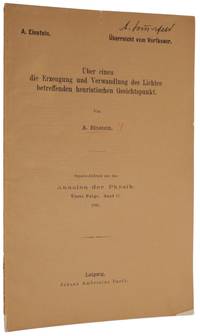
1905ref. 6412Leipzig: Johann Ambrosius Barth 1905. First edition. First edition rare author's presentation offprint 'Überreicht vom Verfasser' from the library of Arnold Sommerfeld - carrying his ink signature the red-pencil accession number '4' of his Einstein-offprint collection and his autograph pencil calculations on two pages - of the paper on light quanta and the photoelectric effect for which Einstein was awarded the 1921 Nobel Prize and the only one of his four annus mirabilis papers that he called sehr revolutionär. From Wien's radiation law he shows that the entropy of high-frequency radiation has the thermodynamic form of an ideal gas of independent quanta of energy hv and applies it to Stokes's rule photoionisation and the photoelectric effect. Sommerfeld's pencil decodes Einstein's β as h/k on p. 136 using the refined constants of Planck's 1906 Vorlesungen and on p. 146 computes Rβ/E the predicted slope h/e of the photoelectric line that Millikan would measure 1912-1916. Sommerfeld with Debye in 1913 argued the equation could be recovered without the light quantum; Compton's 1923 scattering results won him over. . Einstein's Nobel Prize Paper. First edition rare author's presentation offprint 'Überreicht vom Verfasser' from the library of Arnold Sommerfeld - carrying his ink signature the red-pencil accession number '4' of his Einstein-offprint collection beneath Einstein's printed name and his autograph pencil calculations in the margins of two crucial pages - of the paper on light quanta and the photoelectric effect for which Einstein was awarded the 1921 Nobel Prize in Physics. Of the four epochal papers Einstein produced during his annus mirabilis this is the only one he himself described as revolutionary and the one that most squarely broke with the nineteenth-century physics in which he had been trained. It is also the paper on which Thomas Kuhn built his argument that the origin of quantum theory belongs not to Planck in 1900 but to Einstein in 1905. Provenance: Arnold Sommerfeld 1868-1951 with his ink signature the red-pencil accession number '4' of his Einstein-offprint collection beneath Einstein's printed name on the front wrapper and his pencil calculations in the margins of pp. 136 and 146 with a pencilled mark on p. 145. Appointed to the chair of theoretical physics at Munich in 1906 the year after the present paper appeared he held it for more than three decades. Trained at Königsberg under Hurwitz and Lindemann he came to theoretical physics through mathematics and remained one of its greatest teachers. His Munich institute became the most important training ground in the discipline: Heisenberg Pauli Debye Bethe Ewald Landé Laporte and Morse were among his doctoral students and the institute's seminar room served as the workshop in which the old quantum theory took shape. Sommerfeld's own contributions to that theory - the quantisation of elliptical orbits the fine-structure formula the introduction of the fine-structure constant the systematics of selection rules and later the free-electron theory of metals - place him among the founders of modern atomic physics. His textbook Atombau und Spektrallinien first published in 1919 and repeatedly revised was for a generation the standard exposition of the subject. When the ageing professor was due to retire in 1936 in favour of Heisenberg the National Socialist authorities blocked the succession on the grounds that Sommerfeld and his nominee were insufficiently aligned with party science; the chair remained vacant until 1939 and passed in the end to a political appointment. Sommerfeld returned to his institute after the war and continued working until his death in a road accident in Munich in 1951. Max Born in his Royal Society obituary described him as combining classical clarity with the pioneering instinct. The red-pencil '4' on the front wrapper is one entry in a systematic accession numbering that runs in red chinagraph across Sommerfeld's collection of Einstein offprints. Thirteen numbered copies have so far been documented and their numbers are strictly chronological in the papers' publication dates: 4 on the present 1905 paper; 20 on the 1911 paper on gravitation and the propagation of light; 30 on the November 1915 'Zur allgemeinen Relativitätstheorie' with its Nachtrag; 33 and 34 on two duplicate copies of the 1916 'Hamiltonsches Prinzip' taking consecutive numbers; 36 on the 1917 'Kosmologische Betrachtungen'; and 40 44 45 46 47 48 and 49 on papers of 1923-1929 ending with the unified-field-theory series - the sequence resolved to the month even within a single year 44 on a January 1925 paper 45 on a July 1925 paper. The scheme is thus a running ledger of the collection in order of publication and the '4' identifies the present offprint as the fourth Einstein item in it implying just three earlier papers - necessarily drawn from Einstein's handful of Annalen papers of 1901-1904 - ahead of it. One of the documented copies also bears the pre-1918 stamp of Sommerfeld's Munich institute where his papers and library are recorded as having remained for decades after his death in 1951 consistent with the collection surviving intact long into the twentieth century. No published account of the Sommerfeld offprint collection exists; the reconstruction of the scheme rests on the documented copies themselves of which the present one is the earliest. Completed in Bern on 17 March 1905 and dispatched to Annalen der Physik the following day the paper was the first of Einstein's great 1905 contributions - the others being the doctoral dissertation on molecular dimensions the paper on Brownian motion and the two papers founding the special theory of relativity. Einstein was at the time a twenty-six-year-old technical expert third class at the Swiss Patent Office in Bern without academic affiliation without institutional laboratory with his doctorate not yet conferred and with a circle of scientific correspondents that ran to little more than his old Olympia Academy companions Conrad Habicht and Maurice Solovine. The regular correspondence with Planck Laue Stark Sommerfeld Wien and Lorentz that would bring him into the German-speaking academic world lay still in the future; his first surviving letter to Sommerfeld is dated 5 January 1908. The printed presentation formula on the wrapper marks the present copy as one of the small stock of author's offprints Einstein had in hand by the spring of 1905; how and when it reached Sommerfeld is not documented. Their acquaintance in fact opens over relativity rather than light quanta - the 1908 letter discusses the velocity of signals and the two men first met in person at the Salzburg Naturforscherversammlung of September 1909 - but the pencil annotations described below place the close study of this copy in precisely those years as Sommerfeld newly installed in the Munich chair of theoretical physics was turning himself and his school toward the quantum theory of radiation. Writing to Habicht in May 1905 Einstein sketched the four papers that were about to appear and reserved a particular adjective for this one alone. The first he explained concerned radiation and the energetic properties of light and was sehr revolutionär. The second determined the true sizes of atoms from the viscosity of dilute solutions. The third derived the irregular motion of small bodies suspended in a liquid from the molecular-kinetic theory of heat. The fourth still in draft would treat the electrodynamics of moving bodies and would alter as Einstein promised the theory of space and time. In that taxonomy only the light-quantum paper is singled out as revolutionary and Einstein's self-assessment has proved durable. Relativity consummated a line of nineteenth-century thought extending from Maxwell through Lorentz and Poincaré; the light-quantum hypothesis set itself against that entire line. The paper opens from a formal asymmetry that physicists had tolerated without remark. The state of a gas or any ponderable body is described by the positions and velocities of a finite if very large number of atoms and electrons so that the energy of such a body is a sum over a discrete basis. The state of an electromagnetic field by contrast is given by continuous functions in space so that in Maxwell's theory the energy of radiation is an integral over an infinite number of degrees of freedom. Einstein proposes that this asymmetry is not merely formal but physical - that radiation energy like matter may in certain circumstances behave as if it were concentrated into a finite number of localised packets. The wave theory he grants is magnificent where it applies but its predictions refer to time-averaged field values so that nothing in the experimental record rules out a granular structure on short timescales or at low densities of the radiation. The positive case for light quanta rests on a thermodynamic analogy that Einstein develops with remarkable economy. Using Wien's radiation law valid in the high-frequency tail of the black-body spectrum he writes down the entropy of monochromatic radiation of fixed frequency as a function of its volume. The resulting expression has exactly the form of the entropy of an ideal gas whose particle number equals the radiation energy divided by hv. In the Wien region in other words radiation behaves thermodynamically as a collection of independent energy quanta of magnitude hv. This simple audacious conclusion - that the entropy-volume relation of radiation is that of a gas of particles - is the paper's load-bearing result and it arrives without any appeal to detailed mechanical models of emission or absorption. From this thermodynamic footing Einstein advances to three predictions. Stokes's rule stating that fluorescent light has a lower frequency than the exciting light follows directly on the hypothesis that one absorbed quantum of energy hv can re-emit at most one quantum of no greater energy: the emitted frequency cannot exceed the absorbed frequency because the emitted quantum cannot exceed hv in energy. Photoionisation of gases by ultraviolet light follows from the condition that the ionisation energy of a molecule cannot be greater than the energy of the absorbed quantum. And the photoelectric effect in which metallic surfaces release electrons under illumination is reformulated into what became known as Einstein's photoelectric equation: the maximum kinetic energy of the ejected electron equals hv minus the work function of the metal. The linearity of electron energy in frequency and the independence of the slope from the material are predictions derived from the quantum hypothesis. It is on precisely these last two sections of the paper that the Sommerfeld copy speaks most directly. At the foot of p. 136 beside Einstein's statement of Planck's formula with the constants α = 6.10 × 10−56 and β = 4.866 × 10⁻¹¹ Sommerfeld has written in pencil β = h/κ = 6.548 × 10⁻²⁷ / 1.346 × 10⁻¹⁶ grad·sec. Einstein throughout his paper uses Planck's 1901 constants α and β without explicitly connecting them back to Planck's action quantum h and to what would later be called Boltzmann's constant k. Sommerfeld's pencil step reconstructs the bridge - Einstein's β is nothing other than the ratio h/k and 'grad·sec' is that ratio's correct unit - and the numbers he inserts identify the very book he was working from. The pair h = 6.548 × 10⁻²⁷ erg·sec and k = 1.346 × 10⁻¹⁶ erg/grad appears in exactly this form as equation 252 of Planck's Vorlesungen über die Theorie der Wärmestrahlung Leipzig 1906 p. 162 - Planck's own refinement of the rounder values of his 1901 paper - and so far as can be established nowhere else: Planck's second edition of 1913 revised the figure to 6.415 and the later determinations of Millikan 1916 and Birge 1919 differ again. Planck's 1906 text even cites Einstein's paper by page in the passage immediately preceding that equation. The annotation thus records a reader checking Einstein's constants against Planck's newest determination with the textbook open beside the offprint at some point between 1906 and about 1912 - the very years in which Sommerfeld entered the quantum theory of radiation. On p. 146 the second pencil annotation sits beside Einstein's derivation of the photoelectric equation ΠE = Rβv − P′ where E = 9.6 × 10³ is the charge of a gram-equivalent of a monovalent ion and Π is the stopping potential required to arrest the photoelectrons. Sommerfeld has written out Rβ/E = 8.31 × 107 · 4.866 × 10−11 / 9.6 × 10³ - that is the slope dΠ/dv of the stopping potential against frequency. Because Rβ = Rh/k = Nh and the Faraday E = Ne this ratio reduces algebraically to h/e. What Sommerfeld is pencilling in the margin is therefore the predicted slope of Einstein's photoelectric line - the very constant that Robert Andrews Millikan would spend the years 1912-1916 measuring and whose accurate determination by the straight-line fit of electron energy against frequency delivered in 1916 both the most stringent early confirmation of Einstein's equation and a precise new value of Planck's h. On p. 145 a small pencilled '2' and two double dashes in the outer margin bracket a single sentence of §8 - Einstein's caveat that it should not be excluded 'daß Elektronen die Energie von Lichtquanten nur teilweise aufnehmen' that electrons might take up the energy of light quanta only partially. That is precisely the loophole on which the semi-classical readings of the photoelectric equation would later be built Sommerfeld's own among them. That Sommerfeld should have traced those calculations on his own copy is more than incidental. In January 1910 he told Lorentz that he was 'old-fashioned enough to resist for now the light quanta in Einstein's conception' and through the 1910s he was himself among the physicists who argued that Einstein's photoelectric equation could be recovered on semi-classical non-Einsteinian grounds - that is that the equation stood while the light-quantum hypothesis from which Einstein had derived it need not be accepted. Planck Debye Lorentz and O. W. Richardson held variants of the same position; the fullest contemporaneous statement of this approach is Debye and Sommerfeld 'Theorie des lichtelektrischen Effektes vom Standpunkt des Wirkungsquantums' Annalen der Physik 346 1913 pp. 873-930. It would take the Compton experiments of 1922-1923 to change Sommerfeld's mind - at which point he declared with characteristic decisiveness that Compton's scattering results sounded the death knell of the classical wave theory of radiation a position he made public in the preface to the fourth edition of Atombau und Spektrallinien Vieweg 1924 pp. vii-viii where he wrote that he had clung to the wave theory as long as possible before being 'impelled to adopt more and more the position of the extreme light quantum theory'. The two pencil derivations on this copy then are the working-notes precursors to nearly twenty years of sustained theoretical engagement by one of the foremost teachers of modern physics with the very pages marked. The audacity of Einstein's argument was not lost on his contemporaries and neither was its precariousness. The light-quantum hypothesis demanded that a century of evidence for the wave theory - diffraction interference polarisation the entire edifice of physical optics - be folded into a picture in which radiation also travelled as discrete packets. Einstein himself acknowledged the strain and used the word heuristisch in his title to temper it. For nearly two decades after 1905 his contemporaries resisted the hypothesis even as they accepted the equation. When Planck Nernst Rubens and Warburg proposed Einstein for election to the Prussian Academy in 1913 they prefaced their glowing recommendation by asking that he not be held too severely to account for those of his speculations that had missed their mark - their example being precisely the hypothesis of light quanta. Millikan reporting the decisive experimental confirmation of Einstein's photoelectric equation in 1916 went out of his way to describe the underlying quantum hypothesis as untenable and reached instead for classical interpretations. Only with Compton's scattering experiments in 1923 did the physics community at large concede that light itself and not merely its interaction with matter demanded the quantum. The prehistory of the paper runs back to Einstein's undergraduate years. Mach's Wärmelehre which he read in Aarau or shortly thereafter devoted two chapters to thermal radiation and closed with an account of Kirchhoff's universal black-body law. H. F. Weber's physics course at the ETH in the winter of 1898-1899 for which Einstein registered presented measurements of the energy spectrum of thermal radiation and an empirical distribution function that anticipated Wien's displacement law. By March 1899 Einstein had begun thinking seriously about radiation and by the spring of 1901 he was reading Planck with care and scepticism. Planck had derived the black-body formula of 1900 by dividing the energy of a collection of charged oscillators into discrete elements of size hv and counting the ways these elements could be distributed - a procedure that as Einstein would later show is only consistent if one admits that the oscillators themselves can hold only energies that are integer multiples of hv. Planck himself had been unwilling to draw that conclusion. Einstein in 1905 draws it without apology and goes further: if oscillators can hold only quantised energies then the radiation field with which they are in equilibrium must also at least in some regimes be granular. Einstein prepared himself for this step with a long study of the foundations of statistical physics conducted between 1902 and 1904. That work yielded three tools that became indispensable to his quantum argument. The first was the canonical ensemble which gave him a general framework for calculating mean values in thermal equilibrium. The second was a careful reinterpretation of the Boltzmann principle S = k log W in which the probability W is counted over the accessible microstates of the system. The third was a method for computing mean-square fluctuations of state variables at equilibrium. Applied to radiation in thermal equilibrium the fluctuation method reproduced Wien's displacement law and more tellingly suggested that radiation behaved as if its phase space had a finite dimension - an intimation of the quantum granularity the 1905 paper would go on to assert. Two features make the 1905 quantum paper unique even within Einstein's own subsequent work on the subject. It does not rely on Planck's radiation law; it uses only the Wien limit. And it does not rely on the apparatus of the canonical ensemble that Einstein had developed; the argument proceeds through a thermodynamic analogy between radiation entropy and gas entropy. This austerity is part of its power: by leaning on nothing but thermodynamics and the Wien law Einstein removes every interpretive crutch that might soften the conclusion. The radiation is behaving as a gas of particles because the thermodynamic form of its entropy says so. Einstein submitted the paper to Annalen der Physik on 18 March 1905. It appeared in the first issue of Band 17 distributed on 9 June 1905. By April 1905 however - and therefore weeks before the journal issue was bound up and circulated - Einstein had already received his allotment of offprints: his letter to Habicht announcing the four forthcoming papers indicates that he had separates in hand. On the priority of issue then the offprint precedes the journal printing and the printed presentation statement 'Überreicht vom Verfasser' on the wrapper of copies such as the present one marks them as part of the small stock that passed through Einstein's own hands. That circle was small. Weil in the standard bibliography of Einstein's writings notes that the number of offprints produced of papers before 1914 appears to have been very modest that they were given to the author only and that the wrappers usually carry the printed presentation formula. Later trade-attributed testimony from Hans Albert Einstein's copy of the Brownian-motion offprint puts the typical print run for Einstein's early offprints at twenty-five to thirty copies. Of the light-quantum paper in particular offprints in any condition are now encountered only very occasionally in commerce and copies preserved in their original wrappers are rarer still. References: Norman 689 - Weil Einstein Bibliography 6 - Boni Russ & Laurence Bibliographical Checklist 7 - Pais Subtle Is the Lord pp. 364-368 - Planck Vorlesungen über die Theorie der Wärmestrahlung Leipzig: Barth 1906 p. 162 the source of the annotated constants - Eckert Arnold Sommerfeld: Science Life and Turbulent Times Springer 2013 - Born 'Sommerfeld 1868-1951' Obituary Notices of Fellows of the Royal Society 8 1952 pp. 275-296 - Cassidy 'Einstein on the Photoelectric Effect' in Einstein: Image and Impact American Institute of Physics - Stachel et al. eds The Collected Papers of Albert Einstein vol. 2 pp. 134-142 and vol. 5 doc. 72 Einstein to Sommerfeld 5 January 1908 - Eckert & Märker eds Arnold Sommerfeld: Wissenschaftlicher Briefwechsel Band 1: 1892-1918 GNT-Verlag 2000 - Stuewer 'Einstein's Revolutionary Light-Quantum Hypothesis' Acta Physica Polonica B 37 2006 pp. 543-558 - Printing and the Mind of Man 391 Planck's precursor quantum papers. Offprint from Annalen der Physik 4. Folge 17. Band 1905. 8vo 222 × 144 mm pp. 1 132-148. Original printed wrappers with 'A. Einstein. Überreicht vom Verfasser' printed in bold type on the front cover upper outer corner of rear wrapper with loss well clear of the printed area; small chips to the lower outer corner of the front wrapper and to the foot of the spine; faint vertical creases to the front wrapper. . Johann Ambrosius Barth unknown