"EINSTEIN, ALBERT.Livre Rare Book

2.534 resultados
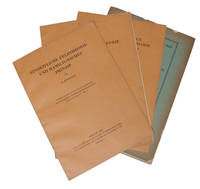
1925ref. 59960Berlin, Königlich Akademie der Wissenschaften, 1925-1929. 1. Einheitliche Feldtheorie von Gravitation und Elektrizität., 1925, pp. 414-419. Uncut, unopened n the original printed wrappers. missing small parts of spine and upper part of front wrapper detached, otherwise fine. (Weil 147 / Boni 155).2. Neue Möglichkeit für eine einheitliche Feldtheorie von Gravitation und Elektrizität. Offprint: S. B. preuss. Akad. Wiss., 1928, pp.235-245. In the original yellow wrappers. Very fine and clean. (Weil 162/ Boni 175).3. Zur einheitlichen Feldtheorie. Offprint: S. B. preuss. Akad. Wiss., 1929, pp.2-7. In the original yellow wrappers. Very fine and clean. (Weil 165/ Boni 183).4. Einheitliche Feldtheorie und Hamiltonsches Prinzip. Offprint: S. B. preuss. Akad. Wiss., 1929, pp.156-159. In the original yellow wrappers. Very fine and clean. (Weil 166/ Boni 184).
1925ref. 59960Berlin Königlich Akademie der Wissenschaften 1925-1929. 1. Einheitliche Feldtheorie von Gravitation und Elektrizität. 1925 pp. 414-419. Uncut unopened n the original printed wrappers. missing small parts of spine and upper part of front wrapper detached otherwise fine. Weil 147 / Boni 155.2. Neue Möglichkeit für eine einheitliche Feldtheorie von Gravitation und Elektrizität. Offprint: S. B. preuss. Akad. Wiss. 1928 pp.235-245. In the original yellow wrappers. Very fine and clean. Weil 162/ Boni 175.3. Zur einheitlichen Feldtheorie. Offprint: S. B. preuss. Akad. Wiss. 1929 pp.2-7. In the original yellow wrappers. Very fine and clean. Weil 165/ Boni 183.4. Einheitliche Feldtheorie und Hamiltonsches Prinzip. Offprint: S. B. preuss. Akad. Wiss. 1929 pp.156-159. In the original yellow wrappers. Very fine and clean. Weil 166/ Boni 184. Fine collection three in offprint and one in the original printed wrappers of the four papers that together constitute Einstein's attempt towards creating a unified field theory: "a new theory of space with a view to unification of all forms of activity that fall within the sphere of physics giving them a common explanation" PMM416. The task of unifying nuclear electromagnetic and gravitational force is nowadays by many considered the holy grail of theoretical physics.Maxwell was the first to develop such a theory when he described the forces of electricity and magnetism as the single force electromagnetism. After Einstein had completed his general theory of relativity a field theory for gravitation he turned his attention towards generalizing his theory even further to include Maxwell's theory. Even though Einstein never succeeded in completing this task in the way that he finished his earlier theories he pioneered and explored many areas of this subject."It had been repeatedly observed that Einstein's general theory of relativity necessitated a pluralistic explanation of the universe. In 1925 he announced that he had resolved this difficulty but the announcement was premature. In 1928 he attacked the problem once more only to find that Riemann's conception of space on which the general theory was based would not permit of a common explanation of electromagnetic and gravitational phenomena. In a series of papers the present devoted to the development of 'A Uniform Theory of Gravitation and Electricity' he outlined a new theory of space with a view to unification of all forms of activity that fall within the sphere of physics giving them a common explanation. All that would then remain to complete a scientific unison is the correlation of the organic and inorganic".PMM 416Barchas 586Weil 147 162 165 & 166. unknown
1916ref. 62767Leipzig, Verlag von Johann Ambrosius Barth (Druck von Metzger & Wittig in Leipzig), 1916. Gr.-8°. 64 S., OKart.
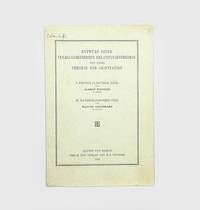
1913ref. 188059Leipzig and Berlin: B. G. Teubner 1913. Generalizing relativity First edition of Einstein's early articulation of general relativity his first paper to describe gravity as the curvature of spacetime containing "virtually all the essential features of his general theory of relativity" Norton p. 253. In 1912 Einstein's old school friend Marcel Grossman 1878-1936 secured him a professorship at ETH Zurich where they had both studied as undergraduates. The two men began a collaboration to provide a firmer mathematical foundation to Einstein's concept of gravity as a geometrical property of time and space. The two sections of the Entwurf outline the resulting theory in full complete with gravitational field equations relating the curvature of spacetime to the distribution of mass and energy within it. Einstein contributed the initial section focussing on physical theories while Grossman added the following section developing the more complex mathematical formulae. Michel Janssen editor of the Einstein Papers Project notes that the Entwurf "was published as a separatum in early 1913 and was reprinted the following year in Zeitschrift für Mathematik und Physik" p. 1. The Zeitschrift reprint includes an added section outlining the famed "Hole" argument. An offprint dated 1914 was published with the journal. Provenance: Edward Vermilye Huntington 1874-1952 the American academic who studied the foundations of mathematics at Harvard for 40 years with his signature on the front wrapper. Octavo. Device to title page formulae in the text. Original light green wrappers printed in black. Light rubbing chipping and creasing to wrappers contents clean: a very good copy indeed. Boni 50; Norman 693; Weil 58a. Michael Janssen "Einstein's First Systematic Exposition of General Relativity" 2004; John Norton "How Einstein found his field equations: 1912-1915" Historical Studies in the Physical Sciences vol. 14 no. 2 1984. unknown
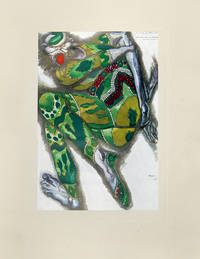
ref. 121457Berlin Ernst Wasmuth 1927. . Limited edition one of 250 German copies this number 100 large 4to 33.5 x 26.4 cm; 41 pp. incl half-title and title 19 pochoir plates with captioned tissue guards first tissue guard torn 29 tipped-in colour plates; vellum-backed gilt decorated purple boards upper board sunned and lower board stained corners bumped otherwise a very good copy. Fresh example of this beautiful work on Leon Bakst. The numerous plates represent not only Bakst most celebrated costumes but also drawings and theatre settings. The text was compiled by Carl Einstein 1885-1940 author of the important Expressionist novel Bebuquin 1912. Berlin, Ernst Wasmuth, 1927. hardcover
1945ref. 180350Lancaster Pennsylvania: American Physical Society 1945 & 1946. His most significant later contribution to cosmology First editions offprint issues of the papers that introduced the Swiss-cheese model of the universe. Einstein and Straus revised the FLRW metric by suggesting that the universe is in fact inhomogeneous. "In two ground-breaking papers Einstein and Straus showed how galaxies fit into a Universe with zero pressure. This model helps to describe the universe observed today" Harwit p. 573. Quarto pp. 5. Disbound wire-stitched as issued. Nicks and creasing to extremities short closed tears to outer margins pp. 120-1 of Influence detached rear blank almost detached: in very good condition. Boni 252 & 252.1; Weil 216. Martin Harwit Astrophysical Concepts 2010. unknown
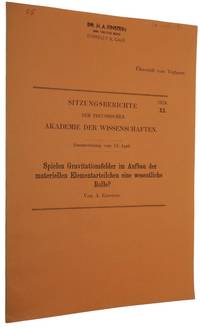
1919ref. 6166Berlin: Verlag der Akademie der Wissenschaften In Kommission bei Walter de Gruyter Reichsdruckerei 1919. First edition. First edition extremely rare author's presentation offprint 'Überreicht vom Verfasser' and the copy of Einstein's son Hans Albert of "Einstein's first attempt at a unified field theory" Pais Subtle is the Lord. Once Einstein completed work on the general theory of relativity at the end of 1915 "his attention shifted to the search for a unified theory of the electromagnetic and gravitational fields out of which he hoped to be able to explain the structure of matter. Quantum effects were to be derived from such a theory rather than postulated ad hoc. This remained his approach for the rest of his life" Cao Conceptual foundations of quantum field theory. . EINSTEIN'S FIRST ATTEMPT AT A UNIFIED FIELD THEORY" PAIS HANS ALBERT EINSTEIN'S COPY OF THE PRESENTATION OFFPRINT. First edition extremely rare author's presentation offprint 'Überreicht vom Verfasser' and the copy of Einstein's son Hans Albert of "Einstein's first attempt at a unified field theory" Pais Subtle is the Lord p. 287. Once Einstein completed work on the general theory of relativity at the end of 1915 "his attention shifted to the search for a unified theory of the electromagnetic and gravitational fields out of which he hoped to be able to explain the structure of matter. Quantum effects were to be derived from such a theory rather than postulated ad hoc. This remained his approach for the rest of his life" Cao Conceptual foundations of quantum field theory pp. 166-167. "As so often the case in relativity the story of quantum gravity begins with Einstein himself. Soon after the final formulation of general relativity he pointed out the need for a quantum modification of the theory. In his first paper on gravitational radiation the 1916 paper 'Näherungsweise Integration der Feldgleichungen der Gravitation' 'Approximate Integration of the Field Equations of Gravitation' Einstein argued that quantum effects must modify the general theory of relativity. Two years later he reiterated this conclusion the 1918 paper 'Über Gravitationswellen' 'On Gravitational Waves': 'As already emphasized in my previous paper the final result of this argument which demands a gravitational energy loss by a body due to its thermal agitation must arouse doubts about the universal validity of the theory. It appears that a fully developed quantum theory must also bring about a modification of the theory of gravitation.' Einstein writing in the 1919 paper offered here soon began to speculate whether gravitation plays a role in the atomistic structure of matter: 'There are reasons for thinking that the elementary formations which go to make up the atom are held together by gravitational forces. The above reflections show the possibility of a theoretical construction of matter out of the gravitational field and the electromagnetic field alone' In order to construct such a model of an 'elementary particle' Einstein shows that it is necessary to modify the original gravitational field equations .The major interest of this paper is that his attention now shifted from possible quantum modifications of general relativity to the search for a unified theory of the electromagnetic and gravitational fields on the basis of which he hoped to explain the structure of matter. Quantum effects are to be derived from such a theory rather than postulated ad hoc. Einstein remained committed to this approach for the rest of his life: the search for a 'natural' mathematical extension of the general theory in the hope that such a theory would somehow explain the quantization of matter and energy" Iyer and Bhawal Black Holes Gravitational Radiation and the Universe pp. 525-526. Einstein's work on unified field theory was inspired by James Clerk Maxwell's success in finding a unified theory of electricity and magnetism one of the greatest achievements of nineteenth century physics which showed that light was a form of electromagnetic wave and made possible modern inventios such as radio television and the telephone. Einstein continued his attempts to devise a unified theory of gravitation and electromagnetism for the rest of his life; his contributions in this area represent about a quarter of his entire research output and half his scientific production after 1920. Although he was ultimately unsuccessful a similar vision was realized in the decades after his death in the construction of the 'standard model' a unified theory of electromagnetism with the weak and strong nuclear forces which were unknown in Einstein's time and efforts to incorporate gravity into the model continue to this day. RBH lists three copies. OCLC lists only one copy none in US. Provenance: Hans Albert Einstein 1904-73 ink stamp and pencil notes on front wrapper. Hans Albert Einstein was a Swiss-American engineer and educator the second child and first son of physicists Albert Einstein and Mileva Marić. He was a long-time professor of hydraulic engineering at the University of California Berkeley. "As early as 1909 in his fundamental paper 'Zum gegenwärtigen Stand des Strahlungsproblems' 'On the current status of the radiation problem' which resulted from a discussion with Walter Ritz Einstein remarks 'dass des elektrische Elementarquantum e ein Fremdling ist in der Maxwell-Lorentzschen Elektrodynamik' 'that the electrical elementary quantum e is alien to Maxwell-Lorentz electrodynamics'. Einstein expressed the hope that 'die gleiche Modifikation der Theorie welche das Elementarquantum e als Konsequenz enthält auch die Quantenstruktur der Strahlung als Konsequenz enthalten wird' 'the same modification of the theory which contains the elementary quantum e as a consequence will also contain the quantum structure of radiation as a consequence'. Pauli 1949 in his review about 'Einstein's Contribution to Quantum theory' pointed out that though quantum theory later on deduced the quantum structure of radiation it has not solved Einstein's first problem and the elementary charge 'auch in der Quantenmechanik ein Fremdling geblieben ist' 'has also remained alien to quantum mechanics'. He emphasized that just this fact had been one of the strongest arguments to Einstein against the finality of the steps leading to quantum mechanics. "So during his Berlin years Einstein made it his task to find a synthesis of his general theory of relativity GRT and the then nascent quantum physics. In this connection he attributed logical primacy to the relevant relativistic field theory because it had reached a high degree of maturity in the GRT. After all Einstein's general-relativistic gravitation theory is the first theory on the fundamentals of physics working with genuinely non-linear equations and Einstein observed that such a nonlinearity is necessary for understanding the existence of the 'discrete field-quanta.' A linear theory allowing arbitrary superposition of fields would without further restrictions in the form of boundary and uniqueness conditions never lead to a discrete spectrum of solutions. But recourse to such restrictions means that the fields are held together by the operation of entities outside the scope of the theory . "In Einstein's view the problem of incorporating the elementary particles into field physics involved the question of finding field-theoretical models of electrons and protons which were the only known particles at that time. Einstein searched for solutions or general-relativistic field equations for the combined gravitational and electromagnetic fields representing mass and charge distributions with central symmetry and he hoped there would emerge self-consistent solutions only for discrete values of the mass and charge parameters i.e. for a 'particle spectrum.' "This 'Einstein particle problem' pursued ideas that had been developed already in the framework of the special theory of relativity and the Maxwell-Lorentz electrodynamics for instance in the nonlinear theory of the electromagnetic field by G. Mie and D. Hilbert. As an essential progress by the general-relativistic treatment Einstein regarded the genuine nonlinearity of the field equations which Mie and Hilbert had to introduce ad hoc and full consideration of the particle dynamics in the sense of the general-relativistic problem of motion. The generalizations of the Maxwell equations considered by Mie and Hilbert contain a too small number of components for the integrability conditions to determine the particle dynamics whereas the Einstein problem of motion in the GRT furnishers just this dynamics as a consequence of the integrability conditions for the field equations of gravitation. It is the GRT that with its metric field for the first time embraces inertia and gravity that is just those properties which are characteristic of all particles. "Einstein in fact succeeded in driving self-consistent gravitational and electromagnetic fields which can be interpreted as particle models of that kind. But his success depended on a weakening of his own equations of gravitation which physically amounts to the introduction of an additional hypothetical cosmical field of the 'Poincaré pressure.' By this weakening it becomes possible to set up self-consistent particle models with spherical symmetry for arbitrary centrosymmetric mass and charge distributions. In 1919 Einstein presented his result to the academy in his paper 'Spielen Gravitationsfelder im Aufbau der materiellen Elementarteilchen eine wesentliche Rolle' His answer to the question says that in his particle models the electrical field energy contributes ¾ and the gravitational energy ¼ of the total energy. "Einstein's first discourses on the particle problem in the GRT were closely related to the 1917/18 papers in which he laid the foundations of relativistic cosmology. In his Academy report 'Kosmologische Betrachtungen zur allgemeinen Relativitätstheorie' 'Cosmological considerations on the general theory of relativity' 1917 Einstein had by introducing the term λgμν with the 'cosmological constant' λ extended his equations of gravitation to his cosmological equations of gravitation Rμν - ½ gμνR λgμν = - κ Tμν . He could show that these equations permit as a particular solution with λ > 0 and constant positive mass density a statical model of the universe representing a closed spheric or elliptic three devotional Riemannian space . "In his paper of 1919 about the role of gravitation in the structure of elementary particles Einstein also interpreted the cosmological constant λ as the universal 'Poincaré' pressure' which according to a hypothesis of H. Poincaré is to guarantee the stability of Lorentz's electrons against their own repulsion forces. Einstein's ideas concerning this matter partly resulted from a controversial discussion with E. Schrödinger 1918 about the gravitational energy in the GRT and the structure of the energy tensor" Treder pp. 149-151. Indeed Schrödinger had pointed out another way of treating the cosmological constant: moving it from the left-hand side of equation where it represents a contribution to space-time curvature to the right-hand side where it represents a contribution to the energy-matter distribution. Then it would correspond physically to a kind of cosmic pressure. Schrödinger believed this might be the pressure postulated by Poincaré to maintain the stability of charged particles: an electric charge on the surface of a sphere creates a force pushing outwards so without any opposing force the charged sphere would explode outwards. Einstein never liked the cosmological constant. In the present paper he acknowledged that his introduction of the cosmological constant was "gravely detrimental to the formal beauty of the theory" Cambridge Companion to Einstein p. 257. Boni-Russ-L. 111; Schilpp 123; Weil 106. Treder 'Antimatter and the particle problem in Einstein's cosmology and field theory of elementary particles A historical essay on Einstein's work at the Akademie der Wissenschaften zu Berlin' Astronomische Nachrichten 296 1975 pp. 149-161. Large 8vo 254 x 182 mm pp. 349-356. Original printed wrappers. A very fine copy. Verlag der Akademie der Wissenschaften, In Kommission bei Walter de Gruyter [Reichsdruckerei] unknown
1938ref. 46475(Princeton, NJ.), Annals of Mathematics, 1938 a. 1940. Both papers in orig. printed wrappers. Offprints from ""Annals of Mathematics"", Vol. 39, No. 1, january, 1938 and Vol. 41, No. 2, April, 1940. Pp. 65-100 and pp. 455-464. Both clean and fine. This copy has belonged to Abraham Pais (1918-2000) - the famous Einstein scholar, theoretical physicist and Einsteins collegue at Princeton - and having his name on top of both frontwrappers ""A Pais"".
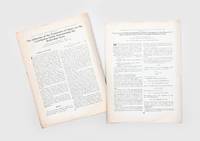
1938ref. 46475Princeton NJ. Annals of Mathematics 1938 a. 1940. Both papers in orig. printed wrappers. Offprints from "Annals of Mathematics" Vol. 39 No. 1 january 1938 and Vol. 41 No. 2 April 1940. Pp. 65-100 and pp. 455-464. Both clean and fine. This copy has belonged to Abraham Pais 1918-2000 - the famous Einstein scholar theoretical physicist and Einsteins collegue at Princeton - and having his name on top of both frontwrappers "A Pais". First editions in the scarce offprint versions of Einstein's last and highly important contributions to General relativity and in which is shown that the equation of motion follows directly from the field equation that defined the geometry."Einstein's last importent contribution to general relativity deals again with the problem of motion. It is the work done with Leopold Infeld and Banash Hoffmann on the N-body problem of motion. In these papers the gravitational field is no longer treated as external. Instead it and the motion of its singular sources are treated simultaneously. Anew approximationscheme is introduced in which the fields are no longer necessarily weak but in which the source velocities are small compared with the light velocity . The equations obtained have found use in situations where Newtonian interaction must be included. 'These equations are widely used in analyses of planetary orbits in the solarsystem. For example the Cal Tech Jet Propulsion Laboratory uses them in modified form to calculate ephmerides for high-precision tracking of planets and spacecraft."Pais "Subtle is the Lord" p. 290-91."The problem of the equation of motion of bodies is the following. The 1916 theory had a classical structure in the sense that there were both field equations the curvature of space-time is determined by the mass and motion of bodies in space-time and equations of motion of bodies the world line of small mass is a geodesic. Are these two statements really separate If the field equations were linear they indeed would be. They are not linear however and Einstein showed in the papers offered that if matter is represented by a point singularity of the metric field these singularities are located on world lines that are geodesics of space-time provided its metric satisfies the equation of general relativity."DSB.Weil: 202 a. 295 both with an asterix denoting a major paper. - Boni: 236 a. 236.1. unknown
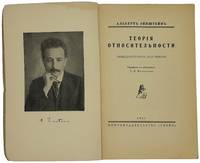
ref. lom-MS001965In Russian. Short description: Einstein A. Teoriya otnositelnosti. [Theory of Relativity]. Public presentation. Translated from German by G.B. Itelson. Berlin: Slovo, 1921. - 150, [2] p., 1 sheet portrait. Publisher's cover. Format 215x140 mm. Lifetime edition of one of the founders of modern physics, Nobel Prize winner Albert Einstein (1879-1955). First Russian edition. Please feel free to contact us for a detailed description of the copies available. SKUMS001965 kn_nat
ref. lom-MS001965In Russian. Short description: Einstein A. Teoriya otnositelnosti. Theory of Relativity. Public presentation. Translated from German by G.B. Itelson. Berlin: Slovo 1921. - 150 2 p. 1 sheet portrait. Publisher's cover. Format 215x140 mm. Lifetime edition of one of the founders of modern physics Nobel Prize winner Albert Einstein 1879-1955. First Russian edition. Please feel free to contact us for a detailed description of the copies available. SKUMS001965 kn_nat unknown
ref. H3990Berlin Akademie der Wissenschaften 1918 In: Sitzungsberichte der Königl.Preuss. Akademie der Wissenschaften Band 1918/1. 4to. S.154-167; S.270-272 S.448-461. Weitere Berichte von: Born M.; u.a. Halbleinenband der Zeit leicht berieben Bibl.-Nr.am Rücken Original-Broschur miteingebunden unaufgeschnitten gutes Exemplar. unknown
ref. H3974Berlin Akademie der Wissenschaften 1914 In: Sitzungsberichte der Königl.Preuss. Akademie der Wissenschaften Band 1914/2. 4to. S. 1030-1095. Anbei weiters: Planck Max: Eine veränderte Formulierung der Quantenhypothese. S.918-923. Schwarzschild K.: 1 Über Diffusion und Absorption in der Sonnenathmosphäre. S.1183-1200. 2 Über die Verschiebungen der Bande bei 3883 A im Sonnenspectrum. S.1201-1213. Halbleinenband der Zeit leicht berieben Bibl.-Nr.am Rücken Original-Broschur miteingebunden unaufgeschnitten gutes Exemplar. unknown
ref. H3998Berlin Akademie der Wissenschaften 1926 In: Sitzungsberichte der Königl.Preuss. Akademie der Wissenschaften Band 1926. 4to. S.334-340. Anbei u.a.: Schrödinger E.: Die Energiestufen des idealen einatomigen Gasmodells. S.23-36; Planck Max: Über die Begründung des zweiten Hauptsatzes der Thermodynamik. S.453-466. Halbleinenband der Zeit leicht berieben Bibl.-Nr.am Rücken Original-Broschur miteingebunden unaufgeschnitten gutes Exemplar. The Einstein and Rupp articles are the heart of the Einstein-Rupp scandal perhaps the most famous of all scientific scandals. unknown
1911ref. 432921911. Einstein Albert 1879-1955. Berichtigung zu meiner Arbeit: "Eine neue Bestimmung der Moleküldimensionen." Offprint from Annalen der Physik 34 1911. 591-592pp. 224 x 146 mm. Original printed wrappers a little chipped splint in lower spine. Light toning but very good. First Edition Offprint Issue. Einstein's correction to his formula for the viscosity coefficient = 1 a key equation in his 1905 doctoral thesis in which he had presented a new theoretical method for determining molecular radii and Avogadro's number. In 1910 Jacques Bacelin a pupil of French physicist Jean-Baptiste Perrin obtained experimental results indicating a possible error in Einstein's formula. "That prompted Einstein after an unsuccessful attempt to find an error to ask his student and collaborator Ludwig Hopf to check his calculations and arguments . . . Hopf did find an error in the dissertation namely in the derivatives of some velocity components and obtained for a corrected coefficient 2.5 . . .In early 1911 Einstein submitted his correction for publication and recalculated Avogadro's number. He obtained a value of 6.56 x 10²³ per mole a value that is close to those derived from kinetic theory and Planck's black-body radiation theory" Duplantier pp. 216-217. Duplantier "Brownian motion 'diverse and undulating'" in Einstein 1905-2005: Poincaré Seminar 2005 pp. 201-293. Pais Subtle is the Lord p. 92. Weil Albert Einstein Bibliography 41. . unknown
1913ref. 43305Leipzig & Berlin: Teubner 1913. 38pp. 254 x 170 mm. Original printed wrappers chipped. Library stamps. Very good. First separate edition. "After his first discussions with Grossmann Einstein had found the correct starting point for general relativity. The real work could now begin . . . The Einstein-Grossmann paper published in 1913 contains profound physical insight into the nature of measurement some correct general relativistic equations some faulty reasoning and clumsy notation" Pais Subtle is the Lord p. 216. Weil Albert Einstein Bibliography 58. Teubner unknown
1915ref. 432951915. Einstein Albert 1879-1955 and Wander Johann de Haas 1878-1960. Notiz zu unserer Arbeit "Experimenteller Nachweis der Ampèreschen Molekularströme." Offprint from Verhandlungen der Deutschen Physikalischen Gesellschaft 17 1915. 1 sheet p. 420. 228 x 156 mm. Original printed wrappers. Fine copy. First Edition Offprint Issue. In 1915 Einstein and Dutch physicist Wander Johannes de Haas conducted gyromagnetic experiments leading to the discovery of the Einstein-de Haas effect which corresponds to the mechanical rotation induced in a ferromagnetic cylinder suspended inside a coil when an impulse of electric current is sent through the coil. Einstein was very enthusiastic about the experimental results stating that he and de Haas had "given firm proof of the existence of Ampère's molecular currents" quoted in Pais Subtle is the Lord pp. 245-246. Einstein and de Haas published their results in a paper published earlier in 1915 see Weil 73; the present "Notiz" is a response to a communication from American physicist Samuel Jackson Barnett who had begun performing similar experiments in 1909 and obtained results complementing those of Einstein and de Haas. Weil Albert Einstein Bibliography 73n. . unknown
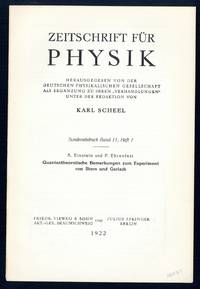
1922ref. 432871922. Einstein Albert 1879-1955 and Paul Ehrenfest 1880-1933. Quantentheoretische Bemerkungen zum Experiment von Stern und Gerlach. Offprint from Zeitschrift für Physik 11 1922. 31-34pp. 229 x 155 mm. Original printed self-wrappers. Light toning but fine otherwise. First Edition Offprint Issue. In 1922 the physicists Otto Stern and Walther Gerlach conducted a now-classic experiment in which a beam of silver atoms was streamed through an inharmonious magnetic field in order to observe the atoms' deflection patterns. Rather than a random and continuous distribution as predicted by classical theory the atoms passing through the field were deflected up or down by a specific amount demonstrating that they had intrinsically quantum properties. The Stern-Gerlach experiment corroborated the Bohr-Sommerfeld model of the atom and strongly influenced later developments in 20th century physics. However the experiment also created some serious difficulties for quantum physicists in the period before the rise of the "new" quantum mechanics. Einstein and Ehrenfest addressed one of these difficulties-connected with space quantization-in their joint paper in which "they dealt in particular with the problem of how the orbits of the atom would obtain their discrete directions which they exhibit while passing through the inhomogeneous magnetic field. Under the assumption that the mechanism causing the orientation was provided by the interaction with the radiation field Einstein and Ehrenfest estimated that for a field strength of 10000 G a change in the direction of the orbit would take place in roughly 1011 s; this long time interval would be reduced in the presence of heat radiation at room temperature . . . to about 109 s. How could they asked the experimental situation be explained which implied that the discrete orientations of the orbits in silver atoms were obtained in less than 10-4 s. In order to deal with this evident puzzle Einstein and Ehrenfest proposed two alternatives: first that the silver atoms were always in the states of spatial quantization; second the orientations of the electron orbits arose from an interaction of the atoms with the radiation field which involved much smaller reaction times . . . However they found that both alternatives created considerable difficulties in the understanding of the atomic processes . . . Thus Einstein and Ehrenfest concluded: 'The difficulties mentioned above show how unsatisfactory are both interpretations of the results found by Stern and Gerlach'" Mehra & Rechenberg The Historical Development of Quantum Theory 1 pp. 443-444. Pais Subtle is the Lord p. 328. Weil Albert Einstein Bibliography 121. . unknown
1911ref. 432921911. Einstein Albert 1879-1955. Berichtigung zu meiner Arbeit: "Eine neue Bestimmung der Moleküldimensionen." Offprint from Annalen der Physik 34 1911. 591-592pp. 224 x 146 mm. Original printed wrappers a little chipped splint in lower spine. Light toning but very good. First Edition Offprint Issue. Einstein's correction to his formula for the viscosity coefficient = 1 a key equation in his 1905 doctoral thesis in which he had presented a new theoretical method for determining molecular radii and Avogadro's number. In 1910 Jacques Bacelin a pupil of French physicist Jean-Baptiste Perrin obtained experimental results indicating a possible error in Einstein's formula. "That prompted Einstein after an unsuccessful attempt to find an error to ask his student and collaborator Ludwig Hopf to check his calculations and arguments . . . Hopf did find an error in the dissertation namely in the derivatives of some velocity components and obtained for a corrected coefficient 2.5 . . .In early 1911 Einstein submitted his correction for publication and recalculated Avogadro's number. He obtained a value of 6.56 x 10²³ per mole a value that is close to those derived from kinetic theory and Planck's black-body radiation theory" Duplantier pp. 216-217. Duplantier "Brownian motion 'diverse and undulating'" in Einstein 1905-2005: Poincaré Seminar 2005 pp. 201-293. Pais Subtle is the Lord p. 92. Weil Albert Einstein Bibliography 41. . unknown books
1913ref. 43305Leipzig & Berlin: Teubner 1913. 38pp. 254 x 170 mm. Original printed wrappers chipped. Library stamps. Very good. First separate edition. "After his first discussions with Grossmann Einstein had found the correct starting point for general relativity. The real work could now begin . . . The Einstein-Grossmann paper published in 1913 contains profound physical insight into the nature of measurement some correct general relativistic equations some faulty reasoning and clumsy notation" Pais Subtle is the Lord p. 216. Weil Albert Einstein Bibliography 58. Teubner unknown books
1922ref. 432871922. Einstein Albert 1879-1955 and Paul Ehrenfest 1880-1933. Quantentheoretische Bemerkungen zum Experiment von Stern und Gerlach. Offprint from Zeitschrift für Physik 11 1922. 31-34pp. 229 x 155 mm. Original printed self-wrappers. Light toning but fine otherwise. First Edition Offprint Issue. In 1922 the physicists Otto Stern and Walther Gerlach conducted a now-classic experiment in which a beam of silver atoms was streamed through an inharmonious magnetic field in order to observe the atoms' deflection patterns. Rather than a random and continuous distribution as predicted by classical theory the atoms passing through the field were deflected up or down by a specific amount demonstrating that they had intrinsically quantum properties. The Stern-Gerlach experiment corroborated the Bohr-Sommerfeld model of the atom and strongly influenced later developments in 20th century physics. However the experiment also created some serious difficulties for quantum physicists in the period before the rise of the "new" quantum mechanics. Einstein and Ehrenfest addressed one of these difficulties-connected with space quantization-in their joint paper in which "they dealt in particular with the problem of how the orbits of the atom would obtain their discrete directions which they exhibit while passing through the inhomogeneous magnetic field. Under the assumption that the mechanism causing the orientation was provided by the interaction with the radiation field Einstein and Ehrenfest estimated that for a field strength of 10000 G a change in the direction of the orbit would take place in roughly 1011 s; this long time interval would be reduced in the presence of heat radiation at room temperature . . . to about 109 s. How could they asked the experimental situation be explained which implied that the discrete orientations of the orbits in silver atoms were obtained in less than 10-4 s. In order to deal with this evident puzzle Einstein and Ehrenfest proposed two alternatives: first that the silver atoms were always in the states of spatial quantization; second the orientations of the electron orbits arose from an interaction of the atoms with the radiation field which involved much smaller reaction times . . . However they found that both alternatives created considerable difficulties in the understanding of the atomic processes . . . Thus Einstein and Ehrenfest concluded: 'The difficulties mentioned above show how unsatisfactory are both interpretations of the results found by Stern and Gerlach'" Mehra & Rechenberg The Historical Development of Quantum Theory 1 pp. 443-444. Pais Subtle is the Lord p. 328. Weil Albert Einstein Bibliography 121. . unknown books
1915ref. 432951915. Einstein Albert 1879-1955 and Wander Johann de Haas 1878-1960. Notiz zu unserer Arbeit "Experimenteller Nachweis der Ampèreschen Molekularströme." Offprint from Verhandlungen der Deutschen Physikalischen Gesellschaft 17 1915. 1 sheet p. 420. 228 x 156 mm. Original printed wrappers. Fine copy. First Edition Offprint Issue. In 1915 Einstein and Dutch physicist Wander Johannes de Haas conducted gyromagnetic experiments leading to the discovery of the Einstein-de Haas effect which corresponds to the mechanical rotation induced in a ferromagnetic cylinder suspended inside a coil when an impulse of electric current is sent through the coil. Einstein was very enthusiastic about the experimental results stating that he and de Haas had "given firm proof of the existence of Ampère's molecular currents" quoted in Pais Subtle is the Lord pp. 245-246. Einstein and de Haas published their results in a paper published earlier in 1915 see Weil 73; the present "Notiz" is a response to a communication from American physicist Samuel Jackson Barnett who had begun performing similar experiments in 1909 and obtained results complementing those of Einstein and de Haas. Weil Albert Einstein Bibliography 73n. . unknown books
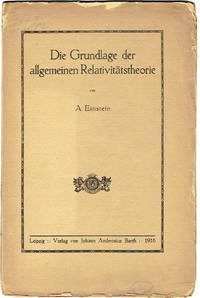
1619ref. 5711KLeipzig: Johann Ambrosius Barth Omnitypie-Ges. Nachfl. L. Zechnall Stuttgart; Metzger & Wittig Leipzig Wrappers 1916 but c. 1919. Near Fine. 8vo. 16: 24 3 cm. 64 pages. Letterpress on machine paper in original publisher’s wrappers on cream stock with black title printing on covers and spine incorporating publisher's emblem and ornamental framing on front cover as well as publisher's advertisements on rear cover. Particularly rare early anastatic reprint of the first separate edition of Einstein's first and most important synopsis of his general theory of relativity. – Edition Contents: „In mid-January 1916 Einstein had still expressed doubts about his ability to write such a paper calling his writings ""correct but quite indigestible"" ""zwar richtig aber reichlich unverdaulich."" Einstein to H. A. Lorentz 17 January 1916“. But a „few months after the final papers had appeared 4 papers of Nov. and Dec. 1915 where he finally had completed the theory of general relativity as a logical structure note WoP Einstein was ready to spend some time writing a review paper in which the whole theory was presented and explained in a consistent and accessible way . It gives an excellent overview of the theory.“ cf. Einstein Papers. For present synopsis Einstein also made substantial additions published here for the first time. „Einstein’s paper of March 1916 concludes with a brief section on the three new predictions: the red shift the bending of light and the precession of the perihelion of Mercury. In the final paragraph of that section is recorded the single major experimental confirmation which at that time could be claimed for the theory: the Mercury anomaly. In 1916 next to nothing was known about the red shift; the bending of light was first observed in 1919.“ cf. Paise – The paper was first printed on May 11th 1916 in the special interest journal »Annalen der Physik« series 4 vol. XLIX issue no. 7 pp. 769-822 and probably simultaneously as separate printing in book form by the Leipzig editor Barth titled »Sonderdruck« enlarged with an introduction by Einstein and a table of content. Edited in this way and therefore more accessible for a broader audience of interested lay people the Barth book edition of Einstein's probably most important achievement in the history of science became popular and was reprinted several times until 1929. According to Weil present first reprint from 1919 is of better printing quality than others and is bound in the original paper wrappers of the 1916 edition with an updated publisher's ads list of 5 available titles appearing between 1911 and 1918. – Condition: Former faults and tears at margins of front and rear cover skilfully restored front cover with shelf wear paper time-stained otherwise clean copy. – Rarity: Scarce in trade. RHB ABPC 1973ff. and JBP/JAP/APO record 4 copies of this particular reprint in the original wrappers and comparable condition at auction 2016 2014 former copy of Karl Malmkvist 2006 2004. – Reference: Boni N.: A bibliographical checklist and index to the published writings of Albert Einstein 78 for the journals issue 78.1 for the separate edition; Carter/Muir Bücher die die Welt verändern 725; Norman 696 for the journal issue; Shields M. C.: Bibliography der Schriften Einsteins. In: Schilpp P. A.: Albert Einstein als Philosoph und Naturforscher 84 for the separate edition 86 for the journal issue; The Collected Papers of Albert Einstein. Volume 6 30 cit. p. XIX and p. 238 fn 1; Weil E.: Albert Einstein. A bibliography of his scientific papers 1901-1930 80a; Pais A.: Subtle is the Lord. The Science and Life of Albert Einstein 2005 ed. p. 273; Sauer T. „Albert Einstein review paper on general relativity theory“. In: Grattan-Guinness I. et al. ed.: Landmark Writings in Western Mathematics 2015 pp. 802-22. Johann Ambrosius Barth (Omnitypie-Ges., Nachfl. L. Zechnall, Stuttgart; Metzger & Wittig, Leipzig [Wrappers]) unknown
1923ref. 4609Praze Prague: Fr. Borový 1923 1923. First and only edition of the Czech translation of Einstein's Über die spezielle und die allgemeine Relativitätstheorie first published in German in 1916 with the English translation appearing in 1920. It was intended by Einstein as a brief popular introduction to his theory of relativity. This Czech edition has a special preface by Einstein written for this translation. Einstein worked in Prague for seventeen months in 1911-12 and retained a fondness for the city. 8vo. 210x135mmpp. 103 21bl. Original Blue card wrappers with striking design. Some toning and creasing to edges of wrappers but otherwise in very good condition and excellent internally. Title page has ownership inscription of Robert Knuwehil . This Czech translation is rare OCLC recording only five copies worldwide. Praze [Prague]: Fr. Borový, 1923 unknown
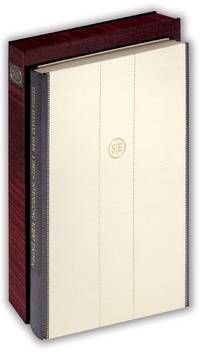
ref. 35452Rockport ME: Two Ponds Press 2015. Fine. Number 35 of 75 copies signed and numbered by Joseph Goldyne. Joseph Goldyne was born in 1942 in Chicago IL. He came to prominence as an artist on the West Coast. He has been credited as one of the artists responsible for the rebirth of monotype and monoprint as valuable approaches to art. He is also known for his artist's books often done in collaboration with printer Peter Rutledge Koch. From the Prospectus: "Joseph Goldyne brought this project to our attention and the Press was convinced that this little-known oratory by George Bernard Shaw deserved wider recognition one that Goldyne thought a most unexpectedly wondrous and humorous introduction to Albert Einstein perhaps the most transformative and towering figure of the twentieth century. Goldyne's own introduction " An Introduction to an Introduction" speaks to his discovery of Shaw's speech its presentation Shaw's record of condemning anti-Semitism and his public support for Einstein. The full text of Shaw's speech is reprinted together with Einstein's response delivered in German and printed here in English translation. Goldyne illustrates the volume with five drypoint etchings created especially for this publication. They pay tribute to the featured speakers as well as to the sense of the event." Beautifully bound in cream paper covered boards with gilt dotted rulings and ornament on front cover of circle with initials "SE" in its center. Gray leather spine and trim along front edges with gilt titling on spine. Printed in Monotype Bembo and Gill Sans types on paper handmade at the Velké Losiny mill in the Czech Republic. Letterpress printing by Arthur Larson at Horton Tank Graphics with additional hand composition by Rose Ku'ulealoha Wisotzky. Design and typography planned by Michael Russem Housed in a slipcase covered in dark red cloth with "SE" symbol on spine. Accompanied by prospectus. A lovely book in fine condition. Measures 6.5 x 10 inches. 39 pages. PRI/112321. Two Ponds Press unknown