2976 risultati
rif. H4002Berlin Akademie der Wissenschaften 1932 In: Sitzungsberichte der Königl.Preuss. Akademie der Wissenschaften Band 1932. 4to. S.130-137 und 522-550. Weiters: Hahn Otto: Radioaktivität und ihre Bedeutung für Fragen der Geochemie. S.2-17. Schrödinger Erwin: Diracsches Elektron im Schwerefeld I. S.105-129. Weiteres von Planck Halbleinenband der Zeit leicht berieben Bibl.-Nr.am Rücken Original-Broschur miteingebunden unaufgeschnitten gutes Exemplar. unknown
rif. H4001Berlin Akademie der Wissenschaften 1929 In: Sitzungsberichte der Königl.Preuss. Akademie der Wissenschaften Band 1929. 4to. S.2-7; 156-162 Anbei: Schrödinger Erwin: Verwaschene Eigenwertspektra. S.668-684. Hahn Otto: Die radioaktiven Substanzen im dienste chemischer und physikalisch-chemischer Forschung. S.535-542. Halbleinenband der Zeit leicht berieben Bibl.-Nr.am Rücken Original-Broschur miteingebunden unaufgeschnitten gutes Exemplar. unknown
1931[8] 9-94 pages. Select Bibliography. First published in London in 1930. "Professor Einstein is better known as a physicist than as a Zionist. Yet for many years he has given abundant proof both of a keen interest in Zionism and of a penetrating insight into its underlying ideas. He is impelled to Zionism by his acute consciousness of the excessive price at which the blessings of assimilation are bought by the Jewish communities of the Western world, which for him are mainly represented by that of Germany. The price is a loss of solidarity, of moral independence and self-respect. These, in his view, can be regained only if assimilated Jews find some common task, of absolute human value, to which they can bend their corporate energies as Jews. Such a task is to be found in the restoration of Jewish national life in Palestine." - Introduction. Unmarked with average wear. Backstrip lettering faded. Binding tight. A sound copy of this important compilation. Emanuel p.51. Boni, Russ & Laurence 306. Book
1915rif. 000012055Leipzig: Verlag von B.G. Teubner 1915. First edition. Hardcover. Near Fine. Large 8vo. 2 pages of publisher's advertisements 6 vi-viii 3 4-762 8 pages of publisher's advertisements pp. Contemporary half black morocco over brown paper boards with gilt lettering in a gilt border on the spine; all edges black. Dark green endpapers and pastedowns. With a blue silk ribbon bookmark bound in. With 106 in-text figures. The second title page states that this is the first volume of the third part of a series Die Kultur der Gegenwart Ihre Entwicklung und Ihre Ziele Herausgegebben von Paul Hinneberg. Dritter Teil Mathematik Naturwissenschaften Medizin. Dritte Abteilung Anorganische Naturwissenschaften unter Lietung von E. Lecher = Contemporary Culture . Part Three: Mathematics Natural Sciences Medicine . . Boni 69-70. Schilpp 76-77. This volume is dedicated to topics within physics: light mechanics motion electricity and other areas of research are illuminated by papers from several of the twentieth century's pre-eminent physicists including Einstein Planck Lorentz among others. This book contains Einstein's "Theoretische Atomistik" and "Die Relativitätstheorie" published here for the first time in book form "Die Relativitätstheorie" first appeared as a journal article. A lovely example. A touch of fading to the boards’ top edges overall an exceptional copy. Verlag von B.G. Teubner hardcover
rif. 150644Plaster bust of theoretical physicist Albert Einstein mounted on a wood pedestal base with an incised signature within the plaster. The entire piece measures 15 inches by 8 inches. From the collection of actress LeGrand Mellon 1937-2005 an American performer whose career spans film television and theater. In addition to her acting career Mellon had been involved in creative and cultural work connected to Haiti launching micro-businesses and continuing the work of her late first husband William Larimer Mellon III with Hôpital Albert Schweitzer. In very good condition. Albert Einstein developed the general theory of relativity one of the two pillars of modern physics alongside quantum mechanics. Einstein's work is also known for its influence on the philosophy of science. Einstein is best known in popular culture for his mass–energy equivalence formula E = mc2 which has been dubbed "the world's most famous equation". He received the 1921 Nobel Prize in Physics for his "services to theoretical physics" in particular his discovery of the law of the photoelectric effect a pivotal step in the evolution of quantum theory David Bodanis. unknown
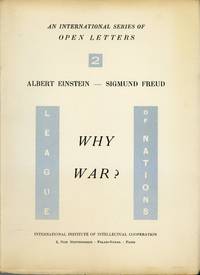
1933rif. 32820626Original wrappers. Near fine. First edition in English one of 2000 numbered copies. Translated from the German by Stuart Gilbert. Einstein initiated this correspondence with Freud as part of the International Institute of Intellectual Co-operation's effort to promote dialogue among leading thinkers to promote peace. At the time Einstein and Freud were perhaps the most famous thinkers in the world. Laid in is a 2pp leaflet advertising this publication and noting the various formats and their prices. International Institute of Intellectual Cooperation, League of Nations paperback
1925rif. 5733K-2Berlin: Verlag der Akademie der Wissenschaften in commission at Georg Reimer Reichsdruckerei 5th March 1925. Near Fine. Imperial 8vo 25 4: 18 2 cm. 8 pages numbered 18-25. Letterpress on machine paper in original publisher’s brochure on orange stock with black title printing. First offprint in the original wrappers of this pioneering paper by Einstein where he for the first time predicted the Bose-Einstein condensate based on the findings of indian physicist Satyendra Nath Bose. - Content: The conclusions of Einstein were empirically proofed as late as in 1995 for which the scholars E. Cornell C. Wiemann and W. Ketterle were awarded the Nobel prize for Physics in 2001. - Condition: Mint. - Rarity: ABPC 1973ff. Drouot Digital LotSearch and JAP 1950ff. records only 2 copies of this edition at auction 2012 2004. - Reference: Schilpp-Shields 195; Weil 145. Verlag der Akademie der Wissenschaften (in commission at Georg Reimer [Reichsdruckerei]) unknown
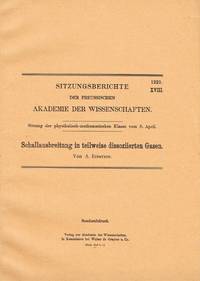
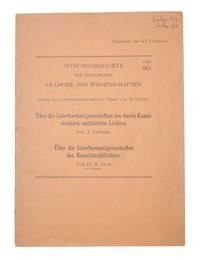
1920rif. 5724KBerlin: Verlag der Akademie der Wissenschaften in commission at Walter de Gruyter Reichsdruckerei 29th April 1920. Near Fine. Imperial 8vo 25 4: 18 2 cm. 6 pages numbered 380-385. Letterpress on machine paper in original publisher’s brochure on cream stock with black title printing. First offprint in the original wrappers of Einstein's paper on the subject of intermolecular forces. – Edition: In this work Einstein calculated the rate of chemical reactions in a gas by means of observations on the propagation of sound and hence delivered an important contribution to modern acoustics see Mason »Physical Acoustics« p. 13. – Condition: Very fine indeed. – Rarity: According to Weil early offprints of Einstein’s papers may also be qualified as original and also highly collectable editions however they were printed in a certain but still small print run for commercial use mainly to sell them to fellow natural scientists: „No doubt the first appearance in a periodical is the „original edition“ but I have to leave it open for collectors librarians and others to decide whether these offprints in wrappers mostly with a printed title on them especially in the »Sitzungsberichte der Königlich Preussischen Akademie der Wissenschaften« are also „original editions“. These offprints are printed from the same setting as the text but often with new pagination.“ p. 4. As of February 2024 RBH records 5 complete copies of present offprint sold at auction 1 of them are additionally marked as author's presentation copies with „Überreicht vom Verfasser“ 2022 2006 2002 1999 1978. – Reference: Boni N.: A bibliographical checklist and index to the published writings of Albert Einstein 119; The Collected Papers of Albert Einstein. Volume 7 39; Shields M. C.: Bibliography der Schriften Einsteins. In: Schilpp P. A.: Albert Einstein als Philosoph und Naturforscher 130; Weil E.: Albert Einstein. A bibliography of his scientific papers 1901-1930 110. Verlag der Akademie der Wissenschaften (in commission at Walter de Gruyter [Reichsdruckerei]) unknown
1934rif. 1728New York: Covici-Friedi 1934. First Edition. Publisher's Green-Gray Cloth Stamped Silver Foil Detailing. Very Good/Very Good. A Very Good Book in a Very Good Dust Jacket Price-Clipped. Book is lightly rubbed sunned and dust soiled to extremities. Top edge of text block is moderately foxed and dust soiled. Previous ownership inscription and marking to flyleaf. A few neat instances of pencil underling which we have chosen not to erase text is otherwise unmarked. Binding is tight and square though cloth is pulled at crown. Exceptionally uncommon printed dust jacket is lightly chipped to extremities and sunned to spine panel. Light scattered soiling otherwise. Hardcover. Octavo. xviii 19-290pp. Covici-Friedi unknown
rif. 123663London: Methuen & Co. Ltd. 1920 1st English edition. Leatherbound xiii 3 138pp 2 8pp. Near fine. 12mo. Rebound in striking red leather; spine with raised bands ruled in gilt each compartment with decorative device in gilt author and title compartments lettered in gilt; top and bottom boards with simple single-rule border in gilt. Binding tight; seemingly scarcely opened. Top-edge gilt. Foxing to fore-edge and bottom-edge. Foxing to half-title; else with only occasional spot of foxing at fore-margin and bottom-margin corresponding from edge. Internally remarkably clean. Portrait frontispiece. Diagrams formulae. With original 8pp of adverts bound at rear. An exceedingly collectible copy of this seminal work; truly the importance of this work cannot be overstated. In specific regards to this edition in addition to being the First English translation of Einstein's paradigm shifting work it includes new text which was written by Einstein specifically for this edition at the request of the translator Appendix III: "The Experimental Confirmation of the General Theory of Relativity". The fourth appendix "The Structure of Space according to the General Theory of Relativity" didn't appear in an English edition until the 14th edition 1946. Relativity 100th Anniversary Edition Princeton UP p.xx. Methuen & Co. Ltd. Hardcover
rif. MA06C-03367Pantheon Irodalmi Intezet. Used - Acceptable. Budapest: Pantheon Irodalmi Intezet 1922. 12mo hardcover. Rebound gray cloth with original front paper wrap bound in. 94pp. Hungarian. Fair book. Ex-Library copy from the New York Public Library with usual markings and pocket on front pastedown in Hungarian. Dampstaining and red paint flecks on front board. Upper corner dampstained throughout. Albert Einstein Theory of Relativity Books in Hungarian Inquire if you need further information. Pantheon Irodalmi Intezet hardcover
1923rif. 170926001New York: Dodd Mead and Company 1923. First Edition. Hardcover. Good. First American edition. 216 pp. Blue cloth with spine label. Near Fine in Fair original dust jacket. Book itself in unusually nice shape. Bookplate on paste down. Faint stain to spine label light foxing to cloth. Dust jacket price intact on spine $4.00; rubbing; spine panel missing a number of chips dampstained; masking tape on verso as well as a bit of archival mending tissue; chips missing along edges especially at top edge. Scarce in jacket nonetheless. An influential collection of papers on relativity with many contributions from Einstein as well as three other leading physicists and mathematicians of the early 20th Century. Includes notes by A. Sommerfeld. Dodd, Mead and Company hardcover books
1926rif. 465401926. Royal8vo. Author's presentation offprint with the printed presentation statement on top of frontwrapper ""Überreicht von den Verfassern"" [i.e. ""Given by the authors""]. Original printed wrappers. Front wrapper loose, but fully intact. ""Chilpp 202"" and ""Recdese 160"" written in hand to top of front wrapper. A very fine and clean copy. Pp. 334-351.
1926rif. 465401926. Royal8vo. Author's presentation offprint with the printed presentation statement on top of frontwrapper "Überreicht von den Verfassern" i.e. "Given by the authors". Original printed wrappers. Front wrapper loose but fully intact. "Chilpp 202" and "Recdese 160" written in hand to top of front wrapper. A very fine and clean copy. Pp. 334-351. First edition in the scarce author's presentation offprint issue of this important paper which contains Einstein's theories on wave-particle duality and German physicist Rupp's work on the same subject seemingly to corroborating Einstein's theories. Rupp's experimental results later turned out to have been falsifications and today he is mainly known as the protagonist in one of the biggest scandals in physics in the 20th century.Rupp published a number of papers on the interference properties of light emitted by canal ray sources. These articles particularly the present that came into being in close collaboration with Albert Einstein attracted quite a lot of attention as they probed the wave versus particle nature of light. They also significantly propelled Rupp's career even though they were considered highly controversial to begin with.In April 1926 Albert Einstein proposed to Emil Rupp to carry out two experiments that were to prove the wave nature of light versus the particle nature of light: the so-called 'Wire Grid Experiment' and the 'Rotated Mirror Experiment' experiments that Einstein had worked on theoretically and now would like to gain confirmation of through experiments. Rupp at the time regarded as one of the most important and most competent experimental physicists gladly took up the challenge. Rupp's observations - though highly controversial - confirmed Einstein's theory. Due to the surprising outcome of the experiments Einstein was interested in exactly how it they were conducted as Rupp's initial descriptions did not convince him that the results were feasible."Rupp stood by his observations and suggested yet other circumstances that might explain them. Did Einstein now realize that there was something rather dubious about Rupp's work He had seen him change his data repeatedly-and each time in better accordance with his own criticism and on one occasion in no less than two days. He had had to accept that Rupp claimed to earlier have "unknowingly" or "unconsciously" rotated a mirror and he will likely have seen that Rupp's work was highly controversial amongst experimentalists leading to very public criticism in Die Naturwissenschaften. He himself was now also convinced that in fact Rupp's results were incomprehensible. So did Einstein choose to suspend the publication of Rupp's piece so that an additional round of checks and balances could take place The answer is no: Rupp's paper was presented by Einstein to the Prussian Academy in a session on 21 October 1926 and it appeared in print in the Academy's proceedings in November of 1926-the articles by Einstein and Rupp came out back to back and reprints circulated with both papers bound together with a joint cover page that displayed both titles. Einstein referred in his article to Rupp's claims and he had even written the abstract of Rupp's paper" Dongen: "Emil Rupp Albert Einstein and the Canal Ray Experiments on Wave-Particle".The first clear indication that Rupp's work was impossible to recreate came in 1930 in a paper published by Staub - nothing was wrong with Einstein's theory but Rupp's work was simply impossible: "Rupp immediately set out to respond to Straub's publication. On 12 July 1930 he sent a first draft to Einstein to whom he also announced his intention of redoing his canal ray experiments-Straub was dismissed as a clumsy graduate student with a lousy apparatus. Einstein suggested inviting Straub once Rupp had his experiment up and running again but cautioned him not to engage the polemic in too sharp a tone". Rupp managed to convince the physics society and continued to publish the new few years. In 1934 various different physicians pointed out that Rupp's work was impossible to recreate and in 1935 the final blow to Rupp's career came about when the German Physical Society's decided not to allow any citations of Rupp's work. This seems to have had very severe consequences as today it is almost impossible to find any quotations - or even mentioning of Rupp in general let alone his fraud - in any historical studies of either quantum theory or of Einstein.Despite the unquestionable fraud by Rupp his experiments and collaboration with Einstein might have had a positive influence on the further progression to quantum mechanics. The two present papers became of seminal importance in the discussions between Bohr and Heisenberg which eventually in 1927 resulted in Heisenberg publishing his landmark thesis on the uncertainty principle. When Max Born received the Nobel Prize in physics he stated that: "An idea of Einstein gave me the lead From the present paper. He had tried to make the duality of particles-light quanta or photons-and waves comprehensible by interpreting the square of the optical wave amplitudes as probability density for the occurrence of photons."Boni 160; Weil 153. unknown
1920rif. 001584New York: Henry Holt and Company 1920. 1st Edition . Cloth. Very Good/No Jacket. 8vo - over 7¾ - 9¾" tall. New York: Henry Holt and Company 1920. 8vo 168 pp. Dark blue cloth. Gilt titles to spine and front board. Gilt entirely faded from the spine moderately to the spine. Light foxing to the title and frontispiece. Interior clean. Binding is tight. Very good. A very acceptable copy of a scarce and important book. Henry Holt and Company hardcover
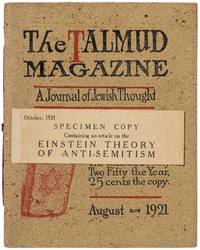
1921rif. 553355Boston: Talmud Society 1921. Softcover. Fine. First edition. 12mo. 64pp. Original cord-tied wrappers printed in red and black. The first and last leaf toned from interaction with the wrappers else about fine. An August issue of the magazine apparently used in October to promote the short-lived magazine this copy with a printed slip affixed to the front wrap: “October 1921. Specimen Copy. Containing an article on the Einstein Theory of Anti-Semitism.” Photographic portrait of Einstein on page 14; along with an English translation of his essay: "Jewish Nationalism and Anti-Semitism: Their Relativity" which originally appeared in the London Jewish Chronicle. Talmud Society unknown
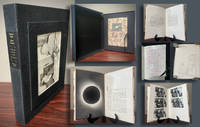
1955rif. 33706New York: The Ram Press 1955. 1st Edition - Limited. 1st Edition - Limited. We are going to experience another full Solar Eclipse April 8 2024. This volume was to celebrate Albert Einstein and the Solar Eclipse of Jun 30 1954 and June 20 1955. Unusual Signed Kilfitt/Zoomar Eclipse Book with original Einstein Frank Back Photo. 8vo 5 1/2" x 8 1/2" 40pp signed and inscribed by Dr. Back on the second free endpaper. "To Leslie and Duke. We should never make statements witch are not planned correct and checked by us .we should not impress by telling sometime .stories in order to make contributions or to say something. Talking is silence. "Silence is gold" Wish you the very best from the heart. T F Back sept 11 1965" A fine copy in handmade decorative paper covered boards printed glossy paper label on the upper cover limited edition of 3000 copies in the original glassine outer wrapper showing some light sunning. This volume was dedicated to Albert Einstein and is the only book that was ever written by "The Father of the Zoom Lens". With / An original black & white silver gelatin 5 x 7 photograph of Dr. Albert Einstein and Dr. Frank Gerald Back seated together in very fine condition acquired directly from Dr. Back's estate. This photograph was taken circa 1954 and is one of the images published in this limited edition. With An 18" x 22" blueprint folded of the Solar Eclipse Spectrograph size "C" drawing. It was made from the original drawing dated 4/1/55 drawn by Zoomar's Chief Designer Alfred Joseph Quittner "AJQ" & approved by Dr. Back "FGB". A very interesting package indeed. Dr. Back was a very close friend of Albert Einstein. Dr. Einstein persuaded the author to take the trip commemorated in this beautifully produced volume in order to capture the total eclipse of the sun which occurred on June 20 1955. Dr. Back intended to provide conclusive evidence for Einstein's theory of relativity by calculating the optical distortion if any of starlight caused by the sun's gravity. Earlier in 1919 Einstein's general relativity principles were supported by observations of a solar eclipse. The two scientists conferred on the project for over a year. Armed with a special Zoomar designed & built wide-angle solar-eclipse spectrograph Dr. Back was off to the Philippine Islands to board a military jet & chase the eclipse. Einstein however died while Back was on his way to Manila. Unable to report the excursion to his friend Dr. Back dedicated this book to his memory. Dr. Frank Back held over 200 patents directly relating to photographic equipment. He was the founder & president of Zoomar Inc. The photographic term " zoom" was derived from Zoomar. Dr. Back created the first widely used zoom lenses for motion picture and television; then in 1959 introduced the first zoom lens for still cameras with the introduction of the 36-82mm/f2.8 Voigtlander Zoomar. Dr. Back & Zoomar purchased the great Heinz Kilfitt optical factory of Munich Germany in 1966 & it became a subsidiary of Zoomar Inc. This volume was never widely distributed & when Zoomar Inc. ceased operations at Glen Cove Long Island many cases of this book were discovered & unceremoniously trashed. The existing number of copies is unknown but the book is not frequently encountered. This copy came from the personal estate of Dr. Frank Gerald Back & it is one of the few copies signed by him. An excellent example suited for collectors of Science Astronomy Einstein Zoomar or Photographic History in general. In a lovely custom clamshell case with a window insert displaying the original Einstein/Back photo. On page 13 there is a typo. He wrote July 301954 instead of June 30 1954 and was never changed. The Ram Press unknown
rif. 504141 First Edition journal issue. The brilliant follow-up to Einstein's landmark 1905 paper on the photoelectric effect. In the 1905 paper Einstein had explained the photoelectric effect-the emission of electrons from a metal when irradiated by light-by making the revolutionary proposal that light rather than consisting of continuous waves was instead made up of discrete particles of energy "light quanta" which transferred their entire payload of energy to an electron on impact. In the 1905 paper Einstein made use of Planck's mathematical formula for blackbody radiation which had introduced the concept of energy quanta but he was only able to derive part of the formula. In his 1906 paper Einstein "used his statistical mechanics to demonstrate that when light interacts with matter Planck's entire formula can arise only from the existence of light quanta-not from waves" Cassidy; emphasis ours. Einstein had realized as he stated in the present paper that "'Planck's theory makes implicit use of the . . . light-quantum hypothesis' . . . his acceptance of Planck's formula albeit as a hypothesis led to a major advance in his own work" Pais Subtle is the Lord p. 378. In 1921 Einstein was awarded the Nobel Prize in physics for his work on the photoelectric effect. Cassidy David "Einstein on the Photoelectric Effect." Einstein: Image and Impact. American Institute of Physics n.d. Web. Accessed 09 July 2014. Shields "Writings of Albert Einstein" in Albert Einstein: Philosopher-Scientist 1948 pp. 689-758 no. 13; also included in Shields' "Chronological list of principal works" on p. 757. Weil Albert Einstein: A Bibliography no. 12. 2 First Edition journal issue of Einstein's second paper on the inertia of energy following his 1905 paper "Ist die Trägheit eines Körpers von seinem Energieinhalt abhängig" Is the inertia of a body dependent on its energy content. In the present paper Einstein presented another argument in support of the proposition that a body's energy depends on its energy content. "About a year after he first introduced the inertia of energy Einstein published a paper entitled "The Principle of the Conservation of the Center of Gravity and the Inertia of Energy" in which he showed that E = mc2 is necessary and sufficient to ensure that the center-of-mass theorem holds for systems in which 'not only mechanical but also electromagnetic processes take place' . . . As Einstein acknowledges his paper is similar to Poincaré's contribution to the Lorentz Festschrift 1900. Einstein showed that in order to avoid the kind of violations of the center-of-mass theorem discussed by Poincaré one has to assume that energy has inertia" Janssen pp. 39-40. Janssen "The Trouton experiment E = mc2 and a slice of Minkowski space-time" in Revisiting the Foundations of Relativistic Physics: Festschrift in Honor of John Stachel 2003 pp. 27-54. Weil Albert Einstein Bibliography 13. . unknown
1931rif. 345H4370New York: The Macmillan Company of Canada Limited. Good. 1931. First American Edition. Hardcover. 8 9-94 pages. Select Bibliography. First published in London in 1930. "Professor Einstein is better known as a physicist than as a Zionist. Yet for many years he has given abundant proof both of a keen interest in Zionism and of a penetrating insight into its underlying ideas. He is impelled to Zionism by his acute consciousness of the excessive price at which the blessings of assimilation are bought by the Jewish communities of the Western world which for him are mainly represented by that of Germany. The price is a loss of solidarity of moral independence and self-respect. These in his view can be regained only if assimilated Jews find some common task of absolute human value to which they can bend their corporate energies as Jews. Such a task is to be found in the restoration of Jewish national life in Palestine." - Introduction. Unmarked with average wear. Backstrip lettering faded. Binding tight. A sound copy of this important compilation. Emanuel p.51. Boni Russ & Laurence 306.; 8vo - over 7¾" - 9¾" tall; Zionism Albert Einstein Politics Israel Palestine Theodor Herzl Zionist Organisation Jewish Colonial Trust Balfour Declaration Keren Hayesod Palestine Foundation Fund . The Macmillan Company of Canada Limited hardcover
1907rif. 432971907. Einstein Albert 1879-1955. Berichtigung zu meiner Arbeit: "Die Plancksche Theorie der Strahlung etc." Offprint from Annalen der Physik 22 1907. Single sheet p. 800. Unbound as issued. 223 x 145 mm. Lower corner lightly creased but very good. First Edition Rare Offprint Issue. Einstein's important correction to his paper on specific heats "Die Plancksche Theorie der Strahlung und die Theorie der spezifischen Wärme" 1907; see Weil 15 which "made clear for the first time that quantum concepts have a far more general applicability" Pais p. 394. "Einstein initially believed that his oscillating lattice points in a three-dimensional crystal lattice were electrically charged ions. A few months later he published a correction to his paper in which he observed that this was an unnecessary assumption . . . Einstein's correction freed the quantum rules in passing one might say from any specific dependence on electromagnetism" Pais p. 396. Pais Subtle is the Lord pp. 394-396. Weil 15n. . unknown
1938rif. 143h5663USA: Crowell 1938. Magazine. Illus. by Reid Robert O. Cover Art; Sawyers Martha; Beall C.C.; McLeod Ronald; Biggs Geoffrey; Cooper Mario; Roth Ben; Lichty George; Timmins Harry L.; Coe RolandBorgstedt Douglas; Keate Jeff; Green George Hamilton; Gentry Thurston; Hilton Ned. Good. Magazine. First Edition. Folio - over 12 - 15" tall. Feature article by Albert Einstein entitled "Why Do They Hate The Jews" offers his views on the subject and includes a large black and white profile photo of the man himself. Additional features include: Local Ghost Makes Good - Jesse James Makes Restitution in Pineville; Coach Ralph Furey explains why football stars are not born article with several photos of football stars of the day; Speak No Evil short story; Hangin' Crazy Benny short story; Uncertain Wings short story; Via All Oceans short story; You Liked a Parade short story; None But The Brave part 5 of 6; Murder for Christmas - part 3 of 10 of this serial by Agatha Christie; Great cover art by Robert O. Reid features young lovely eyeing the dessert table; and more. 70 pages. Unmarked with average wear. Binding intact. Moderate evidence of moisture exposure. A sound vintage copy of this exceptional issue. Boni Russ & Laurence 396. . Crowell Paperback
1906rif. 38892Leipzig 1906. Einstein Albert 1879-1955. 1 Eine neue Bestimmung der Molekuldimensionen. In Ann. d. Physik 4th series 19 1906: 289-306. 2 Zur Theorie der Brownschen Bewegung. In ibid.:371-381. Whole volume 8vo. viii 1080pp. 5 plates. 213 x 143 mm. Original cloth spine faded split in upper half of spine inner hinge cracking. Very good. 1 First Edition in Journal Form Revised of Einstein's doctoral thesis ranked by his biographer as being on the same level as his 1905 papers on relativity the light quanta and Brownian motion. In his thesis Einstein presented a new theoretical method for determining molecular radii and Avogadro's number the number of atoms or molecules needed to make up a mass equal to a substance's atomic or molecular weight in grams. The thesis appeared in print in the spring of 1905; in the journal version published at the beginning of 1906 Einstein added a brief appendix containing an improved value of Avogadro's number. Einstein's biographer Abraham Pais wrote of Einstein's thesis as follows: "It is not sufficiently realized that Einstein's thesis is one of his most fundamental papers. Histories and biographies invariably refer to 1905 as the miraculous year because of his article on relativity the light-quantum and Brownian motion. In my opinion the thesis is on a par with the Brownian motion article. In fact in some-not all-respects his results on Brownian motion are by-products of his thesis work emphasis ours. This goes a long way toward explaining why the paper on Brownian motion was received by the Annalen der Physik on May 11 1905 only eleven days after the thesis had been completed. "Three weeks after the thesis was accepted this same journal received a copy of the thesis for publication. It was published only after Einstein supplied a brief addendum in January 1906. . . . As a result of these various delays the thesis appeared as a paper in the Annalen der Physik only after the Brownian motion article had come out in the same journal. This may have helped create the impression in some quarters that the relation between diffusion and viscosity-a very important equation due to Einstein and Sutherland-was first obtained in Einstein's paper on Brownian motion. Actually it first appeared in his thesis . . . ." "Quite apart from the fundamental nature of some results obtained in the thesis there is another reason why this paper is of uncommon interest: it has had more widespread practical applications than any other paper Einstein ever wrote . . . . The thesis dealing with bulk rheological properties of particle suspensions contains results which have an extraordinarily wide range of applications. They are relevant to the construction industry the motion of sand particles in cement mixes to the dairy industry the motion of casein micelles in cow's milk and to ecology the motion of aerosol particles in clouds to mention but a few scattered examples. Einstein might have enjoyed hearing this since he was quite fond of applying physics to practical situations" Pais Subtle is the Lord pp. 89-90. Pais notes that during the period 1970-1974 the 1906 journal version of Einstein's thesis was cited four times more often than his 1916 paper on general relativity and eight times more often than his 1905 paper on light quanta. 2 First Edition of Einstein's second paper on Brownian motion containing two further methods for finding Avogadro's number. This was the first of his papers on the subject to include the term "Brownian motion" in the title. Pais pp. 95 98. . unknown
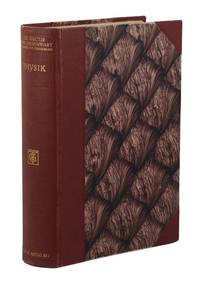
1915rif. 140945614Leipzig & Berlin: B.G. Teubner 1915. First edition. First edition. iv viii 762 8 pp. Bound in publisher's three quarter maroon cloth with marbled paper sides gilt spine lettering. Near Fine with rubbing along edges; a few marks to prelims text otherwise free of markings; hint of foxing to edges. Bookplate on paste down. A German-language physics review with the first book publication of two articles by Albert Einstein as well as work by a number of famous physicists of the early 20th century. B.G. Teubner unknown
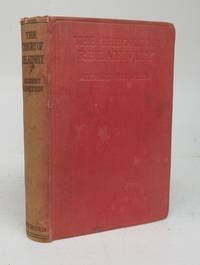
1920rif. 134847London: Methuen & Co 1920. First UK Edition. Hardcover. Good. xiii 3 138 2 8 p. 20 cm. 5 diagrams and frontispiece portrait of the author. Red cloth with blank impressing on front black print on spine. Some soiling to covers corners bumped spine faded small tears in spine head. Front pastedown has bookplate for Brenda Mary O'Keefe and small chip to edge. Offsetting to free endpapers. Front hinge cracking internally. A few stains within. 8 p. of Methuen publications listed at rear. First edition of the authorized translation into English of the "popular exposition" of Einstein's theory of relativity. Includes third appendix on "The Experimental Confirmation of the General Theory of Relativity" written by Einstein specially for this edition at the request of the translator. First published in German in 1916 "Relativity" gives readers an insight into the thought processes of one of the greatest minds of the 20th century. Methuen & Co hardcover
rif. dola813New York: Henry Holt And Company 1920. First American Edition. The English translation contains an additional chapter 'Appendix III The Experimental Confirmation of the General Theory of Relativity.' See Printing and the Mind of Man 408. 8vo. pp. xiii 168. frontis. portrait. biblio. index. cloth spine ends just beginning to fray. Very good copy New York: Henry Holt And Company, 1920 hardcover