2534 risultati
1958rif. 188282New York: Dover 1958. Near Fine. Reprint. Near fine. Dover unknown books
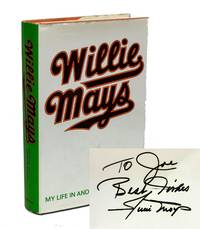
1966rif. WMCE001New York: E. P. Dutton & Co. 1966 First edition first printing. Signed and inscribed by Mays on front free endpaper: "To Joe / Best Wishes / Willie Mays." Publisher's green and orange cloth with "Willie Mays" in blind to front board and spine lettered in black and orange; in its original unclipped dust jacket designed by Bob Korn with white front panel lettered in brown orange and green and a green spine. About fine book with light fading to spine and a hint of rubbing to foot of spine; very good price-clipped dust jacket with light wear to spine ends and some edgewear. With Beckett Letter of Authenticity. Overall a great boldly inscribed copy. Presentation copies from Mays are exceedingly scarce. In this book Willie Mays tells his life story with the help of prolific sportswriter Charles Einstein. Mays started playing professional baseball at 16 in the Negro Leagues and was soon drafted by the New York Giants. He went on to play 21 seasons with the Giants winning a World Series with the team in 1954. His over-the-shoulder catch in that World Series is one of the most iconic moments in sports history. A 24x All-Star and a 12x Gold Glove award winner Mays was inducted into the Hall of Fame in 1979 and was voted to the Major League Baseball All-Century Team in 1999. . Signed. First Edition. Hard Cover. Fine/Dust Jacket Included. New York: E. P. Dutton & Co. hardcover books
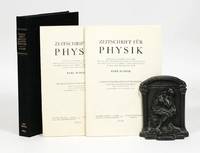
1924rif. 2905Berlin: Julius Springer 1924. First edition. original wrappers. Very Good. FIRST EDITION IN ORIGINAL WRAPPERS of the presentation of "Bose-Einstein statistics." “In 1924 Bose found a way to derive Planck’s equation for black body radiation using a statistical approach based entirely on the idea that light is made up of tiny particles photons. This echoed the statistical mechanics approach of Ludwig Boltzmann to the behaviour of gases but using a different statistical rule; it derives black body radiation entirely in quantum terms without using the idea of electromagnetic radiation at all. Bose wrote a paper about his discovery and sent it to Albert Einstein who immediately saw its significance translated it into German and arranged for its publication in the prestigious Zeitschrift für Physik. Einstein developed the idea to apply to other kinds of particle not just to a ‘gas’ of photons which is why this approach is usually referred to as ‘Bose-Einstein statistics’. Paul Dirac coined the name ‘bosons’ for particles which obey Bose-Einstein statistics" Gribbin Q is for Quantum. Particle Physics: One Hundred Years of Discoveries: “Discovery of new statistical counting rules for light quanta and a new derivation of Planck’s radiation law. Known as Bose-Einstein quantum statistics for particles with integer spins.” WITH a follow-up paper by Bose: "Wärmegleichgewicht im Strahlungsfeld bei Anwesenheit von Materie": "Bose's first paper in 'Zeitschrift für Physik' was followed by another that was also translated by Einstein and published during 1924. In it Bose provided a general statistical treatment of emission and absorption processes for electromagnetic radiation in equilibrium with matter. This paper was accompanied by a note by Einstein expressing serious doubts about the method. In January 1925 Bose wrote to Einstein from Paris that he was working on a paper he felt would remove these doubts. But it seems never to have been completed" DSB. Plancks Gesetz und Lichtquantenhypothese. IN: Zeitschrift für Physik Vol 26 No. 3 August 1924 pp. 178-81. Berlin: Julius Springer 1924. “Wärmegleichgewicht” Vol 27 No. 5/6 September 1924 pp. 384-93. Octavo original wrappers. “Planks Gesetz” with small closed tear at rear wrapper edge; otherwise fine condition; “Wärmegleichgewicht” with small chip to base of front wrapper. SCARCE in original wrappers. Julius Springer unknown books
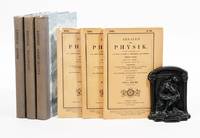
1905rif. 2895Leipzig: Johann Ambrosius Barth 1905. First edition. original wrappers. Very Good. FIRST PRINTINGS WITH EXTREMELY RARE ORIGINAL WRAPPERS of Einstein's revolutionary papers of 1905 including the first edition of the initial paper on special relativity; three of the most important papers in the history of science. Beautiful clean copies without any institutional stamps. In the first paper "On a Heuristic Viewpoint Concerning the Production and Transformation of Light" published in March "Einstein postulated that light is composed of individual quanta later called photons that in addition to wavelike behaviour demonstrate certain properties unique to particles. In a single stroke he thus revolutionized the theory of light and provided an explanation for among other phenomena the emission of electrons from some solids when struck by light called the photoelectric effect" Britannica. It was for this paper on the photoelectric effect that Einstein was granted the Nobel Prize in physics in 1921. The next paper "On the Motion-Required by the Molecular Kinetic Theory of Heat-of Small Particles Suspended in a Stationary Liquid" published in May provided a theoretical explanation of Brownian motion. It is generally regarded as the first proof that molecules exist. Although the first two papers were of astonishing originality and importance it was the third paper introducing what would be later known as Einstein's special theory of relativity that would make him famous. "Toward the end of June it was all written up and on June 30 receipt of the manuscript was recorded at the editorial office of Annalen in Berlin. The thirty-page article published three months later was titled 'On the Electrodynamics of Moving Bodies'. It was a treatise beyond compare and without precedent one of the greatest scientific achievements in content and one of the most brilliant in style. Of course there were later additions some from Einstein himself and some from others but these were mere addenda to a theory which had appeared before all the world ready and complete valid for all time" Folsing Albert Einstein. Einstein's theory with the premise that "if for all frames of reference the speed of light is constant and if all natural laws are the same then both time and motion are found to be relative to the observer" "involved a complete rethinking of the entire conceptual tradition of modern physics from its beginning" Britannica; Folsing. Weil 6. Weil 8. Weil 9. Grolier/Horblit 26b. Zur Elektrodynamik bewegter Korper in Annalen der Physik Vierte Folge Volume 17 part 10 pp. 891-921; WITH: Über einen die Erzeugung und Verwandlung des Lichtes betreffenden heuristischen Gesichtspunkt ibid part 6 pp. 132-148. WITH: Über die von der molekularkinetischen Theorie der Warme geforderte Bewegung von in ruhenden Flussigkeiten suspendierten Teilchen ibid part 8 pp. 549-560. Leipzig: Johann Ambrosius Barth 1905. Octavo three issues in original wrappers rebacked; three custom boxes. Note: The issues are slightly trimmed indicating that it is likely they were originally bound with the wrappers and then re-assembled. With general title page volume half-title and index included in part 6. Some chipping to exceedingly rare and brittle original wrappers; otherwise fine. Extremely rare in such outstanding condition. Johann Ambrosius Barth books
1983rif. 310602San Francisco: Gay Atheist League of America 1983. Magazine. 20p. 5.5x8.5 inches very good digest-size booklet in stapled wraps. Gay and Lesbian Freethought journal. Gay Atheist League of America unknown books
1975rif. 285227New York: Harry N. Abrams Inc 1975. Hardcover. 260p. first edition 12x11 inches; b&w and color plates fore-edge slightly toned small tear between front bottom dj and front panel spine and rear dj heavily toned and slightly soiled minor edgewear and creasing on back dj rear side of spine slightly rubbed else very good. Harry N. Abrams, Inc hardcover books
1979rif. 228499Beijing: Ke xue chu ban she 1979. v 111p. slender paperback very good. Translation of the fifth edition of "The meaning of Relativity. Ke xue chu ban she unknown books
1922rif. 139418Paris: Les Éditions G. Crès & Cie 1922. 32p. 48 b&w plates text in French pencil notes denoting country/region of origin of the artworks first edition in worn 10x7 inch paper boards with inkstains rough chipping to spine else good condition. Questo Volume è Apparso Nello Serie Orbis Pictus. Les Éditions G. Crès & Cie unknown books
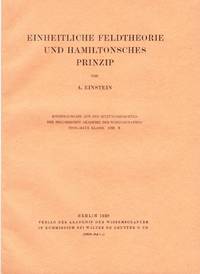
1929rif. 6551Berlin: Verlag der Akademie der Wissenschaften in Kommision bei Walter de Gruyter U. Co 1929. First separate edition. Fine. 6 pages in printed wraps. Not exactly an "offprint" since the pages are numbered from 1 and the pamphlet is given its own title page this is considered the first separate edition of a paper Einstein published in the periodical of the Prussian Academy. It is considered Einstein's initial effort having established general and special relativity to find a unified theory uniting gravity and electromagnetism a problem he struggled with for his remaining life. Verlag der Akademie der Wissenschaften in Kommision bei Walter de Gruyter U. Co paperback books
2010rif. 102564London:: Folio Society. Fine. 2010. Hardcover. Introduction by David Bodanis. First edition thus. Fine in a fine slipcase. ; 370 pages . Folio Society, hardcover books
1880rif. 24284A unique and important artifact of his childhood. ALBERT EINSTEIN. Ephemera. Set of Anker-Steinbaukasten children's building blocks by F. Ad. Richter & Cie. Rudolstadt Germany c.1880s. Approximately 160 composite quartz sand chalk and linseed oil blocks in red limestone and slate gray in various sizes and shapes together with three or more sets of building plans all contained in two wooden boxes with printed Anker-Steinbaukasten labels. Einstein spent his childhood building "complicated structures" with these Anker-Steinbaukasten blocks. Accepting his later theory that "Imagination is more important than knowledge" the toys that encouraged his imagination became building blocks for the most important scientific theories of the last millennium. His sister Maja Winteler-Einstein describing his childhood recalled that "The games he played … were very characteristic of Albert's capacities. These were mostly puzzles fretsaw work the erection of complicated structures with the well-known Anker building blocks and above all the construction of multi-storied card castles with which he filled his leisure." "Beitrag für sein Lebensbild" in The collected papers of Albert Einstein. ed. John Stachel. Volume 1: The early years. 1879-1902. Princeton University Press 1987 p.lix. Translated from German. Based on the work of German educator Friedrich Froebel who created the concept of kindergarten these composite stone blocks were a popular toy of the 1880s and 1890s. The blocks were designed to help develop childrens' tactile senses and manual dexterity and also to stimulate imagination creativity and three-dimensional perception. Fellow scientist J. Robert Oppenheimer as well as architects Frank Lloyd Wright and Walter Gropius are among the geniuses who are known to have played with Anker blocks. Provenance The set had passed by direct descent from Albert Einstein to the consignor from whom we acquired the blocks at Christie's London on July 13 2016. Condition A few blocks chipped and worn with original instructions and boxes worn soiled and defective. Albert Einstein 1879-1955 was a German-Swiss born theoretical physicist internationally recognized as one of the greatest physicists of all time. He enunciated the general theory of Relativity with law explaining the relationship between the speed of light and its consequence the equivalence of mass and energy E=MC2. For his work in theoretical physics—largely for his 1905 paper on photons and photo-electricity—Einstein was awarded the Nobel Prize for Physics announced in November 1922 retroactive for 1921. Working on a unified field theory he then attempted to explain gravitation and electromagnetism within one set of laws. With the expulsion of Jewish scholars from Germany after Hitler's rise to power Einstein joined the Institute for Advanced Study in Princeton New Jersey 1933 which became the most celebrated research center in the world. In 1939 he signed a letter written to President Franklin Roosevelt warning him of the possibility of Germany developing a nuclear bomb. He urged the U.S. to begin uranium research thus beginning the top secret "Manhattan Project." Later at Princeton he tried to develop a unified field theory and to refute the accepted interpretation of quantum physics both unsuccessfully. Einstein received U.S. citizenship in 1940. books
1921rif. 37862New York: Harcourt Brace. Very Good. 1921. Hardcover. Good. No dust jacket. Ex-library copy with all the usual stamps etc. suitable for reading or reference not a collector's copy.; Xiii 366 p. 23 cm. . Harcourt, Brace hardcover books
1947rif. 226469New York: Norton 1947. Hardcover. Very Good. First edition. Very good minus hardcover. First edition. Pages light brown clean text. Corners on cover slightly bent. Some water stains on cover. Cover soiled. Norton hardcover books
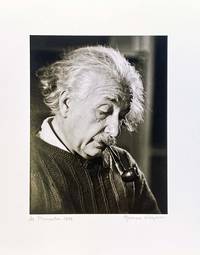
1980rif. 2611New York: np 1980. First edition. Clamshell box. Fine. EXTREMELY RARE COMPLETE SUITE OF SEVEN LARGE SILVER PRINTS FROM EINSTEIN'S FAMOUS PHOTO SHOOT AT PRINCETON WITH ROMAN VISHNIAC. Each print is signed by Vishniac and dated "At Princeton 1942" in his hand below the image and numbered on the back. "One day Vishniac decided to visit Albert Einstein at Princeton to offer greetings from mutual friends in Berlin. Uninvited he hoped Einstein would pose for a portrait but Einstein had little interest. Vishniac recalled: It was a singular experience. An idea had suddenly come to him and the room was filled with the movement of the great man's thought. I waited several minutes and then when I saw that he did not intend to say anything more to me and that he was off in a world of his own I started taking pictures. Einstein later admitted that a Vishniac photograph taken that day was his favorite portrait" Encyclopedia of Twentieth-Century Photography. Vishniac provided details about this portolfio in a letter to an original recipient the letter is not included here explaining: The size of the edition's limitation is uncertain due to my age and only spare time to make them. The most expensive portfolios - Ansel Adams Kertesz - are limited in large numbers I can never measure up - 999 1001 and similar. The originality of Portfolio "Einstein" consists of its special character. It is made not to get images but the feeling that you are present during the creativity by the Great Man. All pictures are made with "hidden camera" method. The value of this portfolio is great and can hardly be estimated today. Princeton/New York: 1942 negatives; 1980 silver prints. Elephant folio clamshell box approx. 17x21 in. housing seven silver prints. Image size: approx. 10.25 x 13.25 in.; with matte 16x20 in. A few minor blemishes to box. Photos in fine condition. RARE. np unknown books
1964rif. 53342New York: Gold Medal 1964. Softcover. Near Fine. First paperback edition. Near fine in wrappers. Gold Medal unknown books
1951rif. WB16897New York: Van Vechten Press 1951. Limited Edition. Hardcover. Fine. One of a total edition of 350. Full blue morocco binding by Suzanne Schrag; housed in clamshell box also by Schrag. With dedicatory essays by John Berryman Herman Broch Albert Einstein Ben Shahn Thomas Mann and others. Van Vechten Press hardcover books
1952rif. 86694NY:: Dover Publications. Good. 1952. Paperback. With notes by A. Sommerfield. Translated from the German by W. Perrett and G. B. Jeffery. With seven diagrams. First edition thus paperback. Covers are age darkened with a few corner creases else good in printed wraps.; 216 pages . Dover Publications, paperback books
1922rif. R5312Berlin: Slovo 1922. Third edition. Paperback. Good. Original wraps; pp. 152 with frontispiece portrait of the author and his preface to the Russian edition. Front cover and endpaper detached but present; cheap paper tanned along the edges and a bit brittle. Slovo paperback books
1921rif. 302276Leipzig Felix Meiner 1921. 1921. First edition. 8vo. Foreword by Raymund Schmidt. Articles by Oskar Kraus Friedrich Lepsius Paul F. Lincke Joseph Petzoldt. Text pages numbered 334-500. Original stiff green wrappers printed in black. Very good. Cover title: Zur Relativitatstheorie. Kraus' article entitled: "Fiktion und Hypothese in der Einsteinschen Relativitatstheorie.". 1st Edition. Soft cover. Very Good/No Jacket. Leipzig, Felix Meiner, 1921. paperback books
1979rif. 300955Princeton Princeton University Press 1979. 1979. First edition. Selected and edited by Helen Dukas and Banesh Hoffman. Frontispiece b/w portrait. Original German texts; chronology. Dust jacket price clipped. Very good. 167 pages. No signatures or bookplates. 1st Edition. Hardcover. Very Good/Very Good. Princeton, Princeton University Press [1979]. hardcover books
rif. 14394NY OXFORD 1945. FIRST AMERICAN EDITION VERY GOOD. 1st Edition. NY, OXFORD, 1945 unknown books
1988rif. 333798New York: Bonanza Books 1988. First Edition Thus; Twenty-Third Printing. Hardcover. Very Good in a Very Good dust jacket. Small closed tear on spine crown. Spine slightly cocked.; 384 pages. Bonanza Books hardcover
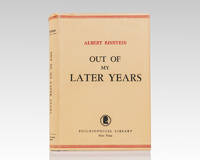
1950rif. 152705New York: Philosophical Library 1950. First edition of Einstein's collection of social science-related articles addresses and speeches. Octavo original cloth frontispiece of Einstein. very good in a very good price-clipped dust jacket with bumping and chipping to the rear panel. Out of My Later Years 1950 is the second and final collection of essays assembled by Albert Einstein 1879-1955 the German-born theoretical physicist whose Special and General Theories of Relativity revolutionized modern thought on the nature of space and time and whose Nobel Prize in Physics in 1921 for his explanation of the photoelectric effect confirmed his standing as the most celebrated scientist of the twentieth century. Drawing on Einstein's articles addresses letters and assorted papers across a fifteen-year period from 1934 to 1950 the volume encompasses his personal convictions on religious and humanitarian issues in the wake and aftermath of the Second World War alongside reflections on scientific method the philosophy of physics education and the moral responsibilities of scientists in the atomic age that Einstein's own theories had helped to bring into being. Philosophical Library hardcover
2026rif. x-0691300550Princeton University Press 2026. Paperback. New. 360 pages. 7.50x0.75x10.00 inches. Princeton University Press paperback
2026rif. x-0691300372Princeton University Press 2026. Paperback. New. 272 pages. 7.50x0.57x10.00 inches. Princeton University Press paperback