Einstein, AlbertBiblio.com
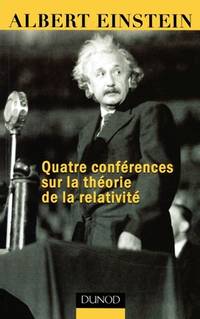
1.949 Ergebnisse
Best.-Nr. 2100492292.Gpaperback. Good. Access codes and supplements are not guaranteed with used items. May be an ex-library book. paperback
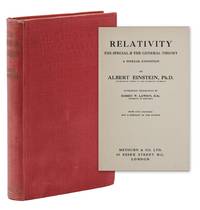
1920Best.-Nr. 140949340London: Methuen & Co 1920. First Edition. Near Fine. First British edition first printing. xiii 3 138 2 8 pp. Bound in publisher's red cloth lettered in blind on front board and gilt on spine. Near Fine with light wear and fading to covers light foxing to upper textblock edge. Light foxing and offsetting to endpapers bookseller ticket to back pastedown and light toning to contents. Binding starting at pp. 33 and 97. A much nicer copy than normally found. The first British edition of Einstein's seminal work translated by Robert W. Lawson from the third German edition. Einstein's introduction to his revolutionary theory was written to be accessible to the general public. Methuen & Co unknown
Best.-Nr. 0994006918.Gpaperback. Good. Access codes and supplements are not guaranteed with used items. May be an ex-library book. paperback
1950Best.-Nr. 2946629Buenos Aires.: Emecé. 1950. Hardcover. Cubierta deslucida. Good. 19 cm. 215 p. Encuadernación en tapa dura de editorial. Cubierta deslucida. Física.530.12 530 Emecé. hardcover
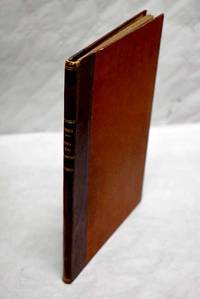
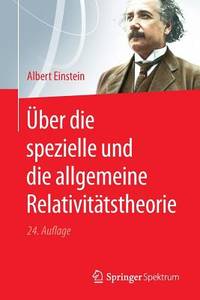
1921Best.-Nr. 2545920Madrid. 1921. Hardcover. Cubierta deslucida. Good. 24 cm. 79 p. Encuadernación en tapa dura artesanal con lomo en piel. Einstein Albert 1879-1955. Über die spezielle und die allgemeine Relativitätstheorie. Traducida de la 12ª ed. alemana por F. Lorente de Nó. Imp. de Suc. de S. Peláez. Relatividad Física . Cubierta deslucida. Física.530.12 530 hardcover
1921Best.-Nr. 2827000Madrid.: S.n. 1921. Paperback. Good. 24 cm. 79 p. Encuadernación en tapa blanda artesanal. Einstein Albert 1879-1955. Über die spezielle und die allgemeine Relativitätstheorie. Traducida de la 12ª ed. alemana por F. Lorente de Nó. Imp. de Suc. de S. Peláez. Relatividad Física . Física.530.12 530 [S.n.]. paperback
Best.-Nr. 0691085498.Gpaperback. Good. Access codes and supplements are not guaranteed with used items. May be an ex-library book. paperback
Best.-Nr. 3642312780.Gpaperback. Good. Access codes and supplements are not guaranteed with used items. May be an ex-library book. paperback
Best.-Nr. 114731795X.Gpaperback. Good. Access codes and supplements are not guaranteed with used items. May be an ex-library book. paperback
Best.-Nr. 1143647637.Gpaperback. Good. Access codes and supplements are not guaranteed with used items. May be an ex-library book. paperback
Best.-Nr. 0394735242.Gpaperback. Good. Access codes and supplements are not guaranteed with used items. May be an ex-library book. paperback
Best.-Nr. 114395047X.Gpaperback. Good. Access codes and supplements are not guaranteed with used items. May be an ex-library book. paperback
Best.-Nr. 1143484908.Gpaperback. Good. Access codes and supplements are not guaranteed with used items. May be an ex-library book. paperback
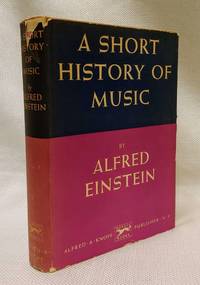
1937Best.-Nr. 336583New York: Alfred A. Knopf 1937. First Edition. Hardcover. Good/Good. First thus. Alfred A. Knopf 1937; stated First American Edition no additional printings indicated same date on title and copyright pages; x 253 xii 1pp. Binding is tight sturdy and square; light wear light foxing to edges of tan cloth boards magenta and brown stamped title and decoration on spine and front board remains bright and bold; text very good throughout. Unclipped $2.50 dust jacket is edge-worn and age-toned with several small closed tears one chip at head of spine; light foxing to jacket as well. A presentable First American printing of Einstein's classic work of music history and criticism. From a private collection. Ships from Dinkytown in Minneapolis Minnesota. Alfred A. Knopf hardcover
Best.-Nr. 0691216827.Gpaperback. Good. Access codes and supplements are not guaranteed with used items. May be an ex-library book. paperback
Best.-Nr. Z1-T-004-02093Charles C Thomas Pub Ltd. Used - Good. Ships from UK in 48 hours or less usually same day. Your purchase helps support Sri Lankan Children's Charity 'The Rainbow Centre'. Ex-library so some stamps and wear but in good overall condition. 100% money back guarantee. We are a world class secondhand bookstore based in Hertfordshire United Kingdom and specialize in high quality textbooks across an enormous variety of subjects. We aim to provide a vast range of textbooks rare and collectible books at a great price. Our donations to The Rainbow Centre have helped provide an education and a safe haven to hundreds of children who live in appalling conditions. We provide a 100% money back guarantee and are dedicated to providing our customers with the highest standards of service in the bookselling industry. Charles C Thomas Pub Ltd unknown
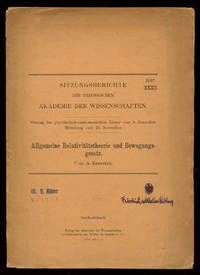
1927Best.-Nr. 1663Berlin: Verlag der Akademie der Wiss 1927. 1st Edition. FIRST EDITION OFFPRINT ISSUE IN ORIGINAL PAPER WRAPS VERY GOOD CONDITION. "Einstein and Grommer's work treats the particle as a singularity in the field and attemptss to obtain the equations of motion by imposing conditions on the exterior field in the neighborhood of the singularity" Stachel Einstein from 'B' to'Z' pp. 507. Weil 155. In 1927 Einstein's research "concentrated on a new approach to the problem of the motion of particles in a general field theory" Mehra The Golden Age of Theoretical Physics 997. He presented his work conducted with Jakob Grommer in this report. Einstein and Grommer here show that 'in the case of a pure gravitational field the mechanical behavior of singularities can be derived' a result which in Einstein's opinion 'opened the possibility to obtain on the basis of the field equations a theory of matter characterized as discontinuities in space' ibid 997; Einstein and Grommer 1927. "After Einstein had tried for years to obtain a theory of material particles in a generalized field theory by describing these objects with the help of continuous functions Einstein and Grommer now proposed 'to consider elementary particles as singular points or singular world lines respectively' motivated by the observation 'that both the equations of the pure gravitational field and the equations augmented by Maxwell's electromagnetic field possess simple spherically-symmetric solutions which contain a singularity' ibid. Finally they arrived at the result: In the approximation of the gravitational field obtained by solving linearized equations the equation of motion for a singularity is completely determined - at least in the case of equilibrium - and corresponds to the law of a geodetic line" ibid. CONDITION & DETAILS: Berlin: Verlag der Akademie der Wiss. Pp. 2-13. Offprint in original wraps. 10 x 7.25 inches; 250 x 181mm. Toning at the edges & bearing the ownership stamp of "Friedrich Wilhelm Ritter" W. F. Ritter 1839-1929. Ritter had a large library. Very good condition. Verlag der Akademie der Wiss paperback
Best.-Nr. 8493427810.Gpaperback. Good. Access codes and supplements are not guaranteed with used items. May be an ex-library book. paperback
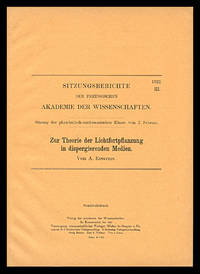
1922Best.-Nr. 1648Berlin: Verlag der Akademie der Wissenschaften 1922. 1st Edition. FIRST EDITION COMMERCIAL OFFPRINT ISSUE OF EINSTEIN'S THEORY OF THE LIGHT PROPAGATION IN DISPERSIVE MEDIA. WEIL 120. "After 1917 Einstein firmly believed that light-quanta were here to stay thus it is not surprising that he would look for new ways in which the existence of photons might lead to observable deviation from the classical picture. In this he did not succeed. At one point in 1921 he thought he had found a new quantum criterion but it soon turned out to be a false lead as demonstrated in this paper" Schilpp-Shields 162. That paper - the one offered here - is Einstein's evidence that his 1921 efforts were incorrect. In it Einstein introduces a calculation on the topic and explains why his earlier proposed experiment had not been well considered because it could not predict a good choice between two theoretical alternatives" Calaprice Einstein Encyclopedia 98. CONDITION & DETAILS: Berlin: Koniglich Akademie der Wissenschaften. Commercial offprint from Sitzungsberichte der Koniglich preussischen Akademie der Wissenschaften III 1916 pp. 18-22. Octavo 252 x 179 mm. Original printed wrappers. Pristine inside and out. Fine. Verlag der Akademie der Wissenschaften unknown
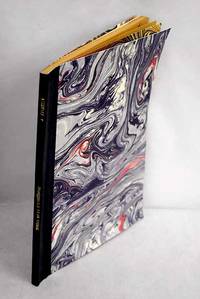
1916Best.-Nr. 1614Braunschweig: Druck und Verlag von Friedr. Vieweg and Son 1916. 1st Edition. FIRST EDITION OF AN IMPORTANT WORK BY EINSTEIN: HIS FIRST PAPER ON THE DERIVATION OF PLANCK'S LAW HERE INTRODUCING THE THEORY OF THE STIMULATED EMISSION OF ELECTROMAGNETIC RADIATION INTO THE QUANTUM THEORY. "EINSTEIN'S CONCEPT OF STIMULATED EMISSION IS THE OPERATING PRINCIPLE OF THE NOW UBIQUITOUS LASER" Brandt Harvest of the Century 136. In 1900 Max Planck laid the foundation for quantum theory with his publication of Planck's law. Though Einstein commended Planck in his own "light-quantum hypothesis of 1905 he Einstein postulated that the energy quantization is a property of the radiation field itself and not due to the material resonators as Planck believed" ibid. "Einstein found a similarity between a cavity filled with radiation consisting of quanta and a vessel filled with gas consisting of atoms" Brandt Harvest of the Century 136. Einstein believed that "although either part of Planck's derivation was in itself consistent their combination was logically incompatible.For Einstein this inconsistency was no reason to reject Planck's quantum theory as such" it was a reason to study the foundations of traditional radiation theory and if needed revise them Jammer The Conceptual Development of Quantum Mechanics 26. "After completion of his general theory of relativity in 1916 Einstein was able to derive Planck's original quantum law to his satisfaction "by considering the possible interactions between radiation and matter" Brandt. From there he was able to suggest that in addition to spontaneous emission and absorption a process of stimulated emission could also take place. In Einstein's derivation of Planck's law he treats "the interaction between light quanta and atoms in the formalism of his A and B coefficients. They describe the probabilities for the absorption and emission of a light quantum of a given energy. The probability of absorption is of course proportional to the density of the radiation of that frequency. The emission is in part spontaneous like radioactivity but there is also stimulated emission which again is proportional to the density of the radiation of that frequency ibid. This is one of two papers Einstein wrote on the subject. Einstein's derivation "predicted that as light passed through a substance it could stimulate the emission of more light. This effect is at the heart of the modern laser" The Quantum and the Cosmos I History AIP portal. CONDITION & DETAILS: Braunschweig: Druck und Verlag von Friedr. Vieweg and Son. 8.5 x 6 in. vi 485 1 2 368. 2. Ex-libris with few markings and non at the spine see scan. Tightly bound. Brown cloth over marbled paper boards; gilt- ruled and lettered at the spine. Clean and bright throughout. Near fine. This volume is bound together with the 1916 volume titled Halbmonatliches Literaturverzeichnis der "Fortschritte der Physik" Bi-monthly bibliography of the "Advances in Physics". Druck und Verlag von Friedr. Vieweg and Son hardcover
1934Best.-Nr. 1564Paris: Paul Gaultier de l'Institut 1934. 1st Edition. Paul Gaultier de l'Institut. 13 x 19.5cm. 258pp. Handsome illustrated cover. How I see the World. Judaism Politics and Pacifism in Germany 1933. Translated from the German by Colonel Cros. Content: Comment je vois le Monde - Politique et Pacifisme - Allemagne - Le Judaisme - Science. Minor wear at edges and spine Bright and clean inside and out. Very good condition. Paul Gaultier, de l'Institut unknown
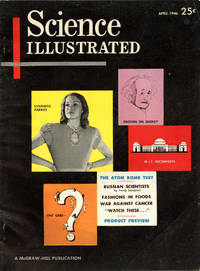
1946Best.-Nr. 1576McGraw-Hill 1946. 1st Edition. IN ORIGINAL WRAPPERS THE FIRST PUBLICATION BY EINSTEIN OF THE FAMILIAR EQUATION E=mc2 IN THAT SPECIFIC FORM. Eight months after Hiroshima the editors of Science Illustrated turned to Albert Einstein to explain "the form of the energy that destroyed Hiroshima;" "to explain in his own words what takes place in the operation of his law" Science Illustrated 1 1 pp. 17 April 1946. The editors believed that given the deployment of two nuclear weapons "average citizens" wanted at least a layman's understanding of the mathematical law that enabled atomic explosions so that they were better able to understand the destruction the bombs unleashed ibid. The mathematical equation or law in question was one Einstein published in 1905 in his Theory of Special Relativity but the form in which it was then written was longer and more complex. In the paper offered here Einstein presents the equation we all now know a shorter more understandable derivation of his equation based upon the law of the conservation of momentum the pressure of radiation and the aberration of light: E = mc2. In layman's terms Einstein also explains the equivalence of mass and energy and discusses the profound 'urgent' implications of his principle ibid. In this article Einstein writes: "'What takes place can be illustrated with the help of our rich man. The atom M is a rich miser who during his life gives away no money energy. But in his will he bequeaths his fortune to his sons M' and M'' on condition that they give to the community a small amount less than one thousandth of the whole estate energy or mass. The sons together have somewhat less than the father had the mass sum M' M'' is somewhat smaller than the mass M of the radioactive atom. But the part given to the community though relatively small is still so enormously large considered as kinetic energy that it brings with it a great threat of evil. Averting that threat has become the most urgent problem of our time" ibid. CONDITION & DETAILS: Complete issue bound in its original wrappers. 4to. pp. 1-128. Very slighy scuffing to the front wrap. There are no address labels. Bright and very clean throughout. McGraw-Hill unknown
1920Best.-Nr. 1433Berlin: Julius Springer 1920. 1st Edition. FIRST EDITION IN ORIGINAL WRAPPERS OF EINSTEIN'S LEIDEN LECTURE EXPLAINING AT LENGTH HIS THEORY OF THE ETHER ALONG WITH THOSE OF LORENTZ & MAXWELL. Very good condition. "Einstein's lecture at the University of Leiden on the occasion of his appointment as a visiting professor summarized his current views on the ether and retrospectively looked at the development of his opinions on the physical properties of space" Calaprice The Einstein Almanac 86. In this lecture Einstein recanted his earlier denial of the ether writing: "Recapitulating we may say that according to the general theory of relativity space is endowed with physical qualities; in this sense therefore there exists an ether. According to the general theory of relativity space without ether is unthinkable; for in such space there not only would be no propagation of light but also no possibility of existence for standards of space and time measuring-rods and clocks nor therefore any space-time intervals in the physical sense. But this ether may not be thought of as endowed with the quality characteristic of ponderable media as consisting of parts which may be tracked through time. The idea of motion may not be applied to it" Einstein Ather 1920. In this lecture Einstein also sought "to reconcile his theory of relativity with his mentor's Lorentz's cherished concept of the aether. Einstein stressed that special relativity took away the last mechanical property of Lorentz's aether: immobility. However he continued that special relativity does not necessarily rule out the aether because the latter can be used to give physical reality to acceleration and rotation. This concept was fully elaborated within general relativity in which physical properties which are partially determined by matter are attributed to space but no substance or state of motion can be attributed to that "aether" aether = curved space-time" Wikipedia. CONDITION & DETAIL: Berlin Julius Springer 1920. Complete in original cream colored wrappers. 8vo. 22 x 15cm. 15pp. Slight toning. Very good condition. ITEM: Ather und Relativitätstheorie. Rede gehalten am 5. Mai 1920 an der Reichs-Universität zu Leiden. Julius Springer unknown
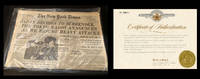
1945Best.-Nr. 1437New York: The New York Times 1945. 1st Edition. First edition of the August 14th 1945 issue of the New York Times complete with "Certificate of Authentication" by the Historic Newspaper Archives. The certificate is #379910; it is signed and includes the seal of the archive. Einstein's article appears in Calaprice's Einstein Almanac No. 244. The certificate will accompany the paper. Most assume that Einstein received the Nobel Prize for his theory of relativity and his famous equation E=mc2. However it was for neither. In 1921 Einstein won the Nobel Prize for discovering the photoelectric effect in 1905. This principle states that when sunlight shines on a metal it emits electrons from the surface of the material. The energy from sunlight photons then transfers to the atoms' electrons and knocks them loose. This discovery was so significant that it has influenced the development of many types of technology from electron microscopes to modern solar cells as we know them today. ALSO INCLUDED: An article by Lewis headlined: "Atoms Not Occult Einstein Declares; Physicist Explains Nuclear and Solar Energy but Refuses to Discuss Use in Bomb" ALSO INCLUDED: New York Time's announces Japan's surrender in 3 line large headline "Japan Decides To Surrender The Tokyo Radio Announces As We Resume Heavy Attacks". CONDITION: Historic Newspaper Archives see above has placed the issue in archival plastic and then into an Archive snap close bag. see photo By any measure this complete issue appears in very good condition. The New York Times unknown
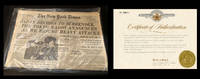
1931Best.-Nr. 1435New York: New York Times 1931. 1st Edition. First edition of the October 19th 1931 issue of the New York Times complete with "Certificate of Authentication" by the Historic Newspaper Archives. The certificate is #379912; it is signed and includes the seal of the archive. Einstein was asked to contribute to the New York Times' "World Mourns the Death of Edison; Body to Lie in State in Laboratory.". CONDITION: Historic Newspaper Archives see above has placed the issue in archival plastic and then into an Archive snap close bag. see photo By any measure this complete issue appears in very good condition. New York Times unknown