EINSTEIN, Albert, & Ernst G StrausBiblio.com
3 027 résultats
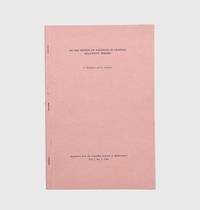
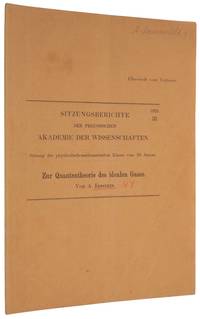
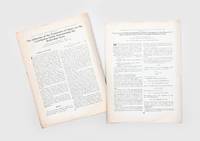
1945réf. 180350Lancaster Pennsylvania: American Physical Society 1945 & 1946. His most significant later contribution to cosmology First editions offprint issues of the papers that introduced the Swiss-cheese model of the universe. Einstein and Straus revised the FLRW metric by suggesting that the universe is in fact inhomogeneous. "In two ground-breaking papers Einstein and Straus showed how galaxies fit into a Universe with zero pressure. This model helps to describe the universe observed today" Harwit p. 573. Quarto pp. 5. Disbound wire-stitched as issued. Nicks and creasing to extremities short closed tears to outer margins pp. 120-1 of Influence detached rear blank almost detached: in very good condition. Boni 252 & 252.1; Weil 216. Martin Harwit Astrophysical Concepts 2010. unknown
1949réf. 180348Ottowa: Canadian Mathematical Society 1949. Their final collaboration First edition offprint issue. Einstein and Infeld demonstrate that "field equations alone suffice as a basis for solving the problem of motion in general relativistic theory since the Einstein equations not only determine how particles must respond to gravitational forces but also contain the information necessary to describe those forces" Calaprice p. 323. Octavo pp. 34. Original orange wrappers wire-stitched as issued front cover lettered in black. Front wrapper lightly marked: a near-fine copy. Boni 259; Weil 223. Alice Calaprice An Einstein Encyclopedia 2015. unknown
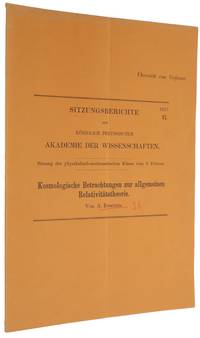
1917réf. 6411Berlin: W. de Gruyter 1917. First edition. First edition an extremely rare author's presentation offprint from the library of the eminent German physicist Arnold Sommerfeld of the groundbreaking paper that "laid the foundations of modern theories of the universe" O'Raifeartaigh. In this seminal work Einstein first applied the principles of general relativity to cosmology introducing the cosmological constant to allow for a static universe - a pivotal conceptual innovation that shaped modern theoretical physics. "There is little doubt that Einstein's 1917 paper 'Cosmological Considerations in the General Theory of Relativity' constituted a key milestone in 20th-century physics" ibid. This presentation offprint - issued in very limited numbers for private distribution by Einstein himself - is vastly scarcer than the commercially available separate printings which appear more regularly on the market. . LAID THE FOUNDATIONS OF MODERN THEORIES OF THE UNIVERSE . First edition extremely rare author's presentation offprint not to be confused with the more common trade separate - see below from the library of the great German physicist Arnold Sommerfeld of Einstein's 'cosmological constant' paper which "laid the foundations of modern theories of the universe" O'Raifeartaigh. "There is little doubt that Einstein's 1917 paper 'Cosmological Considerations in the General Theory of Relativity' constituted a key milestone in 20th century physics. As the first relativistic model of the universe the paper later known as 'Einstein's Static Universe' or the 'Einstein World' set the foundations of modern theoretical cosmology" O'Raifeartaigh et al. "It is generally agreed that the seeds of a revolution in theoretical cosmology were planted when Einstein completed his general theory of relativity in the fall of 1915. On 25 November he read to the Prussian Academy of Sciences the final communication which contained a consistent set of gravitational equations. One and a half years later in a paper announced on 8 February 1917 Einstein took the revolutionary step of exploring the consequences of his new theory for no less than the entire universe" Kragh p. 8. "The consequence of Einstein's version of Mach's principle is that at infinity the components of the metric tensor should degenerate: for an isotropic field the spatial components become zero whereas the timelike component goes to infinity. It turned out to be impossible to realize these conditions for centrally symmetric static fields. Einstein's way out was to postulate a universe that is spatially finite closed and static with a uniform mass distribution a universe in which no boundary conditions are needed. In order to do so however Einstein had to modify his field equations to include what became known as the 'cosmological constant'" Papers 6 p. xx. Max Born said of Einstein's conception "This suggestion of a finite but unbounded space is one of the greatest ideas about the nature of the worlds which has ever been conceived . It solved the mysterious fact why the system of stars did not disperse and thin out which it would do if space were infinite; it gave a physical meaning to Mach's principle which postulated that the law of inertia should not be regarded as a property of empty space but as an effect of the total system of stars; and it opened the way to the concept of the expanding universe" quoted in Clark p. 270. The 'Einstein world' described a static universe but in 1929 Edwin Hubble demonstrated that the universe is not static but expanding. Soon after Einstein rejected his cosmological constant as unnecessary and compromising the simplicity of his field equations. Nevertheless recent discoveries regarding dark matter and dark energy suggest that the cosmological constant may have a role to play in the explanation of the fact that the expansion of the universe appears to be accelerating. OCLC lists copies of this offprint at American Philosophical Society Burndy Huntington and University of Florida but it is unclear if any of these are author's presentation offprints rather than trade separates. We have been unable to locate any other presentation offprint on RBH - it was not present in the collection of Einstein's son Hans Albert Christie's 2006 nor in Einstein's own collection Christie's 2008. RBH lists only four copies of the trade separate in the last 75 years the last sold at Bonham's in 2022 for $15300. Provenance: Arnold Sommerfeld 1868-1951 his characteristic numbering '36' in red pencil on front wrapper. "The son of a physician Sommerfeld was educated at the University of Königsberg. After teaching briefly at the universities of Göttingen Clausthal and Aachen he was appointed professor of physics at the University of Münich in 1906. Sommerfeld should have retired in 1936 in favour of his pupil Werner Heisenberg. Opposition from the Nazi party to Heisenberg's appointment prolonged Sommerfeld's tenure and it was not in fact until late 1939 that he finally retired to be succeeded not by Heisenberg but by Wilhelm Müller a Nazi aerodynamicist without a single publication in physics to his credit. Although Sommerfeld and Heisenberg were not Jewish they were regarded by the Nazis as Jewish sympathizers. Sommerfeld however survived the war and returned to his Münich chair in 1945 continuing to work at physics until he died in a car accident in 1951" Oxford Reference. "Arnold Sommerfeld was one of the most distinguished representatives of the transition period between classical and modern theoretical physics. The work of his youth was still firmly anchored in the conceptions of the nineteenth century; but when in the first decennium of the century the flood of new discoveries experimental and theoretical broke the dams of tradition he became a leader of the new movement and in combining the two ways of thinking he exerted a powerful influence on the younger generation. This combination of a classical mind to whom clarity of conception and mathematical rigour are essential with the adventurous spirit of a pioneer are the roots of his scientific success while his exceptional gift of communicating his ideas by spoken and written word made him a great teacher" Max Born p. 275. "The new relativistic theory of the universe had conceptual roots far back in time especially in problems discussed by Newton in a famous correspondence with the Reverend Richard Bentley in 1692-93 first published as Four letters from Sir Isaac Newton to Doctor Bentley . London 1756. Newton considered the universe as an infinite container with an infinite number of stars but in that case it seemed impossible to define the gravitational force acting upon a body in a definite way. Later scientists sought to resolve the dilemma by keeping to Newton's idea of an infinite space but including a modification of his law of gravitation. In the mid-1890s two German theoreticians Carl von Neumann and Hugo Seeliger suggested independently that the amount of matter in the spatially infinite universe was finite. Although this led to a well-defined gravitational force it also led to a universe which would seem to collapse under the influence of gravitation as realized by Newton. To avoid this consequence Neumann and Seeliger proposed to change Newton's law of gravitation . "When Einstein attacked the cosmological problem he was much aware of the Newtonian anomaly and earlier attempts to solve it such as that of Neumann and Seeliger. He wrote: 'I shall conduct the reader over the road that I have myself travelled rather a rough and winding road because otherwise I cannot hope that he will take much interest in the result at the end of the journey. The conclusion I shall arrive at is that the field equations of gravitation which I have championed hitherto still need a slight modification so that on the basis of the general theory of relativity those fundamental difficulties may be avoided . which confronted the Newtonian theory.' "That the road to the cosmological theory had been rough and winding an intellectual tour de force was also what Einstein wrote to his friend the Dutch physicist Paul Ehrenfest. In early February 1917 Einstein told him that the work had exposed him 'to the danger of being confined in a madhouse.' The conceptual problem which Einstein faced was essentially the same as that Newton had struggled with namely to formulate boundary conditions for an infinite space. In December 1916 he argued in a letter to his friend Michele Besso that a homogeneous symmetrical distribution of matter throughout all of infinite space would not be sufficient to produce the stable universe that both he and Besso presupposed. 'Only the closedness of the universe can get rid of this dilemma' he wrote and added that his new idea was 'one of great scientific significance and not a product of my imagination.' Einstein's solution was to circumvent the problem which he could do by conceiving the universe as a spatially closed continuum in accordance with his general theory of relativity: 'If it were possible to regard the universe as a continuum which is finite closed with respect to its spatial dimension we should have no need at all of any such boundary conditions. We shall proceed to show that both the general postulate of relativity and the fact of the small stellar velocities are compatible with the hypothesis of a spatially finite universe; though certainly in order to carry through this idea we need a generalizing modification of the field equations of gravitation.' Einstein thus assumed the universe to be a spatially closed continuum 'spherical' in four dimensions. This model is also referred to as Einstein's 'cylinder' world: with two of the spatial dimensions suppressed the model universe can be pictured as a cylinder where the radius represents the space and the axis the time coordinate. Einstein was also and naturally so guided by the available empirical evidence. This suggested that the universe was indeed spatially finite that it was static and that it contained a finite amount of matter . "Apart from being influenced by the existing discussion of Newtonian cosmology Einstein was also motivated by the ideas of the famous Austrian physicist and philosopher Ernst Mach. According to Mach's principle proposed in the 1880s the laws of mechanics including the law of inertia should be seen as purely relational namely relative to the universe as a whole. Einstein's version of the principle was rather different; he tended to understand it in the sense that the space-time metric is determined by the masses of the universe and thus that the local dynamics is conditioned by the universe at large. In general Mach's principle is interpreted as the assumption that local inertial frames are determined by some average of the motion of the distant celestial objects. Originally Einstein believed that his relativistic theory of cosmology embodied Mach's principle but in his later years he concluded that the principle could not be harmonized with the general theory of relativity" Kragh pp. 7-9. "Only a year before publishing the present work Einstein had finally completed his great masterwork a new theory of gravity space and time known as the general theory of relativity. From a scientific point of view it is hardly surprising that Einstein quickly turned his attention to cosmology. A fundamental tenet of the general theory was that the geometric structure of a region of spacetime is not an independent self-determined entity but is determined by mass-energy. In modern notation that idea is expressed as the field equations Gμν = −κTμν 1 where Gμν is a four-dimensional tensor that describes the geometry of a region of spacetime and Tμνis a four-dimensional tensor that describes the flux of mass-energy within that region the quantity κ is a constant known as the Einstein constant. Once Einstein had completed the theory it was natural for him to ask if general relativity could deliver a consistent model of all of spacetime-a plausible model of the universe as a whole. As he remarked in a letter to the Dutch astronomer Willem de Sitter 'For me though it was a burning question whether the relativity concept can be followed through to the finish or whether it leads to contradictions.' "Einstein soon found that assuming a universe with a static distribution of matter evidence to the contrary did not emerge until 1929 it was no easy task to obtain a satisfactory solution to the field equations for the case of the universe as a whole. The main difficulty was his insistence that a model of the cosmos should reflect both the principle of relativity which demanded that all frames of reference be equivalent and an assumption he later named Mach's principle-that the inertia of a body is determined entirely by the presence of other masses in the universe. "The outcome of those deliberations was Einstein's 'Cosmological considerations' paper of 1917. His ingenious breakthrough was to postulate that we inhabit a universe of closed spatial geometry. Relativity could deliver a satisfactory model of the known universe if it was assumed that the cosmos had the geometry of a three-dimensional sphere-unbounded spatially yet finite in content. However the Einstein universe came at a price. In his analysis Einstein found that a nonzero solution to the field equations could be obtained only if a new term was introduced to the equations according to: Gμν λgμν = −κTμν. 2 To some the new term λgμν known as the 'cosmological constant' term marred the symmetry and simplicity of the original field equations. However general relativity certainly permitted the term; indeed Einstein had noted the possibility of such an extension to the field equations in his original exposition of 1916. Now the cosmological constant found an important application because it allowed a model of the universe that was consistent with Einstein's views on the relativity of inertia . "Einstein's analysis culminated in a simple relation between the cosmological constant λ the mean density of matter Ï and the radius of the cosmos R according to λ = κÏ/2= 1/R2. 3 "One puzzling aspect of Einstein's 'Cosmological considerations' paper is that he made no attempt to estimate the size of his model universe from equation 3. After all even a rough approximation of the mean density of matter in the universe could have given some estimate of the cosmic radius R. Instead he merely declared at the end of the paper that the model was logically consistent: 'At any rate this view is logically consistent and from the standpoint of the general theory of relativity lies nearest at hand; whether from the standpoint of present astronomical knowledge it is tenable will not here be discussed' . "A second puzzle associated with the 'Cosmological considerations' paper is Einstein's failure to consider the stability of his model universe. After all the quantity Ï in equation 3 represented a mean value for the density of matter in the universe; one could expect a variation in that parameter from time to time which raises the question of the stability of the model against such perturbations. Indeed it was later shown that the Einstein universe is highly unstable against perturbations in matter density a slight increase in density would trigger an inexorable contraction while a slight decrease would result in a runaway expansion . "In 1929 American astronomer Edwin Hubble published the first evidence of a linear relation between the redshifts of the spiral nebulae and their radial distance. Many theorists viewed Hubble's results as evidence of a non-static universe and proposed a variety of relativistic time-varying models of the cosmos. Einstein himself lost little time in abandoning his static cosmology at that point. In the early 1930s he published two distinct models of the expanding universe one of positive spatial curvature and one of Euclidean geometry. In each case he also abandoned the cosmological constant stating that the term was both unsatisfactory it gave an unstable solution and redundant relativity could describe expanding models of the universe without the term . "Some years later the Russian scientist George Gamow reported in his memoirs that Einstein once described the cosmological constant as his 'biggest blunder' . It is intriguing to think that Einstein might have predicted the expansion of the universe many years before Hubble's observations had he not introduced the cosmological constant. However it must be remembered that Einstein's task in 1917 was to investigate whether relativity could describe the known universe that is a universe that was assumed to be static. If Einstein did make the 'biggest blunder' comment he may have been referring to his failure to notice the instability of his model" O'Raifeartaigh. "In the latter third of the twentieth century the situation in cosmology began to change dramatically. Theoretical cosmology became more and more closely associated with elementary particle theory and observational cosmology began to accumulate more and more data limiting the possibilities for and influencing the construction of cosmological models. The cosmological constant has had a dramatic rebirth with the accumulating observation evidence that rather than slowing down as current theories had predicted the expansion of the universe is actually accelerating with cosmic time. By an appropriate choice of sign and value for λ cosmological models with this property are easily constructed. The problem is to give a physical explanation for such a choice of λ. One favored explanation as of 2007 is that the λ-term in the field equations is actually the stress-energy-momentum tensor for 'dark energy' a hitherto unobserved component pervading the entire universe. If this explanation stands the test of time it may also turn out that the 'cosmological constant' is not constant but varies with cosmological time!" DSB. "Today the term cosmological constant has made a dramatic return to the field equations due to the observation of an acceleration in the expansion of the cosmos. It might therefore be argued that Einstein's real blunder was to abandon the term in the 1930s. However such a view is once again somewhat retrospective because evidence of an accelerated expansion was not known to him. "In recent years the Einstein universe has once more become a topic of interest in theoretical cosmology. In attempts to avoid the well-known problem of a big bang singularity some theorists have become interested in the possibility of a universe that inflates from a static Einstein universe a scenario known as the emergent universe. Whether the emergent universe will offer a plausible consistent description of the early universe is not yet known. But it is intriguing to think that like the cosmological constant the Einstein universe might yet make a dramatic comeback" O'Raifeartaigh. This author's presentation offprint is of extreme rarity and must be distinguished from other so-called 'offprints' of papers from the Berlin Sitzungsberichte many of which are commonly available on the market. The celebrated bookseller Ernst Weil 1919-1981 in the introduction to his Einstein bibliography wrote: "I have often been asked about the number of those offprints. It seems to be certain that there were few before 1914. They were given only to the author and mostly 'Überreicht vom Verfasser' Presented by the Author is printed on the wrapper. Later on I have no doubt many more offprints were made and also sold as such especially by the Berlin Academy." If the term 'offprint' means as we believe it should a separate printing of a journal article given only to the author for distribution to colleagues then 'offprints' were not commercially available. Although there is certainly some truth in Weil's remark in our view it requires clarification and explanation. Until about 1916 most of Einstein's papers were published in Annalen der Physik; from 1916 until he left Germany for the United States in 1933 most were published in the Berlin Sitzungsberichte. The Sitzungsberichte differed from other journals in which Einstein published in that it made separate printings of its papers commercially available. These separate printings have 'Sonderabdruck' printed on the front wrapper the usual German term for offprint but they are not offprints according to our definition. They were available to anyone; indeed a price list of these 'trade offprints' is printed on the rear wrapper. True author's presentation offprints can be distinguished from these trade offprints by the presence of 'Überreicht vom Verfasser' on the front wrapper as in the present offprint. In the period 1916 to 1919 or 1920 the Sitzungsberichte trade offprints are themselves rare: for example RBH list only three 'offprints' of Einstein's famous 1917 Sitzungsberichte paper 'Kosmologische Betrachtungen zur allgemeinen Relativitätstheorie' the auction records do not distinguish between trade and author's presentation offprints. After 1919 or 1920 however the trade offprints become much more common although the author's presentation offprints are still very rare. The reason for this change is that it was only in 1919 that Einstein became famous among the general public. It might seem obvious that Einstein's fame dates from 1905 his 'annus mirabilis' in which he published his epoch-making papers on special relativity and the light quantum. However these works did not make him immediately well known even in the physics community - many physicists did not understand or accept his work and it was two or three years before his genius was fully accepted even by his colleagues. Among the general public Einstein became well known only in late 1919 following the success of Eddington's expedition to observe the bending of light by the Sun which confirmed Einstein's general theory of relativity. This was front-page news and made Einstein universally famous. See Chapter 16 'The suddenly famous Doctor Einstein' in Pais Subtle is the Lord for an account of these events. Before 1919 the trade offprints of Einstein's papers would probably only have been purchased by professional physicists; after 1919 everyone wanted a memento of the famous Dr. Einstein whether or not they understood anything of theoretical physics and the trade offprints of his papers were printed and sold in far greater numbers than before to meet the demand. It is telling that when these post-1919 trade offprints appear on the market they are often in mint condition - they were never read simply because their owners were unable to understand them. In our view Einstein's author's presentation offprints are rare from any journal and any period though of course some are rarer than others. Before 1919 or 1920 the Sitzungsberichte trade offprints are also rare although not are rare as the author's presentation offprints; after 1919 or 1920 the trade offprints are much more common. BRL 96; Weil 92. Clark Einstein: The Life and Times 1971. Kragh Cosmology and Controversy 1996. O'Raifeartaigh O'Keeffe Nahm & Mitton 'Einstein's 1917 Static Model of the Universe: A Centennial Review' The European Physical Journal H 42 2017 pp. 431-74. O'Raifeartaigh 'Albert Einstein and the origins of modern cosmology' Physics Today 3 February 2017 . 8vo 252 x 180mm pp. 142-152 1 blank. Original printed orange wrappers light vertical crease for posting small piece of paper adhered to rear wrapper. W. de Gruyter unknown
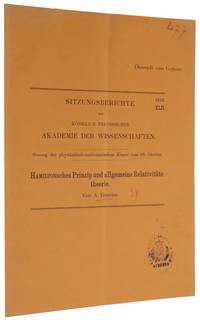
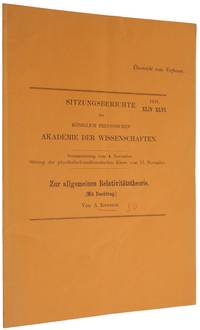
1916réf. 6409Berlin: Königlichen Akademie der Wissenschaften 1916. First edition. First editions extremely rare author's presentation offprint not to be confused with the much more common trade separate - see below from the library of the great German physicist Arnold Sommerfeld of Einstein's derivation of the field equations of gravitation from a variational principle. This was the first time Einstein had derived the field equations of gravitation in arbitrary coordinates - in his celebrated 1915 papers he derived the equations in generally-covariant form but only in special 'unimodular' coordinates. . THE GRAVITATIONAL EQUATIONS FROM A VARIATIONAL PRINCIPLE. First editions extremely rare author's presentation offprint not to be confused with the much more common trade separate - see below from the library of the great German physicist Arnold Sommerfeld of Einstein's derivation of the field equations of gravitation from a variational principle. This was the first time Einstein had derived the field equations of gravitation in arbitrary coordinates - in his celebrated 1915 papers he derived the equations in generally-covariant form but only in special 'unimodular' coordinates. In the early 19th century William Rowan Hamilton 1805-65 showed that Newton's equations of motion for a classical mechanical system were equivalent to the statement that the 'action' of the system now called the Lagrangian has a stationary value generally a minimum. A first variational approach to the gravitational field equations of general relativity was unsuccessfully sketched by Einstein and Marcel Grossmann in 1913-1914 and subsequently by Einstein himself in 1914 the so-called Entwurf Theory. But Einstein's 1914 theory was invalidated by a misconception related to the physically unjustified requirement of restricting the covariance of the gravitational field equations and by some mathematical errors in a crucial proof in the theory. Between March and May 1915 the Italian mathematician Tullio Levi-Civita 1873-1941 in his private correspondence with Einstein singled out the mathematical flaws of the Entwurf theory setting Einstein back on the path of general covariance which eventually brought him in November 1915 to the correct formulation of the gravitational field equations. Also in November 1915 the great German mathematician David Hilbert 1862-1943 published an article in which he correctly showed that Einstein's gravitational field equations could be obtained from a variational principle at least in the presence of an electromagnetic field. Five days later independently of Hilbert Einstein obtained in the present paper the same results thus obtaining the definitive variational formulation of the field equations. Einstein considered his approach to be more general than Hilbert's as Hilbert had made some hypotheses about matter which Einstein dispensed with Einstein also refused to accept the electromagnetic origin of matter which Hilbert had assumed. In the course of this paper Einstein also proved a special case of Emmy Noether's second theorem on the relation between symmetry and conservation laws which she published in full generality two years later. The only author's presentation offprint listed on RBH is that is the collection of Einstein's son Hans Albert Christie's 2006; it was not in Einstein's own collection of his offprints Christie's 2008. Provenance: Arnold Sommerfeld 1868-1951 his characteristic numbering in red pencil '34' on front cover; Institut für Theoretische Physik Munich ink stamp on upper cover. "The son of a physician Sommerfeld was educated at the University of Königsberg. After teaching briefly at the universities of Göttingen Clausthal and Aachen he was appointed professor of physics at the University of Münich in 1906. Sommerfeld should have retired in 1936 in favour of his pupil Werner Heisenberg. Opposition from the Nazi party to Heisenberg's appointment prolonged Sommerfeld's tenure and it was not in fact until late 1939 that he finally retired to be succeeded not by Heisenberg but by Wilhelm Müller a Nazi aerodynamicist without a single publication in physics to his credit. Although Sommerfeld and Heisenberg were not Jewish they were regarded by the Nazis as Jewish sympathizers. Sommerfeld however survived the war and returned to his Münich chair in 1945 continuing to work at physics until he died in a car accident in 1951" Oxford Reference. "Arnold Sommerfeld was one of the most distinguished representatives of the transition period between classical and modern theoretical physics. The work of his youth was still firmly anchored in the conceptions of the nineteenth century; but when in the first decennium of the century the flood of new discoveries experimental and theoretical broke the dams of tradition he became a leader of the new movement and in combining the two ways of thinking he exerted a powerful influence on the younger generation. This combination of a classical mind to whom clarity of conception and mathematical rigour are essential with the adventurous spirit of a pioneer are the roots of his scientific success while his exceptional gift of communicating his ideas by spoken and written word made him a great teacher" Max Born p. 275. "Einstein's first paper on a metric theory of gravity co-authored with his mathematician friend Marcel Grossmann was published as a separatum in early 1913 and was reprinted the following year in Zeitschrift für Mathematik und Physik. Most of the formalism of general relativity as we know it today was already in place in this Einstein-Grossmann theory. Still missing were the generally-covariant Einstein field equations . "In the fall of 1915 Einstein came to the painful realization that the 'Entwurf' field equations are untenable. Casting about for new field equations he fortuitously found his way back to equations of broad covariance that he had reluctantly abandoned three years earlier . on November 4 1915 presented the rediscovered old equations to the Berlin Academy. He returned a week later with an important modification and two weeks after that with a further modification . "When it was all over Einstein commented with typical self-deprecation: 'unfortunately I have immortalized my final errors in the academy-papers;' and 'it's convenient with that fellow Einstein every year he retracts what he wrote the year before.' What excused Einstein's rushing into print was that he knew that the formidable Göttingen mathematician David Hilbert was hot on his trail. Nevertheless these hastily written communications to the Berlin Academy proved hard to follow even for Einstein's staunchest supporters such as the Leyden theorists H. A. Lorentz and Paul Ehrenfest . Ehrenfest's queries undoubtedly helped Einstein organize the material of November 1915 for an authoritative exposition of the new theory . "In March 1916 Einstein sent his new review article 'Die Grundlage der Relativitätstheorie' to Wilhelm Wien editor of the Annalen . In this paper the field equations and energy-momentum conservation are not developed in generally-covariant form but only in special coordinates. Einstein had found the Einstein field equation in terms of these coordinates in November 1915. This part of the review paper is basically a sanitized version of the argument that had led Einstein to these equations in the first place . "As he was writing his review article he was already considering redoing the discussion of the field equations and energy-momentum conservation in arbitrary coordinates. In November 1916 he published such a generally-covariant account in the Berlin Sitzungsberichte the offered paper. This paper is undoubtedly much more satisfactory mathematically than the corresponding part of the review article but it does not offer any insight into how Einstein actually found his theory. Reading the offered paper without having read the November 1915 papers and the 1916 review article one easily comes away with the impression that Einstein hit upon the Einstein field equations simply by picking the mathematically most obvious candidate for the gravitational part of the Lagrangian for the metric field namely the Riemann curvature scalar. This is essentially how Einstein himself came to remember his discovery of general relativity. He routinely trotted out this version of events to justify the purely mathematical speculation he resorted to in his work on unified field theory. "In this paper he derived the generally-covariant field equations from an action principle with the Riemann curvature scalar as the Lagrangian . The present paper fills two important gaps in the review article. First Einstein derived the generally-covariant version of the Bianchi identities which in conjunction with the field equations imply energy-momentum conservation . Second Einstein showed that the identities guaranteeing energy-momentum conservation are a direct consequence of the covariance of the action functional. Einstein had thus in a mathematically impeccable way found a special case of one of Noether's theorems published two years later. "From a purely mathematical point of view the discussion of the field equations and energy-momentum conservation in the present paper is far more elegant than in the review article. This more elegant treatment however obscures the way in which Einstein found the Einstein field equations. It makes it look as if it was a matter ofpicking the most obvious candidate for the Lagrangian the Riemann curvature scalar at which point everything else fell into place. Ironically this is exactly what Einstein in his later years came to believe himself in part no doubt because it made his successful search for the field equations of general relativity look so similar to his fruitless search for a unified field theory. The clumsier discussion in unimodular coordinates in the review article however may serve as a reminder that-whatever he believed said or wrote about it later on-Einstein only discovered the mathematical high road to the Einstein field equations after he had already found these equations at the end of a poorly paved road through physics. Serving as road signs were Newton's gravitational theory Maxwell's electrodynamics and such key results of special relativity as the law of energy-momentum conservation. Considerations of mathematical elegance played only a subsidiary role" Janssen. This author's presentation offprint is of extreme rarity and must be distinguished from other so-called 'offprints' of papers from the Berlin Sitzungsberichte many of which are commonly available on the market. The celebrated bookseller Ernst Weil 1919-1981 in the introduction to his Einstein bibliography wrote: "I have often been asked about the number of those offprints. It seems to be certain that there were few before 1914. They were given only to the author and mostly 'Überreicht vom Verfasser' Presented by the Author is printed on the wrapper. Later on I have no doubt many more offprints were made and also sold as such especially by the Berlin Academy." If the term 'offprint' means as we believe it should a separate printing of a journal article given only to the author for distribution to colleagues then 'offprints' were not commercially available. Although there is certainly some truth in Weil's remark in our view it requires clarification and explanation. Until about 1916 most of Einstein's papers were published in Annalen der Physik; from 1916 until he left Germany for the United States in 1933 most were published in the Berlin Sitzungsberichte. The Sitzungsberichte differed from other journals in which Einstein published in that it made separate printings of its papers commercially available. These separate printings have 'Sonderabdruck' printed on the front wrapper the usual German term for offprint but they are not offprints according to our definition. They were available to anyone; indeed a price list of these 'trade offprints' is printed on the rear wrapper. True author's presentation offprints can be distinguished from these trade separates by the presence of 'Überreicht vom Verfasser' on the front wrapper. In the period 1916 to 1919 or 1920 the Sitzungsberichte trade separates are themselves rare. After 1919 or 1920 however the trade separates become much more common although the author's presentation offprints are still very rare. The reason for this change is that it was only in 1919 that Einstein became famous among the general public. It might seem obvious that Einstein's fame dates from 1905 his 'annus mirabilis' in which he published his epoch-making papers on special relativity and the light quantum. However these works did not make him immediately well known even in the physics community - many physicists did not understand or accept his work and it was two or three years before his genius was fully accepted even by his colleagues. Einstein did not secure an academic position until 1908. Among the general public Einstein became well known only in late 1919 following the success of Eddington's expedition to observe the bending of light by the Sun which confirmed Einstein's general theory of relativity. This was front-page news and made Einstein universally famous. See Chapter 16 'The suddenly famous Doctor Einstein' in Pais Subtle is the Lord for an account of these events. Before 1919 the trade separates of Einstein's papers would probably only have been purchased by professional physicists; after 1919 everyone wanted a memento of the famous Dr. Einstein whether or not they understood anything of theoretical physics and the trade separates of his papers were printed and sold in far greater numbers than before to meet the demand. It is telling that when these post-1919 trade separates appear on the market they are often in mint condition - they were never read simply because their owners were unable to understand them. BRL 90; Weil 88. Born 'Arnold Johannes Wilhelm Sommerfeld 1868-1951' Obituary Notices of Fellows of the Royal Society 8 1952 pp. 275-296. Janssen 'Einstein's First Systematic Exposition of General Relativity' 2004 . 8vo 252 x 180 mm pp. 1111-1116. Original orange printed wrappers light vertical crease for posting. Königlichen Akademie der Wissenschaften unknown
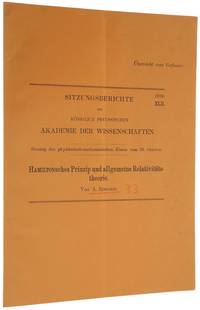
1916réf. 6408Berlin: Königlichen Akademie der Wissenschaften 1916. First edition. First editions extremely rare author's presentation offprint not to be confused with the much more common trade separate - see below from the library of the great German physicist Arnold Sommerfeld of Einstein's derivation of the field equations of gravitation from a variational principle. This was the first time Einstein had derived the field equations of gravitation in arbitrary coordinates - in his celebrated 1915 papers he derived the equations in generally-covariant form but only in special 'unimodular' coordinates. . THE GRAVITATIONAL EQUATIONS FROM A VARIATIONAL PRINCIPLE. First editions extremely rare author's presentation offprint not to be confused with the much more common trade separate - see below from the library of the great German physicist Arnold Sommerfeld of Einstein's derivation of the field equations of gravitation from a variational principle. This was the first time Einstein had derived the field equations of gravitation in arbitrary coordinates - in his celebrated 1915 papers he derived the equations in generally-covariant form but only in special 'unimodular' coordinates. In the early 19th century William Rowan Hamilton 1805-65 showed that Newton's equations of motion for a classical mechanical system were equivalent to the statement that the 'action' of the system now called the Lagrangian has a stationary value generally a minimum. A first variational approach to the gravitational field equations of general relativity was unsuccessfully sketched by Einstein and Marcel Grossmann in 1913-1914 and subsequently by Einstein himself in 1914 the so-called Entwurf Theory. But Einstein's 1914 theory was invalidated by a misconception related to the physically unjustified requirement of restricting the covariance of the gravitational field equations and by some mathematical errors in a crucial proof in the theory. Between March and May 1915 the Italian mathematician Tullio Levi-Civita 1873-1941 in his private correspondence with Einstein singled out the mathematical flaws of the Entwurf theory setting Einstein back on the path of general covariance which eventually brought him in November 1915 to the correct formulation of the gravitational field equations. Also in November 1915 the great German mathematician David Hilbert 1862-1943 published an article in which he correctly showed that Einstein's gravitational field equations could be obtained from a variational principle at least in the presence of an electromagnetic field. Five days later independently of Hilbert Einstein obtained in the present paper the same results thus obtaining the definitive variational formulation of the field equations. Einstein considered his approach to be more general than Hilbert's as Hilbert had made some hypotheses about matter which Einstein dispensed with Einstein also refused to accept the electromagnetic origin of matter which Hilbert had assumed. In the course of this paper Einstein also proved a special case of Emmy Noether's second theorem on the relation between symmetry and conservation laws which she published in full generality two years later. The only author's presentation offprint listed on RBH is that is the collection of Einstein's son Hans Albert Christie's 2006; it was not in Einstein's own collection of his offprints Christie's 2008. Provenance: Arnold Sommerfeld 1868-1951 his characteristic numbering in red pencil '33' on front cover. "The son of a physician Sommerfeld was educated at the University of Königsberg. After teaching briefly at the universities of Göttingen Clausthal and Aachen he was appointed professor of physics at the University of Münich in 1906. Sommerfeld should have retired in 1936 in favour of his pupil Werner Heisenberg. Opposition from the Nazi party to Heisenberg's appointment prolonged Sommerfeld's tenure and it was not in fact until late 1939 that he finally retired to be succeeded not by Heisenberg but by Wilhelm Müller a Nazi aerodynamicist without a single publication in physics to his credit. Although Sommerfeld and Heisenberg were not Jewish they were regarded by the Nazis as Jewish sympathizers. Sommerfeld however survived the war and returned to his Münich chair in 1945 continuing to work at physics until he died in a car accident in 1951" Oxford Reference. "Arnold Sommerfeld was one of the most distinguished representatives of the transition period between classical and modern theoretical physics. The work of his youth was still firmly anchored in the conceptions of the nineteenth century; but when in the first decennium of the century the flood of new discoveries experimental and theoretical broke the dams of tradition he became a leader of the new movement and in combining the two ways of thinking he exerted a powerful influence on the younger generation. This combination of a classical mind to whom clarity of conception and mathematical rigour are essential with the adventurous spirit of a pioneer are the roots of his scientific success while his exceptional gift of communicating his ideas by spoken and written word made him a great teacher" Max Born p. 275. "Einstein's first paper on a metric theory of gravity co-authored with his mathematician friend Marcel Grossmann was published as a separatum in early 1913 and was reprinted the following year in Zeitschrift für Mathematik und Physik. Most of the formalism of general relativity as we know it today was already in place in this Einstein-Grossmann theory. Still missing were the generally-covariant Einstein field equations . "In the fall of 1915 Einstein came to the painful realization that the 'Entwurf' field equations are untenable. Casting about for new field equations he fortuitously found his way back to equations of broad covariance that he had reluctantly abandoned three years earlier . on November 4 1915 presented the rediscovered old equations to the Berlin Academy. He returned a week later with an important modification and two weeks after that with a further modification . "When it was all over Einstein commented with typical self-deprecation: 'unfortunately I have immortalized my final errors in the academy-papers;' and 'it's convenient with that fellow Einstein every year he retracts what he wrote the year before.' What excused Einstein's rushing into print was that he knew that the formidable Göttingen mathematician David Hilbert was hot on his trail. Nevertheless these hastily written communications to the Berlin Academy proved hard to follow even for Einstein's staunchest supporters such as the Leyden theorists H. A. Lorentz and Paul Ehrenfest . Ehrenfest's queries undoubtedly helped Einstein organize the material of November 1915 for an authoritative exposition of the new theory . "In March 1916 Einstein sent his new review article 'Die Grundlage der Relativitätstheorie' to Wilhelm Wien editor of the Annalen . In this paper the field equations and energy-momentum conservation are not developed in generally-covariant form but only in special coordinates. Einstein had found the Einstein field equation in terms of these coordinates in November 1915. This part of the review paper is basically a sanitized version of the argument that had led Einstein to these equations in the first place . "As he was writing his review article he was already considering redoing the discussion of the field equations and energy-momentum conservation in arbitrary coordinates. In November 1916 he published such a generally-covariant account in the Berlin Sitzungsberichte the offered paper. This paper is undoubtedly much more satisfactory mathematically than the corresponding part of the review article but it does not offer any insight into how Einstein actually found his theory. Reading the offered paper without having read the November 1915 papers and the 1916 review article one easily comes away with the impression that Einstein hit upon the Einstein field equations simply by picking the mathematically most obvious candidate for the gravitational part of the Lagrangian for the metric field namely the Riemann curvature scalar. This is essentially how Einstein himself came to remember his discovery of general relativity. He routinely trotted out this version of events to justify the purely mathematical speculation he resorted to in his work on unified field theory. "In this paper he derived the generally-covariant field equations from an action principle with the Riemann curvature scalar as the Lagrangian . The present paper fills two important gaps in the review article. First Einstein derived the generally-covariant version of the Bianchi identities which in conjunction with the field equations imply energy-momentum conservation . Second Einstein showed that the identities guaranteeing energy-momentum conservation are a direct consequence of the covariance of the action functional. Einstein had thus in a mathematically impeccable way found a special case of one of Noether's theorems published two years later. "From a purely mathematical point of view the discussion of the field equations and energy-momentum conservation in the present paper is far more elegant than in the review article. This more elegant treatment however obscures the way in which Einstein found the Einstein field equations. It makes it look as if it was a matter ofpicking the most obvious candidate for the Lagrangian the Riemann curvature scalar at which point everything else fell into place. Ironically this is exactly what Einstein in his later years came to believe himself in part no doubt because it made his successful search for the field equations of general relativity look so similar to his fruitless search for a unified field theory. The clumsier discussion in unimodular coordinates in the review article however may serve as a reminder that-whatever he believed said or wrote about it later on-Einstein only discovered the mathematical high road to the Einstein field equations after he had already found these equations at the end of a poorly paved road through physics. Serving as road signs were Newton's gravitational theory Maxwell's electrodynamics and such key results of special relativity as the law of energy-momentum conservation. Considerations of mathematical elegance played only a subsidiary role" Janssen. This author's presentation offprint is of extreme rarity and must be distinguished from other so-called 'offprints' of papers from the Berlin Sitzungsberichte many of which are commonly available on the market. The celebrated bookseller Ernst Weil 1919-1981 in the introduction to his Einstein bibliography wrote: "I have often been asked about the number of those offprints. It seems to be certain that there were few before 1914. They were given only to the author and mostly 'Überreicht vom Verfasser' Presented by the Author is printed on the wrapper. Later on I have no doubt many more offprints were made and also sold as such especially by the Berlin Academy." If the term 'offprint' means as we believe it should a separate printing of a journal article given only to the author for distribution to colleagues then 'offprints' were not commercially available. Although there is certainly some truth in Weil's remark in our view it requires clarification and explanation. Until about 1916 most of Einstein's papers were published in Annalen der Physik; from 1916 until he left Germany for the United States in 1933 most were published in the Berlin Sitzungsberichte. The Sitzungsberichte differed from other journals in which Einstein published in that it made separate printings of its papers commercially available. These separate printings have 'Sonderabdruck' printed on the front wrapper the usual German term for offprint but they are not offprints according to our definition. They were available to anyone; indeed a price list of these 'trade offprints' is printed on the rear wrapper. True author's presentation offprints can be distinguished from these trade separates by the presence of 'Überreicht vom Verfasser' on the front wrapper. In the period 1916 to 1919 or 1920 the Sitzungsberichte trade separates are themselves rare. After 1919 or 1920 however the trade separates become much more common although the author's presentation offprints are still very rare. The reason for this change is that it was only in 1919 that Einstein became famous among the general public. It might seem obvious that Einstein's fame dates from 1905 his 'annus mirabilis' in which he published his epoch-making papers on special relativity and the light quantum. However these works did not make him immediately well known even in the physics community - many physicists did not understand or accept his work and it was two or three years before his genius was fully accepted even by his colleagues. Einstein did not secure an academic position until 1908. Among the general public Einstein became well known only in late 1919 following the success of Eddington's expedition to observe the bending of light by the Sun which confirmed Einstein's general theory of relativity. This was front-page news and made Einstein universally famous. See Chapter 16 'The suddenly famous Doctor Einstein' in Pais Subtle is the Lord for an account of these events. Before 1919 the trade separates of Einstein's papers would probably only have been purchased by professional physicists; after 1919 everyone wanted a memento of the famous Dr. Einstein whether or not they understood anything of theoretical physics and the trade separates of his papers were printed and sold in far greater numbers than before to meet the demand. It is telling that when these post-1919 trade separates appear on the market they are often in mint condition - they were never read simply because their owners were unable to understand them. BRL 90; Weil 88. Born 'Arnold Johannes Wilhelm Sommerfeld 1868-1951' Obituary Notices of Fellows of the Royal Society 8 1952 pp. 275-296. Janssen 'Einstein's First Systematic Exposition of General Relativity' 2004 . 8vo 252 x 180 mm pp. 1111-1116. Original orange printed wrappers light vertical crease for posting. Königlichen Akademie der Wissenschaften unknown
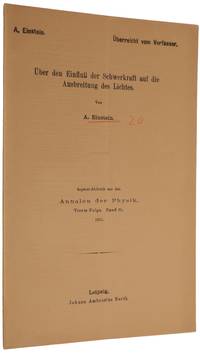
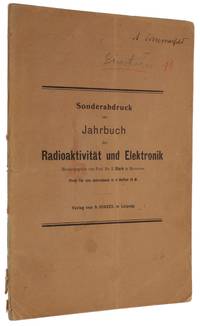
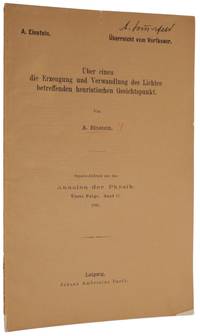
1911réf. 6407Leipzig: Johann Ambrosius Barth 1911. First edition. First edition an extremely rare author's presentation offprint with 'Überreicht vom Verfasser' - Presented by the Author from the library of the eminent German physicist Arnold Sommerfeld of Einstein's "first paper completely devoted to general relativity" Brandt Harvest of a Century. In this groundbreaking work Einstein applied the equivalence principle - the idea that acceleration and gravitation are physically indistinguishable - to predict two profound effects of gravity on light: the gravitational redshift and the bending of light by massive bodies. These predictions would later be spectacularly confirmed notably in the 1919 solar eclipse observations cementing Einstein's reputation worldwide. . GRAVITATIONAL RED-SHIFT AND THE BENDING OF LIGHT . First edition extremely rare author's presentation offprint with 'Überreicht vom Verfasser' Presented by the Author stamped on front wrapper from the library of the great German physicist Arnold Sommerfeld of Einstein's "first paper completely devoted to general relativity" Brandt p. 105. This epochal paper applies the equivalence principle that acceleration and gravitation are equivalent in their physical effects to demonstrate two effects of gravity on light: the gravitational bending of light and the gravitational redshift. "In 1911 Einstein proceeded to revise and improve his earlier presentation in 1907 making the principle of equivalence the central feature of his treatment. Einstein now included an elegant proof based on a cyclic process reminiscent of thermodynamics that the gravitational mass of a body as well as its inertial mass is increased by the amount E/c2 when the body absorbs energy E c being the speed of light" Collected Papers p. xxix. Einstein applies this result to show first that if light of frequency ν travels a distance d against a gravitational field which would exert an acceleration g on a gravitating body its frequency is reduced by Δν = νgd/c2 - this is the gravitational redshift. And second Einstein deduced the deflection of a light ray moving in the gravitational field of a spherical body - he finds that the light suffers a deflection toward the source given by 2Gm/dc2 where d is the distance of closest approach to the body of mass m and G is the gravitational constant. "The paper ends with a plea to the astronomers: 'It is urgently desirable that astronomers concern themselves with the question brought up here even if the foregoing considerations might seem insufficiently founded or even adventurous'" Pais p. 200. The bending of light was famously observed by Eddington and his team during a solar eclipse in 1919; the gravitational redshift was more difficult to measure but Einstein's prediction was confirmed by Pound & Rebka at Harvard in 1960 using a laboratory experiment not astronomical observations. "Thus in 1911 we discern the first glimpses of the new Einstein program: to derive the equivalence principle from a new theory of gravitation. This cannot be achieved within the framework of what he called the ordinary relativity theory the special theory. Therefore one must look for a new theory not only of gravitation but also of relativity. Another point made in this paper likewise bears on that new program. 'Of course one cannot replace an arbitrary gravitational field by a state of motion without gravitational field as little as one can transform to rest by means of a relativity transformation all points of an arbitrarily moving medium.' This statement would continue to be true in the ultimate general theory of relativity" Pais pp. 195-196. OCLC lists three copies: King's College London; Württembergische Landesbibliothek; Swiss National Library. RBH list only two other copies both sold by Christie's: the Plotnick copy in 2002 and that in Einstein's own collection of his offprints in 2008. Provenance: Arnold Sommerfeld 1868-1951 his characteristic numbering in red pencil '20' on front cover. "The son of a physician Sommerfeld was educated at the University of Königsberg. After teaching briefly at the universities of Göttingen Clausthal and Aachen he was appointed professor of physics at the University of Münich in 1906. Sommerfeld should have retired in 1936 in favour of his pupil Werner Heisenberg. Opposition from the Nazi party to Heisenberg's appointment prolonged Sommerfeld's tenure and it was not in fact until late 1939 that he finally retired to be succeeded not by Heisenberg but by Wilhelm Müller a Nazi aerodynamicist without a single publication in physics to his credit. Although Sommerfeld and Heisenberg were not Jewish they were regarded by the Nazis as Jewish sympathizers. Sommerfeld however survived the war and returned to his Münich chair in 1945 continuing to work at physics until he died in a car accident in 1951" Oxford Reference. "Arnold Sommerfeld was one of the most distinguished representatives of the transition period between classical and modern theoretical physics. The work of his youth was still firmly anchored in the conceptions of the nineteenth century; but when in the first decennium of the century the flood of new discoveries experimental and theoretical broke the dams of tradition he became a leader of the new movement and in combining the two ways of thinking he exerted a powerful influence on the younger generation. This combination of a classical mind to whom clarity of conception and mathematical rigour are essential with the adventurous spirit of a pioneer are the roots of his scientific success while his exceptional gift of communicating his ideas by spoken and written word made him a great teacher" Max Born p. 275. "In 1907 still working at the patent office in Bern Einstein began to study the laws of physics in reference frames with an accelerated relative motion. When he completed this work in 1915 he called it the General Theory of Relativity. At various occasions Einstein recalled his starting point in this project. It struck him that a man falling from the top of a roof he said did not feel his own weight. In the reference frame of the building it is the weight or gravitational force which make the man fall but in a reference frame moving with the man there is another force exactly counteracting the weight so that there is no net force. In that frame the man stays at rest. Einstein realized that acceleration and gravitation are equivalent to each other. That was later called the equivalence principle. If he would be able to extend his theory of relativity to accelerated reference frames he would be able to do for the theory of gravitation what he had done for electrodynamics with special relativity. He gave a first glimpse at his new topic in a review article on special relativity written in 1907 'Über das Relativitätprinzip und die aus demselben gezogenen Folgerungen' Jahrbuch der Radioaktivität und Elektronik Bd. 4 pp. 411-62" Brandt p. 105. "A few months before the Solvay Congress Einstein had returned to the questions concerning gravitation and accelerated frames of reference that he first raised in his 1907 review article on relativity. These subjects had gone unmentioned in his papers for four years and hardly ever appear in his correspondence during that time. But in June 1911 Einstein completed a short paper 'On the Influence of Gravitation on the Propagation of Light.' This was only a month after his letter to Besso announcing that he was abandoning his efforts to create a new theory of radiation. It looks as though his renunciation of that quest set him free to focus his attention once more on gravitation" Collected Papers p. xxix. "It is characteristic for Einstein that in the same paper he proposed a way to verify his predictions experimentally . From his formula for the gravitational redshift he computed that the frequency of a spectral line emitted by an atom on the surface of the sun would be reduced by two parts in a million when that light reached the earth. Thus a line spectrum originating from the sun is shifted to lower frequencies and therefore to longer wavelengths compared to a spectrum emitted in the laboratory. This redshift is difficult to measure because the surface of the sun is a nasty environment with high pressure storms and magnetic fields all influencing spectral lines. But with modern techniques it has been well established even in the laboratory with radiation climbing against the earth's gravitation for only a few meters. "Einstein also computed the bending of light by gravitation. If the light of a star passes near the surface of the sun and is then observed by an astronomer on the earth the star appears to be in a slightly different position because the light was attracted by the sun and thus the ray was bent on its way from star to the earth. Einstein found a bending angle of 0.83 seconds of an arc. This number was too small by a factor of two but nobody knew because the effect had not been measured. However Einstein himself realized that his theory had to be refined. For a homogeneous gravitational field a field that is constant everywhere he could replace gravitation by a single transformation to an accelerated coordinate system. For a more complicated field like that of the sun or that of all stars the transformation would have to be different for every point in space. That seemed a formidable problem" Brandt p. 106. The correct calculation of light bending was made only in 1915 when Einstein had the final version of general relativity. "His 1911 paper was specifically prompted by his new realization that it should be possible to observe the gravitational bending of light . One had to observe a star whose light would travel close by the sun on its way to the observer. This could be done during a total eclipse of the sun . "Einstein took the initiative in consulting experimental colleagues about the possibilities for checking these results. In August 1911 he began corresponding with W.H. Julius of Utrecht about the gravitational redshift among other matters. At about the same time he raised with Erwin Freundlich at Berlin the question of observing the deflecting of starlight by the gravitational field of the sun a subject on which he corresponded with George Ellery Hale at the Mount Wilson Observatory two years later. There would however be no reliable results on either of these subjects for years to come. But whether or not there were experimental results to help in guiding his work generalizing relativity and creating a new theory of gravitation became the problem that absorbed his attention for the next few years. 'I am just now lecturing on the foundations of that poor dead mechanics which is so beautiful' he wrote to Zangger a month after the Solvay Congress. 'What will its successor look like With that question I torment myself ceaselessly'" Collected Papers pp. xxix-xxx. "English interest in the bending of light developed soon after copies of Einstein's general relativity papers were sent from Holland by de Sitter to Arthur Stanley Eddington at Cambridge . a subsequent report by Eddington . stressed the importance of the deflection of light. In March 1917 the Astronomer Royal Sir Frank Watson Dyson drew attention to the excellence of the star configuration on May 29 1919 another eclipse date for measuring the alleged deflection . Two expeditions were mounted one to Sobral in Brazil led by Andrew Crommelin from the Greenwich Observatory and one to Principe Island off the coast of Spanish Guinea led by Eddington. Before departing Eddington wrote 'The present eclipse expeditions may for the first time demonstrate the weight of light i.e. the Newton value; or they may confirm Einstein's weird theory of non-Euclidean space which predicted twice the Newton value; or they may lead to a result of yet more far-reaching consequences - no deflection' . The expeditions returned. Data analysis began. According to a preliminary report by Eddington to the meeting of the British Association held in Bournemouth on September 9-13 the bending of light lay between 0.87 and double that value. Word reached Lorentz. Lorentz cabled Einstein . Then came November 6 1919 the day on which Einstein was canonized . the setting a joint meeting of the Royal Society and the Royal Astronomical Society resembled a Congregation of Rites. Dyson acted as postulator ably assisted by Crommelin and Eddington as advocate-procurators. Dyson speaking first concluded his remarks with the statement 'After a careful study of the plates I am prepared to say that they confirm Einstein's prediction. A very definite result has been obtained that light is deflected in accordance with Einstein's law of gravitation'" Pais pp. 304-305. The gravitational bending of light has recently found a new application - the search for extra-solar planets. ". the 'most curious effect' of the bending of starlight by the gravity of intervening foreground stars - now commonly referred to as 'gravitational microlensing' - has become one of the successfully applied techniques to detect planets orbiting stars other than the Sun while being quite unlike any other . Gravitational microlensing favours a range of orbital separations that covers planets whose orbital periods are too long to allow detection by other indirect techniques but which are still too close to their host star to be detected by means of their emitted or reflected light. Rather than being limited to the Solar neighbourhood a unique opportunity is provided for inferring a census of planets orbiting stars belonging to two distinct populations within the Milky Way with a sensitivity not only reaching down to Earth mass but even below with ground-based observations. The capabilities of gravitational microlensing extend even to obtaining evidence of a planet orbiting a star in another galaxy" Dominik. BRL 39; Parkinson p. 471; Weil 43. The Collected Papers of Albert Einstein vol. 3 The Swiss Years: Writings 1909-1911 Princeton: Princeton University Press 1994. Born 'Arnold Johannes Wilhelm Sommerfeld 1868-1951' Obituary Notices of Fellows of the Royal Society 8 1952 pp. 275-296. Brandt The Harvest of a Century Oxford: Oxford University Press 2009. Dominik 'Studying planet populations with Einstein's blip' Philosophical Transactions of the Royal Society A: Mathematical Physical and Engineering Sciences vol. 368 no. 1924 2010. Pais Subtle is the Lord Oxford: Clarendon Press 1982. 8vo 222 x 144 mm pp. 1 blank 898-908. Original printed orange wrappers light vertical crease for posting. Johann Ambrosius Barth unknown
1906réf. 6413Leipzig: Johann Ambrosius Barth 1906. First edition. First edition a very rare author's presentation offprint with 'Überreicht vom Verfasser' from the library of the eminent German physicist Arnold Sommerfeld of this important sequel to Einstein's revolutionary 1905 paper introducing the light-quantum hypothesis - the foundation of quantum theory. In this follow- up work Einstein further develops the implications of his light-quantum hypothesis arguing that Max Planck's black-body radiation law implicitly relies on the same assumption: that light itself consists of discrete quanta of energy. . EINSTEIN ON HIS LIGHT-QUANTUM HYPOTHESIS . First edition very rare author's presentation offprint "Überreicht vom Verfasser" from the library of the great German physicist Arnold Sommerfeld of this brilliant follow-up to Einstein's landmark 1905 paper on the photoelectric effect for which he was awarded the 1921 Nobel Prize in physics. "Thomas Kuhn has argued that it is not to Planck in 1900 but to Einstein in 1905 that we owe the origins of quantum theory" Cassidy. In the 1905 paper 'On a heuristic point of view concerning the production and transformation of light' Einstein had explained the photoelectric effect-the emission of electrons from a metal when irradiated by light-by making the revolutionary proposal that light rather than consisting of continuous waves was instead made up of discrete particles of energy "light quanta" which transferred their entire payload of energy to an electron on impact. In the 1905 paper Einstein made use of Planck's formula for blackbody radiation which had introduced the concept of energy quantization. "In a companion paper published in 1906 offered here Einstein exposed appeal to the quantum as fundamentally counter to the ethos of classical physics: 'the theoretical bases on which Planck's radiation theory rests are different from those of Maxwell's theory'. Planck had not initially intended to quantify light-radiation itself but Einstein demonstrated that his own 'light-quantum hypothesis' was implicit in Planck's earlier work" Honner p. 31. "At first Einstein believed that the light-quantum hypothesis was merely 'heuristic': light behaved only as if it consisted of discontinuous quanta . In his 1906 paper Einstein used his statistical mechanics to demonstrate that when light interacts with matter Planck's entire formula can arise only from the existence of light quanta-not from waves" Cassidy. As Einstein stated when he published the 1905 paper "Planck's theory of radiation seemed to me in a certain respect the antithesis of my own. New considerations which are presented in section 1 of this paper demonstrated to me however that the theoretical bases on which Planck's radiation theory rests are different from those of Maxwell's theory and of electron theory. The difference furthermore is precisely that Planck's theory implicitly makes use of the light-quantum hypothesis" p. 199 of the present paper translation from Kuhn p. 182. Later in the paper p. 203 Einstein is forced to make the following assumption: "Although Maxwell's theory is not applicable to elementary resonators the average energy of such a resonator in a radiation field is the same as that which one would compute from Maxwell's theory". "That statement marks the emergence of the basic paradox of the old quantum theory. The theory has recourse to both Maxwell's equations and those of classical mechanics but its further formulation is incompatible with one or both of those classical theories. Other physicists were to exploit the resulting inconsistency as an argument against any form of quantum discontinuity and Einstein himself was deeply disturbed by it . But neither he nor anyone else was successful in finding a classical resolution of the quantum paradox. When two decades later Bohr and others found a way to resolve it Einstein was unable to accept their fundamentally non-classical interpretation" Kuhn pp. 184-185. RBH lists 4 other copies: in the offprint collections of Einstein himself Christie's June 17 2008 lot 100 Richard Green Christie's June 17 2008 lot 101 Hans Albert Einstein Christie's June 14 2006 lot 264 and Harvey Plotnick Christie's October 4 2002 lot 105. This copy was presented by Einstein to one of the leading physicists of the time surely hoping to make himself known in the scientific world when he was still a technical expert in the Swiss Patent Office. Provenance: Arnold Sommerfeld 1868-1951 his signature and characteristic numbering in red pencil '8' on front cover. "The son of a physician Sommerfeld was educated at the University of Königsberg. After teaching briefly at the universities of Göttingen Clausthal and Aachen he was appointed professor of physics at the University of Münich in 1906. Sommerfeld should have retired in 1936 in favour of his pupil Werner Heisenberg. Opposition from the Nazi party to Heisenberg's appointment prolonged Sommerfeld's tenure and it was not in fact until late 1939 that he finally retired to be succeeded not by Heisenberg but by Wilhelm Müller a Nazi aerodynamicist without a single publication in physics to his credit. Although Sommerfeld and Heisenberg were not Jewish they were regarded by the Nazis as Jewish sympathizers. Sommerfeld however survived the war and returned to his Münich chair in 1945 continuing to work at physics until he died in a car accident in 1951" Oxford Reference. "Arnold Sommerfeld was one of the most distinguished representatives of the transition period between classical and modern theoretical physics. The work of his youth was still firmly anchored in the conceptions of the nineteenth century; but when in the first decennium of the century the flood of new discoveries experimental and theoretical broke the dams of tradition he became a leader of the new movement and in combining the two ways of thinking he exerted a powerful influence on the younger generation. This combination of a classical mind to whom clarity of conception and mathematical rigour are essential with the adventurous spirit of a pioneer are the roots of his scientific success while his exceptional gift of communicating his ideas by spoken and written word made him a great teacher" Max Born p. 275. "Einstein started to study black-body radiation well before 1905. Mach's Wärmelehre which Einstein read in 1897 or shortly thereafter contains two chapters on thermal radiation culminating in a discussion of Kirchhoff's work. Kirchhoff showed that the energy emission spectrum of a perfectly black body defined as one absorbing all incident radiation at a given temperature is a universal function of the temperature and wavelength. He inferred that equilibrium thermal radiation in a cavity with walls maintained at a certain temperature behaves like radiation emitted by a black body at the same temperature. "H. F. Weber Einstein's physics professor at the ETH attempted to determine the universal black-body radiation function. He made measurements of the energy spectrum and proposed an empirical formula for the distribution function . anticipating Wien's formulation of the displacement law for black-body radiation. Weber described his work in a course at the ETH given during the winter semester of 1898-1899 for which Einstein registered. "By March 1899 Einstein had started to think seriously about the problem of radiation. In the spring of 1901 he was closely following Planck's work on black-body radiation. Originally Planck had hoped to explain irreversibility by studying electromagnetic radiation but came to recognize that this could not be done without introducing statistical elements into the argument. In a series of papers published between 1897 and 1900 Planck utilized Maxwell's electrodynamics to develop a theory of thermal radiation in interaction with one or more identical charged harmonic oscillators within a cavity. He was only able to account for the irreversible approach to thermal equilibrium by employing methods analogous to those Boltzmann used in kinetic theory. Planck introduced the notion of 'natural' that is maximally disordered radiation which he defined in analogy with Boltzmann's definition of molecular chaos . "Planck calculated the average energy of an oscillator by making assumptions about the entropy of the oscillators that enabled him to derive Wien's law for the blackbody spectrum which originally seemed well supported by the experimental evidence. But by the turn of the century new observations showed systematic deviations from Wien's law for large values of temperature. "Planck in 1900 presented a new energy density distribution formula that agreed closely with observations over the entire spectrum . this expression now known as Planck's law or Planck's formula involves a new constant h later called Planck's constant. To derive this formula Planck calculated the entropy of the oscillators using what Einstein later called 'the Boltzmann principle': S = k log W where S is the entropy of a macroscopic state of the system the probability of which is W and k is 'Boltzmann's constant'. Following Boltzmann Planck took W proportional to the number of 'complexions' or possible microconfigurations of the system corresponding to its state. He calculated this number by dividing the total energy of the state into a finite number of elements of equal magnitude and counting the number of possible ways of distributing these energy elements among the individual oscillators. If the size of the energy elements is set equal to hv where v is the frequency of the oscillators an expression for the entropy of an oscillator results that leads to Planck's formula . "In the 1905 paper Einstein showed that the expression for the volume dependence of the entropy of radiation at a given frequency is similar in form to that of the entropy of an ideal gas. He concluded that 'monochromatic radiation of low density behaves thermodynamically as though it consisted of quanta of energy which are independent of one another' . Einstein opened the paper by pointing out the 'fundamental formal distinction' between current theories of matter in which the energy of a body is represented as a sum over a finite number of degrees of freedom and Maxwell's theory in which the energy is a continuous spatial function having an infinite number of degrees of freedom. He suggested that the inability of Maxwell's theory to give an adequate account of radiation might be remedied by a theory in which radiant energy is distributed discontinuously in space. Einstein formulated 'the light quantum hypothesis' that the energy of a light ray emitted from a point is not continuously distributed over an ever increasing space but consists of a finite number of energy quanta which are localized at points in space which move without dividing and which can only be produced and absorbed as complete units . Einstein asserted that Planck's derivation implicitly assumes quantization of the energies of charged oscillators" Papers pp. 134-142. "In 1905 Einstein could not make sense of Planck's derivation of Planck's law. In fact he seems to have deliberately avoided any reference to Planck's law in his reasoning . The following year Einstein ceased to avoid Planck's law as he discovered a new way to justify Planck's formal steps toward this law. If a resonator of frequency ν can only emit or absorb full light quanta Einstein reasoned then its energy can only be an integral multiple of hν and Planck's characterization of the complexions for a set of resonators receives a dynamical justification. The only remaining difficulty is that Planck's derivation of the relation between the average energy of a resonator and the spectral density of radiation becomes void. Einstein expressed the need of a new derivation based on some quantized dynamics for the interaction between matter and radiation. Ten years elapsed however before he filled the gap" Janssen & Lehner p. 126. In the final section of this paper Einstein gives a new application of his 'heuristic principle' to the explanation of the 'Volta effect' - that when two different metals are placed in contact a potential difference between them is observed. BRL 12; Weil 12. Shields "Writings of Albert Einstein" in Albert Einstein: Philosopher-Scientist 1948 pp. 689-758 no. 13; also included in Shields' "Chronological list of principal works" on p. 757. The Cambridge Companion to Einstein Janssen & Lehner eds. 2014. The Collected Papers of Albert Einstein Vol. 2: The Swiss Years: Writings 1900-1909. Born 'Arnold Johannes Wilhelm Sommerfeld 1868-1951' Obituary Notices of Fellows of the Royal Society 8 1952 pp. 275-296. Cassidy "Einstein on the Photoelectric Effect." Einstein: Image and Impact. American Institute of Physics n.d. Honner The Description of Nature 1988. Kuhn Black-Body Theory and the Quantum Discontinuity 1894-1912 1978. Pais Subtle is the Lord 1982. 8vo 222 x 144 mm pp. 199-206. Original printed wrappers small chip from upper edge of front wrapper. Johann Ambrosius Barth unknown
1915réf. 6406Berlin: Königlichen Akademie der Wissenschaften 1915. First edition. First editions very rare offprint issue of the first two papers published in November 1915 that document Einstein's final formulation of the general theory of relativity - the culmination of nearly a decade of theoretical work. These papers represent a turning point not only in Einstein's career but in the history of modern physics. Delivered to the Prussian Academy on 4 and 11 November 1915 they contain the essential framework and mathematical formalism of the completed theory preceding the famous final paper of 25 November by just days. Collectively the November papers form the core of Einstein's definitive breakthrough. "In the half century and more of Einstein's work in science one discovery stands above all as his greatest achievement. It is his general theory of relativity" Norton. . EINSTEIN'S COMPLETION OF THE GENERAL THEORY OF RELATIVITY . First editions extremely rare author's presentation offprint not to be confused with the much more common trade separate - see below from the library of the great German physicist Arnold Sommerfeld of the first two of the papers published in November 1915 that document Einstein's final version of the general theory of relativity. "In the half century and more of Einstein's work in science one discovery stands above all as his greatest achievement. It is his general theory of relativity" Norton. "There was difficulty reconciling the Newtonian theory of gravitation with its instantaneous propagation of forces with the requirements of special relativity; and Einstein working on this difficulty was led to a generalization of relativity - which was probably the greatest scientific discovery that was ever made" Dirac quoted in Chandrasekhar p. 3. Einstein's special theory of relativity 1905 showed that the laws of physics are the same in all inertial i.e. non-accelerating frames of reference. It was then natural to ask whether it was possible to extend this principle of relativity to the more general case of frames of reference in arbitrary states of motion. This problem became linked to a theory of gravitation with Einstein's 'equivalence principle' of 1907 according to which the effects of gravity are locally equivalent to those of accelerated motion. Einstein's first steps towards a geometrical theory of gravitation were taken in August 1912 when his friend Marcel Grossmann provided the necessary mathematical tools. "Some time between August 10 and August 16 it became clear to Einstein that Riemannian geometry is the correct mathematical tool for what we now call general relativity theory. The impact of this abrupt realization was to change his outlook on physics and physical theory for the rest of his life" Pais p. 210. The resulting 'Entwurf' theory 1913 had much in common with the final theory of 1915 but based on a fallacious argument Einstein abandoned the requirement that the theory should be 'generally-covariant' i.e. that arbitrary frames of reference should be allowed. "After three years of fruitless peregrinations the revelation came to Einstein that he had been constantly on the wrong track although in 1913 he had been so near to the right solution" Lanczos p. 211. On November 4 1915 he presented to a plenary session of the Prussian Academy a new version of general relativity 'Zur allgemeinen Relativitätstheorie' "based on the postulate of covariance with respect to transformations with determinant 1" and stated that he had "completely lost confidence" in the 'Entwurf' equations. On November 18 he published his calculation of the precession of the perihelion of Mercury based on the new theory: its agreement with observation confirmed that the theory was correct the Entwurf theory predicted half the observed value of the precession. Provenance: Arnold Sommerfeld 1868-1951 his characteristic numbering in red pencil '30' on front cover. "The son of a physician Sommerfeld was educated at the University of Königsberg. After teaching briefly at the universities of Göttingen Clausthal and Aachen he was appointed professor of physics at the University of Münich in 1906. Sommerfeld should have retired in 1936 in favour of his pupil Werner Heisenberg. Opposition from the Nazi party to Heisenberg's appointment prolonged Sommerfeld's tenure and it was not in fact until late 1939 that he finally retired to be succeeded not by Heisenberg but by Wilhelm Müller a Nazi aerodynamicist without a single publication in physics to his credit. Although Sommerfeld and Heisenberg were not Jewish they were regarded by the Nazis as Jewish sympathizers. Sommerfeld however survived the war and returned to his Münich chair in 1945 continuing to work at physics until he died in a car accident in 1951" Oxford Reference. "Arnold Sommerfeld was one of the most distinguished representatives of the transition period between classical and modern theoretical physics. The work of his youth was still firmly anchored in the conceptions of the nineteenth century; but when in the first decennium of the century the flood of new discoveries experimental and theoretical broke the dams of tradition he became a leader of the new movement and in combining the two ways of thinking he exerted a powerful influence on the younger generation. This combination of a classical mind to whom clarity of conception and mathematical rigour are essential with the adventurous spirit of a pioneer are the roots of his scientific success while his exceptional gift of communicating his ideas by spoken and written word made him a great teacher" Max Born p. 275. "In June 1905 while still a patent examiner in Bern Einstein submitted his famous work on the electrodynamics of moving bodies to the Annalen der Physik. This work contained his special theory of relativity in which he asserted the equivalence of all inertial frames of reference as a fundamental postulate of physics. The question which then naturally arose was whether it was possible to extend this principle of relativity to the more general case of frames of reference in arbitrary states of motion. But he could find no workable basis for such an extension until he tried to incorporate gravitation into his new special theory of relativity for a review article in 1907 'Uber das Relativitätsprinzip und die ausdemselben gezogenen Folgerungen' Jahrbuch der Radioaktivitat und Elektronik 4 1907 411-62. The difficulties of this task led him to a new principle later to be called the 'principle of equivalence.' "On the basis of the fact that all bodies fall alike in a gravitational field Einstein postulated the complete physical equivalence of a homogeneous gravitational field and a uniform acceleration of the frame of reference. This extended the principle of relativity to the case of uniform acceleration. It also foreshadowed the problem whose complete solution would lead him to his general theory of relativity: the construction of a relativistically acceptable theory of gravitation based on the principle of equivalence" Norton p. 258. One application of the equivalence principle proved crucial to the subsequent development of his ideas on general relativity. Einstein considered an observer standing on a rotating disc - a non-inertial accelerating reference frame. According to special relativity measuring rods aligned with the circumference of the disc will contract due to their motion whereas measuring rods positioned along the radius of the disc will not. Hence the ratio of the circumference of the disc to its diameter will be less than π. "The spatial geometry for the rotating observer is therefore non-euclidean. Invoking the equivalence principle Einstein concluded that this will be true for an observer in a gravitational field as well. This then is what first suggested to Einstein that gravity should be represented by curved space-time. "To describe curved space-time Einstein turned to Gauss's theory of curved surfaces a subject he vaguely remembered from his student days at the ETH in Zürich. He had learned it from the notes of his classmate Marcel Grossmann. Upon his return to his alma mater as a full professor of physics in 1912 Einstein learned from Grossmann now a colleague in the mathematics department of the ETH about the extension of Gauss's theory to spaces of higher dimension by Riemann and others. Riemann's theory provided Einstein with the mathematical object with which he could unify the effects of gravity and acceleration: the metric field" Janssen p. 65. The first product of this collaboration was the Entwurf einer verallgemeinerten Relativitätstheorie und einer Theorie der Gravitation published before the end of June 1913 which contained many of the essential features of the final general theory of relativity; most importantly it introduced the 'metric' of space-time. In Minkowski's formulation of special relativity 1908 the most important quantity is the 'world function' of two events which determines the metric and causal structure of space-time. If these events have coordinates x y z t and x' y' z' t' in some inertial reference frame the world function is: c2t' - t2 - x' - x2 - y' - y2 - z' - z2 where c is the speed of light. Its crucial property is that it depends only on the two events and not on the choice of inertial reference frame - in other words it is unchanged 'invariant' when x y z t and x' y' z' t' are both subjected to any Lorentz transformation. Einstein and Grossmann began with the world function in differential form: ds2 = c2dt2 - dx2 - dy2 - dz2 If we now subject x y z t to an arbitrary coordinate transformation not necessarily a Lorentz transformation this takes the general form ds2 = g11dx12 g12dx1dx2 . ; the collection of quantities gμν which in general depend on the coordinates x1 x2 x3 x4 is called the metric. Based on analogy with Newton's theory Einstein expected that the gravitational equations should be of the form Gμν = Tμν where Gμν is a purely geometric quantity constructed solely from the metric gμν and its derivatives up to the second order and the 'stress-energy tensor' Tμν contains the information about the matter that is producing the gravitational field including energy density momentum fluxes and stresses. The question was: what exactly should Gμνbe Einstein and Grossmann found that generally covariant equations did not seem to be compatible with energy-momentum conservation or reduce to the equations of Newtonian gravitational theory for weak static fields both essential requirements of the correct theory. Einstein therefore decided to settle in the 'Entwurf' for equations with very limited covariance - instead of arbitrary changes in coordinates only linear ones were allowed. The restricted covariance of the 'Entwurf' field equations continued to bother him until in late August 1913 he convinced himself that such restrictions are unavoidable by means of the infamous "hole argument" first published as an addendum to the reprint of the 'Entwurf' article in Zeitschrift für Physik in January 1914. This ingenious argument showed correctly that if the gravitational equations were generally covariant the metric gμν would not be uniquely determined by the matter distribution i.e. by Tμν. He concluded incorrectly that this implied that general covariance must be ruled out the hole argument does not work if only linear coordinate transformations are allowed. The appropriate analogy is with electromagnetism: the metric is analogous to the scalar and vector potentials of electromagnetism and it was well known certainly to Einstein that these potentials are not uniquely determined by the charges and currents producing the electromagnetic field. That the 'Entwurf' theory was incorrect was made clear by Einstein's attempt in collaboration with Michele Besso another former classmate to explain the motion of the perihelion of Mercury. In 1859 Urbain Jean Joseph Le Verrier had observed the 'precession' of Mercury's orbit: this orbit is an ellipse but the ellipse is not fixed in space but slowly rotates. From early on in his search for a new relativistic theory of gravitation Einstein had been interested in the problem of Mercury's perihelion. In a letter to his friend Conrad Habicht in 1907 Einstein had already expressed his hope that such a theory would explain the anomalous advance of Mercury's perihelion. Besso visited Einstein in Zürich in June 1913 and the two men calculated the precession expected on the basis of the 'Entwurf' theory. Disappointingly it was only about half the observed anomaly. Einstein left Zürich in March 1914 to take up a professorship in Berlin which was to be his home until December 1932. He made no further progress on the gravitational equations until the summer of 1915 although a detailed exposition of the 'Entwurf' theory was published in October 1914 in which Einstein maintained the need for restricted covariance and even claimed that this determined the gravitational Lagrangian uniquely. "Einstein still believed in the 'old' theory as late as July 1915 between July and October he found objections to that theory and his final version was conceived and worked out between late October and November 25 . What made Einstein change his mind between July and October Letters to Sommerfeld and Lorentz show that he had found at least three objections against the old theory: 1 its restricted covariance did not include uniform rotations 2 the precession of the perihelion of Mercury came out too small by a factor of about 2 and 3 his proof of October 1914 of the uniqueness of the gravitational Lagrangian was incorrect. Einstein got rid of all these shortcomings in a series of four brief articles offered here . "On November 4 Einstein presented to the plenary session of the Prussian Academy a new version of general relativity 'based on the postulate of covariance with respect to transformations with determinant 1'. He began this paper by stating that he had 'completely lost confidence' in the equations proposed in October 1914. At that time he had given a proof of the uniqueness of the gravitational Lagrangian. He had realized meanwhile that this proof 'rested on misconception' and so he continued 'I was led back to a more general covariance of the field equations a requirement which I had abandoned only with a heavy heart in the course of my collaboration with my friend Grossmann three years earlier' . "Einstein and Grossmann had concluded that the gravitational equations could be invariant under linear transformations only and Einstein's justification for this restriction was based on the belief that the gravitational equations ought to determine the gμν uniquely a point he continued to stress in October 1914. In his new paper he finally liberated himself from this three-year-old prejudice. That is the main advance on November 4. His answers were still not entirely right. There was still one flaw a much smaller one which he eliminated three weeks later. But the road lay open. He was lyrical. 'No one who has really grasped it can escape the magic of this new theory.' "The remaining flaw was of course Einstein's unnecessary restriction to unimodular transformations. The reasons which led him to introduce this constraint were not deep I believe. He simply noted that this restricted class of transformations permits simplifications of the tensor calculus . The new equations are a vast improvement over the Einstein-Grossmann equations and cure one of the ailments he had diagnosed only recently: unimodular transformations do include rotations with arbitrarily varying angular velocities. In addition he proved that the new equations can be derived from a variational principle and that the conservation laws are satisfied" Pais pp. 250-252. On November 11 he submitted a 'Nachtrag' to his paper of a week earlier. "Einstein proposes a scheme that is even tighter than the one of a week earlier. Not only shall the theory be invariant with respect to unimodular transformations . but more strongly it shall satisfy the condition that the determinant of the matrix gμν is equal to minus one . During the next two weeks Einstein believed that this new condition had brought him closer to general covariance . One week later he remarked that 'no objections of principle' can be raised against it" ibid. pp. 252-253. Norton p. 309 points out that Einstein had in fact made a significant advance in this paper: namely he had finally found generally covariant field equations that reduced to the Newtonian equations in the weak field limit" ibid. p. 253. On November 18 still retaining the restrictions of his paper of a week earlier Einstein presented in 'Erklarung der Perihelbewegung des Merkur aus der allgemeinen Relativitätstheorie'"two of his greatest discoveries. Each of these changed his life. The first result was that his theory explains . quantitatively . the secular rotation of the orbit of Mercury discovered by Le Verrier . without the need of any special hypothesis. This discovery was I believe by far the strongest emotional experience in Einstein's scientific life perhaps in all his life. Nature had spoken to him. He had to be right. 'For a few days I was beside myself with joyous excitement'. Later he told Fokker that his discovery had given him palpitations of the heart. What he told de Haas is even more profoundly significant: when he saw that his calculations agreed with the unexplained astronomical observations he had the feeling that something actually snapped in him . "Einstein's discovery resolved a difficulty that was known for more than sixty years. Urbain Jean Joseph Le Verrier had been the first to find evidence for an anomaly in the orbit of Mercury and also the first to attempt to explain this effect . In 1859 he found that the perihelion of Mercury advances by thirty-eight seconds per century due to 'some as yet unknown action on which no light has been thrown . a grave difficulty worthy of attention by astronomers'" ibid. pp. 253-254. A more accurate measurement of 43 seconds was made by Simon Newcomb in 1882 and this was precisely the value predicted by the new theory. The prediction of the bending of light in a gravitational field was treated only briefly in 'Erklarung der Perihelbewegung des Merkur aus der allgemeinen Relativitätstheorie' probably because no accurate measurement of it had been made so this prediction could not be confirmed at the time. Einstein had realised in 1907 based on the equivalence principle that some bending of light should occur but he believed that the effect was too small to be observed. In 1911 he realized that the effect could be detected for starlight grazing the sun during a total eclipse and found that the amount of bending in that case is 0''.87 - this value could in fact have been computed by Newton from his law of gravitation and his corpuscular theory of light. In 3 Einstein discovered that general relativity implies a bending of light by the sun equal to 1".74 twice the Newtonian value. This factor of 2 set the stage for a confrontation between Newton and Einstein. "It was not until May 1919 that two British expeditions obtained the first useful photographs and not until November 1919 that their results were formally announced . In March 1917 the Astronomer Royal Sir Frank Watson Dyson drew attention to the excellence of the star configuration on May 29 1919 an eclipse date for measuring the alleged deflection . Two expeditions were mounted one to Sobral in Brazil led by Andrew Crommelin from the Greenwich Observatory and one to Principe Island off the coast of Spanish Guinea led by Eddington. Before departing Eddington wrote 'The present eclipse expeditions may for the first time demonstrate the weight of light i.e. the Newton value; or they may confirm Einstein's weird theory of non-Euclidean space; or they may lead to a result of yet more far-reaching consequences - no deflection' . The expeditions returned. Data analysis began. According to a preliminary report by Eddington to the meeting of the British Association held in Bournemouth on September 9-13 the bending of light lay between 0''.87 and double that value. Word reached Lorentz. Lorentz cabled Einstein . Then came November 6 1919 the day on which Einstein was canonized" Pais 304-305. At a joint meeting of the Royal Society and the Royal Astronomical Society on that date Dyson concluded his remarks with the statement "'After a careful study of the plates I am prepared to say that they confirm Einstein's prediction. A very definite result has been obtained that light is deflected in accordance with Einstein's law of gravitation'" ibid. p. 305. Three remarks may be made on the speed with which after eight years of struggle Einstein completed these final papers on his theory. The first is that Einstein had come very close to the correct gravitational equations in the second half of 1912 - they are recorded in his 'Zurich notebook' - but he discarded them because of his arguments against general covariance as we have seen. Once he no longer believed in these arguments he could return to the work carried out in the Zurich notebook and complete it. The second is that the detailed calculations in 3 relating to Mercury's perihelion were in fact very similar to those he had carried out with Besso in 1913 and so required relatively little extra effort. The final point is that Einstein was in competition with the great Göttingen mathematician David Hilbert. This author's presentation offprint is of extreme rarity and must be distinguished from other so-called 'offprints' of papers from the Berlin Sitzungsberichte many of which are commonly available on the market. The celebrated bookseller Ernst Weil 1919-1981 in the introduction to his Einstein bibliography wrote: "I have often been asked about the number of those offprints. It seems to be certain that there were few before 1914. They were given only to the author and mostly 'Überreicht vom Verfasser' Presented by the Author is printed on the wrapper. Later on I have no doubt many more offprints were made and also sold as such especially by the Berlin Academy." If the term 'offprint' means as we believe it should a separate printing of a journal article given only to the author for distribution to colleagues then 'offprints' were not commercially available. Although there is certainly some truth in Weil's remark in our view it requires clarification and explanation. Until about 1916 most of Einstein's papers were published in Annalen der Physik; from 1916 until he left Germany for the United States in 1933 most were published in the Berlin Sitzungsberichte. The Sitzungsberichte differed from other journals in which Einstein published in that it made separate printings of its papers commercially available. These separate printings have 'Sonderabdruck' printed on the front wrapper the usual German term for offprint but they are not offprints according to our definition. They were available to anyone; indeed a price list of these 'trade offprints' is printed on the rear wrapper. True author's presentation offprints can be distinguished from these trade offprints by the presence of 'Überreicht vom Verfasser' on the front wrapper as in the present offprint. In the period 1916 to 1919 or 1920 the Sitzungsberichte trade offprints are themselves rare: for example RBH list only three 'offprints' of Einstein's famous 1917 Sitzungsberichte paper 'Kosmologische Betrachtungen zur allgemeinen Relativitätstheorie' the auction records do not distinguish between trade and author's presentation offprints. After 1919 or 1920 however the trade offprints become much more common although the author's presentation offprints are still very rare. The reason for this change is that it was only in 1919 that Einstein became famous among the general public. It might seem obvious that Einstein's fame dates from 1905 his 'annus mirabilis' in which he published his epoch-making papers on special relativity and the light quantum. However these works did not make him immediately well known even in the physics community - many physicists did not understand or accept his work and it was two or three years before his genius was fully accepted even by his colleagues. Among the general public Einstein became well known only in late 1919 following the success of Eddington's expedition to observe the bending of light by the Sun which confirmed Einstein's general theory of relativity. This was front-page news and made Einstein universally famous. See Chapter 16 'The suddenly famous Doctor Einstein' in Pais Subtle is the Lord for an account of these events. Before 1919 the trade offprints of Einstein's papers would probably only have been purchased by professional physicists; after 1919 everyone wanted a memento of the famous Dr. Einstein whether or not they understood anything of theoretical physics and the trade offprints of his papers were printed and sold in far greater numbers than before to meet the demand. It is telling that when these post-1919 trade offprints appear on the market they are often in mint condition - they were never read simply because their owners were unable to understand them. In our view Einstein's author's presentation offprints are rare from any journal and any period though of course some are rarer than others. Before 1919 or 1920 the Sitzungsberichte trade offprints are also rare although not are rare as the author's presentation offprints; after 1919 or 1920 the trade offprints are much more common. BRL 74; Weil 75; Born 'Arnold Johannes Wilhelm Sommerfeld 1868-1951' Obituary Notices of Fellows of the Royal Society 8 1952 pp. 275-296. Chandrasekhra 'The general theory of relativity: Why "It is probably the most beautiful of all existing theories" Journal of Astrophysics 5 1984 pp. 3-11; Eisenstaedt The Curious History of Relativity 2006; Janssen 'Of pots and holes: Einstein's bumpy road to general relativity' Annalen der Physik 14 Supplement 2005 pp. 58-85; Lanczos Einstein Decade: 1905-1915 1974; Norton 'How Einstein found his field equations: 1912-1915' Historical Studies in the Physical Sciences 14 1984 pp. 253-316; Pais Subtle is the Lord 1982. Large 8vo 252 x 180mm pp. 778-786; 799-801. Original printed wrappers light vertical crease from posting. Königlichen Akademie der Wissenschaften unknown
1925réf. 6417Berlin: Königlich Akademie der Wissenschaften 1925. First edition. First edition very rare author's presentation offprint from the library of the great German physicist Arnold Sommerfeld with his signature and annotations of Einstein's third paper on his quantum theory of the ideal gas of 1924-1925 Einstein's "last major innovative contribution to physics" Pais Subtle is the Lord. "The arguments advanced in this third paper do not make use of the new Bose-Einstein statistics. Instead Einstein invokes arguments involving dimensional analysis and adiabatic compression" Papers Vol. 14. . BOSE-EINSTEIN STATISTICS - WITHOUT THE STATISTICS. First edition very rare author's presentation offprint not to be confused with the more common trade separate - see below from the library of the great German physicist Arnold Sommerfeld with his signature and annotations of Einstein's third paper on his quantum theory of the ideal gas of 1924-1925 Einstein's "last major innovative contribution to physics" Pais Subtle is the Lord p. 343. In 1924 Einstein received a copy of the Indian physicist S. N. Bose's paper 'Planck's law and the hypothesis of light quanta.' Einstein immediately recognized its importance and had it published shortly followed by a paper of his own applying Bose's ideas to ideal gases rather than radiation molecules rather than light quanta. These two papers laid the foundations of 'Bose-Einstein statistics.' Einstein published a second paper in which he showed that the new statistics led to the prediction of a new state of matter the 'Bose-Einstein condensate' the creation of which in the laboratory was the topic of the 2001 Nobel Prize in Physics. At the time however many of Einstein's colleagues in particular his close friend Paul Ehrenfest were sceptical of the new statistics. Einstein therefore attempted in the present paper to justify his quantum theory of the ideal gas by more traditional methods rather than the novel statistics he had used in his two previous papers. "It contains an attempt to extend and exhaust the characterization of the monatomic ideal gas without appealing to combinatorics. Its ambiguities illustrate Einstein's confusion with his initial success in extending Bose's results and in realizing the consequences of what later came to be called Bose-Einstein statistics . Its arguments are based on Einstein's belief in the complete analogy between the thermodynamics of light quanta and of material particles and invoke considerations of adiabatic transformations as well as of dimensional analysis. These techniques were well known to Einstein from earlier work on Wien's displacement law Planck's radiation theory and the specific heat of solids" Pérez & Sauer. "In a letter to Ehrenfest he writes that on his next visit in Leyden 'I shall then convince you completely of the gas-degeneracy-equation. I found another safe though not entirely complete approach to it free of the incriminating statistics'. The arguments advanced in this third paper indeed do not make use of the new statistics. Instead Einstein invokes arguments involving dimensional analysis and adiabatic compression" Papers p. lxx. The only other copy of this offprint listed on RBH is that in Einstein's own collection Christie's 2008. Provenance: Arnold Sommerfeld 1868-1951 his signature and characteristic numbering in red pencil '44' on front cover and three annotations in the text. The annotations consist of corrections to formulas 5 on p. 20 11 and 12 on p. 21 16a on p. 23 and 19 on p. 24 to the equation on the last line of p. 22 and to two mathematical symbolson lines 2 and 3 of p. 25. "The son of a physician Sommerfeld was educated at the University of Königsberg. After teaching briefly at the universities of Göttingen Clausthal and Aachen he was appointed professor of physics at the University of Münich in 1906. Sommerfeld should have retired in 1936 in favour of his pupil Werner Heisenberg. Opposition from the Nazi party to Heisenberg's appointment prolonged Sommerfeld's tenure and it was not in fact until late 1939 that he finally retired to be succeeded not by Heisenberg but by Wilhelm Müller a Nazi aerodynamicist without a single publication in physics to his credit. Although Sommerfeld and Heisenberg were not Jewish they were regarded by the Nazis as Jewish sympathizers. Sommerfeld however survived the war and returned to his Münich chair in 1945 continuing to work at physics until he died in a car accident in 1951" Oxford Reference. "Arnold Sommerfeld was one of the most distinguished representatives of the transition period between classical and modern theoretical physics. The work of his youth was still firmly anchored in the conceptions of the nineteenth century; but when in the first decennium of the century the flood of new discoveries experimental and theoretical broke the dams of tradition he became a leader of the new movement and in combining the two ways of thinking he exerted a powerful influence on the younger generation. This combination of a classical mind to whom clarity of conception and mathematical rigour are essential with the adventurous spirit of a pioneer are the roots of his scientific success while his exceptional gift of communicating his ideas by spoken and written word made him a great teacher" Max Born p. 275. The motivation for the publication of this paper is given by Einstein in the opening paragraph translation from Papers Vol. 14 English Translation Supplement: 'Stimulated by a derivation of Planck's radiation formula originating from Bose which consistently supports itself on the light-quantum hypothesis I recently postulated a quantum theory for ideal gas. This theory seems legitimate when one starts out from the conviction that a light quantum disregarding its polarization property differs from a monatomic molecule essentially only in that the quantum's mass at rest is vanishingly small. But because the presupposition of this analogy is certainly not accepted by all researchers and furthermore because the statistical method used by Mr. Bose and me is certainly not beyond doubt but rather just seems justified a posteriori by its success in the case of radiation I looked for other considerations on the quantum theory of ideal gas that are as free of arbitrary hypotheses as possible. These considerations shall be communicated in the following. They provide an effective support for the theory postulated earlier even though the results attained do not yield a full substitute for that theory. Here it is a matter of establishing considerations in the field of gas theory by a method and with results largely analogous to those in the field of radiation theory leading to Wien's displacement law.' "Einstein followed an approach in this paper that was not based only on statistical considerations and that was closer to thermodynamics. He tried to find general conditions that any theory of the ideal gas would have to satisfy mainly by establishing and exploiting analogies with radiation where the displacement law at least provided some hints as to what the radiation law should look like" Pérez & Sauer. The problem Einstein wished to solve was to find the distribution function Ï = ÏL κT V m where L is the kinetic energy κ the Boltzmann constant T the temperature V the volume and m the mass of the molecules. The distribution law will be of the form dn = ÏL κT V mVdp1dp2dp3 / h3 where dn is the number of molecules whose Cartesian components of the momenta are in the range p1 p2 p3 to p1 dp1 p2 dp2 p3 dp3 h is Planck's constant. Einstein did not assume that collisions between molecules are governed by the laws of mechanics. He asserted that if that were the case one would arrive at the classical Maxwell's distribution law. He neglected interactions among molecules this being essentially the definition of an ideal gas. Einstein first used dimensional analysis to place a restriction on the possible forms of the distribution function. He had used similar arguments in his 1909 paper 'Zum gegenwärtigen Stand des Strahlungsproblems' Physikalische Zeitschrift 10 185-193 to deduce Wien's displacement law and in his 1911 paper on the quantum theory of solids 'Elementare Betrachtungen über die thermische Molekularbewegung in festen Körpern' Annalen der Physik 35 679-694. Since Ï is dimensionless a pure number it had to be a function only of dimensionless combinations of L κT V m and h. There are two independent such combinations which means that Ï is reduced to a function of two variables rather than five: A = L/κT and B = mV/N2/3κT/h2. To reduce Ï to a function of a single variable Einstein needed further restrictions. "Einstein proposed two of those: The entropy of an ideal gas does not change in an 'infinitely slow adiabatic' sic compression. The required velocity distribution is valid for an ideal gas also in an external field of conservative forces. Einstein argued that these two properties should be valid disregarding collisions. But the neglect of intermolecular collisions made their assumption unprovable even if they would be 'very natural.' In support of both he announced they would lead not only to the same result but also to a result according to which Maxwell's distribution law is valid in the region where quantum effects can be neglected" Pérez & Sauer. Einstein deduced from these assumptions that Ï = ΨA χB where Ψ and χ are universal functions of dimensionless variables. Einstein then looked at the case in which the constant h disappears from the expression for dn i.e. at the classical limit. He found that Ï = Be-A i.e. the Maxwell-Boltzmann law. In contrast Einstein's statistical theory had produced the expression Ï = B/eA - 1. "Summarizing Einstein pointed out that two aims have been achieved: 'First we found a general condition equation which has to be satisfied by any theory of the ideal gas. Second it follows from the above that the equation of state which I derived will not be changed by either adiabatic compression or by the existence of conservative force fields'" Pérez & Sauer. Why was this paper little noticed by Einstein's colleagues "The practically immediate appearance of the revolutionary contributions of 1925 to quantum theory eclipsed any possible interest of Einstein's paper. The arguments it contains only concern the ideal gas from a thermodynamic perspective. But what is more important it includes hypotheses that were in open contradiction with the course quantum researches had taken. Many physicists had rejected already the laws of mechanics and Einstein assumed their validity for describing the motions of the gas molecules. "The papers of the twenties that refer to Einstein's theory usually mention all three instalments. This indicates that in spite of the almost complete lack of comments on it its existence was known. We are inclined to think that it simply was not of any interest to Einstein's colleagues. Einstein justified the considerations of the non-statistical paper with the deep dissatisfaction over the statistical route by which he had arrived at the new distribution function. However the problem was not whether his colleagues saw Bose's statistics favourably but that in the following months the physicists' ideas around the quantum issues changed substantially. Bose's statistics in spite of implying a way of counting that was incompatible with classical statistics led to an already accepted result. This was much more than could be said of other attempts of explaining for example the Zeeman effect or multielectronic spectra . "In retrospect Einstein's initial suspicion about Bose's statistics will turn into one of the first symptoms of his later distancing himself from quantum mechanics. For this reason we find no justification for the neglect of Einstein's paper by historians of physics. Perhaps we are dealing here with Einstein's last attempt to contribute positively to the construction of the quantum theory for which he had done so much. In addition this paper closed the circle he initiated in 1905 with the hypothesis of energy quanta. First the analogy was going one way now finally it was also going the other way. The statistical dependence among light quanta which had limited the analogy with an ideal gas now was found also among molecules. Hence for the first time the analogy was complete . "The last 'positive contribution' of Einstein to statistical physics includes a paper in which he offered arguments independent of the 'incriminated statistics' because what nowadays is called Bose-Einstein's statistics was not more according to its creator than a calculatory artifice absolutely devoid of any physical meaning. It was simply a consequence of using the wrong mechanics or of not considering some kind of interaction. As Einstein explained to Halpern it 'cannot be considered as giving a true theoretical basis to Planck's law'" Pérez & Sauer. This author's presentation offprint is very rare and must be distinguished from other so-called 'offprints' of papers from the Berlin Sitzungsberichte many of which are commonly available on the market. The celebrated bookseller Ernst Weil 1919-1981 in the introduction to his Einstein bibliography wrote: "I have often been asked about the number of those offprints. It seems to be certain that there were few before 1914. They were given only to the author and mostly 'Überreicht vom Verfasser' Presented by the Author is printed on the wrapper. Later on I have no doubt many more offprints were made and also sold as such especially by the Berlin Academy." If the term 'offprint' means as we believe it should a separate printing of a journal article given only to the author for distribution to colleagues then 'offprints' were not commercially available. Although there is certainly some truth in Weil's remark in our view it requires clarification and explanation. Until about 1916 most of Einstein's papers were published in Annalen der Physik; from 1916 until he left Germany for the United States in 1933 most were published in the Berlin Sitzungsberichte. The Sitzungsberichte differed from other journals in which Einstein published in that it made separate printings of its papers commercially available. These separate printings have 'Sonderabdruck' printed on the front wrapper the usual German term for offprint but they are not offprints according to our definition. They were available to anyone; indeed a price list of these 'trade offprints' is printed on the rear wrapper. True author's presentation offprints can be distinguished from these trade offprints by the presence of 'Überreicht vom Verfasser' on the front wrapper as in the present offprint. In the period 1916 to 1919 or 1920 the Sitzungsberichte trade offprints are themselves rare: for example RBH list only three 'offprints' of Einstein's famous 1917 Sitzungsberichte paper 'Kosmologische Betrachtungen zur allgemeinen Relativitätstheorie' the auction records do not distinguish between trade and author's presentation offprints. After 1919 or 1920 however the trade offprints become much more common although the author's presentation offprints are still very rare. The reason for this change is that it was only in 1919 that Einstein became famous among the general public. Weil 145. Shields "Writings of Albert Einstein" in Albert Einstein: Philosopher-Scientist 1948 pp. 689-758 no. 195. Born 'Arnold Johannes Wilhelm Sommerfeld 1868-1951' Obituary Notices of Fellows of the Royal Society 8 1952 pp. 275-296. The Collected Papers of Albert Einstein digital Vol. 14: The Berlin Years: Writings & Correspondence April 1923-May 1925. Pais Subtle is the Lord 1982. Pérez & Sauer 'Einstein's quantum theory of the monatomic ideal gas: non-statistical arguments for a new statistics' Archive for History of Exact Sciences 64 2010 pp. 561-612. 8vo 255 x 183 mm pp. 18-25. Original orange printed wrappers. Königlich Akademie der Wissenschaften unknown
1907réf. 6410Leipzig: S. Hirzel 1907. First edition. First edition an extremely rare offprint from the library of the renowned German physicist Arnold Sommerfeld of one of the most important transitional papers in Einstein's scientific career. In this landmark work Einstein first articulated the equivalence principle - the insight that uniform acceleration and gravitation are physically indistinguishable - a profound realization he later described as "the happiest thought of my life." This concept became the foundation of general relativity marking a pivotal departure from special relativity and setting Einstein on the path toward a relativistic theory of gravitation. . THE EQUIVALENCE PRINCIPLE 'THE HAPPIEST THOUGHT OF MY LIFE' . First edition extremely rare author's presentation offprint with 'Überreicht vom Verfasser' Presented by the Author stamped on front wrapper from the library of the great German physicist Arnold Sommerfeld of this crucially important transitional paper in which Einstein introduced the equivalence principle that uniform acceleration and gravitation are equivalent in their physical effects which launched him on his path to general relativity. "Einstein's efforts to incorporate gravitation into the theory of relativity led him in 1907 to formulate a new formal principle later named the principle of equivalence. He stressed that when gravitational effects are taken into account it is impossible to maintain the privileged role that inertial frames of reference still have in the original relativity theory. He concluded that if gravitation is to be included it is necessary to extend the relativity principle. The search for a group of transformations wider than the Lorentz group under which the laws of physics remain invariant when gravitation is included lasted from 1907 until the end of 1915 leading finally to what Einstein considered his greatest achievement the general theory of relativity" Collected Papers 2 p. xxix. "On p. 443 are probably the first explicit statements both of the equivalence of inertial and gravitational mass and of the equation for mass in terms of energy E = mc2 now regarded as the theoretical basis for the release of atomic energy" Weil. In 1905 "Einstein said that all energy of whatever sort has mass. It took even him two years more to come to the stupendous realization that the reverse must also hold: that all mass of whatever sort must have energy. . With mass and energy thus wholly equivalent Einstein was able in 1907 in a long and mainly expository paper published in the Jahrbuch der Radioactivität the offered paper to write his famous equation E = mc2 . In presenting his equation in 1907 Einstein spoke of it as the most important consequence of his theory of relativity" Hoffmann Albert Einstein p. 81. "Of greatest importance is the last part of the paper which generalizes the principle of relativity from uniformly moving systems to uniformly 'accelerated' systems. . He introduces the principle of equivalence which claims that the problem of a uniform and stationary gravitational field on the one hand and the system moving with a constant acceleration without any gravitation on the other hand are physically indistinguishable situations. This principle put him in a position to find out what effect gravitation has on an arbitrary physical phenomenon because all he had to do was to observe that phenomenon from an accelerated reference system. He thus obtains the speeding up of clocks in a field of increased gravitational potential which must lead to a universal red shift of the spectral lines coming from the Sun and likewise to a bending of light rays near to the limb of the Sun. Furthermore this hypothesis at once makes it clear why inertial mass and gravitational mass must be under all circumstances strictly proportional to one another. . Hence the principle of the energy value of inertial mass must be extended to the gravitational mass" Lanczos The Einstein Decade p. 153. Later Einstein wrote that when he was working on this paper "There occurred to me the happiest thought of my life in the following form. The gravitational field has only a relative existence in a way similar to the electric field generated by magnetoelectric induction. Because for an observer falling freely from the roof of a house there exists - at least in his immediate surroundings - no gravitational field" Einstein's emphasis Pais Subtle is the Lord p. 178. Although Einstein submitted the paper on 4 December 1907; it was published in the January 22 issue of the Jahrbuch. This is one of Einstein's rarest major papers in offprint form. RBH lists three copies: Plotnick Christie's 2002; Einstein's own collection of his offprints Christie's 2008; and Richard Green Christie's 2008. OCLC lists 6 copies worldwide Morgan; Princeton; Stanford; Trinity College Cambridge; Queen's University Kingston ON; Thomas Fisher. This copy was presented by Einstein to one of the leading physicists of the time surely hoping to make himself known in the scientific world when he was still a technical expert in the Swiss Patent Office. Provenance: Arnold Sommerfeld 1868-1951 his signature and characteristic numbering in red pencil '11' on front cover. "The son of a physician Sommerfeld was educated at the University of Königsberg. After teaching briefly at the universities of Göttingen Clausthal and Aachen he was appointed professor of physics at the University of Münich in 1906. Sommerfeld should have retired in 1936 in favour of his pupil Werner Heisenberg. Opposition from the Nazi party to Heisenberg's appointment prolonged Sommerfeld's tenure and it was not in fact until late 1939 that he finally retired to be succeeded not by Heisenberg but by Wilhelm Müller a Nazi aerodynamicist without a single publication in physics to his credit. Although Sommerfeld and Heisenberg were not Jewish they were regarded by the Nazis as Jewish sympathizers. Sommerfeld however survived the war and returned to his Münich chair in 1945 continuing to work at physics until he died in a car accident in 1951" Oxford Reference. "Arnold Sommerfeld was one of the most distinguished representatives of the transition period between classical and modern theoretical physics. The work of his youth was still firmly anchored in the conceptions of the nineteenth century; but when in the first decennium of the century the flood of new discoveries experimental and theoretical broke the dams of tradition he became a leader of the new movement and in combining the two ways of thinking he exerted a powerful influence on the younger generation. This combination of a classical mind to whom clarity of conception and mathematical rigour are essential with the adventurous spirit of a pioneer are the roots of his scientific success while his exceptional gift of communicating his ideas by spoken and written word made him a great teacher" Max Born p. 275. "His first important paper on relativity theory after 1905 is the 1907 review. This article was written at the request of Johannes Stark the editor of the Jahrbuch. On September 25 1907 Einstein had accepted this invitation. On November 1 Einstein further wrote to Stark: 'I am now ready with the first part of the work for your Jahrbuch. I am working zealously on the second part in my unfortunately scarce spare time.' Since this second part contains the remarks on gravitation it seems probable that Einstein's 'happiest thought' came to him sometime in November 1907. We certainly know where he was when he had this idea. In his Kyoto lecture he told the story: 'I was sitting in a chair in the patent office at Bern when all of a sudden a thought occurred to me. 'If a person falls freely he will not feel his own weight!' I was startled. This simple thought made a deep impression on me. It impelled me toward a theory of gravitation' . "Three main issues are raised in Section V of the Jahrbuch article. The Equivalence Principle. 'Is it conceivable that the principle of relativity also holds for systems which are accelerated relative to each other' That is Einstein's starting question. Then he gives the standard argument. A reference frame Σ1 is accelerated in the x direction with a constant acceleration γ. A second frame Σ2 is at rest in a homogeneous gravitational field which imparts an acceleration -γ in the x direction to all objects. 'In the present state of experience we have no reason to assume that . Σ1 and Σ2 are distinct in any respect and in what follows we shall therefore assume the complete physical equivalence of a gravitational field and the corresponding acceleration of the reference frame. This assumption extends the principle of relativity to the case of uniformly accelerated motion of the reference frame . he began by applying his new postulate to the Maxwell equations always for uniform acceleration. He did not raise the question of the further extension to nonuniform acceleration until 1912 the year he first referred to his hypothesis as the 'equivalence principle.' The Gravitational Red Shift. Many textbooks on relativity ascribe to Einstein the method of calculating the red shift by means of the Doppler effect of light falling from the top to the bottom of an upwardly accelerating elevator. That is indeed the derivation he gave in 1911. However he was already aware of the red shift in 1907. The derivation he gave at that time is less general more tortured and yet oddly more sophisticated. It deserves particular mention because it contains the germ of two ideas that were to become cornerstones of his final theory: the existence of local Lorenz frames and the constancy of the velocity of light for infinitesimally small paths . Maxwell's Equations; Bending of Light; Gravitational Energy = mc2. Indomitably Einstein goes on. He tackles the Maxwell equations next. He concludes that Maxwell's equations have the same form in a uniformly accelerated reference frame as in a non-accelerated frame but with a modified velocity of light. 'It follows that the light rays . are bent by the gravitational field.' Second he examines the energy conservation law in the accelerated frame and finds 'a very notable result . In a gravitational field one must associate with every energy E an additional position-dependent energy which equals the position-dependent energy of a 'ponderable' mass of magnitude E/mc2. The law E = mc2 therefore holds not only for inertial but also for gravitational mass' . "This review does not have the perfection of the 1905 paper on special relativity. The approximations are clumsy and mask the generality of the conclusions. Einstein was the first to say so in 1911. The conclusion about the bending of light is qualitatively correct quantitatively wrong - though in 1907 not yet logically wrong. Einstein was the first to realize this in 1915. Despite all this I admire this article at least as much as the perfect relativity paper on 1905 not as much for its details as for its courage" Pais pp. 179-182. "In 1920 Einstein recalled how he first arrived at the ideas behind the equivalence principle: 'While I was occupied in 1907 with a comprehensive survey of the special theory for the 'Yearbook for Radioactivity and Electronics' I also had to attempt to modify Newton's theory of gravitation in such a way that its laws fitted into the theory. Attempts along these lines showed the feasibility of this enterprise but did not satisfy me because they had to be based on physical hypotheses that were not well-founded. Then there came to me the most fortunate thought of my life in the following form: 'Like the electric field generated by electromagnetic induction . the gravitational field only has a relative existence. Because for an observer freely falling from the roof of a house during his fall there exists-at least in his immediate neighborhood-no gravitation field. Indeed if the observer lets go of any objects relative to him they remain in a state of rest or uniform motion independently of their particular chemical or physical composition note by AE: air resistance is naturally ignored in this argument. The observer is thus justified in interpreting his state as being at rest. 'Through these considerations the unusually extraordinary experimental law that all bodies fall with equal acceleration in the same gravitational field immediately obtains a deep physical significance. For if there were just one single thing that fell differently from the others in the gravitational field then with its help the observer could recognize that he was falling in a gravitational field. If such a thing does not exist-which experiment has shown with great precision-then there is no objective basis for the observer to regard himself as falling in a gravitational field. Rather he has the right to regard his state as one of rest and with respect to a gravitational field his neighborhood as field free. The experimental fact of the material-independence of the acceleration due to gravity is thus a powerful argument for the extension of the relativity postulate to coordinate systems in non-uniform relative motion with respect to each other . The generalization of the relativity principle thus indicates a speculative path towards the investigation of the properties of the gravitational field.' "Einstein alludes here to his initial attempts to set up a special-relativistic theory of gravitation but gives no details. In 1933 he gave the fullest account of how he 'arrived at the equivalence principle by a detour Umweg' through such attempts. After mentioning his doubts after 1905 about the privileged dynamical role of inertial systems and his early fascination by Mach's idea that the acceleration of a body is not absolute but relative to the rest of the bodies in the universe he turns to the events of 1907: 'I first came a step closer to the solution of the problem when I attempted to treat the law of gravitation within the framework of special relativity. Like most authors at the time I attempted to establish a field law for gravitation since the introduction of an unmediated action at a distance was no longer possible at least in any sort of natural way on account of the abolition of the concept of absolute simultaneity. 'The simplest thing naturally was to preserve the Laplacian scalar gravitational potential and to supplement Poisson's equation in the obvious way by a term involving time derivatives so that the special theory of relativity was satisfactorily taken into account. The equation of motion of a particle also had to be modified to accord with the special theory. The way to do so was less uniquely prescribed since the inertial mass of a body might well depend on its gravitational potential. This was even to be expected on the basis of the law of the inertia of energy. 'However such investigations led to a result that made me highly suspicious. For according to classical mechanics the vertical acceleration of a body in a vertical gravitational field is independent of the horizontal component of its velocity. This is connected with the fact that the vertical acceleration of a mechanical system or rather of its center of mass in such a gravitational field turns out to be independent of its internal kinetic energy. According to the theory I was pursuing however such an independence of the gravitational acceleration from the horizontal velocity or from the internal energy of a system did not occur. 'This did not accord with an old fact of experience that all bodies experience the same acceleration in a gravitational field. This law which can also be formulated as the law of equality of inertial and gravitational mass now appeared to me in its deep significance. I was most highly amazed by it and guessed that in it must lie the key to the deeper under- standing of inertia and gravitation.' "Turning from later reminiscences let us see how Einstein presented his approach to gravitation in 1907: 'Up to now we have only applied the principle of relativity i.e. the presupposition that the laws of nature are independent of the state of motion of the reference system to acceleration-free reference systems. Is it conceivable that the principle of relativity also holds for systems that are accelerated relative to each other 'This is not the place for an exhaustive treatment of this question. Since however it is bound to occur to anyone who has followed the previous applications of the relativity principle I shall not avoid taking a position on the question here. Consider two systems in motion Σ1 and Σ2. Let Σ1 be accelerated in the direction of its X -axis and let γ be the magnitude constant in time of this acceleration. Let Σ2 be at rest but in a homogeneous gravitational field that imparts an acceleration -γ in the direction of the X -axis to all objects. As far as we know the laws of physics with respect to Σ1do not differ from those with respect to Σ2; this is due to the circumstance that all bodies in a gravitational field are equally accelerated. So we have no basis in the current state of our experience for the assumption that the systems Σ1and Σ2differ from each other in any respect; and therefore in what follows shall assume the complete physical equivalence of a gravitational field and the corresponding acceleration of a reference system. 'This assumption extends the principle of relativity to the case of uniformly-accelerated translational motion of the reference system. The heuristic value of this assumption lies in the circumstance that it allows the replacement of a homogeneous gravitational field by a uniformly accelerated reference system which to a certain extent is amenable to theoretical treatment.' "Some further comments on this equivalence in his next paper on gravitation in 1911 are illuminating. He notes that in both systems objects subject to no other forces fall with constant acceleration: 'For the accelerated system K′ corresponding to the 1907 Σ1 this follows directly from the Galileian principle of inertia; for the system K at rest in a homogeneous gravitational field corresponding to the 1907 Σ2 however it follows from the experimental fact that in such a field all bodies are equally strongly uniformly accelerated. This experience of the equal falling of all bodies in a gravitational field is the most universal with which the observation of nature has provided us; in spite of that this law has not found any place in the foundations of our physical picture of the world . From this standpoint one can as little speak of the absolute acceleration of a reference system as one can of the absolute velocity of a system according to the usual special theory of relativity. Naturally one cannot replace an arbitrary gravitational field by a state of motion of the system without a gravitational field; just as little as one can trans- form all points of an arbitrarily moving medium to rest by a relativity transformation. From this standpoint the equal falling of all bodies in a gravitational field is obvious. 'As long as we confine ourselves to purely mechanical processes within the realm of validity of Newtonian mechanics we are certain of the equivalence of the systems K and K′. Our point of view will only have a deeper significance however if the systems K and K′ are equivalent with respect to all physical processes i.e. if the laws of nature with respect to K agree completely with those with respect to K′. By assuming this we obtain a principle that if it really is correct possesses a great heuristic significance. For by means of theoretical consideration of processes that take place relative to a uniformly accelerated reference system we obtain conclusions about the course of processes in a homogeneous gravitational field.' "With hindsight one can see that Einstein's attempt to find the best way to implement mathematically the physical insights about gravitation incorporated in the equivalence principle was hampered significantly by the absence of the appropriate mathematical concepts. His insight as he put is a few years later that gravitation and inertia are "essentially the same" wesensgleich cries out for implementation by their incorporation into a single inertio-gravitational field represented mathematically by a non-flat affine connection on a four-dimensional manifold. But the concept of such a connection was only developed after and largely in response to the formulation of the general theory. So Einstein had to make do with what was available: Riemannian geometry and the tensor calculus as developed by the turn of the century i.e. based on the concept of the metric tensor without a geometrical interpretation of the covariant derivative" Stachel pp. 83-86. BRL 20; Stanitz 94; Weil 21. Born 'Arnold Johannes Wilhelm Sommerfeld 1868-1951' Obituary Notices of Fellows of the Royal Society 8 1952 pp. 275-296. Stachel 'The first two acts' pp. 81-112 in: Gravitation in the Twilight of Classical Physics. The Promise of Mathematics Renn & Schemmel eds. 2007. 8vo 231 x 157 mm pp. 411-462. Original printed wrappers upper cover a bit soiled lower part of spine worn light vertical crease for posting faint ink stain to page 418 spine strip with wear and tear. S. Hirzel unknown
1905réf. 6412Leipzig: Johann Ambrosius Barth 1905. First edition. First edition rare author's presentation offprint 'Überreicht vom Verfasser' from the library of Arnold Sommerfeld - carrying his ink signature the red-pencil accession number '4' of his Einstein-offprint collection and his autograph pencil calculations on two pages - of the paper on light quanta and the photoelectric effect for which Einstein was awarded the 1921 Nobel Prize and the only one of his four annus mirabilis papers that he called sehr revolutionär. From Wien's radiation law he shows that the entropy of high-frequency radiation has the thermodynamic form of an ideal gas of independent quanta of energy hv and applies it to Stokes's rule photoionisation and the photoelectric effect. Sommerfeld's pencil decodes Einstein's β as h/k on p. 136 using the refined constants of Planck's 1906 Vorlesungen and on p. 146 computes Rβ/E the predicted slope h/e of the photoelectric line that Millikan would measure 1912-1916. Sommerfeld with Debye in 1913 argued the equation could be recovered without the light quantum; Compton's 1923 scattering results won him over. . Einstein's Nobel Prize Paper. First edition rare author's presentation offprint 'Überreicht vom Verfasser' from the library of Arnold Sommerfeld - carrying his ink signature the red-pencil accession number '4' of his Einstein-offprint collection beneath Einstein's printed name and his autograph pencil calculations in the margins of two crucial pages - of the paper on light quanta and the photoelectric effect for which Einstein was awarded the 1921 Nobel Prize in Physics. Of the four epochal papers Einstein produced during his annus mirabilis this is the only one he himself described as revolutionary and the one that most squarely broke with the nineteenth-century physics in which he had been trained. It is also the paper on which Thomas Kuhn built his argument that the origin of quantum theory belongs not to Planck in 1900 but to Einstein in 1905. Provenance: Arnold Sommerfeld 1868-1951 with his ink signature the red-pencil accession number '4' of his Einstein-offprint collection beneath Einstein's printed name on the front wrapper and his pencil calculations in the margins of pp. 136 and 146 with a pencilled mark on p. 145. Appointed to the chair of theoretical physics at Munich in 1906 the year after the present paper appeared he held it for more than three decades. Trained at Königsberg under Hurwitz and Lindemann he came to theoretical physics through mathematics and remained one of its greatest teachers. His Munich institute became the most important training ground in the discipline: Heisenberg Pauli Debye Bethe Ewald Landé Laporte and Morse were among his doctoral students and the institute's seminar room served as the workshop in which the old quantum theory took shape. Sommerfeld's own contributions to that theory - the quantisation of elliptical orbits the fine-structure formula the introduction of the fine-structure constant the systematics of selection rules and later the free-electron theory of metals - place him among the founders of modern atomic physics. His textbook Atombau und Spektrallinien first published in 1919 and repeatedly revised was for a generation the standard exposition of the subject. When the ageing professor was due to retire in 1936 in favour of Heisenberg the National Socialist authorities blocked the succession on the grounds that Sommerfeld and his nominee were insufficiently aligned with party science; the chair remained vacant until 1939 and passed in the end to a political appointment. Sommerfeld returned to his institute after the war and continued working until his death in a road accident in Munich in 1951. Max Born in his Royal Society obituary described him as combining classical clarity with the pioneering instinct. The red-pencil '4' on the front wrapper is one entry in a systematic accession numbering that runs in red chinagraph across Sommerfeld's collection of Einstein offprints. Thirteen numbered copies have so far been documented and their numbers are strictly chronological in the papers' publication dates: 4 on the present 1905 paper; 20 on the 1911 paper on gravitation and the propagation of light; 30 on the November 1915 'Zur allgemeinen Relativitätstheorie' with its Nachtrag; 33 and 34 on two duplicate copies of the 1916 'Hamiltonsches Prinzip' taking consecutive numbers; 36 on the 1917 'Kosmologische Betrachtungen'; and 40 44 45 46 47 48 and 49 on papers of 1923-1929 ending with the unified-field-theory series - the sequence resolved to the month even within a single year 44 on a January 1925 paper 45 on a July 1925 paper. The scheme is thus a running ledger of the collection in order of publication and the '4' identifies the present offprint as the fourth Einstein item in it implying just three earlier papers - necessarily drawn from Einstein's handful of Annalen papers of 1901-1904 - ahead of it. One of the documented copies also bears the pre-1918 stamp of Sommerfeld's Munich institute where his papers and library are recorded as having remained for decades after his death in 1951 consistent with the collection surviving intact long into the twentieth century. No published account of the Sommerfeld offprint collection exists; the reconstruction of the scheme rests on the documented copies themselves of which the present one is the earliest. Completed in Bern on 17 March 1905 and dispatched to Annalen der Physik the following day the paper was the first of Einstein's great 1905 contributions - the others being the doctoral dissertation on molecular dimensions the paper on Brownian motion and the two papers founding the special theory of relativity. Einstein was at the time a twenty-six-year-old technical expert third class at the Swiss Patent Office in Bern without academic affiliation without institutional laboratory with his doctorate not yet conferred and with a circle of scientific correspondents that ran to little more than his old Olympia Academy companions Conrad Habicht and Maurice Solovine. The regular correspondence with Planck Laue Stark Sommerfeld Wien and Lorentz that would bring him into the German-speaking academic world lay still in the future; his first surviving letter to Sommerfeld is dated 5 January 1908. The printed presentation formula on the wrapper marks the present copy as one of the small stock of author's offprints Einstein had in hand by the spring of 1905; how and when it reached Sommerfeld is not documented. Their acquaintance in fact opens over relativity rather than light quanta - the 1908 letter discusses the velocity of signals and the two men first met in person at the Salzburg Naturforscherversammlung of September 1909 - but the pencil annotations described below place the close study of this copy in precisely those years as Sommerfeld newly installed in the Munich chair of theoretical physics was turning himself and his school toward the quantum theory of radiation. Writing to Habicht in May 1905 Einstein sketched the four papers that were about to appear and reserved a particular adjective for this one alone. The first he explained concerned radiation and the energetic properties of light and was sehr revolutionär. The second determined the true sizes of atoms from the viscosity of dilute solutions. The third derived the irregular motion of small bodies suspended in a liquid from the molecular-kinetic theory of heat. The fourth still in draft would treat the electrodynamics of moving bodies and would alter as Einstein promised the theory of space and time. In that taxonomy only the light-quantum paper is singled out as revolutionary and Einstein's self-assessment has proved durable. Relativity consummated a line of nineteenth-century thought extending from Maxwell through Lorentz and Poincaré; the light-quantum hypothesis set itself against that entire line. The paper opens from a formal asymmetry that physicists had tolerated without remark. The state of a gas or any ponderable body is described by the positions and velocities of a finite if very large number of atoms and electrons so that the energy of such a body is a sum over a discrete basis. The state of an electromagnetic field by contrast is given by continuous functions in space so that in Maxwell's theory the energy of radiation is an integral over an infinite number of degrees of freedom. Einstein proposes that this asymmetry is not merely formal but physical - that radiation energy like matter may in certain circumstances behave as if it were concentrated into a finite number of localised packets. The wave theory he grants is magnificent where it applies but its predictions refer to time-averaged field values so that nothing in the experimental record rules out a granular structure on short timescales or at low densities of the radiation. The positive case for light quanta rests on a thermodynamic analogy that Einstein develops with remarkable economy. Using Wien's radiation law valid in the high-frequency tail of the black-body spectrum he writes down the entropy of monochromatic radiation of fixed frequency as a function of its volume. The resulting expression has exactly the form of the entropy of an ideal gas whose particle number equals the radiation energy divided by hv. In the Wien region in other words radiation behaves thermodynamically as a collection of independent energy quanta of magnitude hv. This simple audacious conclusion - that the entropy-volume relation of radiation is that of a gas of particles - is the paper's load-bearing result and it arrives without any appeal to detailed mechanical models of emission or absorption. From this thermodynamic footing Einstein advances to three predictions. Stokes's rule stating that fluorescent light has a lower frequency than the exciting light follows directly on the hypothesis that one absorbed quantum of energy hv can re-emit at most one quantum of no greater energy: the emitted frequency cannot exceed the absorbed frequency because the emitted quantum cannot exceed hv in energy. Photoionisation of gases by ultraviolet light follows from the condition that the ionisation energy of a molecule cannot be greater than the energy of the absorbed quantum. And the photoelectric effect in which metallic surfaces release electrons under illumination is reformulated into what became known as Einstein's photoelectric equation: the maximum kinetic energy of the ejected electron equals hv minus the work function of the metal. The linearity of electron energy in frequency and the independence of the slope from the material are predictions derived from the quantum hypothesis. It is on precisely these last two sections of the paper that the Sommerfeld copy speaks most directly. At the foot of p. 136 beside Einstein's statement of Planck's formula with the constants α = 6.10 × 10−56 and β = 4.866 × 10⁻¹¹ Sommerfeld has written in pencil β = h/κ = 6.548 × 10⁻²⁷ / 1.346 × 10⁻¹⁶ grad·sec. Einstein throughout his paper uses Planck's 1901 constants α and β without explicitly connecting them back to Planck's action quantum h and to what would later be called Boltzmann's constant k. Sommerfeld's pencil step reconstructs the bridge - Einstein's β is nothing other than the ratio h/k and 'grad·sec' is that ratio's correct unit - and the numbers he inserts identify the very book he was working from. The pair h = 6.548 × 10⁻²⁷ erg·sec and k = 1.346 × 10⁻¹⁶ erg/grad appears in exactly this form as equation 252 of Planck's Vorlesungen über die Theorie der Wärmestrahlung Leipzig 1906 p. 162 - Planck's own refinement of the rounder values of his 1901 paper - and so far as can be established nowhere else: Planck's second edition of 1913 revised the figure to 6.415 and the later determinations of Millikan 1916 and Birge 1919 differ again. Planck's 1906 text even cites Einstein's paper by page in the passage immediately preceding that equation. The annotation thus records a reader checking Einstein's constants against Planck's newest determination with the textbook open beside the offprint at some point between 1906 and about 1912 - the very years in which Sommerfeld entered the quantum theory of radiation. On p. 146 the second pencil annotation sits beside Einstein's derivation of the photoelectric equation ΠE = Rβv − P′ where E = 9.6 × 10³ is the charge of a gram-equivalent of a monovalent ion and Π is the stopping potential required to arrest the photoelectrons. Sommerfeld has written out Rβ/E = 8.31 × 107 · 4.866 × 10−11 / 9.6 × 10³ - that is the slope dΠ/dv of the stopping potential against frequency. Because Rβ = Rh/k = Nh and the Faraday E = Ne this ratio reduces algebraically to h/e. What Sommerfeld is pencilling in the margin is therefore the predicted slope of Einstein's photoelectric line - the very constant that Robert Andrews Millikan would spend the years 1912-1916 measuring and whose accurate determination by the straight-line fit of electron energy against frequency delivered in 1916 both the most stringent early confirmation of Einstein's equation and a precise new value of Planck's h. On p. 145 a small pencilled '2' and two double dashes in the outer margin bracket a single sentence of §8 - Einstein's caveat that it should not be excluded 'daß Elektronen die Energie von Lichtquanten nur teilweise aufnehmen' that electrons might take up the energy of light quanta only partially. That is precisely the loophole on which the semi-classical readings of the photoelectric equation would later be built Sommerfeld's own among them. That Sommerfeld should have traced those calculations on his own copy is more than incidental. In January 1910 he told Lorentz that he was 'old-fashioned enough to resist for now the light quanta in Einstein's conception' and through the 1910s he was himself among the physicists who argued that Einstein's photoelectric equation could be recovered on semi-classical non-Einsteinian grounds - that is that the equation stood while the light-quantum hypothesis from which Einstein had derived it need not be accepted. Planck Debye Lorentz and O. W. Richardson held variants of the same position; the fullest contemporaneous statement of this approach is Debye and Sommerfeld 'Theorie des lichtelektrischen Effektes vom Standpunkt des Wirkungsquantums' Annalen der Physik 346 1913 pp. 873-930. It would take the Compton experiments of 1922-1923 to change Sommerfeld's mind - at which point he declared with characteristic decisiveness that Compton's scattering results sounded the death knell of the classical wave theory of radiation a position he made public in the preface to the fourth edition of Atombau und Spektrallinien Vieweg 1924 pp. vii-viii where he wrote that he had clung to the wave theory as long as possible before being 'impelled to adopt more and more the position of the extreme light quantum theory'. The two pencil derivations on this copy then are the working-notes precursors to nearly twenty years of sustained theoretical engagement by one of the foremost teachers of modern physics with the very pages marked. The audacity of Einstein's argument was not lost on his contemporaries and neither was its precariousness. The light-quantum hypothesis demanded that a century of evidence for the wave theory - diffraction interference polarisation the entire edifice of physical optics - be folded into a picture in which radiation also travelled as discrete packets. Einstein himself acknowledged the strain and used the word heuristisch in his title to temper it. For nearly two decades after 1905 his contemporaries resisted the hypothesis even as they accepted the equation. When Planck Nernst Rubens and Warburg proposed Einstein for election to the Prussian Academy in 1913 they prefaced their glowing recommendation by asking that he not be held too severely to account for those of his speculations that had missed their mark - their example being precisely the hypothesis of light quanta. Millikan reporting the decisive experimental confirmation of Einstein's photoelectric equation in 1916 went out of his way to describe the underlying quantum hypothesis as untenable and reached instead for classical interpretations. Only with Compton's scattering experiments in 1923 did the physics community at large concede that light itself and not merely its interaction with matter demanded the quantum. The prehistory of the paper runs back to Einstein's undergraduate years. Mach's Wärmelehre which he read in Aarau or shortly thereafter devoted two chapters to thermal radiation and closed with an account of Kirchhoff's universal black-body law. H. F. Weber's physics course at the ETH in the winter of 1898-1899 for which Einstein registered presented measurements of the energy spectrum of thermal radiation and an empirical distribution function that anticipated Wien's displacement law. By March 1899 Einstein had begun thinking seriously about radiation and by the spring of 1901 he was reading Planck with care and scepticism. Planck had derived the black-body formula of 1900 by dividing the energy of a collection of charged oscillators into discrete elements of size hv and counting the ways these elements could be distributed - a procedure that as Einstein would later show is only consistent if one admits that the oscillators themselves can hold only energies that are integer multiples of hv. Planck himself had been unwilling to draw that conclusion. Einstein in 1905 draws it without apology and goes further: if oscillators can hold only quantised energies then the radiation field with which they are in equilibrium must also at least in some regimes be granular. Einstein prepared himself for this step with a long study of the foundations of statistical physics conducted between 1902 and 1904. That work yielded three tools that became indispensable to his quantum argument. The first was the canonical ensemble which gave him a general framework for calculating mean values in thermal equilibrium. The second was a careful reinterpretation of the Boltzmann principle S = k log W in which the probability W is counted over the accessible microstates of the system. The third was a method for computing mean-square fluctuations of state variables at equilibrium. Applied to radiation in thermal equilibrium the fluctuation method reproduced Wien's displacement law and more tellingly suggested that radiation behaved as if its phase space had a finite dimension - an intimation of the quantum granularity the 1905 paper would go on to assert. Two features make the 1905 quantum paper unique even within Einstein's own subsequent work on the subject. It does not rely on Planck's radiation law; it uses only the Wien limit. And it does not rely on the apparatus of the canonical ensemble that Einstein had developed; the argument proceeds through a thermodynamic analogy between radiation entropy and gas entropy. This austerity is part of its power: by leaning on nothing but thermodynamics and the Wien law Einstein removes every interpretive crutch that might soften the conclusion. The radiation is behaving as a gas of particles because the thermodynamic form of its entropy says so. Einstein submitted the paper to Annalen der Physik on 18 March 1905. It appeared in the first issue of Band 17 distributed on 9 June 1905. By April 1905 however - and therefore weeks before the journal issue was bound up and circulated - Einstein had already received his allotment of offprints: his letter to Habicht announcing the four forthcoming papers indicates that he had separates in hand. On the priority of issue then the offprint precedes the journal printing and the printed presentation statement 'Überreicht vom Verfasser' on the wrapper of copies such as the present one marks them as part of the small stock that passed through Einstein's own hands. That circle was small. Weil in the standard bibliography of Einstein's writings notes that the number of offprints produced of papers before 1914 appears to have been very modest that they were given to the author only and that the wrappers usually carry the printed presentation formula. Later trade-attributed testimony from Hans Albert Einstein's copy of the Brownian-motion offprint puts the typical print run for Einstein's early offprints at twenty-five to thirty copies. Of the light-quantum paper in particular offprints in any condition are now encountered only very occasionally in commerce and copies preserved in their original wrappers are rarer still. References: Norman 689 - Weil Einstein Bibliography 6 - Boni Russ & Laurence Bibliographical Checklist 7 - Pais Subtle Is the Lord pp. 364-368 - Planck Vorlesungen über die Theorie der Wärmestrahlung Leipzig: Barth 1906 p. 162 the source of the annotated constants - Eckert Arnold Sommerfeld: Science Life and Turbulent Times Springer 2013 - Born 'Sommerfeld 1868-1951' Obituary Notices of Fellows of the Royal Society 8 1952 pp. 275-296 - Cassidy 'Einstein on the Photoelectric Effect' in Einstein: Image and Impact American Institute of Physics - Stachel et al. eds The Collected Papers of Albert Einstein vol. 2 pp. 134-142 and vol. 5 doc. 72 Einstein to Sommerfeld 5 January 1908 - Eckert & Märker eds Arnold Sommerfeld: Wissenschaftlicher Briefwechsel Band 1: 1892-1918 GNT-Verlag 2000 - Stuewer 'Einstein's Revolutionary Light-Quantum Hypothesis' Acta Physica Polonica B 37 2006 pp. 543-558 - Printing and the Mind of Man 391 Planck's precursor quantum papers. Offprint from Annalen der Physik 4. Folge 17. Band 1905. 8vo 222 × 144 mm pp. 1 132-148. Original printed wrappers with 'A. Einstein. Überreicht vom Verfasser' printed in bold type on the front cover upper outer corner of rear wrapper with loss well clear of the printed area; small chips to the lower outer corner of the front wrapper and to the foot of the spine; faint vertical creases to the front wrapper. . Johann Ambrosius Barth unknown
réf. ria9780415409773_inpPaperback. New. New Book; Fast Shipping from UK; Not signed; Not First Edition; Through a series of fascinating case studies of faith brands marketing insider Mara Einstein has produced a lively account of the book in the commercialization of religion. paperback
réf. ria9780805854039_inpPaperback. New. New Book; Fast Shipping from UK; Not signed; Not First Edition; Media Diversity: Economics Ownership and the FCC is an analysis of the regulation of diversity and its impact on the structure and practices within the broadcast television industry. paperback
réf. 44385542-nnew. unknown
réf. 44383559-nnew. unknown
réf. 44383708-nnew. unknown
réf. 44386213-nnew. unknown
réf. 46456316-nnew. unknown
réf. 44383708like new. unknown
réf. 44385542like new. unknown
réf. 20390606like new. unknown
réf. 44386213like new. unknown
réf. 44383559like new. unknown
réf. 400430like new. unknown