EINSTEIN, ALBERTBiblio.com

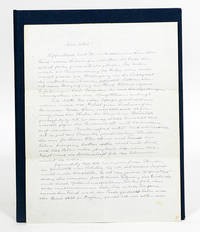
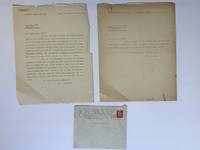
1953ref. 2270Princeton NJ: np 1953. First edition. custom folder. Very Good. TOWARDS THE END OF HIS LIFE EINSTEIN WRITES TO ONE OF HIS FRIENDS FROM THE PATENT OFFICE CONCERNING ONE OF THE CENTRAL STRUGGLES OF HIS SCIENTIFIC LIFE. COMMENTING ON THE WORK OF DIRAC EINSTEIN ADMITS THAT ALTHOUGH HE "CAN'T TAKE A STATISTICAL FOUNDATION OF PHYSICS SERIOUSLY" HE FINDS IT "DIFFICULT TO MOVE BEYOND IT". Background: Einstein's struggle with accepting a strictly statistical quantum theory has been one of the most discussed and debated topics of twentieth-century physics. When introduced to the statistically-based quantum mechanics of Heisenberg Born and Jordan in 1926 Einstein famously wrote to Max Born that "Quantum mechanics is certainly imposing. But an inner voice tells me that it is not yet the real thing. The theory says a lot but does not really bring us any closer to the secret of the 'old one.' I at any rare am convinced that He is not playing at dice." Einstein letter to Born from 4 December 1926. From the onset "Einstein regarded the quantum theory as descriptively incomplete. What he meant was that in typical cases the probabilistic assertions provided by the theory for an individual quantum system do not exhaust all the relevant and true physical assertions about the system. Put briefly according to Einstein the typical statistical story told by quantum theory is not the whole story." Arthur Fine "What is Einstein's Statistical Interpretation or Is It Einstein for Whom Bell's Theorem Tolls". Einstein's discomfort with the new theory haunted him for the next three decades and his challenges to the theory were the cause of some of the most fertile and defining moments of modern science notably the celebrated "Bohr-Einstein debates" begun at the Fifth Solvay Conference 1927 and his monumentally influential "EPR" paper of 1935 "Can Quantum-Mechanical Description of Physical Reality Be Considered Complete" written with Boris Podolsky and Nathan Rosen. As late as 1949 in his "Reply to Criticisms" published in Albert Einstein: Philosopher-Scientist Einstein notes that Born and Wolfgang Pauli in their contributions to the volume "deprecate the fact that I reject the basic idea of contemporary statistical quantum theory insofar as I do not believe that this fundamental concept will provide a useful basis for the whole of physics" and spends the majority of the essay explaining his position and distinguishing between his acceptance of the model for "ensembles of systems" while still rejecting it for an "individual physical system". The letter: Dated September 12 1953 and written to his old colleague at the patent office in Bern Joseph Sauter the letter translated from the original German reads in full: Dear Mr. Sauter If I am able to I will gladly assist Mr. Keberle. I have heard of you often from my old friend Besso and I have also received a manuscript which deals critically with handwritten Dirac's presentation of the statistical approach to quantum theory. I have not been able to judge it myself because it is simply impossible for me to take a statistical foundation of physics seriously. But I have to admit that it is difficult to move beyond it. Yours sincerely signed A. Einstein. Albert Einstein. The recipient Joseph Sauter worked with Einstein at the Bern Patent office during the years he was developing the ideas for his revolutionary papers of 1905. "Among his colleagues at the Patent Office Einstein discovered one with similar scientific interests-Dr. Josef Sauter a French-Swiss who had also studied at the Polytechnic and who had been Professor Weber's chief assistant for a while. Sauter like Einstein tried to fill the gaps in the Polytechnic's syllabus by private study so that Einstein was able to discuss with him Maxwell's thermodynamics and Helmholtz's and Hertz's theoretical concepts. The two also discussed Einstein's publications on thermodynamics with the result that Sauter discovered a mistake in them which Einstein accepted 'without being the least upset.' Fifty years later Einstein recalled 'that I had a lot of discussions with Sauter about. my thermal-statistical papers'. At least as important as his help with the 'rewriting and amending' were Sauter's connections with scientific circles in Bern to which he soon introduced his new colleague." Albrecht Fölsing Albert Einstein. Edouard Keberle mentioned in the first line by Einstein was a Bulgarian physicist who at the time of the letter had just left the Institute of Theoretical Physics in Bern over a publication dispute. Not long after this letter - in early 1954 - Keberle accepted a post at the Midwest Research Institute in Kansas City. It is unclear if Einstein helped him in any way to get this position. Michele Besso - also mentioned in this letter - was Einstein's close lifelong friend. What prompts Einstein to declare that "it is simply impossible for me to take a statistical foundation of physics seriously" is the mention of a manuscript on the work of Paul Dirac. Philosophically Dirac was almost the opposite of Einstein - he had no interest in probing the interpretations of quantum theory wryly noting in his paper "The Inadequacies of Quantum Field Theory" that "The interpretation of quantum mechanics has been dealt with by many authors and I do not want to discuss it here. I want to deal with more fundamental things." It is revealing in this letter that although Einstein re-states his objection to a statistical basis of quantum theory he has doubts about his position admitting - less than two years before his death - that he still has difficulty moving beyond it. Typed Letter Signed. Princeton NJ: September 12 1953. One 8.5x11 inch sheet with Einstein's embossed Mercer Street address at top. Custom silk presentation folder. With original mailing envelope with postmarks. A few small smudges usual folds; fine condition. ONE OF EINSTEIN'S FINAL STATEMENTS ON ONE OF THE CENTRAL TENETS OF HIS SCIENTIFIC PHILOSOPHY. np unknown
1914ref. 2124Berlin: Königlichen Akademie der Wissenschaften 1914. FIRST EDITION OFFPRINT. Original wrappers. Fine. FIRST EDITION COMMERCIAL OFFPRINT ISSUE of Einstein's important 1914 paper on the development of general relativity. "In summer 1914 Einstein felt that the new theory general relativity should be presented in a comprehensive review. He also felt that a mathematical derivation of the field equations that would determine them uniquely was still missing. "Both tasks are addressed in a long paper presented in October 1914 to the Prussian Academy for publication in its Sitzungsberichte. It is entitled 'The formal foundation of the general theory of relativity'; here for the first time Einstein gave the new theory of relativity the epithet 'general' in lieu of the more cautious 'generalized' that he had used for the Entwurf" Landmark Writings in Western Mathematics 1640-1940. "According to John Norton 'How Einstein Found His Field Equations' this major review article was intended to convey the full content of the 1913 'Entwurf' theory: 'The principal novelty lies in the mathematical formulation of the theory. Drawing on earlier work with Marcel Grossman Einstein formulated his gravitational field equations using a variation principle. Using this richer mathematical structure Einstein offered a proof purporting to demonstrate that his theory had the maximum covariance compatible with the hole argument; that is covariance under 'justified' transformation between the 'adapted coordinate systems' he had introduced with Grossman'" Calaprice The Einstein Almanac. Offprint from: Sitzungsberichte der Königlich Preussischen Akademie der Wissenschaften XLI 19 November 1914 pp. 1030-1085. Berlin: Königlichen Akademie der Wissenschaften 1914. Octavo original wrappers; custom box. Neat early ownership name on front wrapper. Only the slightest wear; a fine copy. Rare. Königlichen Akademie der Wissenschaften unknown
1937ref. 1984Princeton: np 1937. First Edition. Very Good. AN EXTRAORDINARY LETTER BY EINSTEIN TO HIS SON OFFERING LIFE ADVICE AND DISCUSSING FREUD SHAKESPEARE AND SCHILLER. Addressed to his son Eduard "Tetel" Einstein and signed "Papa" the letter written in ink on both sides of one sheet reads in full translated from the original German: Dear Tetel I hope by now you've received Freud's lectures from Vienna. I've read most of them myself in the past. They really made me admire the Author but they didn't convince me that his theories were correct. I must admit however that based on my personal experiences my conviction about those theories is weakening -- I feel now that he was onto something at least in regards to the main theses. I would have written to you sooner but work is keeping me very busy. Even though they say that the work of a single person will not have much of an impact in the big picture it does not diminish the passion in which we pursue our interests and that is a good thing. Although personal illusions may bring warmth and joy into one's life when young they don't last a lifetime. Life would be bleak if the work and the passion for discovery did not exist. In my free time I am currently reading Schiller's poems which I have neglected since my youth. They feel a bit pompous but at the same time they are enthralling in their choice of words and grammar. I am really happy that I picked them up again. I would have liked to send you another book on the top of the Freud but didn't know which one to send -- especially because I don't get a lot of German writings anymore. When I have some extra free time after finishing Schiller I really want to start reading Shakespeare everything from him I can get my hands on. If you like to read it too perhaps we could discuss it at some later time Albert is a real delight -- he has been traveling up and down the country for the past 6 weeks and will have seen and experienced many interesting things. I really hope he has followed my advice and kept a journal but I am not holding high hopes. When it comes to talking and writing he seems to be chronically constipated. With my warmest regards Papa Einstein's life advice underscoring one of his core beliefs: Einstein often stated that his main goal in life was the quest for truth no matter how difficult and painstaking the quest. He advises Eduard in this letter that it is the pursuit and the work in attaining the goal that brings satisfaction and sustains one throughout life even if "the work of a single person will not have much of an impact in the big picture". This he notes is critical to understand after the illusions of youth have succumbed to reality. Einstein Eduard and Freud: Eduard Einstein nicknamed "Tete" or "Tetel" born in 1910 was the second son of Albert and his first wife Mileva. From an early age he became enamored with the teachings of Freud even hanging a picture of famous psychiatrist on his bedroom wall. By the age of twenty he was diagnosed with schizophrenia and consequently was institutionalized several times throughout his life. Einstein's views of Freud's teachings were somewhat more nuanced than those of his son. Initially Einstein did not show much interest in Freud's theories and after their first meeting in 1927 Freud famously remarked "He understands as much about psychology as I do about physics." Over the years however Einstein began studying Freud's works. After corresponding with Freud somewhat regularly throughout the 1930s and even collaborating with him on a project sponsored by the League of Nations "Why War" 1932 Einstein began to move from a deep skepticism to - as indicated in this letter - a growing acceptance. By 1936 - just before this letter was written - Einstein sent birthday greetings to Freud acknowledging: "Until recently I could only apprehend the speculative power of your train of thought together with its enormous influence on the Weltanschauung of the present era without being in a position to form a definite opinion about the amount of truth it contains. Not long ago however I had the opportunity of hearing about a few instances not very important in themselves which in my judgment exclude any other interpretation than that provided by the theory of repression. I was delighted to come across them since it is always delightful when a great and beautiful conception proves to be consonant with reality." In this letter to Eduard Einstein admits to Eduard that he now believes Freud "was onto something at least in regards to the main theses." Einstein Shakespeare Schiller: Einstein's fondness for music is well-known but not as much has been recorded about his literary tastes. It is not surprising and has been previously documented that Einstein had a fondness for the great German poet Schiller but we can find no other references to Shakespeare by Einstein in any other letters or manuscripts. His words to Eduard "I really want to start reading Shakespeare everything from him I can get my hands on" imply that Einstein has recently "discovered" Shakespeare and is excited at the discovery. Note: Although the letter is not dated we can assume that it was written late November - December in 1937 when Einstein's son Albert was visiting the United States a trip he refers to in the letter. Princeton: November - December 1937. One 8.5x11 inch leaf written on both sides. In German. Usual folds otherwise fine. A LONG REMARKABLE AND REVEALING LETTER UNITING THE INTELLECTUAL GIANTS EINSTEIN FREUD AND SHAKESPEARE AND SHARING ONE OF HIS CORE BELIEFS WITH HIS SON. np unknown
1932ref. 1864np: np 1932. First edition. nb. UNPUBLISHED CANDID PHOTOGRAPHS OF EINSTEIN AND LETTERS BY WILLIAM HUBBARD OFFERING AN INTIMATE VIEW OF THE SCIENTIST ON VACATION. On March 2 1932 at the height of his career and world fame Albert Einstein and his wife Elsa set off on a vacation to their German homeland departing from Los Angeles on the M. S. San Francisco. Another passenger aboard the ship was the renowned music scholar William Lines Hubbard. Famous in his own right Hubbard was the music critic for the Chicago Tribune and author of a definitive 11-volume work on the history of opera published 1908. Accompanying Hubbard was his companion Julia Reid their cabins adjacent to that of the Einstein's. As was the practice during this era Hubbard kept detailed journals and letters of his travel experiences. This collection from the estate of Hubbard contains the following items: 1. Three unpublished small black-and-white and sepia photographs. The first photograph 4.5" x 2.5" pictures Einstein his wife Elsa the Ship's Captain Hubbard the tall figure and three other of the ship's passengers dated 3/14/32. The second photograph 3.5" x 3.25" is an outstanding full front image of Einstein his wife Elsa and the ship's Captain. The final photograph 4.5" x 2.5" is a full frontal image of Einstein and his wife Elsa both seated in deck chairs with the ship's Captain standing behind. 2. Typed letter dated March 22 1932 written while sailing through the South Atlantic. Six pages typed front and back on two pieces folded of the ship's original stationary approx. 7.5x11 in. Excerpts on Einstein include: Of our Six Passengers two are Prof. Einstein and wife. They are proving very delightful companions-- sincere unaffected and jolly. At first they were very reserved and merely bowed and smiled and "Guten-Morgan-ed" when entering and leaving the dining room but when they had become rested and saw that none of the rest of us planned to intrude they came forward and have been very genial. She is a great talker but talks interestingly. He walks deck smoking his stubby black pipe or whistling cheerily his gray hair blowing in the breeze. Each forenoon and sometimes in the afternoon he goes to the piano and plays for half hour or so. Plays in that satisfying manner peculiar to a man to whom music is a comfort and who thinks musically. It is in no wise brilliant playing but it is throughly enjoyable to hear. The rest of the time he sits in his steamer chair or in his cabin reading or thinking. On the 14th he had his 53rd birthday and the Capt had ordered from La Libertad Salvador where we had taken cargo the day before large bunches of easter and tiger lilies which in the morning were on the Einstein table together with a birthday cake the ship's cook had made and countless cards and letters which friends had sent. It was all a complete surprise to them both and their happiness was childlike in its spontaneity and sincerity. It was heart warming to watch them. They seem to appreciate being left to themselves and not being lionized. It is the third time they have come through the canal on these boards an they enjoy it to the full. 3. Typed letter dated April 1 1932 written while entering the English Channel. Seven pages on two approx. 8.5x11in sheets folded of the ship's original stationary. Excerpts on Einstein include: We had good fun watching for crocodiles along the banks as we came up the cut and Prof Einstein was especially gleeful when he discovered one. Professor Einstein loves the roung sic weather and has reveled in it. He and the Mme are proving very delightful fellow passengers. She is very chatty but chats interestingly and he struts up and down deck smoking his stubby pipe or whistling like a jolly kid his white hair blowing in the breeze. We have some talks occasionally and he yesterday when he saw the copy of Living Philosophies which I had given me sic before I left San Diego and in which his article is the first took the book and autographed his picture and wrote in remembrance of the happy days on board the San Francisco. I don't think I told you of his birthday which occurred on the 14 of March the day before we reached the Canal. The Capt came to know if it and when the Einsteins came to their table at breakfast they found it decorated with three huge vases of Easter and Tiger lilies which the Capt had secured in La Libertad. The cook had made a gorgeously decorated Torte-- one of the filled and frosted German cakes-- and there were letters and telegrams from friends which had been sent in the Capt's care. It was a complete surprise to the Einsteins and they were like two happy kiddies. It was gladdening to watch their simple and keen enjoyment. Later we had pieces of the Torte which were a bit of muchness for breakfast but which of course we ate. 4. Typed letter dated April 24 1932 written in Merano Italy. Six pages on five 5.5x7in sheets. While recalling a cargo transfer on the M. S. San Fransisco Hubbard writes: The Einsteins were especially enthusiastic and we had a great fun over the boss of the unloading. He was a huge and tremendously rotund gent wearing a soft felt hat and a short overcoat the buttons of which seemed fated to "bust off" at any moment. His chief employment seemed to be running about from side to side of the dock into the warehouse and out again clambering onboard and then clambering off and all the time shouting orders at the top of his voice and gesticulating wildly. Einstein had been reading the "Living Philosophies" which I had loaned him and was especially curious concerning Mencken and how he happened to be included in the great ones in the book. I gave him an outline of Mr. M's greatness and assured him that the book cold sic well largely on account of M being included. All of which amused the Einsteins greatly. So when this wild boss hove into sight that morning and began his excited directing Mrs E said "there is Mister Mencken" and thus he remained so long as we were in Rotterdam. The Einsteins were starting early the next morning for Berlin so they went about 9 pm to the custom house and had their 16 packages bundles and gifts examined. Frau Professor had a funny story to tell of their experience with the 150 pound bag of coffee that had been presented them in Salvador. 5. An official passenger list from the M. S. San Francisco printed on the ship's original stationary 4.75" x 8.25" dated March 2 1932. With "Professor Albert Einstein" and "Mrs. Albert Einstein" shown under the list of cabin passengers going from Los Angeles to Bremen. 6. A postcard depicting Hubbard's profile in black and white 3.45" x 5.45". All items in very good condition letters with wear and soiling at folds and housed in a custom cloth presentation folder. RARE FIRST-HAND TESTIMONY REVEALING THE PERSONALITY OF EINSTEIN IN RELAXED AND INFORMAL MOMENTS. np unknown
1934ref. 1478Princeton: np 1934. 1st Edition. No Binding. Very Good. AN IMPORTANT SIGNED LETTER in English by Einstein revealing his reservations of associating with communism even in the fight against fascism. Written from Princeton NJ to Professor Albert Sprague Coolidge of Harvard University and dated February 16 1934 the letter reads: My dear Professor Coolidge: I had an opportunity of meeting personally Lord Marley and has sic very favorably impressed by his personality. It became known to me that he sympathizes with the Russian Government i.g. with the Russian communist party and that the committee for which he is active is influenced by communists. The problem as to the attitude which is advisable to be taken towards this committee is rather complicated. On the one hand the world-wide danger of fascism makes it necessary that all enemies of fascism cooperate; on the other hand an action which has communist leanings might endanger that fight since the important task undertaken in defense of culture and civilization may be linked up with interests of a political party. I myself have severed my connections with the committee which with my permission had used my name up to the end of last year. It seems to me advisable to take an attitude as follows: to help their action against fascism but not to identify oneself with the committee. Very truly yours signed A. Einstein P.S. I wish you would be good enough to use this strictly confidentially. In 1934 Lord Baron Marley Dudley Leigh Aman toured the United States to raise funds for his association the World Committee for the Victims of German Fascism. Marley through his committee was "passionately advocating a scheme for which he was to become an international figurehead - resettlement of oppressed German and Polish Jews in the Jewish Autonomous Region" in Siberia. He published a book "The Brown Book of the Hitler Terror and the Burning of the Reichstag sponsored by the World Committee and with an Introduction written by Lord Marley himself which was the first popular exposé of what was happening in Hitler's Germany. It documented the destruction of political parties trade unions and universities book-burning and the building of concentration camps. "At a fundraising dinner held in his honour in New York in February 1934 where Einstein presumably met him just before writing this letter Marley opened the Brown Book and 'speaking quietly declaring that he did not intend to harrow' read aloud to his audience of 600 American Jews some of the collected evidence of Nazi repressions. Here were documentary records of what was happening in Germany - a substantiation of the brutality that hitherto had had no distinct form in the mind of the American Jewish public. What before had been the subject of a growing fear mingled with disbelief was now being presented as hard fact and supported with detailed evidence. The New York Times 8 February 2005 reports the audience being 'startled' by the disclosures and the night ending with $3500 raised for the World Committee" The Jewish Quarterly No. 198. Einstein was correct to be suspicious of Marley's activities for it was later determined that the "World Committee" was indeed a Communist front; Einstein writing here to Coolidge in 1934 was prescient about the motives of the committee. This letter in addition to underscoring Einstein's passionate stance against fascism is particularly important as documentary evidence of Einstein's caution about having any dealings with communism especially considering that the U.S. FBI worried about Einstein's political leanings kept a file on Einstein that grew to 1427 pages. Princeton NJ: February 16 1934. One 8.5 x 11 in. page. Envelope folds minor spotting. An outstanding letter with important and revealing content. np unknown
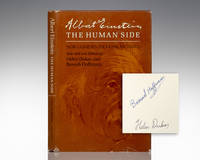
1979ref. 148235New Jersey: Princeton University Press 1979. First edition early printing of this curated collection of Einstein’s writings. Octavo original leather frontispiece. Boldly signed by Helen Dukas and Banesh Hoffman on the front free endpaper. Helen Dukas 1896–1982 was Albert Einstein’s longtime secretary and trusted confidante serving in that role from 1928 until his death in 1955. Deeply involved in preserving and organizing Einstein’s legacy she co-edited several collections of his writings and letters and played a key role in curating the Einstein Archives at the Institute for Advanced Study in Princeton. Banesh Hoffmann 1906–1986 was a physicist and mathematician who collaborated with Albert Einstein and made significant contributions to relativity and quantum mechanics. Near fine in a near fine price-clipped dust jacket. Uncommon signed by both contributors. Albert Einstein: The Human Side 1979 edited by Helen Dukas and Banesh Hoffmann offers a unique perspective on Einstein beyond his scientific achievements by compiling his personal letters reflections and anecdotes. Unlike traditional biographies that focus on his contributions to physics this collection highlights Einstein’s thoughts on philosophy politics ethics and personal relationships revealing his wit humility and deep moral convictions. Through carefully selected writings the book presents Einstein as both a brilliant scientist and a deeply introspective individual who grappled with the social and ethical implications of his work. Princeton University Press hardcover
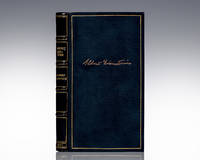
1931ref. 150006New York: The MacMillan Company 1931. First edition of this volume of Einstein's speeches and letters concerning his views on Zionism. Octavo bound in full morocco by the Harcourt Bindery with gilt titles and tooling to the spine in five compartments within raised gilt bands gilt ruling to the front and rear panel gilt signature to the front panel gilt inner dentelles stamp-signed by the Harcourt Bindery marbled endpapers all edges gilt. In fine condition. Translated and edited with an introduction by Leon Simon. An exceptional presentation. Einstein was a prominent supporter of both Labor Zionism and efforts to encourage Jewish-Arab cooperation. He supported the creation of a Jewish national homeland in the British mandate of Palestine but was opposed to the idea of a Jewish state "with borders an army and a measure of temporal power." In a letter to Jawaharlal Nehru dated June 13 1947 he asserted "Long before the emergence of Hitler I made the cause of Zionism mine because through it I saw a means of correcting a flagrant wrong.The Jewish people alone has for centuries been in the anomalous position of being victimized and hounded as a people though bereft of all the rights and protections which even the smallest people normally has.Zionism offered the means of ending this discrimination." Einstein's speeches lectures and letters concerning Zionism were first published in 1930 by The Soncino Press and eleven of these essays were later collected in The World as I See It published in 1933 which Einstein dedicated "to the Jews of Germany". The MacMillan Company unknown
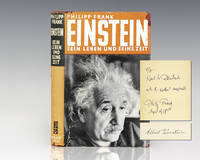
1949ref. 133215Munchen: Paul List Verlag 1949. First German edition of this classic work by Frank a famed contemporary of Einstein. Octavo original cloth. Signed by Albert Einstein on the slip to the title page and inscribed by the author on the front free endpaper "To Karl W. Deutsch with the author's compliments Philipp Frank August 10 1950." Philipp Frank was a physicist mathematician and also a philosopher during the first half of the 20th century. He was a logical-positivist and a member of the Vienna Circle. He was influenced by Mach and was one of the Machists criticised by Lenin in Materialism and Empirio-criticism. He studied physics at the University of Vienna and graduated in 1907 with a thesis in theoretical physics under the supervision of Ludwig Boltzmann. Albert Einstein recommended him as his successor for a professorship at the German Charles-Ferdinand University of Prague a position which he held from 1912 until 1938. Very good in a good dust jacket. Much has been written about Albert Einstein technical and biographical but very little remains as valuable as this unique hybrid of a book written by Einstein's colleague and contemporary. Both rich in personal insights and grounded in a deep knowledge of twentieth-century science Phillip Frank's biography anchors the reader with a lucid overview of physics and draws an intimate portrait of the Nobel Prize–winner. Paul List Verlag hardcover
ref. 1543108717.Gpaperback. Good. Access codes and supplements are not guaranteed with used items. May be an ex-library book. paperback
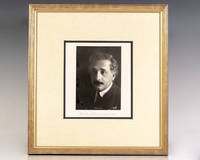
1923ref. 1413011923. Extremely rare original photograph boldly signed "Albert Einstein Jerusalem 1923" during his only trip to Palestine in 1923. Einstein's return voyage from his tour of Japan and China took him via the Red Sea and Suez Canal which allowed him to accept the invitation of Arthur Ruppin the director of the Palestine office of the Zionist Organization in Jaffa to visit the region for twelve days. Einstein arrived in Port Said on February 1 1923 and from there he traveled to Jerusalem Tel Aviv Jaffa and Haifa. The photographer Zvi Oron began his career in Warsaw and the United States before opening a studio in Tel Aviv in 1919. In 1930 he moved to Jerusalem and opened a studio of Jaffa Street working in the service of press clients and the British Government. He was well regarded for his candid images that captured daily life in the British Mandate. The Zionist archive holds over 1300 of his negatives. Double matted and framed the entire piece measures 19.75 inches by 15.5 inches. An exceptional piece. This is the only signed photograph known from his time in Palestine. Albert Einstein developed the general theory of relativity one of the two pillars of modern physics alongside quantum mechanics. Einstein's work is also known for its influence on the philosophy of science. Einstein is best known in popular culture for his mass–energy equivalence formula E = mc2 which has been dubbed "the world's most famous equation". He received the 1921 Nobel Prize in Physics for his "services to theoretical physics" in particular his discovery of the law of the photoelectric effect a pivotal step in the evolution of quantum theory David Bodanis. unknown
1952ref. 720911952. Rare original black and white silver gelatin photograph of Albert Einstein. Signed "A Einstein 52." Full-length group portrait showing Albert Einstein standing with Hadassah National President Rebecca Beldner Shulman and others at his Princeton home in June of 1952 during a celebration marking the commencement of building of the Hadassah-Hebrew University Medical Center in Jerusalem. The photograph measures 8 inches by 9.5 inches. Double matted and framed. The entire piece measures 19 inches by 20.5 inches. An exceptional piece. Albert Einstein developed the general theory of relativity one of the two pillars of modern physics alongside quantum mechanics. Einstein's work is also known for its influence on the philosophy of science. Einstein is best known in popular culture for his mass–energy equivalence formula E = mc2 which has been dubbed "the world's most famous equation". He received the 1921 Nobel Prize in Physics for his "services to theoretical physics" in particular his discovery of the law of the photoelectric effect a pivotal step in the evolution of quantum theory David Bodanis. unknown
2018ref. __069117881XPrinceton Univ Pr 2018. Hardcover. New. bilingual edition. 1075 pages. 10.50x8.00x2.00 inches. Princeton Univ Pr hardcover
1995ref. __0691037051Princeton Univ Pr 1995. Hardcover. New. 420 pages. 10.50x8.00x2.00 inches. Princeton Univ Pr hardcover
2015ref. __069116410XPrinceton Univ Pr 2015. Hardcover. New. documentary edition. 1208 pages. 10.75x8.50x2.75 inches. Princeton Univ Pr hardcover
2012ref. __0691156735Princeton Univ Pr 2012. Hardcover. New. 1st edition. 904 pages. 10.00x7.75x2.75 inches. Princeton Univ Pr hardcover
ref. 0691033226.Ghardcover. Good. Access codes and supplements are not guaranteed with used items. May be an ex-library book. hardcover
ref. 0415255384.Ghardcover. Good. Access codes and supplements are not guaranteed with used items. May be an ex-library book. hardcover
ref. 3540877762.Gpaperback. Good. Access codes and supplements are not guaranteed with used items. May be an ex-library book. paperback
2021ref. __0691216827Princeton Univ Pr 2021. Paperback. New. 544 pages. 10.00x7.48x1.10 inches. Princeton Univ Pr paperback
ref. 0691026106.Gpaperback. Good. Access codes and supplements are not guaranteed with used items. May be an ex-library book. paperback
ref. 0078824028.Gpaperback. Good. Access codes and supplements are not guaranteed with used items. May be an ex-library book. paperback
ref. 1025605748.Ghardcover. Good. Access codes and supplements are not guaranteed with used items. May be an ex-library book. hardcover
1931ref. 1403337Potsdam Germany 1931. Two letters by Albert Einstein. The first is a single-paged autograph letter signed by Albert Einstein with one horizontal fold and one vertical fold. In Very Good condition . Measuring 22.5 x 28.5 cm. Letter accompanied with mailing envelope both with matching paper-clip rust stain. Letter with some light wear along edges small staining to lower corner. Addressed to G. W. Meyer and dated 8 Oktober 31 in Potsdam the Letter reads in full: "Sehr geehrter Herr! Indem ich Ihnen für die Uebersendung des Buches von Henry George bestens danke sende ich Ihnen anliegend die gewünschte Meinungsäusserung mit der Bitte um Weiterleitung an Mrs. Evans. Mit ausgezeichneter Hochachtung" and signed in ink "A. Einstein". He thanks Meyer for serving as an intermediary in getting a book to him and for forwarding the enclosed letter. The second letter is a typed copy of Einstein's previously enclosed letter presumably made by Meyer before he passed the original on to Evans. Addressed to R. W. Evans and dated 8.10.1931 in Potsdam the letter discusses Henry George's economic theory of poverty and land nationalization compares it to Franz Oppenheimer's work and proposes questions to be asked. Presumably he was sent a copy of Henry George's Progress and Poverty. First published in 1879 it sparked the Progressive Era discussing the paradox of increasing inequality and poverty amid economic and technological progress as well as the economic value of land. Consignment. Shelved Case 3. The Letter reads in full: "Sehr geehrte Mrs. Evans! Ich habe das Buch von Henry George zum grössten Teil mit ausserordentlichem Interesse gelesen und glaube dass es in der Hauptsache einen unanfechtbaren Standpunkt vertritt insbesondere was die Ursache der Armut betrifft. Nie in diesem Buch vertretenen Ansichten stimmen soweit ich es beurteilen kann vollkommen mit den Resultaten des zeitgenössischen Professors Franz Oppenheimer überein der sie offenbar selbständig herausgefunden hat. Nicht einverstanden bin ich mit der Theorie des Zinses. Mit dem vorgeschlagenen Heilmittel der Verstaatlichung des Bodens und der Bodenschätzung scheint mir allerdings mehr ein Problem als eine Lösung gegeben zu sein. Soll z. Beispiel ein Boden Eigentum der Gemeinschaft das darauf hingestellte Haus aber Privateigentum sein Jedenfalls ist es schon von höchster Wichtigkeit dass das Wesen des Uebels klar aufgezeigt ist. Schon darum wäre es wichtig wenn das Buch die ihm gebührende Beachtung fände. Mit ausgezeichneter Hochachtung gez. A. Einstein." 1403337. Shelved Dupont Bookstore. unknown
1932ref. 3054Caputh Germany: np 1932. First edition. Very Good. AN IMPORTANT SCIENTIFIC LETTER FROM EINSTEIN TO HIS CLOSEST MATHEMATICAL COLLABORATOR ACCOMPANIED BY A MANUSCRIPT LEAF OF CALCULATIONS IN EINSTEIN'S HAND ON THE SAME LINE OF RESEARCH. Although the original association of the letter and the leaf of calculations cannot be confirmed the two pieces clearly emerge from the same scientific context and have been preserved together. A superb pair from the final months of Einstein's German period. The Letter: In this intense and intellectually urgent letter Einstein writes to Walther Mayer his indispensable mathematical collaborator often referred to as "Einstein's Calculator" describing a newly conceived approach to the technical obstacles in their unified-field theory involving semi-vectors spinors and modified Dirac-type equations. Einstein tells Mayer he believes he "sees a new possibility" one that determines key constants in the system without resorting to the semi-vector construction. He then sketches the structure of the revised scheme points to the condition under which the full set of field equations reduces to a single one and warns that if this same collapse occurs in the general case "the whole thing would be useless." With his imminent departure from Germany he urges Mayer to examine the issue quickly and gives instructions for where a reply will reach him while en route. Dirac and De Broglie - Significance of the Scientific References: Of particular importance is Einstein's explicit engagement in this letter with the work of Paul Dirac and Louis de Broglie two of the central figures in early quantum theory. Einstein refers directly to the Dirac equations introduced only a few years earlier which provided a relativistic formulation of the electron and played a foundational role in quantum mechanics. He also invokes the De Broglie equations for matter waves reflecting his continued effort to reconcile quantum ideas with relativistic field theory. These references place the letter squarely at the intersection of Einstein's unified-field program and the emerging quantum framework he famously regarded with both fascination and skepticism. The letter thus documents Einstein actively testing whether concepts originating in quantum mechanics-Dirac's relativistic wave equation and De Broglie's wave-particle duality-could be absorbed into a geometrically unified classical field theory. Letters in which Einstein explicitly grapples with Dirac and De Broglie at this technical level are rare and represent an important record of his engagement with the central theoretical developments of the early twentieth century. Historical Context: Einstein's collaboration with Walther Mayer beginning around 1930 produced some of the most technically sophisticated papers of Einstein's later career. Together they developed new mathematical structures-semi-vectors spinors and higher-dimensional tangent-space formulations-used in their unified-field attempts. This letter dates from December 1932 only weeks before Einstein left Germany permanently and belongs to the final phase of their joint work published in the Sitzungsberichte of the Prussian Academy. Einstein valued Mayer so highly that he later persuaded the Institute for Advanced Study to create a permanent position for him the only such appointment ever granted for one of Einstein's collaborators. The Manuscript Calculations: Accompanying the letter is a two-page manuscript leaf containing Einstein's working calculations: trial expressions constraint conditions and variant formulations of the same type of semi-vector and spinor problems addressed in the letter. While we cannot confirm that these pages were originally enclosed with the letter they concern the same scientific material and have been preserved alongside it. Einstein manuscript leaves of this depth and technical significance-especially when tied to a known collaborative problem-are scarce. Significance: Whether or not originally sent together the letter and the calculations form a powerful and coherent scientific pair offering a rare view of Einstein actively working through equations testing ideas and relying on Mayer to verify mathematical structure. They capture Einstein at a critical inflection point in both his scientific life and personal circumstances as he prepared to leave Germany forever. --------- The letter from Einstein to Mayer reads in full translated from the original German: Dear Mr. Mayer! I believe I see a new possibility which promises success. It is along the lines of the recently devised way according to which one places zero on the right side of the Dirac-Equations. The novelty is in the fact that the constants a1 . a4 aside from a totally irrelevant factor are completely known without passing on to the specific Semi-Vectors. After omission of the _-terms the equations read Ee st ys = s 1 xe Or for De-Broglie-Equations of the restless particle E4 st ys = s 1a x4 Here is what's new: How does one choose the ay so that the De Broglie - Choices stay largely undetermined Result: The four equations 1a reduce themselves into a single one when and only when if one lets a1 = 1 a2 = 1 a3 = 1 a4 = 1 I believe that with this selection ay is for the equation describing the _-terms 1 the fitting substitute for the DeBroglie-Equation. These equations are already supplied by the simplest Hamilton function. See if the general equations 1 degenerate with this placing for a as well. If this were the case the whole thing would be useless. I leave on Saturday. A letter that is sent to Antwerp to the `Oakland' Hapag Antwerp harbor will reach me until December 13. Cordial greetings from your A. E. Autograph Letter Signed Written in German. One page 8.5 x 11 in.; 216 x 279 mm. probably Caputh near Potsdam Germany the location of Einstein's country home Sunday 4 December 1932. Scattered spotting affecting four words; usual folds. WITH: Two-page leaf of mathematical calculations. Housed together in decorated half-leather box by noted book artist Sjoerd Hofstra. np unknown
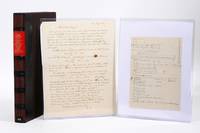
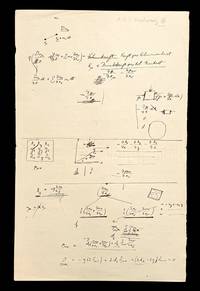
1912ref. 3056np: np 1912. first edition. custom box. Very Good. ON THE ROAD TO RELATIVITY: A four-panel working bifolium from Einstein's early post-Minkowski tensor phase. A remarkable working sheet showing Einstein making tensor formalism physically operational for continuum mechanics. Across three working zones the manuscript moves from a formal four-dimensional tensor transformation identity written in a distinct unidentified hand to Einstein's own derivations involving Volumenkraft Druckkraft stress force density diagrammatic testing and a heavily underlined mechanical equilibrium result. The folded rotated format gives the sheet the character of a compact notebook in miniature: formal tensor language brought into contact with physical terms local force relations diagrams and repeated calculation. The manuscript's all-lower-index notation explicit summations in Einstein's hand mixed coordinate idiom second-hand tensor identity and visible effort to make tensor language mechanically operational point most naturally to the 1912-1913 Zurich tensor period when Einstein was absorbing the post-Minkowski mathematics that General Relativity would require. Later revisitations cannot be entirely excluded but they explain the sheet less naturally. A rare survival documenting Einstein's working method on one of the foundational matter-side problems on the road to General Relativity. EINSTEIN ALBERT. Autograph scientific manuscript unsigned and undated most plausibly 1912-1913. A four-panel working bifolium 330 × 210 mm open from Einstein's early post-Minkowski tensor period retained among his private research papers and annotated by Helen Dukas: "A.E.'s Handwriting H.D." Provenance: Sotheby's New York 26 June 1998; Jagdish Mehra. PLEASE CLICK ON THE LINK BENEATH THE IMAGES FOR A PDF CONTAINING THE FULL DESCRIPTION. np unknown