2534 risultati
1910rif. 38842Leipzig J.A. Barth 1910. Contemp. hcalf. Spine gilt a fs scratches to spine. VIII1584 pp. and 6 plates. Einstein papers: pp. 1096: pp. 1105-1115; pp. 1275-1298. Fine and clean. The whole volume offered. All three papers first edition. The purpose of "A theorem in probability and its application in the Theory of radiation" is to demonstrate that the failure of statistical mechanics with respect to the radiation law Rayleigh - Jeans law contradicted by experience cannot be removed by the conjecture that perhaps the individual statistical events should not follow the usual law of independence product of probabilities instead of assuming a certain interdependence between them. Lanczos. The second paper "Statistical investigation on of the motion of an oscillator in a radiation field" makes use of the results of the previous investigation. Einstein's aim is to demonstrate that the Rayleigh-jeans law of radiation contracdicted by the physical facts is an unavoidable consequence of statistics even if we avoid any kind of assumption which may be suspected of needing correction. Lanczos. The third paper "Theory of the opalescence of homogenous fluids and fluid mixtures near the critical state" is an importent investigation and one of the most difficult of all his papers to understand. The aim of the paper is to complement the work of Smoluchovski Ann. d. Physik25 1908 who gave a general explanation of the strong density fluctuations - and the opalescence thus generated - of two fluids near the critical state of mixture or a single fluid near the critical state of condensation on the basis of the kinetic theory of heat. he did notgive howeverthe quantitative details concerning the scattered light associated with this phenomenon. Lanczos. - Weil Nos 34 35 and 36 with an asterix denoting major work. unknown
1907rif. 41347Leipzig Barth 1907. 8vo. Extract from "Annalen der Physik IV23" pp.197-198. First edition in the periodical form. - Weil No. 17. unknown
1923rif. 49811Berlin Vieweg u. Sohn 1923. 8vo. Bound in contemporary full cloth. In "Zeitschrift für Physik. Hrsg. von Karl Scheel. 16. Band" entire volume offered. Embossed stamp to title page. P. 228. Entire volume: IV 2 409 pp. First printing of Einstein commentary to Friedman's seminal papers in which he "introduced into cosmology two concepts of revolutionary importance the age og the world and the creation of the world"Kragh Cosmology and Controversy. Also contained in the volume are:BOTHE W.: Eichmethoden für Emanationselektrometer Über eine neue Sekundärstrahlung der Röntgenstrahlen. - First appearance of Bothe's early paper on the Compton effect which together with his later paper in Bd 32 Zeitschrift für Physik awarded him the Nobel Prize in Physics "for the coincidence method and his discoveries made therewith".PAULI JR. W. : Über die Gesetzmässigkeiten des anomalen Zeemaneffektes. LANDÉ A.: Zur Theorie der Röntgenspektren.HEISENBERG W. M. BORN.: Die Elektronenbahnen im angeregten Heliumatom.Weil 122 hardcover
1912rif. 38839Leipzig J.A. Barth 1912. Bound in two contemp. hcalf richly gilt spine and one later full cloth. A library stamp on the first volume. "Annalen der Physik. Vierte Folge. Band 37 und 38. Hrsg. von W. Wien und M. Planck." VIII1048;VIII1064 pp. 58 plates. Einstein papers: pp. 832-38 vol.37 pp. 881-84 Nachtrag vol. 38; pp. 443-458 vol. 38; p. 888 vol. 38; pp. 1059-1064 vol. 38; Planck: pp. 642-656. Internally fine and clean. Both volumes offered. All papers first edition. In the first paper "Thermodynamical derivation of the photochemical equivalence" Einstein calls "the law of photochemical equivalence" the statement that the decomposition of one gram equivalent of any substance by a photochemical proces demands the radiation energy of 'Nhv' where N=the Avogadro number. In this paper he demonstrates how this law is deducible by purely thermodynamical arguments if certain olausible assumotions are made. Lanzos. - The second paper "Concerning the theory of a static gravitational field" states that the 'equivalence hypothesis' permits us to come to very definite conclusions about the behaviour of a static gravitational field. - The next Einstein paper gives an answer to J. Stark as Stark claimed priority to the photochemical equivalence law. - In the last paper "Relativity and Gravitation. Reply to a remark of M. Abraham" Einstein elaborates his answer to the critique of M. Abraham. - Weil Nos 46 1-2 a. 48. - Planck Akademie No 95. hardcover
1923rif. 49498Berlin Julius Springer 1923. 8vo. Bound in contemporary full cloth with gilt lettering to spine. Entire volume 19 "Zeitschrift für Physik" Library stamp to title-page and paper label pasted on to lower part of spine. Minor wear to extremities. A nice and clean copy. Pp. 301-6. Entire volume: IV 426 pp. First edition.Weil 138; Schilpp-Shields 178.The volume also contains:Meitner Lise. Ueber eine mögliche Deutung des kontinuierlichen beta-Strahlenspektrums. Pp. 307-321. hardcover
1903rif. 38800Leipzig Johann Ambrosius Barth 1903. Contemp. hcloth. Some small nicks to spine. = "Annalen der Physik. Vierte Folge. Band 11. Herausgegeben von Paul Drude.". VIII1144pp. and 6 plates. The Einstein paper: pp. 170-187. Internally fine and clean. First edition of Einsteins fourth paper. In his paper from 1902 Einstein "says in his introduction that nobody has yet succeeded in deriving the conditions of thermal equilibrium and of the second law of thermodynamics from probability considerations although Maxwell and Boltzmann came near to it. Willard Gibbs is not mentioned. In fact Einstein's paper was written in ignorance of Gibbs paper published 1901. In the present paper Einstein builds the theory on another basis not used by Gibbs namely on the consideration of a single system in course of time later called "Zeit-Gesamtheit" time assembly and proves that this is equivalent to a certain virtual assembly of many systems Gibb's micro-canonical assembly.Einstein at once proceeded to apply his theorems to a case of utmost importance namely to systems of a size suited for demonstrating the reality of molecules and the correctness of the kinetic theory of matter."Walter Alicke. - Weil No. 4. hardcover
1929rif. 28364Berlin Gruyter & Co. 1929. 4to. Orig. printed orange wrappers. Offprint/Sonderausgabe aus Sitzungsberichten.pp. 1-6. Fine fresh copy. First edition in the rare Offprint now called "Sonderausgabe" instead of "Sonderabdruck" having separate printed title and separate pagination. See Weil: 166 where this is not mentioned.The early Offprints from "Sitzungsberichten." are called "Sonderabdruck" up to Weil No.165 including this. From Weil 166 they are called "Sonderausgabe.". - Before 161 up to 160 the Offprints do not have separate title and pagination the pagination follows the numbering in the periodical. From 166 the Offprint has both separate printed title and pagination. - So Weil Nos 161-165 is still "Abdruck" but with separate title and pagination. These facts are not mentioned in the bibliographies.Weil No. 166. unknown
1902rif. 49500Berlin J.A. Barth 1902. 8vo. Bound in contemporary half cloth with paper label pasted on to spine. In "Annalen der Physik. Vierte Folge. Band 8. Hrsg. von Paul Drude.". Entire volume offered. Front board loose and stamp to pasted down front free end paper. Otherwise a fine copy. First edition of Einstein's second publication. Here "Einstein was looking for experimental support for a hypothesis concerning molecular forces"Pais Subtle is the Lord P. 56 Weil No 2. hardcover
1907rif. 50595Leibzig Johann Ambrosius Barth 1907. 8vo. In contemporary full cloth with gilt lettering to spine. In "Annalen der Physik" Vierte Folge Band 23. Entire volume offered. Ex-libris pasted on to top right corner of pasted down front free end-paper. Light rubbing to extremities a very fine and clean copy not an ex-library copy. Pp.371-384. Entire volume: VIII 1000 pp. 4 plates. First edition of the first explicit statement of Einstein's landmark energy-mass equation E=mc2.Nearly all descriptions of Einstein's scientific work state that the mass-energy equivalence E=mc2 was first formulated in Einstein's 1907 review paper 'Über das Relativitätsprinzip und die aus demselben gezogenen.' published in 'Jahrbuch der Radioaktivität und Elektronik' see Weil no. 21 and Dictionary of Scientific Biography vol. 4 pp.323 for examples. However in his paper 'Über die von Relativitätsprincip geforderte Trägheit der Energie' the offered paper which predates the former mentioned by six months Einstein gave a clear statement of the mass-energy equivalence E=mc2. See Lanczos: The Einstein Decade pp.149-150 and 153 as well as Volume 2 of 'The Collected Papers of Albert Einstein' pp. 428.Einstein's first paper regarding the relation E=mc2 is his fourth 1905 paper 'Ist die Trägheit eines Körpers von seinem Energieinhalt abhängig'. In this short paper Einstein showed that a body releasing the energy E in the form of radiation will have its mass decreased by E/c2 and concluded that the mass of a body is a measure of its energy content e.g. that all energy has mass. The next time Einstein returns to the subject is in his 1906 paper 'Das Prinzip von der Erhaltung der Schwerpunkts Bewegung und die Trägheit der Energie.'. Here Einstein concluded that one must either ascribe the inertial mass E/c2 to any form of energy E or else give up the fundamental law mechanics regarding conservation of the motion of the center of gravity. Then finally in the 1907 paper 'Über die von Relativitätsprincip geforderte Trägheit der Energie.' the offered paper Einstein makes the decisive step of assuming that all mass has energy. On page 382 Einstein considers the total energy of a moving mass point as the sum of its kinetic energy and its rest energy. In classical mechanics it is most convenient to set the second term to zero but in relativistic mechanics one obtains the simplest expression by setting the rest energy equal to mc2. Einstein then continues to show that this stipulation cannot lead to a contradiction in any relativistic argument. In a footnote on page 382 Einstein states for the first time the equation E=mc2 and mentions that this equation is the expression of the principle of the equivalence of mass and energy - see Volume 2 of 'The Collected Papers of Albert Einstein' pp. 428.The volume contains another paper by Einstein "Bemerkungen zu der Notiz von Hrn. Paul Ehrenfest: "Die Translation deformierbarer Elektronen und der Flächensatz"" pp.206-208. - Weil No. 18.Collected Works Doc. 45. Weil 19. Boni 19. hardcover
1906rif. 38833Leipzig J. A. Barth 1906. Contemp. hcloth. Light wear to edges. A small tear at upper part of fronthinge. "Annalen der Physik. Vierte Folge. Band 21. Hrsg. von W.Wien und M. Planck". VIII1056 pp.and 9 plates. Einstein paper: pp. 583-86. Internally clean and fine. The whole volume offered. First edition. Einsten describes in this paper "Method for the determination of the ratio of the transversal to the longitudinal mass of the electron" an apparatus which would make it possible to determine with great accuracy the law according to which the mass of the electron changes with the velocity. - Weil No 14. hardcover
1920rif. 29310Berlin Julius Springer 1920. Uncut in orig. printed wrappers. 15 pp. First edition. - Weil No. 111. unknown
1920rif. 9913Leipzig Berlin 1920. Orig. boards. Back discoloure. 4146 pp. -The corrected third edition of these importent contributions to the theory of relativity. hardcover
1927rif. 22776Berlin 1927. Orig. printed orange wrappers. Back strengthend with matching paper. Fresh copy. Offprint/Sonderabdr. aus "Sitzungsberichte". pp. 23-30. First edition. Weil No. 156. unknown
1938rif. 46475Princeton NJ. Annals of Mathematics 1938 a. 1940. Both papers in orig. printed wrappers. Offprints from "Annals of Mathematics" Vol. 39 No. 1 january 1938 and Vol. 41 No. 2 April 1940. Pp. 65-100 and pp. 455-464. Both clean and fine. This copy has belonged to Abraham Pais 1918-2000 - the famous Einstein scholar theoretical physicist and Einsteins collegue at Princeton - and having his name on top of both frontwrappers "A Pais". First editions in the scarce offprint versions of Einstein's last and highly important contributions to General relativity and in which is shown that the equation of motion follows directly from the field equation that defined the geometry."Einstein's last importent contribution to general relativity deals again with the problem of motion. It is the work done with Leopold Infeld and Banash Hoffmann on the N-body problem of motion. In these papers the gravitational field is no longer treated as external. Instead it and the motion of its singular sources are treated simultaneously. Anew approximationscheme is introduced in which the fields are no longer necessarily weak but in which the source velocities are small compared with the light velocity . The equations obtained have found use in situations where Newtonian interaction must be included. 'These equations are widely used in analyses of planetary orbits in the solarsystem. For example the Cal Tech Jet Propulsion Laboratory uses them in modified form to calculate ephmerides for high-precision tracking of planets and spacecraft."Pais "Subtle is the Lord" p. 290-91."The problem of the equation of motion of bodies is the following. The 1916 theory had a classical structure in the sense that there were both field equations the curvature of space-time is determined by the mass and motion of bodies in space-time and equations of motion of bodies the world line of small mass is a geodesic. Are these two statements really separate If the field equations were linear they indeed would be. They are not linear however and Einstein showed in the papers offered that if matter is represented by a point singularity of the metric field these singularities are located on world lines that are geodesics of space-time provided its metric satisfies the equation of general relativity."DSB.Weil: 202 a. 295 both with an asterix denoting a major paper. - Boni: 236 a. 236.1. unknown
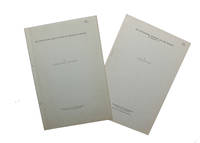
1902rif. 49829Berlin J.A. Barth 1902. Contemp. hcalf. Gilt spine. Some scratches along edges. Stamp on halftitle and title-page. "Annalen der Physik. Vierte Folge. Band 8. Hrsg. von Paul Drude." VIII928 pp. and 7 plates. Einstein paper: pp. 798-814. Internally fine and clean. The entire volume offered. First editon. - Weil No 2. unknown
1907rif. 29338Leipzig Barth 1907. 8vo. Extract from "Annalen der Physik IV23" pp.197-198. Some slight browning to leaves. First edition. Weil No. 17. unknown
1927rif. 28360Berlin Gruyter & Co. 1927. 4to. Orig. printed orange wrappers. Offprint/Sonderabdruck aus Sitzungsberichten.pp.23-30. Fine fresh copy. First edition of rare Offprint still called "Abdruck". - Weil No. 156.The early Offprints from "Sitzungsberichten." are called "Sonderabdruck" up to Weil No.165 including this. From Weil 166 they are called "Sonderausgabe.". - Before 161 up to 160 the Offprints do not have separate title and pagination the pagination follows the numbering in the periodical. From 166 the Offprint has both separate printed title and pagination. - So Weil Nos 161-165 is still "Abdruck" but with separate title and pagination. These facts are not mentioned in the bibliographies. unknown
1914rif. 48163Braunschweig Vieweg & Sohn 1914. No wrappers. "Verhandlungen der Deutschen Physikalischen Gesellschaft im Jahre 1914. Hrsg. von Karl Scheel." 16. Jahrgang Nr. 16. Pp. 765- 834. Entire issue offered. With the general titlepage to 16. Jahrg. Titlepage stamped at foot. Einstein paper pp. 820-828. First edition. In this paper "Contributions to quantum theory" two considerations are given which are interrelated by a common goal inasmuch as it is attempted to derive two of the most importent achievementss of quantum theory viz. Planck's radiation law and Nernst's third law of thermodynamics in a new manner. The proofs do not involve Boltzmann's equation and are thus based enterely on macroscopic thermodynamics. They do introduce however the quantum hupothesis. Einstein points out that the alleged 'proofs' which try to derive the theorem of Nernst from the mere fact that the heat capacity of all substances goes to zero at absolute zero temterature are not genuine. Cornelius Lanczos.Weil No 67. unknown
1932rif. 22769Berlin 1932. Orig. printed orange wrappers. Back strengthend with matching paper. Fresh copy. Offprint/Sonderabdr. aus "Sitzungsberichten". pp. 1-32. First edition. Weil No. 186. unknown
1923rif. 22766Berlin 1923. Orig. printed orange wrappers. Back strengthend with matching paper. Fresh copy. Offprint/Sonerabdr. aus "Sitzungsberichte". pp. 369-364. First edition. Weil No. 137. unknown
1906rif. 38794Leipzig Johann Ambrosius Barth 1906. Bound together in one contemp. hcloth. Small tears to spine ends. = "Annalen der Physik. Vierte Folge. Band 20. Herausgegeben von Paul Drude." Portrait Paul Drude VIII1048 pp. and 6 plates. Einstein papers: pp. 199-206 and 627-33. Internally fine and clean. The whole volume offered. Both papers first edition. It was for the papers "Ueber einen die Erzeugung und Verwandlung des Lichtes betreffenden heuristischen Gesichtspunkt" of 1905 and "Zur Theorie der Lichterzeugung. Theory of light emission and absorption the offered item that Einstein was awarded the Nobel Prize in 1921."The quantum theory has affected virtually every branch of physics. Its earliest and one of its most significant developments was Einstein's application of the theory to what is known as the 'photo-electrical effect'.Einstein explained this effext by suggesting that the classical view that light is emitted in the form of continous waves must be abandoned. The photo-electrical effect could be explained only as an example of quantum action where the waves of light or X-rays are emitted in minute particles or bullets. It is he size of the bullet the wave-lenght of the radiation which determines the number of electrons ejected. It was for this and not for the theory of relativity that Einstein was awarded the Nobel Prize in 1921. Einstein's two fundamental papers on this subject are "Ueber einem Erzeugung." 1905 and Zur Theorie der Lichterzeugung the paper offered here" PMM the note to 391. In the second paper Principle of the conservation of the centre of mass motion and the inertia of energy he shows that the conservation of mass is a special application of his energy principle E= Mc2 - Weil: 12 & 13.Among the many papers in this volume we have Max von Laue: Zur Thermodynamik der Inteferenzerscheinungen. pp. 365-378. hardcover
1906rif. 46956Leipzig Johann Ambrosius Barth 1906. No wrappers. Extracted from "Annalen der Physik" Vierte Folge. Bd. 20. Pp. 199-206. Clean and fine. First printing of one of the papers for which Einstein was awarded the Nobel Prize in 1921. It was for the papers "Ueber einen die Erzeugung und Verwandlung des Lichtes betreffenden heuristischen Gesichtspunkt" of 1905 and "Zur Theorie der Lichterzeugung. Theory of light emission and absorption the offered item that Einstein received the prize: "for his services to theoretical physics and especially for his discoveryof the law of the photoelectrical effect" - his reward was not based on relativity."The quantum theory has affected virtually every branch of physics. Its earliest and one of its most significant developments was Einstein's application of the theory to what is known as the 'photo-electrical effect'.Einstein explained this effext by suggesting that the classical view that light is emitted in the form of continous waves must be abandoned. The photo-electrical effect could be explained only as an example of quantum action where the waves of light or X-rays are emitted in minute particles or bullets. It is he size of the bullet the wave-lenght of the radiation which determines the number of electrons ejected. It was for this and not for the theory of relativity that Einstein was awarded the Nobel Prize in 1921. Einstein's two fundamental papers on this subject are "Ueber einem Erzeugung." 1905 and Zur Theorie der Lichterzeugung the paper offered here" PMM the note to 391.Weil: 12 with an asterix denoting a major paper - Boni:12. unknown
1930rif. 38646Berlin Akademie der Wissenschaften 1930. 4to. Orig. printed green wrapper. No VI 1930 of Sitzungsberichte der Preussische Akademie der Wissenschaften. Wrappers with very small nicks atspine. Small part of one corner gone. pp. 110-120. A small stamp at foot of frontwrapper. First edition in the periodical form. - Weil No. 170 unknown
1918rif. 40496Leipzig Johann Ambrosius Barth 1918. Without wrappers as extracted from "Annalen der Physik" Vierte Folge Bd. 55 Heft 4. The whole number present pp. 241-336. Einsteins paper pp. 241-244. First printing the periodical form. Einstein believed around 1918 "in the relativity of inertia that in 1918 in the paper offered he stated as being on equal footing three principles on which a satisfactory theory of gravitation should rest: 1. The principle of relativity as expressed by general covarianc. 2. The principle of equivalence. 3. Mach's principle the first time this term entered the literature: 'Das G-Feld ist 'restlos' durch die Massen der Körper bestimmt.' that is the g. are completely determined by the mass of bodies more generally bu T."Pais The Science of Albert Einstein p.287. - Weil:96. - Boni: 100. unknown
1912rif. 49779Leipzig Barth1912. 8vo. No wrappers. In: "Annalen der Physik IV Bd. 38" No 7. Pp.249-472 a. 3 plates. Entire issue offered. Einstein's papers: pp. 355-369 and pp. 443-458. Clean and fine. Both papers in first edition and they are considered as the first appearance of a Nonlinear Field Equation for Gravitation. "Einstein published two remarkable memoirs in 1912 which were efforts to construct a complete theory of gravitation incorporating the equivalence principle. In these memoirs Einstein supposed that the gravitational field can be characterized completely by one function the local speed of light analogous to the Newtonian description where only the gravitational potential appears. By an extraordinary argument he extended the potential equation of Newton.In his second Memoir in 1912 he used the equivalence principle to show the influence of a static gravitational field on electromagnetic and thermal processes." DSB IV p.320 ff. - Weil No. 47 and 48. unknown