EINSTEIN, AlfredBiblio.com

2.986 resultados
ref. 109875Stockholm Aldus / Bonnier 1964. 8:o. 332 4 s. Mörkblått halvmarokängband blekt guldornerad rygg med upphöjda bind och med omslaget medbundet ryggen har blekts till grönt. Ur Lars Berglöfs bibliotek med hans initialer i guld på ryggen. Fint exemplar av en bok som annars sällan överhuvudtaget är inbunden! Det tyska originalet ”Mozart - sein Character sein Werk” utkom 1945 och denna svenska översättning av Kajsa Rootzén utkom första gången 1956. unknown
2013ref. DADAX0415854717Routledge 2013-07-02. 1. paperback. New. 5.08x0.44x7.80. Buy with confidence. Excellent Customer Service & Return policy. Routledge paperback
ref. B9780195007329Paperback / softback. New. paperback
ref. B9781258115357Paperback / softback. New. paperback
ref. 1568219830.Gpaperback. Good. Access codes and supplements are not guaranteed with used items. May be an ex-library book. paperback
1931ref. SKU1139774Simon and Schuster 1931. Hardcover. Good. New York 1931; black boards with gold cover titles and spine titles; mild corner and edge wear; some discoloration at edges; orange dust jacket with black cover titles and spine titles; light chipping at jacket edges; parts of jacket edges taped over; 8vo - over 7 3/4" to 9 3/4" tall; "ex libris" sticker on front pastedown; rest of interior is clean and unmarked. 333 pages. Simon and Schuster hardcover
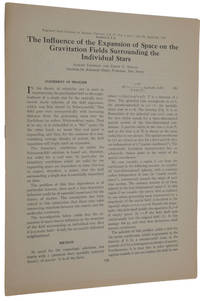
1945ref. 5054Lancaster PA: American Physical Society 1945. First edition. First edition extremely rare offprints of Einstein & Straus's introduction of the 'Swiss-cheese' model of the universe. "By the spring of 1945 Einstein and Straus had found a new type of possible universe using Einstein's equations . This was a step towards a more realistic universe in which the matter was not smoothly spread with the same density everywhere but gathered up into lumps like galaxies which were spread about in empty space" Barrow The Book of Universes pp. 106-107. . EINSTEIN'S 'SWISS-CHEESE' MODEL OF THE UNIVERSE - OFFPRINT ISSUE. First edition extremely rare offprints of Einstein & Straus's introduction of the 'Swiss-cheese' model of the universe. "After a decade and a half of sometimes intense work on cosmology Einstein returned to the subject only occasionally in his later years. His most significant later contribution was a discussion of the impact of cosmological expansion on the gravitational field surrounding a star i.e. the offered papers . This was an important first step in understanding the impact of global cosmological expansion on local physics" Janssen & Lehner pp. 257-8. In the 1920s and 1930s a general relativistic model of the universe was developed called the Friedmann-Lemaître-Robertson-Walker FLRW model which correctly described the expansion of the universe discovered by Edwin Hubble. But the FLRW model was 'homogeneous' - it described a universe which looks the same wherever the observer is located. The actual universe however is manifestly inhomogeneous - it contains stars galaxies and clusters of galaxies. Einstein and Straus's papers represent the first serious attempt to model an inhomogeneous universe. "By the spring of 1945 Einstein and Straus had found a new type of possible universe using Einstein's equations. It described a universe which looked largely like one of the simple expanding universes of Friedmann and Lemaître containing material like galaxies which exerted no pressure. But it had spherical regions removed from it like bubbles in a Swiss cheese. Each empty hole then had a mass placed at its centre. The mass was equal in magnitude to what had been excavated to create the hole. This was a step towards a more realistic universe in which the matter was not smoothly spread with the same density everywhere but gathered up into lumps like galaxies which were spread about in empty space" Barrow pp. 106-107. Not on OCLC; no copies in auction records. In 1916 just a few months after Einstein had formulated his general theory of relativity Karl Schwarzschild had found a solution of Einstein's equations which described the gravitational field in the vicinity of a spherical distribution of mass such as a star or to anticipate later developments a black hole. This was in fact the first exact solution of Einstein's equations to be found - Einstein had earlier calculated an approximate solution which was enough to show that his theory correctly accounted for the advance of Mercury's perihelion. However at great distances from the star Schwarzschild's solution approaches the flat Minkowski spacetime with zero curvature and not the FLRW solution that represented an expanding universe. It seemed therefore that Schwarzschild's solution could not correctly describe the gravitational field of a star in an expanding FLRW universe. If the expansion of the universe meant that Schwarzschild's solution had to be modified this could make it possible to detect and measure the expansion of the universe by making local observations rather than by observing the motion of distant galaxies as Hubble had done. The problem of describing the gravitational field of a star in an expanding FLRW universe was addressed by Einstein and Straus in the offered papers. "In the early 1930s theorists began to develop a richer account of the evolution of the universe based on expanding models. Hubble's results qualitatively agreed with the redshift effect calculated in these models but the utility of the simple dynamical models depends on whether the universe is approximately uniform. The status of this assumption was the focus of lively debate . Relativistic cosmologists regarded the idealized uniformity of the FLRW models as a simplifying assumption . The unrelenting uniformity built into the FLRW models conflicts with the clear non-uniformity of the stars star clusters and galaxies of the local universe but the models might still serve as a useful approximation if the non-uniformities are negligible at larger scales" Janssen & Lehner p. 256. "By 1944 Einstein had recruited a new assistant at Princeton. His assistants were always talented young mathematicians who could make up for Einstein's self-confessed weakness in this area. Ernst Straus 1922-1983 was something of a mathematical prodigy . He was born in Munich but after the Nazis came to power in 1933 his family fled to Palestine where he was educated at high school and at the Hebrew University in Jerusalem. Straus didn't stay to take an undergraduate degree and instead while still a teenager moved to New York's Columbia University in 1941 to begin graduate research. In 1944 he found himself recruited as Einstein's new research assistant at the Institute for Advanced Study in Princeton. The young Straus had no background in physics and his mathematical inclinations were towards number theory and 'pure' mathematical topics but he lost no time in filling the gap left by the departures of Nathan Rosen 1935-45 and Leopold Infeld 1936-38" Barrow pp. 105-6. Einstein and Straus found an exact solution of the equations of general relativity in which a spherical 'hole' is cut out of an FLRW universe and the hole is replaced by a single mass point e.g. a star surrounded by a spherical cavity. The initially homogeneous matter within the cavity can be thought of as having been "condensed into the star". Einstein and Straus found that the interior of the cavity is described by the standard Schwarzschild solution. The radius of the hole is such that at its spherical boundary the outward pull from the cosmological masses is just balanced by the inward pull from the star. The cavity boundary expands according to the Hubble expansion of the whole universe. The universe outside the cavity is described by the standard expanding homogeneous FLRW solution. The possibility of exactly matching the Schwarzschild solution near the star to the FLRW solution outside it showed that it was not in fact possible to detect the expansion of the universe by making observations close to the star. There were similar solutions with more than one hole - Einstein said that this reminded him of the holes in Swiss cheese. The static vacuum region inside the cavity is now called an 'Einstein-Straus vacuole'. The methods introduced by Einstein and Straus in these papers have been used extensively to model inhomogeneities in the universe. For example in 1968 Martin Rees and Dennis Sciama investigated the effects of large-scale inhomogeneities such as superclusters of galaxies on the cosmic microwave background the so-called 'Rees-Sciama effect'. The Swiss-cheese model has also been used in the study of inflationary models of the early universe. According to this theory the universe expanded exponentially in the first tiny fraction of a second after the big bang with some parts of space-time expanding more quickly than others. This created 'bubbles' in space-time. The Swiss-cheese "embodies a natural way to model physical problems such as describing the boundary between a galaxy and intergalactic space or the relation between bubbles at the end of an inflationary era by taking two different regions where the behaviour is smooth and joining them at a surface of discontinuity" Ellis et al. p. 426. In the last decade several authors have suggested that Swiss-cheese models might solve a long-standing problem on the rate of expansion of the universe. Distant supernovas have been observed to be dimmer than expected on the basis of standard cosmological theories indicating that the universe is expanding faster than these theories predict. This has been explained by hypothesizing the existence of 'dark energy' although exactly what dark energy might be is a mystery. But if the light from distant supernovas had to cross large vacuoles in reaching an observer on the earth these would act like concave lenses making the supernovas appear dimmer and further away than they really are. Other authors have noted that the Milky Way is near the centre of a region that has fewer galaxies than other parts of the universe and that we might be living near the centre of a particularly large vacuole perhaps more than a billion light years in diameter see for example Bonnor. Weil 216. Barrow The Book of Universes 2011. Bonnor 'A generalisation of the Einstein-Straus vacuole' Classical and Quantum Gravity 17 2000 pp. 2739-2748. Ellis Maartens & MacCallum Relativistic Cosmology 2012. Janssen & Lehner eds. The Cambridge Companion to Einstein 2014. Together two offprints 4to 267 x 200 mm pp. 120-124 & 148-149. Stapled as issued in original self-wrappers. American Physical Society unknown
1920ref. B6223Toronto; London: the Ryerson Press.; Methuen & Co. Edition. 1920. A near fine example text and illustrations clean and crisp. . Edition: First Canadian Edition. after the first London. Binding: Contemporary full red cloth title on flat spine debossed stamped title on the upper board lacks the dust jacket. Notes: Albert Einstein 1879 – 1955 was a German-born theoretical physicist who developed the theory of relativity one of the two pillars of modern physics alongside quantum mechanics. His work is also known for its influence on the philosophy of science. He is best known to the general public for his mass–energy equivalence formula which has been dubbed "the world's most famous equation". He received the 1921 Nobel Prize in Physics "for his services to theoretical physics and especially for his discovery of the law of the photoelectric effect" a pivotal step in the development of quantum theory. Size: Octavo 8vo. Illustration: Illustrated with five diagrams and numerous in text mathematical equations. A foundation work in physics and astronomy. Category: Book Canada; Book Science & Technology; the Ryerson Press.; Methuen & Co. Edition. hardcover
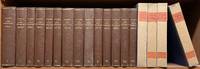
ref. 84067Leipzig Breitkopf und Härtel 1918-35. 8vo. Later brown cloth up to 1932 1932-35 sewn as issued in boxes. 14 volumes and four boxes. With library stamps from Musikmuseet in Stockholm. All published. Alfred Einstein was editor up to 1933 when he had to leave Nazi Germany. Editor for the two last years was Max Schneider. hardcover
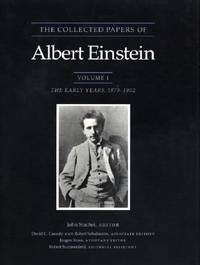
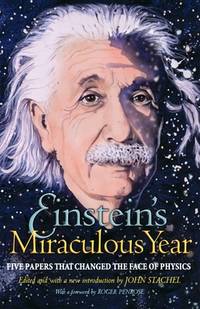
1987ref. 50442Princeton University Press 1987. First Edition . Cloth. Fine/Near Very Fine. 4to - over 9¾" - 12" tall. Edited by John Stachal. Very large very heavy sturdy book quality blue cloth very bright gilt lettering on spine 433 pages illustrations throughout including drawings and formulas. DJ glossy beneath mylar black background photo of young Einstein in white frame at center front. DJ has light crease along bottom back. Near Very Fine DJ/Very Fine book. Princeton University Press hardcover
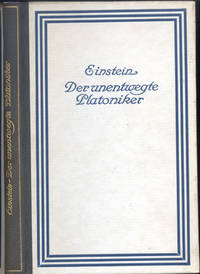
ref. 0336-02Lpz. Wolff 1918. 177 2 S. OHLdr. mit Kopfgoldschnitt u. Rückengoldpräg. EA. W.- G.² 6; Raabe/Hannich-B. 65.4 - In nur 850 Expl. gedruckt. - Enthält die drei Erzählungen: Der unentwegte Platoniker; G.F.R.G. Gesellschaft für religiöse Gründungen; Die Mädchen auf dem Dorfe. Lpz., Wolff [1918]. unknown
1970ref. P-24781New York: Horizon Press 1970. Hardcover. Fine/First Edition. Octavo. The first book publication of these conversations and interviews with the legendary physicist as translated by Henry L. Brose. Single 1970 date on copyright page and $8.50 flap price bound in the original grey cloth with Einstein's name debossed on the front cover. A clean unmarked copy quite fine and uncommon thus. Archival Mylar jacket cover included. Horizon Press hardcover
1950ref. P-27103Princeton: Princeon University Press 1950. Hardcover. Fine/3rd Edition. Duodecimo. The revised third edition including The Generalized Theory Of Gravitation.' 12mo 165 pp 2 leaves index. Original cloth. Book is fine in very good unclipped dust jacket with light spine tanning and a small 1/$" V chip to the lower spine. Attractive and solid in the archival Mylar jacket cover. Princeon University Press hardcover
1979ref. P-18052Princeton NJ: Princeton University Press 1979. Hardcover. As New/First Edition. Octavo. With the reeata slip laid in. First publication of these letters by Einstein. A clean unmarked and unclipped copy. Princeton University Press hardcover
ref. 600810New York: Oxford University Press 1962. First Paperback Edition; Fifteenth Printing. Softcover. Very Good in wraps. Rubbing on panel edges. Toning on text block edges.; 492 pages. Oxford University Press unknown
1921ref. 35419London: Methuen 1921. Fourth edition. Cloth bound in very good condition; Spine somewhat faded. Translation by Robert W. Lawson; Frontis portrait of the author and five diagrams; xiii 138 8 publisher's catalogue; Bookplate of Hugh Ripman. Methuen unknown
1998ref. 1-0691059381Princeton Univ Dept of Art & 1998. Hardcover. New. illustrated edition. 198 pages. 8.75x6.00x0.75 inches. Princeton Univ Dept of Art & hardcover
2019ref. 1-0764357271Schiffer Pub Ltd 2019. Hardcover. New. 272 pages. 11.25x8.75x1.25 inches. Schiffer Pub Ltd hardcover
1950ref. 046941New York: Philosophical Library 1950. 1st Edition 1st Printing. Hardcover. Near Fine/Very Good. Frontispiece. 282 Pp. Green Cloth Lettered In Gilt On Front CoverAlso Lettered In Gilt In Spine Stamped On Two Blocks Of Dark Blue Background. Dust Jacket Priced $4.75 With Only 15 Titles On Rear Panel Two First Published In 1950 The Others First Published By Philosophical Library 1942 To 1949. Frontispiece Portrait Of Einstein By Lotte Jacobi. There Are Many Issues With Identical Pagination In Cloth Or Boards Of Various Colors All With Later Post-1950 Publications Indicated On The Rear Panel In Both The Plainer Dust Jacket As On This Copy And In A More Elaborate Jacket; We Believe This Is The First Issue Only By A Process Of Elimination Not Having Seen Many Different Bindings And Dust Jackets. Book With Light Wear Gilt Brilliant No Marks. Dust Jacket With Wear Small Losses/Chips At Corners Not Price Clipped Slight Browning To Spine Panel. Philosophical Library hardcover
ref. 697874291Springer . Papeback. New. pp. 400 Springer unknown
ref. 44564555-nnew. unknown
1938ref. mon0000583392Cambridge University Press 1938T. hardcover. Acceptable. 2.7919 in x 19.5431 in x 12.9442 in. NOT an ex-library book. Well read with some wear but still very useable. Cambridge University Press hardcover
ref. 53500568-nnew. unknown
ref. 54551210-nnew. unknown