A EinsteinBiblio.com

1911 resultados
ref. ria9783112590577_inpHardcover. New. New Book; Fast Shipping from UK; Not signed; Not First Edition; N/A hardcover
1946ref. COD-05253Cassell and Company Ltd 1946. hardcover. Good. Good condition with light wear. Cassell and Company Ltd hardcover
2000ref. mon0003697463Princeton University Press 7/26/2009 12:00:01 A. paperback. Good. 0.7000 9.9000 7.4000. Princeton University Press paperback
ref. 344930Methuen & Co Ltd 36 Essex Street W.C. London 1920. FIRST EDITION octavo red buckram boards black lettering to spine blind lettering to front board frontispiece xiii 138pp 8pp to rear G moderate fading to spine moderate scuffing & fraying to spine extrems & board corners moderate to heavy soiling to boards light to moderate tanning & foxing to page edges heavy loss to front pastedown with 2x ownership ink markings also prev. owner's name in pencil & newspaper clipping & moderate tanning to ffep v heavy crack to front gutter- board shaky multiple library ink stamps to rear pastedown- no others detected elsewhere in book moderate cracking to rear gutter light tanning to rear eps occasional moderate to heavy cracking to gutters & pencil markings to margins & spots of soiling throughout Methuen & Co Ltd, 36 Essex Street W.C., London 1920 hardcover
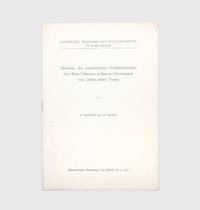
1934ref. 180324Princeton: Princeton University Press 1934. First edition offprint issue of the fourth and final paper on Einstein and Mayer's semi-vectors in which they aimed to incorporate the Dirac equation into the general theory of relativity. This last article "was presented foremost as an exercise with exclusively mathematical appeal" Van Dongen p. 106. Large octavo pp. 7. Disbound from wrappers wire-stitched. Nicks and a handful of short closed tears to extremities: a very good copy. Boni 225; Weil 193. Jeroen van Dongen Einstein's Unification 2010. unknown
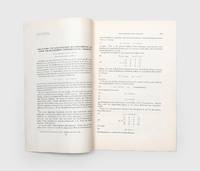
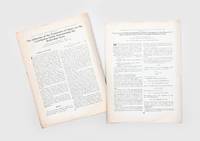
1933ref. 180322Amsterdam: Koninklijke Akademie van Wetenschappen 1933. First edition offprint issue of the second of Einstein and Mayer's four classic papers on semi-vectors in which they aimed to incorporate the Dirac equation into the general theory of relativity. "By introducing semi-vectors Einstein wanted to arrive at a mathematically simpler and more general formulation of spinors. The semi-vector generalization of the Dirac equation was thought to give a unified description of charged elementary particles in particular of the electron and proton. In their second semi-vector paper Einstein and Mayer were on the lookout for the most general Dirac system possible for the semivector" Van Dongen pp. 103-11. Large octavo pp. 20. Original cream wrappers front wrapper printed in black. Wire-stitching sometime removed front wrappers lightly soiled: a very good copy. Boni 222; Weil 191. Jeroen van Dongen Einstein's Unification 2010. unknown
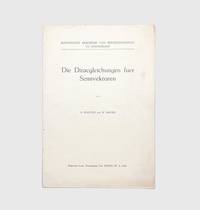
1933ref. 180318Amsterdam: Koninklijke Akademie van Wetenschappen 1933. First edition offprint issue of the third of Einstein and Mayer's four classic papers on semi-vectors in which they aimed to incorporate the Dirac equation into the general theory of relativity. "By introducing semi-vectors Einstein wanted to arrive at a mathematically simpler and more general formulation of spinors. The semi-vector generalization of the Dirac equation was thought to give a unified description of charged elementary particles in particular of the electron and proton" Van Dongen pp. 103-5. Large octavo pp. 4. Original cream wrappers front wrapper printed in black wire-stitched as issued. Extremities gently creased short closed tears at spine ends occasional light foxing: a very good copy. Boni 223; Weil 192. Jeroen van Dongen Einstein's Unification 2010. unknown
1945ref. 180350Lancaster Pennsylvania: American Physical Society 1945 & 1946. His most significant later contribution to cosmology First editions offprint issues of the papers that introduced the Swiss-cheese model of the universe. Einstein and Straus revised the FLRW metric by suggesting that the universe is in fact inhomogeneous. "In two ground-breaking papers Einstein and Straus showed how galaxies fit into a Universe with zero pressure. This model helps to describe the universe observed today" Harwit p. 573. Quarto pp. 5. Disbound wire-stitched as issued. Nicks and creasing to extremities short closed tears to outer margins pp. 120-1 of Influence detached rear blank almost detached: in very good condition. Boni 252 & 252.1; Weil 216. Martin Harwit Astrophysical Concepts 2010. unknown
1949ref. 180348Ottowa: Canadian Mathematical Society 1949. Their final collaboration First edition offprint issue. Einstein and Infeld demonstrate that "field equations alone suffice as a basis for solving the problem of motion in general relativistic theory since the Einstein equations not only determine how particles must respond to gravitational forces but also contain the information necessary to describe those forces" Calaprice p. 323. Octavo pp. 34. Original orange wrappers wire-stitched as issued front cover lettered in black. Front wrapper lightly marked: a near-fine copy. Boni 259; Weil 223. Alice Calaprice An Einstein Encyclopedia 2015. unknown
1932ref. 180272Easton Pennsylvania: Mack Printing Company 1932. Einstein revises his "biggest blunder" First edition journal issue of the paper in which Einstein rejected his 1917 cosmological constant and acknowledged the expansion of the universe. Drawing on Hubble's law Einstein and de Sitter proposed that the constant should be set equal to zero thereby offering a new model of the universe. "In 1917 Einstein had shown how to construct a universe that was static by introducing a 'cosmological constant' into his equations. This matched well with the idea current before Hubble's 1924 measurement of the distances to the nebulae of a small and static 'universe' that was confined to the stars of the Milky Way galaxy. Einstein's idea of a static universe suspended between gravity pulling inward and the cosmological constant making the universe expand was ruled out by Hubble's data" Kirshner pp. 9-12. In Einstein and de Sitter's revised model "the galaxies receded forever but the recession rate declines to zero as time approaches infinity. Some sources indicate that this is the first attempt to describe our universe rather than a mathematical abstraction of universes possible under general relativity. Shortly after Einstein formally renounced his cosmological constant and according to George Gamow called it 'the biggest blunder of my life'" Wenner. Einstein and de Sitter 1872-1934 were close collaborators in the 1920s at Leiden where de Sitter was chair of astronomy and Einstein was a visiting professor. De Sitter is also known for the concepts of De Sitter space and the De Sitter universe. Large octavo. Original brown wrappers covers printed in black. Short closed tears to spine a little loss to ends corners gently creased: a very good copy. Boni 214; Weil 184; Wenner p. 256. Robert P. Kirshner "Hubble's Diagram and Cosmic Expansion" Proceedings of the National Academy of Sciences of the United States of America vol. 101 no. 1 December 2003. unknown
1921ref. 148232New York: Harcourt Brace and Company 1921. First edition of this popular science book that made Albert Einstein’s theory of relativity accessible to general readers. Octavo original cloth frontispiece with black and white illustrations. In very good condition name to the title page. Easy Lessons in Einstein 1920 by Edwin E. Slosson is an early and influential work of science communication that seeks to explain Albert Einstein’s theory of relativity in accessible terms for a general audience. Written at a time when Einstein’s ideas were gaining international attention but remained largely misunderstood by the public Slosson's book demystifies complex scientific concepts such as space-time the constancy of the speed of light and the relativity of motion using analogies and clear language rather than technical mathematics. As a chemist and science writer Slosson played a key role in making cutting-edge scientific developments comprehensible to non-specialists. The book reflects both the growing public fascination with modern physics in the early 20th century and the importance of translating theoretical science into broader cultural understanding. Harcourt, Brace and Company hardcover
1956ref. 149754London: Methuen & Co. Ltd 1956. Sixth edition of Einstein's clear and systematic exposition of the theory of relativity with the ownership stamp on the front and rear pastedowns "Stephen Hawking Newton Institute University of Cambridge Cambridge England." Octavo original cloth. Translated By Edwin Plimpton Adams and Ernest G. Straus. Fine in a very good dust jacket. An exceptional association. In the book Einstein outlines both the special and general theories of relativity explaining their mathematical foundations and physical implications particularly regarding the nature of space time and gravitation. Designed for readers with a background in physics and mathematics the text serves as both a summary of Einstein’s groundbreaking contributions and an accessible guide to the conceptual shifts his theories introduced to modern science. The work remains a significant historical and intellectual document illustrating Einstein’s effort to communicate complex scientific ideas with clarity and precision. Methuen & Co. Ltd hardcover
1930ref. 144683New York: Albert & Charles Boni 1930. First edition early printing of this Einstein biography written by Rudolf Kayser a German literary historian and husband to Albert Einstein's stepdaughter Ilse under the pseudonym Anton Reiser. Octavo original cloth frontispiece of Einstein. In near fine condition. Albert Einstein developed the general theory of relativity one of the two pillars of modern physics alongside quantum mechanics. Einstein's work is also known for its influence on the philosophy of science. Einstein is best known in popular culture for his mass–energy equivalence formula E = mc2 which has been dubbed "the world's most famous equation". He received the 1921 Nobel Prize in Physics for his "services to theoretical physics" in particular his discovery of the law of the photoelectric effect a pivotal step in the evolution of quantum theory David Bodanis. Albert & Charles Boni hardcover
2009ref. __1113139862BCR Bibliographical Center for Research 2009. Paperback. New. 310 pages. 8.75x5.75x0.70 inches. BCR (Bibliographical Center for Research) paperback
2009ref. __1113139889BCR Bibliographical Center for Research 2009. Paperback. New. 310 pages. 10.00x7.50x0.70 inches. BCR (Bibliographical Center for Research) paperback
2019ref. x-0691655936Princeton Univ Pr 2019. Hardcover. New. 448 pages. 10.00x8.00x1.25 inches. Princeton Univ Pr hardcover
2023ref. x-1032358440CRC Press 2023. Hardcover. New. 552 pages. 10.00x7.00x1.10 inches. CRC Press hardcover
2024ref. x-1032378425Routledge 2024. Hardcover. New. 384 pages. 9.19x6.13x0.98 inches. Routledge hardcover
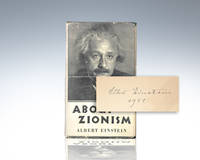
1931ref. 146050New York: The MacMillan Company 1931. First edition of this volume of Einstein's speeches and letters concerning his views on Zionism. Octavo original cloth. Boldly signed and dated in the year of publication on the front free endpaper "Albert Einstein 1931." Near fine with light toning to the endpapers in the scarce original dust jacket which is in good condition with some wear. Translated and edited with an introduction by Leon Simon. Exceptionally rare signed. Einstein was a prominent supporter of both Labor Zionism and efforts to encourage Jewish-Arab cooperation. He supported the creation of a Jewish national homeland in the British mandate of Palestine but was opposed to the idea of a Jewish state "with borders an army and a measure of temporal power." In a letter to Jawaharlal Nehru dated June 13 1947 he asserted "Long before the emergence of Hitler I made the cause of Zionism mine because through it I saw a means of correcting a flagrant wrong.The Jewish people alone has for centuries been in the anomalous position of being victimized and hounded as a people though bereft of all the rights and protections which even the smallest people normally has.Zionism offered the means of ending this discrimination." Einstein's speeches lectures and letters concerning Zionism were first published in 1930 by The Soncino Press and eleven of these essays were later collected in The World as I See It published in 1933 which Einstein dedicated "to the Jews of Germany". The MacMillan Company hardcover
2006ref. SKU0620200Penguin Classics 2006-07-25. paperback. New. 5x0x7. New Textbook Ships with Tracking Penguin Classics paperback
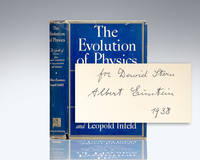
1938ref. 146188Cambridge: Cambridge University Press 1938. First edition of this classic work which traces the development of ideas in physics. Octavo original blue cloth. Presentation copy inscribed by the author in the year of publication on the second free endpaper "For David Stern Albert Einstein 1938." Fine in a near dust jacket with a few small closed tears. Trade editions signed by Einstein are scarce. Upon publication The Saturday Review of Literature praised Evolution of Physics as "masterly Einstein and Infelds book should do much to spread an understanding and appreciation one of the great dramas in the evolution of human thought." Cambridge University Press hardcover
2024ref. x-1032490195Routledge 2024. Hardcover. New. 240 pages. 9.00x6.00x9.00 inches. Routledge hardcover
2024ref. x-1032490152Routledge 2024. Paperback. New. 240 pages. 9.00x6.00x9.00 inches. Routledge paperback
2001ref. 1-3898211681ibidem-Verlag 2001. Paperback. New. 134 pages. German language. 8.11x5.67x0.39 inches. ibidem-Verlag paperback
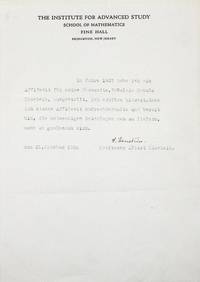
1938ref. 366717Princeton New Jersey 1938. 7 lines typed in German on letterhead of the Institute for Advanced Study School of Mathematics watermarked Chieftain Bond signed in ink. 4to 9-7/8 x 7-1/8 inches. Old folds. Fine. 7 lines typed in German on letterhead of the Institute for Advanced Study School of Mathematics watermarked Chieftain Bond signed in ink. 4to 9-7/8 x 7-1/8 inches. Im Jahre 1837 habe ich ein Affidavit für meine Verwandte Fräulein Ursula Einstein ausgestellt. Ich erkläre hiermit dass ich dieses Affidavit aufrechterhalte und bereit bin di notwendigen Unterlagen neu zi liefern wenn es gewünscht wird. den 31. Oktober 1938 signed Professor Albert Einstein. "In the year 1937 I signed an affidavit on behalf of my relative Miss Urusula Einstein. I hereby state that I continue to certify this affidavit is correct and am ready to submit the necessary documents anew if this is requested." Albert Einstein 1879-1955 German-born physicist renowned for developing the theory of relativity in papers published in 1905 and 1916 was awarded the Nobel Prize for Physics in 1921 and left Germany in 1933. He was associated with the Institute for Advanced Study at Princeton. This statement was almost certainly prepared in connection with efforts to assist his relative in emigrating. In a letter to his sister Maja Winteler-Einstein then resident in Switzerland dated December 1938 Einstein wrote "I am now working as some sort of itinerant relief committee and buckets of letters are coming in . I am helping the Ulm relatives with emigrating". Ursula Einstein born 1916 was able to get out; in 1940 she was a refugee in Port-au-Prince and later reached Brazil. Her younger sister Barbara was not so fortunate. Barbara Einstein born 1918 took her own life in March 1943 after her fiancé Harry Jacob was taken off to the concentration camps. A choice Einstein autograph. unknown