Albert EinsteinBiblio.com

2 986 résultats
1988réf. 124910New York: Bonanza Books 1988. Hardcover. Very Good in a Very Good dust jacket.; 8.1 X 5.6 X 1.3 inches; 384 pages. Bonanza Books hardcover
réf. 46563Berlin Akademie 2006. 4° 492 S. Abb. OLwd. m. OU Tadellos. EA. = Deutsches Forum für Kunstgeschichte. 010 Berlin, Akademie, 2006 unknown
1966réf. 121803New York: E. P. Dutton 1966. First Edition; First Printing. Hardcover. Very Good in a Very Good clipped dust jacket. All 4 flap corners clipped price remains. 1/4 inch open tear at bottom of front gutter. Light bumping at top of front/rear panels and spine crown/heel. E. P. Dutton hardcover
1933réf. 19458Geneva: Institut International De Cooperation Intellectuelle 1933 French language first edition. This rare and virtually impossible book in hardcover to find is a first edition written by Albert Einstein and Sigmund Freud from a letter exchange they had as a plea for no war again in Europe. It was published in 1933 simultaneously in English Why War French and German for a total printing of 3000 copies. The 2000 copies in German were seized by Adolf Hitler and the Nazis in 1933 and banned for sale and distribution and were burned. This is an extremely rare book and is only seen in a reprint. This is the French first edition published in Geneva Switzerland in 1933. Green woven cloth exterior with small black spine label in near fine unmarked condition. "Einstein-Freud Pourquoi La Guerre" on spine label. This copy was found in a bookstall in 2009 in Rome Italy. This book is copy No 392 /3000. First Edition. Hardcover. Very Good. Institut International De Cooperation Intellectuelle hardcover
1933réf. 19458Geneva: Institut International De Cooperation Intellectuelle 1933 French language first edition. This rare and virtually impossible book in hardcover to find is a first edition written by Albert Einstein and Sigmund Freud from a letter exchange they had as a plea for no war again in Europe. It was published in 1933 simultaneously in English Why War French and German for a total printing of 3000 copies. The 2000 copies in German were seized by Adolf Hitler and the Nazis in 1933 and banned for sale and distribution and were burned. This is an extremely rare book and is only seen in a reprint. This is the French first edition published in Geneva Switzerland in 1933. Green woven cloth exterior with small black spine label in near fine unmarked condition. "Einstein-Freud Pourquoi La Guerre" on spine label. This copy was found in a bookstall in 2009 in Rome Italy. This book is copy No 392 /3000. First Edition. Hardcover. Very Good. Institut International De Cooperation Intellectuelle hardcover
réf. 67548A.G. Berlin: Ernst Wasmuth N.D. Hardcover. Very Good boards. Boards slightly bowed. Wear to spine ends. Text is in German. No date.; 4to - over 9¾" - 12" tall. Ernst Wasmuth hardcover
1993réf. 64339New York: Wings Books 1993. Revised Edition. Hardcover. Very Good in a Very Good dust jacket. Creaes to front flap.; 7.80 X 5.50 X 1.20 inches; 288 pages. Wings Books hardcover
1995réf. 030660Las Vegas: Mike O=Callagghan Middle School. A near fine or better copy. Has some little known history of Las Vegas. Illustrated Size: 4to - over 9¾" - 12" Tall . Near Fine. 1995. Mike O=Callagghan Middle School unknown
réf. DADAX0195007328Oxford University Press 1965-12-31. Reprint. paperback. New. 8.50x5.50x1.40. Buy with confidence. Excellent Customer Service & Return policy. Oxford University Press paperback
2007réf. DADAX0415409772Routledge 2007-09-18. 1. paperback. New. 6.14x0.58x9.21. Buy with confidence. Excellent Customer Service & Return policy. Routledge paperback
2007réf. DADAX0415409764Routledge 2007-09-17. hardcover. New. 6.00x0.75x9.25. Buy with confidence. Excellent Customer Service & Return policy. Routledge hardcover
1957réf. 49057New York: Vintage Books 1957. 4th American Edition; Later Printing. Softcover. Very Good in wrappers. Small crease to front panel.; 12mo 7" - 7½" tall. Vintage Books unknown
réf. 51755New York: W. W. Norton & Company N.D. First Edition; First Printing. Hardcover. Very Good in a Very Good price clipped dust jacket. Ink price stamp to FEP. Small tear to jacket crown at spine. No date copyright page states "1947" however book has an ISBN which weren't in use until 1970.; 1.5 x 9.4 x 6.3 Inches. W. W. Norton & Company hardcover
réf. GOR001800200Hardback. Very Good. hardcover
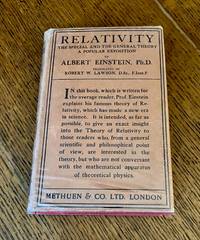
1939réf. 11847Methuen & Co. Ltd. London. 1939. TWELFTH ENGLISH EDITION. Octavo. 7.6 x 5.2 inches. Portrait frontis and five line diagrams within the text. A little foxing to the first couple of pages but overall a very good copy in the publishers red cloth with gilt lettering and ruled lines to the spine. Front board ruled and lettered in blind. Gilt stamped school coat of arms to the front panel and school prize label dated July 1939 on front pastedown endpaper. In the original dustwrapper which has some chipping to the edges but is generally clean and bright. ----- Contains a bibliography of selected works on Relativity. Methuen & Co. Ltd. London. 1939 hardcover
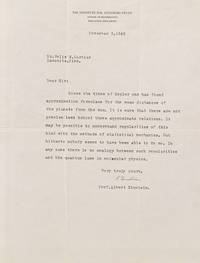
1942réf. 1265881942. Signed. EINSTEIN Albert. Typed letter signed. Princeton November 3 1942. One sheet measuring 8-1/2 by 11 inches typing on recto only; matted and framed with a portrait of Einstein entire piece measures 21 by 17 inches. $38000.An exceptional typed letter signed by Einstein on precursors like Johannes Kepler's work to his Special and General Theories of Relativity beautifully framed.The letter on letterhead from the Institute for Advanced Study in Princeton reads in full: ""November 3 1942. Mr. Felix W. Cartier. Laconite Minn. Dear Sir: Since the times of Kepler one has found approximation formulaes for the mean distances of the planets from the sun. It is sure that there are not precise laws behind those approximate relations. It may be possible to understand the irregularities of this kind with the methods of statistical mechanics. But hitherto nobody seems to have been able to do so. In any case there is no analogy between such regularities and the quantum laws in molecular physics. Very truly yours signed A. Einstein. Prof. Albert Einstein.""Early in the 17th century Johannes Kepler 1571-1630 discovered that planets orbit the sun in ellipses rather than perfect circles. This great discovery paved the way for Isaac Newton's laws of gravity and for Albert Einstein's general and special theories of relativity. Previous to Einstein's time people believed in real distances and absolute time and showed that instruments could not objectively measure the distances between planets. Einstein's theories which hypothesized that light and space curve near a massive object revolutionized scientific thought and gave man an exciting new perspective of his universe.Einstein's letter reflects on some of the most important scientific revelations in the history of physics and astronomy. Kepler defined three laws of planetary motion; however the one specifically referred to in this letter is that all planets move about the Sun in elliptical orbits having the Sun as one of the foci. If the Universe then consisted only of two point massesÑthe Sun and a planetÑthe orbit of that planet would make a perfect closed ellipse that returned the world to its starting location with each trip around the Sun. But in a Universe governed by Newtonian gravity with a plethora of massive bodies in our Solar System that ellipse will precess or rotate slightly in its orbit.In the mid-1800s orbital deviations of Uranus from its predicted motions led to the discovery of Neptune as the outermost world's gravitational influence accounted for the excess motion. But in the inner Solar System the nearest planet to the Sun Mercury was experiencing a similar problem. With detailed accurate observations going back to the late 1500s thanks to astronomer Tycho Brahe we could measure how Mercury's perihelion its closest orbital point to the Sun was advancing. The number we came up with was 5600"" per century just over 1.5 degrees over a 100 year period. But of that 5025"" came from the precession of Earth's equinoxes a well-known phenomenon while 532"" was due to Newtonian gravity.But 5025"" plus 532"" comes up short by a small but significant amount. Attempts at explanationÑincluding the existence of an unknown inner planet interior to MercuryÑall failed. But after Einstein's special theory of relativity came out in 1905 mathematician Henri Poincare showed that the phenomena of length contraction and time dilation contributed a fraction between 15-25% of the needed amount towards the solution dependent on the error. That plus Minkowski's formalization of space and time as not separate entities but as a single structure bound together by their union spacetime led Einstein to develop the general theory of relativity. On November 25 1915 he presented his results computing the spectacular figure that the contribution of the extra curvature of space predicted an additional precession of 43"" per century exactly the right figure needed to explain this observation sending shockwaves through the astronomy and physics communities. Less than two months after this Karl Schwarzschild found an exact solution predicting the existence of black holes. The deflection of starlight and gravitational redshifts/blueshifts were realized as possible tests and finally the solar eclipse of 1919 validated general relativity as superseding Newtonian gravity. Expected fold lines. An incredible letter scarce in its important content. unknown
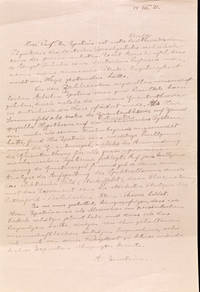
1921réf. 1206201921. Signed. EINSTEIN Albert. Autograph letter signed. No place August 14 1921. Single sheet of cream lined paper measuring 7-1/2 by 11 inches; p. 1. $35000.Rare heartfelt autograph letter of recommendation written and signed by Einstein in German enthusiastically recommending his friend and colleague physicist Prof. Dr. Paul Epstein for an academic position.The autograph letter dated ""14 VIII 21"" written entirely in Einstein's hand reads translated from the original German: ""Prof. Dr. Epstein is certainly one of the most prominent living theoretical physicists of the German-speaking world. Without a doubt he would have been appointed to a German professorship a long time ago had his Russian nationality not stood in the way. Among Epstein's numerous original scientific papers two findings which advanced the modern quantum theory in crucial ways should be noted. After Mr. Sommerfeld as the first physicist who on the basis of special hypotheses had applied the quantum theory to a certain mechanical system of more than one degree of freedom Mr. Epstein discovered an important generalization of the quantum principle which established the application of the quantum theory for all quasi-periodic mechanical systems. Based on that general application of the quantum principle he then provided an analysis of the splitting of spectral lines in the electrical field Stark effect the accordance of which with the experiment provides one of the strongest supports for the Rutherford-Bohr atomic theory. I would like to add that I have also come to appreciate Mr. Epstein in personal interactions as a human being and that I had the pleasure of attending several scientific lectures given by him which enabled me to convince myself of his competence in delivering clearly understandable oral exposition. / A. Einstein.""Einstein and Epstein were friends and longtime correspondents who shared an interest in physics Judaism and the founding of Israel. Paul Epstein was a Russian-American mathematical physicist. He remains best known for his contributions to the development of quantum mechanics. Indeed he was one of a select group that included Lorentz Einstein Minkowski Thomson Rutherford Sommerfeld Rntgen von Laue Bohr de Broglie Ehrenfest and Schwarzschild. Born in Warsaw then part of Imperial Russia Epstein was brought up solidly middle class. He later stated that his mother recognized his potential at the age of four and predicted his future as a mathematician. Epstein studied mathematics and physics for his entire university career eventually earning a degree from the Imperial University of Moscow. He then went on to earn a Ph.D. at the Technical University of Munich in 1914 concentrating on a problem in the theory of diffraction of electromagnetic waves. However the outbreak of World War I rendered Epstein an enemy alien in Germany. Sommerfeld intervened on his behalf and he was allowed to stay as a private citizen and continue his research. In 1916 Epstein published an important paper explaining the Stark Effect using the Bohr-Sommerfeld quantum theory. After the war Epstein went to Leiden and worked as an assistant for Lorentz and Ehrenfest. In 1921Ñthe year this letter was writtenÑEpstein was recruited by Robert Millikan to join the physicists at the California Institute of Technology. Epstein accepted the position and stayed there for the rest of his career publishing extensively on quantum theory. Epstein was something of polymath and worked in numerous areas outside of quantum theory including work on air resistance the settling of gasses the theory of vibration and the absorption of sound. He was an avid supported of Freudian psychoanalysis including as one of the founding members of the Psychoanalytic Study Group that later merged with the Los Angeles Institute for Psychoanalysis. Epstein was also notably anti-communist and worried about the threat of nationalism.The areas of study mentioned in Einstein's letter of recommendation all came together to help form the science behind atomic and hydrogen bombs though neither Einstein nor Epstein anticipated quite where the science was headed in 1921. The letter mentions the Stark effect which is the shifting and splitting of spectral lines of atoms and molecules due to the presence of an external electric field. It is analogous to the Zeeman effect in which a magnetic field is the influence. The Rutherford-Bohr model presented in 1913 is a system consisting of a small dense nucleus surrounded by orbiting electronsÑsomewhat like the Solar System but with electrostatic forces instead of gravity. The Bohr model came to be recognized as a relatively primitive model of the hydrogen atom compared to the valence shell atom model. However because of its simplicity and the correct results it generates for certain systems it is still commonly used to introduce students to quantum mechanics.Overall this letter provides valuable insight into the scientific world during the height of Einstein's international career right when he first began traveling abroad and meeting fellow scientists internationally. The letter reflects Einstein's importance in the community and is a testament to Epstein's ability as a physicist. Original mailing creases. Fine condition. unknown
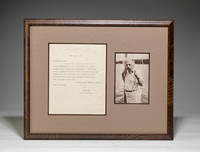
1946réf. 1206241946. Signed. EINSTEIN Albert. Typed letter signed. Princeton April 3 1946. Single sheet of gray letterhead measuring 8-1/2 by 11 inches; p. 1. Matted and framed with a portrait entire piece measures 19 by 15-1/2 inches. $9500.Original typed letter signed by Albert Einstein thanking his friend Dr. Isadore Held for his birthday wishes as well as for sending a new book that Einstein found both ""extraordinarily enlightening"" and humorous. Text in German.The letter typed on Einstein's personal letterhead with his name and Princeton address blindstamped at the top reads in full translation: ""3 April 1946. Dear Mr. Held: I would like to express my sincere thanks for your birthday wishes and for the sending of the last work of this wonderful contemporary. I have already read quite a bit and find that it is extraordinarily enlightening. His penetration into the mentality of far-off times and attitudes toward thinking is most remarkable and his humor no less. With fond greetings to you and your dear wife. Yours signed Albert Einstein."" This letter was written to Austrian-American medical Dr. Isadore Held who was friends with Einstein since at least 1938. Held and Einstein shared numerous interests particularly related to Jewish humanitarian relief and Israel. At Held's death Einstein wrote to his widow that ""True goodness emanated from this man who alleviated the harshness of human relations and who understood and forgave all weaknessesÉ As a role model for his fellow men he was the best that a human being can be."" Einstein was not a huge fan of birthdays though he happily acknowledged well wishes from friends. Just before turning 65 Einstein crankily said to a New York Times interviewer: ""What is there to celebrate Birthdays are automatic things. Anyway birthdays are for children."" In a 1954 letter to physicist Hans Mhsam Einstein described his birthday as ""a natural disaster a shower of paper full of flattery under which one is drowned."" Einstein was generally quite shy and did not like to be the center of attention particularly from strangers obsessed with his accomplishments and fame. However well-meaning letters and small gifts like the book given by Held were always welcomed and graciously accepted by Einstein. Original mailing creases and a few pinpoint holes along top edge possibly from stapling. About-fine condition. unknown
1930réf. 510131930. Einstein Albert 1879-1955. Théorie unitaire du champ physique. In Annales de l'Institut Henri Poincaré 1 fasc. 1 1930: 1-24. With: Fermi Enrico 1901-54. La théorie du rayonnement. In ibid.: 25-52. Whole number. 2 74 2pp. 285 x 197 mm. uncut and unopened. Original printed wrappers a bit sunned lower corner of front wrapper chipped and creased. Very good. First Edition. This issue of the Annales de l'Institut Henri Poincaré contains the texts of Einstein's lecture on unified field theory and Fermi's lecture on the theory of radiation both delivered at the Institut in 1929. Weil Albert Einstein Bibliography 174. Not in Fermi Collected Papers. . unknown
1914réf. 50425Leipzig: Johann Ambrosius Barth 1914. 1 Einstein Albert 1879-1955 and A.driaan D.aniël Fokker 1887-1972. Die Nordströmsche Gravitationstheorie vom Standpunkt des absoluten Differentialkalküls. In Annalen der Physik 44 10: 321-328. 2 Born Max 1882-1970. Zur Raumgitter theorie des Diamanten. In Annalen der Physik 44 12: 605-642. 3 Schrödinger Erwin Rudolf Josef Alexander 1887-1961. Zur Dynamik elastisch gekoppelter Punktesysteme. In Annalen der Physik 44 14: 916-934. Leipzig: Johann Ambrosius Barth 1914. Whole volume: viii 1272 pp. 22 plates Numbered Taf. I-XXII. Taf. I-IX: b/w/ silver photos; Taf. XI w/ one b/w silver photo; Taf. XII is folding and XIII XIV are b/w silver photos; Taf. XV and XVI are large folding tables; Taf. XVII XVIII XIX b/w/ silv.photos; and Taf.XX--XXII are photographs of X-ray images. Figs. Text-illust. 210 x 140 mm. Red cloth gilt lettering on spine. Very good. Along the margin of p. 802 written in pencil are the words: "Mallock R.S. 1910" probably written in Lord Rayleigh's hand most likely in reference to the title "The dampening of sound by frothy liquids" by A. Mallock in Proc. R.S. Lond ser. A vol. 84: 391-94. London 1911. A.D. Fokker 1887-1972 was a Dutch physicist and cousin to aeronautical engineer Anthony Fokker 1890-1939. He was musically inclined having invented the 31EDO pipe organ. He earned his doctorate in 1913 continuing his studies with Albert Einstein Ernest Rutheford 1871-1937 and William Bragg 1862-1942. In his 1913 thesis he derived the Fokker-Planck equation with Max Planck 1858-1947. Fokker made contributions to special relativity and general relativity particularly the effects of the curvature of space-time formally called "geodetic precession". Wikipedia. . Johann Ambrosius Barth unknown
1913réf. 50339Leipzig: Johann Ambrosius Barth 1913. Einstein Albert 1879-1955. Einige argumente fur die annahme einer molekularen agitaation beim absoluten nullpunkt. In Annalen der Physik 40 pp.551-560. With: Otto Stern 1888-1969. Red cloth with gilt lettering on the spine. Whole volume: 1056 pp. 1 plate. 210 x 130 mm. A very good copy. "Some arguments for the assumption of molecular agitation at absolute zero." In this paper Einstein and Stern show that the quantum theory of solids to give the best agreement with experiments at normal temperatures seems to demand that at absolute zero a residual energy would remain in the solids which they term "zero-point energy." They thus introduced this important concept to physics." p. 292. Calaprice Kennefick & Shulmann. An Einstein Encyclopedia. 2015. Otto Stern was a German-American physicist and Nobel Laureate in Physics. He was the second most nominated person for a Nobel Prize with 82 nominations in the years 1925-1945 ultimately winning in 1943 "for his contribution to the development of the molecular rat method and his discovery of the magnetic moment of the proton". In 1912 Stern did his doctoral dissertation in concentrated solutions. After receiving his Ph.D. degree Stern took advantage of his economic independence to join Albert Einstein at Prague. Stern was with Einstein from the spring of 1912 until 1914. Weil's Bibliography no. 53. . Johann Ambrosius Barth unknown
1912réf. 50337Leipzig: Johann Ambrosius Barth 1912. Einstein Albert 1879-1955. Thermodynamische Begründung des photochemischen Äquivalentgesetzes. In Annalen der Physik 37 832-838 pp. Red cloth with gilt lettering on the spine. Whole volume: 1048 pp. 5 plates 4 folding 1 b/w silver photograph w/ small fold at foot. Figs. Text-illust. 210 x 130 mm. Very good copy. "A supplement published in vol. 38 1912: 881-884 See Book ID: 50338. Einstein presents a continuation of his earlier work on the interaction between light matter and on photochemical processes. It contrasts with earlier work in that it makes no use of the quantum hypothesis. He demonstrates how what he calls 'the law of photochemical equivalence' is deducible by purely thermodynamical arguments if one makes certain plausible assumptions. He wrote a supplement to the paper in five months later in the same journal." p. 291-2. Calaprice Kennefick & Shulmann. An Einstein Encyclopedia. 2015. Weil's Bibliography of Einstein's Papers no. 46. Boni's Bibliographical Checklist no. 42. . Johann Ambrosius Barth unknown
1918réf. 50342Leipzig 1918. Prinzipielles zur allgemeinen relativitätstheorie. In Annalen der Physik 55 241-244 pp. Red cloth with gilt lettering on the spine. Bookbinder's embossed stamp of ffep. Whole volume: 632 pp. 1 folding plate. Figs. Text-illust. 210 x 130 mm. Very good. Approximate English translation of title: "On the foundations of the general theory of relativity." "Here we are given the first new presentation of the foundations of general relativity since the developments of March 1916 when Einstein gave his first systematic exposition." p. 300. Calaprice Kennefick & Shulmann. An Einstein Encyclopedia. 2015. Weil's Einstein Bibliography no. 96. Boni's Checklist no. 100. Also in this volume: Born Max 1882-1970. Elektronentheorie des Natürlichen optischen Drehungs vermögens isotroper und anisotroper Flüssigkeiten pp. 175-240. Approximate Eng. translation of title: "Electron theory of the natural optical rotation ability of isotropic and anisotropic liquids". Max Born 1882-1970 was a German physicist and mathematician who was instrumental in the development of quantum mechanics. He also made contributions to solid-state physics and optics as well as supervised a number of notable physicists in the 1920s and 1930s. Born won the 1954 Nobel Prize in Physics "for his fundamental research in quantum mechanics especially in the statistical interpretation of the wave function." In 1919 a chance meeting with Fritz Haber 1868-1934 led to the discussion of how an ionic compound is formed when a metal reacts with a halogen - a process now known as the Born-Haber cycle Wikipedia. . unknown
1908réf. 50421Leipzig 1908. 1 Planck Max 1858-1947. Zur dynamik bewegter systeme. In Annalen der Physik 26 6: 1-34 pp. 2 Einstein Albert 1879-1965 and Jakob Laub 1882-1962. Über die elektromagnetischen grundgleichungen für bewegte Körper. In Annalen der Physik 26 8: 532-40 pp. Boni 22 Weil 22. 3 Einstein A. and J. Laub. Über die im elektromagnetischen felde auf ruhende Körper ausgeubten ponderomotorischen Krafte. In Annalen der Physik 26 8: 541-50 pp. Boni 23 Weil 23. Red cloth gilt lettering on spine. Figs. Text-illust. 230 x 141 mm. Whole volume: viii 1032 pp. 8 plates 3 folding 3 b/w silver photos. Spine a little worn but still Very Good. Approximate English translations of titles: 1 "On the dynamics of moving systems". 2 "On the fundamental electromagnetic equations for moving bodies;" and 3 "On the ponderomotive forces exerted on bodies at rest in the electromagnetic field." "Einstein wrote no. 2 above and "Elementary theory of Brownian motion" in Zeitschrift für Elektrochemie und angewandte physikalische Chemie 14 1908: 235-239 pp. in a three-week period with Jakob Laub his first scientific collaborator to address the problems of formulating relativistically invariant equations for electromagnetic fields in moving media first raised by Hermann Minowski the year before." Calaprice An Einstein Encyclopedia. 2015. A correction to this paper no. 2 was published later in the year in vol. 27 1908: 232 and a supplement for the following year in vol. 28 1909: 445-447. Elaborating on the relativistic transformation of Maxwell's vacuum equations . . . Einstein and Laub also consider the displacement vector D and the magnetic induction B. Weil's Einstein Bibliography nos. 22 23. Boni's Einstein Checklist nos. 22 23. Max Karl Ernst Ludwig Planck 1858-1947 was a German theoretical physicist who was awarded the 1918 Nobel Prize in Physics "in recognition of the services he rendered to the advancement of Physics by his discovery of energy quanta" nobelprize.org. Planck revolutionized human understanding of atomic and subatomic processes as the originator of the quantum theory. Jakob Laub 1882-1962 was a physicist who is best known for his work in the early period of special relativity having worked alongside Albert Einstein during that time. . unknown
réf. 504141 First Edition journal issue. The brilliant follow-up to Einstein's landmark 1905 paper on the photoelectric effect. In the 1905 paper Einstein had explained the photoelectric effect-the emission of electrons from a metal when irradiated by light-by making the revolutionary proposal that light rather than consisting of continuous waves was instead made up of discrete particles of energy "light quanta" which transferred their entire payload of energy to an electron on impact. In the 1905 paper Einstein made use of Planck's mathematical formula for blackbody radiation which had introduced the concept of energy quanta but he was only able to derive part of the formula. In his 1906 paper Einstein "used his statistical mechanics to demonstrate that when light interacts with matter Planck's entire formula can arise only from the existence of light quanta-not from waves" Cassidy; emphasis ours. Einstein had realized as he stated in the present paper that "'Planck's theory makes implicit use of the . . . light-quantum hypothesis' . . . his acceptance of Planck's formula albeit as a hypothesis led to a major advance in his own work" Pais Subtle is the Lord p. 378. In 1921 Einstein was awarded the Nobel Prize in physics for his work on the photoelectric effect. Cassidy David "Einstein on the Photoelectric Effect." Einstein: Image and Impact. American Institute of Physics n.d. Web. Accessed 09 July 2014. Shields "Writings of Albert Einstein" in Albert Einstein: Philosopher-Scientist 1948 pp. 689-758 no. 13; also included in Shields' "Chronological list of principal works" on p. 757. Weil Albert Einstein: A Bibliography no. 12. 2 First Edition journal issue of Einstein's second paper on the inertia of energy following his 1905 paper "Ist die Trägheit eines Körpers von seinem Energieinhalt abhängig" Is the inertia of a body dependent on its energy content. In the present paper Einstein presented another argument in support of the proposition that a body's energy depends on its energy content. "About a year after he first introduced the inertia of energy Einstein published a paper entitled "The Principle of the Conservation of the Center of Gravity and the Inertia of Energy" in which he showed that E = mc2 is necessary and sufficient to ensure that the center-of-mass theorem holds for systems in which 'not only mechanical but also electromagnetic processes take place' . . . As Einstein acknowledges his paper is similar to Poincaré's contribution to the Lorentz Festschrift 1900. Einstein showed that in order to avoid the kind of violations of the center-of-mass theorem discussed by Poincaré one has to assume that energy has inertia" Janssen pp. 39-40. Janssen "The Trouton experiment E = mc2 and a slice of Minkowski space-time" in Revisiting the Foundations of Relativistic Physics: Festschrift in Honor of John Stachel 2003 pp. 27-54. Weil Albert Einstein Bibliography 13. . unknown