Einstein, AlbertBiblio.com
1.949 resultados
ref. 5881818like new. unknown
ref. SKU0572692Cambridge University Press 2019-12-05. paperback. Good. 6x0x9. Textbook May Have Highlights Notes and/or Underlining BOOK ONLY-NO ACCESS CODE NO CD Ships with Tracking Cambridge University Press paperback
2006ref. SKU0620200Penguin Classics 2006-07-25. paperback. New. 5x0x7. New Textbook Ships with Tracking Penguin Classics paperback
ref. SKU0620198Touchstone 2067-10-30. paperback. New. 5x1x8. New Textbook Ships with Tracking Touchstone paperback
ref. SKU0620199Cambridge University Press 2019-12-05. paperback. New. 6x0x9. New Textbook Ships with Tracking Cambridge University Press paperback
1998ref. 1-0691059381Princeton Univ Dept of Art & 1998. Hardcover. New. illustrated edition. 198 pages. 8.75x6.00x0.75 inches. Princeton Univ Dept of Art & hardcover
ref. ria9780195007329_inpPaperback. New. New Book; Fast Shipping from UK; Not signed; Not First Edition; N/A paperback
ref. ria9780190625887_inpHardcover. New. New Book; Fast Shipping from UK; Not signed; Not First Edition; N/A hardcover
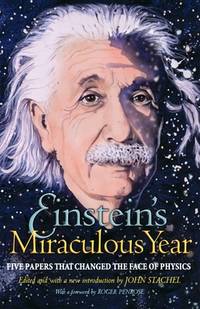
ref. ria9780691000992_inpPaperback. New. New Book; Fast Shipping from UK; Not signed; Not First Edition; Documents Albert Einstein's scientific activity: his concentration for years on the unfathomable problems of quanta and radiation his knowledge of experimental physics his many fruitful interactions with experimentalists and his stru paperback
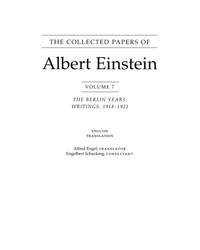
ref. ria9780691017341_inpPaperback. New. New Book; Fast Shipping from UK; Not signed; Not First Edition; Every document in "The Collected Papers of Albert Einstein" appears in the language in which it was written. This title presents the English translations of those non-English materials. paperback
ref. ria9780691200736_inpHardcover. New. New Book; Fast Shipping from UK; Not signed; Not First Edition; Volume 3 of 3. This monumental three-volume work on the Italian madrigal from its beginnings about 1500 to its decline in the 17th century is based on the research of 40 years and is a cultural history of the development of Italian mus hardcover
ref. ria9780691085494_inpPaperback. New. New Book; Fast Shipping from UK; Not signed; Not First Edition; Every document in "The Collected Papers of Albert Einstein" appears in the language in which it was written. This title presents the English translations of those non-English materials. paperback
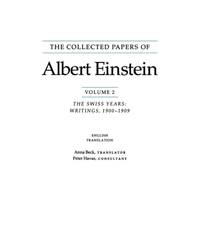
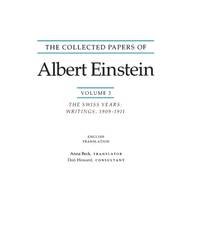
ref. ria9780691102504_inpPaperback. New. New Book; Fast Shipping from UK; Not signed; Not First Edition; Presents Einstein's writings for the two-year period starting in October 1909. This volume concludes with the report that Einstein by then a full professor at the German-language university in Prague gave to the original Solvay Congre paperback
ref. ria9780691141916_inpPaperback. New. New Book; Fast Shipping from UK; Not signed; Not First Edition; Every document in "The Collected Papers of Albert Einstein" appears in the language in which it was written. This book presents the English translations of non-English materials. paperback
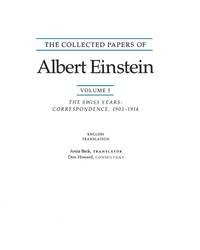
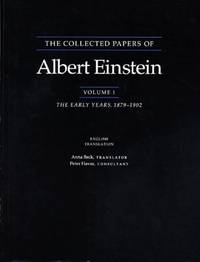
ref. ria9780691084756_inpPaperback. New. New Book; Fast Shipping from UK; Not signed; Not First Edition; Presents material on the young Einstein. In addition to Einstein's known correspondence and other writings from this period this volume includes the relevant portions of third-party letters and other contemporary documents that provide paperback
ref. ria9780691627533_inpPaperback. New. New Book; Fast Shipping from UK; Not signed; Not First Edition; Volume 1 of 3. This monumental three-volume work on the Italian madrigal from its beginnings about 1500 to its decline in the 17th century is based on the research of 40 years and is a cultural history of the development of Italian mus paperback
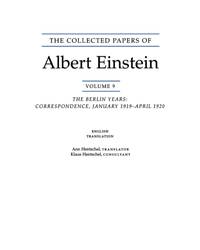
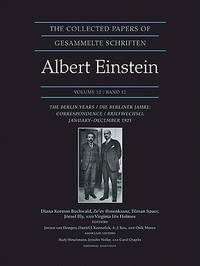
ref. ria9780691121246_inpPaperback. New. New Book; Fast Shipping from UK; Not signed; Not First Edition; Set in the turbulent post-World War I period this volume finds Einstein awaiting news of the 1919 British eclipse expedition to test the general relativistic prediction of the deflection of starlight by the sun. It reveals facets of Ei paperback
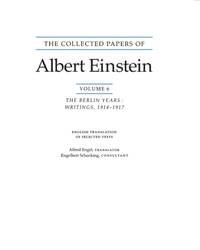
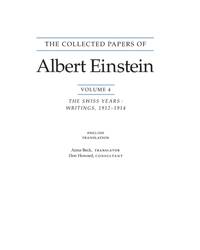
ref. ria9780691026107_inpPaperback. New. New Book; Fast Shipping from UK; Not signed; Not First Edition; Presents Einstein's writings from the final period of his work in Switzerland. The material in this volume documents Einstein's search for a relativistic theory of gravitation a search that ended in Berlin in the fall of 1915 with the paperback
ref. ria9780691156743_inpPaperback. New. New Book; Fast Shipping from UK; Not signed; Not First Edition; Includes documents that appears in the language in which it was written and presents the English translations of select portions of non-English materials. paperback
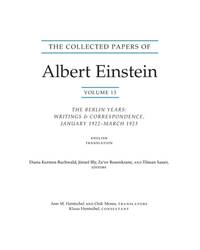
ref. ria9780691057187_inpPaperback. New. New Book; Fast Shipping from UK; Not signed; Not First Edition; In the spring of 1919 two British solar eclipse expeditions confirmed the correctness of general relativity theory and propelled Albert Einstein to instant celebrity. This work include a collection of papers of Einstien. paperback
ref. ria9780691655840_inpPaperback. New. New Book; Fast Shipping from UK; Not signed; Not First Edition; Volume 3 of 3. This monumental three-volume work on the Italian madrigal from its beginnings about 1500 to its decline in the 17th century is based on the research of 40 years and is a cultural history of the development of Italian mus paperback
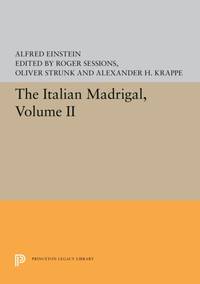
ref. ria9780691655789_inpPaperback. New. New Book; Fast Shipping from UK; Not signed; Not First Edition; Volume 2 of 3. This monumental three-volume work on the Italian madrigal from its beginnings about 1500 to its decline in the 17th century is based on the research of 40 years and is a cultural history of the development of Italian mus paperback
ref. DADAX0415773261New unknown
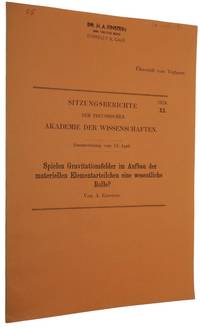
1919ref. 6166Berlin: Verlag der Akademie der Wissenschaften In Kommission bei Walter de Gruyter Reichsdruckerei 1919. First edition. First edition extremely rare author's presentation offprint 'Überreicht vom Verfasser' and the copy of Einstein's son Hans Albert of "Einstein's first attempt at a unified field theory" Pais Subtle is the Lord. Once Einstein completed work on the general theory of relativity at the end of 1915 "his attention shifted to the search for a unified theory of the electromagnetic and gravitational fields out of which he hoped to be able to explain the structure of matter. Quantum effects were to be derived from such a theory rather than postulated ad hoc. This remained his approach for the rest of his life" Cao Conceptual foundations of quantum field theory. . EINSTEIN'S FIRST ATTEMPT AT A UNIFIED FIELD THEORY" PAIS HANS ALBERT EINSTEIN'S COPY OF THE PRESENTATION OFFPRINT. First edition extremely rare author's presentation offprint 'Überreicht vom Verfasser' and the copy of Einstein's son Hans Albert of "Einstein's first attempt at a unified field theory" Pais Subtle is the Lord p. 287. Once Einstein completed work on the general theory of relativity at the end of 1915 "his attention shifted to the search for a unified theory of the electromagnetic and gravitational fields out of which he hoped to be able to explain the structure of matter. Quantum effects were to be derived from such a theory rather than postulated ad hoc. This remained his approach for the rest of his life" Cao Conceptual foundations of quantum field theory pp. 166-167. "As so often the case in relativity the story of quantum gravity begins with Einstein himself. Soon after the final formulation of general relativity he pointed out the need for a quantum modification of the theory. In his first paper on gravitational radiation the 1916 paper 'Näherungsweise Integration der Feldgleichungen der Gravitation' 'Approximate Integration of the Field Equations of Gravitation' Einstein argued that quantum effects must modify the general theory of relativity. Two years later he reiterated this conclusion the 1918 paper 'Über Gravitationswellen' 'On Gravitational Waves': 'As already emphasized in my previous paper the final result of this argument which demands a gravitational energy loss by a body due to its thermal agitation must arouse doubts about the universal validity of the theory. It appears that a fully developed quantum theory must also bring about a modification of the theory of gravitation.' Einstein writing in the 1919 paper offered here soon began to speculate whether gravitation plays a role in the atomistic structure of matter: 'There are reasons for thinking that the elementary formations which go to make up the atom are held together by gravitational forces. The above reflections show the possibility of a theoretical construction of matter out of the gravitational field and the electromagnetic field alone' In order to construct such a model of an 'elementary particle' Einstein shows that it is necessary to modify the original gravitational field equations .The major interest of this paper is that his attention now shifted from possible quantum modifications of general relativity to the search for a unified theory of the electromagnetic and gravitational fields on the basis of which he hoped to explain the structure of matter. Quantum effects are to be derived from such a theory rather than postulated ad hoc. Einstein remained committed to this approach for the rest of his life: the search for a 'natural' mathematical extension of the general theory in the hope that such a theory would somehow explain the quantization of matter and energy" Iyer and Bhawal Black Holes Gravitational Radiation and the Universe pp. 525-526. Einstein's work on unified field theory was inspired by James Clerk Maxwell's success in finding a unified theory of electricity and magnetism one of the greatest achievements of nineteenth century physics which showed that light was a form of electromagnetic wave and made possible modern inventios such as radio television and the telephone. Einstein continued his attempts to devise a unified theory of gravitation and electromagnetism for the rest of his life; his contributions in this area represent about a quarter of his entire research output and half his scientific production after 1920. Although he was ultimately unsuccessful a similar vision was realized in the decades after his death in the construction of the 'standard model' a unified theory of electromagnetism with the weak and strong nuclear forces which were unknown in Einstein's time and efforts to incorporate gravity into the model continue to this day. RBH lists three copies. OCLC lists only one copy none in US. Provenance: Hans Albert Einstein 1904-73 ink stamp and pencil notes on front wrapper. Hans Albert Einstein was a Swiss-American engineer and educator the second child and first son of physicists Albert Einstein and Mileva Marić. He was a long-time professor of hydraulic engineering at the University of California Berkeley. "As early as 1909 in his fundamental paper 'Zum gegenwärtigen Stand des Strahlungsproblems' 'On the current status of the radiation problem' which resulted from a discussion with Walter Ritz Einstein remarks 'dass des elektrische Elementarquantum e ein Fremdling ist in der Maxwell-Lorentzschen Elektrodynamik' 'that the electrical elementary quantum e is alien to Maxwell-Lorentz electrodynamics'. Einstein expressed the hope that 'die gleiche Modifikation der Theorie welche das Elementarquantum e als Konsequenz enthält auch die Quantenstruktur der Strahlung als Konsequenz enthalten wird' 'the same modification of the theory which contains the elementary quantum e as a consequence will also contain the quantum structure of radiation as a consequence'. Pauli 1949 in his review about 'Einstein's Contribution to Quantum theory' pointed out that though quantum theory later on deduced the quantum structure of radiation it has not solved Einstein's first problem and the elementary charge 'auch in der Quantenmechanik ein Fremdling geblieben ist' 'has also remained alien to quantum mechanics'. He emphasized that just this fact had been one of the strongest arguments to Einstein against the finality of the steps leading to quantum mechanics. "So during his Berlin years Einstein made it his task to find a synthesis of his general theory of relativity GRT and the then nascent quantum physics. In this connection he attributed logical primacy to the relevant relativistic field theory because it had reached a high degree of maturity in the GRT. After all Einstein's general-relativistic gravitation theory is the first theory on the fundamentals of physics working with genuinely non-linear equations and Einstein observed that such a nonlinearity is necessary for understanding the existence of the 'discrete field-quanta.' A linear theory allowing arbitrary superposition of fields would without further restrictions in the form of boundary and uniqueness conditions never lead to a discrete spectrum of solutions. But recourse to such restrictions means that the fields are held together by the operation of entities outside the scope of the theory . "In Einstein's view the problem of incorporating the elementary particles into field physics involved the question of finding field-theoretical models of electrons and protons which were the only known particles at that time. Einstein searched for solutions or general-relativistic field equations for the combined gravitational and electromagnetic fields representing mass and charge distributions with central symmetry and he hoped there would emerge self-consistent solutions only for discrete values of the mass and charge parameters i.e. for a 'particle spectrum.' "This 'Einstein particle problem' pursued ideas that had been developed already in the framework of the special theory of relativity and the Maxwell-Lorentz electrodynamics for instance in the nonlinear theory of the electromagnetic field by G. Mie and D. Hilbert. As an essential progress by the general-relativistic treatment Einstein regarded the genuine nonlinearity of the field equations which Mie and Hilbert had to introduce ad hoc and full consideration of the particle dynamics in the sense of the general-relativistic problem of motion. The generalizations of the Maxwell equations considered by Mie and Hilbert contain a too small number of components for the integrability conditions to determine the particle dynamics whereas the Einstein problem of motion in the GRT furnishers just this dynamics as a consequence of the integrability conditions for the field equations of gravitation. It is the GRT that with its metric field for the first time embraces inertia and gravity that is just those properties which are characteristic of all particles. "Einstein in fact succeeded in driving self-consistent gravitational and electromagnetic fields which can be interpreted as particle models of that kind. But his success depended on a weakening of his own equations of gravitation which physically amounts to the introduction of an additional hypothetical cosmical field of the 'Poincaré pressure.' By this weakening it becomes possible to set up self-consistent particle models with spherical symmetry for arbitrary centrosymmetric mass and charge distributions. In 1919 Einstein presented his result to the academy in his paper 'Spielen Gravitationsfelder im Aufbau der materiellen Elementarteilchen eine wesentliche Rolle' His answer to the question says that in his particle models the electrical field energy contributes ¾ and the gravitational energy ¼ of the total energy. "Einstein's first discourses on the particle problem in the GRT were closely related to the 1917/18 papers in which he laid the foundations of relativistic cosmology. In his Academy report 'Kosmologische Betrachtungen zur allgemeinen Relativitätstheorie' 'Cosmological considerations on the general theory of relativity' 1917 Einstein had by introducing the term λgμν with the 'cosmological constant' λ extended his equations of gravitation to his cosmological equations of gravitation Rμν - ½ gμνR λgμν = - κ Tμν . He could show that these equations permit as a particular solution with λ > 0 and constant positive mass density a statical model of the universe representing a closed spheric or elliptic three devotional Riemannian space . "In his paper of 1919 about the role of gravitation in the structure of elementary particles Einstein also interpreted the cosmological constant λ as the universal 'Poincaré' pressure' which according to a hypothesis of H. Poincaré is to guarantee the stability of Lorentz's electrons against their own repulsion forces. Einstein's ideas concerning this matter partly resulted from a controversial discussion with E. Schrödinger 1918 about the gravitational energy in the GRT and the structure of the energy tensor" Treder pp. 149-151. Indeed Schrödinger had pointed out another way of treating the cosmological constant: moving it from the left-hand side of equation where it represents a contribution to space-time curvature to the right-hand side where it represents a contribution to the energy-matter distribution. Then it would correspond physically to a kind of cosmic pressure. Schrödinger believed this might be the pressure postulated by Poincaré to maintain the stability of charged particles: an electric charge on the surface of a sphere creates a force pushing outwards so without any opposing force the charged sphere would explode outwards. Einstein never liked the cosmological constant. In the present paper he acknowledged that his introduction of the cosmological constant was "gravely detrimental to the formal beauty of the theory" Cambridge Companion to Einstein p. 257. Boni-Russ-L. 111; Schilpp 123; Weil 106. Treder 'Antimatter and the particle problem in Einstein's cosmology and field theory of elementary particles A historical essay on Einstein's work at the Akademie der Wissenschaften zu Berlin' Astronomische Nachrichten 296 1975 pp. 149-161. Large 8vo 254 x 182 mm pp. 349-356. Original printed wrappers. A very fine copy. Verlag der Akademie der Wissenschaften, In Kommission bei Walter de Gruyter [Reichsdruckerei] unknown
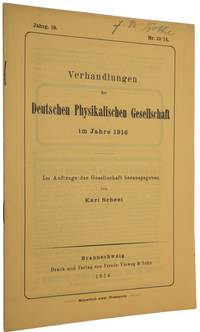
1916ref. 6164Braunschweig: Druck und Verlag von Friedr. Vieweg and Son 1916. First edition. First edition complete journal issue in original printed wrappers inscribed by Einstein to fellow Nobel Laureate Walther Bothe. "This work represents a major step forward in quantum theory" Calaprice p. 297. It introduced the concept of stimulated emission of radiation the theoretical basis for the laser; it also contained a new derivation of Planck's radiation law which provided as a by-product a justification of the frequency rule forming the basis of Bohr's theory of atomic spectra. . DISCOVERY OF STIMULATED EMISSION OF RADIATION THE PRINCIPLE OF THE LASER INSCRIBED BY EINSTEIN TO A FELLOW NOBEL LAUREATE. First edition complete journal issue in original printed wrappers inscribed by Einstein to fellow Nobel Laureate Walther Bothe. "This work represents a major step forward in quantum theory" Calaprice p. 297. It introduced the concept of stimulated emission of radiation the theoretical basis for the laser; it also contained a new derivation of Planck's radiation law which provided as a by-product a justification of the frequency rule forming the basis of Bohr's theory of atomic spectra. "According to Albert Einstein when more atoms occupy a higher energy state than a lower one under normal temperature equilibrium it is possible to force atoms to return to an unexcited state by stimulating them with the same energy as would be emitted naturally" Britannica. This is 'stimulated emission.' "To claim that Einstein almost invented the laser would be an exaggeration but the laser's underlying mechanism stimulated emission of radiation was a creation of his radiation theory" Kleppner pp. 32-33. "During the summer of 1916 less than a year after he had completed the general theory of relativity Einstein made a new major contribution to the quantum theory. The two papers he wrote then deal with the quantum theory of radiation by arguments that do not depend on the classical electromagnetic theory as had all earlier treatments of Planck's radiation law . When Einstein returned to the radiation problem in 1916 the quantum theory had undergone a major change. Niels Bohr's papers had opened a new and fertile domain for the application of quantum concepts - the explanation of atomic structure and atomic spectra. In addition Bohr's work and its generalizations by Arnold Sommerfeld and others constituted a fresh approach to the foundations of the quantum theory of matter" DSB. In this paper "Einstein considers a system of atoms in equilibrium with an external radiation field. An atom can change its internal energy state by absorbing or emitting radiation. Einstein introduces three basic assumptions about these exchanges of energy between matter and field. First the probability of absorption of radiation is proportional to the radiation density. Second there are two kinds of emission processes: one - spontaneous - following a law like that of radioactive decay; the other - stimulated - induced by the radiation field and with probability proportional to the radiation density. Third at equilibrium the atoms are distributed among their internal states according to the Boltzmann distribution law. From these assumptions Planck's law follows in a simple way. Einstein was very pleased with his derivation which he characterized in a letter to Besso: 'An amazingly simple derivation of Planck's formula I should like to say the derivation.' As a bonus from his derivation Einstein found that the energy difference between two internal energy states of the atom had to be equal to hv with v the frequency of the radiation absorbed or emitted in transitions between these two states thus confirming one of the postulates of Niels Bohr's theory of spectra" Papers 6 xxiii-xxiv. "Einstein meant the second part of this study a proof of the oriented character of the emission process to be his most essential contribution to quantum radiation theory this second paper was published later in 1916 as 'Zür Quantentheorie der Strahlung'. Instead Bohr gave more importance to the new deduction of the blackbody law; for this deduction reinforced the basic assumptions of his atomic theory and completed them with a statistical description of radiation processes" Darrigol p. 120. Provenance: Inscribed by Einstein on front wrapper "für. Dr Bothe" i.e. Walther Bothe 1891-1957. "In 1929 in collaboration with W. Kolhörster Bothe introduced a new method for the study of cosmic and ultraviolet rays by passing them through suitably arranged Geiger counters and by this method demonstrated the presence of penetrating charged particles in the rays and defined the paths of individual rays. For his discovery of the 'method of coincidence' and the discoveries subsequently made by it which laid the foundations of nuclear spectroscopy Bothe was awarded jointly with Max Born the Nobel Prize in Physics 1954" . While Einstein commended Planck's epoch-making derivation of his radiation law in 1900 which ushered in the quantum era he had also noted its limitations. Einstein also saw inconsistencies in Planck's derivation of his law. For Einstein this inconsistency was no reason to reject Planck's quantum theory but it was a reason to study the foundations of traditional radiation theory and if needed revise them. "As Einstein had noted in 1906 Planck's derivation of the Rayleigh-Jeans law uν = 8πν2/c3 kT between average resonator energy uν and radiation spectrum ν only applied to classical resonators T is the temperature k is Boltzmann's constant. A new quantum-theoretical picture of the interaction between matter and radiation was needed. Einstein found it in the summer of 1916 after the completion of his general theory of gravitation left him more time for quantum meditation. "The new picture presumably emerged from a combination of three elements: Einstein's derivation of the law of photochemical equivalence his analogy between quantum states and chemical species and Niels Bohr's theory of atomic spectra. According to Bohr atoms and molecules can only exist in a series of quantum states S0 S1 . . . Sn . . . with well-defined energies E0 E1 . . . En . . . Their interaction with radiation occurs through quantum jumps with characteristic values of the frequency of the emitted or absorbed radiation. Regarding the quantum states as chemical species and remembering his photochemical reasoning Einstein knew that he could derive Wien's law by balancing the absorption process Sn hν → Sn1 with the emission process Sn1 → Sn hν and by making the probability of the first reaction proportional to the density of radiation at frequency ν. Something in this reasoning needed to be altered in order to get Planck's law instead of Wien's. "At this point Einstein appealed to an analogy between classical and quantum theory. According to classical theory an oscillating dipole spontaneously emits radiation whether or not radiation is initially present in its surroundings. When external radiation encounters this dipole it may either be absorbed if the phase of the incoming wave agrees with that of the oscillator or it may be amplified in the contrary case. In the quantum theory of radiation Einstein similarly admitted the existence of three kinds of processes: spontaneous emission Ausstrahlung absorption negative Einstrahlung and stimulated emission positive Einstrahlung. The modern terminology is Bohr's. For the probability per time unit of the respective sorts of quantum jump Einstein assumed the forms Anm ÏνBnm ÏνBmn where n is the upper quantum state m the lower one and Ïν is the density of radiation at the frequency ν. "Einstein did not say much on the nature of the probabilities he thus introduced. He only commented that his theory had the weakness to leave to chance the instant and direction of the spontaneous emission of light. He also noted the similarity between spontaneous emission and radioactive decay. Undoubtedly he would have preferred a theory in which the emission and absorption probabilities were deduced from an underlying deterministic theory. He nonetheless expressed his 'full trust in the present way of reasoning'. The probabilistic description of the interaction was a natural counterpart of the discrete character of quantum states: if a quantum system evolves mostly through quantum jumps then the probability of a quantum jump obviously is the main quantity of physical interest. Instead of speculating on the precise timing and fine structure of the jumps Einstein proceeded to show what could be done by means of the new probability coefficients. "At thermal equilibrium Einstein reasoned statistical mechanics requires the number of atoms in a quantum state n to be proportional to exp−En /kT. The kinetic equilibrium between the atoms and surrounding radiation further requires that the number of quantum jumps from m to n should be equal to the number of reverse jumps: ÏνBnm exp−Em /kT = ÏνBnm Anm exp−En /kT. In the high temperature limit for which Ïν → ∞ this condition gives Bnm = Bmn. Therefore the equilibrium value uν of the density Ïν is given by uνexpEn − Em/kT - 1 = Anm / Bnm. According to a thermodynamic theorem by Wien uν/ν3 must be a function of ν/T only. Hence En − Em must be proportional to ν. Einstein thus derived Bohr's strange frequency rule ΔE = hν with complete generality and without recourse to any of the empirical laws of spectra. He then required the expression of uν to agree with the Rayleigh-Jeans law in the low-frequency limit. The outcome was Planck's law as well as the relation Anm / Bnm = 8πhν3/c3 between Einstein's two probability coefficients . "Einstein's new theory of radiation is now remembered for the introduction of stimulated emission which famously permitted the conception of masers and lasers. For Einstein and for his contemporaries the importance of these memoirs lay elsewhere. First Einstein filled an important gap in the derivation of Planck's law by means of a simple statistical description of radiation processes. Second he corroborated two basic assumptions of Bohr's atomic theory: the existence of stationary states and the frequency rule. In this regard it should be emphasized that before Einstein's and Sommerfeld's contributions of 1916 Bohr believed that his frequency rule only applied to strictly periodic systems. For instance he regarded the Zeeman effect as a violation of this rule. Einstein's new considerations established its complete generality" Darrigol in Cambridge Companion to Einstein pp. 134-136. "The implication of Einstein's theory of stimulated emission was that if one arranges for a large number of atoms to be in identical excited states a stray photon of the right energy can stimulate one atom to emit another photon which stimulates another. and all the atoms release their excess energy in a sudden cascade. What's more the photon released by stimulated emission will be in phase - coherent - with the one that stimulated it and so all the light produced in the cascade will be coherent. "In 1955 American physicist Charles Townes of Columbia University in New York an expert in molecular spectroscopy and his co-workers showed how stimulated emission could be used to make a device for generating or amplifying microwaves which they called a maser microwave amplified stimulated emission of radiation. Three years later Townes and Arthur Schawlow explained how to extend the idea to visible and infrared frequencies to make an 'optical maser' - in effect the laser. "They proposed using ordinary incoherent light to pump atoms into an excited state setting up the 'population inversion' in which the atoms are primed to return to their ground state by emitting photons. And their design used an optical cavity - basically two mirrors between which photons would bounce - to trap the emitted photons while they stimulated more emission. The device they explained would generate 'extremely monochromatic single-wavelength and coherent light'. Theodore Maiman of the Hughes Research Laboratories in Malibu California described such a device using a ruby crystal already used for masers as the lasing medium in 1960" 'A century ago Einstein sparked the notion of the laser' Physics World History Blog 31 August 2017. Weil 85. Calaprice An Einstein Encyclopedia 2015. Darrigol From c-numbers to q-numbers 1992. Kleppner 'Rereading Einstein on radiation' Physics Today 58 2005 pp. 30-33. Pais Subtle is the Lord 1982. 8vo 228 x 154 mm pp. 315-332. Original printed wrappers. A fine copy. Druck und Verlag von Friedr. Vieweg and Son unknown