Einstein, AlbertBiblio.com

2 557 résultats
1917réf. 6547Braunschweig: Friedrich Vieweg 1917. Ninth printing. Acceptable. 23 cm; iv. 79 pages. Three figures in text along with numerous equations. In original printed wraps. Acceptable only with paper peeling from the spine and sewing tender. Paper cover is completely detached in front and hanging by a thread in back. The pages are yellowed. There is an ownership autograph of one E. Bodländer. That said a clean unmarked copy in original state. The original German edition of Einstein's epoch-making "On the Special and General Theory of Relativity. Friedrich Vieweg paperback
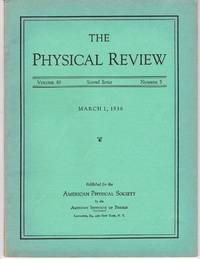
1936réf. 6550Lancaster PA: American Physical Society 1 March 1936. Second series volume 49 number 5. Very Good. ppl 341-422. Original green wraps. Slight nick at bottom edge of lower wrap else better than very good. Includes the retort by Einstein and Rosen originators of speculation on the existence of "worm-holes" in spacetime to objections made to the general theory of relativity. According to Galina Weinstein: "Between 1935 and 1936 Einstein was occupied with the Schwarzschild solution and the singularity within it while working in Princeton on the unified field theory and with his assistant Nathan Rosen on the theory of the Einstein-Rosen bridges. He was also occupied with quantum theory. He believed that quantum theory was an incomplete representation of real things. Together with Rosen and Boris Podolsky he invented the EPR paradox. I demonstrate that the two-body problem in general relativity was a heuristic guide in Einstein's and collaborators' 1935 work on the Einstein-Rosen bridge and EPR paradox." Also articles by notable physicists on radioactivity electron mobility quantum-mechanical measurement and so on. American Physical Society paperback
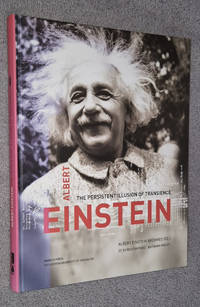
2007réf. 018809Particularly well-illustrated survey of Einstein's life and ideas through photographs and reproductions of his fascinating personal papers. 263 p. : ill. some col. ; 32 cm. Rev. and enlarged ed. Previous ed. published under the title: Albert through the looking-glass. 1998. Illustrated boards slight shelf wear to edges some fading around the spine no inscriptions tight and square binding. Photographs available on request. All books dispatched same or next working day in robust packaging. Albert Einstein Archives : Magnes Press, the Hebrew University of Jerusalem hardcover
1992réf. 79402hUSA: Princeton University Press 1992. Book. Fine. Hardcover. 4to - over 9¾ - 12" tall. Hardcover in dust jacket Clean tight and unmarked. Very neat -- a sound and handsome copy. . Princeton University Press Hardcover
réf. 9476EINSTEIN Carl. DIE KUNST DES 20 JAHRHUNDERTS. Berlin: Im Propylaen 1926. 4to. Cloth spine boards. 575 1 pages 43 plates. First edition. Arntzen I-19. An illustrated survey of 20th-century art featuring the work of Andre Derain Picasso Braque Juan Gris and others including 43 color photographs. Covers rubbed ex-library copy with markings front hinge internally cracked else good. unknown
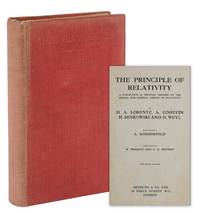
1923réf. 140949178London: Methuen & Co 1923. First Edition. Very Good. First British edition first printing. viii 216 8 ads pp. Bound in publisher's red cloth lettered in blind on front board and in gilt on spine; lacking the dust jacket. Very Good with fading light wear and soiling to covers. Evidence of bookplate removal to front pastedown offsetting to free endpapers rear hinge starting. Contents lightly toned with foxing to first and last few pages and textblock edges. An influential collection of eleven papers on relativity. Seven are authored by Einstein two by Henrik Lorentz and one each by Hermann Minkowski and Hermann Weyl. The first edition of this translation of Das Relativitaetsprinzip taken from the fourth German edition. Methuen & Co unknown
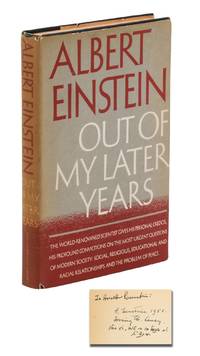
1950réf. 140948403New York: Philosophical Library 1950. First Edition. Near Fine/Near Fine. First edition first printing. Signed by Albert Einstein on the front free endpaper and dated the year of publication. Above and beneath Einstein's signature Rabbi Irving Levey has inscribed this book to former owner Harold Rosenstein and written two lines of Hebrew that translate to "A day that is exceptionally good 19 Kislev 5711." According to Rosenstein's grandson Einstein's signature was procured by Rabbi Levey who lead temple at the Jewish Center at Princeton from 1949-51. Levey and Einstein and worked together on issues relating to the then-newly formed State of Israel. vi 282 pp. Bound in publisher's blue cloth stamped in gilt. Near Fine with light rubbing to corners and spine ends offsetting at endsheets. In a Near Fine unclipped dust jacket with toning light edge wear small stain to rear flap. The iconic theoretical physicist's second collection of essays covering the years 1934-1950 surrounding his personal convictions around religious and humanitarian issues in the wake and aftermath of WWII. Boni 515. Philosophical Library unknown
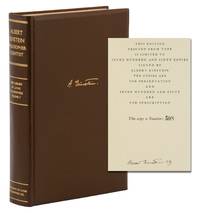
1949réf. 140948474Evanston Illinois: The Library of Living Philosophers Inc 1949. Signed Limited First Edition. Near Fine. First edition. Number 508 of a limited 760 copies signed and dated by Albert Einstein. 777 pp. Bound in publisher's brown leatherette stamped in gilt; top edge gilt; lacking the glassine dust jacket and slipcase. Text in English and German. Near Fine with very faint tidemark to edge of half-title frontisportrait and title page. A collection of critical essays devoted to the theoretical physicist by twenty-five eminent scholars and scientists with Einstein's remarks. Published on Einstein's 70th birthday the work has contributions by noted contemporaries such as Max Born Kurt Godel and Wolfgang Pauli. The Library of Living Philosophers, Inc unknown
réf. 0802703267.Ghardcover. Good. Access codes and supplements are not guaranteed with used items. May be an ex-library book. hardcover
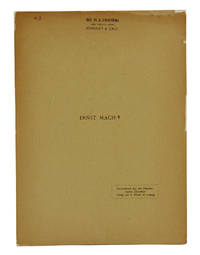
1916réf. 140941831Leipzig Germany: S. Hirzel 1916. First separate edition. First separate edition. 4 pp. Illustrated with portrait of August Mach from photograph. Publisher's original printed wrappers. Very Good with some small chips to fragile wrappers faint crease to top of front wrap contents toned with age. This copy belonged to Hans Albert Einstein Albert Einstein's oldest son with his inkstamp at top of front wrapper; likely a presentation copy from his father. Neatly written at top of front wrapper is "43" and date "14.III.16." OCLC/WorldCat locates four copies two at the University of Toronto one at the Smithsonian Institution and one at the American Philosophical Society. Weil 89. Very rare author's offprint stating "Uberreicht vom Verfasser" of the eulogy by Albert Einstein for fellow physicist Ernst Mach as first published in Physikalischen Zeitschrift. A noted scientist in his own right Mach is best known for the concept of "Mach's principle" which asserts that an entity's inertial mass is determined by all the other masses in the universe. Einstein in fact coined the phrase "Mach's principle" and his application of it had major ramifications for the development of his theory of general relativity Einstein in 1918 labeling it one of the "three pillars" of general relativity. S. Hirzel unknown
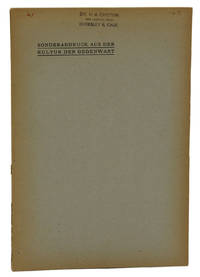
1925réf. 140941837Berlin: No Publisher 1925. Revised edition. 783-797 pp. Publisher's original printed wrappers. About Very Good with thin tear along front wrap fold near head a little chipping to wraps at spine front wrap hinge fragile contents toned with age. This copy belonged to Hans Albert Einstein Albert Einstein's oldest son with his inkstamp at top of front wrapper; likely a presentation copy from his father. Neatly written at top of front wrapper are "41" and 163." Very rare author's offprint from Die Kulture der Gegenwart of an essay on relativity theory which was first published in 1914 revised to incorporate Einstein's later research. OCLC/WorldCat locates no physical copies. Weil 71. [No Publisher] unknown
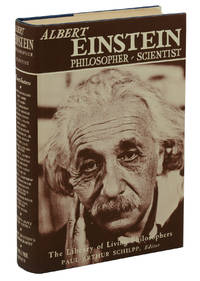
1949réf. 140941891Evanston IL: The Library of Living Philosophers Inc 1949. First Edition. Fine/Fine. First edition trade issue. xvi 781 pp. Bound in publisher's navy cloth with gilt spine lettering. Fine with offsetting to endpapers in a Fine dust jacket unfaded and unworn. A very sharp copy of a collectible volume all about the famous theoretical physicist. The Library of Living Philosophers, Inc unknown
1949réf. 140941039Evanston IL: The Library of Living Philosophers Inc 1949. First Edition. Near Fine/Very Good. First edition first printing. Bound in publisher's original dark blue cloth stamped in gilt. Near Fine with toning to pages offsetting to endsheets former owner name to front free endpaper and small sticker ghost to front paste down. In a Very Good dust jacket with fraying and chip at bottom spine end and short closed tear at head light edge wear toning and soiling to rear panel. The Library of Living Philosophers, Inc unknown
1923réf. 171111001Princeton: Princeton University Press 1923. First Edition. Hardcover. Very Good. First American edition first printing. Near Fine with slight fade to spine cloth gilt stamping very sharp on front cover. Previous owner bookplate to front paste down with patch of abrasion at nearby gutter. Pages toned with several hinges just slightly over-opened. In a Very Good dust jacket with a large chip and tear at the top of the spine toning to spine and edges and several small edge tears. A very nice copy in the scarce dust jacket. Princeton University Press hardcover
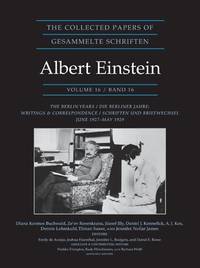
2021réf. 113562Princeton NJ: Princeton University Press 2021. Hardcover. Fine in Very Good dust jacket. 2" tear up from bottom edge of DJ spine and 4" tear from rear DJ bottom long edge; rear bottom DJ edge is creased between the two tears; DJ in mylar protector. ; Editors are Diana Kormos Buchwald Ze'ev Rosenkranz Jozsef Illy Daniel J. Kennerfick A. J. Kox Dennis Lehmkuhl Tilman Sauer and Jennifer Nollar James. Blue cloth boards. Shipping will be extra for this heavy book please inquire. ; 7 3/4 x 10 1/4"; 1021 pages. Princeton University Press hardcover
2021réf. __0691216819Princeton Univ Pr 2021. Hardcover. New. 1192 pages. 10.00x7.48x2.80 inches. Princeton Univ Pr hardcover
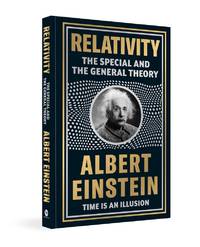
réf. 9789358561579Fingerprint Publishing. New. New Fingerprint Publishing unknown
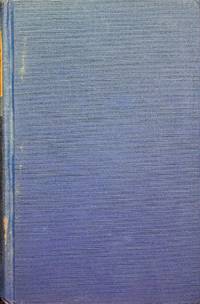
1923réf. 20260506001New York: Dodd Mead and Company 1923. Hardcover. Good. 23 cm. Dodd Mead and Company Published 1923. Hardcover viii 216 pp.; 23 cm; First Edition dated 1923 on title page with no additional printings; with seven diagrams; printed at the University Press Aberdeen. In Good condition lacking the dust jacket. Blue cloth-covered boards with the original printed paper label on the spine bearing the title and authors. Mild to moderate shelf wear with some color loss along the edges and soiling and toning to the spine cloth. The paper spine label has chipping along the right edge with loss to the upper right corner. A few razor-thin cracks to the binding but the text block remains very solid in the boards. Pages mildly toned with heavier toning to the endpapers and pastedowns. Otherwise unmarked.The first English-language collection of original memoirs on the special and general theory of relativity. Translated by W. Perrett and G. B. Jeffery from the German collection "Des Relativitätsprinzip" Teubner 4th ed. 1922 with notes by A. Sommerfeld. Gathers key papers in the development of modern physics including Einstein's "On the Electrodynamics of Moving Bodies" 1905 Minkowski's "Space and Time" 1908 Einstein's "The Foundation of the General Theory of Relativity" 1916 and Weyl's "Gravitation and Electricity" along with contributions by Lorentz on Michelson's interference experiment and electromagnetic phenomena.Contents: Michelson's Interference Experiment by H. A. Lorentz; Electromagnetic Phenomena in a System Moving with Any Velocity Less Than That of Light by H. A. Lorentz; On the Electrodynamics of Moving Bodies by A. Einstein; Does the Inertia of a Body Depend Upon Its Energy-Content by A. Einstein; Space and Time by H. Minkowski; On the Influence of Gravitation on the Propagation of Light by A. Einstein; The Foundation of the General Theory of Relativity by A. Einstein; Hamilton's Principle and the General Theory of Relativity by A. Einstein; Cosmological Considerations on the General Theory of Relativity by A. Einstein; Do Gravitational Fields Play an Essential Part in the Structure of the Elementary Particles of Matter by A. Einstein; Gravitation and Electricity by H. Weyl. Dodd, Mead and Company hardcover
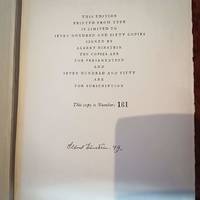
1949réf. 250705Evanston: Library Of Living Philosophers 1949. First Limited edition. Hardcover. fine /no glassine. Karsh frontis photos facs. Octavo publisher's green cloth bevelled edges in a custom-made clamshell cloth box with morocco spine labels Numbered copy 161 of only 760 numbered copies. Autographed: "Albert Einstein 49." Contains Einstein's own "Autobiographical Notes bi-lingual text German & English" and "Remarks to the Essays Appearing in this Collective Volume". Includes a Bibliography of Einstein's writings to 1949. At least 6 of the 25 contributors to this volume were awarded the Nobel Prize in Science. The contributors include Niels Bohr "Discussion with Einstein on Epistemological Problems in Atomic Physics" Kurt Godel F.S.C. Northrop Wolfgang Pauli etc. Illustrated with Yousuf Karsh's frontispiece portrait of Einstein photos facsimiles. Boni BIBLIOGRAPHICAL CHECKLIST 512. Library Of Living Philosophers hardcover
réf. 329146Princeton New Jersey: Princeton University Press 2015-04-13. First Edition. Hardcover. Near Fine/Very Good Dust Jacket. 5x0x8. 1st printing with complete number line. Near fine hardcover in very good dust jacket DJ has some rubbing. From a private home collection. Text unmarked and clean pages bright and crisp. Binding is tight sturdy and square. Boards look great corners sharp. Ships same or next business day from Dinkytown in Minneapolis Minnesota. Due to the size/weight of this book extra charges may apply for international shipping. Princeton University Press hardcover
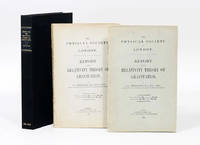
1918réf. 2839London: Fleetway Press 1918. FIRST EDITION. Original wrappers. Fine. THE FIRST INTRODUCTION OF EINSTEIN'S GENERAL RELATIVITY TO THE ENGLISH-SPEAKING WORLD. The groundbreaking first edition 1918 with the second edition 1920 containing the account of Eddington's 1919 expedition proving Einstein's theory both in original wrappers. "Einstein's discovery of the General Theory of Relativity was communicated to the Berlin Academy of Sciences in 1915. Because of the First World War direct communication with physicists in Germany was not possible but the papers were forwarded to Eddington who was then Secretary of the Royal Astronomical Society by Willem de Sitter a personal friend of Eddington's in neutral Holland. The theory is of considerable mathematical complexity but as Einstein stated in the last paragraph of his paper 'scarcely anyone who has fully understood this theory can escape from its magic'. Eddington was the ideal expositor of these ideas in English and within 2 years had written his Report on the Relativity Theory of Gravitation for the Physical Society of London" Malcolm Longair "Bending Space-time". The second edition is notable for containing a new preface that discusses the results of the "eclipse expedition" led by Eddington that verified General Relativity and catapulted Einstein into world-wide fame. This preface precedes Eddington's full report in the Philosophical Transactions. Provenance: Almost certainly Nobel Prize winning physicist's Charles Glover Barkla's copy of the 1918 report with an original 1918 receipt in Barkla's name laid in. Barkla won the 1917 Nobel Prize in Physics "for his discovery of the characteristic Röntgen radiation of the elements". London: Fleetway Press for The Physical Society of London 1918 and 1920. Octavo original wrappers; custom box. General light wear to wrappers. Beautiful copies. RARE. Fleetway Press unknown
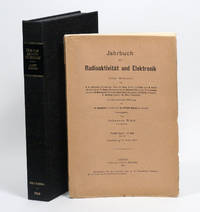
1908réf. 2507Leipzig: S. Hirzel 1908. First edition. original wrappers. Very Good. THE BIRTH OF GENERAL RELATIVITY: FIRST PRINTING IN RARE ORIGINAL WRAPPERS OF ONE ONE EINSTEIN'S MOST IMPORTANT PAPERS; containing the beginning of general relativity the derivations of the equivalence principle gravitational redshift and the gravitational bending of light. "Einstein's road to general relativity began in November 1907 when he was struggling against a deadline to finish an article for a science yearbook explaining his special theory of relativity. Two limitations of that theory still bothered him: it applied only to uniform constant-velocity motion. and it did not incorporate Newton's theory of gravity. "'I was sitting in a chair in the patent office at Bern when all of a sudden a thought occurred to me' he recalled. 'If a person falls freely he will not feel his own weight.' That realization which 'startled' him launched him on an arduous eight-year effort to generalize his special theory of relativity and 'impelled me toward a theory of gravitation.' Later he would call it 'the happiest though in my life.' "The tale of the falling man has become an iconic one and in some accounts it actually involves a painter who fell from the roof of an apartment building near the patent office. Einstein refined his thought experiment so that the falling man was in an enclosed chamber such as an elevator in free fall above the earth. In this falling chamber at least until it crashed the man would feel weightless. Any objects he emptied from his pocket and let loose would float alongside him. "Looking at it another way Einstein imagined a man in an enclosed chamber floating in deep space 'far removed from stars and other appreciable masses.' He would experience the same perceptions of weightlessness. 'Gravitation naturally does not exist for this observer. He must fasten himself with strings to the floor otherwise the slightest impact against the floor will cause him to rise slowly towards the ceiling.' "Then Einstein imagined that a rope was hooked onto the roof of the chamber and pulled up with a constant force. 'The chamber together with the observer then begin to move "upwards" with a uniformly accelerated motion.' The man inside will feel himself pressed to the floor. 'He is then standing in the chest in exactly the same way as anyone stands in a room of a house on our earth. The man in the chamber will come to the conclusion that he and the chest are in a gravitational field. Just then however he discovers the hook in the middle of the lid of the chest and the rope which is attached to it and he consequently comes to the conclusion that the chamber is suspended at rest in the gravitational field.' Einstein observed that inertial mass always equals gravitational mass and through his thought experiments concluded that "From this correspondence it follows that it is impossible to discover by experiment whether a given system of coordinates is accelerated or whether. the observed effects are due to a gravitational field." "Einstein called this 'the equivalence principle.' The local effects of gravity and of acceleration are equivalent. "In 1907 working against the deadline imposed by the Yearbook of Radioactivity and Electronics Einstein tacked on a fifth section to his article on relativity that sketched out his new ideas. He also came up with many predictions that could be tested including that light should be bent by gravity and that the wavelength of light emitted from a source with a large mass such as the sun should increase slightly in what has become known as the gravitational redshift. "It would take Einstein another eight years until November 1915 to work out the fundamentals of this theory and find the math to express it. Then it would take another four years before the most vivid of his predictions the extent to which gravity would bend light was verified by dramatic observations. But at least Einstein now had a vision one that started him on the road toward one of the most elegant and impressive achievements in the history of physics: the general theory of relativity" Isaacson Einstein 145-49. Weil in his bibliography also notes that "On p.443 are probably the first explicit statements both of the equivalence of inertial and gravitational mass and of the equation for mass in terms of energy now regarded as the theoretical basis for the release of atomic energy." Weil 21. Although Einstein submitted the paper on 4 December 1907 it wasn't published until the January 22 issue of the Jarbuch. Note: There was a very short "Correction" in a subsequent issue not included here. IN: Jahrbuch der Radioactivität under Electronik Vierter Band - 4. Heft No. 16 pp. 411-462. Leipzig: S. Hirzel 1908. Octavo original wrappers; handsome custom box. Light wear to wrappers and split to spine; text fine with Einstein paper largely unopened. AN EXTREMELY RARE COPY IN ORIGINAL WRAPPERS OF ONE OF EINSTEIN'S MOST IMPORTANT PAPERS. S. Hirzel unknown
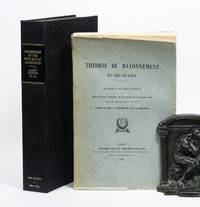
1912réf. 2508Paris: Gauthier-Villars 1912. First edition. Original wrappers custom box. Very Good. RARE FIRST EDITION IN ORIGINAL WRAPPERS OF THE REPORTS FROM THE HISTORIC FIRST SOLVAY CONFERENCE "THE FIRST INTERNATIONAL CONFERENCE IN PHYSICS EVER ORGANIZED" AND A CRITICAL MOMENT IN THE BIRTH OF QUANTUM PHYSICS. In the short time that followed Planck's hypothesis of the universal constant that would bear his name the greatest minds in physics were largely at a loss about how to deal with the bizarre theoretical results that followed let alone the experimental results which confirmed them!. Much of the focus at the time was on black-body radiation including work by Planck himself as well as Lorentz Rayleigh and Jeans. However shortly before the first Solvay conference a young Einstein had also started investigating the related question of materials' specific heat. Kuhn. "The purpose of the first Solvay Conference was thus two-fold: first there was the need to examine whether classical theories molecular-kinetic theory and electrodynamics could in some undiscovered ways provide an explanation of the problem of black-body radiation and of the specific heat of polyatomic substances at low temperatures; secondly to consider phenomena in which the theory of quanta could be successfully used." Mehra. Underlying these questions was the more fundamental mystery of how to interpret the existence of the Planck constant. There were two camps both of which were represented at the conference. Planck's took the constant to indicate some fundamental constraint on the radiative processes of emission and absorption. For example "Sommerfeld introduced a version of the quantum hypothesis which he considered to be compatible with classical electrodynamics. He postulated that in 'every purely molecular process' a quantized quantity of action is exchanged." Staumann. Einstein's camp on the other hand took the quantum of action to represent the physicality of a perhaps pseudo-corpuscular theory of energy exchange - his photons of light. Although the debates that followed the lectures included in the proceedings did not rise to the famous heated exchange that Einstein would have with Bohr at the 1927 Solvay conference we do see some of the young Einstein's hotheadedness as he opens the debate following Planck's plenary lecture: "What I find strange about the way Mr. Planck applies Boltzmann's equation is that he introduces a state probability W without giving this quantity a physical definition. If one proceeds in such a way then to begin with Boltzmann's equation does not have a physical meaning." As translated by Straumann. It would take another 14 years for quantum mechanics to be fully formalized but the first Solvay conference represents a pivotal point in quantum history: "During 1911 the situation changed quickly. Articles that applied the quantum to other topics then outnumbered those on blackbody radiation for the first time and some were backed by impressive experimental evidence. In part because of that evidence physicists like Planck and Lorentz who had previously taken the constant h to be characteristic only of the radiation problem began to consider additional areas in which others had earlier staked quantum claims." Kuhn. Albert Einstein and the Solvay Conference: Among the most renown scientists of the day - including Ernest Rutherford Marie Curie and Max Planck - Einstein made quite an impression. At age 32 he was the second youngest participant in the conference. The youngest was British physicist Frederick Lindemann later to become scientific adviser to Winston Churchill. Although "Einstein had already published so many masterpieces none had actually been put to the test and his theories were looked on rather as tours de force than as definitive additions to knowledge. But his pre-eminence among the twelve greatest theoretical physicists of the day was clear to any unprejudiced observer." Frederick Lindemann quoted in Brian. References: Headline quote from the Solvay Institute website. Kuhn T. 1978 Black Body Theory and the Quantum Discontinuity 1894-1912. University of Chicago Press. Mehra J. 1975 The Solvay Conferences on Physics: Aspects of the Development of Physics Since 1911. Straumann N. 2011. On the first Solvay Congress in 1911. The European Physical Journal H 363 379-399. Denis Brian Einstein: A Life p.82. Paris: Gauthier-Villars 1912. Octavo original wrappers; custom box. Splits to top and bottom joint of upper wrapper two creases to front wrapper. Text in fine condition largely unopened. FIRST PRINTINGS IN ORIGINAL WRAPPERS ARE EXTREMELY SCARCE. Gauthier-Villars unknown
1943réf. 2376Princeton NJ: np 1943. First edition. nb. Fine. EINSTEIN OFFERS STRONG AND PRESCIENT WORDS OF ENCOURAGEMENT TO THE LEADER OF THE NAACP IN THE FIGHT AGAINST RACIAL SEGREGATION AND DISCRIMINATION IN THE UNITED STATES. Background: Einstein's fight against racial discrimination in the United States: The imperative "to protect the rights of the individual. was Einstein's most fundamental political tenet. Individualism and freedom were necessary for creative art and science to flourish. Personally politically and professionally he was repulsed by any restraints. "That is why he remained outspoken about racial discrimination in America. As a Jew who had grown up in Germany Einstein was acutely sensitive to such discrimination. 'The more I feel an American the more this situation pains me' he wrote in an essay called 'The Negro Question' for the January 1946 issue of Pageant magazine. 'I can escape the feeling of complicity in it only by speaking out.'" Isaacson Albert Einstein 505. Even more directly in his 1946 commencement speech to Lincoln University the first degree-granting Historically Black College and University HBCU in the United States Einstein strongly denounced segregation as "an American tradition which is uncritically handed down from one generation to the next" noting that "There is separation of colored people from white people in the United States. That separation is not a disease of colored people. It is a disease of white people. I do not intend to be quiet about it." This remarkable letter - from 1943 - is one of the earliest examples of his interest in condemning racism in the United States. The letter: Dated 22 September 1943 and handwritten on his embossed Mercer Street Princeton letterhead Einstein writes in English to Walter F. White the enormously influential African-American civil rights leader who led the NAACP from 1929-1955 praising him for his work and revealing his own awareness of and frustrations with racism and prejudice in America. The text reads in full: Dear Mr. White: I have been quite impressed by the address you delivered some years ago at a meeting of the Princeton Branch of the National Association for the Advancement of Colored People. I know how hard it is to awaken the conscience even of good-hearted and well-meaning people when deep rooted prejudices are in the way. It is a great work indeed which you are doing relentlessly for the betterment of the living conditions of our Colored fellow-citizens for justice and for the accomplishment of national unity of the American people. With sincere respect and kind wishes Yours Albert Einstein ------------- On April 28 1940 White was the keynote speaker at "an inter-racial meeting sponsored by the Princeton branch of the National Association for the Advancement of Colored People" where his topic was "What Happens to Democracy When It Encounters the Color Line." Princeton Herald April 26 1940. At the time Princeton did not admit African Americans and the community was debating the question of whether or not to end segregation at the university. Princeton in fact did not admit its first African-American student until the fall of 1947. Einstein - writing in 1943 - notes that he heard White speak "some years ago". Something clearly must have deeply impressed Einstein about White's speech for him to write this thoughtful letter to White over three years after the event. Note: In addition to its content this apparently unpublished letter is also remarkable for being one of the very few letters Einstein hand-wrote in English during this period as German was still very much his preferred tongue. Princeton: September 22 1943. One page on Einstein's embossed Mercer Street Princeton letterhead 7.25x10 in visible handsomely matted and framed with a photograph of Einstein. Fine condition. np unknown
1916réf. 2364Braunschweig: Druck und Verlag von Friedr Vieweg and Son 1916. First edition. Original wrappers. Very Good. FIRST PRINTING IN ORIGINAL WRAPPERS OF ONE OF EINSTEIN'S MAJOR WORKS: HIS FIRST PAPER ON THE DERIVATION OF PLANK'S LAW AND PROVIDING THE THEORETICAL BASIS FOR THE LASER. "Einstein commended the 'unparalleled boldness' of Planck's derivation of 1900 meaning not only the problem itself but also the fact that it was based on assumptions that were not entirely free of contradictions. Einstein now succeeded in the first of two papers in eliminating that flaw. More interesting than the derivation itself was the general character of his methods. Einstein proceeded from Niels Bohr's basic--and by then well tested--assumption that the electrons within an atom occupy a number of discrete energy states and are able through emission or absorption of radiation to pass from one of those states to another. Added to this was an assumption of thermodynamic equilibrium between radiation field and atom as well as a consideration of the 'classical' limiting case at high temperatures--and there was Planck's formula. This brief argument. also covers emission stimulated by the radiation field; thus the formulas already by implication contain the theory of the laser though it was to take nearly half a century to be realized" Folsing Albert Einstein 389. Weil 85. The "implication" containing the theory of the laser was more fully developed in his companion paper "On the Quantum Theory of Radiation" published a few weeks later. In the first paper Einstein wrestled with the concept that the atomic emission of radiation could be a directed process; in the second paper he convincingly demonstrates that this is indeed the case. IN: Verhandl. D. Deutch. Phys. Ges. Vol 18 pp. 318-323. Braunschweig: Druck und Verlag von Friedr. Vieweg and Son 1916. Octavo original wrappers; housed in custom half leather chemise. One thread literally resewn on wrappers a little creasing and soiling. A beautiful copy. RARE IN ORIGINAL WRAPPERS. Druck und Verlag von Friedr Vieweg and Son unknown