Einstein, AlbertBiblio.com
2976 resultados
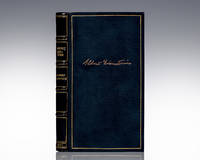
1931ref. 150006New York: The MacMillan Company 1931. First edition of this volume of Einstein's speeches and letters concerning his views on Zionism. Octavo bound in full morocco by the Harcourt Bindery with gilt titles and tooling to the spine in five compartments within raised gilt bands gilt ruling to the front and rear panel gilt signature to the front panel gilt inner dentelles stamp-signed by the Harcourt Bindery marbled endpapers all edges gilt. In fine condition. Translated and edited with an introduction by Leon Simon. An exceptional presentation. Einstein was a prominent supporter of both Labor Zionism and efforts to encourage Jewish-Arab cooperation. He supported the creation of a Jewish national homeland in the British mandate of Palestine but was opposed to the idea of a Jewish state "with borders an army and a measure of temporal power." In a letter to Jawaharlal Nehru dated June 13 1947 he asserted "Long before the emergence of Hitler I made the cause of Zionism mine because through it I saw a means of correcting a flagrant wrong.The Jewish people alone has for centuries been in the anomalous position of being victimized and hounded as a people though bereft of all the rights and protections which even the smallest people normally has.Zionism offered the means of ending this discrimination." Einstein's speeches lectures and letters concerning Zionism were first published in 1930 by The Soncino Press and eleven of these essays were later collected in The World as I See It published in 1933 which Einstein dedicated "to the Jews of Germany". The MacMillan Company unknown
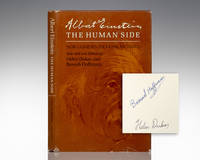
1979ref. 148235New Jersey: Princeton University Press 1979. First edition early printing of this curated collection of Einstein’s writings. Octavo original leather frontispiece. Boldly signed by Helen Dukas and Banesh Hoffman on the front free endpaper. Helen Dukas 1896–1982 was Albert Einstein’s longtime secretary and trusted confidante serving in that role from 1928 until his death in 1955. Deeply involved in preserving and organizing Einstein’s legacy she co-edited several collections of his writings and letters and played a key role in curating the Einstein Archives at the Institute for Advanced Study in Princeton. Banesh Hoffmann 1906–1986 was a physicist and mathematician who collaborated with Albert Einstein and made significant contributions to relativity and quantum mechanics. Near fine in a near fine price-clipped dust jacket. Uncommon signed by both contributors. Albert Einstein: The Human Side 1979 edited by Helen Dukas and Banesh Hoffmann offers a unique perspective on Einstein beyond his scientific achievements by compiling his personal letters reflections and anecdotes. Unlike traditional biographies that focus on his contributions to physics this collection highlights Einstein’s thoughts on philosophy politics ethics and personal relationships revealing his wit humility and deep moral convictions. Through carefully selected writings the book presents Einstein as both a brilliant scientist and a deeply introspective individual who grappled with the social and ethical implications of his work. Princeton University Press hardcover
1949ref. 133215Munchen: Paul List Verlag 1949. First German edition of this classic work by Frank a famed contemporary of Einstein. Octavo original cloth. Signed by Albert Einstein on the slip to the title page and inscribed by the author on the front free endpaper "To Karl W. Deutsch with the author's compliments Philipp Frank August 10 1950." Philipp Frank was a physicist mathematician and also a philosopher during the first half of the 20th century. He was a logical-positivist and a member of the Vienna Circle. He was influenced by Mach and was one of the Machists criticised by Lenin in Materialism and Empirio-criticism. He studied physics at the University of Vienna and graduated in 1907 with a thesis in theoretical physics under the supervision of Ludwig Boltzmann. Albert Einstein recommended him as his successor for a professorship at the German Charles-Ferdinand University of Prague a position which he held from 1912 until 1938. Very good in a good dust jacket. Much has been written about Albert Einstein technical and biographical but very little remains as valuable as this unique hybrid of a book written by Einstein's colleague and contemporary. Both rich in personal insights and grounded in a deep knowledge of twentieth-century science Phillip Frank's biography anchors the reader with a lucid overview of physics and draws an intimate portrait of the Nobel Prize–winner. Paul List Verlag hardcover
ref. 1543108717.Gpaperback. Good. Access codes and supplements are not guaranteed with used items. May be an ex-library book. paperback
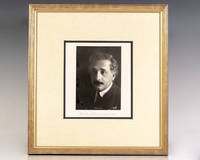
1923ref. 1413011923. Extremely rare original photograph boldly signed "Albert Einstein Jerusalem 1923" during his only trip to Palestine in 1923. Einstein's return voyage from his tour of Japan and China took him via the Red Sea and Suez Canal which allowed him to accept the invitation of Arthur Ruppin the director of the Palestine office of the Zionist Organization in Jaffa to visit the region for twelve days. Einstein arrived in Port Said on February 1 1923 and from there he traveled to Jerusalem Tel Aviv Jaffa and Haifa. The photographer Zvi Oron began his career in Warsaw and the United States before opening a studio in Tel Aviv in 1919. In 1930 he moved to Jerusalem and opened a studio of Jaffa Street working in the service of press clients and the British Government. He was well regarded for his candid images that captured daily life in the British Mandate. The Zionist archive holds over 1300 of his negatives. Double matted and framed the entire piece measures 19.75 inches by 15.5 inches. An exceptional piece. This is the only signed photograph known from his time in Palestine. Albert Einstein developed the general theory of relativity one of the two pillars of modern physics alongside quantum mechanics. Einstein's work is also known for its influence on the philosophy of science. Einstein is best known in popular culture for his mass–energy equivalence formula E = mc2 which has been dubbed "the world's most famous equation". He received the 1921 Nobel Prize in Physics for his "services to theoretical physics" in particular his discovery of the law of the photoelectric effect a pivotal step in the evolution of quantum theory David Bodanis. unknown
1952ref. 720911952. Rare original black and white silver gelatin photograph of Albert Einstein. Signed "A Einstein 52." Full-length group portrait showing Albert Einstein standing with Hadassah National President Rebecca Beldner Shulman and others at his Princeton home in June of 1952 during a celebration marking the commencement of building of the Hadassah-Hebrew University Medical Center in Jerusalem. The photograph measures 8 inches by 9.5 inches. Double matted and framed. The entire piece measures 19 inches by 20.5 inches. An exceptional piece. Albert Einstein developed the general theory of relativity one of the two pillars of modern physics alongside quantum mechanics. Einstein's work is also known for its influence on the philosophy of science. Einstein is best known in popular culture for his mass–energy equivalence formula E = mc2 which has been dubbed "the world's most famous equation". He received the 1921 Nobel Prize in Physics for his "services to theoretical physics" in particular his discovery of the law of the photoelectric effect a pivotal step in the evolution of quantum theory David Bodanis. unknown
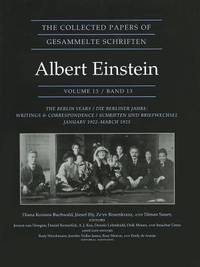
2018ref. __069117881XPrinceton Univ Pr 2018. Hardcover. New. bilingual edition. 1075 pages. 10.50x8.00x2.00 inches. Princeton Univ Pr hardcover
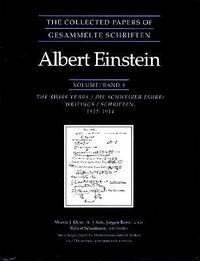
1995ref. __0691037051Princeton Univ Pr 1995. Hardcover. New. 420 pages. 10.50x8.00x2.00 inches. Princeton Univ Pr hardcover
2015ref. __069116410XPrinceton Univ Pr 2015. Hardcover. New. documentary edition. 1208 pages. 10.75x8.50x2.75 inches. Princeton Univ Pr hardcover
2012ref. __0691156735Princeton Univ Pr 2012. Hardcover. New. 1st edition. 904 pages. 10.00x7.75x2.75 inches. Princeton Univ Pr hardcover
ref. 0691033226.Ghardcover. Good. Access codes and supplements are not guaranteed with used items. May be an ex-library book. hardcover
ref. 0415255384.Ghardcover. Good. Access codes and supplements are not guaranteed with used items. May be an ex-library book. hardcover
ref. 3540877762.Gpaperback. Good. Access codes and supplements are not guaranteed with used items. May be an ex-library book. paperback
2021ref. __0691216827Princeton Univ Pr 2021. Paperback. New. 544 pages. 10.00x7.48x1.10 inches. Princeton Univ Pr paperback
ref. 0691026106.Gpaperback. Good. Access codes and supplements are not guaranteed with used items. May be an ex-library book. paperback
ref. 0078824028.Gpaperback. Good. Access codes and supplements are not guaranteed with used items. May be an ex-library book. paperback
ref. 1025605748.Ghardcover. Good. Access codes and supplements are not guaranteed with used items. May be an ex-library book. hardcover
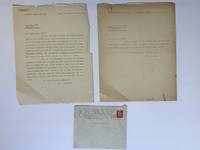
1931ref. 1403337Potsdam Germany 1931. Two letters by Albert Einstein. The first is a single-paged autograph letter signed by Albert Einstein with one horizontal fold and one vertical fold. In Very Good condition . Measuring 22.5 x 28.5 cm. Letter accompanied with mailing envelope both with matching paper-clip rust stain. Letter with some light wear along edges small staining to lower corner. Addressed to G. W. Meyer and dated 8 Oktober 31 in Potsdam the Letter reads in full: "Sehr geehrter Herr! Indem ich Ihnen für die Uebersendung des Buches von Henry George bestens danke sende ich Ihnen anliegend die gewünschte Meinungsäusserung mit der Bitte um Weiterleitung an Mrs. Evans. Mit ausgezeichneter Hochachtung" and signed in ink "A. Einstein". He thanks Meyer for serving as an intermediary in getting a book to him and for forwarding the enclosed letter. The second letter is a typed copy of Einstein's previously enclosed letter presumably made by Meyer before he passed the original on to Evans. Addressed to R. W. Evans and dated 8.10.1931 in Potsdam the letter discusses Henry George's economic theory of poverty and land nationalization compares it to Franz Oppenheimer's work and proposes questions to be asked. Presumably he was sent a copy of Henry George's Progress and Poverty. First published in 1879 it sparked the Progressive Era discussing the paradox of increasing inequality and poverty amid economic and technological progress as well as the economic value of land. Consignment. Shelved Case 3. The Letter reads in full: "Sehr geehrte Mrs. Evans! Ich habe das Buch von Henry George zum grössten Teil mit ausserordentlichem Interesse gelesen und glaube dass es in der Hauptsache einen unanfechtbaren Standpunkt vertritt insbesondere was die Ursache der Armut betrifft. Nie in diesem Buch vertretenen Ansichten stimmen soweit ich es beurteilen kann vollkommen mit den Resultaten des zeitgenössischen Professors Franz Oppenheimer überein der sie offenbar selbständig herausgefunden hat. Nicht einverstanden bin ich mit der Theorie des Zinses. Mit dem vorgeschlagenen Heilmittel der Verstaatlichung des Bodens und der Bodenschätzung scheint mir allerdings mehr ein Problem als eine Lösung gegeben zu sein. Soll z. Beispiel ein Boden Eigentum der Gemeinschaft das darauf hingestellte Haus aber Privateigentum sein Jedenfalls ist es schon von höchster Wichtigkeit dass das Wesen des Uebels klar aufgezeigt ist. Schon darum wäre es wichtig wenn das Buch die ihm gebührende Beachtung fände. Mit ausgezeichneter Hochachtung gez. A. Einstein." 1403337. Shelved Dupont Bookstore. unknown
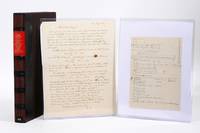
1932ref. 3054Caputh Germany: np 1932. First edition. Very Good. AN IMPORTANT SCIENTIFIC LETTER FROM EINSTEIN TO HIS CLOSEST MATHEMATICAL COLLABORATOR ACCOMPANIED BY A MANUSCRIPT LEAF OF CALCULATIONS IN EINSTEIN'S HAND ON THE SAME LINE OF RESEARCH. Although the original association of the letter and the leaf of calculations cannot be confirmed the two pieces clearly emerge from the same scientific context and have been preserved together. A superb pair from the final months of Einstein's German period. The Letter: In this intense and intellectually urgent letter Einstein writes to Walther Mayer his indispensable mathematical collaborator often referred to as "Einstein's Calculator" describing a newly conceived approach to the technical obstacles in their unified-field theory involving semi-vectors spinors and modified Dirac-type equations. Einstein tells Mayer he believes he "sees a new possibility" one that determines key constants in the system without resorting to the semi-vector construction. He then sketches the structure of the revised scheme points to the condition under which the full set of field equations reduces to a single one and warns that if this same collapse occurs in the general case "the whole thing would be useless." With his imminent departure from Germany he urges Mayer to examine the issue quickly and gives instructions for where a reply will reach him while en route. Dirac and De Broglie - Significance of the Scientific References: Of particular importance is Einstein's explicit engagement in this letter with the work of Paul Dirac and Louis de Broglie two of the central figures in early quantum theory. Einstein refers directly to the Dirac equations introduced only a few years earlier which provided a relativistic formulation of the electron and played a foundational role in quantum mechanics. He also invokes the De Broglie equations for matter waves reflecting his continued effort to reconcile quantum ideas with relativistic field theory. These references place the letter squarely at the intersection of Einstein's unified-field program and the emerging quantum framework he famously regarded with both fascination and skepticism. The letter thus documents Einstein actively testing whether concepts originating in quantum mechanics-Dirac's relativistic wave equation and De Broglie's wave-particle duality-could be absorbed into a geometrically unified classical field theory. Letters in which Einstein explicitly grapples with Dirac and De Broglie at this technical level are rare and represent an important record of his engagement with the central theoretical developments of the early twentieth century. Historical Context: Einstein's collaboration with Walther Mayer beginning around 1930 produced some of the most technically sophisticated papers of Einstein's later career. Together they developed new mathematical structures-semi-vectors spinors and higher-dimensional tangent-space formulations-used in their unified-field attempts. This letter dates from December 1932 only weeks before Einstein left Germany permanently and belongs to the final phase of their joint work published in the Sitzungsberichte of the Prussian Academy. Einstein valued Mayer so highly that he later persuaded the Institute for Advanced Study to create a permanent position for him the only such appointment ever granted for one of Einstein's collaborators. The Manuscript Calculations: Accompanying the letter is a two-page manuscript leaf containing Einstein's working calculations: trial expressions constraint conditions and variant formulations of the same type of semi-vector and spinor problems addressed in the letter. While we cannot confirm that these pages were originally enclosed with the letter they concern the same scientific material and have been preserved alongside it. Einstein manuscript leaves of this depth and technical significance-especially when tied to a known collaborative problem-are scarce. Significance: Whether or not originally sent together the letter and the calculations form a powerful and coherent scientific pair offering a rare view of Einstein actively working through equations testing ideas and relying on Mayer to verify mathematical structure. They capture Einstein at a critical inflection point in both his scientific life and personal circumstances as he prepared to leave Germany forever. --------- The letter from Einstein to Mayer reads in full translated from the original German: Dear Mr. Mayer! I believe I see a new possibility which promises success. It is along the lines of the recently devised way according to which one places zero on the right side of the Dirac-Equations. The novelty is in the fact that the constants a1 . a4 aside from a totally irrelevant factor are completely known without passing on to the specific Semi-Vectors. After omission of the _-terms the equations read Ee st ys = s 1 xe Or for De-Broglie-Equations of the restless particle E4 st ys = s 1a x4 Here is what's new: How does one choose the ay so that the De Broglie - Choices stay largely undetermined Result: The four equations 1a reduce themselves into a single one when and only when if one lets a1 = 1 a2 = 1 a3 = 1 a4 = 1 I believe that with this selection ay is for the equation describing the _-terms 1 the fitting substitute for the DeBroglie-Equation. These equations are already supplied by the simplest Hamilton function. See if the general equations 1 degenerate with this placing for a as well. If this were the case the whole thing would be useless. I leave on Saturday. A letter that is sent to Antwerp to the `Oakland' Hapag Antwerp harbor will reach me until December 13. Cordial greetings from your A. E. Autograph Letter Signed Written in German. One page 8.5 x 11 in.; 216 x 279 mm. probably Caputh near Potsdam Germany the location of Einstein's country home Sunday 4 December 1932. Scattered spotting affecting four words; usual folds. WITH: Two-page leaf of mathematical calculations. Housed together in decorated half-leather box by noted book artist Sjoerd Hofstra. np unknown
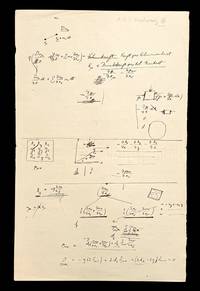
1912ref. 3056np: np 1912. first edition. custom box. Very Good. ON THE ROAD TO RELATIVITY: A four-panel working bifolium from Einstein's early post-Minkowski tensor phase. A remarkable working sheet showing Einstein making tensor formalism physically operational for continuum mechanics. Across three working zones the manuscript moves from a formal four-dimensional tensor transformation identity written in a distinct unidentified hand to Einstein's own derivations involving Volumenkraft Druckkraft stress force density diagrammatic testing and a heavily underlined mechanical equilibrium result. The folded rotated format gives the sheet the character of a compact notebook in miniature: formal tensor language brought into contact with physical terms local force relations diagrams and repeated calculation. The manuscript's all-lower-index notation explicit summations in Einstein's hand mixed coordinate idiom second-hand tensor identity and visible effort to make tensor language mechanically operational point most naturally to the 1912-1913 Zurich tensor period when Einstein was absorbing the post-Minkowski mathematics that General Relativity would require. Later revisitations cannot be entirely excluded but they explain the sheet less naturally. A rare survival documenting Einstein's working method on one of the foundational matter-side problems on the road to General Relativity. EINSTEIN ALBERT. Autograph scientific manuscript unsigned and undated most plausibly 1912-1913. A four-panel working bifolium 330 × 210 mm open from Einstein's early post-Minkowski tensor period retained among his private research papers and annotated by Helen Dukas: "A.E.'s Handwriting H.D." Provenance: Sotheby's New York 26 June 1998; Jagdish Mehra. PLEASE CLICK ON THE LINK BENEATH THE IMAGES FOR A PDF CONTAINING THE FULL DESCRIPTION. np unknown
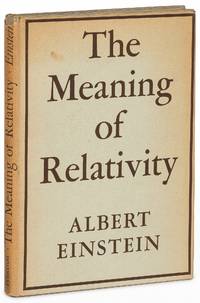
1945ref. 617621Princeton New Jersey: Princeton University Press 1945. Hardcover. Near Fine/Very Good. Second edition with a new appendix by Einstein and translated by Ernst G. Straus. Octavo. 135pp. Tiny owner name on front fly else fine in uniformly and modestly spine-toned very good dust jacket with nominal soiling. Princeton University Press hardcover
ref. B9781032378411Paperback / softback. New. There’s religion in my marketing! There’s marketing in my religion! Selling the Sacred explores the religio-cultural and media implications of a two-sided phenomenon: marketing religion as a product and marketing products as religion. paperback
1968ref. 015659New York: G.P. Putnam's Sons 1968. Nice copy in its first printing. Unmarked tight and square. Tan boards with black lettering bright and fresh. Two short creases on spine. Light dusting to top page edges. Price intact jacket is bright and fresh with no sunnin. Rear panel has faint foxing. Minor wear at spine ends. In mylar. . First American Edition. Hardcover. Very Good Plus to Near Fine/Very Good Plus to Near Fine. 8vo - over 7¾" - 9¾" tall. G.P. Putnam's Sons Hardcover
ref. 1412924693.Gpaperback. Good. Access codes and supplements are not guaranteed with used items. May be an ex-library book. paperback
ref. 0691085269.Ghardcover. Good. Access codes and supplements are not guaranteed with used items. May be an ex-library book. hardcover