1.949 Ergebnisse
1930Best.-Nr. 46969New York The Science Press 1930. Royal8vo. Bound in contemporary black full cloth with gilt lettering to spine. In "Science" Vol. 71 1930. Small stamp to lower part of front free end-paper. Otherwise a very fine and clean copy. Pp.608-10. Entire volume: VIII 670 pp advertisements. First printing. Einstein was invited to give a lecture at the University of Nottingham by a lecturer there Henry Brose who also acted as interpreter. Einstein came with his wife Elsa on 6th June 1930. He was due to start the lecture at 3.45pm but did not arrive until 6.30 as he took a detour to visit the birth place of Isaac Newton. The blackboard on which he wrote was quickly varnished over when the lecture was over and is still preserved in the university. While in Nottingham Einstein commented on George Green's contribution to mathematics saying that he had been 20 years ahead of his time.Weil no 174a. hardcover
1931Best.-Nr. 28366Berlin Gruyter & Co. 1931. 4to. Orig. printed orange wrappers. Offprint/Sonderausgabe aus Sitzungsberichten.pp.1-5. Fine fresh copy. First edition in the rare Offprint with the separate printed title and separate pagination. See Weil No. 179 where this is not mentioned.The early Offprints from "Sitzungsberichten." are called "Sonderabdruck" up to Weil No.165 including this. From Weil 166 they are called "Sonderausgabe.". - Before 161 up to 160 the Offprints do not have separate title and pagination the pagination follows the numbering in the periodical. From 166 the Offprint has both separate printed title and pagination. - So Weil Nos 161-165 is still "Abdruck" but with separate title and pagination. These facts are not mentioned in the bibliographies. unknown
1906Best.-Nr. 50324Leipzig Ambrosius Barth 1906. 8vo. In contemporary halv calf with four raised bands and gilt lettering to spine. In "Annalen der Physik" Vierte Folge Band 21. Entire volume offered. Stamp to title page. Wear to extremities. Internally fine and clean. Pp. 583-86. Entire volume: 1055 VIII pp. First printing of Einstein's paper on a method for the determination of the transversal and longitudinal mass of the electron. This eventually caused a major breakthrough in Weil no. 14 hardcover
1920Best.-Nr. 29309Berlin Julius Springer 1920. Clothbacked boards. Bound with orig. printed wrappers. Small inkspots in inner margins of wrappers. 15 pp. First edition. - Weil No. 111. hardcover
1953Best.-Nr. 46832Leiden 1953. 8vo. In the original green printed wrappers. A fine and clean copy. 8 pp. frontispiece-portrait of Lorentz. First printing of Einstein's essay on Hendrik Lorentz a Dutch physicist who shared the 1902 Nobel Prize in Physics with Pieter Zeeman for the discovery and theoretical explanation of the Zeeman effect. Einstein was particulaly interested and indebted to Lorenz; Lorenz derived the transformation equations subsequently used by Albert Einstein to describe space and time. unknown
1931Best.-Nr. 38647Berlin Akademie der Wissenschaften 1931. 4to. Orig. printed green wrappers in Sitzungsberichte 1931 Heft XIII-XV pp. 257-65. Small nicks to frontwrapper. First edition in the periodical form. - Weil: 180. unknown
1930Best.-Nr. 28376Berlin Gruyter & Co. 1930. 4to. Orig. printed orange wrappers. Offprint/Sonderausgabe aus Sitzungsberichten.pp. 1-13. Fine fresh copy. First edition in the rare Offprint with its separate printed title and separate pagination. Se Weil No. 170 not mentioning this.The early Offprints from "Sitzungsberichten." are called "Sonderabdruck" up to Weil No.165 including this. From Weil 166 they are called "Sonderausgabe.". - Before 161 up to 160 the Offprints do not have separate title and pagination the pagination follows the numbering in the periodical. From 166 the Offprint has both separate printed title and pagination. - So Weil Nos 161-165 is still "Abdruck" but with separate title and pagination. These facts are not mentioned in the bibliographies. unknown
1941Best.-Nr. 46476Tucuman Argentina 1941. Royal8vo. Orig. printed wrappers. Offprint from "Revista. Universidad Nacional de Tucuman" Series A Matematicas y Fisica Teorica Vol. 2 Diciembre de 1941 Nos 1 y 2. Pp. 11-15. Fine and clean. This copy has belonged to Abraham Pais 1918-2000 - the famous Einstein scholar theoretical physicist and Einsteins collegue at Princeton - and having his name on top of the frontwrapper "A Pais" First edition of a scarce paper in the offprint version. The paper "represents the basis of the one written by the same author in collaboration with Wolfgang Pauli in 1943 in which by following analogous lines the proof of the non-existence of regular particle-type solutions was generalized to the case of cilyndrical geometries in Kaluza-Klein theory Einstein & Pauli 1943. Besides other generalizations were subsequently presented. The non-existence of such solutions in classical unified field theory was undoubtedly an important criterion leading Einstein's investigations."Galvagno and Giribet."In his search for a unified field theory that could undercut quantum mechanics Einstein considered five-dimensional classical Kaluza-Klein theory. He studied this theory most intensively during the years 1938-1943. One of his primary objectives was finding a non-singular particle solution. In the full theory this search got frustrated and in the x5-independent theory Einstein together with Pauli argued it would be impossible to find these structures." Jeroen van Dongen.Weil: 208. - Boni: 243. unknown
1938Best.-Nr. 42901Paris Freien Deutschen Hochschule 1938. Orig. printed wrappers. In. "Zeitschrift für Freie deutsche Forschung" Vol. I no. 1:pp. 5-19 a. no. 2 pp. 1-14. Whole issues present: "Nummer" 1 u. 2. pp. 1-168 a. pp. 1-144. The German version from the same year in which the paper was printed in "Franklin Institute Journal" vol. 221 1936. - Weyl. 197. unknown
1916Best.-Nr. 38829Leipzig J.A. Barth 1916. Orig. printed wrappers. Frontwrapper lacking lower left coener. "Annalenn der Physik. Vierte Folge. Band 51. 6. Heft." =1916 No. 22 pp. 577-684 and 3 plates. Einstein's paper: pp. 639-42. Internally clean and fine. First edition. Weil No 81. unknown
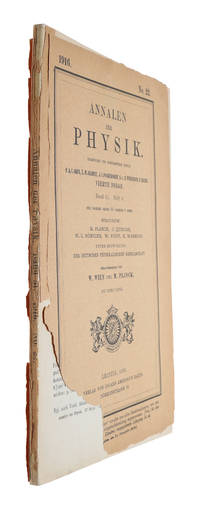
1910Best.-Nr. 38842Leipzig J.A. Barth 1910. Contemp. hcalf. Spine gilt a fs scratches to spine. VIII1584 pp. and 6 plates. Einstein papers: pp. 1096: pp. 1105-1115; pp. 1275-1298. Fine and clean. The whole volume offered. All three papers first edition. The purpose of "A theorem in probability and its application in the Theory of radiation" is to demonstrate that the failure of statistical mechanics with respect to the radiation law Rayleigh - Jeans law contradicted by experience cannot be removed by the conjecture that perhaps the individual statistical events should not follow the usual law of independence product of probabilities instead of assuming a certain interdependence between them. Lanczos. The second paper "Statistical investigation on of the motion of an oscillator in a radiation field" makes use of the results of the previous investigation. Einstein's aim is to demonstrate that the Rayleigh-jeans law of radiation contracdicted by the physical facts is an unavoidable consequence of statistics even if we avoid any kind of assumption which may be suspected of needing correction. Lanczos. The third paper "Theory of the opalescence of homogenous fluids and fluid mixtures near the critical state" is an importent investigation and one of the most difficult of all his papers to understand. The aim of the paper is to complement the work of Smoluchovski Ann. d. Physik25 1908 who gave a general explanation of the strong density fluctuations - and the opalescence thus generated - of two fluids near the critical state of mixture or a single fluid near the critical state of condensation on the basis of the kinetic theory of heat. he did notgive howeverthe quantitative details concerning the scattered light associated with this phenomenon. Lanczos. - Weil Nos 34 35 and 36 with an asterix denoting major work. unknown
1907Best.-Nr. 41347Leipzig Barth 1907. 8vo. Extract from "Annalen der Physik IV23" pp.197-198. First edition in the periodical form. - Weil No. 17. unknown
1923Best.-Nr. 49811Berlin Vieweg u. Sohn 1923. 8vo. Bound in contemporary full cloth. In "Zeitschrift für Physik. Hrsg. von Karl Scheel. 16. Band" entire volume offered. Embossed stamp to title page. P. 228. Entire volume: IV 2 409 pp. First printing of Einstein commentary to Friedman's seminal papers in which he "introduced into cosmology two concepts of revolutionary importance the age og the world and the creation of the world"Kragh Cosmology and Controversy. Also contained in the volume are:BOTHE W.: Eichmethoden für Emanationselektrometer Über eine neue Sekundärstrahlung der Röntgenstrahlen. - First appearance of Bothe's early paper on the Compton effect which together with his later paper in Bd 32 Zeitschrift für Physik awarded him the Nobel Prize in Physics "for the coincidence method and his discoveries made therewith".PAULI JR. W. : Über die Gesetzmässigkeiten des anomalen Zeemaneffektes. LANDÉ A.: Zur Theorie der Röntgenspektren.HEISENBERG W. M. BORN.: Die Elektronenbahnen im angeregten Heliumatom.Weil 122 hardcover
1912Best.-Nr. 38839Leipzig J.A. Barth 1912. Bound in two contemp. hcalf richly gilt spine and one later full cloth. A library stamp on the first volume. "Annalen der Physik. Vierte Folge. Band 37 und 38. Hrsg. von W. Wien und M. Planck." VIII1048;VIII1064 pp. 58 plates. Einstein papers: pp. 832-38 vol.37 pp. 881-84 Nachtrag vol. 38; pp. 443-458 vol. 38; p. 888 vol. 38; pp. 1059-1064 vol. 38; Planck: pp. 642-656. Internally fine and clean. Both volumes offered. All papers first edition. In the first paper "Thermodynamical derivation of the photochemical equivalence" Einstein calls "the law of photochemical equivalence" the statement that the decomposition of one gram equivalent of any substance by a photochemical proces demands the radiation energy of 'Nhv' where N=the Avogadro number. In this paper he demonstrates how this law is deducible by purely thermodynamical arguments if certain olausible assumotions are made. Lanzos. - The second paper "Concerning the theory of a static gravitational field" states that the 'equivalence hypothesis' permits us to come to very definite conclusions about the behaviour of a static gravitational field. - The next Einstein paper gives an answer to J. Stark as Stark claimed priority to the photochemical equivalence law. - In the last paper "Relativity and Gravitation. Reply to a remark of M. Abraham" Einstein elaborates his answer to the critique of M. Abraham. - Weil Nos 46 1-2 a. 48. - Planck Akademie No 95. hardcover
1923Best.-Nr. 49498Berlin Julius Springer 1923. 8vo. Bound in contemporary full cloth with gilt lettering to spine. Entire volume 19 "Zeitschrift für Physik" Library stamp to title-page and paper label pasted on to lower part of spine. Minor wear to extremities. A nice and clean copy. Pp. 301-6. Entire volume: IV 426 pp. First edition.Weil 138; Schilpp-Shields 178.The volume also contains:Meitner Lise. Ueber eine mögliche Deutung des kontinuierlichen beta-Strahlenspektrums. Pp. 307-321. hardcover
1903Best.-Nr. 38800Leipzig Johann Ambrosius Barth 1903. Contemp. hcloth. Some small nicks to spine. = "Annalen der Physik. Vierte Folge. Band 11. Herausgegeben von Paul Drude.". VIII1144pp. and 6 plates. The Einstein paper: pp. 170-187. Internally fine and clean. First edition of Einsteins fourth paper. In his paper from 1902 Einstein "says in his introduction that nobody has yet succeeded in deriving the conditions of thermal equilibrium and of the second law of thermodynamics from probability considerations although Maxwell and Boltzmann came near to it. Willard Gibbs is not mentioned. In fact Einstein's paper was written in ignorance of Gibbs paper published 1901. In the present paper Einstein builds the theory on another basis not used by Gibbs namely on the consideration of a single system in course of time later called "Zeit-Gesamtheit" time assembly and proves that this is equivalent to a certain virtual assembly of many systems Gibb's micro-canonical assembly.Einstein at once proceeded to apply his theorems to a case of utmost importance namely to systems of a size suited for demonstrating the reality of molecules and the correctness of the kinetic theory of matter."Walter Alicke. - Weil No. 4. hardcover
1929Best.-Nr. 28364Berlin Gruyter & Co. 1929. 4to. Orig. printed orange wrappers. Offprint/Sonderausgabe aus Sitzungsberichten.pp. 1-6. Fine fresh copy. First edition in the rare Offprint now called "Sonderausgabe" instead of "Sonderabdruck" having separate printed title and separate pagination. See Weil: 166 where this is not mentioned.The early Offprints from "Sitzungsberichten." are called "Sonderabdruck" up to Weil No.165 including this. From Weil 166 they are called "Sonderausgabe.". - Before 161 up to 160 the Offprints do not have separate title and pagination the pagination follows the numbering in the periodical. From 166 the Offprint has both separate printed title and pagination. - So Weil Nos 161-165 is still "Abdruck" but with separate title and pagination. These facts are not mentioned in the bibliographies.Weil No. 166. unknown
1902Best.-Nr. 49500Berlin J.A. Barth 1902. 8vo. Bound in contemporary half cloth with paper label pasted on to spine. In "Annalen der Physik. Vierte Folge. Band 8. Hrsg. von Paul Drude.". Entire volume offered. Front board loose and stamp to pasted down front free end paper. Otherwise a fine copy. First edition of Einstein's second publication. Here "Einstein was looking for experimental support for a hypothesis concerning molecular forces"Pais Subtle is the Lord P. 56 Weil No 2. hardcover
1907Best.-Nr. 50595Leibzig Johann Ambrosius Barth 1907. 8vo. In contemporary full cloth with gilt lettering to spine. In "Annalen der Physik" Vierte Folge Band 23. Entire volume offered. Ex-libris pasted on to top right corner of pasted down front free end-paper. Light rubbing to extremities a very fine and clean copy not an ex-library copy. Pp.371-384. Entire volume: VIII 1000 pp. 4 plates. First edition of the first explicit statement of Einstein's landmark energy-mass equation E=mc2.Nearly all descriptions of Einstein's scientific work state that the mass-energy equivalence E=mc2 was first formulated in Einstein's 1907 review paper 'Über das Relativitätsprinzip und die aus demselben gezogenen.' published in 'Jahrbuch der Radioaktivität und Elektronik' see Weil no. 21 and Dictionary of Scientific Biography vol. 4 pp.323 for examples. However in his paper 'Über die von Relativitätsprincip geforderte Trägheit der Energie' the offered paper which predates the former mentioned by six months Einstein gave a clear statement of the mass-energy equivalence E=mc2. See Lanczos: The Einstein Decade pp.149-150 and 153 as well as Volume 2 of 'The Collected Papers of Albert Einstein' pp. 428.Einstein's first paper regarding the relation E=mc2 is his fourth 1905 paper 'Ist die Trägheit eines Körpers von seinem Energieinhalt abhängig'. In this short paper Einstein showed that a body releasing the energy E in the form of radiation will have its mass decreased by E/c2 and concluded that the mass of a body is a measure of its energy content e.g. that all energy has mass. The next time Einstein returns to the subject is in his 1906 paper 'Das Prinzip von der Erhaltung der Schwerpunkts Bewegung und die Trägheit der Energie.'. Here Einstein concluded that one must either ascribe the inertial mass E/c2 to any form of energy E or else give up the fundamental law mechanics regarding conservation of the motion of the center of gravity. Then finally in the 1907 paper 'Über die von Relativitätsprincip geforderte Trägheit der Energie.' the offered paper Einstein makes the decisive step of assuming that all mass has energy. On page 382 Einstein considers the total energy of a moving mass point as the sum of its kinetic energy and its rest energy. In classical mechanics it is most convenient to set the second term to zero but in relativistic mechanics one obtains the simplest expression by setting the rest energy equal to mc2. Einstein then continues to show that this stipulation cannot lead to a contradiction in any relativistic argument. In a footnote on page 382 Einstein states for the first time the equation E=mc2 and mentions that this equation is the expression of the principle of the equivalence of mass and energy - see Volume 2 of 'The Collected Papers of Albert Einstein' pp. 428.The volume contains another paper by Einstein "Bemerkungen zu der Notiz von Hrn. Paul Ehrenfest: "Die Translation deformierbarer Elektronen und der Flächensatz"" pp.206-208. - Weil No. 18.Collected Works Doc. 45. Weil 19. Boni 19. hardcover
1906Best.-Nr. 38833Leipzig J. A. Barth 1906. Contemp. hcloth. Light wear to edges. A small tear at upper part of fronthinge. "Annalen der Physik. Vierte Folge. Band 21. Hrsg. von W.Wien und M. Planck". VIII1056 pp.and 9 plates. Einstein paper: pp. 583-86. Internally clean and fine. The whole volume offered. First edition. Einsten describes in this paper "Method for the determination of the ratio of the transversal to the longitudinal mass of the electron" an apparatus which would make it possible to determine with great accuracy the law according to which the mass of the electron changes with the velocity. - Weil No 14. hardcover
1920Best.-Nr. 29310Berlin Julius Springer 1920. Uncut in orig. printed wrappers. 15 pp. First edition. - Weil No. 111. unknown
1920Best.-Nr. 9913Leipzig Berlin 1920. Orig. boards. Back discoloure. 4146 pp. -The corrected third edition of these importent contributions to the theory of relativity. hardcover
1927Best.-Nr. 22776Berlin 1927. Orig. printed orange wrappers. Back strengthend with matching paper. Fresh copy. Offprint/Sonderabdr. aus "Sitzungsberichte". pp. 23-30. First edition. Weil No. 156. unknown
1938Best.-Nr. 46475Princeton NJ. Annals of Mathematics 1938 a. 1940. Both papers in orig. printed wrappers. Offprints from "Annals of Mathematics" Vol. 39 No. 1 january 1938 and Vol. 41 No. 2 April 1940. Pp. 65-100 and pp. 455-464. Both clean and fine. This copy has belonged to Abraham Pais 1918-2000 - the famous Einstein scholar theoretical physicist and Einsteins collegue at Princeton - and having his name on top of both frontwrappers "A Pais". First editions in the scarce offprint versions of Einstein's last and highly important contributions to General relativity and in which is shown that the equation of motion follows directly from the field equation that defined the geometry."Einstein's last importent contribution to general relativity deals again with the problem of motion. It is the work done with Leopold Infeld and Banash Hoffmann on the N-body problem of motion. In these papers the gravitational field is no longer treated as external. Instead it and the motion of its singular sources are treated simultaneously. Anew approximationscheme is introduced in which the fields are no longer necessarily weak but in which the source velocities are small compared with the light velocity . The equations obtained have found use in situations where Newtonian interaction must be included. 'These equations are widely used in analyses of planetary orbits in the solarsystem. For example the Cal Tech Jet Propulsion Laboratory uses them in modified form to calculate ephmerides for high-precision tracking of planets and spacecraft."Pais "Subtle is the Lord" p. 290-91."The problem of the equation of motion of bodies is the following. The 1916 theory had a classical structure in the sense that there were both field equations the curvature of space-time is determined by the mass and motion of bodies in space-time and equations of motion of bodies the world line of small mass is a geodesic. Are these two statements really separate If the field equations were linear they indeed would be. They are not linear however and Einstein showed in the papers offered that if matter is represented by a point singularity of the metric field these singularities are located on world lines that are geodesics of space-time provided its metric satisfies the equation of general relativity."DSB.Weil: 202 a. 295 both with an asterix denoting a major paper. - Boni: 236 a. 236.1. unknown
1902Best.-Nr. 49829Berlin J.A. Barth 1902. Contemp. hcalf. Gilt spine. Some scratches along edges. Stamp on halftitle and title-page. "Annalen der Physik. Vierte Folge. Band 8. Hrsg. von Paul Drude." VIII928 pp. and 7 plates. Einstein paper: pp. 798-814. Internally fine and clean. The entire volume offered. First editon. - Weil No 2. unknown