Einstein AlbertABAA

2.976 resultados
1911ref. 432921911. Einstein Albert 1879-1955. Berichtigung zu meiner Arbeit: "Eine neue Bestimmung der Moleküldimensionen." Offprint from Annalen der Physik 34 1911. 591-592pp. 224 x 146 mm. Original printed wrappers a little chipped splint in lower spine. Light toning but very good. First Edition Offprint Issue. Einstein's correction to his formula for the viscosity coefficient = 1 a key equation in his 1905 doctoral thesis in which he had presented a new theoretical method for determining molecular radii and Avogadro's number. In 1910 Jacques Bacelin a pupil of French physicist Jean-Baptiste Perrin obtained experimental results indicating a possible error in Einstein's formula. "That prompted Einstein after an unsuccessful attempt to find an error to ask his student and collaborator Ludwig Hopf to check his calculations and arguments . . . Hopf did find an error in the dissertation namely in the derivatives of some velocity components and obtained for a corrected coefficient 2.5 . . .In early 1911 Einstein submitted his correction for publication and recalculated Avogadro's number. He obtained a value of 6.56 x 10²³ per mole a value that is close to those derived from kinetic theory and Planck's black-body radiation theory" Duplantier pp. 216-217. Duplantier "Brownian motion ‘diverse and undulating'" in Einstein 1905-2005: Poincaré Seminar 2005 pp. 201-293. Pais Subtle is the Lord p. 92. Weil Albert Einstein Bibliography 41. . unknown books
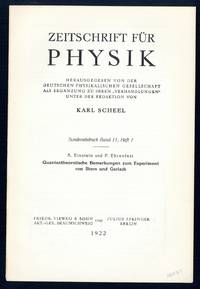
1922ref. 432871922. Einstein Albert 1879-1955 and Paul Ehrenfest 1880-1933. Quantentheoretische Bemerkungen zum Experiment von Stern und Gerlach. Offprint from Zeitschrift für Physik 11 1922. 31-34pp. 229 x 155 mm. Original printed self-wrappers. Light toning but fine otherwise. First Edition Offprint Issue. In 1922 the physicists Otto Stern and Walther Gerlach conducted a now-classic experiment in which a beam of silver atoms was streamed through an inharmonious magnetic field in order to observe the atoms' deflection patterns. Rather than a random and continuous distribution as predicted by classical theory the atoms passing through the field were deflected up or down by a specific amount demonstrating that they had intrinsically quantum properties. The Stern-Gerlach experiment corroborated the Bohr-Sommerfeld model of the atom and strongly influenced later developments in 20th century physics. However the experiment also created some serious difficulties for quantum physicists in the period before the rise of the "new" quantum mechanics. Einstein and Ehrenfest addressed one of these difficulties—connected with space quantization—in their joint paper in which "they dealt in particular with the problem of how the orbits of the atom would obtain their discrete directions which they exhibit while passing through the inhomogeneous magnetic field. Under the assumption that the mechanism causing the orientation was provided by the interaction with the radiation field Einstein and Ehrenfest estimated that for a field strength of 10000 G a change in the direction of the orbit would take place in roughly 1011 s; this long time interval would be reduced in the presence of heat radiation at room temperature . . . to about 109 s. How could they asked the experimental situation be explained which implied that the discrete orientations of the orbits in silver atoms were obtained in less than 10-4 s. In order to deal with this evident puzzle Einstein and Ehrenfest proposed two alternatives: first that the silver atoms were always in the states of spatial quantization; second the orientations of the electron orbits arose from an interaction of the atoms with the radiation field which involved much smaller reaction times . . . However they found that both alternatives created considerable difficulties in the understanding of the atomic processes . . . Thus Einstein and Ehrenfest concluded: 'The difficulties mentioned above show how unsatisfactory are both interpretations of the results found by Stern and Gerlach'" Mehra & Rechenberg The Historical Development of Quantum Theory 1 pp. 443-444. Pais Subtle is the Lord p. 328. Weil Albert Einstein Bibliography 121. . unknown books
1932ref. 433001932. Offprint from Sitzungsberichte der Preussischen Akademie der Wissenschaften 32 1932. 31pp. 256 x 183 mm. Original printed wrappers a little chipped and darkened small splits in spine. Very good. First edition offprint issue. Einstein's work on semivectors "was stimulated by Ehrenfest's insistence on a better understanding of the relation between single-valued and double-valued representations of the Lorentz group . . . Einstein and Mayer went on to relate semivectors to the Dirac equation and to generalize the formalism to general relativity" Pais Subtle is the Lord pp. 451-452. Weil Albert Einstein Bibliography 186. unknown books
1906ref. 432891906. Einstein Albert 1879-1955. Über eine Methode zur Bestimmung des Verhältnisses der transversalen und longitudinalen Masse des Elektrons. Offprint from Annalen der Physik 21 1906. 583-586pp. 223 x 145 mm. Original printed wrappers chipped spine splitting minor spotting. Light toning but very good. First Edition Rare Offprint Issue. In his landmark 1905 paper on special relativity Einstein used the velocity-dependent concepts of transverse and longitudinal mass for the moving electron these terms have now been replaced with the concept of relativistic mass first defined by Lewis and Tolman in 1909. In the present paper Einstein proposed an experimental method for determining the ratio of the transverse to the longitudinal mass and invited experimentalists to verify his special theory of relativity. Einstein later abandoned velocity-dependent mass concepts stating in 1948 that "it is better to introduce no other mass concept than the ‘rest mass' m" quoted in L. B. Okun "The concept of mass" Physics Today 1989: 31-36. Lavenda A New Perspective on Relativity pp. 7-8. Weil Albert Einstein Bibliography 14. . unknown books
1915ref. 432951915. Einstein Albert 1879-1955 and Wander Johann de Haas 1878-1960. Notiz zu unserer Arbeit "Experimenteller Nachweis der Ampèreschen Molekularströme." Offprint from Verhandlungen der Deutschen Physikalischen Gesellschaft 17 1915. 1 sheet p. 420. 228 x 156 mm. Original printed wrappers. Fine copy. First Edition Offprint Issue. In 1915 Einstein and Dutch physicist Wander Johannes de Haas conducted gyromagnetic experiments leading to the discovery of the Einstein-de Haas effect which corresponds to the mechanical rotation induced in a ferromagnetic cylinder suspended inside a coil when an impulse of electric current is sent through the coil. Einstein was very enthusiastic about the experimental results stating that he and de Haas had "given firm proof of the existence of Ampère's molecular currents" quoted in Pais Subtle is the Lord pp. 245-246. Einstein and de Haas published their results in a paper published earlier in 1915 see Weil 73; the present "Notiz" is a response to a communication from American physicist Samuel Jackson Barnett who had begun performing similar experiments in 1909 and obtained results complementing those of Einstein and de Haas. Weil Albert Einstein Bibliography 73n. . unknown books
1921ref. 433071921. Offprint from "Der Festschrift der Kaiser Wilhelm Gesellschaft zur Förderung der Wissenschaften zu ihrem 10jährigen Jubiläum" Berlin: Julius Springer 1921. 50-52pp. 260 x 175 mm. Original printed wrappers a little chipped. Very good. First separate edition. Title translation: A simple application of Newton's law of gravitation to globular clusters. Weil Albert Einstein Bibliography 117. unknown books
1908ref. 432171908. Einstein Albert 1879-1955 and Jakob Johann Laub 1884-1962. Über die elektromagnetischen Grundgleichungen für bewegter Körper. Offprint from Annalen der Physik 4th series 26 1908. 532-540pp. 225 x 146 mm. Original printed wrappers. Fine. First Edition Offprint Issue. Einstein's first paper written jointly with a collaborator on the relativistic electrodynamics of ponderable media. "In 1908 Laub wrote works together with Einstein on the basic electromagnetic equations which was aimed to replace the four-dimensional formulation of the electrodynamics by Minkowski by a simpler classical formulation. Both Laub and Einstein discounted the spacetime formalism as too complicated. However it turned out that Minkowski's spacetime formalism was fundamental for the further development of special relativity" Wikipedia. Pais Subtle is the Lord pp. 151 154. Shields 23. Weil 23. . unknown books
1913ref. 44851Leipzig & Berlin: Teubner 1913. 38pp. 254 x 170 mm. Original printed wrappers chipped. Library stamps ownership inscription. Very good. First separate edition. "After his first discussions with Grossmann Einstein had found the correct starting point for general relativity. The real work could now begin . . . The Einstein-Grossmann paper published in 1913 contains profound physical insight into the nature of measurement some correct general relativistic equations some faulty reasoning and clumsy notation" Pais Subtle is the Lord p. 216. Weil Albert Einstein Bibliography 58. Teubner unknown books
1941ref. 433111941. Offprint from Universidad Nacional de Tucuman Revista Serie A 2 1941. 11-15pp. 270 x 179 mm. Original printed wrappers. Very good. "Address to joint meeting of the American Physics Society and the American Association of Physics Teachers Princeton Dec. 29 1941 under the title: 'Solutions of finite mass of the gravitational equations'" Weil. Weil Albert Einstein Bibliography 208. unknown books
1930ref. 433141930. Offprint from Sitzungsberichte der preussischen Akademie der Wissenschaften 1930. Single sheet pp. 1-2. 256 x 184 mm. Upper edge a bit creased light toning but very good. First edition offprint issue. One of Einstein's last papers on Riemann metrics and distant parallelism written the year before he abandonded this approach to constructing a unified field theory. Pais Subtle is the Lord p. 347. Weil Albert Einstein Bibliography 173. unknown books
1907ref. 432971907. Einstein Albert 1879-1955. Berichtigung zu meiner Arbeit: "Die Plancksche Theorie der Strahlung etc." Offprint from Annalen der Physik 22 1907. Single sheet p. 800. Unbound as issued. 223 x 145 mm. Lower corner lightly creased but very good. First Edition Rare Offprint Issue. Einstein's important correction to his paper on specific heats "Die Plancksche Theorie der Strahlung und die Theorie der spezifischen Wärme" 1907; see Weil 15 which "made clear for the first time that quantum concepts have a far more general applicability" Pais p. 394. "Einstein initially believed that his oscillating lattice points in a three-dimensional crystal lattice were electrically charged ions. A few months later he published a correction to his paper in which he observed that this was an unnecessary assumption . . . Einstein's correction freed the quantum rules in passing one might say from any specific dependence on electromagnetism" Pais p. 396. Pais Subtle is the Lord pp. 394-396. Weil 15n. . unknown books
1921ref. 433161921. Offprint from Sitzungsberichte der preussischen Akademie der Wissenschaften 1921. Single sheet pp. 882-883. 256 x 184 mm. Minor marginal tears one corner chipped but very good. First ediiton offprint issue. "Since after 1917 Einstein firmly believed that light-quanta were here to stay it is not surprising that he would look for new ways in which the existence of photons might lead to observable devations from the classical picture. In this he did not succeed. At one point in 1921 he thought he had found a new quantum criterion published in the present paper but it soon turned out to be a false lead" Pais Subtle is the Lord pp. 412-413. Weil Albert Einstein Bibliography 118. unknown books
1923ref. 433181923. Offprint from Zeitschrift für Physik 16 1923. Single sheet unpaginated. 230 x 155 mm. One corner creased but very good. First edition offprint issue. Einstein's second response to Friedmann's groudbreaking paper on equations governing the expansion of space which made a valuable contribution to Einstein's theory of relativity and admitted the possibility of an expanding universe. Einstein at first believed that Friedmann's reasoning was incorrect then corrected his own objection in the present brief "Notiz" and called Friedmann's results "clarifying." Pais Subtle is the Lord p. 288. Weil Albert Einstein Bibliography 130. unknown books
1923ref. 433171923. Offprint from Sitzungsberichte der preussischen Akademie der Wissenschaften 1923. Single sheet pp. 76-77. 265 x 184 mm. A few marginal chips and tiny tears but very good. First edition offprint issue. The second of the four short papers Einstein published in 1923 on Eddington's program for a unified field theory. Weil Albert Einstein Bibliography 131n. unknown books
1880ref. 24284A unique and important artifact of his childhood. ALBERT EINSTEIN.Ephemera. Set of Anker-Steinbaukasten children's building blocks by F. Ad. Richter & Cie. Rudolstadt Germany c.1880s. Approximately 160 composite quartz sand chalk and linseed oil blocks in red limestone and slate gray in various sizes and shapes together with three or more sets of building plans all contained in two wooden boxes with printed Anker-Steinbaukasten labels. Einstein spent his childhood building "complicated structures" with these Anker-Steinbaukasten blocks. Accepting his later theory that "Imagination is more important than knowledge" the toys that encouraged his imagination became building blocks for the most important scientific theories of the last millennium. His sister Maja Winteler-Einstein describing his childhood recalled that "The games he played … were very characteristic of Albert's capacities. These were mostly puzzles fretsaw work the erection of complicated structures with the well-known Anker building blocks and above all the construction of multi-storied card castles with which he filled his leisure." "Beitrag für sein Lebensbild" in The collected papers of Albert Einstein. ed. John Stachel. Volume 1: The early years. 1879-1902. Princeton University Press 1987 p.lix. Translated from German. Based on the work of German educator Friedrich Froebel who created the concept of kindergarten these composite stone blocks were a popular toy of the 1880s and 1890s. The blocks were designed to help develop childrens' tactile senses and manual dexterity and also to stimulate imagination creativity and three-dimensional perception. Fellow scientist J. Robert Oppenheimer as well as architects Frank Lloyd Wright and Walter Gropius are among the geniuses who are known to have played with Anker blocks. Provenance The set had passed by direct descent from Albert Einstein to the consignor from whom we acquired the blocks at Christie's London on July 13 2016. Condition A few blocks chipped and worn with original instructions and boxes worn soiled and defective. Albert Einstein 1879-1955 was a German-Swiss born theoretical physicist internationally recognized as one of the greatest physicists of all time. He enunciated the general theory of Relativity with law explaining the relationship between the speed of light and its consequence the equivalence of mass and energy E=MC2. For his work in theoretical physics—largely for his 1905 paper on photons and photo-electricity—Einstein was awarded the Nobel Prize for Physics announced in November 1922 retroactive for 1921. Working on a unified field theory he then attempted to explain gravitation and electromagnetism within one set of laws. With the expulsion of Jewish scholars from Germany after Hitler's rise to power Einstein joined the Institute for Advanced Study in Princeton New Jersey 1933 which became the most celebrated research center in the world. In 1939 he signed a letter written to President Franklin Roosevelt warning him of the possibility of Germany developing a nuclear bomb. He urged the U.S. to begin uranium research thus beginning the top secret "Manhattan Project." Later at Princeton he tried to develop a unified field theory and to refute the accepted interpretation of quantum physics both unsuccessfully. Einstein received U.S. citizenship in 1940. books
1916ref. 432941916. Einstein Albert 1879-1955. Ein einfaches Experiment zum Nachweis der Ampèreschen Molekularströme. Offprint from Verhandlung der Deutschen Physikalischen Gesellschaft 18 1916. 173-177pp. 230 x 157 mm. Original printed wrappers. Fine copy. First Edition Offprint Issue. In 1915 Einstein and Dutch physicist Wander Johannes de Haas conducted gyromagnetic experiments leading to the discovery of the Einstein-de Haas effect which corresponds to the mechanical rotation induced in a ferromagnetic cylinder suspended inside a coil when an impulse of electric current is sent through the coil. Einstein was very enthusiastic about the experimental results stating that he and de Haas had "given firm proof of the existence of Ampère's molecular currents" quoted in Pais Subtle is the Lord pp. 245-246. After his collaboration with de Haas ended Einstein published the present paper on the Einstein-de Haas effect proposing a new experimental method for determining gyromagnetism. The Einstein-de Haas effect is now known to reveal a relationship between magnetism angular momentum and electron spin; however this was not understood at the time as electron spin was not discovered until the 1920s. Weil Albert Einstein Bibliography 82. . unknown books
1932ref. 37427Berlin: Akad. Wiss 1932. Akad. Wiss unknown books
1923ref. 374081923. Offprint from S. preuss. Akad. Wiss. Weil 137. unknown books
1931ref. 37423Berlin: Akad. Wiss 1931. Akad. Wiss unknown books
1927ref. 374151927. Offprint from S. preuss. Akad. Wiss. Weil 155. unknown books
1920ref. 374021920. Weil 110. Offprint from S. preuss. Akad. Wiss. unknown books
ref. 32479unknown books
1931ref. 37425Berlin: Akad. Wiss 1931. Einstein Albert 1879-1955 and Walther Mayer 1887-1948. 1 Einheitliche Theorie von Gravitation und Electrizität. Offprint from Sitzungsberichten der preussischen Akademie der Wissenschaften 1931. 19pp. 2 Einheitliche Theorie von Gravitation und Elektrizität. Zweite Abhandlung. Offprint from Sitzungsberichten der preussischen Akademie der Wissenschaften 1932. 10pp. Together 2 offprints. 258 x 185 mm. Original printed wrappers no. 1 lightly creased vertically. Fine copies. First Editions Offprint Issues. Einstein made several attempts at a five-dimensional unified field theory including this two-part collaboration with mathematician Walther Mayer "in which a new unified field theory was proposed one based on a four-dimensional space-time continuum with a five-dimensional tangent space attached at each point" Pais Subtle is the Lord p. 492. This two-part paper is included on Shields's list of Einstein's most significant papers; see Albert Einstein Philosopher-Scientist 1949 p. 758. Shields 251; 261. Weil 182; 185. . Akad. Wiss unknown books
1906ref. 38892Leipzig 1906. Einstein Albert 1879-1955. 1 Eine neue Bestimmung der Molekuldimensionen. In Ann. d. Physik 4th series 19 1906: 289-306. 2 Zur Theorie der Brownschen Bewegung. In ibid.:371-381. Whole volume 8vo. viii 1080pp. 5 plates. 213 x 143 mm. Original cloth spine faded split in upper half of spine inner hinge cracking. Very good. 1 First Edition in Journal Form Revised of Einstein's doctoral thesis ranked by his biographer as being on the same level as his 1905 papers on relativity the light quanta and Brownian motion. In his thesis Einstein presented a new theoretical method for determining molecular radii and Avogadro's number the number of atoms or molecules needed to make up a mass equal to a substance's atomic or molecular weight in grams. The thesis appeared in print in the spring of 1905; in the journal version published at the beginning of 1906 Einstein added a brief appendix containing an improved value of Avogadro's number. Einstein's biographer Abraham Pais wrote of Einstein's thesis as follows: "It is not sufficiently realized that Einstein's thesis is one of his most fundamental papers. Histories and biographies invariably refer to 1905 as the miraculous year because of his article on relativity the light-quantum and Brownian motion. In my opinion the thesis is on a par with the Brownian motion article. In fact in some-not all-respects his results on Brownian motion are by-products of his thesis work emphasis ours. This goes a long way toward explaining why the paper on Brownian motion was received by the Annalen der Physik on May 11 1905 only eleven days after the thesis had been completed. "Three weeks after the thesis was accepted this same journal received a copy of the thesis for publication. It was published only after Einstein supplied a brief addendum in January 1906. . . . As a result of these various delays the thesis appeared as a paper in the Annalen der Physik only after the Brownian motion article had come out in the same journal. This may have helped create the impression in some quarters that the relation between diffusion and viscosity-a very important equation due to Einstein and Sutherland-was first obtained in Einstein's paper on Brownian motion. Actually it first appeared in his thesis . . . ." "Quite apart from the fundamental nature of some results obtained in the thesis there is another reason why this paper is of uncommon interest: it has had more widespread practical applications than any other paper Einstein ever wrote . . . . The thesis dealing with bulk rheological properties of particle suspensions contains results which have an extraordinarily wide range of applications. They are relevant to the construction industry the motion of sand particles in cement mixes to the dairy industry the motion of casein micelles in cow's milk and to ecology the motion of aerosol particles in clouds to mention but a few scattered examples. Einstein might have enjoyed hearing this since he was quite fond of applying physics to practical situations" Pais Subtle is the Lord pp. 89-90. Pais notes that during the period 1970-1974 the 1906 journal version of Einstein's thesis was cited four times more often than his 1916 paper on general relativity and eight times more often than his 1905 paper on light quanta. 2 First Edition of Einstein's second paper on Brownian motion containing two further methods for finding Avogadro's number. This was the first of his papers on the subject to include the term "Brownian motion" in the title. Pais pp. 95 98. . unknown books
1928ref. 374171928. Weil 161. Offprint from S. preuss. Akad. Wiss. unknown books