Einstein, AlbertABAA
Einstein, AlbertABAA
Allgemeine Relativitatstheorie und Bewegungsgesetz. Offprint
1927réf. 374151927. Offprint from S. preuss. Akad. Wiss. Weil 155. unknown books

Jeremy Norman & Co., Inc. · États-Unis300,00 $US≈ 267,50 €
2 978 résultats
1931réf. 37424Berlin: Akad. Wiss 1931. Weil 180. Offprint from S. preuss. Akad. Wiss. Akad. Wiss unknown books
1906réf. 38892Leipzig 1906. Einstein Albert 1879-1955. 1 Eine neue Bestimmung der Molekuldimensionen. In Ann. d. Physik 4th series 19 1906: 289-306. 2 Zur Theorie der Brownschen Bewegung. In ibid.:371-381. Whole volume 8vo. viii 1080pp. 5 plates. 213 x 143 mm. Original cloth spine faded split in upper half of spine inner hinge cracking. Very good. 1 First Edition in Journal Form Revised of Einstein's doctoral thesis ranked by his biographer as being on the same level as his 1905 papers on relativity the light quanta and Brownian motion. In his thesis Einstein presented a new theoretical method for determining molecular radii and Avogadro's number the number of atoms or molecules needed to make up a mass equal to a substance's atomic or molecular weight in grams. The thesis appeared in print in the spring of 1905; in the journal version published at the beginning of 1906 Einstein added a brief appendix containing an improved value of Avogadro's number. Einstein's biographer Abraham Pais wrote of Einstein's thesis as follows: "It is not sufficiently realized that Einstein's thesis is one of his most fundamental papers. Histories and biographies invariably refer to 1905 as the miraculous year because of his article on relativity the light-quantum and Brownian motion. In my opinion the thesis is on a par with the Brownian motion article. In fact in some-not all-respects his results on Brownian motion are by-products of his thesis work emphasis ours. This goes a long way toward explaining why the paper on Brownian motion was received by the Annalen der Physik on May 11 1905 only eleven days after the thesis had been completed. "Three weeks after the thesis was accepted this same journal received a copy of the thesis for publication. It was published only after Einstein supplied a brief addendum in January 1906. . . . As a result of these various delays the thesis appeared as a paper in the Annalen der Physik only after the Brownian motion article had come out in the same journal. This may have helped create the impression in some quarters that the relation between diffusion and viscosity-a very important equation due to Einstein and Sutherland-was first obtained in Einstein's paper on Brownian motion. Actually it first appeared in his thesis . . . ." "Quite apart from the fundamental nature of some results obtained in the thesis there is another reason why this paper is of uncommon interest: it has had more widespread practical applications than any other paper Einstein ever wrote . . . . The thesis dealing with bulk rheological properties of particle suspensions contains results which have an extraordinarily wide range of applications. They are relevant to the construction industry the motion of sand particles in cement mixes to the dairy industry the motion of casein micelles in cow's milk and to ecology the motion of aerosol particles in clouds to mention but a few scattered examples. Einstein might have enjoyed hearing this since he was quite fond of applying physics to practical situations" Pais Subtle is the Lord pp. 89-90. Pais notes that during the period 1970-1974 the 1906 journal version of Einstein's thesis was cited four times more often than his 1916 paper on general relativity and eight times more often than his 1905 paper on light quanta. 2 First Edition of Einstein's second paper on Brownian motion containing two further methods for finding Avogadro's number. This was the first of his papers on the subject to include the term "Brownian motion" in the title. Pais pp. 95 98. . unknown books
1928réf. 374171928. Weil 161. Offprint from S. preuss. Akad. Wiss. unknown books
1927réf. 374151927. Offprint from S. preuss. Akad. Wiss. Weil 155. unknown books
1920réf. 374021920. Weil 110. Offprint from S. preuss. Akad. Wiss. unknown books
1931réf. 37423Berlin: Akad. Wiss 1931. Akad. Wiss unknown books
1930réf. 37422Berlin: Akad. Wiss 1930. Weil 170. Offprint from S. preuss. Akad. Wiss. Akad. Wiss unknown books
1920réf. 37403Berlin: Springer 1920. Springer unknown books
1923réf. 374061923. unknown books
1926réf. 374131926. Weil 153. Offprint from S. preuss. Akad. Wiss. unknown books
1922réf. 37430Berlin: Slowa 1922. 51 5pp. Original printed wrappers faded front hinge weak tears at spine. First edition in Russian of Weil 111; see Weil 111e. Slowa unknown books
1923réf. 374071923. Einstein Albert 1879-1955. Zur affinen Feldtheorie. Offprint from Sitzungsberichte der preussischen Akademie der Wissenschaften 17 1923. 137-140pp. 256 x 185 mm. Original printed wrappers. Fine. First Edition Offprint Issue. In 1923 Einstein published four short papers of which "Zur affinen Feldtheorie" is the third on Eddington's attempt at a unified field theory marking the beginning of a scientific passion that would dominate the remainder of his career. In 1921 British physicist Arthur Eddington had proposed a unified field theory inspired by the work of Hermann Weyl. "Einstein's own initial reaction was that Eddington had created a beautiful framework without content. Nevertheless he began to examine what would be made of these ideas and finally decided that 'I must absolutely publish since Eddington's idea must be thought through to the end.' That was what he wrote to Weyl. Three days later he wrote to him again about unified field theories: 'Above stands the marble smile of implacable Nature which has endowed us more with longing than with intellectual capacity.' Thus romantically began Einstein's adventures with general connections adventures that were to continue until his final hours" Pais Subtle is the Lord p. 343. This paper is included on Shields's list of Einstein's most significant papers; see Albert Einstein Philosopher-Scientist 1949 p. 758. Shields 175. Weil 132. . unknown books
1922réf. 37429Braunschweig: F. Vieweg & Sohn 1922. Weil 124. F. Vieweg & Sohn unknown books
1929réf. 374191929. Einstein Albert 1879-1955. Zur einheitlichen Feldtheorie. Offprint from Sitzungsberichten der preussischen Akademie der Wissenschaften 1 1929. 8vo. 8pp. Berlin: Verlag der Akademie der Wissenschaft 1929. 256 x 183 mm. Original printed wrappers slightly soiled and creased. Very good. First Separate Edition. "In 1928 Einstein embarked on a new approach to a unified field theory . . . involving what he called 'distant parallelism'. . . . By early 1929 he had solved the main problems involved in writing down field equations for his unified theory. On the day of official publication of the third of a formidably technical series of nine articles on the theory . . . excited headlines appeared in foreign newspapers throughout the world. . . . In this frenzied unscientific atmosphere Einstein's new theory was hailed in the press as an outstanding scientific advance. Yet Einstein had stated in his article that it was still tentative; and soon he found he had to abandon it Hoffman Einstein pp. 225-26. This paper is included on Shields's list of Einstein's most significant papers; see Albert Einstein Philosopher-Scientist 1949 p. 758. Weil 165. Pais Subtle is the Lord pp. 344-46. . unknown books
1996réf. UEINGER00drpContinuum 1996. Very Good. Einstein Albert. German Essays on Science in the 20th Century. Heisenberg Werner; Planck Max; Schirmacher Wolfgang. NY: Continuum 1996. 314pp. Bibliography. 8vo. Paperback. Book condition: Very good with gentle rubbing and bumping. Continuum paperback books
1958réf. 33773Sporosky 1958. Flexible Covers. Very Good. Flexible Covers. Flexible green cloth boards with gilt title in Japanese to spine. Creasing to covers and spine. Housed in a beige cardboard slipcase with Japanese titling to spine and front panels. Wear and browning to case. All text in Japanese with one page in Russian. Includes several photographic illustrations many equations and a few diagrams. Foxing to fore-edge of textblock. Clean interior overall; however some passages have been underlined in pen. 339 pages. SCI/010220. (Sporosky) unknown books
1994réf. S11423New York:: Warner Books 1994. 1994. Small 8vo. 179 pp. Printed wrappers. Fine. ISBN: 0446670111 Warner Books, (1994). unknown books
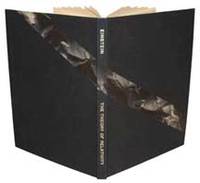
2005réf. CNAP071San Francisco: The Arion Press 2005. Hardcover. New. 10-1/2 by 8 inches eighty pages. Printed by letterpress from lead-alloy type cast in the Mackenzie & Harris typefoundry the formulas were set by hand as was the display type while the prose was composed and cast in Monotype. The types are Modern for the text with special characters as needed for mathematical symbols; Egyptian for the interspersed annotations printed in blue; and Lining Gothic for display. The paper is Schiller a German mouldmade sheet. A pixelated portrait of Einstein is the frontispiece. This image is based on a photograph taken about 1910 rendered as a coarse halftone for reference then handset in units of six-point type: three sizes of solid squares and one centered dot. Over 4000 pieces of type make up the picture. The portrait is printed in gray as is the famous equation: E=mc2 which appears on the flyleaves. The binding is dark blue cloth over boards with a band of tie-dyed Thai paper to create an unusual spatial effect spanning the cover diagonally. The titling on the spine is stamped in silver foil. The edition is limited to 400 numbered copies for sale. One of the great achievements in science Albert Einstein's Theory of Relativity was set forth in two papers published in the Leipzig physics journal Annalen der Physik in 1905. The German text was translated into English in 1923 by W. Perrett and G. B. Jeffrey and this is the version with some later corrections that is presented in this book. The Einstein papers are annotated by Richard Muller who has also provided a foreword and afterword. The foreword gives a general overview of the problems Einstein addressed against the background of nineteenth-century physics. The afterword carries the story from the miraculous year of 1905 when Einstein was only twenty-six through the effects of the theory on twentieth-century science. Muller conjectures on the progress of physics had Einstein not appeared and considers his career as a whole its last thirty-five years devoted mainly to an unsuccessful attempt to create a unified field theory. ___POSTAGE: International customers please note that additional postage may apply as the standard does not always cover costs; please inquire for details. ___Swan's Fine Books is pleased to be a member of the ABAA ILAB and IOBA and we stand behind every book we sell. Please contact us with any questions you may have we are here to help. The Arion Press hardcover books
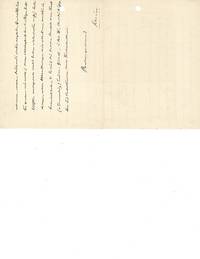
1918réf. 135751918. Mathematics Klein Felix. Autograph Letter Signed 10 November 1918 written in German to a former student and colleague directly references Einstein's recently published General Theory of Relativity and comments on the work of the International Mathematical Education Commission. Composed in the closing days of the First World War the letter places Klein within active scholarly exchange concerning the mathematical implications of relativity which had been formally presented in 1915 and widely disseminated by 1918. Klein long established for his foundational contributions to group theory non-Euclidean geometry and mathematical physics addresses questions raised by "Einstein's theory" noting that he required further reflection to clarify its implications for his own work. The document supports research in the history of relativity German mathematical networks scientific communication during wartime and the institutional organization of mathematics in the early twentieth century. Klein Felix. Autograph Letter Signed 10 November 1918. Two pages written on both sides of a single leaf. In German with accompanying English translation. Addressed to a former student the letter discusses the circulation of lecture manuscripts difficulties in securing copyists during wartime conditions and the intellectual demands posed by Einstein's theory: "A further exploration of my work does not exist yet as I had and still have more thinking to do about questions raised by Einstein's theory to clarify it for myself." Klein also comments critically on the IMUK observing that its published statements are "a display of wasted paper" while acknowledging the commission's broader social significance. He singles out contemporary educational treatises including studies by W. Trost Heinrich Emil Timerding and M. Girndt indicating his sustained engagement with mathematical pedagogy alongside theoretical research. The letter was written days before the November Revolution in Germany and at a moment when academic institutions faced political upheaval and material shortages. Klein's remarks regarding limited copyists and uncertainty about the coming months provide contemporaneous evidence of scholarly life under strained postwar conditions. His reference to Einstein situates the correspondence within the earliest phase of professional reception of general relativity among leading mathematicians while his comments on the International Mathematical Education Commission underscore his longstanding commitment to mathematical instruction and institutional reform. Clean and well preserved with strong legibility and a clear signature. Overall near fine condition. A substantive document of early relativity discourse and mathematical research at the end of the First World War. unknown books
1946réf. 110238New York: Rudolf Schick Publishing Co 1946. Hardcover. Near Fine. First edition. Modest offsetting from front endpapers from a clipping else near fine without dustwrapper. Rudolf Schick Publishing Co hardcover books
1981réf. 101451Reading Massachusetts: Addison-Wesley Publishing Company Inc 1981. Softcover. Fine. Third printing. Fine with slight bumping to the corners in wrappers. Addison-Wesley Publishing Company, Inc unknown books
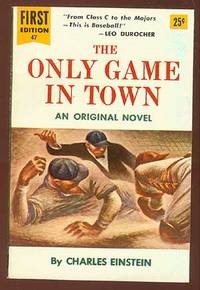
1955réf. 23282New York: Dell First Edition 1955. Softcover. Fine. Paperback original. Pages slightly yellowed else a fine unread copy. Leo Durocher blurb. Novel by the compiler of The Fireside Book of Baseball about an aging player-manager taking one last shot at the big time. McCue p.38. Dell First Edition unknown books
1962réf. 439676New York: Oxford University Press 1962. Softcover. Very Good. Later printing. Trade paperback. 492pp. Translated by Arthur Mendel and Nathan Broder. Pages lightly age-toned edges rubbed very good. Oxford University Press unknown books
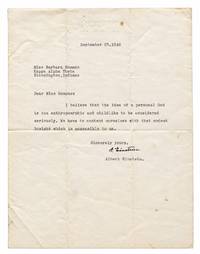
1948réf. 3094Princeton: np 1948. first edition. Very Good. ONE OF EINSTEIN'S MOST DIRECT STATEMENTS ON GOD: A POWERFUL AND CONCISE PRECURSOR TO HIS CELEBRATED "GOD LETTER". In the letter dated September 25 1948 and addressed to the Indiana University student Barbara Homans Einstein writes: "I believe that the idea of a personal God is too anthropomrphic sic and childlike to be considered seriously. We have to content ourselves with that modest insight which is accessible to us." The letter is a strikingly concentrated statement of Einstein's religious philosophy. In two sentences he rejects the notion of an anthropomorphic personal deity while setting against it a characteristically modest view of human knowledge: rather than claiming access to metaphysical certainty "we have to content ourselves" with the limited understanding available to us. That formulation places the letter squarely within one of the most important recurring themes of Einstein's later correspondence: his distinction between conventional belief in a personal God and his own sense of awe before the rational order of the universe. Six years later in his famous letter to the philosopher Eric Gutkind of 3 January 1954 Einstein would return to the same subject in far greater detail describing the word "God" as an expression of human weakness and rejecting traditional religious conceptions with exceptional directness. Christie's described the Gutkind letter as Einstein's most fully articulated statement of his religious and philosophical views; it sold in 2018 for $2892500 at Christie's. The present letter is remarkable because the essential position of the later "God Letter" is already present here in distilled form. The shared target is the anthropomorphic personal God: a conception Einstein repeatedly rejected while maintaining that a profound sense of wonder before the structure of nature could still be called religious. It is a direct statement of Einstein's mature religious philosophy anticipating the central argument of the 1954 "God Letter" by more than five years. Typed letter signed "A. Einstein" to Barbara Homans. Princeton 25 September 1948. One page 8 1/2 x 11 in typed on Einstein's Princeton stationery with embossed address at head; signed "A. Einstein" in ink. Folded for mailing with light toning and a few small stains. np unknown books
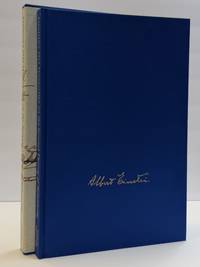
1996réf. 1418697New York: George Braziller 1996. First Edition. Hardcover. Quarto 92 pages. In Very Good condition and housed in publisher's Very Good blue cloth and tan paper slip case. Bound in publisher's blue cloth with tan lettering to spine. Minor shelf wear. Small indentations on top of first few pages. Shelved on the Front Table. 1418697. Shelved Dupont Bookstore. George Braziller hardcover books