EINSTEIN ALBERTABAA

2 976 résultats
1934réf. 1478Princeton: np 1934. 1st Edition. No Binding. Very Good. AN IMPORTANT SIGNED LETTER in English by Einstein revealing his reservations of associating with communism even in the fight against fascism. Written from Princeton NJ to Professor Albert Sprague Coolidge of Harvard University and dated February 16 1934 the letter reads: My dear Professor Coolidge: I had an opportunity of meeting personally Lord Marley and has sic very favorably impressed by his personality. It became known to me that he sympathizes with the Russian Government i.g. with the Russian communist party and that the committee for which he is active is influenced by communists. The problem as to the attitude which is advisable to be taken towards this committee is rather complicated. On the one hand the world-wide danger of fascism makes it necessary that all enemies of fascism cooperate; on the other hand an action which has communist leanings might endanger that fight since the important task undertaken in defense of culture and civilization may be linked up with interests of a political party. I myself have severed my connections with the committee which with my permission had used my name up to the end of last year. It seems to me advisable to take an attitude as follows: to help their action against fascism but not to identify oneself with the committee. Very truly yours signed A. Einstein P.S. I wish you would be good enough to use this strictly confidentially. In 1934 Lord Baron Marley Dudley Leigh Aman toured the United States to raise funds for his association the World Committee for the Victims of German Fascism. Marley through his committee was "passionately advocating a scheme for which he was to become an international figurehead - resettlement of oppressed German and Polish Jews in the Jewish Autonomous Region" in Siberia. He published a book "The Brown Book of the Hitler Terror and the Burning of the Reichstag sponsored by the World Committee and with an Introduction written by Lord Marley himself which was the first popular exposé of what was happening in Hitler's Germany. It documented the destruction of political parties trade unions and universities book-burning and the building of concentration camps. "At a fundraising dinner held in his honour in New York in February 1934 where Einstein presumably met him just before writing this letter Marley opened the Brown Book and 'speaking quietly declaring that he did not intend to harrow' read aloud to his audience of 600 American Jews some of the collected evidence of Nazi repressions. Here were documentary records of what was happening in Germany - a substantiation of the brutality that hitherto had had no distinct form in the mind of the American Jewish public. What before had been the subject of a growing fear mingled with disbelief was now being presented as hard fact and supported with detailed evidence. The New York Times 8 February 2005 reports the audience being 'startled' by the disclosures and the night ending with $3500 raised for the World Committee" The Jewish Quarterly No. 198. Einstein was correct to be suspicious of Marley's activities for it was later determined that the "World Committee" was indeed a Communist front; Einstein writing here to Coolidge in 1934 was prescient about the motives of the committee. This letter in addition to underscoring Einstein's passionate stance against fascism is particularly important as documentary evidence of Einstein's caution about having any dealings with communism especially considering that the U.S. FBI worried about Einstein's political leanings kept a file on Einstein that grew to 1427 pages. Princeton NJ: February 16 1934. One 8.5 x 11 in. page. Envelope folds minor spotting. An outstanding letter with important and revealing content. np unknown books
1923réf. 108095Princeton University Press 1923. 1st Edition. Hardcover. Very Good/Very Good. First edition with Published 1922 on copyright page and 1923 on title page very good in the very rare dust jacket which had some wear and chips. Short tear at bottom of rear free endpaper. Housed in a custom-made collector's slipcase. Princeton University Press hardcover books
2018réf. 185442California: Triton Museum of Art/ Grand Central Press 2018. Hardcover. VG/VG. Color illustrated boards with black lettering on a clear dust jacket; 287 pp; profusely illustrated throughout in bw and color. Published on the occasion of the exhibition David Einstein : a 50-year retrospective 1968-2018 presented by Triton Museum of Art in Santa Clara California from February 17 through April 22 2018. Contents include: Foreword -- Introduction : letting go and the possibilities of abstract expressionism -- David Einstein : a narrative chronology / biography by Mark B. Johnson -- Transcendent abstractions : color echoes and other works / Preston Metcalf -- Form color and process : the evolution of a mark maker / Judith Cook -- A mark maker in life and art : the early years / Roy Kotynek and John Cohassey -- The spiritual journey of a master mark maker / Stephanie Learmonth -- Gesture as language / Sienna Brown -- Reflecting on light echo #21-color veil / Scott A. Shields -- Prelude to the desert : the earth & sky series / Amy B. Scott -- Color veils and the shaping of David Einstein's painting / Ori Z. Soltes -- Selected works : 1968-2016. Triton Museum of Art/ Grand Central Press hardcover books
1984réf. S12510Princeton:: Princeton University Press 1984. 1984. 8vo. xxxii 439 pp. Illus. index. Printed wrappers. Very good. ISBN: 0691023832 Princeton University Press, (1984). unknown books
2006réf. S12505Sagamore Beach:: Science History Publications 2006. 2006. 8vo. xii 228 pp. Illus. bibliography appendix index. Black silver-stamped cloth dust-jacket. Fine. ISBN: 0-88135-283-7 ". . . In tandem with the revival of quantum skepticism in physics Elzinga's book helps us recover Einstein's story from the tendentious interpretation of it that has gone unchallenged far too long."—BJHS ". . . The great value of Einstein's Nobel Prize is its detailed analysis of relevant documents showing how the academy managed to give Einstein the prize despite his work on relativity. . . "—Isis. Science History Publications, 2006. hardcover books
1994réf. S11423New York:: Warner Books 1994. 1994. Small 8vo. 179 pp. Printed wrappers. Fine. ISBN: 0446670111 Warner Books, (1994). unknown books
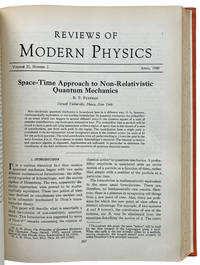
1948réf. S10249Lancaster:: American Physical Society 1948. 1948. Large 8vo. 266 x 205 mm. iv 728 pp. Frontis. port. of Robert Andrews Millikan photos figs. tables. Later orange cloth gilt-stamped spine title; spine faded. Very good. TWO PAPERS FROM THE TWO GIANTS OF 20TH CENTURY PHYSICS AS THEY WERE ORIGINALLY PUBLISHED IN ONE COLLECTED VOLUME. Einstein's "Generalized Theory of Gravitation" is considered the last principal work issued by the 20th Century's premiere scientist. Schilpp-Shields. Einstein: "A new presentation. . . which constitutes a certain progress in clarity as compared with previous presentations." from the Introduction. Feynman: "At first Feynman's fundamental article RMP 1948 did not arouse much interest among theoretical physicists who were not familiar with Feynman's new approach to doing quantum mechanics. As Feynman recalled: 'At the Shelter Island Conference. . . they asked me if I would explain my path-integral method for doing quantum mechanics so I did. I must have been preparing the manuscript for my paper RMP 1948 so that everything was organized and I explained it. It's hard to pay attention to some new idea and they didn't pay much attention to it.' However nowadays Feynman's RMP 1948 paper is one of the most well-known and widely cited papers; it is one of the cornerstones of modern theoretical physics." Mehra. "It is a curious historical fact that modern quantum mechanics began with two quite different mathematical formulations: the differential equation of Schroedinger and the matrix algebra of Heisenberg. . . This paper will describe what is essentially a third formulation of non-relativistic quantum theory. This formulation was suggested by some of Paul Dirac's remarks concerning the relation of classical action to quantum mechanics. A probability amplitude is associated with an entire motion of a particle as a function of time rather than simply with a position of the particle at a particular time." from the Introduction. Provenance: David Middleton b. 1920 noted pioneer in the field of statistical communication theory last name gilt-stamped on spine. Einstein: Boni-Russ-Laurence 258; Schilpp-Shields 308 also see p. 758; Wasson Nobel Prize Winners p. 289-294; Weil 222 marked with asterisk by Weil. Feynman: Gleick Genius: The Life and Science of Richard Feynman p. 249; Mehra The Beat of a Different Drum: The Life and Science of Richard Feynman p. 200; Wasson Nobel Prize Winners p. 316-319. American Physical Society, 1948. hardcover books
1987réf. S9126Princeton NJ:: Princeton University Press 1987. 1987. Two volumes. Large 8vo. lxvi 433; xxii 196 pp. Figs. bibliog. index. Gilt-stamped navy cloth dust jacket; wrappers. Fine. ISBN: 0691084076 Princeton University Press, 1987. hardcover books
1988réf. S8998Princeton:: Princeton University Press 1988. 1988. 8vo. 166 pp. Printed wrappers. Fine. Fifth edition. ISBN: 069102352 Princeton University Press, (1988). unknown books
1924réf. 26006"I'm working a lot but not managing to come up with the real thing. Science is a difficult profession. Sometimes I'm glad that you chose a practical vocation where one doesn't have to search for four-leaf clovers." ALBERT EINSTEIN.Autograph Letter Signed "Papa" to his son Hans Albert Einstein March 7 1924 Berlin Germany. In German. 1 p. Complete Translation 7.III.24 Dear Albert My research projects of the past few years are completely inappropriate for a popular lecture and then I generally dread public appearances of such a kind. That's why I unfortunately have to decline the talk this time too. The Fr 45000 I designated for the down payment of the house purchase; and I invested another Fr 45000 which is supposed to belong to you that is Mama. I hope you'll find a suitable little home. I'm probably going to be staying in Zurich for a bit on the trip back from Naples; on the trip there only briefly. There's no question of it being official; the main thing for me is to be with you for a while. I don't have much time because I'm supposed to go to Kiel in May. In any case I'm very happy about seeing you all again soon. I'm working a lot but not managing to come up with the real thing. Science is a difficult profession. Sometimes I'm glad that you chose a practical vocation where one doesn't have to search for four-leaf clovers. Looking forward to a happy reunion! Best regards to the three of you from your Papa. Historical Background Einstein's Theory of Relativity published in 1915 describes gravity as a curved geometric property of spacetime. Though E=mc2 captures the theory for which he is most remembered he never won the Nobel Prize in Physics. Rather in 1922 he won for his 1905 explanation of the photoelectric effect. In 1914 Albert and Mileva Marić-Einstein separated and she and their sons returned to Zurich. When they divorced in 1919 they agreed that any Nobel Prize money he might win would go to Mileva for the children. He won the Nobel Prize for Physics in 1922. In May 1924 two months after this letter Marić purchased a building in Zurich and moved into the third floor apartment. In 1930 she purchased two more buildings but when the worldwide economic crisis reached Switzerland many tenants could not afford their rent; she lost the two additional buildings to foreclosure in 1936. Einstein had invested the remaining prize money in America in Marić's name. He lost much of that due to the Great Depression but he ultimately paid Marić more than he received from the prize. Einstein also mentions to his nineteen-year-old son his plans to travel to Naples in May. He would attend the fifth International Congress of Philosophy with his theory of relativity scheduled to be "an object of particular discussion." First organized in 1900 the Congress was a global meeting held every few years under the auspices of the International Federation of Philosophical Societies. It was interrupted by both World Wars but reconvened in 1948 and has been held every five years since in locations throughout the world. Einstein also planned to go to Kiel Germany to stay and work with Hermann Anschütz-Kaempfe 1872-1931 a German art historian and inventor. Kaempfe pioneered gyro compasses for ships and submarines. From the 1920s until his death in 1955 the most elusive clover for which Einstein searched was a unified field theory. Einstein tried to meld together general relativity and electromagnetism. This would describe a single field in which all forces are mediated and the properties of all particles could be deduced. Albert Einstein 1879-1955 was born in the Kingdom of Wurttemberg in the German Empire to non-observant Ashkenazi Jewish parents. In 1894 the family moved to Italy. Einstein graduated from the Swiss Federal Polytechnic in Zürich in 1900. In 1903 he married Mileva Marić 1875-1948 with whom he had two sons. In 1905 he received a Ph.D. from the University of Zürich. From 1908 to 1932 he taught at a series of universities in Switzerland the Austrian Empire and the German Empire. As a theoretical physicist he published ground-breaking papers as early as 1905 and developed the theory of relativity including the mass–energy equivalence formula E=mc2. Albert and Mileva divorced in 1919. That same year he married Elsa Löwenthal. In 1922 he received the Nobel Prize in Physics for the discovery of the photoelectric effect. In January 1933 when Adolph Hitler came to power Einstein was visiting the U.S. and remained here In 1939 he signed a letter to President Franklin D. Roosevelt warning that Germany could develop a nuclear bomb thus inspiring the "Manhattan project." He became a U.S. citizen in 1940. After the war he became known for efforts to further world peace. At the Institute for Advanced Study in Princeton N.J. from 1933 until his death in 1955 he worked to develop a unified field theory and to refute the accepted interpretation of quantum physics. Considered the father of modern physics and one of the most prolific intellects of history Einstein published more than 300 scientific papers and over 150 non-scientific works. Hans Albert Einstein 1904-1973 was born in Bern Switzerland to Albert Einstein and Mileva Marić. Hans followed both parents in studying at ETH the Swiss Federal Institute of Technology in Zurich graduating with a degree in civil engineering in 1926. In 1927 he married Frieda Knecht and they had four children two of whom died very young. In 1936 Hans earned a doctor of technical science degree. At his father's advice he left Switzerland in 1938 to escape the Nazi threat. He settled in Greenville South Carolina and worked for the U.S. Department of Agriculture studying sediment transport. In 1943 he transferred to the California Institute of Technology and in 1947 he accepted a position teaching hydraulic engineering at the University of California Berkeley. He became a full professor and eventually professor emeritus winning several research awards and fellowships. books
1923réf. 171111001Princeton: Princeton University Press 1923. First Edition. Hardcover. Very Good. First American edition first printing. Near Fine with slight fade to spine cloth gilt stamping very sharp on front cover. Previous owner bookplate to front paste down with patch of abrasion at nearby gutter. Pages toned with several hinges just slightly over-opened. In a Very Good dust jacket with a large chip and tear at the top of the spine toning to spine and edges and several small edge tears. A very nice copy in the scarce dust jacket. Princeton University Press hardcover books
1925réf. 45497Paris: Gauthier-Villars et Cie 1925. FIRST FRENCH EDITION. Hardcover. Very good/No dust jacket. Published in the series ÒLes Maitres de la Pensee scientifiqueÓ. Paris: Gauthier-Villars et Cie 1925. Translated into French by M. Solovine. FIRST FRENCH EDITION. Frontis portrait of the author. 56 pp. Text in French. Hardcover. Small 8vo. Light brown stiff wrappers. Top quarter and bottom quarter of spine detached from binding but still present; small vertical tear to rear hinge; head and heel worn; corners and extremities lightly rubbed; wraps lightly soiled and toned at edges; pages untrimmed. Former ownerÕs signature and date to front free endpaper; pages toned especially at edges; publisherÕs promotional material laid in to pages 28/29. This is the first French edition to present translations of EinsteinÕs works ÒElektrodynamik bewegter KorperÓ and ÒIst die Tragheit eines Korpers von seinem Energieinhalt abhangigÓ. Very good/No dust jacket. Insurance required to ship this item. Gauthier-Villars et Cie hardcover books
1949réf. 140941460Evanston IL: The Library of Living Philosophers Inc 1949. First Edition; Signed Limited Issue. Near Fine. First edition signed limited issue; copy #362 of a 760 signed by Albert Einstein. Bound in publisher's brown morocco-grain cloth over bevel-edged boards stamped in gilt. Near Fine with slight darkening to spine and trivial rubbing to crown. Endsheets faintly browned. In a Near Fine publisher's original slipcase with light sunning and wear at edges. A fantastic copy signed by the iconic physicist whose name in synonymous with genius. The Library of Living Philosophers, Inc unknown books
1923réf. 140940078Princeton NJ: Princeton University Press 1923. First American Edition. Very Good. First American edition first printing. Bound in publisher's dark blue cloth lettered in gilt; lacking the dust jacket. Very Good. Cloth lightly edge worn patch of rubbing to front cover ding to top edge of front board. Pages toned. Previous owner inkless emboss to front free endpaper and name and date inked to following blank sheet where hinge is also over-exposed at the top edge. Pages toned. Princeton University Press unknown books
1982réf. 015731New York: Abrams 1982. Book. Near fine condition. Hardcover. Revised edition. Quarto 4to. 296 pages of text. Original hardcover binding with a small bump to the top of the spine; otherwise almost new condition. Unclipped dustjacket with minimal shelfwear and minor sunning to the spine; protected in archival mylar. Contains 217 illustrations including 82 plates in full color. The text is clean and unmarked. First published in 1975 this full-scale book on Francis is enlarged and brought up to date. First printing of the Revised Edition. Abrams Hardcover books
1905réf. 2103Leipzig: Johann Ambrosius Barth 1905. First edition. Contemporary morocco over marbled boards. Very Good. FIRST PRINTING of Albert Einstein's groundbreaking 1905 paper the introduction and derivation of the most famous equation in modern physics: E=mc2. "A few months after first publishing the theory of relativity Einstein discovered something that particularly intrigued him; the relation between inertial mass and energy. He wrote to Conrad Habicht during the summer of 1905: 'One more consequence of the paper on electrodynamics has also occurred to me. The principle of relativity in conjunction with Maxwell's equations requires that mass be a direct measure of the energy contained in a body; light carries mass with it. A noticeable decrease of mass should occur in the case of radium. The argument is amusing and seductive but for all I know the Lord might be laughing over it and leading me around by the nose'" Stachel Einstein's Miraculous Year. Einstein continued to work late into the summer on this "amusing and seductive" problem before proving the mass-energy relationship that would become known throughout the world as the simple and elegant E=mc2. Received by Annalen der Physik on September 27 Einstein's derivation and proof of his most famous equation was a dramatic contribution to his annus mirabilis of 1905. Weil 10. Note: In this paper and others until 1912 Einstein used the symbol "L" for energy in his equations and wrote the formula in the form: Mass= L/c2. In: Annalen der Physik Vierte Folge Volume 18 part 13 pages 639-41. Leipzig: Barth 1905. Octavo contemporary half-morocco over marbled boards. The whole volume 18 offered complete with volume halt-title title and contents. Some scuffing to spine of binding; text exceptionally fine. A rare copy in a contemporary binding with no institutional stamps. Johann Ambrosius Barth unknown books
1949réf. 94288NY:: Philosophical Library. Very Good in Very Good dust jacket. 1949. Hardcover. Translated from the German by Alan Harris. First edition thus. Very good in a very good dust jacket. ; 112 pages . Philosophical Library, hardcover books
1908réf. 140937838Leipzig: Johann Ambrosius Barth 1908. First Edition. Very Good. First edition scarce author's offprint ''Uberreicht von den Verfassern'' essentially a presentation copy of the article for the authors' use. One of a small unspecified number perhaps 25-50 of copies thus also printed in the journal Annalen der Physik Vierte Folge Band 26; very few survive. 532-540 pp. Original cream-colored wrappers. In German. Very Good with chips in brittle front and back double-sided wraps tear along entire back wrap repaired with clear tape on verso; contents fine. No foxing. The first separate publication of the paper "On the Fundamental Electromagnetic Equations for Moving Bodies" by Einstein then still a patent clerk and Laub. Johann Ambrosius Barth unknown books
1926réf. 25045ALBERT EINSTEIN.Autograph Correspondence Card Signed to Michele Besso May 1 1926 Berlin. In German. 1 p. 4¼ x 5⅞ in. Complete Translation 1 May 1926 Dear Michele I read that paperright away at the time but I don't think that anything more profound lies behind it. There is naturally a rough connection between a decrease in volume and energy and from here one can try to come nearer to the empirical phenomena by introducing further parameters. But this happens in such a way that neither rhyme nor reason can be made of it. It is very reminiscent of Traube. Using such apothecary's methods one cannot reveal any of God's secrets I think. Schrödinger did a couple of wonderful studies on quantum rules Ann d Physik. That has the scent of a deeper truth. Let it be explained to you. I'm coming to Switzerland in July. End of July is LN meeting in Geneva. Then I'm going somewhere in the mountains with Tete. So I'll visit you or else we can meet. Warm regards also to Anna and Vero your Albert Historical Background Early in 1926 Michele Besso sent Einstein an early draft of a paper by Swiss chemist Gottfried Beck on quantum mechanics. Beck had initially submitted the paper to the Swiss scientific journal Helvetica Chemica Acta which rejected it as too speculative. On April 25 1926 Besso wrote to Einstein about Beck's paper. After discussing the details he writes "This surely is an amusing thing; I was surprised that you didn't write me anything about it. Here too reality is once again simpler than the theoretical conceptions would lead one to expect." Three months later Einstein wrote to Besso regarding Beck's paper: "it is obviously particularly painful to use the quantum condition together with the equations of motion here because the validity of the latter appears to be irreconcilable with the validity of the former." Einstein was skeptical that Beck's equation "has any reality left within it in the face of quanta. I vigorously doubt it." However Einstein found the construction of the left side of the equation "surely contains a deeper truth." Einstein declared to Besso "I cannot make myself glue two things together like the left- and right-hand sides of this equation that have nothing to do with each other logico-mathematically." Michele Besso 1873-1955 was born in Zurich Switzerland into an Italian Jewish family. He was a close friend of Albert Einstein when they worked together at the Federal Polytechnic Institute in Zurich and at the patent office in Bern where Einstein helped Besso get a job. Besso met his future wife Anna Winteler through Einstein in June 1897. In 1898 their son Vero was born in Winterthur Switzerland. Einstein referred to Besso as "the best sounding board in Europe" for scientific ideas. Besso died in Geneva just over one month before Einstein died in Princeton New Jersey. Johann Gottfried Beck 1900-1992 received his Ph.D. in chemistry from the University of Bern in December 1925. He worked as an assistant to Heinrich Zangger at the Institute for Forensic Medicine at the University of Zurich. Isidor Traube 1860-1943 was born in Hanover the son of a wealthy German-Jewish merchant. He received his doctorate in organic chemistry in 1882. He founded capillary chemistry and conducted advanced research on liquids helping to define the concepts of surface tension and critical temperature. In 1882 he joined the faculty of Technische Hochshule in Berlin and became a professor of chemistry there in 1900. Unacceptable to National Socialists Traube was barred from his laboratory and he left Germany in 1934. Through the aid of British colleagues he was provided with a laboratory at the University of Edinburgh. During his long career he was a persistent and stubborn controversialist in opposition to various theories. Erwin Schrödinger 1887-1961 was born in Vienna Austria. He was a commissioned officer in the Austrian fortress artillery during World War I. After the war he advanced through the academic ranks to become a full professor in 1921 in Breslau now Wroclaw Poland. That year he moved to the University of Zurich and in 1927 to the Friedrich Wilhelm University in Berlin. He received the Nobel Prize in Physics in 1933 and left Germany as he opposed the Nazis. After brief positions in a number of places he settled in Dublin Ireland in 1940 where he remained until retiring in 1955. During his career Schrödinger developed a number of fundamentals of quantum theory including the wave equation. He also published many works in various fields of physics. Although Schrödinger was an atheist he believed his scientific work was an approach to the godhead in a metaphorical sense. Eduard Einstein 1910-1965 was born in Zürich Switzerland to Albert and Mileva Marić Einstein. In 1914 his parents separated and his mother returned to Zürich with Eduard and older brother Hans Albert who were both deeply affected. Eduard was interested in music art and poetry. Unlike his father Eduard was a good student. He had started to study medicine and psychiatry but in 1930 was diagnosed with schizophrenia. He was first institutionalized in 1932; it is not clear if his treatment particularly electroconvulsive therapy did more good than harm. Albert fondly referred to Eduard as "Tete" for petit and they corresponded regularly but never saw each other after a heart-breaking final visit in 1933. Marić and Eduard's Swiss citizenship undoubtedly saved Eduard from Aktion T4 the Nazi euthanasia program and perhaps both of them from the Holocaust. His mother cared for Eduard until her death in 1948 and Eduard thereafter lived mostly at a psychiatric clinic in Zurich where he died from a stroke in 1965. books
1917réf. 27729Leipzigh Germany: S. Hirzel 1917. First Edition. Hardcover. Very Good. Albert Einstein's 1879-1955 derivation of Planck's law for thermal radiation. Einstein also introduces the possibility of stimulated emission of radiation the principle behind the laser. xi 604 pp. 4to. Black cloth binding with gold embossed titling to spine. Ex-library stamp on title page the only indication of its former life in an institution. Very clean within. S. Hirzel hardcover books
1922réf. 25530Braunschweig & Berlin Germany: Friedr. Vieweg & Sohn/Julius Springer 1922 1923 1924. First Edition. Hardcover. Very Good. Alexander Alexandrovich Friedmann 1888-1925 was a Russian mathematician and physicist who built upon Einstein's theory of relativity and further expanded his own theories that the universe has both homogeneous looks the same from every location and isotropic looks the same in every direction. The following articles expand upon these theories: "Über die Krümmung des Raumes" "On the Curvature of Space" by Alexander Friedmann Zeitschrift für Physik 10 pp. 377-386 1922. "Notiz du der Arbeit von A. Friedmann ‘Über die Krümmung des Raumes'" "Note on the work of A. Friedmann ‘On the Curvature of Space'" by Albert Einstein Zeitschrift für Physik 16 p. 228 1923. "Über die Möglichkeit einer Welt mit konstanter negativer Krümmung des Raumes" "On the possibility of a world with constant negative curvature of space" by Alexander Friedmann Zeitschrift für Physik 21 pp. 326-332 1924. Volume 10: iv 413 pp. 8vo; Volume 16: iv 409 1 pp. 8vo; Volume 21: iv 382 pp 8vo. Each volume is ex-library with brown patterned paper boards lighter brown cloth spines and corner tips; gold embossed titling to spine. Library stamps within including stamps on title page of each volume very clean with card pocket remaining on the rear pastedown of each volume. All text in German. Friedr. Vieweg & Sohn/Julius Springer hardcover books
1938réf. 21982London: The De La More Press 1938. 39 pages; inscribed on the front endpaper by the author "To Ivan from Lewis"; limited edition privately printed of one hundred; poetry including some prophetically Anti-Hitler by Lewis David Einstein 1877 -1967 American diplomat and historian; original cream-white paper-covered boards binding black spine titles; some wear and soiling to boards; in very good condition. Signed by Author. First Edition. Hard Cover. Very Good. The De La More Press Hardcover books
1931réf. 4675JHollywood 1931. An unusually large image 11” x 14” taken on January 8 1931 when Einstein and his wife visited Hollywood. The image shows Albert Einstein and Film Mogul Carl Laemmle Senior Founder of Universal Pictures. The photograph is a striking informal image of these two noted Jewish leaders and fellow German emigres chatting on a studio sound stage at Universal City with Mrs. Einstein visible in the background. The photograph is inscribed and signed by Albert Einstein to the head of Universal’s publicity department John LeRoy Johnston who had sent this photograph of Einstein with his boss Laemmle to Einstein to sign. Einstein has written in white ink: “Fur Kohn Johnston - Albert Einstein”. Tipped to the verso is a typed note written in German from Johnston on his printed Universal Pictures stationery to Professor Einstein asking him to inscribe the photograph. Many photograph portraits of Einstein are rather stuffy affairs and a number look like police lineups when he appeared in public and met famous people and dignitaries. This is a striking image of the two men conversing. A historic and excellent photograph and the finest piece from his visit to Hollywood to ever appear on the market. unknown books
1979réf. 285534Princeton: Princeton University Press 1979. First. hardcover. fine/fine. 235 pages 8vo. stamped orange cloth d.w. First edition. Princeton: Princeton University Press 1979. A fine copy in a fine wrapper. Princeton University Press unknown books
1938réf. 165146Paris 1938. paperback. Pp. 5-19 IN: Zeitschrift fur Freie Deutsche Forschung. Jahrgang 1 Nummer 1. Herausgegeben von der Freien Deutschen Hochschule in Paris. 168p. printed wrappers. Paris Juli 1938. First number of this scarce short-lived exile publication featuring German & Austrian writers and scholars. Fine. unknown books