3 003 résultats
1950réf. 27614Editions Albin Michel, coll. “Les savants et le monde” 1950 In-8 broché 20,5 cm sur 13. 435 pages. Très bon état d’occasion.
réf. 27616Le Club du livre du mois - CLM In-8, cartonnage éditeur. 243 pp
1984réf. 27617Editions Mengès 1984 Broché. Très bon état d’occasion.
1958réf. 27618Flammarion 1958 Broché. Très bon état d’occasion.
1989réf. 20350Edita, Lausanne/Conti 1989 In-4, broché couv. illustrée. 153pp. dos insole.
2005réf. 91518Editions Frison-Roche 2005 In-8 broché 22,4 cm sur 14,8. 378 pages. Très bon état d’occasion.
1974réf. 102394Editions Complexe 1974 Préface de Serge Moscovici. Edition de 1974. In-8 broché 23 cm sur 15. 381 pages. État moyen, salissure sur la tranche supérieure ainsi que sur la couverture.
1992réf. 102411Flammarion, coll. « Figures de la science » 1992 In-8 broché 22 cm sur 13,5. 298 pages. Bon état d’occasion.
1980réf. 102415Editions du Centre national de la recherche scientifique, Editions du CNRS 1980 Grand In-8 broché 27 cm sur 18. Couverture écornée, dépigmentée partiellement. Bon état d’occasion.
1989réf. 120415Seuil, CNRS, coll. « Sources Du Savoir » 1989 In-8 reliure éd. sous jaquette 22,1 cm sur 17,8. 345697 pages. Jaquette en très bon état. Très bon état d’occasion.
1925réf. 131958Paris, G. Doin 1925 In-8 22 x 13,5 cm. Reliure demi-basane fauve, dos à nerfs, pièce de titre maroquin rouge, couvertures conservées, XII-401 pp., 124 figures dans le texte et 18 planches hors texte, table des matières. Exemplaire en bon état.
1972réf. 133380Seuil 1972 In-8 broché 20,6 cm sur 14,1. 255 pages. État correct d’occasion.
réf. 2378Paris, Gauthier-Villars, 1921 ; plaquette in-8, brochée. 19pp. Couverture jaunie avec de petites déchirures marginales.
réf. 69397Gauthier-Villars 1979 livre étude 20,5*13,5 96 pages collection "discours de la méthode"
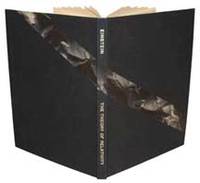
2005réf. CNAP071San Francisco: The Arion Press 2005. Hardcover. New. 10-1/2 by 8 inches eighty pages. Printed by letterpress from lead-alloy type cast in the Mackenzie & Harris typefoundry the formulas were set by hand as was the display type while the prose was composed and cast in Monotype. The types are Modern for the text with special characters as needed for mathematical symbols; Egyptian for the interspersed annotations printed in blue; and Lining Gothic for display. The paper is Schiller a German mouldmade sheet. A pixelated portrait of Einstein is the frontispiece. This image is based on a photograph taken about 1910 rendered as a coarse halftone for reference then handset in units of six-point type: three sizes of solid squares and one centered dot. Over 4000 pieces of type make up the picture. The portrait is printed in gray as is the famous equation: E=mc2 which appears on the flyleaves. The binding is dark blue cloth over boards with a band of tie-dyed Thai paper to create an unusual spatial effect spanning the cover diagonally. The titling on the spine is stamped in silver foil. The edition is limited to 400 numbered copies for sale. One of the great achievements in science Albert Einstein's Theory of Relativity was set forth in two papers published in the Leipzig physics journal Annalen der Physik in 1905. The German text was translated into English in 1923 by W. Perrett and G. B. Jeffrey and this is the version with some later corrections that is presented in this book. The Einstein papers are annotated by Richard Muller who has also provided a foreword and afterword. The foreword gives a general overview of the problems Einstein addressed against the background of nineteenth-century physics. The afterword carries the story from the miraculous year of 1905 when Einstein was only twenty-six through the effects of the theory on twentieth-century science. Muller conjectures on the progress of physics had Einstein not appeared and considers his career as a whole its last thirty-five years devoted mainly to an unsuccessful attempt to create a unified field theory. ___POSTAGE: International customers please note that additional postage may apply as the standard does not always cover costs; please inquire for details. ___Swan's Fine Books is pleased to be a member of the ABAA ILAB and IOBA and we stand behind every book we sell. Please contact us with any questions you may have we are here to help. The Arion Press hardcover books
1918réf. 135751918. Mathematics Klein Felix. Autograph Letter Signed 10 November 1918 written in German to a former student and colleague directly references Einstein's recently published General Theory of Relativity and comments on the work of the International Mathematical Education Commission. Composed in the closing days of the First World War the letter places Klein within active scholarly exchange concerning the mathematical implications of relativity which had been formally presented in 1915 and widely disseminated by 1918. Klein long established for his foundational contributions to group theory non-Euclidean geometry and mathematical physics addresses questions raised by "Einstein's theory" noting that he required further reflection to clarify its implications for his own work. The document supports research in the history of relativity German mathematical networks scientific communication during wartime and the institutional organization of mathematics in the early twentieth century. Klein Felix. Autograph Letter Signed 10 November 1918. Two pages written on both sides of a single leaf. In German with accompanying English translation. Addressed to a former student the letter discusses the circulation of lecture manuscripts difficulties in securing copyists during wartime conditions and the intellectual demands posed by Einstein's theory: "A further exploration of my work does not exist yet as I had and still have more thinking to do about questions raised by Einstein's theory to clarify it for myself." Klein also comments critically on the IMUK observing that its published statements are "a display of wasted paper" while acknowledging the commission's broader social significance. He singles out contemporary educational treatises including studies by W. Trost Heinrich Emil Timerding and M. Girndt indicating his sustained engagement with mathematical pedagogy alongside theoretical research. The letter was written days before the November Revolution in Germany and at a moment when academic institutions faced political upheaval and material shortages. Klein's remarks regarding limited copyists and uncertainty about the coming months provide contemporaneous evidence of scholarly life under strained postwar conditions. His reference to Einstein situates the correspondence within the earliest phase of professional reception of general relativity among leading mathematicians while his comments on the International Mathematical Education Commission underscore his longstanding commitment to mathematical instruction and institutional reform. Clean and well preserved with strong legibility and a clear signature. Overall near fine condition. A substantive document of early relativity discourse and mathematical research at the end of the First World War. unknown books
1946réf. 110238New York: Rudolf Schick Publishing Co 1946. Hardcover. Near Fine. First edition. Modest offsetting from front endpapers from a clipping else near fine without dustwrapper. Rudolf Schick Publishing Co hardcover books
1981réf. 101451Reading Massachusetts: Addison-Wesley Publishing Company Inc 1981. Softcover. Fine. Third printing. Fine with slight bumping to the corners in wrappers. Addison-Wesley Publishing Company, Inc unknown books
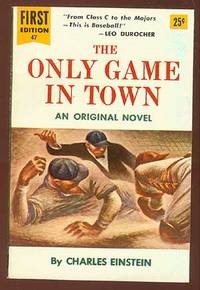
1955réf. 23282New York: Dell First Edition 1955. Softcover. Fine. Paperback original. Pages slightly yellowed else a fine unread copy. Leo Durocher blurb. Novel by the compiler of The Fireside Book of Baseball about an aging player-manager taking one last shot at the big time. McCue p.38. Dell First Edition unknown books
réf. 24136In-8, demi-chagrin à coins de l'époque (lég. défr.), XVI, 396 p. Paris, Payot, 1925.
réf. 34292Grand in-8, broché, couverture bleue imprimée, 72 p. Paris, Librairie Scientifique J. Hermann, 1923.
réf. 34294In-8 broché, couverture imprimée, 126, (2) p. Paris, Chiron, s.d. [ca 1920].
réf. 34297In-8, broché, couverture imprimée (leg. défraichie), 16, (1) p. Paris, Vuibert, 1923.
1958réf. 14215paris Flammarion 1958 1 Un volume broché de format in 8° de 220 pp sur papier.; Portrait en couverture.
réf. 67584Coll. "Sciences", Paris, éd. Hachette, 1998, EDITION ORIGINALE, in-8, br., couv. ill. coul. éd., 320 pp., quelques graphiques en noir, glossaire, notes, table des matières, Il y a plus de quatre siècles, après que Copernic eut ébranlé l'idée d'une position absolue, Galilée découvrait que le " mouvement est comme rien " : il n'existe pas en soi, un corps ne se meut que par rapport à un autre corps. Au début du XXe siècle, Poincaré et Einstein franchissaient une nouvelle étape avec la relativité restreinte, où l'espace et le temps ne sont plus séparés. Puis Einstein inventait une nouvelle manière de penser avec la relativité généralisée. Celle-ci n'est plus seulement une théorie des objets dans un cadre préétabli. Elle offre une description dynamique de la géométrie d'un espace-temps courbe et dépendant de son contenu matériel. La gravitation n'y existe plus en soi, mais devient, elle-même, relative au choix du système de coordonnées. La relativité a-t-elle dit son dernier mot ? Son principe exige que les lois de la nature soient valides quel que soit le système de référence. Mais les lois de la mécanique quantique ne l'ont-elles pas mis en défaut vers les échelles microscopiques ? Laurent Nottale suggère d'envisager les effets quantiques comme la manifestation d'une relativité étendue aux changements d'échelle. En passant du macroscopique au microscopique, l'espace-temps, de courbe, deviendrait fractal. Un essai à la fois très accessible et profondément novateur. Très bon état