3003 resultados
ref. 32479unknown books
1918ref. 50342Leipzig 1918. Prinzipielles zur allgemeinen relativitätstheorie. In Annalen der Physik 55 241-244 pp. Red cloth with gilt lettering on the spine. Bookbinder's embossed stamp of ffep. Whole volume: 632 pp. 1 folding plate. Figs. Text-illust. 210 x 130 mm. Very good. Approximate English translation of title: "On the foundations of the general theory of relativity." "Here we are given the first new presentation of the foundations of general relativity since the developments of March 1916 when Einstein gave his first systematic exposition." p. 300. Calaprice Kennefick & Shulmann. An Einstein Encyclopedia. 2015. Weil's Einstein Bibliography no. 96. Boni's Checklist no. 100. Also in this volume: Born Max 1882-1970. Elektronentheorie des Natürlichen optischen Drehungs vermögens isotroper und anisotroper Flüssigkeiten pp. 175-240. Approximate Eng. translation of title: "Electron theory of the natural optical rotation ability of isotropic and anisotropic liquids". Max Born 1882-1970 was a German physicist and mathematician who was instrumental in the development of quantum mechanics. He also made contributions to solid-state physics and optics as well as supervised a number of notable physicists in the 1920s and 1930s. Born won the 1954 Nobel Prize in Physics "for his fundamental research in quantum mechanics especially in the statistical interpretation of the wave function." In 1919 a chance meeting with Fritz Haber 1868-1934 led to the discussion of how an ionic compound is formed when a metal reacts with a halogen - a process now known as the Born-Haber cycle Wikipedia. . unknown books
1961ref. 205945New York: Bonanza 1961. Hardcover. Reprint. Fine in a fine dust jacket. Bonanza hardcover books
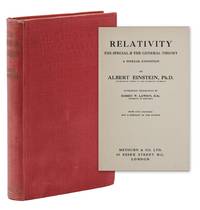
1920ref. 140949340London: Methuen & Co 1920. First Edition. Near Fine. First British edition first printing. xiii 3 138 2 8 pp. Bound in publisher's red cloth lettered in blind on front board and gilt on spine. Near Fine with light wear and fading to covers light foxing to upper textblock edge. Light foxing and offsetting to endpapers bookseller ticket to back pastedown and light toning to contents. Binding starting at pp. 33 and 97. A much nicer copy than normally found. The first British edition of Einstein's seminal work translated by Robert W. Lawson from the third German edition. Einstein's introduction to his revolutionary theory was written to be accessible to the general public. Methuen & Co unknown books
1928ref. 374171928. Weil 161. Offprint from S. preuss. Akad. Wiss. unknown books
1920ref. 374021920. Weil 110. Offprint from S. preuss. Akad. Wiss. unknown books
1932ref. 37427Berlin: Akad. Wiss 1932. Akad. Wiss unknown books
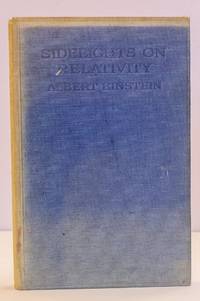
1922ref. 1415530London UK: Methuen & Co 1922. First Edition Thus. Hardcover. Small octavo 60 10 pages. In Good Plus condition. Bound in publisher's blue fabric with gilt lettering on spine. Light general shelfwear. Agetoning to spine and top edge of front board. Small spots of discoloration on back board spine hinges and front board. Mild foxing to text block and paste downs. Pencil marks from previous owner in text block concentrated in first section. Shelved in Case 10. 1415530. Shelved Dupont Bookstore. Methuen & Co hardcover books
1983ref. 556751New York: Dover Publications Inc 1983. Softcover. Very Good. Reprint. 56pp. Pictorial wrappers. Ex-library with a label on the front cover and a stamp on the front fly spine partially unglued from text block faint dampstain in the margin of several pages about very good. Originally published by E.P. Dutton in 1923. Dover Publications Inc unknown books
1983ref. 35229NY: Dover 1983. 8vo pp. 56. Paper wraps. Cover very slightly soiled o/w a nice tight copy. Two addresses: Ether and the theory of relativity 1920 and Geometry and experience 1921. Dover unknown books
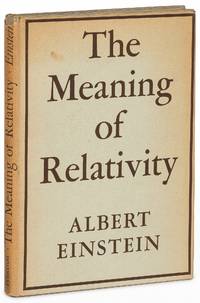
1945ref. 1292Princeton: Princeton University Press 1945. Second edition first printing. 1945 LANDMARK SUMMARY OF NOBELIST ALBERT EINSTEIN'S THEORIES THAT ESTABLISHED MODERN PHYSICS--COPY OF NOBELIST CARLETON GAJDUSEK WHO DISCOVERED KURU THE FIRST PRION DISEASE. 8 inches tall hardcover gray cloth binding gilt title to spine decorative bookplate of D. Carleton Gajdusek to front paste-down signature of D. Carleton Gajdusek to front free endpaper vi 135 pp near fine in very good unclipped jacket with faint splash mark to cover light wear to spine ends and corners in protective mylar sleeve. This first printing of the second edition contains an appendix added by the author discussing advances in the theory of relativity since the first edition in 1921. ALBERT EINSTEIN 1879 – 1955 was a German-born theoretical physicist widely acknowledged to be one of the greatest and most influential physicists of all time. Einstein is best known for developing the theory of relativity but he also made important contributions to the development of the theory of quantum mechanics. Relativity and quantum mechanics are together the two pillars of modern physics. In 1922 he was awarded the 1921 Nobel Prize in Physics "for his services to Theoretical Physics and especially for his discovery of the law of the photoelectric effect". The Meaning of Relativity: Four Lectures Delivered at Princeton University May 1921 is a book published by Princeton University Press in 1922 that compiled the 1921 Stafford Little Lectures at Princeton University given by Albert Einstein. The lectures were translated into English by Edwin Plimpton Adams. The lectures and the subsequent book were Einstein's last attempt to provide a comprehensive overview of his theory of relativity and is his only book that provides an accessible overview of the physics and mathematics of general relativity. The book is made of four lectures. The first is titled "Space and Time in Pre-Relativity Physics". The second lecture is titled The Theory of Special Relativity and discusses the special theory of relativity. The third and fourth lectures cover the general theory of relativity in two parts. Einstein added an appendix to update the book for its second edition published in 1945 offered here. PROVENANCE: DANIEL CARLTON GAJDUSEK 1923-2008 was an American medical doctor and researcher who was co-recipient of the Nobel Prize in Physiology or Medicine in 1976 for his work in Kuru the first prion disease. Gajdusek graduated from Harvard Medical school at age 23 served as head of virological and neurological research at the National Institute for Health in 1958; and inducted into the National Academy of sciences in 1974. Gajdusek's best-known work focused on kuru. This disease was rampant among the South Fore people of New Guinea in the 1950s and 1960s. Gajdusek connected the spread of the disease to the practice of funerary cannibalism by the South Fore. With elimination of cannibalism kuru disappeared among the South Fore within a generation. He proved his hypothesis by successfully transmitting the disease to primates and demonstrating that it had an unusually long incubation period of several years. This was the first demonstration of the infectious spread of a noninflammatory degenerative disease in humans. Subsequently additional human agents belonging to the same group were discovered. They include sporadic familial and variant Creutzfeldt–Jakob disease. Gajdusek recognized that diseases like Kuru and Creutzfeldt–Jakob disease were caused by a new infectious agent that had not yet been identified. Princeton University Press hardcover books
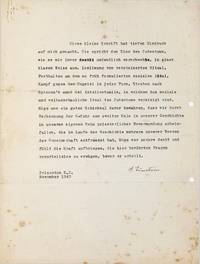
1943ref. 3079Princeton NJ: np 1943. first. Very Good. AN EXTRAORDINARY SIGNED 1943 STATEMENT DEFINING EINSTEIN'S CONCEPTION OF JUDAISM THROUGH REASON AND SPINOZA WHILE WARNING AGAINST "CLERICAL DOMINATION" IN A FUTURE JEWISH HOMELAND. Of course we all know Einstein as the great scientist. From the theoretical physicists among us to those of use who barely survived high school physics we are all captivated by the man and accept his place at the outer limits of human intellectual capacity. Yet it's when Einstein leaves the world of relativity and theoretical physics that we are often most drawn to his never-ending charisma. Especially exciting to so many of us are his deep convictions about human affairs especially politics and religion. Einstein famously was irreligiously religious. Born to a secular Jewish family his upbringing lacked the complex ritual we associate with Orthodox Judaism. He briefly became curious about religiosity as a child but his attempts at following religious ritual and doctrine ended a few years later as he confronted the conflict between scientific ideas and Biblical stories. Yet one still sees a deep spirituality in Einstein who saw a special camaraderie in the 17th-century Dutch Jewish philosopher Baruch Spinoza. Spinoza was a Jewish radical who had little patience for endless ritual. He did not see God as a being intervening in human affairs but as a great rational force who formed the universe using rational methods. We become close to God therefore by trying to understand the natural world not obeying endless rituals. One can easily see Spinoza's approach as appealing to Einstein. In Spinoza's view the scientist is the holyman his work bringing him closer to God's creations. While in 1943 many of Einstein's contemporaries could accept such a view in seventeenth-century Amsterdam it was another matter: Spinoza was formally expelled from his Jewish community. Shikmoni's Pamphlet & Einstein's Views Humanistisches Judentum Humanistic Judaism was not a conventional commercial publication. It was issued privately in Haifa in 1948 "on behalf of a Circle of Friends" with Einstein's contribution prominently advertised on the title page as a "Geleitwort von Prof. Albert Einstein." Shikmoni's short pamphlet aligns closely with Einstein's view of religion. Its central proposition is quite radical: a genuinely renewed Jewish culture must recover what Shikmoni regards as Judaism's original combination of humanism and a rational worldview. He traces that tradition through Moses and the Prophets incorporates Jesus "the Nazarene" and sees it culminating in Spinoza. For Shikmoni as for Einstein Spinoza offered a way of reconciling Jewish intellectual identity with reason and freedom from religious orthodoxy. Shikmoni's devotion to Spinoza extended beyond this pamphlet. In 1950 he founded the Spinoza House Bet Shpinozah or Spinozaeum in Haifa a center devoted to promoting Spinoza's philosophy in the newly established State of Israel. The organization attracted prominent supporters including David Ben-Gurion and Albert Einstein. The Document The typescript we have here was written by Einstein on his Princeton letterhead in November 1943 in response to Shikmoni's pamphet and would eventually be published as Einstein's foreword to the pamphlet. The pamphlet would not appear until 1948 five years after Einstein wrote these words. It is not difficult to understand why Shikmoni's manuscript made such an impression on Einstein. He recognized in it many of his own ideas about Judaism religion and Spinoza. Indeed in the typescript Einstein begins by admitting that Shikmoni had articulated something that he himself had long felt but had struggled to define: "This little work has made a deep impression on me. It expresses in a clear manner the meaning of Judaism as it had always hovered indistinctly before me." What follows is almost a miniature statement of Einstein's own religious philosophy: "liberation from petrified ritual; adherence to the social ideal formulated so early; struggle against the spirit of unreason in every form; striving toward Spinoza's amor dei intellectualis." Like Spinoza Einstein's Judaism is not defined principally by ritual observance but by ethics reason intellectual freedom and the pursuit of understanding. But Einstein then moves from religion to politics. The typescript is dated November 1943 five years before the establishment of Israel. We see Einstein already contemplating the character of a future Jewish homeland and warning against allowing religious authority to dominate it: "May a favorable fate preserve us from failing to recognize the danger and for a second time in our history falling in our own homeland under clerical domination which over the course of history has alienated several of our finest people from the community." The warning brings us directly back to Spinoza. Einstein had just invoked a Jewish thinker who had himself been expelled from his religious community for his unorthodox ideas; in the very next paragraph he warns of religious authority once again alienating "several of our finest people" from the Jewish community. There is another important feature of the present typescript. When Einstein's statement was finally published as the foreword to Shikmoni's pamphlet in 1948 one of its most forceful phrases had disappeared. Einstein's original reads: "Kampf gegen den Ungeist in jeder Form" "struggle against the spirit of unreason in every form". The entire phrase is omitted from the published version. The present signed typescript therefore preserves a substantive passage from Einstein's original statement that did not survive into its eventual publication. Full German Transcription Diese kleine Schrift hat tiefen Eindruck auf mich gemacht. Sie spricht den Sinn des Judentums wie er mir immer dunkel undeutlich vorschwebte in einer klaren Weise aus. Loslösung vom versteinerten Ritual Festhalten an dem so früh formulierten sozialen Ideal Kampf gegen den Ungeist in jeder Form Streben nach Spinoza's amor dei intellectualis in welchem das soziale und weltanschauliche Ideal des Judentums vereinigt sind. Möge uns ein gutes Schicksal davor bewahren dass wir durch Verkennung der Gefahr zum zweiten Male in unserer Geschichte in unserem eigenen Heim priesterlicher Bevormundung anheimfallen die im Laufe der Geschichte mehrere unserer Besten der Gemeinschaft entfremdet hat. Möge wer anders denkt und fühlt die Kraft aufbringen die hier berührten Fragen vorurteilslos zu erwägen bevor er urteilt. Princeton N.J. November 1943 A. Einstein English Translation This little work has made a deep impression on me. It expresses in a clear manner the meaning of Judaism as it had always hovered indistinctly before me: liberation from petrified ritual; adherence to the social ideal formulated so early; struggle against the spirit of unreason in every form; striving toward Spinoza's amor dei intellectualis in which the social and philosophical ideals of Judaism are united. May a favorable fate preserve us from failing to recognize the danger and for a second time in our history falling in our own homeland under clerical domination which over the course of history has alienated several of our finest people from the community. May those who think and feel differently summon the strength to consider without prejudice the questions touched upon here before passing judgment. Princeton N.J. November 1943 A. Einstein In a single page later published in an obscure German pamphlet Einstein brings together some of the convictions that defined his life beyond physics: his Jewish identity his reverence for Spinoza his distrust of religious orthodoxy and his belief that reason humanism and intellectual freedom should prevail over dogma. Typescript on Einstein's Princeton letterhead with his embossed Mercer Street address at top; signed by Einstein "A. Einstein." at bottom right. Princeton New Jersey November 1943. One page approx. 8.5 x 11 in; rust mark from paper clip at top left; scattered foxing; two binder punch holes at right margin. A RARE CLEAR EXPLANATION OF EINSTEIN'S RELIGIOUS BELIEFS AND HIS RELATIONSHIP TO JUDAISM. np unknown books
1960ref. 18958Gauthier-Villars Couverture souple Paris 1960
1916ref. 2364Braunschweig: Druck und Verlag von Friedr Vieweg and Son 1916. First edition. Original wrappers. Very Good. FIRST PRINTING IN ORIGINAL WRAPPERS OF ONE OF EINSTEIN'S MAJOR WORKS: HIS FIRST PAPER ON THE DERIVATION OF PLANK'S LAW AND PROVIDING THE THEORETICAL BASIS FOR THE LASER. "Einstein commended the 'unparalleled boldness' of Planck's derivation of 1900 meaning not only the problem itself but also the fact that it was based on assumptions that were not entirely free of contradictions. Einstein now succeeded in the first of two papers in eliminating that flaw. More interesting than the derivation itself was the general character of his methods. Einstein proceeded from Niels Bohr's basic--and by then well tested--assumption that the electrons within an atom occupy a number of discrete energy states and are able through emission or absorption of radiation to pass from one of those states to another. Added to this was an assumption of thermodynamic equilibrium between radiation field and atom as well as a consideration of the 'classical' limiting case at high temperatures--and there was Planck's formula. This brief argument. also covers emission stimulated by the radiation field; thus the formulas already by implication contain the theory of the laser though it was to take nearly half a century to be realized" Folsing Albert Einstein 389. Weil 85. The "implication" containing the theory of the laser was more fully developed in his companion paper "On the Quantum Theory of Radiation" published a few weeks later. In the first paper Einstein wrestled with the concept that the atomic emission of radiation could be a directed process; in the second paper he convincingly demonstrates that this is indeed the case. IN: Verhandl. D. Deutch. Phys. Ges. Vol 18 pp. 318-323. Braunschweig: Druck und Verlag von Friedr. Vieweg and Son 1916. Octavo original wrappers; housed in custom half leather chemise. One thread literally resewn on wrappers a little creasing and soiling. A beautiful copy. RARE IN ORIGINAL WRAPPERS. Druck und Verlag von Friedr Vieweg and Son unknown books
1931ref. 37424Berlin: Akad. Wiss 1931. Weil 180. Offprint from S. preuss. Akad. Wiss. Akad. Wiss unknown books
2005Mm 130x200 Collana "Menti dinamiche" - Brossura editoriale con bandelle, 125 pagine. Edizione a cura e con un saggio di Armin Hermann. Introduzione di Francesco La Teana. Opera in condizioni pari al nuovo. SPEDIZIONE IN 24 ORE DALLA CONFERMA DELL'ORDINE.
1945ref. 617621Princeton New Jersey: Princeton University Press 1945. Hardcover. Near Fine/Very Good. Second edition with a new appendix by Einstein and translated by Ernst G. Straus. Octavo. 135pp. Tiny owner name on front fly else fine in uniformly and modestly spine-toned very good dust jacket with nominal soiling. Princeton University Press hardcover books
1923ref. 171111001Princeton: Princeton University Press 1923. First Edition. Hardcover. Very Good. First American edition first printing. Near Fine with slight fade to spine cloth gilt stamping very sharp on front cover. Previous owner bookplate to front paste down with patch of abrasion at nearby gutter. Pages toned with several hinges just slightly over-opened. In a Very Good dust jacket with a large chip and tear at the top of the spine toning to spine and edges and several small edge tears. A very nice copy in the scarce dust jacket. Princeton University Press hardcover books
1950ref. 134020Princeton NJ: Princeton University Press 1950. Hardbound. VG exlibrary with minimal marks slighly soiled with signs of use perforation stamp to first page. Greyish cloth boards sideways title on spine. 162 3 pp index. A well-used copy but lacking the errata slip so don't use it to build anything! Princeton University Press hardcover books
2005ref. CNAP071San Francisco: The Arion Press 2005. Hardcover. New. 10-1/2 by 8 inches eighty pages. Printed by letterpress from lead-alloy type cast in the Mackenzie & Harris typefoundry the formulas were set by hand as was the display type while the prose was composed and cast in Monotype. The types are Modern for the text with special characters as needed for mathematical symbols; Egyptian for the interspersed annotations printed in blue; and Lining Gothic for display. The paper is Schiller a German mouldmade sheet. A pixelated portrait of Einstein is the frontispiece. This image is based on a photograph taken about 1910 rendered as a coarse halftone for reference then handset in units of six-point type: three sizes of solid squares and one centered dot. Over 4000 pieces of type make up the picture. The portrait is printed in gray as is the famous equation: E=mc2 which appears on the flyleaves. The binding is dark blue cloth over boards with a band of tie-dyed Thai paper to create an unusual spatial effect spanning the cover diagonally. The titling on the spine is stamped in silver foil. The edition is limited to 400 numbered copies for sale. One of the great achievements in science Albert Einstein's Theory of Relativity was set forth in two papers published in the Leipzig physics journal Annalen der Physik in 1905. The German text was translated into English in 1923 by W. Perrett and G. B. Jeffrey and this is the version with some later corrections that is presented in this book. The Einstein papers are annotated by Richard Muller who has also provided a foreword and afterword. The foreword gives a general overview of the problems Einstein addressed against the background of nineteenth-century physics. The afterword carries the story from the miraculous year of 1905 when Einstein was only twenty-six through the effects of the theory on twentieth-century science. Muller conjectures on the progress of physics had Einstein not appeared and considers his career as a whole its last thirty-five years devoted mainly to an unsuccessful attempt to create a unified field theory. ___POSTAGE: International customers please note that additional postage may apply as the standard does not always cover costs; please inquire for details. ___Swan's Fine Books is pleased to be a member of the ABAA ILAB and IOBA and we stand behind every book we sell. Please contact us with any questions you may have we are here to help. The Arion Press hardcover books
1907ref. 433121907. Offprint from "Zeitschrift für Elektrochemie" 1907. Single sheet pp. 41-42. 287 x 206 mm. Chipped several marginal tears some toning. Fair. First edition offprint issue. "In 1907 Einstein published a paper entitled 'Theoretical Observations on the Brownian Motion' in which he considered the instantaneous velocity of a Brownian particle. Einstein showed that by measuring this quantity one could prove that 'the kinetic energy of the motion of the center of gravity of a particle is independent of the size and nature of the particle and independent of the nature of its environment.' This is one of the basic tenets of statistical mechanics known as the equipartition theorem. However Einstein concluded that due to the very rapid randomization of the motion the instantaneous velocity of a Brownian particle would be impossible to measure in practice. "Einstein: The Formative Years. unknown books
1912ref. 50337Leipzig: Johann Ambrosius Barth 1912. Einstein Albert 1879-1955. Thermodynamische Begründung des photochemischen Äquivalentgesetzes. In Annalen der Physik 37 832-838 pp. Red cloth with gilt lettering on the spine. Whole volume: 1048 pp. 5 plates 4 folding 1 b/w silver photograph w/ small fold at foot. Figs. Text-illust. 210 x 130 mm. Very good copy. "A supplement published in vol. 38 1912: 881-884 See Book ID: 50338. Einstein presents a continuation of his earlier work on the interaction between light matter and on photochemical processes. It contrasts with earlier work in that it makes no use of the quantum hypothesis. He demonstrates how what he calls 'the law of photochemical equivalence' is deducible by purely thermodynamical arguments if one makes certain plausible assumptions. He wrote a supplement to the paper in five months later in the same journal." p. 291-2. Calaprice Kennefick & Shulmann. An Einstein Encyclopedia. 2015. Weil's Bibliography of Einstein's Papers no. 46. Boni's Bibliographical Checklist no. 42. . Johann Ambrosius Barth unknown books
1934ref. 1478Princeton: np 1934. 1st Edition. No Binding. Very Good. AN IMPORTANT SIGNED LETTER in English by Einstein revealing his reservations of associating with communism even in the fight against fascism. Written from Princeton NJ to Professor Albert Sprague Coolidge of Harvard University and dated February 16 1934 the letter reads: My dear Professor Coolidge: I had an opportunity of meeting personally Lord Marley and has sic very favorably impressed by his personality. It became known to me that he sympathizes with the Russian Government i.g. with the Russian communist party and that the committee for which he is active is influenced by communists. The problem as to the attitude which is advisable to be taken towards this committee is rather complicated. On the one hand the world-wide danger of fascism makes it necessary that all enemies of fascism cooperate; on the other hand an action which has communist leanings might endanger that fight since the important task undertaken in defense of culture and civilization may be linked up with interests of a political party. I myself have severed my connections with the committee which with my permission had used my name up to the end of last year. It seems to me advisable to take an attitude as follows: to help their action against fascism but not to identify oneself with the committee. Very truly yours signed A. Einstein P.S. I wish you would be good enough to use this strictly confidentially. In 1934 Lord Baron Marley Dudley Leigh Aman toured the United States to raise funds for his association the World Committee for the Victims of German Fascism. Marley through his committee was "passionately advocating a scheme for which he was to become an international figurehead - resettlement of oppressed German and Polish Jews in the Jewish Autonomous Region" in Siberia. He published a book "The Brown Book of the Hitler Terror and the Burning of the Reichstag sponsored by the World Committee and with an Introduction written by Lord Marley himself which was the first popular exposé of what was happening in Hitler's Germany. It documented the destruction of political parties trade unions and universities book-burning and the building of concentration camps. "At a fundraising dinner held in his honour in New York in February 1934 where Einstein presumably met him just before writing this letter Marley opened the Brown Book and 'speaking quietly declaring that he did not intend to harrow' read aloud to his audience of 600 American Jews some of the collected evidence of Nazi repressions. Here were documentary records of what was happening in Germany - a substantiation of the brutality that hitherto had had no distinct form in the mind of the American Jewish public. What before had been the subject of a growing fear mingled with disbelief was now being presented as hard fact and supported with detailed evidence. The New York Times 8 February 2005 reports the audience being 'startled' by the disclosures and the night ending with $3500 raised for the World Committee" The Jewish Quarterly No. 198. Einstein was correct to be suspicious of Marley's activities for it was later determined that the "World Committee" was indeed a Communist front; Einstein writing here to Coolidge in 1934 was prescient about the motives of the committee. This letter in addition to underscoring Einstein's passionate stance against fascism is particularly important as documentary evidence of Einstein's caution about having any dealings with communism especially considering that the U.S. FBI worried about Einstein's political leanings kept a file on Einstein that grew to 1427 pages. Princeton NJ: February 16 1934. One 8.5 x 11 in. page. Envelope folds minor spotting. An outstanding letter with important and revealing content. np unknown books
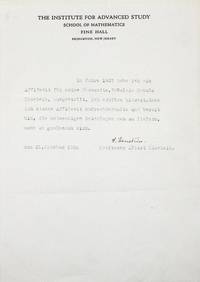
1938ref. 366717Princeton New Jersey 1938. 7 lines typed in German on letterhead of the Institute for Advanced Study School of Mathematics watermarked Chieftain Bond signed in ink. 4to 9-7/8 x 7-1/8 inches. Old folds. Fine. 7 lines typed in German on letterhead of the Institute for Advanced Study School of Mathematics watermarked Chieftain Bond signed in ink. 4to 9-7/8 x 7-1/8 inches. Im Jahre 1837 habe ich ein Affidavit für meine Verwandte Fräulein Ursula Einstein ausgestellt. Ich erkläre hiermit dass ich dieses Affidavit aufrechterhalte und bereit bin di notwendigen Unterlagen neu zi liefern wenn es gewünscht wird. den 31. Oktober 1938 signed Professor Albert Einstein. "In the year 1937 I signed an affidavit on behalf of my relative Miss Urusula Einstein. I hereby state that I continue to certify this affidavit is correct and am ready to submit the necessary documents anew if this is requested." Albert Einstein 1879-1955 German-born physicist renowned for developing the theory of relativity in papers published in 1905 and 1916 was awarded the Nobel Prize for Physics in 1921 and left Germany in 1933. He was associated with the Institute for Advanced Study at Princeton. This statement was almost certainly prepared in connection with efforts to assist his relative in emigrating. In a letter to his sister Maja Winteler-Einstein then resident in Switzerland dated December 1938 Einstein wrote "I am now working as some sort of itinerant relief committee and buckets of letters are coming in . I am helping the Ulm relatives with emigrating". Ursula Einstein born 1916 was able to get out; in 1940 she was a refugee in Port-au-Prince and later reached Brazil. Her younger sister Barbara was not so fortunate. Barbara Einstein born 1918 took her own life in March 1943 after her fiancé Harry Jacob was taken off to the concentration camps. A choice Einstein autograph. unknown books
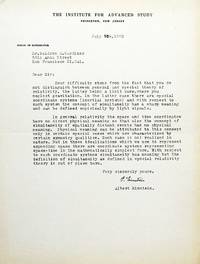
1952ref. 3091Princeton: np 1952. First edition. no binding. Very Good. EXTRAORDINARY EINSTEIN LETTER IN ENGLISH EXPLAINING SIMULTANEITY ONE OF THE CENTRAL TENETS OF RELATIVITY THEORY. Einstein's "1905 paper on special relativity is widely regarded as having destroyed the classical conceptions of absolute time and space along with absolute simultaneity and absolute length which had reigned in physics from the times of Galileo and Newton to the dawn of the twentieth century. The Special Theory teaches us that simultaneity is not as we supposed an absolute concept but is always relative to some inertial frame of reference. If we change the inertial frame of reference we change the events to be reckoned simultaneous." -Craig and Smith Einstein Relativity and Absolute Simultaneity The concept of simultaneity lies at the core of relativity theory. The very first sub-section of Einstein's legendary 1905 paper on Special Relativity is introduced by the title "Definition of Simultaneity" and "in the second paragraph of his 1905 relativity paper Einstein proved that simultaneity as defined in the first paragraph is a relative concept. This means as Einstein explained that 'we must not ascribe absolute meaning to the concept of simultaneity; instead two events that are simultaneous when observed from some particular coordinate system can no longer be considered simultaneous when observed from a system that is moving relative to that system.' In these words Einstein for the first time offered an explicit definition of what he means when he speaks of a relative concept. As we see it is a concept whose validity depends on the coordinate system chosen or in brief it is a frame-dependent concept. Simultaneity is no longer a binary relation depending also on the coordinate-frame involved. Furthermore Einstein's proof of the relativity of simultaneity in this paragraph is the first ever published rigorous proof of the relativity of a physical concept. The relativity of simultaneity became also the first major subject of dispute between proponents and opponents of the theory of relativity" Max Jammer Concepts of Simultaneity: From Antiquity to Einstein and Beyond. When Einstein expanded his relativity theory into his General Theory of 1916 the notion of simultaneity became less well-defined and more problematic and therefore much-debated. Einstein in the present letter is answering a question from Dr. Waldron Gardiner a physician apparently without any particular expertise in relativity theory about the concept of simultaneity in space the domain of general relativity. Dated July 10 1952 the letter reads in full: Dear Sir: "Your difficulty stems from the fact that you do not distinguish between general and special theory of relativity the latter being a limit case where you neglect gravitation. In the latter case there are special coordinate systems inertial systems and with respect to such system the concept of simultaneity has a sharp meaning and can be defined empirically by light signals. In general relativity the space and time coordinates have no direct physical meaning so that also the concept of simultaneity of spatially distant events has no physical meaning. Physical meaning can be attributed to this concept only in certain special cases which are characterized by certain symmetry qualities. Such case is not realized in nature. But in those idealizations which we use to represent expanding space there are coordinate systems representing space-time in the mathematically simplest form. With respect to such coordinate systems simultaneity has meaning but the definition of simultaneity as defined in special relativity theory is out of place here. Very sincerely yours SignedA. Einstein PrintedAlbert Einstein In short Einstein is explaining to Dr. Gardiner that since "space and time coordinates have no direct physical meaning" in cosmological terms i.e. there are no frames of reference that cover all of space his understanding of simultaneity in general relativity is flawed and based on the model of special relativity "a limit case" achieved only through a reductive and localized application of general relativity. Einstein concludes the letter with the provocative comment that in idealized systems representing expanding space simultaneity has meaning and in fact this "meaning" of simultaneity in general relativity has become a fertile area of exploration over the years see Jammer ibid. Note: A carbon of Dr. Gardiner's original letter to Einstein is included. Princeton: July 10 1952. One 8.5 x 11 inch page of Einstein's Institute for Advanced Study letterhead. Signed "A. Einstein" in ink. Date corrected from July 9th to July 10th. Usual but very light folds small spot of soiling at top left corner; a tiny bit of toning to extreme edges. Housed in custom presentation folder. LETTERS BY EINSTEIN DISCUSSING MAJOR ELEMENTS OF RELATIVITY PARTICULARLY IN ENGLISH ARE EXCEEDINGLY RARE. np unknown books