Albert EinsteinABAA
213 résultats
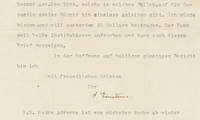
1941réf. 3262211/9/41. A generous demonstration by Einstein of his loyalty to friends and belief in the importance of music Dr. Theodor Rosenheim was a physician at the famed Medical University Clinic of the Charité in Germany in the 1880s. He was primarily concerned with the physiology and pathology of the digestive tract. He published an early textbook on the “Pathologie und Therapie der Krankheiten des Verdauungsapparates”. Rosenheim was one of the first in Germany to describe and publish on ulcerative colitis. He was intensively involved in the technical development of esophagoscopy and gastroscopy which at that time were only possible with rigid instruments. The Rosenheim line which was named after him described the largest diagonal diameter of the gastric percussion figure. Rosenheim was appointed professor extraordinarius at Berlin University in 1921. He also founded a polyclinic and a private sanatorium for stomach and intestinal patients. He was well respected in Berlin and his private practice developed successfully with a large circle of patients including Albert Einstein. Theodor’s wife was Hedwig Rosenheim and their daughter Kate was a hero of the Holocaust. She helped several thousand children from Jewish families to escape from Germany. She personally accompanied the legendary Kindertransporte to England among other places. She travelled to the USA in 1936 to negotiate directly with the aid organizations there. She then returned to Germany to actively continue the aid campaigns. Theodor died in 1939. Käte Rosenheim was able to flee Berlin together with her 72-year-old mother Hedwig Rosenheim on January 23 1941. They reached Havana Cuba via France Spain and Portugal. From there they were able to continue to New York where they arrived on April 1 1941. Albert Einstein was an accomplished violinist and music lover who was inspired by music in his scientific work. He often said that he would have been a musician if he hadn't pursued science. Another music lover was Hedwig Rosenheim. She had escaped Germany without her possessions especially her precious musical instruments. Upon arrival in the United States she contacted the old family friend Albert Einstein hoping he could help her get a flute either for herself or another escapee one who may have agreed to look for her. Einstein was sympathetic and rose to the occasion. He even contributed some of his personal funds to secure the flute. Typed letter signed his vacation house in Knollwood at Saranac Lake N.Y. September 11 1941 to his old friend Mrs. Hedwig Rosenheim in New York City. “ The matter of i.e. the quest for the flute shall not fail. First one should know what the committee is giving out – or loaning. Second there is the Hebrew Free Loan Society 108 Second Ave. New York which in such cases provides interest-free loans in exchange for the backing of two guarantors. I will serve as a guarantor and contribute 20 dollars on top of that. The man should visit both institutions and can show this letter. In the hope of receiving a positive report soon I remain with warm greetings your A. Einstein.” “PS. Starting next week my address will again be in Princeton.” The committee he referred may have been the American Jewish Joint Distribution Committee though there were others as well. It shows a lot about Einstein - his generosity his continued concern for old friends who had escaped from Germany and love for music - that he volunteered to make a personal financial contribution to obtaining the flute. <img class=""alignnone wp-image-25018 size-post-window"" src=""https://cdn.raabcollection.com/wp-content/uploads/20231204144051/Folder-site-11-1600x1327.jpg"" alt="""" width=""1600"" height=""1327"" /> unknown books
1880réf. 24284A unique and important artifact of his childhood. ALBERT EINSTEIN. Ephemera. Set of Anker-Steinbaukasten children's building blocks by F. Ad. Richter & Cie. Rudolstadt Germany c.1880s. Approximately 160 composite quartz sand chalk and linseed oil blocks in red limestone and slate gray in various sizes and shapes together with three or more sets of building plans all contained in two wooden boxes with printed Anker-Steinbaukasten labels. Einstein spent his childhood building "complicated structures" with these Anker-Steinbaukasten blocks. Accepting his later theory that "Imagination is more important than knowledge" the toys that encouraged his imagination became building blocks for the most important scientific theories of the last millennium. His sister Maja Winteler-Einstein describing his childhood recalled that "The games he played … were very characteristic of Albert's capacities. These were mostly puzzles fretsaw work the erection of complicated structures with the well-known Anker building blocks and above all the construction of multi-storied card castles with which he filled his leisure." "Beitrag für sein Lebensbild" in The collected papers of Albert Einstein. ed. John Stachel. Volume 1: The early years. 1879-1902. Princeton University Press 1987 p.lix. Translated from German. Based on the work of German educator Friedrich Froebel who created the concept of kindergarten these composite stone blocks were a popular toy of the 1880s and 1890s. The blocks were designed to help develop childrens' tactile senses and manual dexterity and also to stimulate imagination creativity and three-dimensional perception. Fellow scientist J. Robert Oppenheimer as well as architects Frank Lloyd Wright and Walter Gropius are among the geniuses who are known to have played with Anker blocks. Provenance The set had passed by direct descent from Albert Einstein to the consignor from whom we acquired the blocks at Christie's London on July 13 2016. Condition A few blocks chipped and worn with original instructions and boxes worn soiled and defective. Albert Einstein 1879-1955 was a German-Swiss born theoretical physicist internationally recognized as one of the greatest physicists of all time. He enunciated the general theory of Relativity with law explaining the relationship between the speed of light and its consequence the equivalence of mass and energy E=MC2. For his work in theoretical physics—largely for his 1905 paper on photons and photo-electricity—Einstein was awarded the Nobel Prize for Physics announced in November 1922 retroactive for 1921. Working on a unified field theory he then attempted to explain gravitation and electromagnetism within one set of laws. With the expulsion of Jewish scholars from Germany after Hitler's rise to power Einstein joined the Institute for Advanced Study in Princeton New Jersey 1933 which became the most celebrated research center in the world. In 1939 he signed a letter written to President Franklin Roosevelt warning him of the possibility of Germany developing a nuclear bomb. He urged the U.S. to begin uranium research thus beginning the top secret "Manhattan Project." Later at Princeton he tried to develop a unified field theory and to refute the accepted interpretation of quantum physics both unsuccessfully. Einstein received U.S. citizenship in 1940. books
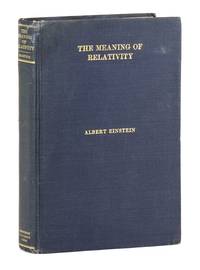
1923réf. 32639Princeton NJ: Princeton University Press 1923. Very Good. Princeton NJ: Princeton University Press 1923. First U.S. Edition. Octavo 18 cm; publisher's gilt-lettered navy cloth; 123pp. Boards bumped at corners spine ends scuffed. Water staining to spine crown bleeding into upper cover minor separation of head of spine material from book block. Last free endsheet creased. Endsheets toned. Endsheets first few pages last few pages and pages 106-112 show water staining at top margin but bulk of text block is clean and bright. Starting slightly after first free endsheet. A Very Good example overall. Collection of four lectures delivered by Einstein at Princeton for the Stafford Little Lectures in 1921. The majority of the lectures are an attempt to reconcile issues with his theory of relativity and defend it as well as give a comprehensive overview of the physics and math involved in the theory in an accessible way. Princeton University Press unknown books
1927réf. 49047Berlin: Ernst Wasmuth A.-G 1927. First edition. Good- to fine condition. 176/330. 41 1pp. 42 plates with printed tissue guards. Original quarter vellum over brown paper-covered boards with gilt vignette on cover gilt lettering on spine. Title page with publisher's device and black double frame. Cover design by Lucian Zabel. With an introduction on Russian culture the tradition of ballet and theater set and costume design by Carl Einstein. Many of the plates with dates ranging from 1910 to 1923 including motifs created during the war. The motifs of the plates range from close-up figure drawings to simple folk costumes elaborate gowns for members of the Court mystical figures and various set designs. Illustrated with forty-two plates nineteen of them fully or partially colored by hand or pochoir some heightened in gilt or silver three b/w one sepia-toned lithograph and nineteen plates reproduced in high quality offset printing. The title page calls for forty-two plates and six illustrations in the text. Our copy is illustrated with seven tipped-in color offset reproductions and one b/w lithograph as endpiece on page seventeen. In addition the work is extra-illustrated with five color offset reproductions: one full-page embossed color plate with extensive hand-applied gilt overlay facing page seven Le Roi a full-page embossed color offset reproduction with extensive silver overlay facing plate one Phedre Thesee dated 1923 and three full page color offset reproductions facing plates fifteen L'Amazone with black overprinting twenty-five Scheherazade embossed and heightened in silver and Lampe d'Aladin multicolor overprint and thirty-six La Sultane embossed and overprinted in gilt facing the same image though with greater detail. The copies listed in OCLC vary in publication dates all calling for 42 plates and six in-text illustrations. Auction records call for 1925. One auction record for the 1925 edition calls for the lithograph line drawing in the text. Our copy contains two plates dated 1922 in addition to others dated 1917. We've been unable to find any bibliographic record that describes seven in-text illustrations or the five additional illustrations facing four of the plates and the first page of the text as described. Text in German. Binding with light wear along edges but vellum smudged and variously discolored. Block lightly starting at a few plates 11 15 19 27 30 42. A couples of tissue guards for plates loose but present. Binding in overall good- plates in very good to fine condition. Leon Bakst 1866-1924 was a Russian painter costume and set designer. Bakst studied art at the St. Petersburg Academy of Arts and was a member of the Sergei Diaghilev circle. In 1893 he moved to Paris for four years studying at the Academy Julian. He founded the magazine 'Mir Iskusstva World of Art' with his friends Alexander Benois Sergei Diaghilev and Valentin Serov. Bakst is best known for his work in set and costume design for the Ballet Russes. Ernst Wasmuth A.-G unknown books
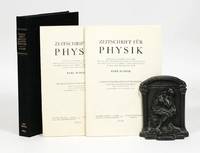
1924réf. 2905Berlin: Julius Springer 1924. First edition. original wrappers. Very Good. FIRST EDITION IN ORIGINAL WRAPPERS of the presentation of "Bose-Einstein statistics." “In 1924 Bose found a way to derive Planck’s equation for black body radiation using a statistical approach based entirely on the idea that light is made up of tiny particles photons. This echoed the statistical mechanics approach of Ludwig Boltzmann to the behaviour of gases but using a different statistical rule; it derives black body radiation entirely in quantum terms without using the idea of electromagnetic radiation at all. Bose wrote a paper about his discovery and sent it to Albert Einstein who immediately saw its significance translated it into German and arranged for its publication in the prestigious Zeitschrift für Physik. Einstein developed the idea to apply to other kinds of particle not just to a ‘gas’ of photons which is why this approach is usually referred to as ‘Bose-Einstein statistics’. Paul Dirac coined the name ‘bosons’ for particles which obey Bose-Einstein statistics" Gribbin Q is for Quantum. Particle Physics: One Hundred Years of Discoveries: “Discovery of new statistical counting rules for light quanta and a new derivation of Planck’s radiation law. Known as Bose-Einstein quantum statistics for particles with integer spins.” WITH a follow-up paper by Bose: "Wärmegleichgewicht im Strahlungsfeld bei Anwesenheit von Materie": "Bose's first paper in 'Zeitschrift für Physik' was followed by another that was also translated by Einstein and published during 1924. In it Bose provided a general statistical treatment of emission and absorption processes for electromagnetic radiation in equilibrium with matter. This paper was accompanied by a note by Einstein expressing serious doubts about the method. In January 1925 Bose wrote to Einstein from Paris that he was working on a paper he felt would remove these doubts. But it seems never to have been completed" DSB. Plancks Gesetz und Lichtquantenhypothese. IN: Zeitschrift für Physik Vol 26 No. 3 August 1924 pp. 178-81. Berlin: Julius Springer 1924. “Wärmegleichgewicht” Vol 27 No. 5/6 September 1924 pp. 384-93. Octavo original wrappers. “Planks Gesetz” with small closed tear at rear wrapper edge; otherwise fine condition; “Wärmegleichgewicht” with small chip to base of front wrapper. SCARCE in original wrappers. Julius Springer unknown books
1943réf. NF0266RELATIVITY Privately published 1943 first edition a vg copy in flexible black leatherette. A seventy page treatise on energy as matter in motion culminating with the general law of relativity. Replete with many mathematical equations and forty-two figures. Privately published 1943 hardcover books
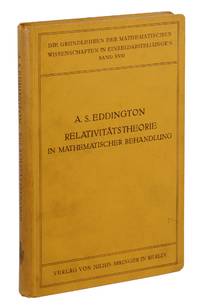
1925réf. 140945616Berlin: Verlag von Julius Springer 1925. First edition. First edition. xiv 377 1 4 pp. Bound in publisher's orangish yellow boards. Near Fine with light rubbing and soiling to boards tiny pen squiggle to front board. Contents bright and unmarked. An uncommon German-language physics text with an appendix by Einstein. Verlag von Julius Springer unknown books
1986réf. 345581986. Softcover. VG. White ill. stapled wraps. 6 pp. 4 color plates. paperback books
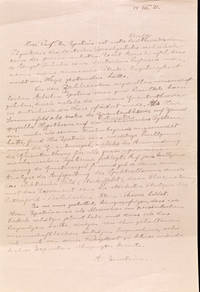
1921réf. 1206201921. Signed. EINSTEIN Albert. Autograph letter signed. No place August 14 1921. Single sheet of cream lined paper measuring 7-1/2 by 11 inches; p. 1. $35000.Rare heartfelt autograph letter of recommendation written and signed by Einstein in German enthusiastically recommending his friend and colleague physicist Prof. Dr. Paul Epstein for an academic position.The autograph letter dated ""14 VIII 21"" written entirely in Einstein's hand reads translated from the original German: ""Prof. Dr. Epstein is certainly one of the most prominent living theoretical physicists of the German-speaking world. Without a doubt he would have been appointed to a German professorship a long time ago had his Russian nationality not stood in the way. Among Epstein's numerous original scientific papers two findings which advanced the modern quantum theory in crucial ways should be noted. After Mr. Sommerfeld as the first physicist who on the basis of special hypotheses had applied the quantum theory to a certain mechanical system of more than one degree of freedom Mr. Epstein discovered an important generalization of the quantum principle which established the application of the quantum theory for all quasi-periodic mechanical systems. Based on that general application of the quantum principle he then provided an analysis of the splitting of spectral lines in the electrical field Stark effect the accordance of which with the experiment provides one of the strongest supports for the Rutherford-Bohr atomic theory. I would like to add that I have also come to appreciate Mr. Epstein in personal interactions as a human being and that I had the pleasure of attending several scientific lectures given by him which enabled me to convince myself of his competence in delivering clearly understandable oral exposition. / A. Einstein.""Einstein and Epstein were friends and longtime correspondents who shared an interest in physics Judaism and the founding of Israel. Paul Epstein was a Russian-American mathematical physicist. He remains best known for his contributions to the development of quantum mechanics. Indeed he was one of a select group that included Lorentz Einstein Minkowski Thomson Rutherford Sommerfeld Rntgen von Laue Bohr de Broglie Ehrenfest and Schwarzschild. Born in Warsaw then part of Imperial Russia Epstein was brought up solidly middle class. He later stated that his mother recognized his potential at the age of four and predicted his future as a mathematician. Epstein studied mathematics and physics for his entire university career eventually earning a degree from the Imperial University of Moscow. He then went on to earn a Ph.D. at the Technical University of Munich in 1914 concentrating on a problem in the theory of diffraction of electromagnetic waves. However the outbreak of World War I rendered Epstein an enemy alien in Germany. Sommerfeld intervened on his behalf and he was allowed to stay as a private citizen and continue his research. In 1916 Epstein published an important paper explaining the Stark Effect using the Bohr-Sommerfeld quantum theory. After the war Epstein went to Leiden and worked as an assistant for Lorentz and Ehrenfest. In 1921Ñthe year this letter was writtenÑEpstein was recruited by Robert Millikan to join the physicists at the California Institute of Technology. Epstein accepted the position and stayed there for the rest of his career publishing extensively on quantum theory. Epstein was something of polymath and worked in numerous areas outside of quantum theory including work on air resistance the settling of gasses the theory of vibration and the absorption of sound. He was an avid supported of Freudian psychoanalysis including as one of the founding members of the Psychoanalytic Study Group that later merged with the Los Angeles Institute for Psychoanalysis. Epstein was also notably anti-communist and worried about the threat of nationalism.The areas of study mentioned in Einstein's letter of recommendation all came together to help form the science behind atomic and hydrogen bombs though neither Einstein nor Epstein anticipated quite where the science was headed in 1921. The letter mentions the Stark effect which is the shifting and splitting of spectral lines of atoms and molecules due to the presence of an external electric field. It is analogous to the Zeeman effect in which a magnetic field is the influence. The Rutherford-Bohr model presented in 1913 is a system consisting of a small dense nucleus surrounded by orbiting electronsÑsomewhat like the Solar System but with electrostatic forces instead of gravity. The Bohr model came to be recognized as a relatively primitive model of the hydrogen atom compared to the valence shell atom model. However because of its simplicity and the correct results it generates for certain systems it is still commonly used to introduce students to quantum mechanics.Overall this letter provides valuable insight into the scientific world during the height of Einstein's international career right when he first began traveling abroad and meeting fellow scientists internationally. The letter reflects Einstein's importance in the community and is a testament to Epstein's ability as a physicist. Original mailing creases. Fine condition. unknown books
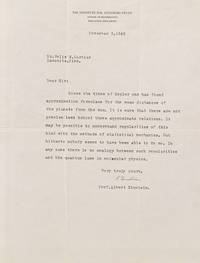
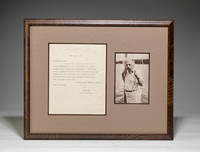
1942réf. 1265881942. Signed. EINSTEIN Albert. Typed letter signed. Princeton November 3 1942. One sheet measuring 8-1/2 by 11 inches typing on recto only; matted and framed with a portrait of Einstein entire piece measures 21 by 17 inches. $38000.An exceptional typed letter signed by Einstein on precursors like Johannes Kepler's work to his Special and General Theories of Relativity beautifully framed.The letter on letterhead from the Institute for Advanced Study in Princeton reads in full: ""November 3 1942. Mr. Felix W. Cartier. Laconite Minn. Dear Sir: Since the times of Kepler one has found approximation formulaes for the mean distances of the planets from the sun. It is sure that there are not precise laws behind those approximate relations. It may be possible to understand the irregularities of this kind with the methods of statistical mechanics. But hitherto nobody seems to have been able to do so. In any case there is no analogy between such regularities and the quantum laws in molecular physics. Very truly yours signed A. Einstein. Prof. Albert Einstein.""Early in the 17th century Johannes Kepler 1571-1630 discovered that planets orbit the sun in ellipses rather than perfect circles. This great discovery paved the way for Isaac Newton's laws of gravity and for Albert Einstein's general and special theories of relativity. Previous to Einstein's time people believed in real distances and absolute time and showed that instruments could not objectively measure the distances between planets. Einstein's theories which hypothesized that light and space curve near a massive object revolutionized scientific thought and gave man an exciting new perspective of his universe.Einstein's letter reflects on some of the most important scientific revelations in the history of physics and astronomy. Kepler defined three laws of planetary motion; however the one specifically referred to in this letter is that all planets move about the Sun in elliptical orbits having the Sun as one of the foci. If the Universe then consisted only of two point massesÑthe Sun and a planetÑthe orbit of that planet would make a perfect closed ellipse that returned the world to its starting location with each trip around the Sun. But in a Universe governed by Newtonian gravity with a plethora of massive bodies in our Solar System that ellipse will precess or rotate slightly in its orbit.In the mid-1800s orbital deviations of Uranus from its predicted motions led to the discovery of Neptune as the outermost world's gravitational influence accounted for the excess motion. But in the inner Solar System the nearest planet to the Sun Mercury was experiencing a similar problem. With detailed accurate observations going back to the late 1500s thanks to astronomer Tycho Brahe we could measure how Mercury's perihelion its closest orbital point to the Sun was advancing. The number we came up with was 5600"" per century just over 1.5 degrees over a 100 year period. But of that 5025"" came from the precession of Earth's equinoxes a well-known phenomenon while 532"" was due to Newtonian gravity.But 5025"" plus 532"" comes up short by a small but significant amount. Attempts at explanationÑincluding the existence of an unknown inner planet interior to MercuryÑall failed. But after Einstein's special theory of relativity came out in 1905 mathematician Henri Poincare showed that the phenomena of length contraction and time dilation contributed a fraction between 15-25% of the needed amount towards the solution dependent on the error. That plus Minkowski's formalization of space and time as not separate entities but as a single structure bound together by their union spacetime led Einstein to develop the general theory of relativity. On November 25 1915 he presented his results computing the spectacular figure that the contribution of the extra curvature of space predicted an additional precession of 43"" per century exactly the right figure needed to explain this observation sending shockwaves through the astronomy and physics communities. Less than two months after this Karl Schwarzschild found an exact solution predicting the existence of black holes. The deflection of starlight and gravitational redshifts/blueshifts were realized as possible tests and finally the solar eclipse of 1919 validated general relativity as superseding Newtonian gravity. Expected fold lines. An incredible letter scarce in its important content. unknown books
1946réf. 1206241946. Signed. EINSTEIN Albert. Typed letter signed. Princeton April 3 1946. Single sheet of gray letterhead measuring 8-1/2 by 11 inches; p. 1. Matted and framed with a portrait entire piece measures 19 by 15-1/2 inches. $9500.Original typed letter signed by Albert Einstein thanking his friend Dr. Isadore Held for his birthday wishes as well as for sending a new book that Einstein found both ""extraordinarily enlightening"" and humorous. Text in German.The letter typed on Einstein's personal letterhead with his name and Princeton address blindstamped at the top reads in full translation: ""3 April 1946. Dear Mr. Held: I would like to express my sincere thanks for your birthday wishes and for the sending of the last work of this wonderful contemporary. I have already read quite a bit and find that it is extraordinarily enlightening. His penetration into the mentality of far-off times and attitudes toward thinking is most remarkable and his humor no less. With fond greetings to you and your dear wife. Yours signed Albert Einstein."" This letter was written to Austrian-American medical Dr. Isadore Held who was friends with Einstein since at least 1938. Held and Einstein shared numerous interests particularly related to Jewish humanitarian relief and Israel. At Held's death Einstein wrote to his widow that ""True goodness emanated from this man who alleviated the harshness of human relations and who understood and forgave all weaknessesÉ As a role model for his fellow men he was the best that a human being can be."" Einstein was not a huge fan of birthdays though he happily acknowledged well wishes from friends. Just before turning 65 Einstein crankily said to a New York Times interviewer: ""What is there to celebrate Birthdays are automatic things. Anyway birthdays are for children."" In a 1954 letter to physicist Hans Mhsam Einstein described his birthday as ""a natural disaster a shower of paper full of flattery under which one is drowned."" Einstein was generally quite shy and did not like to be the center of attention particularly from strangers obsessed with his accomplishments and fame. However well-meaning letters and small gifts like the book given by Held were always welcomed and graciously accepted by Einstein. Original mailing creases and a few pinpoint holes along top edge possibly from stapling. About-fine condition. unknown books
1914réf. 50425Leipzig: Johann Ambrosius Barth 1914. 1 Einstein Albert 1879-1955 and A.driaan D.aniël Fokker 1887-1972. Die Nordströmsche Gravitationstheorie vom Standpunkt des absoluten Differentialkalküls. In Annalen der Physik 44 10: 321-328. 2 Born Max 1882-1970. Zur Raumgitter theorie des Diamanten. In Annalen der Physik 44 12: 605-642. 3 Schrödinger Erwin Rudolf Josef Alexander 1887-1961. Zur Dynamik elastisch gekoppelter Punktesysteme. In Annalen der Physik 44 14: 916-934. Leipzig: Johann Ambrosius Barth 1914. Whole volume: viii 1272 pp. 22 plates Numbered Taf. I-XXII. Taf. I-IX: b/w/ silver photos; Taf. XI w/ one b/w silver photo; Taf. XII is folding and XIII XIV are b/w silver photos; Taf. XV and XVI are large folding tables; Taf. XVII XVIII XIX b/w/ silv.photos; and Taf.XX--XXII are photographs of X-ray images. Figs. Text-illust. 210 x 140 mm. Red cloth gilt lettering on spine. Very good. Along the margin of p. 802 written in pencil are the words: "Mallock R.S. 1910" probably written in Lord Rayleigh's hand most likely in reference to the title "The dampening of sound by frothy liquids" by A. Mallock in Proc. R.S. Lond ser. A vol. 84: 391-94. London 1911. A.D. Fokker 1887-1972 was a Dutch physicist and cousin to aeronautical engineer Anthony Fokker 1890-1939. He was musically inclined having invented the 31EDO pipe organ. He earned his doctorate in 1913 continuing his studies with Albert Einstein Ernest Rutheford 1871-1937 and William Bragg 1862-1942. In his 1913 thesis he derived the Fokker-Planck equation with Max Planck 1858-1947. Fokker made contributions to special relativity and general relativity particularly the effects of the curvature of space-time formally called "geodetic precession". Wikipedia. . Johann Ambrosius Barth unknown books
1954réf. 195551954. in German black ink. Signed “A. Einstein”. A poem written by Einstein to his colleague and collaborator Ernst Straus and his son Daniel. “Dear Strausse both! My best wishes and greetings in poetic form. It brings even more happiness If it has been anticipated for so long also in one’s circle of friends the event is doubly appreciated. This is what I wish: Let Daniel be like his father thoroughly intelligent and not less joyous so few humans are like that. Many - alas - are born few are chosen to bring light and joy. Let such gift be his drive. Yours A. Einstein” In German “Strauss” means bunch bouquet etc. or ostrich and “Strausse” is plural. Ernst G. Straus 1922-1983 was a mathematician who helped found the theories of Euclidean Ramsey theory and of the arithmetic properties of analytic functions. He was Einstein’s assistant and collaborator both at Princeton and afterwards when he moved to become a professor of mathematics at UCLA. His son Daniel is a professor of chemistry at Cal State San Jose. unknown books
1921réf. 18099New York: Henry Holt and Company 1921. THIRD EDITION. With frontispiece portrait Einstein dated 1920. Blue cloth small tear at top of spine corners slightly worn no dust wrapper; front hinge a bit loose otherwise a very clean copy. From the library of Martin J. Klein professor of the history of science at Yale and the first recipient of the Abraham Pais Prize for the History of Physics. This copy was given to Klein as a gift from his summer program NEH class of 1986 and is signed by 13 of his students. Third edition though the only change is the date on the title page of one of Einstein’s most renowned works intended for readers with a general scientific and philosophical background. Part I treats the special theory of relativity part II the general theory and part III considers the universe as a whole. Not in Weil or Boni. Henry Holt and Company unknown books
1958réf. 188282New York: Dover 1958. Near Fine. Reprint. Near fine. Dover unknown books
1915réf. 14657Leipzig and Berlin: B.G. Teubner 1915. With frontispiece portrait of Minkowski and text figures. Boards spine and corners frayed and cracking. Sammelband containing the original papers on the special and general theories of relativity with a foreword by O. Blumenthal. It is in Minkowski's famous paper Raum und Zeit Space and time that he proposes the concept of time as the fourth dimension and initiates a mathematical study that became the basis of the later development of the theory. Included here is the re-issue of that work by Einstein and Lorentz with notes by A. Sommerfeld published after Minkowski's untimely death along with other papers by the two scientists whose works led to the abandonment of space and time as separate entities. Weil 59; see Printing & the Mind of Man 401. B.G. Teubner unknown books
1929réf. 19299Berlin: Verlag der Akademia der Wissenschaften in Kommission bei Walter de Gruyter 1929. FIRST EDITION. Original printed orange wrappers; a fine copy unopened and bound into morocco-backed cloth boards spine labeled in gilt. First edition first issue in the rare author’s offprint form with a newly set title-page. One of Einstein’s last important scientific works this publication of the unified field theory caused quite a sensation. It was the first separate printing of one of a series of five papers published between 1925 and 1929 in which Einstein attempted to develop a unified field theory reconciling in a single formula the laws of electromagnetism and gravitation. Weil 165; Printing & the Mind of Man 418. Verlag der Akademia der Wissenschaften in Kommission bei Walter de Gruyter unknown books
1912réf. 50338Leipzig: Johann Ambrosius Barth 1912. Einstein Albert 1879-1955. 1 Lichtgeschwindigkeit und Statik des Gravitationsfeldes pp. 355-369. Weil 47 Boni 43. 2 Zur Theorie des statischen Gravitationsfeldes pp. 443-458. Weil 48 Boni 44. 3 Nachtrag zu meiner Arbeit: "Thermodynamische Begrundung des photochemischen Aquivalentgesetzes" pp. 881-885. Weil 46 Boni 42. 4 Antwort auf eine Bemerkung von J. Stark: "Uber eine Anwedung des Planckschen Elementargesetzes" pp. 888. Weil 49 Boni 45. 5 Relativitat und Gravitation. Erwiderung auf eine Bemerkung des Hrn. A. Einstein pp. 1059-1064. Weil 50 Boni 46. In Annalen der Physik 38 1912. Red cloth with gilt lettering on the spine. Whole volume: 1064 pp. 8 plates. Text-figs. 210 x 130 mm. Very good copy. Approximate English translations of titles with brief explanations of referenced paper if available: 1 "The speed of light and the statics of the gravitational field." "Further exploring his studies of gravitation based on the equivalence principle Einstein sees with growing clarity that gravitation is intimitely linked with the problem of the measurement of space and time" p. 292. Calaprice Kennefick & Shulmann. An Einstein Encyclopedia. 2015.; 2 "On the theory of the static gravitational field." "Einstein more closely analyzes the equations of motion stated in no. 1 above concluding that those equations cannot be reconciled with the given field equations for c . . . because the principle of "action equals reaction" is violated. p. 290. Calaprice Kennefick & Shulmann. An Einstein Encyclopedia. 2015.; 3 "Addendum to my work: 'Thermodynamic justification of the photochemical equivalent law' "; 4 "Answer to my remark by J. Stark: "On an application of Planck's elementary law' "; 5 "Relativity and gravitation. Response to a remark by Mr. A Einstein". Weil's Einstein Bibliography nos. 47 48 46 49 and 50. Boni's Einstein Checklist nos. 43 44 42 45 and 46. . Johann Ambrosius Barth unknown books
réf. 504141 First Edition journal issue. The brilliant follow-up to Einstein's landmark 1905 paper on the photoelectric effect. In the 1905 paper Einstein had explained the photoelectric effect-the emission of electrons from a metal when irradiated by light-by making the revolutionary proposal that light rather than consisting of continuous waves was instead made up of discrete particles of energy "light quanta" which transferred their entire payload of energy to an electron on impact. In the 1905 paper Einstein made use of Planck's mathematical formula for blackbody radiation which had introduced the concept of energy quanta but he was only able to derive part of the formula. In his 1906 paper Einstein "used his statistical mechanics to demonstrate that when light interacts with matter Planck's entire formula can arise only from the existence of light quanta-not from waves" Cassidy; emphasis ours. Einstein had realized as he stated in the present paper that "'Planck's theory makes implicit use of the . . . light-quantum hypothesis' . . . his acceptance of Planck's formula albeit as a hypothesis led to a major advance in his own work" Pais Subtle is the Lord p. 378. In 1921 Einstein was awarded the Nobel Prize in physics for his work on the photoelectric effect. Cassidy David "Einstein on the Photoelectric Effect." Einstein: Image and Impact. American Institute of Physics n.d. Web. Accessed 09 July 2014. Shields "Writings of Albert Einstein" in Albert Einstein: Philosopher-Scientist 1948 pp. 689-758 no. 13; also included in Shields' "Chronological list of principal works" on p. 757. Weil Albert Einstein: A Bibliography no. 12. 2 First Edition journal issue of Einstein's second paper on the inertia of energy following his 1905 paper "Ist die Trägheit eines Körpers von seinem Energieinhalt abhängig" Is the inertia of a body dependent on its energy content. In the present paper Einstein presented another argument in support of the proposition that a body's energy depends on its energy content. "About a year after he first introduced the inertia of energy Einstein published a paper entitled "The Principle of the Conservation of the Center of Gravity and the Inertia of Energy" in which he showed that E = mc2 is necessary and sufficient to ensure that the center-of-mass theorem holds for systems in which 'not only mechanical but also electromagnetic processes take place' . . . As Einstein acknowledges his paper is similar to Poincaré's contribution to the Lorentz Festschrift 1900. Einstein showed that in order to avoid the kind of violations of the center-of-mass theorem discussed by Poincaré one has to assume that energy has inertia" Janssen pp. 39-40. Janssen "The Trouton experiment E = mc2 and a slice of Minkowski space-time" in Revisiting the Foundations of Relativistic Physics: Festschrift in Honor of John Stachel 2003 pp. 27-54. Weil Albert Einstein Bibliography 13. . unknown books
1920réf. 37403Berlin: Springer 1920. Springer unknown books
1920réf. 43308Berlin: Springer 1920. 15pp. 221 x 146 mm. Original printed wrappers foxed. Minor internal foxing but very good. First edition cover title does not include the date Einstein delivered his lecture; see Weil. "By royal decree of June 24 1920 a special chair in Leiden University was created for Einstein enabling him to come to that university for short periods of his choosing. On October 27 1920 Einstein began his new position with an inaugural address on aether and relativity theory" Pais Subtle is the Lord p. 313. Weil Albert Einstein Bibliography 111. Springer unknown books
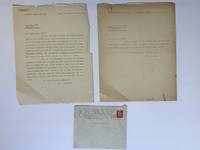
1931réf. 1403337Potsdam Germany 1931. Two letters by Albert Einstein. The first is a single-paged autograph letter signed by Albert Einstein with one horizontal fold and one vertical fold. In Very Good condition . Measuring 22.5 x 28.5 cm. Letter accompanied with mailing envelope both with matching paper-clip rust stain. Letter with some light wear along edges small staining to lower corner. Addressed to G. W. Meyer and dated 8 Oktober 31 in Potsdam the Letter reads in full: "Sehr geehrter Herr! Indem ich Ihnen für die Uebersendung des Buches von Henry George bestens danke sende ich Ihnen anliegend die gewünschte Meinungsäusserung mit der Bitte um Weiterleitung an Mrs. Evans. Mit ausgezeichneter Hochachtung" and signed in ink "A. Einstein". He thanks Meyer for serving as an intermediary in getting a book to him and for forwarding the enclosed letter. The second letter is a typed copy of Einstein's previously enclosed letter presumably made by Meyer before he passed the original on to Evans. Addressed to R. W. Evans and dated 8.10.1931 in Potsdam the letter discusses Henry George's economic theory of poverty and land nationalization compares it to Franz Oppenheimer's work and proposes questions to be asked. Presumably he was sent a copy of Henry George's Progress and Poverty. First published in 1879 it sparked the Progressive Era discussing the paradox of increasing inequality and poverty amid economic and technological progress as well as the economic value of land. Consignment. Shelved Case 3. The Letter reads in full: "Sehr geehrte Mrs. Evans! Ich habe das Buch von Henry George zum grössten Teil mit ausserordentlichem Interesse gelesen und glaube dass es in der Hauptsache einen unanfechtbaren Standpunkt vertritt insbesondere was die Ursache der Armut betrifft. Nie in diesem Buch vertretenen Ansichten stimmen soweit ich es beurteilen kann vollkommen mit den Resultaten des zeitgenössischen Professors Franz Oppenheimer überein der sie offenbar selbständig herausgefunden hat. Nicht einverstanden bin ich mit der Theorie des Zinses. Mit dem vorgeschlagenen Heilmittel der Verstaatlichung des Bodens und der Bodenschätzung scheint mir allerdings mehr ein Problem als eine Lösung gegeben zu sein. Soll z. Beispiel ein Boden Eigentum der Gemeinschaft das darauf hingestellte Haus aber Privateigentum sein Jedenfalls ist es schon von höchster Wichtigkeit dass das Wesen des Uebels klar aufgezeigt ist. Schon darum wäre es wichtig wenn das Buch die ihm gebührende Beachtung fände. Mit ausgezeichneter Hochachtung gez. A. Einstein." 1403337. Shelved Dupont Bookstore. unknown books
1979réf. 300955Princeton Princeton University Press 1979. 1979. First edition. Selected and edited by Helen Dukas and Banesh Hoffman. Frontispiece b/w portrait. Original German texts; chronology. Dust jacket price clipped. Very good. 167 pages. No signatures or bookplates. 1st Edition. Hardcover. Very Good/Very Good. Princeton, Princeton University Press [1979]. hardcover books
1927réf. 374151927. Offprint from S. preuss. Akad. Wiss. Weil 155. unknown books
1927réf. 433031927. Offprint from Sitzungsberichte der preussischen Akademie der Wissenschaften 1927. 235-245pp. 255 x 183 mm. Original printed wrappers. Fine. On the problem of motion in general relativity theory; a follow-up to his and Grommer's paper of the same title published earlier in 1927. Weil Albert Einstein Bibliography 160. unknown books