Albert EinsteinABAA
2557 resultados
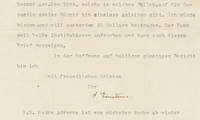
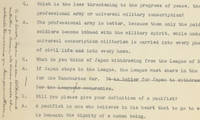
1502ref. 2446215/02/1933. He revises the typescript of his interview with the War Resisters League of which he was Honorary Chairman and calls out William Randolph Hearst and the head of the press and film empire in Germany who aided Hitler’s rise On philosophy: “The intellect without the emotions is insignificant”; On racism: “The main thing is that minority groups should be allowed security in the community.” They ought to be “accepted with friendliness as equal members” On the press: He criticizes William Randolph Heart by name but says “The freedom of the press is necessary despite all the dangers or abuse that come with it.”. On pacifism and peace keeping: “A pacifist is one who believes in his heart that to go to war is beneath the dignity of a human being” “Society needs some form of organization for security and protection in international life” and “An international police force…is almost absolutely necessary as one step toward achieving peace. Force when used by an impartial third party to achieve law and order it's not contrary to pacifism”. This document has never previously been offered for sale and was acquired by us from the family that has had it all this time Einstein was well known as a pacifist until Hitler’s rise to power. In 1930 on his second visit to America he joined the War Resisters League and accepted the office of Honorary Chairman. Einstein spoke to the organization that year saying “True pacifists must publicly declare in time of peace that they will not take up arms under any circumstances… even if only 2% of those assigned to perform military service should announce their refusal to fight governments would be powerless they would not dare send such a large number of people to jail.” The league then issued a pamphlet “Einstein on War Resistance” that was widely read and discussed. Meanwhile back in Germany the rising Nazi movement found a convenient target in Einstein and relativity branding the latter “Jewish physics” and sponsoring conferences and book burnings to denounce Einstein and his theories. The Nazis even enlisted other physicists to denounce Einstein; “One Hundred Authors Against Einstein” was published in 1931. When asked to comment on this denunciation of relativity by so many scientists Einstein replied that to defeat relativity one did not need the word of 100 scientists just one fact. <img class=""alignnone wp-image-24605 size-post-window"" src=""https://cdn.raabcollection.com/wp-content/uploads/20231204150044/Einstein-Feb-15-1933-3-1-1600x209.jpg"" alt="""" width=""1600"" height=""209"" /> In December 1932 Einstein decided to leave Germany. The reason: it became obvious to him that his life was in danger. A Nazi organization published a magazine with Einstein’s picture and the caption “Not Yet Hanged” on the cover. There was even a price on his head. In January 1933 Einstein came to the United States to serve at the California Institute of Technology in Pasadena California as a visiting professor. The appointment of Adolf Hitler as chancellor took effect late that month and Einstein decided he would not return to his home in Germany where he had been a professor at the Berlin Academy of Sciences. He would instead return to Europe and assess the situation from there. He and his wife Elsa returned by ship to Belgium in March 1933 to find that that their residences in Germany had been raided numerous times. Einstein accepted the fact that he could not return to Germany and turned in his passport to the German consulate; he also formally renounced his German citizenship. By the summer Einstein learned that his name was on a list of assassination targets. He resided in Belgium for some months and then moved to England for a short period. On October 17 1933 he returned to the US and took up a position at the Institute for Advanced Study at Princeton in New Jersey. And there he remained until his death. On February 15 1933 after Hitler had taken power but before Einstein learned that his homes had been raided he granted an interview to the War Resisters League at the home of one of its officials John Dorland. Dorland wanted the interview to be read aloud at the upcoming March 2 meeting of the members in Pasadena. He prepared a five page typescript of the interview and sent it to Einstein to review. As Dorland said in his cover letter to Einstein “Would you be kind enough to read it and if the answers misrepresent you in any detail may we request that you revise it in such particular as we are very anxious to have these correct.” He also asked Einstein's permission to read the interview aloud. This is the original typescript of the Einstein interview sent to Einstein by Dorland complete with Einstein’s handwritten notations. It is the only such annotated interview of Einstein that we have seen and it covers important topics. <img class=""alignnone wp-image-24606 size-post-window"" src=""https://cdn.raabcollection.com/wp-content/uploads/20231204150037/Einstein-Feb-15-1933-2-1-1600x247.jpg"" alt="""" width=""1600"" height=""247"" /> On page one Einstein makes it clear he was not ready to abandon his resistance to war. “The War Resisters” he stated at the interview “are doing a fine work. They have done more than any other peace group. A strong organized minority who have declared themselves absolutely against war is very powerful.” Question from Dorland. “Can we hope to convince everybody” Answer: “Oh no we cannot convince everybody but we do not need to. One strong man is worth much and has great influence Individuals thoroughly convinced and small groups working earnestly are of the utmost value.” Q: “In trying to arouse interest is it better to appeal to the intellect or the emotions” A: “To both; the intellect without the emotions is insignificant.” On page two Einstein states that “Public protests are very valuable” as is control over munitions production. “The private munitions business is a great threat to the peace of the world and there should be government control. Public opinion is not yet awake to the atrocities of the munitions firms.” Then Dorland changes the subject to “race relations.” Einstein responded “The main thing is that minority groups should be allowed security in the community.” Then Einstein hand writes in some thoughts. If they are not afforded such security “they should isolate themselves from the rest of society since they are not accepted with friendliness as equal members.” Then some fascinating free thoughts emerge. Clearly thinking of the Jews in Germany he crosses out “It insecurity is not so bad” and instead says “They can achieve a healthy existence”. But thinking of the current situation he finishes the thought by adding at least “Up until now!” He surely had less confidence about the future. On page three Einstein discusses the part to be played by international organizations. “The main thing is organization. Disputes will always come but we must have other methods than war for settling them. Society needs some form of organization for security and protection in international life.” Einstein then writes in “Obligatory court of arbitration. Unconditional obligation of the states to accept their verdicts and enforce them.” He is then asked which is less threatening to the progress of peace a professional army or universal military conscription. Einstein answers “The professional army is better because then only the professional soldiers become imbued with the military spirit.” Asked about Japan leaving the League of Nations he hand writes “It is better to let Japan secede from the League of Nations rather than have it the League compromised by a bad compromise.” Sooner let them go than compromise principles to keep them in. Lastly he is asked for his definition of a pacifist and responds “A pacifist is one who believes in his heart that to go to war is beneath the dignity of a human being.” <img class=""alignnone wp-image-24607 size-post-window"" src=""https://cdn.raabcollection.com/wp-content/uploads/20231204150030/Einstein-Feb-15-1933-5-1-1600x242.jpg"" alt="""" width=""1600"" height=""242"" /> On page four Einstein continues by saying that a pacifist “must be active in the prevention of war; that is he must support justice arbitration and conciliation.” In terms of having some international force enforce the peace Einstein is in favor. “an international police force as suggested by the French is almost absolutely necessary as one step toward achieving peace. Force when used by an impartial third party to achieve law and order it's not contrary to pacifism. This international force would exist only for a transition perhaps 20 years.” Dorland then asks Einstein “What do you think of the control over public opinion by the press” Einstein in the interview stated it was not good but in this document he elaborated further. “The freedom of the press is necessary despite all the dangers or abuse that come with it. This is the point with the biggest dependence of the peace movement peace work on economic circumstances. Hearst in America and Hugenberg in Germany demonstrate this fact with frightening clarity”. Alfred Hugenberg was the head of a press and film empire in Germany who aided Hitler’s rise. Einstein’s comparison of William Randolph Hearst with him is interesting. He clearly feels that the press in the wrong hands motivated by profit and political power was a danger. The next question was “Are religious bodies a power for peace” Einstein’s answer: “Not greatly now.” On the final page Einstein states his belief that though no one can change human nature “we can change traditional institutions.” <img class=""alignnone wp-image-24608 size-post-window"" src=""https://cdn.raabcollection.com/wp-content/uploads/20231204150023/Einstein-Feb-15-1933-4-1-1600x231.jpg"" alt="""" width=""1600"" height=""231"" /> This document is full of gems: “The intellect without the emotions is insignificant”; “The main thing is that minority groups should be allowed security in the community.” They ought to be “accepted with friendliness as equal members”; “Society needs some form of organization for security and protection in international life”; “A pacifist is one who believes in his heart that to go to war is beneath the dignity of a human being”; “An international police force…is almost absolutely necessary as one step toward achieving peace. Force when used by an impartial third party to achieve law and order it's not contrary to pacifism”; and “The freedom of the press is necessary despite all the dangers or abuse that come with it.” This is a great and fascinating rarity. A search of public sale records going back over 40 years turns up only one other example of an Einstein annotated interview nor have we ever had one. It wasn’t long in 1933 before the intensity of the threat from Naziism convinced Einstein that only force would be a deterrent a Hitler triumph. He resigned from the War Resisters League later in 1933. To Einstein pacifism became not an absolute concept but one that had to be re-examined depending on the magnitude of the threat. <img class=""alignnone wp-image-24457 size-post-window"" src=""https://cdn.raabcollection.com/wp-content/uploads/20231204150746/Folder-site-8-1600x1327.jpg"" alt="""" width=""1600"" height=""1327"" /> unknown books
1941ref. 3262211/9/41. A generous demonstration by Einstein of his loyalty to friends and belief in the importance of music Dr. Theodor Rosenheim was a physician at the famed Medical University Clinic of the Charité in Germany in the 1880s. He was primarily concerned with the physiology and pathology of the digestive tract. He published an early textbook on the “Pathologie und Therapie der Krankheiten des Verdauungsapparates”. Rosenheim was one of the first in Germany to describe and publish on ulcerative colitis. He was intensively involved in the technical development of esophagoscopy and gastroscopy which at that time were only possible with rigid instruments. The Rosenheim line which was named after him described the largest diagonal diameter of the gastric percussion figure. Rosenheim was appointed professor extraordinarius at Berlin University in 1921. He also founded a polyclinic and a private sanatorium for stomach and intestinal patients. He was well respected in Berlin and his private practice developed successfully with a large circle of patients including Albert Einstein. Theodor’s wife was Hedwig Rosenheim and their daughter Kate was a hero of the Holocaust. She helped several thousand children from Jewish families to escape from Germany. She personally accompanied the legendary Kindertransporte to England among other places. She travelled to the USA in 1936 to negotiate directly with the aid organizations there. She then returned to Germany to actively continue the aid campaigns. Theodor died in 1939. Käte Rosenheim was able to flee Berlin together with her 72-year-old mother Hedwig Rosenheim on January 23 1941. They reached Havana Cuba via France Spain and Portugal. From there they were able to continue to New York where they arrived on April 1 1941. Albert Einstein was an accomplished violinist and music lover who was inspired by music in his scientific work. He often said that he would have been a musician if he hadn't pursued science. Another music lover was Hedwig Rosenheim. She had escaped Germany without her possessions especially her precious musical instruments. Upon arrival in the United States she contacted the old family friend Albert Einstein hoping he could help her get a flute either for herself or another escapee one who may have agreed to look for her. Einstein was sympathetic and rose to the occasion. He even contributed some of his personal funds to secure the flute. Typed letter signed his vacation house in Knollwood at Saranac Lake N.Y. September 11 1941 to his old friend Mrs. Hedwig Rosenheim in New York City. “ The matter of i.e. the quest for the flute shall not fail. First one should know what the committee is giving out – or loaning. Second there is the Hebrew Free Loan Society 108 Second Ave. New York which in such cases provides interest-free loans in exchange for the backing of two guarantors. I will serve as a guarantor and contribute 20 dollars on top of that. The man should visit both institutions and can show this letter. In the hope of receiving a positive report soon I remain with warm greetings your A. Einstein.” “PS. Starting next week my address will again be in Princeton.” The committee he referred may have been the American Jewish Joint Distribution Committee though there were others as well. It shows a lot about Einstein - his generosity his continued concern for old friends who had escaped from Germany and love for music - that he volunteered to make a personal financial contribution to obtaining the flute. <img class=""alignnone wp-image-25018 size-post-window"" src=""https://cdn.raabcollection.com/wp-content/uploads/20231204144051/Folder-site-11-1600x1327.jpg"" alt="""" width=""1600"" height=""1327"" /> unknown books
ref. 69397Gauthier-Villars 1979 livre étude 20,5*13,5 96 pages collection "discours de la méthode"
1880ref. 24284A unique and important artifact of his childhood. ALBERT EINSTEIN. Ephemera. Set of Anker-Steinbaukasten children's building blocks by F. Ad. Richter & Cie. Rudolstadt Germany c.1880s. Approximately 160 composite quartz sand chalk and linseed oil blocks in red limestone and slate gray in various sizes and shapes together with three or more sets of building plans all contained in two wooden boxes with printed Anker-Steinbaukasten labels. Einstein spent his childhood building "complicated structures" with these Anker-Steinbaukasten blocks. Accepting his later theory that "Imagination is more important than knowledge" the toys that encouraged his imagination became building blocks for the most important scientific theories of the last millennium. His sister Maja Winteler-Einstein describing his childhood recalled that "The games he played … were very characteristic of Albert's capacities. These were mostly puzzles fretsaw work the erection of complicated structures with the well-known Anker building blocks and above all the construction of multi-storied card castles with which he filled his leisure." "Beitrag für sein Lebensbild" in The collected papers of Albert Einstein. ed. John Stachel. Volume 1: The early years. 1879-1902. Princeton University Press 1987 p.lix. Translated from German. Based on the work of German educator Friedrich Froebel who created the concept of kindergarten these composite stone blocks were a popular toy of the 1880s and 1890s. The blocks were designed to help develop childrens' tactile senses and manual dexterity and also to stimulate imagination creativity and three-dimensional perception. Fellow scientist J. Robert Oppenheimer as well as architects Frank Lloyd Wright and Walter Gropius are among the geniuses who are known to have played with Anker blocks. Provenance The set had passed by direct descent from Albert Einstein to the consignor from whom we acquired the blocks at Christie's London on July 13 2016. Condition A few blocks chipped and worn with original instructions and boxes worn soiled and defective. Albert Einstein 1879-1955 was a German-Swiss born theoretical physicist internationally recognized as one of the greatest physicists of all time. He enunciated the general theory of Relativity with law explaining the relationship between the speed of light and its consequence the equivalence of mass and energy E=MC2. For his work in theoretical physics—largely for his 1905 paper on photons and photo-electricity—Einstein was awarded the Nobel Prize for Physics announced in November 1922 retroactive for 1921. Working on a unified field theory he then attempted to explain gravitation and electromagnetism within one set of laws. With the expulsion of Jewish scholars from Germany after Hitler's rise to power Einstein joined the Institute for Advanced Study in Princeton New Jersey 1933 which became the most celebrated research center in the world. In 1939 he signed a letter written to President Franklin Roosevelt warning him of the possibility of Germany developing a nuclear bomb. He urged the U.S. to begin uranium research thus beginning the top secret "Manhattan Project." Later at Princeton he tried to develop a unified field theory and to refute the accepted interpretation of quantum physics both unsuccessfully. Einstein received U.S. citizenship in 1940. books
1955Albert Einstein , Leopold Infeld L'evoluzione della fisica. , Einaudi 1955, Pagine intonse brunite ai margini con tagli irregolari e barbe. Copertina flessibile cartonata con segni d'uso ai margini. Traduzione di Abele Graziadei. Buono (Good) . 312
1910ref. 83637Zurich 21 juin 1910 | 9 x 14 cm | une carte postale
1983ref. 056774France Loisirs Jaquette en très bon état reliure Rigide Décorative Paris 1983 320 pages en format 14 -21 cm - dessins - reliure rigide en percaline avec dessins en dorure 2-7242-4426-5
1948ref. 500223125Flammarion 1948 1948.
ref. lc_91125et traduites en français, avec une introduction de M. Solovine
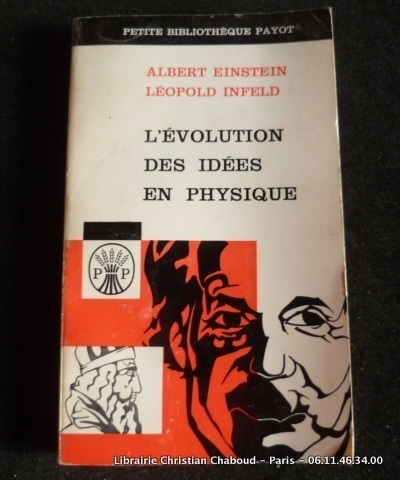
1963ref. 26910Paris, Petite Bibliothèque Payot, 1963, poche, broché, 280 pages. Bon état.
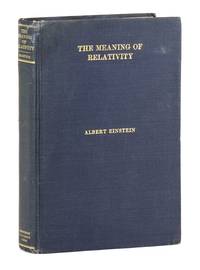
1923ref. 32639Princeton NJ: Princeton University Press 1923. Very Good. Princeton NJ: Princeton University Press 1923. First U.S. Edition. Octavo 18 cm; publisher's gilt-lettered navy cloth; 123pp. Boards bumped at corners spine ends scuffed. Water staining to spine crown bleeding into upper cover minor separation of head of spine material from book block. Last free endsheet creased. Endsheets toned. Endsheets first few pages last few pages and pages 106-112 show water staining at top margin but bulk of text block is clean and bright. Starting slightly after first free endsheet. A Very Good example overall. Collection of four lectures delivered by Einstein at Princeton for the Stafford Little Lectures in 1921. The majority of the lectures are an attempt to reconcile issues with his theory of relativity and defend it as well as give a comprehensive overview of the physics and math involved in the theory in an accessible way. Princeton University Press unknown books
1987ref. 10620Near new condition. Companion English translation to hardcover text also available. Inventory number 10618 Princeton University Press paperback
2011Praticamente coetanei - uno medico e teologo, l'altro scienziato e filosofo, il primo luterano, il secondo ebreo - Albert Schweitzer, premio Nobel per la Pace nel 1952, e Albert Einstein, premio Nobel per la Fisica nel 1921, si incontrarono solo due volte e si scambiarono una serie di lettere, tutte tra il 1948 e il 1955. Nondimeno entrambi misero in guardia i contemporanei contro i pericoli di un progresso tecnico-scientifico acefalo, facendo pressioni contro i test e le sperimentazioni della bomba atomica - la cui costruzione, in un primo tempo, Einstein aveva appoggiato nel timore che il regime nazista se ne dotasse per primo - e battendosi per il disarmo nucleare e la pace. Autori: Alberto Guglielmi Manzoni.
2006ref. 27290Frankfurt am Main, Berlin, Bern, Bruxelles, New York, Oxford, Wien: Peter Lang, 2006. 520 S., 7 Abb. Originalbroschur.
2007UTET 2007 XI-297 PP. FONDO DI MAGAZZINO: LIEVI SEGNI DEL TEMPO, VOLUME PERFETTO E INTONSO. La meccanica celeste ha sempre accompagnato lo sviluppo della civiltà sul nostro pianeta. Dalle prime osservazioni astronomiche degli antichi Caldei, attraverso i lavori di Henri Poincaré la meccanica celeste è tornata in prima linea. Infatti, i recenti progressi tecnologici nel campo dell'astronomia osservativa hanno notevolmente aumentato il numero di oggetti celesti scoperti dall'uomo: migliaia di asteroidi, centinaia di comete, decine di satelliti naturali e anelli planetari, una nuova popolazione di corpi celesti oltre l'orbita di Nettuno, nonché innumerevoli sistemi planetari extra-solari attorno ad altre stelle. A ciò si aggiunga che l'uomo ha ormai un programma consolidato di esplorazione interplanetaria e nelle vicinanze della Terra: una nube di satelliti artificiali e di detriti spaziali circonda il nostro pianeta. Sulla base di tali recenti sviluppi scientifici, la moderna meccanica celeste ha assunto un ruolo fortemente interdisciplinare, coinvolgendo argomenti quali la stabilità, le risonanze e il caos. L'obiettivo del libro, pubblicato in edizione inglese nel 2007 dalla casa editrice Praxis-Springer, è di presentare la moderna meccanica celeste come una disciplina di facile comprensione per il lettore non specialista e allo stesso tempo di stimolare un pubblico più specializzato, mostrando le possibili connessioni tra i diversi affascinanti campi di studio. Il volume è introdotto dalla prefazione di Margherita Hack.
1922In-4°; ripr. di un ritratto in fotografia di Einstein. pp. 240; coperta telata con titolo inpresso in oro al dorso e al piatto; più un opuscolo del Prof. Bruno Mehnert.
1953ref. GB0000CIJJXI3N01Cassell 1953. Hardcover. Good. Missing dust jacket; Pages can have notes/highlighting. Spine may show signs of wear. ~ ThriftBooks: Read More Spend Less.Dust jacket quality is not guaranteed. Cassell hardcover
ref. ria9780313273636_inpHardcover. New. New Book; Fast Shipping from UK; Not signed; Not First Edition; N/A hardcover
1989ref. BN586969VEB Breitkopf & Härtel 1989. 1989. Chronologisch-thematisches Verzeichnis sämtlicher Tonwerke Wolfgang Amadé Mozarts nebst Angabe der verlorengegangenen angefangenen übertragenen zweifelhaften und unterschobenen Kompositionen = Köchelverzeichnis Chronologisch-thematisches Verzeichnis sämtlicher Tonwerke Wolfgang Amadé Mozarts nebst Angabe der verlorengegangenen angefangenen übertragenen zweifelhaften und unterschobenen Kompositionen = Köchelverzeichnis Alfred Einstein ed. Ludwig Ritter von Köchel VEB Breitkopf & Härtel unknown
1992ref. BN255921J.B. Metzler Part of Springer Nature - Springer-Verlag GmbH 1992. 1992. Die Romantik in der Musik Die Romantik in der Musik Alfred Einstein J.B. Metzler, Part of Springer Nature - Springer-Verlag GmbH unknown
ref. 6655822Oxford University Press OUP . Papeback. New. pp. 512 Oxford University Press OUP unknown
ref. A9780195007329Paperback / softback. New. paperback
ref. ria9780195007329_inpPaperback. New. New Book; Fast Shipping from UK; Not signed; Not First Edition; N/A paperback
ref. B9780195007329Paperback / softback. New. paperback
ref. 600810New York: Oxford University Press 1962. First Paperback Edition; Fifteenth Printing. Softcover. Very Good in wraps. Rubbing on panel edges. Toning on text block edges.; 492 pages. Oxford University Press unknown