2986 resultados
ref. AJ16713POCHE BON ETAT PLIS SUR COUV
ref. A5067PHOTOS SUR DEMANDE
1986ref. R160131050PETITE BIBLIOTHEQUE PAYOT N°62. 17 OCT 1986. In-12. Broché. Bon état, Couv. convenable, Dos satisfaisant, Intérieur acceptable. 179 pages. Quelques calculs en noir et blanc dans le texte.. . . . Classification Dewey : 800-LITTERATURE (BELLES-LETTRES)
ref. RO40016618Payot. Non daté. In-12. Broché. Bon état, Couv. convenable, Dos satisfaisant, Intérieur frais. 184 pages.. . . . Classification Dewey : 500-SCIENCES DE LA NATURE ET MATHEMATIQUES
ref. 13979526Paris: Gauthier-Villars, 1956 in-8, vi-179 pages. Broché.
1974ref. RO60085762Ullstein. 1974. In-12. Broché. Bon état, Couv. légèrement pliée, Dos satisfaisant, Intérieur acceptable. 200 pages.. . . . Classification Dewey : 430-Langues germaniques. Allemand
ref. SLIVCN-9791041411863POINTS
1971ref. RO40230124Gauthier-Villars. 1971. In-8. Broché. Bon état, Couv. convenable, Dos satisfaisant, Intérieur frais. 96 pages.. . . . Classification Dewey : 530-Physique
1976ref. R160222012Gauthier-villars. 1976. In-8. Broché. Bon état, Couv. convenable, Dos satisfaisant, Intérieur frais. 96 pages.. . . . Classification Dewey : 500-SCIENCES DE LA NATURE ET MATHEMATIQUES
In 8o, pp. 322, br. Introduzione di Bruno Cermignani. Qualche traccia d'uso e note a penna (6022/ FISICA - EINSTEIN - RELATIVITA')
1961ref. RO80261002Crown Publishers. 1961. In-8. Broché. Etat d'usage, Couv. convenable, Dos satisfaisant, Intérieur acceptable. 164 pages. Annotation au stylo en page de titre. Texte en anglais.. . . . Classification Dewey : 530-Physique
1960(mm.220x130), pagg.192. Legatura in cartonato editoriale. Alcune sottolineature alle prime 90 pagine, poi da pagina 99 in avanti, mai sfogliato, ancora a fogli chiusi. Timbro di appartenenza al frontespizio ed alle prime 4 pagine sulla parte bianca.
1951ref. R160220220Methuen & Co.Ltd. London. 1951. In-12. Relié. Bon état, Couv. convenable, Dos satisfaisant, Intérieur frais. 161 pages - ouvrage en anglais.. . . . Classification Dewey : 420-Langue anglaise. Anglo-saxon
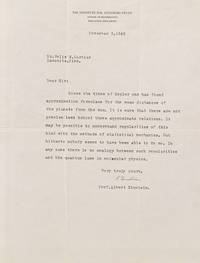
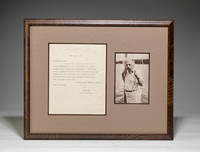
1942ref. 1265881942. Signed. EINSTEIN Albert. Typed letter signed. Princeton November 3 1942. One sheet measuring 8-1/2 by 11 inches typing on recto only; matted and framed with a portrait of Einstein entire piece measures 21 by 17 inches. $38000.An exceptional typed letter signed by Einstein on precursors like Johannes Kepler's work to his Special and General Theories of Relativity beautifully framed.The letter on letterhead from the Institute for Advanced Study in Princeton reads in full: ""November 3 1942. Mr. Felix W. Cartier. Laconite Minn. Dear Sir: Since the times of Kepler one has found approximation formulaes for the mean distances of the planets from the sun. It is sure that there are not precise laws behind those approximate relations. It may be possible to understand the irregularities of this kind with the methods of statistical mechanics. But hitherto nobody seems to have been able to do so. In any case there is no analogy between such regularities and the quantum laws in molecular physics. Very truly yours signed A. Einstein. Prof. Albert Einstein.""Early in the 17th century Johannes Kepler 1571-1630 discovered that planets orbit the sun in ellipses rather than perfect circles. This great discovery paved the way for Isaac Newton's laws of gravity and for Albert Einstein's general and special theories of relativity. Previous to Einstein's time people believed in real distances and absolute time and showed that instruments could not objectively measure the distances between planets. Einstein's theories which hypothesized that light and space curve near a massive object revolutionized scientific thought and gave man an exciting new perspective of his universe.Einstein's letter reflects on some of the most important scientific revelations in the history of physics and astronomy. Kepler defined three laws of planetary motion; however the one specifically referred to in this letter is that all planets move about the Sun in elliptical orbits having the Sun as one of the foci. If the Universe then consisted only of two point massesÑthe Sun and a planetÑthe orbit of that planet would make a perfect closed ellipse that returned the world to its starting location with each trip around the Sun. But in a Universe governed by Newtonian gravity with a plethora of massive bodies in our Solar System that ellipse will precess or rotate slightly in its orbit.In the mid-1800s orbital deviations of Uranus from its predicted motions led to the discovery of Neptune as the outermost world's gravitational influence accounted for the excess motion. But in the inner Solar System the nearest planet to the Sun Mercury was experiencing a similar problem. With detailed accurate observations going back to the late 1500s thanks to astronomer Tycho Brahe we could measure how Mercury's perihelion its closest orbital point to the Sun was advancing. The number we came up with was 5600"" per century just over 1.5 degrees over a 100 year period. But of that 5025"" came from the precession of Earth's equinoxes a well-known phenomenon while 532"" was due to Newtonian gravity.But 5025"" plus 532"" comes up short by a small but significant amount. Attempts at explanationÑincluding the existence of an unknown inner planet interior to MercuryÑall failed. But after Einstein's special theory of relativity came out in 1905 mathematician Henri Poincare showed that the phenomena of length contraction and time dilation contributed a fraction between 15-25% of the needed amount towards the solution dependent on the error. That plus Minkowski's formalization of space and time as not separate entities but as a single structure bound together by their union spacetime led Einstein to develop the general theory of relativity. On November 25 1915 he presented his results computing the spectacular figure that the contribution of the extra curvature of space predicted an additional precession of 43"" per century exactly the right figure needed to explain this observation sending shockwaves through the astronomy and physics communities. Less than two months after this Karl Schwarzschild found an exact solution predicting the existence of black holes. The deflection of starlight and gravitational redshifts/blueshifts were realized as possible tests and finally the solar eclipse of 1919 validated general relativity as superseding Newtonian gravity. Expected fold lines. An incredible letter scarce in its important content. unknown books
1946ref. 1206241946. Signed. EINSTEIN Albert. Typed letter signed. Princeton April 3 1946. Single sheet of gray letterhead measuring 8-1/2 by 11 inches; p. 1. Matted and framed with a portrait entire piece measures 19 by 15-1/2 inches. $9500.Original typed letter signed by Albert Einstein thanking his friend Dr. Isadore Held for his birthday wishes as well as for sending a new book that Einstein found both ""extraordinarily enlightening"" and humorous. Text in German.The letter typed on Einstein's personal letterhead with his name and Princeton address blindstamped at the top reads in full translation: ""3 April 1946. Dear Mr. Held: I would like to express my sincere thanks for your birthday wishes and for the sending of the last work of this wonderful contemporary. I have already read quite a bit and find that it is extraordinarily enlightening. His penetration into the mentality of far-off times and attitudes toward thinking is most remarkable and his humor no less. With fond greetings to you and your dear wife. Yours signed Albert Einstein."" This letter was written to Austrian-American medical Dr. Isadore Held who was friends with Einstein since at least 1938. Held and Einstein shared numerous interests particularly related to Jewish humanitarian relief and Israel. At Held's death Einstein wrote to his widow that ""True goodness emanated from this man who alleviated the harshness of human relations and who understood and forgave all weaknessesÉ As a role model for his fellow men he was the best that a human being can be."" Einstein was not a huge fan of birthdays though he happily acknowledged well wishes from friends. Just before turning 65 Einstein crankily said to a New York Times interviewer: ""What is there to celebrate Birthdays are automatic things. Anyway birthdays are for children."" In a 1954 letter to physicist Hans Mhsam Einstein described his birthday as ""a natural disaster a shower of paper full of flattery under which one is drowned."" Einstein was generally quite shy and did not like to be the center of attention particularly from strangers obsessed with his accomplishments and fame. However well-meaning letters and small gifts like the book given by Held were always welcomed and graciously accepted by Einstein. Original mailing creases and a few pinpoint holes along top edge possibly from stapling. About-fine condition. unknown books
1920ref. 108736Couverture souple. Broché. 83 pages. Papier bruni. Couverture légèrement défraîchie. Découpure de quelques millimètres sur la longueur des plats.
1922ref. 35133Brunswick Friedrich Vieweg 1922 in-8 dérelié
1979ref. R100067671Hermann. 1979. In-8. Broché. Bon état, Couv. convenable, Dos satisfaisant, Intérieur frais. LXIII+327 pages.. . . . Classification Dewey : 830-Littératures des langues germaniques
1974ref. R100072245Payot. 1974. In-12. Broché. Bon état, Couv. convenable, Dos satisfaisant, Papier jauni. 280 pages - nombreuses figures en noir et blanc dans le texte.. . . . Classification Dewey : 530-Physique
2010Milano, RCS Quotidiani, 2010, 8vo brossura editoriale, pp. 11 (I classici del pensiero libero, 11; supplemento a Sette Corriere della Sera) .
2009ref. RO20272203LE MONDE - FLAMMARION - LES LIVRES QUI ONT CHANGE LE MONDE. 2009. In-12. Broché. Bon état, Couv. convenable, Dos satisfaisant, Intérieur frais. 243 PAGES. . . . Classification Dewey : 830-Littératures des langues germaniques
1933ref. 144376Société des Nations Institut Société des Nations Institut de Coopération Intellectuelle, 1933. Collection correspondance à tirage limité, In-8 broché, couverture à rabats de 63 pages. Exemplaire N° 113 imprimé sur papier de Châtaignier. Très petite déchirure sans manque à la charnière en queue et infimes salissures sans aucune gravité, corps de l'ouvrage en très bel état, absence totale de taches ou rousseurs.. Correspondance entre les deux grands hommes à la demande de l'Institut de Coopération Intellectuelle pour le dialogue au service de la paix. Le titre de la publication fût choisi par S. Freud. Bel exemplaire, rare dans cette condition
1990ref. RO30059388FRANCE LOISIRS. 1990. In-8. Relié. Bon état, Couv. convenable, Dos satisfaisant, Intérieur frais. 319 pages.. Avec Jaquette. . . Classification Dewey : 820-Littératures anglaise et anglo-saxonne
1989ref. RO80196346FRANCE LOISIRS. 1989. In-8. Relié. Bon état, Couv. convenable, Dos satisfaisant, Intérieur frais. 320 pages - signet conservé - jaquette en bon état -. Avec Jaquette. . . Classification Dewey : 820-Littératures anglaise et anglo-saxonne
1990ref. R240034392FRANCE LOISIRS / FLAMMARION. 1990. In-8. Relié. Bon état, Couv. convenable, Dos satisfaisant, Intérieur frais. 319 pages.. Avec Jaquette. . . Classification Dewey : 600-TECHNIQUE (SCIENCES APPLIQUEES)