Einstein AlbertLivre Rare Book

2557 resultados
1951ref. R160220220Methuen & Co.Ltd. London. 1951. In-12. Relié. Bon état, Couv. convenable, Dos satisfaisant, Intérieur frais. 161 pages - ouvrage en anglais.. . . . Classification Dewey : 420-Langue anglaise. Anglo-saxon
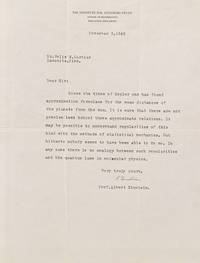
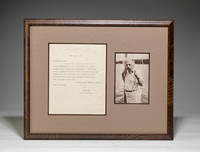
1942ref. 1265881942. Signed. EINSTEIN Albert. Typed letter signed. Princeton November 3 1942. One sheet measuring 8-1/2 by 11 inches typing on recto only; matted and framed with a portrait of Einstein entire piece measures 21 by 17 inches. $38000.An exceptional typed letter signed by Einstein on precursors like Johannes Kepler's work to his Special and General Theories of Relativity beautifully framed.The letter on letterhead from the Institute for Advanced Study in Princeton reads in full: ""November 3 1942. Mr. Felix W. Cartier. Laconite Minn. Dear Sir: Since the times of Kepler one has found approximation formulaes for the mean distances of the planets from the sun. It is sure that there are not precise laws behind those approximate relations. It may be possible to understand the irregularities of this kind with the methods of statistical mechanics. But hitherto nobody seems to have been able to do so. In any case there is no analogy between such regularities and the quantum laws in molecular physics. Very truly yours signed A. Einstein. Prof. Albert Einstein.""Early in the 17th century Johannes Kepler 1571-1630 discovered that planets orbit the sun in ellipses rather than perfect circles. This great discovery paved the way for Isaac Newton's laws of gravity and for Albert Einstein's general and special theories of relativity. Previous to Einstein's time people believed in real distances and absolute time and showed that instruments could not objectively measure the distances between planets. Einstein's theories which hypothesized that light and space curve near a massive object revolutionized scientific thought and gave man an exciting new perspective of his universe.Einstein's letter reflects on some of the most important scientific revelations in the history of physics and astronomy. Kepler defined three laws of planetary motion; however the one specifically referred to in this letter is that all planets move about the Sun in elliptical orbits having the Sun as one of the foci. If the Universe then consisted only of two point massesÑthe Sun and a planetÑthe orbit of that planet would make a perfect closed ellipse that returned the world to its starting location with each trip around the Sun. But in a Universe governed by Newtonian gravity with a plethora of massive bodies in our Solar System that ellipse will precess or rotate slightly in its orbit.In the mid-1800s orbital deviations of Uranus from its predicted motions led to the discovery of Neptune as the outermost world's gravitational influence accounted for the excess motion. But in the inner Solar System the nearest planet to the Sun Mercury was experiencing a similar problem. With detailed accurate observations going back to the late 1500s thanks to astronomer Tycho Brahe we could measure how Mercury's perihelion its closest orbital point to the Sun was advancing. The number we came up with was 5600"" per century just over 1.5 degrees over a 100 year period. But of that 5025"" came from the precession of Earth's equinoxes a well-known phenomenon while 532"" was due to Newtonian gravity.But 5025"" plus 532"" comes up short by a small but significant amount. Attempts at explanationÑincluding the existence of an unknown inner planet interior to MercuryÑall failed. But after Einstein's special theory of relativity came out in 1905 mathematician Henri Poincare showed that the phenomena of length contraction and time dilation contributed a fraction between 15-25% of the needed amount towards the solution dependent on the error. That plus Minkowski's formalization of space and time as not separate entities but as a single structure bound together by their union spacetime led Einstein to develop the general theory of relativity. On November 25 1915 he presented his results computing the spectacular figure that the contribution of the extra curvature of space predicted an additional precession of 43"" per century exactly the right figure needed to explain this observation sending shockwaves through the astronomy and physics communities. Less than two months after this Karl Schwarzschild found an exact solution predicting the existence of black holes. The deflection of starlight and gravitational redshifts/blueshifts were realized as possible tests and finally the solar eclipse of 1919 validated general relativity as superseding Newtonian gravity. Expected fold lines. An incredible letter scarce in its important content. unknown books
1946ref. 1206241946. Signed. EINSTEIN Albert. Typed letter signed. Princeton April 3 1946. Single sheet of gray letterhead measuring 8-1/2 by 11 inches; p. 1. Matted and framed with a portrait entire piece measures 19 by 15-1/2 inches. $9500.Original typed letter signed by Albert Einstein thanking his friend Dr. Isadore Held for his birthday wishes as well as for sending a new book that Einstein found both ""extraordinarily enlightening"" and humorous. Text in German.The letter typed on Einstein's personal letterhead with his name and Princeton address blindstamped at the top reads in full translation: ""3 April 1946. Dear Mr. Held: I would like to express my sincere thanks for your birthday wishes and for the sending of the last work of this wonderful contemporary. I have already read quite a bit and find that it is extraordinarily enlightening. His penetration into the mentality of far-off times and attitudes toward thinking is most remarkable and his humor no less. With fond greetings to you and your dear wife. Yours signed Albert Einstein."" This letter was written to Austrian-American medical Dr. Isadore Held who was friends with Einstein since at least 1938. Held and Einstein shared numerous interests particularly related to Jewish humanitarian relief and Israel. At Held's death Einstein wrote to his widow that ""True goodness emanated from this man who alleviated the harshness of human relations and who understood and forgave all weaknessesÉ As a role model for his fellow men he was the best that a human being can be."" Einstein was not a huge fan of birthdays though he happily acknowledged well wishes from friends. Just before turning 65 Einstein crankily said to a New York Times interviewer: ""What is there to celebrate Birthdays are automatic things. Anyway birthdays are for children."" In a 1954 letter to physicist Hans Mhsam Einstein described his birthday as ""a natural disaster a shower of paper full of flattery under which one is drowned."" Einstein was generally quite shy and did not like to be the center of attention particularly from strangers obsessed with his accomplishments and fame. However well-meaning letters and small gifts like the book given by Held were always welcomed and graciously accepted by Einstein. Original mailing creases and a few pinpoint holes along top edge possibly from stapling. About-fine condition. unknown books
1920ref. 108736Couverture souple. Broché. 83 pages. Papier bruni. Couverture légèrement défraîchie. Découpure de quelques millimètres sur la longueur des plats.
1922ref. 35133Brunswick Friedrich Vieweg 1922 in-8 dérelié
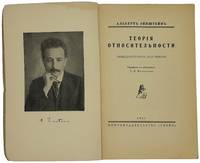
ref. lom-MS001965In Russian. Short description: Einstein A. Teoriya otnositelnosti. [Theory of Relativity]. Public presentation. Translated from German by G.B. Itelson. Berlin: Slovo, 1921. - 150, [2] p., 1 sheet portrait. Publisher's cover. Format 215x140 mm. Lifetime edition of one of the founders of modern physics, Nobel Prize winner Albert Einstein (1879-1955). First Russian edition. Please feel free to contact us for a detailed description of the copies available. SKUMS001965 kn_nat
ref. lom-MS001965In Russian. Short description: Einstein A. Teoriya otnositelnosti. Theory of Relativity. Public presentation. Translated from German by G.B. Itelson. Berlin: Slovo 1921. - 150 2 p. 1 sheet portrait. Publisher's cover. Format 215x140 mm. Lifetime edition of one of the founders of modern physics Nobel Prize winner Albert Einstein 1879-1955. First Russian edition. Please feel free to contact us for a detailed description of the copies available. SKUMS001965 kn_nat unknown
1921ref. 70090Paris: Gauthier-Villars et C. 1921. Cm. 23 pp. 20. Con due figure nel testo. Brossura editoriale. Perfetta copia entro velina. Prima edizione francese. Gauthier-Villars et C. unknown
ref. 65642Gauthier-Villars Paris 1956 In-8 23 cm 179pp couverture avec dos restaure etat moyen Ats30 traduit de l'allemand par Maurice Solovine unknown
1907ref. 25711Weinheim: Offprint from: Zeitschrift für Elektrochemie. Nr. 6. 1907 February. First Edition Offprint Issue from Volume 13 number 6. Single sheet approximately 10" x 8" pp 41-42 pp. A very fine example of this rare issue a very minor and unobtrusive stain to an upper corner. SCARCE OFFPRINT ISSUE OF AN IMPORTANT EINSTEIN PAPER OF STATISTICAL MECHANICS and a continuation of his remarkable 1905 and 1906 publications on Brownian Motion which not only led to the proof of the existence of the atom but also worked to determine the size of atoms and how many atoms there are in a mole or the molecular weight in grams of a gas. This paper also contains a note on the technical meaning of "average velocity. Offprint from: Zeitschrift für Elektrochemie. Nr. 6. unknown
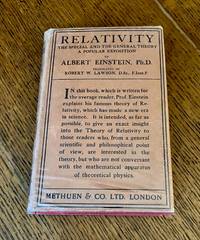
1939ref. 11847Methuen & Co. Ltd. London. 1939. TWELFTH ENGLISH EDITION. Octavo. 7.6 x 5.2 inches. Portrait frontis and five line diagrams within the text. A little foxing to the first couple of pages but overall a very good copy in the publishers red cloth with gilt lettering and ruled lines to the spine. Front board ruled and lettered in blind. Gilt stamped school coat of arms to the front panel and school prize label dated July 1939 on front pastedown endpaper. In the original dustwrapper which has some chipping to the edges but is generally clean and bright. ----- Contains a bibliography of selected works on Relativity. Methuen & Co. Ltd. London. 1939 hardcover
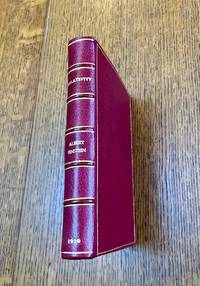
1920ref. 11566Methuen & Co. Ltd. London. 1920. FIRST ENGLISH EDITION. 8vo. 7.7 x 5.2 inches. Portrait frontis and five line diagrams within the text. Complete with the 8pp publishers adverts at back of book. Overall a clean bright copy in recent fine binding of full red morocco. Spine with raised bands compartments ruled decorated and lettered in gilt. Single gilt ruled border on boards. Top edge gilt others untrimmed with rough edges. ------ This important translation apart from being the first English edition also contains new text written by Einstein specially for this edition-- Appendix III The Experimental Confirmation of the General Theory of Relativity. Methuen & Co. Ltd. London. 1920 hardcover
2024ref. 49805Folio Society 2024. 8vo. First Edition thus with portrait frontispiece; pictorial boards a near fine copy in publisher's blocked slip-case. Includes the author's 1923 Nobel Prize lecture. Folio Society, hardcover
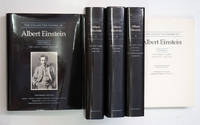
ref. 108243Princeton University Press 1987–1995. 4° XXIII 433 S.; XXII 655 S.; XXXII 644 S.; 4: XVIII 715 S.; 460 S. OLwd. m. OU.; Bd. 6: Broschur Tadell. Sprache: engl. 010 Princeton, University Press, 1987–1995 unknown
1942ref. 1265881942. Signed. EINSTEIN Albert. Typed letter signed. Princeton November 3 1942. One sheet measuring 8-1/2 by 11 inches typing on recto only; matted and framed with a portrait of Einstein entire piece measures 21 by 17 inches. $38000.An exceptional typed letter signed by Einstein on precursors like Johannes Kepler's work to his Special and General Theories of Relativity beautifully framed.The letter on letterhead from the Institute for Advanced Study in Princeton reads in full: ""November 3 1942. Mr. Felix W. Cartier. Laconite Minn. Dear Sir: Since the times of Kepler one has found approximation formulaes for the mean distances of the planets from the sun. It is sure that there are not precise laws behind those approximate relations. It may be possible to understand the irregularities of this kind with the methods of statistical mechanics. But hitherto nobody seems to have been able to do so. In any case there is no analogy between such regularities and the quantum laws in molecular physics. Very truly yours signed A. Einstein. Prof. Albert Einstein.""Early in the 17th century Johannes Kepler 1571-1630 discovered that planets orbit the sun in ellipses rather than perfect circles. This great discovery paved the way for Isaac Newton's laws of gravity and for Albert Einstein's general and special theories of relativity. Previous to Einstein's time people believed in real distances and absolute time and showed that instruments could not objectively measure the distances between planets. Einstein's theories which hypothesized that light and space curve near a massive object revolutionized scientific thought and gave man an exciting new perspective of his universe.Einstein's letter reflects on some of the most important scientific revelations in the history of physics and astronomy. Kepler defined three laws of planetary motion; however the one specifically referred to in this letter is that all planets move about the Sun in elliptical orbits having the Sun as one of the foci. If the Universe then consisted only of two point massesÑthe Sun and a planetÑthe orbit of that planet would make a perfect closed ellipse that returned the world to its starting location with each trip around the Sun. But in a Universe governed by Newtonian gravity with a plethora of massive bodies in our Solar System that ellipse will precess or rotate slightly in its orbit.In the mid-1800s orbital deviations of Uranus from its predicted motions led to the discovery of Neptune as the outermost world's gravitational influence accounted for the excess motion. But in the inner Solar System the nearest planet to the Sun Mercury was experiencing a similar problem. With detailed accurate observations going back to the late 1500s thanks to astronomer Tycho Brahe we could measure how Mercury's perihelion its closest orbital point to the Sun was advancing. The number we came up with was 5600"" per century just over 1.5 degrees over a 100 year period. But of that 5025"" came from the precession of Earth's equinoxes a well-known phenomenon while 532"" was due to Newtonian gravity.But 5025"" plus 532"" comes up short by a small but significant amount. Attempts at explanationÑincluding the existence of an unknown inner planet interior to MercuryÑall failed. But after Einstein's special theory of relativity came out in 1905 mathematician Henri Poincare showed that the phenomena of length contraction and time dilation contributed a fraction between 15-25% of the needed amount towards the solution dependent on the error. That plus Minkowski's formalization of space and time as not separate entities but as a single structure bound together by their union spacetime led Einstein to develop the general theory of relativity. On November 25 1915 he presented his results computing the spectacular figure that the contribution of the extra curvature of space predicted an additional precession of 43"" per century exactly the right figure needed to explain this observation sending shockwaves through the astronomy and physics communities. Less than two months after this Karl Schwarzschild found an exact solution predicting the existence of black holes. The deflection of starlight and gravitational redshifts/blueshifts were realized as possible tests and finally the solar eclipse of 1919 validated general relativity as superseding Newtonian gravity. Expected fold lines. An incredible letter scarce in its important content. unknown
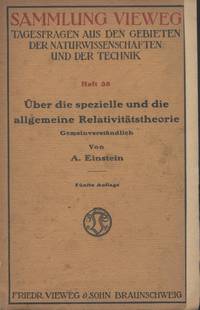
1920ref. 108736Friedr. Vieweg und Sohn in Braunschweig 1920. Paperback. Livre en anglais. Couverture souple. Mit 3 Figuren. Fünfte Auflage. Sammlung Vieweg. Heft 38. Broché. 83 pages. Papier bruni. Couverture légèrement défraîchie. Découpure de quelques millimètres sur la longueur des plats. ref. 108736 Friedr. Vieweg und Sohn in Braunschweig paperback
1929ref. 17857Berlin: Verlag Der Akademie der Wissenschaften 1929. An important offprint first edition. With mathematical formulas in text. Small folio in the original orange off-print paper wrappers printed in black on both covers. 8 pp. Very fine nearly as new. A RARE AND IMPORTANT OFFPRINT. EINHEITLICHEN FELDTHEORIE which means "A Coherent Theory of the Electro-Magnetic Field" and is the title of a five-page paper of highest mathematical formulae which Relativist Albert Einstein worked on for ten years. His report is a purely mathematical extension of the general theory of relativity to include gravitational and electromagnetic phenomena. His relativity theory which he phrased within only three printed pages made time & space the creator of matter. When this paper on the Unified Field Theory was published it was a headline story in the newspapers. Few if any people understood the complex mathematics but many were fascinated by the thought that Einstein had possibly came up with a new theory expanding on "General Relativity" and unifying the fundamental forces of nature. It is considered Einstein's last important scientific work Weil #165. "In 1928 Einstein embarked on a new approach to a unified field theory. involving what he called 'distant parallelism'. By early 1929 he had solved the main problems involved in writing down field equations for his unified field theory. On the day of official publication of the third of a formidably technical series of nine articles on the theory. excited headlines appeared in foreign newspapers throughout the world. In this frenzied unscientific atmosphere Einstein's new theory was hailed in the press as an outstanding scientific advance. Yet Einstein had stated in his article that this was still tentative; and soon he found he had to abandon it" Hoffmann/Dukas ''Albert Einstein: Creator and Rebel'' 1972 pp. 225-226 Verlag Der Akademie der Wissenschaften unknown
ref. 23638Edition Albin Michel, collection ",Les savants et le monde",, couverture cornée et légèrement abîmée au niveau de la tranche.
1980ref. 1215101980 Editions InterEditions - 1980 - In-8, broché - 130 p. - Ouvrage bilingue (français-allemand)
1980ref. 1215111980 Editions InterEditions - 1980 - In-8, broché - 197 p. - Ouvrage bilingue (français-allemand)
1935ref. NATW0902Prag, Selbstvlg. 1935. 285 S., mit 1 Titelportr. u. 10 Briefbeigaben im Text, OLn., unwes. Gebrauchsspuren, Name auf Tit.,
ref. NATW0902Prag Selbstvlg. 1935. 285 S. mit 1 Titelportr. u. 10 Briefbeigaben im Text OLn. unwes. Gebrauchsspuren Name auf Tit. Prag, Selbstvlg. 1935. unknown
ref. a112364Report on pp. 108-110 in single complete bound volume of Physikalische Zeitschrift Funfzehnter jahrgang Leipzig 1914. Complete year bound in one hardcover 4to volume. 956 pages in entire volume. In German. In addition to the Einstein article the volume contains important articles by other scientists including H A Lorentz G. Nordstrom M. Laue. Spine and tips balck cloth with black and ivory marbled boards. Hinges not cracked or out . no owner marks. Text bright and clean with no marks. Binding very secure. VG light fraying of spine ends and extreme cover tips. . hardcover
ref. a89431Report on pp. 108-110 in single complete bound volume of Physikalische Zeitschrift Funfzehnter jahrgang Leipzig 1914. Complete year bound in one hardcover 4to volume. 956 pages in entire volume. In German. In addition to the Einstein article the volume contains important articles by other scientists including H A Lorentz G. Nordstrom M. Laue. Finely bound in half leather with leather tips. Gilt spine decoration and lettering. Institute stamp on end papers and titlepage but no other ownership marks. VG leather lightly rubbed. Text Fine. Pictures available on request. . hardcover
1933ref. 19458Geneva: Institut International De Cooperation Intellectuelle 1933 French language first edition. This rare and virtually impossible book in hardcover to find is a first edition written by Albert Einstein and Sigmund Freud from a letter exchange they had as a plea for no war again in Europe. It was published in 1933 simultaneously in English Why War French and German for a total printing of 3000 copies. The 2000 copies in German were seized by Adolf Hitler and the Nazis in 1933 and banned for sale and distribution and were burned. This is an extremely rare book and is only seen in a reprint. This is the French first edition published in Geneva Switzerland in 1933. Green woven cloth exterior with small black spine label in near fine unmarked condition. "Einstein-Freud Pourquoi La Guerre" on spine label. This copy was found in a bookstall in 2009 in Rome Italy. This book is copy No 392 /3000. First Edition. Hardcover. Very Good. Institut International De Cooperation Intellectuelle hardcover