2 980 résultats
1906réf. 59121Leipzig Johann Ambrosius Barth 1906. Full cloth. Spine with gilt lettering. In: "Annalen der Physik. Vierte Folge. Band 20. Herausgegeben von Paul Drude." Portrait Paul Drude VIII1048 pp. and 6 plates. Einstein papers: pp. 199-206 and 627-33. Internally fine and clean. The entire volume offered. Broad margins. Both papers first edition. It was for the papers "Ueber einen die Erzeugung und Verwandlung des Lichtes betreffenden heuristischen Gesichtspunkt" of 1905 and "Zur Theorie der Lichterzeugung. Theory of light emission and absorption the offered item that Einstein was awarded the Nobel Prize in 1921. "The quantum theory has affected virtually every branch of physics. Its earliest and one of its most significant developments was Einstein's application of the theory to what is known as the 'photo-electrical effect'.Einstein explained this effext by suggesting that the classical view that light is emitted in the form of continous waves must be abandoned. The photo-electrical effect could be explained only as an example of quantum action where the waves of light or X-rays are emitted in minute particles or bullets. It is he size of the bullet the wave-lenght of the radiation which determines the number of electrons ejected. It was for this and not for the theory of relativity that Einstein was awarded the Nobel Prize in 1921. Einstein's two fundamental papers on this subject are "Ueber einem Erzeugung." 1905 and Zur Theorie der Lichterzeugung the paper offered here" PMM the note to 391. In the second paper Principle of the conservation of the centre of mass motion and the inertia of energy he shows that the conservation of mass is a special application of his energy principle E= Mc2 - Weil: 12 & 13.Among the many papers in this volume we have Max von Laue: Zur Thermodynamik der Inteferenzerscheinungen. pp. 365-378. hardcover
réf. 74098Leipzig Johann Ambosius Barth 1922. 8vo. 14 pp. Original printed wrappers. = An important contribution to the understanding of the radiometer effect by the physicist Edith Einstein 1888-1960. "The Crookes radiometer also known as a light mill consists of an airtight glass bulb containing a partial vacuum with a set of vanes which are mounted on a spindle inside. The vanes rotate when exposed to light with faster rotation for more intense light providing a quantitative measurement of electromagnetic radiation intensity. The reason for the rotation was a cause of much scientific debate in the ten years following the invention of the device" Wikipedia. James Clerk Maxwell first gave a wrong then a correct explanation. However some subtleties still needed to be solved. "In 1920 Albert Einstein selected this topic as a suitable PhD thesis for his cousin Edith Einstein. She completed her doctorate under the supervision of Paul Epstein but with considerable imput from Einstein himself" Calaprice et al. Later in 1924 Albert wrote another paper on the radiometer effect correcting Edith on a few issues. Published in the famous Annalen der Physik vierte Folge Band 69. This being the complete Heft 4 published on 30 November 1922. Minimal wear to spine ends otherwise a very good clean copy. Very uncommon. Calaprice et al. An Einstein Encyclopaedia p. 160. unknown
réf. 72535Braunschweig Friedrich Vierweg & Sohn; Berlin J. Springer 1924. 8vo 22.8 x 15.4 cm. 6 pp. Original printed wrappers. = On the theory of radiometer forces. "The Crookes radiometer also known as a light mill consists of an airtight glass bulb containing a partial vacuum with a set of vanes which are mounted on a spindle inside. The vanes rotate when exposed to light with faster rotation for more intense light providing a quantitative measurement of electromagnetic radiation intensity. The reason for the rotation was a cause of much scientific debate in the ten years following the invention of the device" Wikipedia. James Clerk Maxwell first gave a wrong then a correct explanation. However some subtleties still needed to be solved and in 1924 Albert Einstein had a crack at it "A partial explanation is that gas molecules hitting the warmer side of the vane will pick up some of the heat bouncing off the vane with increased speed. Giving the molecule this extra boost effectively means that a minute pressure is exerted on the vane. The imbalance of this effect between the warmer black side and the cooler silver side means the net pressure on the vane is equivalent to a push on the black side and as a result the vanes spin round with the black side trailing. The problem with this idea is that while the faster moving molecules produce more force they also do a better job of stopping other molecules from reaching the vane so the net force on the vane should be the same. The greater temperature causes a decrease in local density which results in the same force on both sides. Years after this explanation was dismissed Albert Einstein showed that the two pressures do not cancel out exactly at the edges of the vanes because of the temperature difference there. The force predicted by Einstein would be enough to move the vanes but not fast enough" Wikipedia. Contained first paper in: Zeitschrift für Physik volume 271. The complete issue in its original wrappers. Front wrapper slightly spotted at the fore and bottom edges. Volume number written on spine. A very good clean copy. Weil 139. unknown
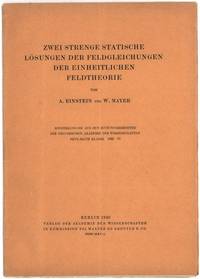
1930réf. 433141930. Offprint from Sitzungsberichte der preussischen Akademie der Wissenschaften 1930. Single sheet pp. 1-2. 256 x 184 mm. Upper edge a bit creased light toning but very good. First edition offprint issue. One of Einstein's last papers on Riemann metrics and distant parallelism written the year before he abandonded this approach to constructing a unified field theory. Pais Subtle is the Lord p. 347. Weil Albert Einstein Bibliography 173. unknown
1924réf. 49431Berlin Springer 1924. 8vo. Bound in contemporary half cloth. In "Zeitschrift für Physik" Bd. 27. Entire volume offered. Stamp to front free end paper. Fine and clean. Einstein: Pp. 1-6; P. 392. Bose: P. 392. Entire volume: IV 395 1 pp. First appearance of Einstein's paper on statistical mechanics and the physics of radiometers. Weil 139 143a hardcover
1906réf. 38794Leipzig Johann Ambrosius Barth 1906. Bound together in one contemp. hcloth. Small tears to spine ends. = "Annalen der Physik. Vierte Folge. Band 20. Herausgegeben von Paul Drude." Portrait Paul Drude VIII1048 pp. and 6 plates. Einstein papers: pp. 199-206 and 627-33. Internally fine and clean. The whole volume offered. Both papers first edition. It was for the papers "Ueber einen die Erzeugung und Verwandlung des Lichtes betreffenden heuristischen Gesichtspunkt" of 1905 and "Zur Theorie der Lichterzeugung. Theory of light emission and absorption the offered item that Einstein was awarded the Nobel Prize in 1921."The quantum theory has affected virtually every branch of physics. Its earliest and one of its most significant developments was Einstein's application of the theory to what is known as the 'photo-electrical effect'.Einstein explained this effext by suggesting that the classical view that light is emitted in the form of continous waves must be abandoned. The photo-electrical effect could be explained only as an example of quantum action where the waves of light or X-rays are emitted in minute particles or bullets. It is he size of the bullet the wave-lenght of the radiation which determines the number of electrons ejected. It was for this and not for the theory of relativity that Einstein was awarded the Nobel Prize in 1921. Einstein's two fundamental papers on this subject are "Ueber einem Erzeugung." 1905 and Zur Theorie der Lichterzeugung the paper offered here" PMM the note to 391. In the second paper Principle of the conservation of the centre of mass motion and the inertia of energy he shows that the conservation of mass is a special application of his energy principle E= Mc2 - Weil: 12 & 13.Among the many papers in this volume we have Max von Laue: Zur Thermodynamik der Inteferenzerscheinungen. pp. 365-378. hardcover
1906réf. 46956Leipzig Johann Ambrosius Barth 1906. No wrappers. Extracted from "Annalen der Physik" Vierte Folge. Bd. 20. Pp. 199-206. Clean and fine. First printing of one of the papers for which Einstein was awarded the Nobel Prize in 1921. It was for the papers "Ueber einen die Erzeugung und Verwandlung des Lichtes betreffenden heuristischen Gesichtspunkt" of 1905 and "Zur Theorie der Lichterzeugung. Theory of light emission and absorption the offered item that Einstein received the prize: "for his services to theoretical physics and especially for his discoveryof the law of the photoelectrical effect" - his reward was not based on relativity."The quantum theory has affected virtually every branch of physics. Its earliest and one of its most significant developments was Einstein's application of the theory to what is known as the 'photo-electrical effect'.Einstein explained this effext by suggesting that the classical view that light is emitted in the form of continous waves must be abandoned. The photo-electrical effect could be explained only as an example of quantum action where the waves of light or X-rays are emitted in minute particles or bullets. It is he size of the bullet the wave-lenght of the radiation which determines the number of electrons ejected. It was for this and not for the theory of relativity that Einstein was awarded the Nobel Prize in 1921. Einstein's two fundamental papers on this subject are "Ueber einem Erzeugung." 1905 and Zur Theorie der Lichterzeugung the paper offered here" PMM the note to 391.Weil: 12 with an asterix denoting a major paper - Boni:12. unknown
1906réf. 46962Leipzig Johann Ambrosius Barth 1906. Bound together in one contemp. halfcalf. Spine gilt. Minor scratches to spine. A stamp to titlepage and htitle. "Annalen der Physik. Vierte Folge. Band 20. Herausgegeben von Paul Drude." Portrait Paul Drude VIII1048 pp. and 6 plates. Einstein papers: pp. 199-206 and 627-33. The entire volume offered. Both papers first edition. It was for the papers "Ueber einen die Erzeugung und Verwandlung des Lichtes betreffenden heuristischen Gesichtspunkt" of 1905 and "Zur Theorie der Lichterzeugung. Theory of light emission and absorption the offered item that Einstein was awarded the Nobel Prize in 1921."The quantum theory has affected virtually every branch of physics. Its earliest and one of its most significant developments was Einstein's application of the theory to what is known as the 'photo-electrical effect'.Einstein explained this effext by suggesting that the classical view that light is emitted in the form of continous waves must be abandoned. The photo-electrical effect could be explained only as an example of quantum action where the waves of light or X-rays are emitted in minute particles or bullets. It is he size of the bullet the wave-lenght of the radiation which determines the number of electrons ejected. It was for this and not for the theory of relativity that Einstein was awarded the Nobel Prize in 1921. Einstein's two fundamental papers on this subject are "Ueber einem Erzeugung." 1905 and Zur Theorie der Lichterzeugung the paper offered here" PMM the note to 391. In the second paper Principle of the conservation of the centre of mass motion and the inertia of energy he shows that the conservation of mass is a special application of his energy principle E= Mc2 - Weil: 12 & 13.Among the many papers in this volume we have Max von Laue: Zur Thermodynamik der Inteferenzerscheinungen. pp. 365-378. unknown
1922réf. 28358Berlin Gruyter & Co. 1922. 4to. Orig.printed orange wrappers. Offprint/Sonderabdruck aus Sitzungsberichten. pp. 18-22. Fine fresh copy. First edition in the rare Offprint still called "Abdruck". - Weil No. 120.The early Offprints from "Sitzungsberichten." are called "Sonderabdruck" up to Weil No.165 including this. From Weil 166 they are called "Sonderausgabe.". - Before 161 up to 160 the Offprints do not have separate title and pagination the pagination follows the numbering in the periodical. From 166 the Offprint has both separate printed title and pagination. - So Weil Nos 161-165 is still "Abdruck" but with separate title and pagination. These facts are not mentioned in the bibliographies. unknown
1906réf. 292Leipzig: Barth 1906. 1st Edition. FIRST EDITION FIRST ISSUE of two important 1906 Einstein papers. Einstein wrote two papers on the photoelectric effect his revolutionary 1905 paper and "Zur Theorie der Lichterzeugung und Lichtabsorption" his continuation of it. In them Einstein employed Planck's theory that luminous energy can be absorbed or emitted only in discrete amounts called quanta and proposed a theory of light quanta involving particles with no mass photons whose energy depended on frequency. All of Einstein's experimental results confirmed that light actually consisted of discrete energy packets. "Based on this theory Einstein wrote an equation describing how the photoelectric effect works. The energy of individual electrons emitted by a photocell is a function of the frequency of the light hitting the photocell and the rate of electron emission is a function of the light source's intensity number of photons with sufficient energy being emitted. This is contrary to what is predicted by classical physics" History of Physics: The Wenner Collection. In this Einstein's second paper on photoelectrics he revisited Planck's theory and from it developed his ideas to show that an electromagnetic wave such as light could be described as a particle photon with discrete quanta of energy that was dependent on its frequency. In the long history of quantum mechanics this would lead to a theory of unity between subatomic particles and electromagnetic waves called wave-particle duality in which particles and waves were neither one nor the other but had certain properties of both. At first Einstein believed that light-quantum hypothesis was merely 'heuristic': that it behaved only as if it consisted of discontinuous quanta. But in this paper and others to follow Einstein used his statistical mechanics to demonstrate that when light interacts with matter Planck's entire formula can arise only from the existence of light quanta -- not from waves. In other words in explaining the photoelectric effect by extending Planck's concept of quantum of energy had Einstein "demonstrated that his own 'light-quantum hypothesis' was implicit in Planck's earlier work" Honner The Description of Nature 31. ALSO included in this volume is "Daz Prinzip von der Erhaltung." The Principle of Conservation of Motion of the Center of Gravity and the Inertia of Energy. In this "ingenious thought experiment involving energy transport in a hollow cylinder Einstein returned to the relationship between inertial mass and energy giving more general arguments for their complete equivalence" Calaprice The Einstein Almanac 18. This was the first statement that the conservation of mass is a special case of the conservation of energy. CONDITION & DETAILS: Leipzig: Barth 1906. Octavo. 8.75 x 6 inches; 222 x 152mm. Ex-libris bearing minimal markings only a small stamp on the title page. Illustration: 6 plates and figures throughout. Entire volume in black cloth gilt-lettered at the spine. The cloth is a bit rubbed and scuffed and there is fading at the spine. Solidly and tightly bound. Bright and clean throughout. Barth hardcover
réf. a88012a1924 first edition. Viewig Article on pp. 1-6 in one complete issue of Zeitschrift fur Physik siebenundzwanzigster band 27 heft 1. In complete volume. Hardcover. Octavo 395p. blue buckram. Many similiar important articles in same volume by other scientists. Near Fine. . hardcover
1922réf. 32430Berlin: Sitzungsberichten der Preussischen Akademie der Wissenschaften 1922. First Thus. First Thus. Einstein Albert 1879-1955. Zur Theorie der Lichtfortpflanzung in dispergierenden Medien. Complete. Quarto. Offprint from Sitzungsberichten der Preussischen Akademie der Wissenschaften. Berlin: 1922. First edition in very fine condition. This superb offprint is a separate printing of the Prussian Academy's session reports here with independent pagination. A small number of such off prints were presented to the author by the publisher as voucher copies. References: Schilpp-Shields 162; Weil 120. This paper gives evidence that Einsteins ideas on the photon were not able to contradict classical theory. "Since after 1917 Einstein firmly believed that light-quanta were here to stay it is not surprising that he would look for new ways in which the existence of photons might lead to observable deviation from the classical picture. In this he did not succeed. At one point in 1921 he thought he had found a new quantum criterion but it soon turned out to be a false lead as demonstrated in this paper". An excellent example. "The early Offprints from "Sitzungsberichten." are called "Sonderabdruck" up to Weil No.165 including this. From Weil 166 they are called "Sonderausgabe.". - Before 161 up to 160 the Offprints do not have separate title and pagination the pagination follows the numbering in the periodical. From 166 the Offprint has both separate printed title and pagination. - So Weil Nos 161-165 is still "Abdruck" but with separate title and pagination. Sitzungsberichten der Preussischen Akademie der Wissenschaften unknown
1922réf. 374051922. unknown
1930réf. 270851930. S.Ber. Akad. Wiss. Berl. 1930/ 6. - Berlin Verlag der Akademie der Wissenschaften 1930 8° 13 S. orig. Broschur. First Edtion; the rare off-print from the "Sitzungsberichte". Weil No. 170; Schilpp-Shields No.240; Alicke No. 144 unknown
1930réf. 28376Berlin Gruyter & Co. 1930. 4to. Orig. printed orange wrappers. Offprint/Sonderausgabe aus Sitzungsberichten.pp. 1-13. Fine fresh copy. First edition in the rare Offprint with its separate printed title and separate pagination. Se Weil No. 170 not mentioning this.The early Offprints from "Sitzungsberichten." are called "Sonderabdruck" up to Weil No.165 including this. From Weil 166 they are called "Sonderausgabe.". - Before 161 up to 160 the Offprints do not have separate title and pagination the pagination follows the numbering in the periodical. From 166 the Offprint has both separate printed title and pagination. - So Weil Nos 161-165 is still "Abdruck" but with separate title and pagination. These facts are not mentioned in the bibliographies. unknown
1930réf. 38646Berlin Akademie der Wissenschaften 1930. 4to. Orig. printed green wrapper. No VI 1930 of Sitzungsberichte der Preussische Akademie der Wissenschaften. Wrappers with very small nicks atspine. Small part of one corner gone. pp. 110-120. A small stamp at foot of frontwrapper. First edition in the periodical form. - Weil No. 170 unknown
1930réf. 37422Berlin: Akad. Wiss 1930. Weil 170. Offprint from S. preuss. Akad. Wiss. Akad. Wiss unknown
1990réf. BN657787Silver & Goldstein. 1990. 1990. Softcover. Zwischen Bebuquin und Negerplastik. Materialien Band I. Zwischen Bebuquin und Negerplastik. Materialien Band I. Einstein Carl - Baacke Rolf-Peter Herausgeber Silver & Goldstein. paperback
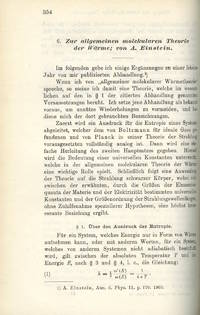
1904réf. 32820371Brown buckram. Library markings. FIRST EDITION of Einstein's fifth published paper "On the General Molecular Theory of Heat" pp. 354-362. Annalen der Physik
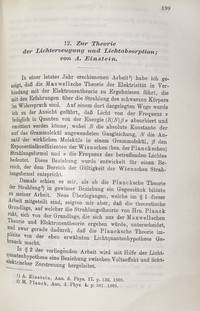
1906réf. 32820369Contemporary half dark green roan. Rubbed some chipping separation at upper joint. Library markings. FIRST EDITION of "On the Theory of Light Production and Light Absorption" pp. 199-206. This classic in the history of physics is Einstein's second paper on the photoelectric effect. Einstein reconciles his and Planck's independent derivations of the blackbody formula E=hν. Planck's derivation of this formula ascribed it to a restriction on the energy changes possible when radiation is produced or absorbed by matter which implied no restriction on the energies of either matter or radiation. Einstein's 1905 derivation ascribed it to a restriction on the energy of radiation alone but in this paper he proposes the modern idea that the energies of both matter and radiation are quantized which led to his work on quantum specific heats. and FIRST EDITION of "The Principle of Conservation of Motion of the Center of Gravity and the Inertia of Energy" pp. 627-633. In this "ingenious thought experiment involving energy transport in a hollow cylinder Einstein returned to the relationship between inertial mass and energy giving more general arguments for their complete equivalence" Calaprice The Einstein Almanac. This is the first statement that the conservation of mass is a special case of the conservation of energy. Annalen der Physik
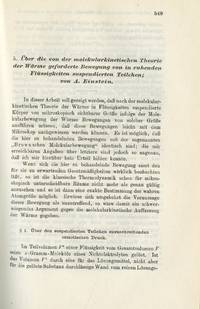
1905réf. 32820546FIRST EDITION. "On the Movement of Small Particles Suspended in a Stationary Liquid Demanded by the Molecular Kinetic Theory of Heat" appears here on pp. 549-560. This landmark paper on Brownian motion is one of the three great papers from 1905 Einstein annus mirabilis. Although most physicists and chemists accepted the idea of atoms as a useful concept in 1905 many still questioned whether they actually existed. Einstein later claimed that "my major aim in this research was to find facts which would guarantee as much as possible the existence of atoms of finite size." In 1827 botanist Robert Brown had used a microscope to look at dust grains floating in water. He found that the floating grains were moving about erratically a phenomenon that became known as "Brownian motion." In this paper Einstein proved the reality of these molecules and their motions by producing the first statistical physics analysis of Brownian motion. French physicist Jean Perrin used Einstein's results to experimentally determine the mass and the dimensions of atoms thereby conclusively verifying Dalton's atomic theory first proposed in 1808. "Eventually the experimental evidence supporting Einstein's theory of Brownian motion became so compelling that the naysayers were forced to accept the existence of material atoms. His fundamental work on applying statistical methods to the random motions of Newtonian atoms also led to his insights into the photo electric effect through the discovery of a critical connection between his statistical theory of heat and the behavior of electromagnetic radiation. This was the first step in his goal to unify the two fields" APS. Complete issue removed from bound volume. Very good.
1917réf. 19286Leipzig: S. Hirzel 1917. FIRST EDITION. Contemporary half cloth and marbled boards preserved in a morocco slipcase. An excellent clean copy. First edition of this classic work on the quantum theory of radiation by Einstein in which he predicts the existence of the phenomenon of stimulated emission of radiation. He here analyzes the properties of photons and demonsrtrtes that Planck’s law is directly deducible from quantum theory and the concept of transition probabilities. Four decades later MASER and LASER devices are operated to prove him right. Boni 95; Weil 91. S. Hirzel unknown
1920réf. 7913FB1920. Berlin Springer 1920. 8°. 15 1 S. Unbeschnittene Original-Broschur gebräunt leicht fleckig. Durchgehend mäßig braunfleckig. Sonst gut. unknown
1920réf. 29309Berlin Julius Springer 1920. Clothbacked boards. Bound with orig. printed wrappers. Small inkspots in inner margins of wrappers. 15 pp. First edition. - Weil No. 111. hardcover
1920réf. 29310Berlin Julius Springer 1920. Uncut in orig. printed wrappers. 15 pp. First edition. - Weil No. 111. unknown