ALBERT EINSTEINABAA

215 Ergebnisse
1880Best.-Nr. 24284A unique and important artifact of his childhood. ALBERT EINSTEIN. Ephemera. Set of Anker-Steinbaukasten children's building blocks by F. Ad. Richter & Cie. Rudolstadt Germany c.1880s. Approximately 160 composite quartz sand chalk and linseed oil blocks in red limestone and slate gray in various sizes and shapes together with three or more sets of building plans all contained in two wooden boxes with printed Anker-Steinbaukasten labels. Einstein spent his childhood building "complicated structures" with these Anker-Steinbaukasten blocks. Accepting his later theory that "Imagination is more important than knowledge" the toys that encouraged his imagination became building blocks for the most important scientific theories of the last millennium. His sister Maja Winteler-Einstein describing his childhood recalled that "The games he played … were very characteristic of Albert's capacities. These were mostly puzzles fretsaw work the erection of complicated structures with the well-known Anker building blocks and above all the construction of multi-storied card castles with which he filled his leisure." "Beitrag für sein Lebensbild" in The collected papers of Albert Einstein. ed. John Stachel. Volume 1: The early years. 1879-1902. Princeton University Press 1987 p.lix. Translated from German. Based on the work of German educator Friedrich Froebel who created the concept of kindergarten these composite stone blocks were a popular toy of the 1880s and 1890s. The blocks were designed to help develop childrens' tactile senses and manual dexterity and also to stimulate imagination creativity and three-dimensional perception. Fellow scientist J. Robert Oppenheimer as well as architects Frank Lloyd Wright and Walter Gropius are among the geniuses who are known to have played with Anker blocks. Provenance The set had passed by direct descent from Albert Einstein to the consignor from whom we acquired the blocks at Christie's London on July 13 2016. Condition A few blocks chipped and worn with original instructions and boxes worn soiled and defective. Albert Einstein 1879-1955 was a German-Swiss born theoretical physicist internationally recognized as one of the greatest physicists of all time. He enunciated the general theory of Relativity with law explaining the relationship between the speed of light and its consequence the equivalence of mass and energy E=MC2. For his work in theoretical physics—largely for his 1905 paper on photons and photo-electricity—Einstein was awarded the Nobel Prize for Physics announced in November 1922 retroactive for 1921. Working on a unified field theory he then attempted to explain gravitation and electromagnetism within one set of laws. With the expulsion of Jewish scholars from Germany after Hitler's rise to power Einstein joined the Institute for Advanced Study in Princeton New Jersey 1933 which became the most celebrated research center in the world. In 1939 he signed a letter written to President Franklin Roosevelt warning him of the possibility of Germany developing a nuclear bomb. He urged the U.S. to begin uranium research thus beginning the top secret "Manhattan Project." Later at Princeton he tried to develop a unified field theory and to refute the accepted interpretation of quantum physics both unsuccessfully. Einstein received U.S. citizenship in 1940. books
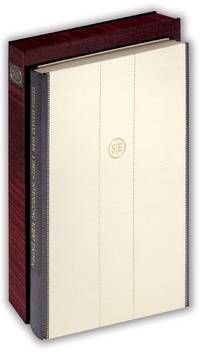
Best.-Nr. 35452Rockport ME: Two Ponds Press 2015. Fine. Number 35 of 75 copies signed and numbered by Joseph Goldyne. Joseph Goldyne was born in 1942 in Chicago IL. He came to prominence as an artist on the West Coast. He has been credited as one of the artists responsible for the rebirth of monotype and monoprint as valuable approaches to art. He is also known for his artist's books often done in collaboration with printer Peter Rutledge Koch. From the Prospectus: "Joseph Goldyne brought this project to our attention and the Press was convinced that this little-known oratory by George Bernard Shaw deserved wider recognition one that Goldyne thought a most unexpectedly wondrous and humorous introduction to Albert Einstein perhaps the most transformative and towering figure of the twentieth century. Goldyne's own introduction " An Introduction to an Introduction" speaks to his discovery of Shaw's speech its presentation Shaw's record of condemning anti-Semitism and his public support for Einstein. The full text of Shaw's speech is reprinted together with Einstein's response delivered in German and printed here in English translation. Goldyne illustrates the volume with five drypoint etchings created especially for this publication. They pay tribute to the featured speakers as well as to the sense of the event." Beautifully bound in cream paper covered boards with gilt dotted rulings and ornament on front cover of circle with initials "SE" in its center. Gray leather spine and trim along front edges with gilt titling on spine. Printed in Monotype Bembo and Gill Sans types on paper handmade at the Velké Losiny mill in the Czech Republic. Letterpress printing by Arthur Larson at Horton Tank Graphics with additional hand composition by Rose Ku'ulealoha Wisotzky. Design and typography planned by Michael Russem Housed in a slipcase covered in dark red cloth with "SE" symbol on spine. Accompanied by prospectus. A lovely book in fine condition. Measures 6.5 x 10 inches. 39 pages. PRI/112321. Two Ponds Press unknown books
1951Best.-Nr. 33824London: Cassell 1951. Hardcover. Very Good. Octavo. Boards. 91 pp. Some browning and foxing. Cassell hardcover books
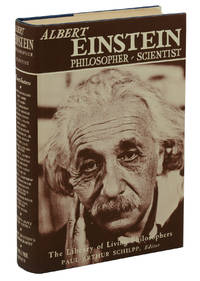
1949Best.-Nr. 140941039Evanston IL: The Library of Living Philosophers Inc 1949. First Edition. Near Fine/Very Good. First edition first printing. Bound in publisher's original dark blue cloth stamped in gilt. Near Fine with toning to pages offsetting to endsheets former owner name to front free endpaper and small sticker ghost to front paste down. In a Very Good dust jacket with fraying and chip at bottom spine end and short closed tear at head light edge wear toning and soiling to rear panel. The Library of Living Philosophers, Inc unknown books
1949Best.-Nr. 140941891Evanston IL: The Library of Living Philosophers Inc 1949. First Edition. Fine/Fine. First edition trade issue. xvi 781 pp. Bound in publisher's navy cloth with gilt spine lettering. Fine with offsetting to endpapers in a Fine dust jacket unfaded and unworn. A very sharp copy of a collectible volume all about the famous theoretical physicist. The Library of Living Philosophers, Inc unknown books
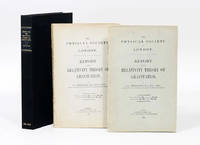
1918Best.-Nr. 2839London: Fleetway Press 1918. FIRST EDITION. Original wrappers. Fine. THE FIRST INTRODUCTION OF EINSTEIN'S GENERAL RELATIVITY TO THE ENGLISH-SPEAKING WORLD. The groundbreaking first edition 1918 with the second edition 1920 containing the account of Eddington's 1919 expedition proving Einstein's theory both in original wrappers. "Einstein's discovery of the General Theory of Relativity was communicated to the Berlin Academy of Sciences in 1915. Because of the First World War direct communication with physicists in Germany was not possible but the papers were forwarded to Eddington who was then Secretary of the Royal Astronomical Society by Willem de Sitter a personal friend of Eddington's in neutral Holland. The theory is of considerable mathematical complexity but as Einstein stated in the last paragraph of his paper 'scarcely anyone who has fully understood this theory can escape from its magic'. Eddington was the ideal expositor of these ideas in English and within 2 years had written his Report on the Relativity Theory of Gravitation for the Physical Society of London" Malcolm Longair "Bending Space-time". The second edition is notable for containing a new preface that discusses the results of the "eclipse expedition" led by Eddington that verified General Relativity and catapulted Einstein into world-wide fame. This preface precedes Eddington's full report in the Philosophical Transactions. Provenance: Almost certainly Nobel Prize winning physicist's Charles Glover Barkla's copy of the 1918 report with an original 1918 receipt in Barkla's name laid in. Barkla won the 1917 Nobel Prize in Physics "for his discovery of the characteristic Röntgen radiation of the elements". London: Fleetway Press for The Physical Society of London 1918 and 1920. Octavo original wrappers; custom box. General light wear to wrappers. Beautiful copies. RARE. Fleetway Press unknown books
1994Best.-Nr. S11423New York:: Warner Books 1994. 1994. Small 8vo. 179 pp. Printed wrappers. Fine. ISBN: 0446670111 Warner Books, (1994). unknown books
1958Best.-Nr. 33773Sporosky 1958. Flexible Covers. Very Good. Flexible Covers. Flexible green cloth boards with gilt title in Japanese to spine. Creasing to covers and spine. Housed in a beige cardboard slipcase with Japanese titling to spine and front panels. Wear and browning to case. All text in Japanese with one page in Russian. Includes several photographic illustrations many equations and a few diagrams. Foxing to fore-edge of textblock. Clean interior overall; however some passages have been underlined in pen. 339 pages. SCI/010220. (Sporosky) unknown books
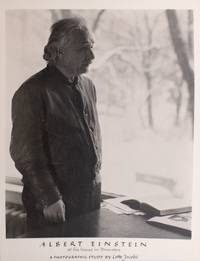
1933Best.-Nr. 13747Los Angeles 1933. Signed by the photographer Aaron Tycko of Los Angeles. Prominently signed “Albert Einstein. 1933” below image. Rarely seen photograph of the famous scientist taken during his last visit to Southern California in January 1933 the month Hitler took power in his native Germany. During the five-month trip Einstein 1879-1955 spent most of his time at the Mount Wilson Observatory and the California Institute of Technology where he was offered a position. Later that year he renounced his German citizenship and accepted a professorship at the Institute for Advanced Studies in Princeton New Jersey. Tycko 1893-1975 was based in Los Angeles and often photographed Einstein along with other Hollywood icons of the early twentieth century including Irving Berlin. At the time this photograph was taken Tycko also shot a well-known photograph of Einstein with his wife Elsa. Interestingly Tycko is mention in Einstein’s FBI files because a Hollywood informant reported that the photographer believed Einstein was a communist. This informant contended that Tycko thought Einstein was “the brain that was setting up Hollywood in the 1930’s for the big Communist push . . . He was one of the most dangerous and powerful figures in what has become the Communist movement.” Jerome The Einstein File: J. Edgar Hoover’s Secret War Against the World’s Most Famous Scientist. unknown books
1905Best.-Nr. 19259Leipzig: Johann Ambrosius Barth 1905. FIRST EDITION. Line-block and halftone text illustrations one folding table 3 halftone plates 1 collotype plate. Contemporary cloth-backed marbled boards title and date in gilt on spine; an excellent copy with the small stamp of the University of Basel on the fly-leaf preserved in a clamshell box. First edition journal issues of three important early papers by Einstein. In the first paper “Einstein suggested that light be considered a collection of independent particles of energy which he called ‘light quanta.’ Such a hypothesis he argued would provide an answer to the problem of black-body radiation where classical theories had failed and would also explain several puzzling properties of fluorescence photoionization and the photoelectric effect” Norman. It was for this paper together with one of the photoelectric effect “Zur theorie der Lichterzeugung und Lichtabsorption” published in 1906 that Einstein was awarded the Nobel Prize in Physics in 1921. The second paper proved according to Einstein himself that “according to the molecular theory of heat bodies of dimensions of the order of 1/1000 mm. suspended in liquid experience apparent random movement due to the thermal Brownian molecular movement quoted by R.W. Clark Einstein New York 1984 p. 87. Experimental verification of the predictions made in this paper contributed to proving the physical reality of molecules. The third paper on the electodynamics of moving bodies was Einstein’s first statement of the special theory of relativity. In it he argued that all motion is relative to the inertial system in which it is measured and that matter and energy are equivalent. As he himself remarked “it modifies the theory of space and time.” I: Weil 6; Norman 689; II: Weil 8 Norman 690; III: Weil 9 Dibner Heralds of Science 167; Grolier/Horblit 26b Norman 691A. Johann Ambrosius Barth unknown books
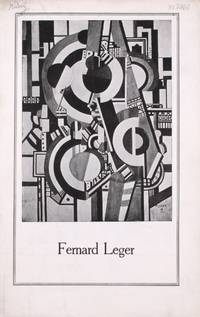
1925Best.-Nr. 333269New York: Société Anonyme Inc 1925. First edition. 6 black and white illustrations 11 pp. 8vo. Side-stapled printed wrappers somewhat soiled. First edition. 6 black and white illustrations 11 pp. 8vo. Published in conjunction with an exhibition of Leger's work by the Société Anonyme from November 16th to the 28th 1925. Includes an introduction by Dreier a creative piece translated from the French of Karl Einstein and "Notations on Plastic Values" by Léger. Scarce OCLC only records a copy at Yale from the papers of Katherine S. Dreier. Collection of the Société Anonyme p. 218 Société Anonyme, Inc unknown books
2001Best.-Nr. 541251Gambier Ohio: Kenyon College 2001. Softcover. Fine. First edition. Special collaborative issue two magazines in one volume. Tall Octavo. 285pp. Fine in pictorial wrappers. Includes contributions from: Seamus Heaney Samuel Beckett Marie Curie Albert Einstein Pablo Neruda William Butler Yeats Joseph Brodsky Robert Hass and many more. Cultures of Creativity: The Centennial Celebration of the Nobel Prizes. Kenyon College unknown books
1981Best.-Nr. 101451Reading Massachusetts: Addison-Wesley Publishing Company Inc 1981. Softcover. Fine. Third printing. Fine with slight bumping to the corners in wrappers. Addison-Wesley Publishing Company, Inc unknown books
1940Best.-Nr. 3293321940. Black and white photographic print. 6 1/2 x 4 7/8 in. Fine. Black and white photographic print. 6 1/2 x 4 7/8 in. unknown books
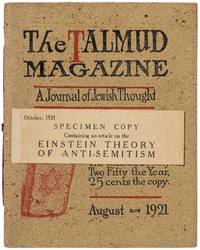
1921Best.-Nr. 553355Boston: Talmud Society 1921. Softcover. Fine. First edition. 12mo. 64pp. Original cord-tied wrappers printed in red and black. The first and last leaf toned from interaction with the wrappers else about fine. An August issue of the magazine apparently used in October to promote the short-lived magazine this copy with a printed slip affixed to the front wrap: “October 1921. Specimen Copy. Containing an article on the Einstein Theory of Anti-Semitism.” Photographic portrait of Einstein on page 14; along with an English translation of his essay: "Jewish Nationalism and Anti-Semitism: Their Relativity" which originally appeared in the London Jewish Chronicle. Talmud Society unknown books