2 965 résultats
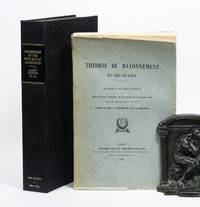
1912réf. 2508Paris: Gauthier-Villars 1912. First edition. Original wrappers custom box. Very Good. RARE FIRST EDITION IN ORIGINAL WRAPPERS OF THE REPORTS FROM THE HISTORIC FIRST SOLVAY CONFERENCE "THE FIRST INTERNATIONAL CONFERENCE IN PHYSICS EVER ORGANIZED" AND A CRITICAL MOMENT IN THE BIRTH OF QUANTUM PHYSICS. In the short time that followed Planck's hypothesis of the universal constant that would bear his name the greatest minds in physics were largely at a loss about how to deal with the bizarre theoretical results that followed let alone the experimental results which confirmed them!. Much of the focus at the time was on black-body radiation including work by Planck himself as well as Lorentz Rayleigh and Jeans. However shortly before the first Solvay conference a young Einstein had also started investigating the related question of materials' specific heat. Kuhn. "The purpose of the first Solvay Conference was thus two-fold: first there was the need to examine whether classical theories molecular-kinetic theory and electrodynamics could in some undiscovered ways provide an explanation of the problem of black-body radiation and of the specific heat of polyatomic substances at low temperatures; secondly to consider phenomena in which the theory of quanta could be successfully used." Mehra. Underlying these questions was the more fundamental mystery of how to interpret the existence of the Planck constant. There were two camps both of which were represented at the conference. Planck's took the constant to indicate some fundamental constraint on the radiative processes of emission and absorption. For example "Sommerfeld introduced a version of the quantum hypothesis which he considered to be compatible with classical electrodynamics. He postulated that in 'every purely molecular process' a quantized quantity of action is exchanged." Staumann. Einstein's camp on the other hand took the quantum of action to represent the physicality of a perhaps pseudo-corpuscular theory of energy exchange - his photons of light. Although the debates that followed the lectures included in the proceedings did not rise to the famous heated exchange that Einstein would have with Bohr at the 1927 Solvay conference we do see some of the young Einstein's hotheadedness as he opens the debate following Planck's plenary lecture: "What I find strange about the way Mr. Planck applies Boltzmann's equation is that he introduces a state probability W without giving this quantity a physical definition. If one proceeds in such a way then to begin with Boltzmann's equation does not have a physical meaning." As translated by Straumann. It would take another 14 years for quantum mechanics to be fully formalized but the first Solvay conference represents a pivotal point in quantum history: "During 1911 the situation changed quickly. Articles that applied the quantum to other topics then outnumbered those on blackbody radiation for the first time and some were backed by impressive experimental evidence. In part because of that evidence physicists like Planck and Lorentz who had previously taken the constant h to be characteristic only of the radiation problem began to consider additional areas in which others had earlier staked quantum claims." Kuhn. Albert Einstein and the Solvay Conference: Among the most renown scientists of the day - including Ernest Rutherford Marie Curie and Max Planck - Einstein made quite an impression. At age 32 he was the second youngest participant in the conference. The youngest was British physicist Frederick Lindemann later to become scientific adviser to Winston Churchill. Although "Einstein had already published so many masterpieces none had actually been put to the test and his theories were looked on rather as tours de force than as definitive additions to knowledge. But his pre-eminence among the twelve greatest theoretical physicists of the day was clear to any unprejudiced observer." Frederick Lindemann quoted in Brian. References: Headline quote from the Solvay Institute website. Kuhn T. 1978 Black Body Theory and the Quantum Discontinuity 1894-1912. University of Chicago Press. Mehra J. 1975 The Solvay Conferences on Physics: Aspects of the Development of Physics Since 1911. Straumann N. 2011. On the first Solvay Congress in 1911. The European Physical Journal H 363 379-399. Denis Brian Einstein: A Life p.82. Paris: Gauthier-Villars 1912. Octavo original wrappers; custom box. Splits to top and bottom joint of upper wrapper two creases to front wrapper. Text in fine condition largely unopened. FIRST PRINTINGS IN ORIGINAL WRAPPERS ARE EXTREMELY SCARCE. Gauthier-Villars unknown books
1925réf. 140941837Berlin: No Publisher 1925. Revised edition. 783-797 pp. Publisher's original printed wrappers. About Very Good with thin tear along front wrap fold near head a little chipping to wraps at spine front wrap hinge fragile contents toned with age. This copy belonged to Hans Albert Einstein Albert Einstein's oldest son with his inkstamp at top of front wrapper; likely a presentation copy from his father. Neatly written at top of front wrapper are "41" and 163." Very rare author's offprint from Die Kulture der Gegenwart of an essay on relativity theory which was first published in 1914 revised to incorporate Einstein's later research. OCLC/WorldCat locates no physical copies. Weil 71. [No Publisher] unknown books
1916réf. 140941831Leipzig Germany: S. Hirzel 1916. First separate edition. First separate edition. 4 pp. Illustrated with portrait of August Mach from photograph. Publisher's original printed wrappers. Very Good with some small chips to fragile wrappers faint crease to top of front wrap contents toned with age. This copy belonged to Hans Albert Einstein Albert Einstein's oldest son with his inkstamp at top of front wrapper; likely a presentation copy from his father. Neatly written at top of front wrapper is "43" and date "14.III.16." OCLC/WorldCat locates four copies two at the University of Toronto one at the Smithsonian Institution and one at the American Philosophical Society. Weil 89. Very rare author's offprint stating "Uberreicht vom Verfasser" of the eulogy by Albert Einstein for fellow physicist Ernst Mach as first published in Physikalischen Zeitschrift. A noted scientist in his own right Mach is best known for the concept of "Mach's principle" which asserts that an entity's inertial mass is determined by all the other masses in the universe. Einstein in fact coined the phrase "Mach's principle" and his application of it had major ramifications for the development of his theory of general relativity Einstein in 1918 labeling it one of the "three pillars" of general relativity. S. Hirzel unknown books
1979réf. 1199794Braunschweig, Wiesbaden : Vieweg Verlag, 1979. 467 S. : 1 Ill. ; 23 cm; fadengeh. Orig.-Pappband m. OUmschl.
2005réf. 251199München : Langen Müller, 2005. 391 S. ; 21 cm Originalpappband mit Original-Schutzumschlag.
1913réf. 76293Leipzig ; Berlin : Teubner 1913. 1st Edition 1st Edition 38 S. ; 25cm Halbleinen [3 Warenabbildungen] 0
1985Einstein, Albert e Infeld, Leopold (Castagnoli, Carlo: Prefazione di) L'evoluzione della fisica. Sviluppo delle idee dai concetti iniziali alla relatività e ai quanti (volume doppio). Torino, Paolo Boringhieri-Editore Boringhieri società per azioni (corso Vittorio Emanuele 86) - tipografia Gravinese (Stampa) 1985 italian, in sedicesimo pp. (2)+310+(4)=316 X impressione della I ed. nella collana Universale scientifica Boringhieri: giugno 1985 (ed. originale: The Evolution of Physics. The Growth of Ideas from Early Concepts to Relativity and Quanta, Cambridge University Press 1938 - I ed. italiana: Torino, Boringhieri 1948 - I ed. Universale scientifica Boringhieri: 1965). Traduzione di Adele Graziadei. Collana Universale scientifica Boringhieri, volume doppio 1/2. XVI grande/ (2)+310+(4)=316/ brossura in cartoncino bianco goffrato effetto tela con grafica in nero e bianco e con illustrazione in b/n al primo piatto. Con figure in nero nel testo e in nero e in b/n in tavole patinate f.t.. Stato buono (usura della copertina, in particolare al dorso e ai margini- copertina e pagine brunite e con fioriture).
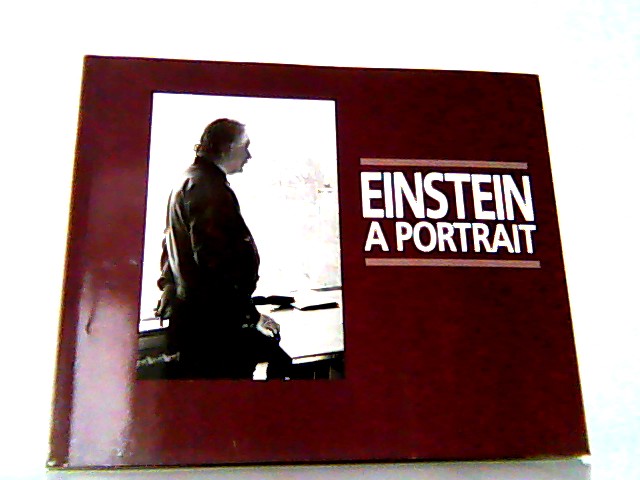
1984réf. 13657Corte Madera (Calif.), Pomegranate Artbooks, 1984.
1915réf. 432951915. Einstein Albert 1879-1955 and Wander Johann de Haas 1878-1960. Notiz zu unserer Arbeit "Experimenteller Nachweis der Ampèreschen Molekularströme." Offprint from Verhandlungen der Deutschen Physikalischen Gesellschaft 17 1915. 1 sheet p. 420. 228 x 156 mm. Original printed wrappers. Fine copy. First Edition Offprint Issue. In 1915 Einstein and Dutch physicist Wander Johannes de Haas conducted gyromagnetic experiments leading to the discovery of the Einstein-de Haas effect which corresponds to the mechanical rotation induced in a ferromagnetic cylinder suspended inside a coil when an impulse of electric current is sent through the coil. Einstein was very enthusiastic about the experimental results stating that he and de Haas had "given firm proof of the existence of Ampère's molecular currents" quoted in Pais Subtle is the Lord pp. 245-246. Einstein and de Haas published their results in a paper published earlier in 1915 see Weil 73; the present "Notiz" is a response to a communication from American physicist Samuel Jackson Barnett who had begun performing similar experiments in 1909 and obtained results complementing those of Einstein and de Haas. Weil Albert Einstein Bibliography 73n. . unknown books
1932réf. 433001932. Offprint from Sitzungsberichte der Preussischen Akademie der Wissenschaften 32 1932. 31pp. 256 x 183 mm. Original printed wrappers a little chipped and darkened small splits in spine. Very good. First edition offprint issue. Einstein's work on semivectors "was stimulated by Ehrenfest's insistence on a better understanding of the relation between single-valued and double-valued representations of the Lorentz group . . . Einstein and Mayer went on to relate semivectors to the Dirac equation and to generalize the formalism to general relativity" Pais Subtle is the Lord pp. 451-452. Weil Albert Einstein Bibliography 186. unknown books
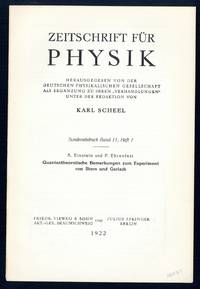
1922réf. 432871922. Einstein Albert 1879-1955 and Paul Ehrenfest 1880-1933. Quantentheoretische Bemerkungen zum Experiment von Stern und Gerlach. Offprint from Zeitschrift für Physik 11 1922. 31-34pp. 229 x 155 mm. Original printed self-wrappers. Light toning but fine otherwise. First Edition Offprint Issue. In 1922 the physicists Otto Stern and Walther Gerlach conducted a now-classic experiment in which a beam of silver atoms was streamed through an inharmonious magnetic field in order to observe the atoms' deflection patterns. Rather than a random and continuous distribution as predicted by classical theory the atoms passing through the field were deflected up or down by a specific amount demonstrating that they had intrinsically quantum properties. The Stern-Gerlach experiment corroborated the Bohr-Sommerfeld model of the atom and strongly influenced later developments in 20th century physics. However the experiment also created some serious difficulties for quantum physicists in the period before the rise of the "new" quantum mechanics. Einstein and Ehrenfest addressed one of these difficulties-connected with space quantization-in their joint paper in which "they dealt in particular with the problem of how the orbits of the atom would obtain their discrete directions which they exhibit while passing through the inhomogeneous magnetic field. Under the assumption that the mechanism causing the orientation was provided by the interaction with the radiation field Einstein and Ehrenfest estimated that for a field strength of 10000 G a change in the direction of the orbit would take place in roughly 1011 s; this long time interval would be reduced in the presence of heat radiation at room temperature . . . to about 109 s. How could they asked the experimental situation be explained which implied that the discrete orientations of the orbits in silver atoms were obtained in less than 10-4 s. In order to deal with this evident puzzle Einstein and Ehrenfest proposed two alternatives: first that the silver atoms were always in the states of spatial quantization; second the orientations of the electron orbits arose from an interaction of the atoms with the radiation field which involved much smaller reaction times . . . However they found that both alternatives created considerable difficulties in the understanding of the atomic processes . . . Thus Einstein and Ehrenfest concluded: 'The difficulties mentioned above show how unsatisfactory are both interpretations of the results found by Stern and Gerlach'" Mehra & Rechenberg The Historical Development of Quantum Theory 1 pp. 443-444. Pais Subtle is the Lord p. 328. Weil Albert Einstein Bibliography 121. . unknown books
1923réf. 432881923. Einstein Albert 1879-1955 and Paul Ehrenfest 1880-1933. Zur Quantentheorie des Strahlungsgleichgewichts. Offprint from Zeitschrift für Physik 19 1923. 301-306pp. Original printed self-wrappers. 230 x 157 mm. Light toning but very good. First Edition Offprint Issue. In 1916 after publishing his great work on general relativity Einstein returned to the question of blackbody radiation. In November 1916 he wrote to his friend Besso that "a splendid light has dawned on me about the absorption and emission of radiation" quoted in Pais p. 405 one that led him to a new derivation of Planck's radiation law and convinced him of the reality of light-quanta photons. After publishing these results in three papers culminating with the famous "Zur Quantentheorie der Strahlung" 1917 Einstein kept looking for "new ways in which the existence of photons might lead to observable derivations from the classical picture" Pais p. 413. He found none until 1923 when Arthur Compton and Peter Debye independently derived the relativistic kinematics for the scattering of a photon off an electron at rest. The work of Compton and Debye led Wolfgang Pauli to extend Einstein's work of 1917 to the case of radiation in equilibrium with free electrons see Pais p. 414n. "Pauli examined the requirements of detailed balance under Lorentz transformations and found that scattering of light by free electrons must include a term of a form which we would now call stimulated emission . . . Einstein and Ehrenfest then showed that Pauli's results could be obtained by an extension of Einstein's 1917 paper with the unnecessary specialization to discrete energy levels removed . . . The core of Einstein's argument is that the scattering process should be broken into two parts: the absorption of energy from radiation of frequency 1 and the emission of energy as radiation of frequency 2" Lewis p. 42. Lewis "Einstein's derivation of Planck's radiation law" American Journal of Physics 41 1973: 38-44. Pais Subtle is the Lord ch. 21. Weil Albert Einstein Bibliography 138. . unknown books
1913réf. 50339Leipzig: Johann Ambrosius Barth 1913. Einstein Albert 1879-1955. Einige argumente fur die annahme einer molekularen agitaation beim absoluten nullpunkt. In Annalen der Physik 40 pp.551-560. With: Otto Stern 1888-1969. Red cloth with gilt lettering on the spine. Whole volume: 1056 pp. 1 plate. 210 x 130 mm. A very good copy. "Some arguments for the assumption of molecular agitation at absolute zero." In this paper Einstein and Stern show that the quantum theory of solids to give the best agreement with experiments at normal temperatures seems to demand that at absolute zero a residual energy would remain in the solids which they term "zero-point energy." They thus introduced this important concept to physics." p. 292. Calaprice Kennefick & Shulmann. An Einstein Encyclopedia. 2015. Otto Stern was a German-American physicist and Nobel Laureate in Physics. He was the second most nominated person for a Nobel Prize with 82 nominations in the years 1925-1945 ultimately winning in 1943 "for his contribution to the development of the molecular rat method and his discovery of the magnetic moment of the proton". In 1912 Stern did his doctoral dissertation in concentrated solutions. After receiving his Ph.D. degree Stern took advantage of his economic independence to join Albert Einstein at Prague. Stern was with Einstein from the spring of 1912 until 1914. Weil's Bibliography no. 53. . Johann Ambrosius Barth unknown books
1913réf. 43305Leipzig & Berlin: Teubner 1913. 38pp. 254 x 170 mm. Original printed wrappers chipped. Library stamps. Very good. First separate edition. "After his first discussions with Grossmann Einstein had found the correct starting point for general relativity. The real work could now begin . . . The Einstein-Grossmann paper published in 1913 contains profound physical insight into the nature of measurement some correct general relativistic equations some faulty reasoning and clumsy notation" Pais Subtle is the Lord p. 216. Weil Albert Einstein Bibliography 58. Teubner unknown books
1908réf. 432171908. Einstein Albert 1879-1955 and Jakob Johann Laub 1884-1962. Über die elektromagnetischen Grundgleichungen für bewegter Körper. Offprint from Annalen der Physik 4th series 26 1908. 532-540pp. 225 x 146 mm. Original printed wrappers. Fine. First Edition Offprint Issue. Einstein's first paper written jointly with a collaborator on the relativistic electrodynamics of ponderable media. "In 1908 Laub wrote works together with Einstein on the basic electromagnetic equations which was aimed to replace the four-dimensional formulation of the electrodynamics by Minkowski by a simpler classical formulation. Both Laub and Einstein discounted the spacetime formalism as too complicated. However it turned out that Minkowski's spacetime formalism was fundamental for the further development of special relativity" Wikipedia. Pais Subtle is the Lord pp. 151 154. Shields 23. Weil 23. . unknown books
1938réf. 15852New York: Simon and Schuster 1938. FIRST EDITION THIRD PRINTING. Original cloth; interior clean. A newspaper article pasted onto the paste-down plus the flaps from the dust jacket pasted in. Ownership signature of Charles Schuchert 1858-1942 American paleontologist that was the leader in the development of paleogeography on the fly-leaf. First edition third printing. Intended as an explanation of the totality of Einstein’s accomplishments for the layperson the publication of this extraordinarily successful work was also used in an attempt to find Infeld a university position he eventually ended up in Canada. According to the preface “the book is a simple chat between you and us. You may find it boring or interesting dull or exciting but our aim will be accomplished if these pages give you some idea of the eternal struggle of the inventive human mind for a fuller understanding of the laws governing physical phenomena.” Weil 201. Simon and Schuster unknown books
1944réf. 556012New York: The American Christian Palestine Committee 1944. Softcover. Very Good. First separate edition. Small octavo. 12pp. Stapled self-wrappers. Slight age-toning on the wrappers and very tiny nicks soiling and light wear very good or better. Two articles jointly written by Einstein and Kahler in response to two articles laying out anti-Zionist testimony given by Dr. Philip Hitti of Princeton before the Committee on Foreign Affairs of the House of Representatives. Both of Hitti's articles and the Einstein and Kahler articles were all published in The Princeton Herald. This publication doesn't include the Hitti articles but summarizes them in the Einstein and Kahler rejoinders. Scarce. The American Christian Palestine Committee unknown books
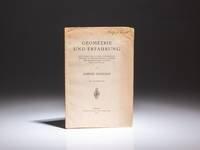
1921réf. 17649Berlin: Verlag Von Julius Springer 1921. First Trade Edition. Wraps. Very good. The first trade edition of Geometrie Und Erfahrung Geometry and Experience by Albert Einstein from the collection of Einstein's English translator Dr. Wilfrid Perrett. Octavo 20pp. Publisher's original wraps bound with two staples. Light soiling and wear on wraps internally clean. Includes two illustrations advertisements on verso of rear flap. Staples showing rust some wear to edges of original wraps. Weil 115 Schlipp-Shields 143 This copy is signed by Wilfrid Perrett on the front cover. This work first appeared in the Sitzungsberichte der Preussischen Akademie der Wissenschaften accompanied by an "author's offprint" which was bound in orange wrappers. Weil 114. This work is the first separate trade edition. The recipient of this copy Dr. Wilfrid Perrett worked with Dr. George Barker Jeffery to translate many of Einstein's most notable works into English. Perrett was a "distinguished German scholar" and would "overlook the literary side of the work" while Jeffery would oversee the mathematical translations. The two worked together on Das Relativitätsprinzip On the Relativity Principle beginning in 1922 and numerous other works by Einstein over his career. Jammer 113-114. Verlag Von Julius Springer unknown books
réf. 1412611Norwalk: The Easton Press CT. First Edition. Hardcover. Octavo xii 166 pages. In Very Good condition. Bound in publisher's brown leather with paneling and gilt lettering to spine. Edges of text block gilt. Mild general shelf wear. Shelved in Easton Press. 1412611. Shelved Dupont Bookstore. The Easton Press hardcover books
2005réf. 39118ABWeinheim, Wiley-VCH, 2005. 8°, 727 S., original Pappband mit illustr. original Schutzumschlag, (Hardcover), bis Seite 12 einige Bleistiftanstreichungen und Randmarginalien, danach ein ungelesenes, sauberes Exemplar der maßgeblichen Einstein-Biographie
1981réf. 32557Frankfurt am Main : Suhrkamp 1981. 417 S. : 1 Ill., graph. Darst ; 18 cm kart., Taschenbuch, Exemplar in gutem Erhaltungszustand, Neupreis in Euro: 29,99
réf. 08777Np; 1923. First Edition. Fine. offprint from Sitzungsberichten der Presussichen Akademie der Wissenschaften Sitzung der physikalishch-mahematischen klasse vom 31 mai XVII. p. 137-140 bound in original orange printied wraps; quarto 254 x 184mm. Einstein's first investigation of Weyl's ideas published in the present work introduced the notion of distant parallelism; however Einstein later rejected Weyl's theory. Housed in a custom quarter-leather clamshell box. A fine copy. unknown books
réf. 50102pamphlet. 11 pages p 1105-1115 FROM: Annalen der Physik fourth series vol. 33. Modern wrappers. Leipzig 1910. unknown books
1912réf. 50338Leipzig: Johann Ambrosius Barth 1912. Einstein Albert 1879-1955. 1 Lichtgeschwindigkeit und Statik des Gravitationsfeldes pp. 355-369. Weil 47 Boni 43. 2 Zur Theorie des statischen Gravitationsfeldes pp. 443-458. Weil 48 Boni 44. 3 Nachtrag zu meiner Arbeit: "Thermodynamische Begrundung des photochemischen Aquivalentgesetzes" pp. 881-885. Weil 46 Boni 42. 4 Antwort auf eine Bemerkung von J. Stark: "Uber eine Anwedung des Planckschen Elementargesetzes" pp. 888. Weil 49 Boni 45. 5 Relativitat und Gravitation. Erwiderung auf eine Bemerkung des Hrn. A. Einstein pp. 1059-1064. Weil 50 Boni 46. In Annalen der Physik 38 1912. Red cloth with gilt lettering on the spine. Whole volume: 1064 pp. 8 plates. Text-figs. 210 x 130 mm. Very good copy. Approximate English translations of titles with brief explanations of referenced paper if available: 1 "The speed of light and the statics of the gravitational field." "Further exploring his studies of gravitation based on the equivalence principle Einstein sees with growing clarity that gravitation is intimitely linked with the problem of the measurement of space and time" p. 292. Calaprice Kennefick & Shulmann. An Einstein Encyclopedia. 2015.; 2 "On the theory of the static gravitational field." "Einstein more closely analyzes the equations of motion stated in no. 1 above concluding that those equations cannot be reconciled with the given field equations for c . . . because the principle of "action equals reaction" is violated. p. 290. Calaprice Kennefick & Shulmann. An Einstein Encyclopedia. 2015.; 3 "Addendum to my work: 'Thermodynamic justification of the photochemical equivalent law' "; 4 "Answer to my remark by J. Stark: "On an application of Planck's elementary law' "; 5 "Relativity and gravitation. Response to a remark by Mr. A Einstein". Weil's Einstein Bibliography nos. 47 48 46 49 and 50. Boni's Einstein Checklist nos. 43 44 42 45 and 46. . Johann Ambrosius Barth unknown books
réf. 504141 First Edition journal issue. The brilliant follow-up to Einstein's landmark 1905 paper on the photoelectric effect. In the 1905 paper Einstein had explained the photoelectric effect-the emission of electrons from a metal when irradiated by light-by making the revolutionary proposal that light rather than consisting of continuous waves was instead made up of discrete particles of energy "light quanta" which transferred their entire payload of energy to an electron on impact. In the 1905 paper Einstein made use of Planck's mathematical formula for blackbody radiation which had introduced the concept of energy quanta but he was only able to derive part of the formula. In his 1906 paper Einstein "used his statistical mechanics to demonstrate that when light interacts with matter Planck's entire formula can arise only from the existence of light quanta-not from waves" Cassidy; emphasis ours. Einstein had realized as he stated in the present paper that "'Planck's theory makes implicit use of the . . . light-quantum hypothesis' . . . his acceptance of Planck's formula albeit as a hypothesis led to a major advance in his own work" Pais Subtle is the Lord p. 378. In 1921 Einstein was awarded the Nobel Prize in physics for his work on the photoelectric effect. Cassidy David "Einstein on the Photoelectric Effect." Einstein: Image and Impact. American Institute of Physics n.d. Web. Accessed 09 July 2014. Shields "Writings of Albert Einstein" in Albert Einstein: Philosopher-Scientist 1948 pp. 689-758 no. 13; also included in Shields' "Chronological list of principal works" on p. 757. Weil Albert Einstein: A Bibliography no. 12. 2 First Edition journal issue of Einstein's second paper on the inertia of energy following his 1905 paper "Ist die Trägheit eines Körpers von seinem Energieinhalt abhängig" Is the inertia of a body dependent on its energy content. In the present paper Einstein presented another argument in support of the proposition that a body's energy depends on its energy content. "About a year after he first introduced the inertia of energy Einstein published a paper entitled "The Principle of the Conservation of the Center of Gravity and the Inertia of Energy" in which he showed that E = mc2 is necessary and sufficient to ensure that the center-of-mass theorem holds for systems in which 'not only mechanical but also electromagnetic processes take place' . . . As Einstein acknowledges his paper is similar to Poincaré's contribution to the Lorentz Festschrift 1900. Einstein showed that in order to avoid the kind of violations of the center-of-mass theorem discussed by Poincaré one has to assume that energy has inertia" Janssen pp. 39-40. Janssen "The Trouton experiment E = mc2 and a slice of Minkowski space-time" in Revisiting the Foundations of Relativistic Physics: Festschrift in Honor of John Stachel 2003 pp. 27-54. Weil Albert Einstein Bibliography 13. . unknown books