2557 risultati
1902rif. 49500Berlin, J.A. Barth, 1902. 8vo. Bound in contemporary half cloth with paper label pasted on to spine. In ""Annalen der Physik. Vierte Folge. Band 8. Hrsg. von Paul Drude."". Entire volume offered. Front board loose and stamp to pasted down front free end paper. Otherwise a fine copy.
1917rif. 38838Braunschweig, Vieweg & Sohn, 1917. Contemp. hcalf. Spine worn and covers detached. Internally clean and fine. ""Verhandlungen der Deutschen Physikalischen Gesellschaft im Jahre 1917. Neunzehnter Jahrgang. Herausgegeben von Karl Scheel."" V,372 pp. Einstein paper: pp. 82-92. The whole volume offered.
1904rif. 38818Leipzig, J.A. Barth, 1904. Contemp. hcloth, tears to hinges at upper part of spine. ""Annalen der Physik. Vierte Folge. Band 14. Herausgegeben von Paul Drude"". VIII,1040 pp. and 3 plates. The Einstein paper: pp. 354-362. Internally clean and fine. The whole volume offered.
1920rif. 38643Berlin, Julius Springer, 1920. Uncut in orig. printed wrappers. 15, (1) pp. Clean and fine, near mint condition.
1920rif. 29309Berlin, Julius Springer, 1920. Clothbacked boards. Bound with orig. printed wrappers. Small inkspots in inner margins of wrappers. 15 pp.
1920rif. 29310Berlin, Julius Springer, 1920. Uncut in orig. printed wrappers. 15 pp.
1910rif. 38842Leipzig, J.A. Barth, 1910. Contemp. hcalf. Spine gilt, a fs scratches to spine. VIII,1584 pp. and 6 plates. Einstein papers: pp. 1096: pp. 1105-1115" pp. 1275-1298. Fine and clean. The whole volume offered.
rif. 108151aafPrinceton Univ. Press, 1995, in-4to, XVII (+1) +384 p., paperback.
1930rif. 38646Berlin, Akademie der Wissenschaften, 1930. 4to. Orig. printed green wrapper. No VI, 1930 of Sitzungsberichte der Preussische Akademie der Wissenschaften. Wrappers with very small nicks atspine. Small part of one corner gone. pp. 110-120. A small stamp at foot of frontwrapper.
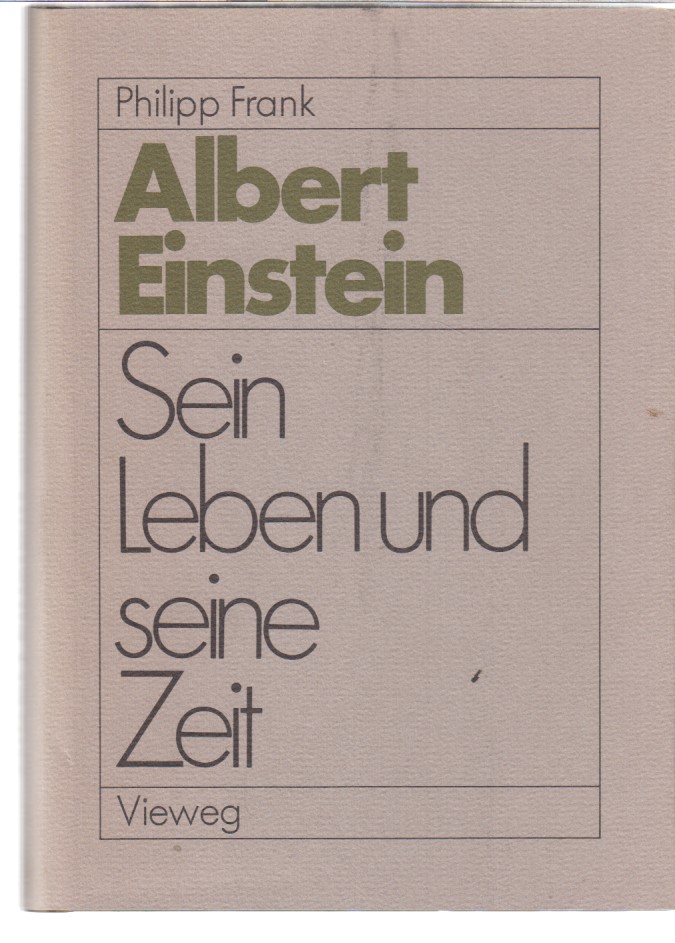
1979rif. 1199794Braunschweig, Wiesbaden : Vieweg Verlag, 1979. 467 S. : 1 Ill. ; 23 cm; fadengeh. Orig.-Pappband m. OUmschl.
1913rif. 38832Berlin, J.A. Barth, 1913. Later full cloth. ""Annalen der Physik. Vierte Folge. Band 40. Hrsg. von W. Wien und M. Planck."", VIII,1056 pp., 1 plate. Einstein paper: pp. 551-60. Internally fine and clean. The whole volume offered.
2005rif. 251199München : Langen Müller, 2005. 391 S. ; 21 cm Originalpappband mit Original-Schutzumschlag.
1913rif. 76293Leipzig ; Berlin : Teubner 1913. 1st Edition 1st Edition 38 S. ; 25cm Halbleinen [3 Warenabbildungen] 0
1910rif. 29307(Leipzig, Barth, 1910). 8vo. Extracted from ""Annalen der Physik IV, Bd. 33"" pp. 1096-1104 and pp. 1105-1115. Fine and clean. Supplied with a facsimile wrapper from the offprint to the first paper.
1915rif. 38835Braunschweig, Vieweg & Sohn, 1915. Contemp. hcalf, gilt. Spine with a few scratches and light wear to spine ends. ""Verhandlungen der Deutschen Physikalischen Gesellschaft im Jahre 1915. 17. Jahrgang. Im Auftrage der Gesellschaft herausgegeben von Karl Scheel."" VI,489 pp. textillustr. Einstein/Haas papers: pp. 152-170 a. p. 203 a. p. 420. - Planck paper: pp. 407-418 a. 418-19 a. 438-51. - Laue paper: pp. 198-202. Internally clean and fine. The whole volume offered.
1931rif. 38647Berlin, Akademie der Wissenschaften, 1931. 4to. Orig. printed green wrappers in Sitzungsberichte 1931 Heft XIII-XV pp. 257-65. Small nicks to frontwrapper.
1979rif. 46566Hermann Couverture souple Paris 1979
1985Einstein, Albert e Infeld, Leopold (Castagnoli, Carlo: Prefazione di) L'evoluzione della fisica. Sviluppo delle idee dai concetti iniziali alla relatività e ai quanti (volume doppio). Torino, Paolo Boringhieri-Editore Boringhieri società per azioni (corso Vittorio Emanuele 86) - tipografia Gravinese (Stampa) 1985 italian, in sedicesimo pp. (2)+310+(4)=316 X impressione della I ed. nella collana Universale scientifica Boringhieri: giugno 1985 (ed. originale: The Evolution of Physics. The Growth of Ideas from Early Concepts to Relativity and Quanta, Cambridge University Press 1938 - I ed. italiana: Torino, Boringhieri 1948 - I ed. Universale scientifica Boringhieri: 1965). Traduzione di Adele Graziadei. Collana Universale scientifica Boringhieri, volume doppio 1/2. XVI grande/ (2)+310+(4)=316/ brossura in cartoncino bianco goffrato effetto tela con grafica in nero e bianco e con illustrazione in b/n al primo piatto. Con figure in nero nel testo e in nero e in b/n in tavole patinate f.t.. Stato buono (usura della copertina, in particolare al dorso e ai margini- copertina e pagine brunite e con fioriture).
1984rif. 13657Corte Madera (Calif.), Pomegranate Artbooks, 1984.
1915rif. 432951915. Einstein Albert 1879-1955 and Wander Johann de Haas 1878-1960. Notiz zu unserer Arbeit "Experimenteller Nachweis der Ampèreschen Molekularströme." Offprint from Verhandlungen der Deutschen Physikalischen Gesellschaft 17 1915. 1 sheet p. 420. 228 x 156 mm. Original printed wrappers. Fine copy. First Edition Offprint Issue. In 1915 Einstein and Dutch physicist Wander Johannes de Haas conducted gyromagnetic experiments leading to the discovery of the Einstein-de Haas effect which corresponds to the mechanical rotation induced in a ferromagnetic cylinder suspended inside a coil when an impulse of electric current is sent through the coil. Einstein was very enthusiastic about the experimental results stating that he and de Haas had "given firm proof of the existence of Ampère's molecular currents" quoted in Pais Subtle is the Lord pp. 245-246. Einstein and de Haas published their results in a paper published earlier in 1915 see Weil 73; the present "Notiz" is a response to a communication from American physicist Samuel Jackson Barnett who had begun performing similar experiments in 1909 and obtained results complementing those of Einstein and de Haas. Weil Albert Einstein Bibliography 73n. . unknown books
1932rif. 433001932. Offprint from Sitzungsberichte der Preussischen Akademie der Wissenschaften 32 1932. 31pp. 256 x 183 mm. Original printed wrappers a little chipped and darkened small splits in spine. Very good. First edition offprint issue. Einstein's work on semivectors "was stimulated by Ehrenfest's insistence on a better understanding of the relation between single-valued and double-valued representations of the Lorentz group . . . Einstein and Mayer went on to relate semivectors to the Dirac equation and to generalize the formalism to general relativity" Pais Subtle is the Lord pp. 451-452. Weil Albert Einstein Bibliography 186. unknown books
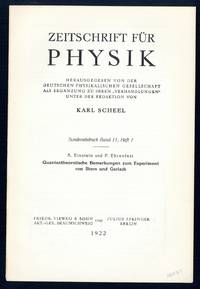
1922rif. 432871922. Einstein Albert 1879-1955 and Paul Ehrenfest 1880-1933. Quantentheoretische Bemerkungen zum Experiment von Stern und Gerlach. Offprint from Zeitschrift für Physik 11 1922. 31-34pp. 229 x 155 mm. Original printed self-wrappers. Light toning but fine otherwise. First Edition Offprint Issue. In 1922 the physicists Otto Stern and Walther Gerlach conducted a now-classic experiment in which a beam of silver atoms was streamed through an inharmonious magnetic field in order to observe the atoms' deflection patterns. Rather than a random and continuous distribution as predicted by classical theory the atoms passing through the field were deflected up or down by a specific amount demonstrating that they had intrinsically quantum properties. The Stern-Gerlach experiment corroborated the Bohr-Sommerfeld model of the atom and strongly influenced later developments in 20th century physics. However the experiment also created some serious difficulties for quantum physicists in the period before the rise of the "new" quantum mechanics. Einstein and Ehrenfest addressed one of these difficulties-connected with space quantization-in their joint paper in which "they dealt in particular with the problem of how the orbits of the atom would obtain their discrete directions which they exhibit while passing through the inhomogeneous magnetic field. Under the assumption that the mechanism causing the orientation was provided by the interaction with the radiation field Einstein and Ehrenfest estimated that for a field strength of 10000 G a change in the direction of the orbit would take place in roughly 1011 s; this long time interval would be reduced in the presence of heat radiation at room temperature . . . to about 109 s. How could they asked the experimental situation be explained which implied that the discrete orientations of the orbits in silver atoms were obtained in less than 10-4 s. In order to deal with this evident puzzle Einstein and Ehrenfest proposed two alternatives: first that the silver atoms were always in the states of spatial quantization; second the orientations of the electron orbits arose from an interaction of the atoms with the radiation field which involved much smaller reaction times . . . However they found that both alternatives created considerable difficulties in the understanding of the atomic processes . . . Thus Einstein and Ehrenfest concluded: 'The difficulties mentioned above show how unsatisfactory are both interpretations of the results found by Stern and Gerlach'" Mehra & Rechenberg The Historical Development of Quantum Theory 1 pp. 443-444. Pais Subtle is the Lord p. 328. Weil Albert Einstein Bibliography 121. . unknown books
1923rif. 432881923. Einstein Albert 1879-1955 and Paul Ehrenfest 1880-1933. Zur Quantentheorie des Strahlungsgleichgewichts. Offprint from Zeitschrift für Physik 19 1923. 301-306pp. Original printed self-wrappers. 230 x 157 mm. Light toning but very good. First Edition Offprint Issue. In 1916 after publishing his great work on general relativity Einstein returned to the question of blackbody radiation. In November 1916 he wrote to his friend Besso that "a splendid light has dawned on me about the absorption and emission of radiation" quoted in Pais p. 405 one that led him to a new derivation of Planck's radiation law and convinced him of the reality of light-quanta photons. After publishing these results in three papers culminating with the famous "Zur Quantentheorie der Strahlung" 1917 Einstein kept looking for "new ways in which the existence of photons might lead to observable derivations from the classical picture" Pais p. 413. He found none until 1923 when Arthur Compton and Peter Debye independently derived the relativistic kinematics for the scattering of a photon off an electron at rest. The work of Compton and Debye led Wolfgang Pauli to extend Einstein's work of 1917 to the case of radiation in equilibrium with free electrons see Pais p. 414n. "Pauli examined the requirements of detailed balance under Lorentz transformations and found that scattering of light by free electrons must include a term of a form which we would now call stimulated emission . . . Einstein and Ehrenfest then showed that Pauli's results could be obtained by an extension of Einstein's 1917 paper with the unnecessary specialization to discrete energy levels removed . . . The core of Einstein's argument is that the scattering process should be broken into two parts: the absorption of energy from radiation of frequency 1 and the emission of energy as radiation of frequency 2" Lewis p. 42. Lewis "Einstein's derivation of Planck's radiation law" American Journal of Physics 41 1973: 38-44. Pais Subtle is the Lord ch. 21. Weil Albert Einstein Bibliography 138. . unknown books
1913rif. 50339Leipzig: Johann Ambrosius Barth 1913. Einstein Albert 1879-1955. Einige argumente fur die annahme einer molekularen agitaation beim absoluten nullpunkt. In Annalen der Physik 40 pp.551-560. With: Otto Stern 1888-1969. Red cloth with gilt lettering on the spine. Whole volume: 1056 pp. 1 plate. 210 x 130 mm. A very good copy. "Some arguments for the assumption of molecular agitation at absolute zero." In this paper Einstein and Stern show that the quantum theory of solids to give the best agreement with experiments at normal temperatures seems to demand that at absolute zero a residual energy would remain in the solids which they term "zero-point energy." They thus introduced this important concept to physics." p. 292. Calaprice Kennefick & Shulmann. An Einstein Encyclopedia. 2015. Otto Stern was a German-American physicist and Nobel Laureate in Physics. He was the second most nominated person for a Nobel Prize with 82 nominations in the years 1925-1945 ultimately winning in 1943 "for his contribution to the development of the molecular rat method and his discovery of the magnetic moment of the proton". In 1912 Stern did his doctoral dissertation in concentrated solutions. After receiving his Ph.D. degree Stern took advantage of his economic independence to join Albert Einstein at Prague. Stern was with Einstein from the spring of 1912 until 1914. Weil's Bibliography no. 53. . Johann Ambrosius Barth unknown books
1913rif. 43305Leipzig & Berlin: Teubner 1913. 38pp. 254 x 170 mm. Original printed wrappers chipped. Library stamps. Very good. First separate edition. "After his first discussions with Grossmann Einstein had found the correct starting point for general relativity. The real work could now begin . . . The Einstein-Grossmann paper published in 1913 contains profound physical insight into the nature of measurement some correct general relativistic equations some faulty reasoning and clumsy notation" Pais Subtle is the Lord p. 216. Weil Albert Einstein Bibliography 58. Teubner unknown books