2.965 resultados
1920ref. 37403Berlin: Springer 1920. Springer unknown books
1920ref. 43308Berlin: Springer 1920. 15pp. 221 x 146 mm. Original printed wrappers foxed. Minor internal foxing but very good. First edition cover title does not include the date Einstein delivered his lecture; see Weil. "By royal decree of June 24 1920 a special chair in Leiden University was created for Einstein enabling him to come to that university for short periods of his choosing. On October 27 1920 Einstein began his new position with an inaugural address on aether and relativity theory" Pais Subtle is the Lord p. 313. Weil Albert Einstein Bibliography 111. Springer unknown books
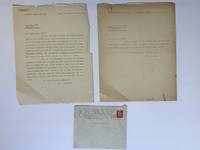
1931ref. 1403337Potsdam Germany 1931. Two letters by Albert Einstein. The first is a single-paged autograph letter signed by Albert Einstein with one horizontal fold and one vertical fold. In Very Good condition . Measuring 22.5 x 28.5 cm. Letter accompanied with mailing envelope both with matching paper-clip rust stain. Letter with some light wear along edges small staining to lower corner. Addressed to G. W. Meyer and dated 8 Oktober 31 in Potsdam the Letter reads in full: "Sehr geehrter Herr! Indem ich Ihnen für die Uebersendung des Buches von Henry George bestens danke sende ich Ihnen anliegend die gewünschte Meinungsäusserung mit der Bitte um Weiterleitung an Mrs. Evans. Mit ausgezeichneter Hochachtung" and signed in ink "A. Einstein". He thanks Meyer for serving as an intermediary in getting a book to him and for forwarding the enclosed letter. The second letter is a typed copy of Einstein's previously enclosed letter presumably made by Meyer before he passed the original on to Evans. Addressed to R. W. Evans and dated 8.10.1931 in Potsdam the letter discusses Henry George's economic theory of poverty and land nationalization compares it to Franz Oppenheimer's work and proposes questions to be asked. Presumably he was sent a copy of Henry George's Progress and Poverty. First published in 1879 it sparked the Progressive Era discussing the paradox of increasing inequality and poverty amid economic and technological progress as well as the economic value of land. Consignment. Shelved Case 3. The Letter reads in full: "Sehr geehrte Mrs. Evans! Ich habe das Buch von Henry George zum grössten Teil mit ausserordentlichem Interesse gelesen und glaube dass es in der Hauptsache einen unanfechtbaren Standpunkt vertritt insbesondere was die Ursache der Armut betrifft. Nie in diesem Buch vertretenen Ansichten stimmen soweit ich es beurteilen kann vollkommen mit den Resultaten des zeitgenössischen Professors Franz Oppenheimer überein der sie offenbar selbständig herausgefunden hat. Nicht einverstanden bin ich mit der Theorie des Zinses. Mit dem vorgeschlagenen Heilmittel der Verstaatlichung des Bodens und der Bodenschätzung scheint mir allerdings mehr ein Problem als eine Lösung gegeben zu sein. Soll z. Beispiel ein Boden Eigentum der Gemeinschaft das darauf hingestellte Haus aber Privateigentum sein Jedenfalls ist es schon von höchster Wichtigkeit dass das Wesen des Uebels klar aufgezeigt ist. Schon darum wäre es wichtig wenn das Buch die ihm gebührende Beachtung fände. Mit ausgezeichneter Hochachtung gez. A. Einstein." 1403337. Shelved Dupont Bookstore. unknown books
1979ref. 300955Princeton Princeton University Press 1979. 1979. First edition. Selected and edited by Helen Dukas and Banesh Hoffman. Frontispiece b/w portrait. Original German texts; chronology. Dust jacket price clipped. Very good. 167 pages. No signatures or bookplates. 1st Edition. Hardcover. Very Good/Very Good. Princeton, Princeton University Press [1979]. hardcover books
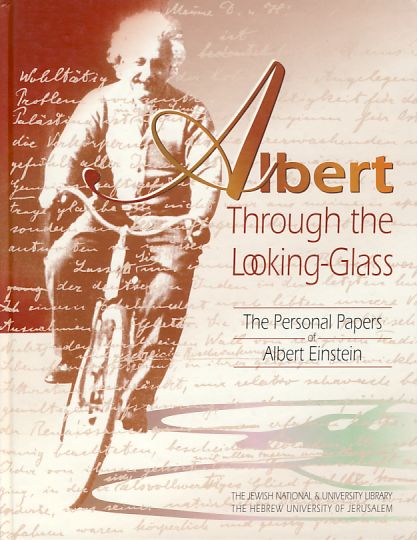
1998ref. 917101Hebrew University of Jerusalem, 1998. 156 S. mit zahlr. Abb., gebundene Ausgabe.
1927ref. 374151927. Offprint from S. preuss. Akad. Wiss. Weil 155. unknown books
1927ref. 433031927. Offprint from Sitzungsberichte der preussischen Akademie der Wissenschaften 1927. 235-245pp. 255 x 183 mm. Original printed wrappers. Fine. On the problem of motion in general relativity theory; a follow-up to his and Grommer's paper of the same title published earlier in 1927. Weil Albert Einstein Bibliography 160. unknown books
1921ref. 302276Leipzig Felix Meiner 1921. 1921. First edition. 8vo. Foreword by Raymund Schmidt. Articles by Oskar Kraus Friedrich Lepsius Paul F. Lincke Joseph Petzoldt. Text pages numbered 334-500. Original stiff green wrappers printed in black. Very good. Cover title: Zur Relativitatstheorie. Kraus' article entitled: "Fiktion und Hypothese in der Einsteinschen Relativitatstheorie.". 1st Edition. Soft cover. Very Good/No Jacket. Leipzig, Felix Meiner, 1921. paperback books
1930ref. 433061930. Offprint from Mathematische Annalen 102 1930. 685-697pp. Original printed self-wrappers. 233 x 157 mm. Very good apart from small split in lower spine. Weil Albert Einstein Bibliography 171. unknown books
1984ref. 16377CBFrankfurt/M/Berlin/Wien, Ullstein Verlag (= Ullstein-Materialien Taschenbuch Band 35196), 1984. 8°, 272 S., original Kartonage (Paperback), an den Einbandkanten zum Teil minimal berieben, sonst schönes, sauberes Exemplar
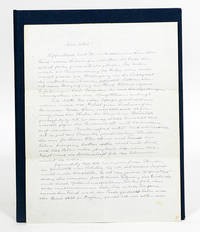
1937ref. 1984Princeton: np 1937. First Edition. Very Good. AN EXTRAORDINARY LETTER BY EINSTEIN TO HIS SON OFFERING LIFE ADVICE AND DISCUSSING FREUD SHAKESPEARE AND SCHILLER. Addressed to his son Eduard "Tetel" Einstein and signed "Papa" the letter written in ink on both sides of one sheet reads in full translated from the original German: Dear Tetel I hope by now you've received Freud's lectures from Vienna. I've read most of them myself in the past. They really made me admire the Author but they didn't convince me that his theories were correct. I must admit however that based on my personal experiences my conviction about those theories is weakening -- I feel now that he was onto something at least in regards to the main theses. I would have written to you sooner but work is keeping me very busy. Even though they say that the work of a single person will not have much of an impact in the big picture it does not diminish the passion in which we pursue our interests and that is a good thing. Although personal illusions may bring warmth and joy into one's life when young they don't last a lifetime. Life would be bleak if the work and the passion for discovery did not exist. In my free time I am currently reading Schiller's poems which I have neglected since my youth. They feel a bit pompous but at the same time they are enthralling in their choice of words and grammar. I am really happy that I picked them up again. I would have liked to send you another book on the top of the Freud but didn't know which one to send -- especially because I don't get a lot of German writings anymore. When I have some extra free time after finishing Schiller I really want to start reading Shakespeare everything from him I can get my hands on. If you like to read it too perhaps we could discuss it at some later time Albert is a real delight -- he has been traveling up and down the country for the past 6 weeks and will have seen and experienced many interesting things. I really hope he has followed my advice and kept a journal but I am not holding high hopes. When it comes to talking and writing he seems to be chronically constipated. With my warmest regards Papa Einstein's life advice underscoring one of his core beliefs: Einstein often stated that his main goal in life was the quest for truth no matter how difficult and painstaking the quest. He advises Eduard in this letter that it is the pursuit and the work in attaining the goal that brings satisfaction and sustains one throughout life even if "the work of a single person will not have much of an impact in the big picture". This he notes is critical to understand after the illusions of youth have succumbed to reality. Einstein Eduard and Freud: Eduard Einstein nicknamed "Tete" or "Tetel" born in 1910 was the second son of Albert and his first wife Mileva. From an early age he became enamored with the teachings of Freud even hanging a picture of famous psychiatrist on his bedroom wall. By the age of twenty he was diagnosed with schizophrenia and consequently was institutionalized several times throughout his life. Einstein's views of Freud's teachings were somewhat more nuanced than those of his son. Initially Einstein did not show much interest in Freud's theories and after their first meeting in 1927 Freud famously remarked "He understands as much about psychology as I do about physics." Over the years however Einstein began studying Freud's works. After corresponding with Freud somewhat regularly throughout the 1930s and even collaborating with him on a project sponsored by the League of Nations "Why War" 1932 Einstein began to move from a deep skepticism to - as indicated in this letter - a growing acceptance. By 1936 - just before this letter was written - Einstein sent birthday greetings to Freud acknowledging: "Until recently I could only apprehend the speculative power of your train of thought together with its enormous influence on the Weltanschauung of the present era without being in a position to form a definite opinion about the amount of truth it contains. Not long ago however I had the opportunity of hearing about a few instances not very important in themselves which in my judgment exclude any other interpretation than that provided by the theory of repression. I was delighted to come across them since it is always delightful when a great and beautiful conception proves to be consonant with reality." In this letter to Eduard Einstein admits to Eduard that he now believes Freud "was onto something at least in regards to the main theses." Einstein Shakespeare Schiller: Einstein's fondness for music is well-known but not as much has been recorded about his literary tastes. It is not surprising and has been previously documented that Einstein had a fondness for the great German poet Schiller but we can find no other references to Shakespeare by Einstein in any other letters or manuscripts. His words to Eduard "I really want to start reading Shakespeare everything from him I can get my hands on" imply that Einstein has recently "discovered" Shakespeare and is excited at the discovery. Note: Although the letter is not dated we can assume that it was written late November - December in 1937 when Einstein's son Albert was visiting the United States a trip he refers to in the letter. Princeton: November - December 1937. One 8.5x11 inch leaf written on both sides. In German. Usual folds otherwise fine. A LONG REMARKABLE AND REVEALING LETTER UNITING THE INTELLECTUAL GIANTS EINSTEIN FREUD AND SHAKESPEARE AND SHARING ONE OF HIS CORE BELIEFS WITH HIS SON. np unknown books
1943ref. 2376Princeton NJ: np 1943. First edition. nb. Fine. EINSTEIN OFFERS STRONG AND PRESCIENT WORDS OF ENCOURAGEMENT TO THE LEADER OF THE NAACP IN THE FIGHT AGAINST RACIAL SEGREGATION AND DISCRIMINATION IN THE UNITED STATES. Background: Einstein's fight against racial discrimination in the United States: The imperative "to protect the rights of the individual. was Einstein's most fundamental political tenet. Individualism and freedom were necessary for creative art and science to flourish. Personally politically and professionally he was repulsed by any restraints. "That is why he remained outspoken about racial discrimination in America. As a Jew who had grown up in Germany Einstein was acutely sensitive to such discrimination. 'The more I feel an American the more this situation pains me' he wrote in an essay called 'The Negro Question' for the January 1946 issue of Pageant magazine. 'I can escape the feeling of complicity in it only by speaking out.'" Isaacson Albert Einstein 505. Even more directly in his 1946 commencement speech to Lincoln University the first degree-granting Historically Black College and University HBCU in the United States Einstein strongly denounced segregation as "an American tradition which is uncritically handed down from one generation to the next" noting that "There is separation of colored people from white people in the United States. That separation is not a disease of colored people. It is a disease of white people. I do not intend to be quiet about it." This remarkable letter - from 1943 - is one of the earliest examples of his interest in condemning racism in the United States. The letter: Dated 22 September 1943 and handwritten on his embossed Mercer Street Princeton letterhead Einstein writes in English to Walter F. White the enormously influential African-American civil rights leader who led the NAACP from 1929-1955 praising him for his work and revealing his own awareness of and frustrations with racism and prejudice in America. The text reads in full: Dear Mr. White: I have been quite impressed by the address you delivered some years ago at a meeting of the Princeton Branch of the National Association for the Advancement of Colored People. I know how hard it is to awaken the conscience even of good-hearted and well-meaning people when deep rooted prejudices are in the way. It is a great work indeed which you are doing relentlessly for the betterment of the living conditions of our Colored fellow-citizens for justice and for the accomplishment of national unity of the American people. With sincere respect and kind wishes Yours Albert Einstein ------------- On April 28 1940 White was the keynote speaker at "an inter-racial meeting sponsored by the Princeton branch of the National Association for the Advancement of Colored People" where his topic was "What Happens to Democracy When It Encounters the Color Line." Princeton Herald April 26 1940. At the time Princeton did not admit African Americans and the community was debating the question of whether or not to end segregation at the university. Princeton in fact did not admit its first African-American student until the fall of 1947. Einstein - writing in 1943 - notes that he heard White speak "some years ago". Something clearly must have deeply impressed Einstein about White's speech for him to write this thoughtful letter to White over three years after the event. Note: In addition to its content this apparently unpublished letter is also remarkable for being one of the very few letters Einstein hand-wrote in English during this period as German was still very much his preferred tongue. Princeton: September 22 1943. One page on Einstein's embossed Mercer Street Princeton letterhead 7.25x10 in visible handsomely matted and framed with a photograph of Einstein. Fine condition. np unknown books
1930ref. 2349np: np 1930. First edition. Fine. EINSTEIN ON THE CONCEPT OF PEACE: A POWERFUL AUTOGRAPH STATEMENT IN EXCEPTIONALLY LARGE FORMAT. Translated from the original German: "No person has the moral right to call himself a Christian or Jew so long as he is prepared to engage in systematic murder at the command of an authority or allow himself to be used in any way in the service of war or the preparation for it." Beginning in 1925 the World League for Peace Ligue mondiale pour la paix under the direction of its president Georges Dejean solicited statements on peace from prominent scientists writers artists political leaders and other public figures throughout the world sending them large 11.5x16.5 inch sheets for their submissions. The resulting collection of more than 1000 original manuscripts was assembled between 1925 and 1932. A selection was reproduced in facsimile in the limited-edition volume Pax Mundi: Livre d'or de la paix published in Geneva by Paxunis in 1932. This is Einstein's original manuscript contribution to the project. A highly unusual format with exceptionally large Einstein signature 2.25 in / 6 cm of an important Einstein statement consistent with his life-long dedication to pacifism. c.1925-1930. One large folio page 11.5 x 16.5 inches. In German. Fine condition. np unknown books
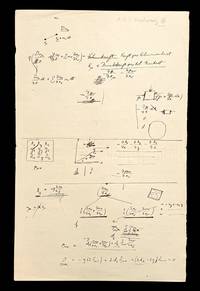
1912ref. 3056np: np 1912. first edition. custom box. Very Good. ON THE ROAD TO RELATIVITY: A four-panel working bifolium from Einstein's early post-Minkowski tensor phase. A remarkable working sheet showing Einstein making tensor formalism physically operational for continuum mechanics. Across three working zones the manuscript moves from a formal four-dimensional tensor transformation identity written in a distinct unidentified hand to Einstein's own derivations involving Volumenkraft Druckkraft stress force density diagrammatic testing and a heavily underlined mechanical equilibrium result. The folded rotated format gives the sheet the character of a compact notebook in miniature: formal tensor language brought into contact with physical terms local force relations diagrams and repeated calculation. The manuscript's all-lower-index notation explicit summations in Einstein's hand mixed coordinate idiom second-hand tensor identity and visible effort to make tensor language mechanically operational point most naturally to the 1912-1913 Zurich tensor period when Einstein was absorbing the post-Minkowski mathematics that General Relativity would require. Later revisitations cannot be entirely excluded but they explain the sheet less naturally. A rare survival documenting Einstein's working method on one of the foundational matter-side problems on the road to General Relativity. EINSTEIN ALBERT. Autograph scientific manuscript unsigned and undated most plausibly 1912-1913. A four-panel working bifolium 330 × 210 mm open from Einstein's early post-Minkowski tensor period retained among his private research papers and annotated by Helen Dukas: "A.E.'s Handwriting H.D." Provenance: Sotheby's New York 26 June 1998; Jagdish Mehra. PLEASE CLICK ON THE LINK BENEATH THE IMAGES FOR A PDF CONTAINING THE FULL DESCRIPTION. np unknown books
1911ref. 50315Leipzig: Johann Ambrosius Barth 1911. Einstein Albert 1879-1955. 1 Bemerkung zu dem Gesetz von Eötvös. In Annalen der Physik 34 1: 165-169 pp. 1910. Weil 38 Boni 35. 2 Eine beziehung zwischen dem elastischen Verhalten und der spezifischen Wärme bei festen Körpen mit einatomigem Molekül. In Annalen der Physik 34 1: 170-174 pp. 1910. Weil 39 Boni 36. 3 Bemerkungen zu den P. Hertzschen Arbeiten: "Über die mechanischen Grundlagen der Thermodynamik." In Annalen der Physik 34 1: 175-176 pp. 1910. Weil 40 Boni 37. 4 Bemerkung zu meiner Arbeit: "Eine Beziehung zwischen dem elastischen Verhalten . . ." In Annalen der Physik 34 3: p. 590. Weil 40. 5 Berichtigung zu meiner Arbeit: "Eine neue Bestimmung der Moleküldimensionen." In Annalen der Physik 34 3: p. 591. Weil 41. Leipzig: Johann Ambrosius Barth 1911. Whole volume: viii 1032 pp. 6 plates 5 folding 1 b/w/ silver photograph. Figs. Text-illust. 210 x 140 mm. Red cloth with gilt lettering on spine. First Edition. Pages are a little toned as are plates 5 and 6 otherwise Very Good. Approximate English translations of titles: 1 "Remarks on the law of Eötvös." 2 "A connection between the elastic conduct and the specific heat of solid bodies with monatomic molecule." 3 "Remarks on P. Hertz' work: 'On the mechanical foundations of thermodynamics.'" Eövtös' findings served as part of the basis of Albert Einstein's General Theory of Relativity in which the principle of equivalence acts as the keystone no. 1 above. "Einstein adds a comment on p.590 of the same journal no. 2 above. To supplement Sutherland's observation that infared eigenfrequencies of solid bodies possibly originate in the elastic vibrations of these bodies Einstein adds that electrically charged ions are the source of optical vibrations while the mututal motions of the entire molecule cause elastic vibrations." Calaprice Alice et al. An Einstein Encyclopedia. 2015. p. 291. Weil's Einstein Bibliography nos. 38 39 40 and 41. Boni's Einstein Checklist nos. 35 36 and 37. . Johann Ambrosius Barth unknown books
1923ref. 433171923. Offprint from Sitzungsberichte der preussischen Akademie der Wissenschaften 1923. Single sheet pp. 76-77. 265 x 184 mm. A few marginal chips and tiny tears but very good. First edition offprint issue. The second of the four short papers Einstein published in 1923 on Eddington's program for a unified field theory. Weil Albert Einstein Bibliography 131n. unknown books
1907ref. 432971907. Einstein Albert 1879-1955. Berichtigung zu meiner Arbeit: "Die Plancksche Theorie der Strahlung etc." Offprint from Annalen der Physik 22 1907. Single sheet p. 800. Unbound as issued. 223 x 145 mm. Lower corner lightly creased but very good. First Edition Rare Offprint Issue. Einstein's important correction to his paper on specific heats "Die Plancksche Theorie der Strahlung und die Theorie der spezifischen Wärme" 1907; see Weil 15 which "made clear for the first time that quantum concepts have a far more general applicability" Pais p. 394. "Einstein initially believed that his oscillating lattice points in a three-dimensional crystal lattice were electrically charged ions. A few months later he published a correction to his paper in which he observed that this was an unnecessary assumption . . . Einstein's correction freed the quantum rules in passing one might say from any specific dependence on electromagnetism" Pais p. 396. Pais Subtle is the Lord pp. 394-396. Weil 15n. . unknown books
1911ref. 432921911. Einstein Albert 1879-1955. Berichtigung zu meiner Arbeit: "Eine neue Bestimmung der Moleküldimensionen." Offprint from Annalen der Physik 34 1911. 591-592pp. 224 x 146 mm. Original printed wrappers a little chipped splint in lower spine. Light toning but very good. First Edition Offprint Issue. Einstein's correction to his formula for the viscosity coefficient = 1 a key equation in his 1905 doctoral thesis in which he had presented a new theoretical method for determining molecular radii and Avogadro's number. In 1910 Jacques Bacelin a pupil of French physicist Jean-Baptiste Perrin obtained experimental results indicating a possible error in Einstein's formula. "That prompted Einstein after an unsuccessful attempt to find an error to ask his student and collaborator Ludwig Hopf to check his calculations and arguments . . . Hopf did find an error in the dissertation namely in the derivatives of some velocity components and obtained for a corrected coefficient 2.5 . . .In early 1911 Einstein submitted his correction for publication and recalculated Avogadro's number. He obtained a value of 6.56 x 10²³ per mole a value that is close to those derived from kinetic theory and Planck's black-body radiation theory" Duplantier pp. 216-217. Duplantier "Brownian motion 'diverse and undulating'" in Einstein 1905-2005: Poincaré Seminar 2005 pp. 201-293. Pais Subtle is the Lord p. 92. Weil Albert Einstein Bibliography 41. . unknown books
1923ref. 374081923. Offprint from S. preuss. Akad. Wiss. Weil 137. unknown books
1923ref. 433151923. Offprint from Sitzungsberichte der preussischen Akademie der Wissenschaften 1923. 359-364pp. 254 x 184 mm. Original printed wrappers. Very good. First Edition offprint issue. Weil Albert Einstein Bibliography 137. unknown books
1979ref. Ein0029Paris, Collection Savoir Hermann, 1979. - kartoniert, 327 S. - deutliche Lesespuren, etwas eselsohrig, Rücken knickspurig, Besitzervermerk auf Titel - 8° Buch kartoniert
1931ref. 021909New York: Covici Friede 1931. First Edition. hardcover. Some pencil markings in text title page and endpapers darkened not really affecting Einstein's inscription; covers a little soiled. Good to Very Good and quite scarce. With a long biographical note and an appreciation by George Bernard Shaw. Subjects include Disarmament Pacifism the Jewish Homeland and more. This copy INSCRIBED and SIGNED by the author with his scarcer full signature on the front endpaper: "To little Pauline/Albert Einstein/1933." An uncommon title to find signed by the man of the century. With a letter of authenticity from James Spence if you need that kind of security blanket. Covici Friede hardcover books
1941ref. 433111941. Offprint from Universidad Nacional de Tucuman Revista Serie A 2 1941. 11-15pp. 270 x 179 mm. Original printed wrappers. Very good. "Address to joint meeting of the American Physics Society and the American Association of Physics Teachers Princeton Dec. 29 1941 under the title: 'Solutions of finite mass of the gravitational equations'" Weil. Weil Albert Einstein Bibliography 208. unknown books
1914ref. 2124Berlin: Königlichen Akademie der Wissenschaften 1914. FIRST EDITION OFFPRINT. Original wrappers. Fine. FIRST EDITION COMMERCIAL OFFPRINT ISSUE of Einstein's important 1914 paper on the development of general relativity. "In summer 1914 Einstein felt that the new theory general relativity should be presented in a comprehensive review. He also felt that a mathematical derivation of the field equations that would determine them uniquely was still missing. "Both tasks are addressed in a long paper presented in October 1914 to the Prussian Academy for publication in its Sitzungsberichte. It is entitled 'The formal foundation of the general theory of relativity'; here for the first time Einstein gave the new theory of relativity the epithet 'general' in lieu of the more cautious 'generalized' that he had used for the Entwurf" Landmark Writings in Western Mathematics 1640-1940. "According to John Norton 'How Einstein Found His Field Equations' this major review article was intended to convey the full content of the 1913 'Entwurf' theory: 'The principal novelty lies in the mathematical formulation of the theory. Drawing on earlier work with Marcel Grossman Einstein formulated his gravitational field equations using a variation principle. Using this richer mathematical structure Einstein offered a proof purporting to demonstrate that his theory had the maximum covariance compatible with the hole argument; that is covariance under 'justified' transformation between the 'adapted coordinate systems' he had introduced with Grossman'" Calaprice The Einstein Almanac. Offprint from: Sitzungsberichte der Königlich Preussischen Akademie der Wissenschaften XLI 19 November 1914 pp. 1030-1085. Berlin: Königlichen Akademie der Wissenschaften 1914. Octavo original wrappers; custom box. Neat early ownership name on front wrapper. Only the slightest wear; a fine copy. Rare. Königlichen Akademie der Wissenschaften unknown books
1916ref. 19266Leipzig: J.A Barth 1916. FIRST SEPARATE EDITION. Original printed wrappers on rippled paper; wrappers and interior soiled and spotted mostly likely with minor water damage. From the library of Einstein protege Dr. Kurt Eisenmann with his siganture and stamps. First separate printing of Einstein’s classic paper. Not an offprint from the Annalen der Physik as is often thought but a completely new setting of type with significant and important additions and revisions including an introduction published here for the first time which was not in the journal issue. Printing & the Mind of Man 408; Weil 80a. J.A Barth unknown books