1 308 résultats
1918réf. 005931Leipzig: Johann Ambrosius Barth 1918. Contemporary half cloth boards. Joints repaired slightly worn; book plate; ink stamp on front flyleaf and title. First Edition. About Very Good. Johann Ambrosius Barth hardcover
réf. H1017Leipzig J. A. Barth 1906 S. 371-381. Halbleinenband der Zeit mit goldgeprägtem Rückentitel gr. 8°. Vorderdeckel etwas berieben.2 St. a. Titel. Text sauber und frisch. bedeutender Botaniker und Nachfolger Dryanders als Bibliothekar Joseph Banks' ist noch heute durch seine Entdeckung der sog. Brownschen Bewegung auch Brownschen Molekularbewegung Brownian Movement im Jahr 1827 bekannt. Bei Beobachtungen mit dem Mikroskop fiel ihm die unregelmäßige Zitterbewegung von auf der Wasserfläche dahintreibenden Blütenstaubpartikeln auf. Brown konnte keine Erklärung dafür finden. Es war Albert Einstein der 1905 herausfand dass sie durch Zusammenstöße mit unter dem Mikroskop nicht sichtbaren Atomen und Molekülen herrührt. Einstein veröffentlichte seine Beobachtung in den Abhandlungen "Über die von der molekularkinetischen Theorie der Wärme geforderte Bewegung von in ruhenden Flüssigkeiten suspendierten Teilchen" Annalen der Physik 4. Folge Bd. 17 1905 und – hier vorliegend - "Zur Theorie der Brownschen Bewegung" dass. Bd. 19 1906. Die erfolgreiche Erklärung der brownschen Bewegung gilt als Meilenstein auf dem Weg zum wissenschaftlichen Nachweis der Existenz der Moleküle und damit der Atome. Robert Brown 1773-1858 zählte zu den bedeutendsten Botanikern der ersten Hälfte des 19. Jahrhunderts. Nach dem Studium der Medizin und Botanik in Edinburgh wurde er zunächst als Militärarzt im Norden Irlands tätig. 1798 machte er die Bekanntschaft von Joseph Banks – ein Treffen das entscheidend für sein ganzes weiteres Leben sein sollte. Banks bot ihm eine Stelle als Naturwissenschaftler auf Flinders Expedition zur Erforschung der australischen Küsten an. Brown nahm an und arbeitete in der Folge eng mit dem Pflanzenmaler Ferdinand Bauer zusammen. Als Flinders aufgrund des untragbaren Zustandes des Expeditionsschiffs "Investigator" gezwungen war die Reise vorzeitig abzubrechen blieben Brown und Bauer in Port Jackson zurück um ihre Forschungen bis zur Rückkehr Flinders' fortzuführen. Brown ging in der Folge nach Van Diemens-Land Tasmanien Bauer auf die Norfolk-Insel. 1805 traf man sich in Sydney wieder und trat die Heimreise an. Kurz nach seiner Rückkehr wurde Brown zum Bibliothekar der Linnéan Society. 1810 nach dem Tod Dryanders übernahm er dessen Stelle in der Bibliothek Banks'. Letzterer gab Brown testamentarisch das Recht auf lebenslange Nutzung seiner Sammlungen und seiner Bibliothek. Als man diese 1827 ins British Museum verlegte wurde Brown zum Bibliothekar und Kurator der dortigen botanischen Abteilung. Nach Banks' Tod gab Brown seine Stellung als Bibliothekar der Linnéan Society auf und fungierte von 1849 bis 1853 als deren Präsident. Bereits 1839 hatte man ihm für seine Forschungen über den pflanzlichen Befruchtungsprozess die Copley-Medaille verliehen. unknown
réf. H4002Berlin Akademie der Wissenschaften 1932 In: Sitzungsberichte der Königl.Preuss. Akademie der Wissenschaften Band 1932. 4to. S.130-137 und 522-550. Weiters: Hahn Otto: Radioaktivität und ihre Bedeutung für Fragen der Geochemie. S.2-17. Schrödinger Erwin: Diracsches Elektron im Schwerefeld I. S.105-129. Weiteres von Planck Halbleinenband der Zeit leicht berieben Bibl.-Nr.am Rücken Original-Broschur miteingebunden unaufgeschnitten gutes Exemplar. unknown
réf. H3997Berlin Akademie der Wissenschaften 1924-1925 In: Sitzungsberichte der Königl.Preuss. Akademie der Wissenschaften 2 Bände 1924 und 1925. 4to. S.261-267; S.3-25; S.414-419. Anbei u.a.: Schrödinger E.: Über die statistische Entropiedefinition beim idealen Gas. S.434-441; Planck Max: Zur Frage der Quantelung einatomiger Gase. S.49-56. Halbleinenband der Zeit leicht berieben Bibl.-Nr.am Rücken Original-Broschur miteingebunden unaufgeschnitten gutes Exemplar. unknown
réf. H3991Berlin Akademie der Wissenschaften 1919 In: Sitzungsberichte der Königl.Preuss. Akademie der Wissenschaften Band 1919/1. 4to. S.349-356; S.433.438. Halbleinenband der Zeit leicht berieben Bibl.-Nr.am Rücken Original-Broschur miteingebunden unaufgeschnitten gutes Exemplar. unknown
réf. H3999Berlin Akademie der Wissenschaften 1931 In: Sitzungsberichte der Königl.Preuss. Akademie der Wissenschaften Band 1931. 4to. S.235-237 258-265 und A. 541-561. Weiters: Schrödinger Erwin: Zur Quantendynamik des Elektrons. S.63-72: Planck Max: Über die Grenzschicht verdünnter Elektrolyte Zweite Mitteilung. S.113-122; Schrödinger Erwin: Über die Umkehrung der Naturgesetze. S.144-153. Halbleinenband der Zeit leicht berieben Bibl.-Nr.am Rücken Original-Broschur miteingebunden unaufgeschnitten gutes Exemplar. unknown
réf. H3996Berlin Akademie der Wissenschaften 1923 In: Sitzungsberichte der Königl.Preuss. Akademie der Wissenschaften Band 1923/2. 4to. S.32-38; S. 76-77; S.137-140; S. 359-364. Halbleinenband der Zeit leicht berieben Bibl.-Nr.am Rücken Original-Broschur miteingebunden unaufgeschnitten gutes Exemplar. unknown
réf. H4001Berlin Akademie der Wissenschaften 1929 In: Sitzungsberichte der Königl.Preuss. Akademie der Wissenschaften Band 1929. 4to. S.2-7; 156-162 Anbei: Schrödinger Erwin: Verwaschene Eigenwertspektra. S.668-684. Hahn Otto: Die radioaktiven Substanzen im dienste chemischer und physikalisch-chemischer Forschung. S.535-542. Halbleinenband der Zeit leicht berieben Bibl.-Nr.am Rücken Original-Broschur miteingebunden unaufgeschnitten gutes Exemplar. unknown
réf. H3995Berlin Akademie der Wissenschaften 1922 In: Sitzungsberichte der Königl.Preuss. Akademie der Wissenschaften Band 1922/2. 4to. S.18-22; S.448-449. Weitere Berichte von: Laue v. und Gordon W.: Ein Verfahren zur Bestimmung der Wärmeleitfähigkeit bei Glühtemperaturen. S.118-126. Laue von: Die Bedeutung des Nullkegels in der allgemeinen Relativitätstheorie. S.127-136 Planck Max: Über die freie Energie von Gasmolekülen mit beliebiger Geschwindigkeitsverteilung. S.63-71 u.a. Halbleinenband der Zeit leicht berieben Bibl.-Nr.am Rücken Original-Broschur miteingebunden unaufgeschnitten gutes Exemplar. unknown
réf. H4000Berlin Akademie der Wissenschaften 1930 In: Sitzungsberichte der Königl.Preuss. Akademie der Wissenschaften Band 1930. 4to. S.418-428; S:296-303. Weiters 3 Berichte von Einstein Albert: 1 Die Kompatabilität der Feldgleichungen in der einheitlichen Feldtheorie S.18-23; 2 mit W. Mayer: Zwei Strenge Statische Lösungen der Feldgleichungen der Einheitlichen Feldtheorie. S. 110-120; 3 Zur Theorie der Räume mit Riemann-Metrik und Fernparallelismus. S. 401-402. Halbleinenband der Zeit leicht berieben Bibl.-Nr.am Rücken Original-Broschur miteingebunden unaufgeschnitten gutes Exemplar. unknown
réf. H3990Berlin Akademie der Wissenschaften 1918 In: Sitzungsberichte der Königl.Preuss. Akademie der Wissenschaften Band 1918/1. 4to. S.154-167; S.270-272 S.448-461. Weitere Berichte von: Born M.; u.a. Halbleinenband der Zeit leicht berieben Bibl.-Nr.am Rücken Original-Broschur miteingebunden unaufgeschnitten gutes Exemplar. unknown
2009réf. __4896422848Tōkyō : Michitani 2009. 2009. Tankobon Hardcover. New. Japanese language. 7.72x5.28x1.50 inches. Tōkyō : Michitani, 2009. hardcover
1938réf. 69317-A-65099Amsterdam: D.B. Centen 1938. Linnen gebonden. Met prospectus van het boek gevouwen a-4. 319 pp. ills. -Schutbladen verkleurd wat roestvlekken op de snee onderstrepingen in potlood verder in goede staat. D.B. Centen unknown
1968réf. 57192New Haven CT: Yale University Press 1968. good fair. 269 illus. biographical directory bibliography of Lewis Einstein's published writings index front DJ flap price clipped. Raised stamp on half title DJ worn and discolored small edge tears and chips to DJ edges discoloration inside front and rear boards and flyleaves. Foreword by George F. Kennan. Lewis Einstein 1877-1967 entered the diplomatic service in 1903; serving for 25 years he was possibly the first American of the 20th century to perceive the meaning of the emerging role of the United States in the world balance of power. There are references to Presidents Theodore Roosevelt and William Howard Taft in the index. Yale University Press hardcover
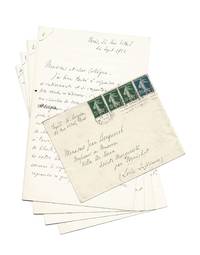
1922réf. Bergson2EINSTEIN BERGSON Henri 1859-1941 Autograph letter signed " Henri Bergson " to Jean Becquerel Paris 24 September 1922 16 pages in-8° with envelope Some typographic pencil notes A highly significant letter on the issues and interpretation of the theory of relativity This intervention of the philosopher continues up to this day to create multiple controversies We transcribe here only a few fragments of this letter which although known in its substance has remained unpublished to this day " Monsieur et cher collègue J'ai bien tardé à répondre à la lettre si intéressante et si importante que vous avez bien voulu m'adresser. C'est qu'elle est allée me chercher de divers côtés et m'a atteint en Suisse à un moment où j'étais pris à Genève par le travail de " Coopération intellectuelle " qui nous avait été confié par la Société des nations. Me voici de retour à Paris ; je profite de mes premiers instants de liberté pour vous écrire. Le passage essentiel de votre lettre est naturellement celui qui concerne le voyage en boulet. Laissez-moi reprendre ce que j'ai dit dans mon livre Durée et simultanéité paru à l'été 1922 en y joignant quelques explications complémentaires. Il y a d'abord deux remarques importantes à faire. 1° Si l'on se place en dehors de la Théorie de la Relativité on conçoit un mouvement absolu et par là même une immobilité absolue ; il y aura dans l'univers des systèmes réellement immobiles. Mais si l'on pose que tout mouvement est relatif que devient l'immobilité Ce sera l'état du système de référence je veux dire du système où le physicien se suppose placé à l'intérieur duquel il se voit prenant des mesures et auquel il rapporte tous les points de l'univers. … 2° Si l'on se place en dehors de la Théorie de la Relativité on conçoit très bien un personnage Pierre absolument immobile au point A à côté d'un canon absolument immobile ; on conçoit aussi un personnage Paul intérieur à un boulet qui est lancé loin de Pierre se mouvant en ligne droite d'un mouvement uniforme absolu vers le point B et revenant ensuite en ligne droite et d'un mouvement uniforme absolu encore au point A. Mais du point de vue de la Théorie de la Relativité il n'y a plus de mouvement absolu ni d'immobilité absolue … Paul une fois lancé dans l'espace n'est plus qu'une représentation de l'esprit une image — ce que j'ai appelé un " fantôme " ou encore une " marionnette vide ". C'est ce Paul en route ni vivant ni conscient n'existant plus que comme image qui est dans un Temps plus lent que celui de Pierre. … Le Paul qui sort du boulet au retour du voyage le Paul qui fait de nouveau partie alors du système de Pierre est quelque chose comme un personnage qui sortirait en chair et en os de la toile où il était représenté en peinture : c'était à la peinture et non pas au personnage c'était à Paul référé et non pas à Paul référant que s'appliquaient les raisonnements et les calculs de Pierre pendant que Paul était en voyage. … Je ne voudrais pas clore sans saisir l'occasion qui s'offre à moi de vous dire combien m'a intéressé et instruit votre beau livre sur " Le principe de relativité " et la " Théorie de la gravitation " – livre indispensable à tous ceux qui ont le souci d'approfondir la théorie d'Einstein. Veuillez Monsieur et cher collègue agréer l'expression de mes sentiments les plus distingués et dévoués H. Bergson " In publishing Durée et simultanéité published by Alcan in the summer of 1922 Bergson was taking a risk that he probably did not measure himself. The purpose of this essay was to discuss the philosophical issues of the theory of relativity. The criticism of his scientific colleagues was not long in coming. Those of Einstein in the first place deploring the "blunders" or "dumplings" of the philosopher. In France it was Jean Becquerel who opened fire with a letter addressed directly to the author and of which this document constitutes the reply. At the time Becquerel held a chair of applied physics at the Museum of Natural History. He wrote a textbook entitled Le Principe de relativité et la théorie de la gravitation Gauthier-Villars 1922 which made him one of the first introducers of Einsteinian theory in the French context. Two sources give an idea of the content of Becrerel's letter: his article published the following year "Critique de l'ouvrage durée et Simultaneity de M. Bergson" Bulletin scientifique des étudiants de Paris 10 2 March-April 1923 and the extract given by Bergson himself in the first of three appendices added to the 1923 edition of Durée et simultanéité – appendix which also contains with a few lines the entirety of his answer. Bergson then chose to preserve the anonymity of his correspondent in order to avoid giving the impression of a "polemic" according to the interview of December 30 1923 with Jacques Chevalier. He merely evokes "a letter very interesting which was addressed to us by a most distinguished physicist." The discussion crystallizes on a specific point: the interpretation of the slowdown of moving clocks predicted by the theory. The famous "twin paradox" attributed to Paul Langevin provides a pictorial version of the problem as part of a Jules Verne-style narrative: an astronaut here "Paul" embarked on a "ball journey" would find himself on his return younger than his twin brother who remained on Earth here "Pierre" as if time had passed less quickly for him! In his letter Becquerel insists on the fact that the theory of relativity speaks of time actually measured on both sides by observers in relative motion. Bergson repeats by clarifying it the argument developed in his book namely that the differences relate less to real times than to fictitious times that is to say times attributed to other observers who acquire at the same time the status of simple images or "ghosts". Thus the "dilation" of durations associated with the slowing down of moving clocks is only a "perspective effect". Bergson is led to this conclusion by a strict interpretation of the principle of relativity: between two observers in relative motion there is a "perfect symmetry" each can consider itself motionless or mobile with respect to the other. Multiple empirical confirmations have since objectively proved the philosopher wrong but the question of the status of time in relativity as well as that of the relevance of the arguments exchanged continues to fuel contemporary philosophical debates. In that sense that letter constitutes a key part of the case. We thank Mr. Elie During for the information he kindly communicated to us
réf. MA06C-03367Pantheon Irodalmi Intezet. Used - Acceptable. Budapest: Pantheon Irodalmi Intezet 1922. 12mo hardcover. Rebound gray cloth with original front paper wrap bound in. 94pp. Hungarian. Fair book. Ex-Library copy from the New York Public Library with usual markings and pocket on front pastedown in Hungarian. Dampstaining and red paint flecks on front board. Upper corner dampstained throughout. Albert Einstein Theory of Relativity Books in Hungarian Inquire if you need further information. Pantheon Irodalmi Intezet hardcover
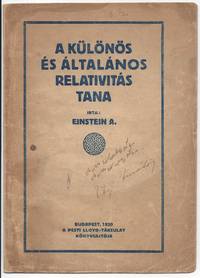
1920réf. 1870Budapest: A Pesti Lloyd-Társulat Könyvsajtója 1920. First separate edition. Offprint of Természettudományi Közlöny. In publisher’s printed wrappers. Cover chipped at extremities. Restored rear panel replaced with cardboard similar to original. Old ownership inscriptions on front panel. Contemporary notes and underlines throughout in pen and pencil. Pages discolored due to the acidic paper. Overall in good condition. First separate edition. Offprint of Természettudományi Közlöny. In publisher’s printed wrappers. 2 19 1 p. First Hungarian edition of Einstein’s Über die spezielle und allgemeine Relativitätstheorie Braunschweig 1917 published as an extract. Offprint of Természettudományi Közlöny. One of the earliest Hungarian publications of Einstein’s works. . A Pesti Lloyd-Társulat Könyvsajtója unknown
1980réf. 2610130008Dover 1980. Paperback. Good. An extremely large collection of foundational mathematical texts from a mathematical professor's library 68 volume set. Softcover. Most volumes are in good condition. Clean unmarked pages. Some volumes have reading creases down the spine various wear and are only fair condition. Various dates most volumes are from the late 1970s-1980s. Includes: 1. Handbook of Mathematical Functions: With Formulas Graphs and Mathematical Tables Milton Abramowitz; Irene A. Stegun2. Lectures on Ordinary Differential Equations Witold Hurewicz; 3. The Divine Proportion: A Study in Mathematical Beauty H E Huntley; 4. Infinite Sequences and Series Knopp Konrad; 5. Functional Analysis Frigyes Riesz; Bela Sz.-Nagy;6. Lectures on Classical Differential Geometry: 2nd Ed Struik Dirk J.;7. Advanced Number Theory Cohn Harvey; 8. Contributions to the Founding of the Theory of Transfinite Numbers Cantor Georg; 9. Geometry of Complex Numbers Hans Schwerdtfeger;10. Introduction to Partial Differential Equations with Applications Zachmanoglou E. C.; Thoe Dale W.;11. Thirty Years That Shook Physics: The Story of Quantum Theory Gamow George;12. Information Theory Robert Ash; 13. Introduction to Bessel Functions Frank Bowman; 14. Mathematical Foundations of Information Theory A Ya Khinchin; 15. Vector and Tensor Analysis with Applications Borisenko A. I. Tarapov I. E.; 16. On Formally Undecidable Propositions of Principia Mathematica and Related Systems Godel Kurt; 17. Tensor Calculus Synge J. L.; Schild A.; 18. Differential Geometry Kreyszig Erwin; 19. A Collection of Problems on Complex Analysis Volkovyskii L. I.; Lunts G. L.; Aramanovich I. G.;20. Introduction to Difference Equations Samuel Goldberg;21. Distribution Theory and Transform Analysis: An Introduction to Generalized Functions with Applications Zemanian A. H.; 22. Physics of Waves Elmore William C.; Heald Mark A.; 23. Orthogonal Functions G. Sansone; 24. Lie Algebras Jacobson Nathan; 25. Topology John G Hocking; 26. Mathematical Recreations and Essays Ball W. W. Rouse; Coxeter; 27. An Introduction to Algebraic Structures Landin Joseph28. Differential Forms with Applications to the Physical Sciences Harley Flanders;29. The Theory of Groups and Quantum Mechanics Hermann Weyl; 30. Nonlinear Mathematics Thomas L. Saaty; Joseph Bram; 31. An Introduction to Information Theory Symbols Signals and Noise John R Pierce; 32. Introduction to the Theory of Fourier's Series and Integrals Carslaw H. S.; 33. Quantum Theory David Bohm; 34. Introduction to Differentiable Manifolds Auslander Louis Mackenzie Robert E.; 35. An Introduction to Harmonic Analysis Katznelson Yitzhak; 36. Conformal Mapping on Riemann Surfaces Harvey Cohn; 37. Conformal Mapping Nehari Zeev; 38. Axiomatic Set Theory Suppes Patrick; 39. Differential Geometry Heinrich W. Guggenheimer; 40. Challenging Mathematical Problems With Elementary Solutions Vol. 1 A. M. Yaglom;41. Group Theory W. R. Scott; 42. An Introduction to the Calculus of Variations Fox Charles; 43. Tensor Analysis on Manifolds Goldberg Samuel I. Bishop Richard; 44. Non-Euclidean Geometry Bonola Roberto; 45. The Philosophy of Mathematics Korner Stephan; 46. Computational Methods of Linear Algebra Faddeeva V. N.; 47. Tensors Differential Forms and Variational Principles Lovelock David Rund Hanno;48. Metric Affine Geometry Snapper Ernst & Troyer Robert J.; 49. Fourier Series and Orthogonal Functions Harry F Davis;50. Unbounded Linear Operations Goldberg Seymour; 51. Geometry Relativity and the Fourth Dimension Rudolf Rucker; 52. Banach Spaces of Analytic Functions Hoffman Kenneth; 53. Topological Uniform Structures Page Warren; 54. The Higher Arithmetic: An Introduction to the Theory of Numbers Harold Davenport;55. The Thirteen Books of the Elements Vol. 2 Euclid; 56. The Theory of the Properties of Metals and Alloys Jones Mott Neville; 57. Asymptotic Expansions of Integrals Norman Bleistein; 58. Investigations on the Theory of the Brownian Movement Einstein Albert; 59. The Principle of Relativity Albert Einstein; 60. The Theory of Spinors Bagemihl Bagemihl; 61. Selected Papers on Quantum Electrodynamics Julian Schwinger; 62. About Vectors Banesh Hoffmann; 63. Fads and Fallacies in the Name of Science Martin Gardner; 64. Theory of Sets Kamke E.; 65. First Order Mathematical Logic Angelo Margaris; 66. Essays on the Theory of Numbers Dedekind Richard; 67. Modern Nonlinear Equations Thomas Saaty; 68. Theory of Groups of Finite Order Burnside. This is an oversized or heavy book which WILL require additional postage for Priority Mail or International delivery outside the US. Dover paperback
réf. 022646413X.Ghardcover. Good. Access codes and supplements are not guaranteed with used items. May be an ex-library book. hardcover
réf. 61266827Nova Science Publishers Incorporated . Hardback. Used. pp. xiii 239 Index Nova Science Publishers, Incorporated hardcover
réf. 1017081166.Ghardcover. Good. Access codes and supplements are not guaranteed with used items. May be an ex-library book. hardcover
réf. B9781017081169Hardback. New. hardcover
réf. 14497Softcover. UCLA Fowler Museum of Cultural History c1996 spiral-bound paperback about 8½x11 Fine 70 pages QUILTS QUILTING AMISH CULTURE; E2555 . paperback
1953réf. GB0000CIJJXI3N01Cassell 1953. Hardcover. Good. Missing dust jacket; Pages can have notes/highlighting. Spine may show signs of wear. ~ ThriftBooks: Read More Spend Less.Dust jacket quality is not guaranteed. Cassell hardcover
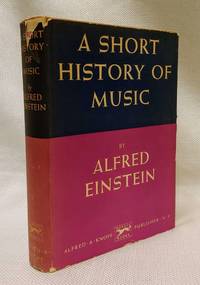
1937réf. 336583New York: Alfred A. Knopf 1937. First Edition. Hardcover. Good/Good. First thus. Alfred A. Knopf 1937; stated First American Edition no additional printings indicated same date on title and copyright pages; x 253 xii 1pp. Binding is tight sturdy and square; light wear light foxing to edges of tan cloth boards magenta and brown stamped title and decoration on spine and front board remains bright and bold; text very good throughout. Unclipped $2.50 dust jacket is edge-worn and age-toned with several small closed tears one chip at head of spine; light foxing to jacket as well. A presentable First American printing of Einstein's classic work of music history and criticism. From a private collection. Ships from Dinkytown in Minneapolis Minnesota. Alfred A. Knopf hardcover