211 risultati
1922rif. 37430Berlin: Slowa 1922. 51 5pp. Original printed wrappers faded front hinge weak tears at spine. First edition in Russian of Weil 111; see Weil 111e. Slowa unknown books
1950rif. 617622New York: Philosophical Library 1950. Hardcover. Fine/Near Fine. First edition. Octavo. Fine in very slightly toned near fine dust jacket. Philosophical Library hardcover books
1950rif. 140948403New York: Philosophical Library 1950. First Edition. Near Fine/Near Fine. First edition first printing. Signed by Albert Einstein on the front free endpaper and dated the year of publication. Above and beneath Einstein's signature Rabbi Irving Levey has inscribed this book to former owner Harold Rosenstein and written two lines of Hebrew that translate to "A day that is exceptionally good 19 Kislev 5711." According to Rosenstein's grandson Einstein's signature was procured by Rabbi Levey who lead temple at the Jewish Center at Princeton from 1949-51. Levey and Einstein and worked together on issues relating to the then-newly formed State of Israel. vi 282 pp. Bound in publisher's blue cloth stamped in gilt. Near Fine with light rubbing to corners and spine ends offsetting at endsheets. In a Near Fine unclipped dust jacket with toning light edge wear small stain to rear flap. The iconic theoretical physicist's second collection of essays covering the years 1934-1950 surrounding his personal convictions around religious and humanitarian issues in the wake and aftermath of WWII. Boni 515. Philosophical Library unknown books
1950rif. 148775New York: Philosophical Library 1950. Hardcover. Very Good/Good. Very good in good dust jacket. Book rubbed on edges. Dustwrapper browned and rubbed. Philosophical Library hardcover books
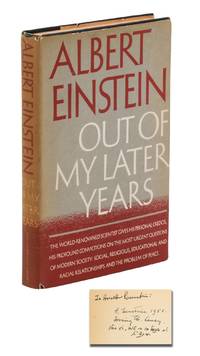
1950rif. 6682New York: Philosophical Library 1950. First edition. Very Good in pretty good dust jacket. 21 cm; 279 pages portrait frontispiece. Turquoise cloth in plain cream-colored dust jacket. Dust jacket chipped at top of spine. Of the variant dust jackets and issues this is the one with the fewest number of titles advertised on the rear and the price of $4.75 on the inside flap. Philosophical Library hardcover books
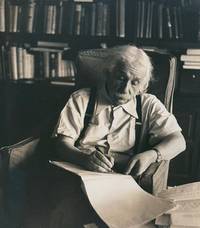
1950rif. 2896Princeton: np 1950. Very Good. A beautiful photo of Einstein at work in his study seemingly absorbed with his thoughts. The photographer Hermann Landshoff like Einstein was a German-Jewish émigré who settled in the United States in the 1930s. His large body of work encompasses portraits of some of the most influential figures of the century. Landshoff was highly respected by his peers with his work prompting the American photographer Richard Avedon to claim "I owe everything to Landshoff." Landshoff visited Einstein to photograph him several times in the 1940s and early 1950s showing Einstein in quieter moments at his home or study in Princeton. With Landshoff's copyright stamp on verso marking this as a "Sample copy" and "Not for sale or reproduction." Also with Landshoff's signature on the original matte board. The original non-archival matte was removed during framing to better preserve the photo but the signature was preserved and is now displayed on verso. Gelatin silver print with sepia tones. Taken c.1950 likely a contemporary or early printing. Approx. 9.25 x 10.5 in 235 x 263 mm. Archivally framed under museum glass to a size of 16 x 17.5 in. A few tiny spots to image generally in fine condition handsomely framed. np unknown books
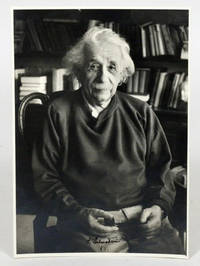
1954rif. 2832Princeton NJ: np 1954. First edition. nb. Fine. EXTREMELY RARE AND BEAUTIFUL SIGNED PHOTOGRAPH OF EINSTEIN BY FREDERICK PLAUT. SIGNED ON THE IMAGE BY EINSTEIN: "A. Einstein 54". A fine photograph of Einstein in 1954 a year before his death sitting in his Princeton home surrounded by books and holding his pipe gazing slightly away from the camera. In his 1964 collection of photographs The Unguarded Moment the photographer Frederick Plaut explains the circumstances of his evocative photo of the elderly Einstein: "There must be a moment in every professional photographer's life when he is so in awe of his subject that he can scarcely focus his camera. That moment for me was when I met Albert Einstein at his home in Princeton. Certainly the great man was not formidable; he greeted my wife and me graciously and proceeded to chat with her while I went to work. I remember that she asked him about his music and when he told her that he no longer played his violin she murmured 'That's too bad.' He smiled 'Ah no. It would have been too bad if I went on.' In the final moments of our visit Einstein looked at me very seriously. 'I hope' he said 'you can sell these pictures for a good price.' Astounded I blurted out: 'Oh no Sir. I have nothing to sell. I just wanted to photograph you.' His face clouded. 'Not sell them If I had known that I never would have let you take them.' After we left I realized the significant of a delightful remark attributed to Mrs. Einstein. Someone once asked Mrs. Einstein whether she understood Professor Einstein's theory of relativity. She answered without hesitation 'No but I understand Professor Einstein'" Frederick Plaut The Unguarded Moment A Photographic Interpretation. The photographer Frederick Plaut moved to the United States from Europe in 1940. After being "discovered" by the legendary photographer Edward Steichen Plaut soon was invited to exhibit in numerous exhibitions. "At the Museum of Modern Art his photographs have been shown in many exhibitions including: 'The Family of Man' 'Music and Musicians' 'The Exact Instant' and others. Plaut's work has appeared in Time Life Esquire Look Saturday Review Vogue U.S. Camera Modern and Popular Photography andRealities et al" The Unguarded Moment. Provenance: Acquired directly from the family of the original recipient Arthur Klein with the original mailing envelope stamped "Jan 27 '54" from The Institute for Advanced Study in Princeton where Einstein was working at the time. Arthur Klein is primarily known for founding with his wife Luce Spoken Arts a highly influential company formed in the 1950s that created and distributed recordings of the works of famous writers and artists usually reading from their own works. Princeton NJ: 1954. Silver gelatin print approximately 4.75 x 6.75 inches. With Plaut's studio stamp on verso. Fine condition with Einstein signature - nicely centered at the base of the photograph - particularly strong. As Plaut mentioned in his account of the photographic session he never intended to sell this photograph and it is likely very few of these photos were printed and distributed. EXTREMELY RARE: WE CAN FIND NO OTHER EXAMPLE OF THIS PHOTOGRAPH SIGNED BY EINSTEIN. np unknown books
1932rif. 1864np: np 1932. First edition. nb. UNPUBLISHED CANDID PHOTOGRAPHS OF EINSTEIN AND LETTERS BY WILLIAM HUBBARD OFFERING AN INTIMATE VIEW OF THE SCIENTIST ON VACATION. On March 2 1932 at the height of his career and world fame Albert Einstein and his wife Elsa set off on a vacation to their German homeland departing from Los Angeles on the M. S. San Francisco. Another passenger aboard the ship was the renowned music scholar William Lines Hubbard. Famous in his own right Hubbard was the music critic for the Chicago Tribune and author of a definitive 11-volume work on the history of opera published 1908. Accompanying Hubbard was his companion Julia Reid their cabins adjacent to that of the Einstein's. As was the practice during this era Hubbard kept detailed journals and letters of his travel experiences. This collection from the estate of Hubbard contains the following items: 1. Three unpublished small black-and-white and sepia photographs. The first photograph 4.5" x 2.5" pictures Einstein his wife Elsa the Ship's Captain Hubbard the tall figure and three other of the ship's passengers dated 3/14/32. The second photograph 3.5" x 3.25" is an outstanding full front image of Einstein his wife Elsa and the ship's Captain. The final photograph 4.5" x 2.5" is a full frontal image of Einstein and his wife Elsa both seated in deck chairs with the ship's Captain standing behind. 2. Typed letter dated March 22 1932 written while sailing through the South Atlantic. Six pages typed front and back on two pieces folded of the ship's original stationary approx. 7.5x11 in. Excerpts on Einstein include: Of our Six Passengers two are Prof. Einstein and wife. They are proving very delightful companions-- sincere unaffected and jolly. At first they were very reserved and merely bowed and smiled and "Guten-Morgan-ed" when entering and leaving the dining room but when they had become rested and saw that none of the rest of us planned to intrude they came forward and have been very genial. She is a great talker but talks interestingly. He walks deck smoking his stubby black pipe or whistling cheerily his gray hair blowing in the breeze. Each forenoon and sometimes in the afternoon he goes to the piano and plays for half hour or so. Plays in that satisfying manner peculiar to a man to whom music is a comfort and who thinks musically. It is in no wise brilliant playing but it is throughly enjoyable to hear. The rest of the time he sits in his steamer chair or in his cabin reading or thinking. On the 14th he had his 53rd birthday and the Capt had ordered from La Libertad Salvador where we had taken cargo the day before large bunches of easter and tiger lilies which in the morning were on the Einstein table together with a birthday cake the ship's cook had made and countless cards and letters which friends had sent. It was all a complete surprise to them both and their happiness was childlike in its spontaneity and sincerity. It was heart warming to watch them. They seem to appreciate being left to themselves and not being lionized. It is the third time they have come through the canal on these boards an they enjoy it to the full. 3. Typed letter dated April 1 1932 written while entering the English Channel. Seven pages on two approx. 8.5x11in sheets folded of the ship's original stationary. Excerpts on Einstein include: We had good fun watching for crocodiles along the banks as we came up the cut and Prof Einstein was especially gleeful when he discovered one. Professor Einstein loves the roung sic weather and has reveled in it. He and the Mme are proving very delightful fellow passengers. She is very chatty but chats interestingly and he struts up and down deck smoking his stubby pipe or whistling like a jolly kid his white hair blowing in the breeze. We have some talks occasionally and he yesterday when he saw the copy of Living Philosophies which I had given me sic before I left San Diego and in which his article is the first took the book and autographed his picture and wrote in remembrance of the happy days on board the San Francisco. I don't think I told you of his birthday which occurred on the 14 of March the day before we reached the Canal. The Capt came to know if it and when the Einsteins came to their table at breakfast they found it decorated with three huge vases of Easter and Tiger lilies which the Capt had secured in La Libertad. The cook had made a gorgeously decorated Torte-- one of the filled and frosted German cakes-- and there were letters and telegrams from friends which had been sent in the Capt's care. It was a complete surprise to the Einsteins and they were like two happy kiddies. It was gladdening to watch their simple and keen enjoyment. Later we had pieces of the Torte which were a bit of muchness for breakfast but which of course we ate. 4. Typed letter dated April 24 1932 written in Merano Italy. Six pages on five 5.5x7in sheets. While recalling a cargo transfer on the M. S. San Fransisco Hubbard writes: The Einsteins were especially enthusiastic and we had a great fun over the boss of the unloading. He was a huge and tremendously rotund gent wearing a soft felt hat and a short overcoat the buttons of which seemed fated to "bust off" at any moment. His chief employment seemed to be running about from side to side of the dock into the warehouse and out again clambering onboard and then clambering off and all the time shouting orders at the top of his voice and gesticulating wildly. Einstein had been reading the "Living Philosophies" which I had loaned him and was especially curious concerning Mencken and how he happened to be included in the great ones in the book. I gave him an outline of Mr. M's greatness and assured him that the book cold sic well largely on account of M being included. All of which amused the Einsteins greatly. So when this wild boss hove into sight that morning and began his excited directing Mrs E said "there is Mister Mencken" and thus he remained so long as we were in Rotterdam. The Einsteins were starting early the next morning for Berlin so they went about 9 pm to the custom house and had their 16 packages bundles and gifts examined. Frau Professor had a funny story to tell of their experience with the 150 pound bag of coffee that had been presented them in Salvador. 5. An official passenger list from the M. S. San Francisco printed on the ship's original stationary 4.75" x 8.25" dated March 2 1932. With "Professor Albert Einstein" and "Mrs. Albert Einstein" shown under the list of cabin passengers going from Los Angeles to Bremen. 6. A postcard depicting Hubbard's profile in black and white 3.45" x 5.45". All items in very good condition letters with wear and soiling at folds and housed in a custom cloth presentation folder. RARE FIRST-HAND TESTIMONY REVEALING THE PERSONALITY OF EINSTEIN IN RELAXED AND INFORMAL MOMENTS. np unknown books
1938rif. 165146Paris 1938. paperback. Pp. 5-19 IN: Zeitschrift fur Freie Deutsche Forschung. Jahrgang 1 Nummer 1. Herausgegeben von der Freien Deutschen Hochschule in Paris. 168p. printed wrappers. Paris Juli 1938. First number of this scarce short-lived exile publication featuring German & Austrian writers and scholars. Fine. unknown books
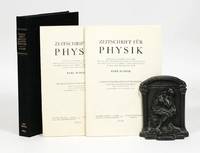
1924rif. 2905Berlin: Julius Springer 1924. First edition. original wrappers. Very Good. FIRST EDITION IN ORIGINAL WRAPPERS of the presentation of "Bose-Einstein statistics." “In 1924 Bose found a way to derive Planck’s equation for black body radiation using a statistical approach based entirely on the idea that light is made up of tiny particles photons. This echoed the statistical mechanics approach of Ludwig Boltzmann to the behaviour of gases but using a different statistical rule; it derives black body radiation entirely in quantum terms without using the idea of electromagnetic radiation at all. Bose wrote a paper about his discovery and sent it to Albert Einstein who immediately saw its significance translated it into German and arranged for its publication in the prestigious Zeitschrift für Physik. Einstein developed the idea to apply to other kinds of particle not just to a ‘gas’ of photons which is why this approach is usually referred to as ‘Bose-Einstein statistics’. Paul Dirac coined the name ‘bosons’ for particles which obey Bose-Einstein statistics" Gribbin Q is for Quantum. Particle Physics: One Hundred Years of Discoveries: “Discovery of new statistical counting rules for light quanta and a new derivation of Planck’s radiation law. Known as Bose-Einstein quantum statistics for particles with integer spins.” WITH a follow-up paper by Bose: "Wärmegleichgewicht im Strahlungsfeld bei Anwesenheit von Materie": "Bose's first paper in 'Zeitschrift für Physik' was followed by another that was also translated by Einstein and published during 1924. In it Bose provided a general statistical treatment of emission and absorption processes for electromagnetic radiation in equilibrium with matter. This paper was accompanied by a note by Einstein expressing serious doubts about the method. In January 1925 Bose wrote to Einstein from Paris that he was working on a paper he felt would remove these doubts. But it seems never to have been completed" DSB. Plancks Gesetz und Lichtquantenhypothese. IN: Zeitschrift für Physik Vol 26 No. 3 August 1924 pp. 178-81. Berlin: Julius Springer 1924. “Wärmegleichgewicht” Vol 27 No. 5/6 September 1924 pp. 384-93. Octavo original wrappers. “Planks Gesetz” with small closed tear at rear wrapper edge; otherwise fine condition; “Wärmegleichgewicht” with small chip to base of front wrapper. SCARCE in original wrappers. Julius Springer unknown books
1948rif. 2327Princeton NJ: np 1948. framed. Fine. ONE OF THE MOST CELEBRATED IMAGES OF EINSTEIN SIGNED BY MASTER PHOTOGRAPHER YOUSUF KARSH. On February 11 1948 Yousuf Karsh perhaps the most accomplished portrait photographer of his generation visited The Institute for Advanced Study in Princeton to fulfill a dream of his: to photograph Albert Einstein. As he later explained: "Among the tasks that life as a photographer had set me a portrait of Albert Einstein had always seemed a 'must' - not only because this greatest refugee of our century has been accounted by all the world as the most outstanding scientist since Newton but because his face in all its rough grandeur invited and challenged the camera." Karsh: Beyond the Camera David Travis ed. "At Princeton's Institute for Advanced Study I found Einstein a simple kindly almost childlike man too great for any of the postures of eminence. One did not have to understand his science to feel the power of his mind or the force of his personality" official Karsh website. "Awed before this unique intellect I yet ventured to ask Einstein his views on human immortality. He mused for a moment and then replied 'What I believe of immortality There are two kinds. The first lives in the imagination of people and is thus an illusion. There is a relative immortality which may conserve the memory of an individual for some generations. But there is only one true immortality on a cosmic scale ant that is the immortality of the cosmos itself. There is no other.' "He spoke of these ultimate mysteries as calmly as he might a student's question about mathematics - with such an air of quiet confidence indeed that I found his answer profoundly disturbing to one who held other views. Knowing him to be an accomplished violinist I turned the conversation and asked if there were any connection between music and mathematics. 'In art he said 'and in the higher ranges of science there is a feeling of harmony which underlies all endeavour. There is no true greatness in art or science without that sense of harmony. He who lacks it can never be more than a great technician in either field.' "Was he optimistic about the future harmony of mankind itself He appeared to ponder deeply and remarked in graver tones: 'Optimistic No. But if mankind fails to find a harmonious solution than there will be disaster on a dimension beyond anyone's imagination.' To what source should we look for the hope of the world's future 'To ourselves' said Einstein. He spoke sadly yet serenely as one who had looked into the universe far past mankind's small affairs. In this humor my camera caught him. the portrait of a man who had traveled beyond hope or despair." Yousuf Karsh Regarding Heroes. Opening quote from: Colin Naylor ed. Contemporary Photographers. Silver print. Photo taken Princeton 1948. Printed later. Signed by Karsh in full beneath the image on photographer's mount. With Karsh's original calling "card" - a 4x10 inch cardboard slip - included. Image: 8x9 inches. Framed to an overall size of 12x15 inches. Fine condition. np unknown books
rif. 32479unknown books
1952rif. 86694NY:: Dover Publications. Good. 1952. Paperback. With notes by A. Sommerfield. Translated from the German by W. Perrett and G. B. Jeffery. With seven diagrams. First edition thus paperback. Covers are age darkened with a few corner creases else good in printed wraps.; 216 pages . Dover Publications, paperback books
1918rif. 50342Leipzig 1918. Prinzipielles zur allgemeinen relativitätstheorie. In Annalen der Physik 55 241-244 pp. Red cloth with gilt lettering on the spine. Bookbinder's embossed stamp of ffep. Whole volume: 632 pp. 1 folding plate. Figs. Text-illust. 210 x 130 mm. Very good. Approximate English translation of title: "On the foundations of the general theory of relativity." "Here we are given the first new presentation of the foundations of general relativity since the developments of March 1916 when Einstein gave his first systematic exposition." p. 300. Calaprice Kennefick & Shulmann. An Einstein Encyclopedia. 2015. Weil's Einstein Bibliography no. 96. Boni's Checklist no. 100. Also in this volume: Born Max 1882-1970. Elektronentheorie des Natürlichen optischen Drehungs vermögens isotroper und anisotroper Flüssigkeiten pp. 175-240. Approximate Eng. translation of title: "Electron theory of the natural optical rotation ability of isotropic and anisotropic liquids". Max Born 1882-1970 was a German physicist and mathematician who was instrumental in the development of quantum mechanics. He also made contributions to solid-state physics and optics as well as supervised a number of notable physicists in the 1920s and 1930s. Born won the 1954 Nobel Prize in Physics "for his fundamental research in quantum mechanics especially in the statistical interpretation of the wave function." In 1919 a chance meeting with Fritz Haber 1868-1934 led to the discussion of how an ionic compound is formed when a metal reacts with a halogen - a process now known as the Born-Haber cycle Wikipedia. . unknown books
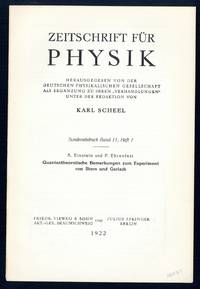
1922rif. 432871922. Einstein Albert 1879-1955 and Paul Ehrenfest 1880-1933. Quantentheoretische Bemerkungen zum Experiment von Stern und Gerlach. Offprint from Zeitschrift für Physik 11 1922. 31-34pp. 229 x 155 mm. Original printed self-wrappers. Light toning but fine otherwise. First Edition Offprint Issue. In 1922 the physicists Otto Stern and Walther Gerlach conducted a now-classic experiment in which a beam of silver atoms was streamed through an inharmonious magnetic field in order to observe the atoms' deflection patterns. Rather than a random and continuous distribution as predicted by classical theory the atoms passing through the field were deflected up or down by a specific amount demonstrating that they had intrinsically quantum properties. The Stern-Gerlach experiment corroborated the Bohr-Sommerfeld model of the atom and strongly influenced later developments in 20th century physics. However the experiment also created some serious difficulties for quantum physicists in the period before the rise of the "new" quantum mechanics. Einstein and Ehrenfest addressed one of these difficulties-connected with space quantization-in their joint paper in which "they dealt in particular with the problem of how the orbits of the atom would obtain their discrete directions which they exhibit while passing through the inhomogeneous magnetic field. Under the assumption that the mechanism causing the orientation was provided by the interaction with the radiation field Einstein and Ehrenfest estimated that for a field strength of 10000 G a change in the direction of the orbit would take place in roughly 1011 s; this long time interval would be reduced in the presence of heat radiation at room temperature . . . to about 109 s. How could they asked the experimental situation be explained which implied that the discrete orientations of the orbits in silver atoms were obtained in less than 10-4 s. In order to deal with this evident puzzle Einstein and Ehrenfest proposed two alternatives: first that the silver atoms were always in the states of spatial quantization; second the orientations of the electron orbits arose from an interaction of the atoms with the radiation field which involved much smaller reaction times . . . However they found that both alternatives created considerable difficulties in the understanding of the atomic processes . . . Thus Einstein and Ehrenfest concluded: 'The difficulties mentioned above show how unsatisfactory are both interpretations of the results found by Stern and Gerlach'" Mehra & Rechenberg The Historical Development of Quantum Theory 1 pp. 443-444. Pais Subtle is the Lord p. 328. Weil Albert Einstein Bibliography 121. . unknown books
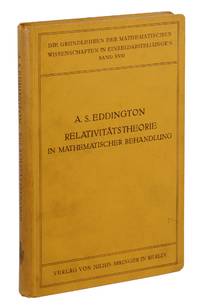
1925rif. 140945616Berlin: Verlag von Julius Springer 1925. First edition. First edition. xiv 377 1 4 pp. Bound in publisher's orangish yellow boards. Near Fine with light rubbing and soiling to boards tiny pen squiggle to front board. Contents bright and unmarked. An uncommon German-language physics text with an appendix by Einstein. Verlag von Julius Springer unknown books
1943rif. NF0266RELATIVITY Privately published 1943 first edition a vg copy in flexible black leatherette. A seventy page treatise on energy as matter in motion culminating with the general law of relativity. Replete with many mathematical equations and forty-two figures. Privately published 1943 hardcover books
1961rif. 205945New York: Bonanza 1961. Hardcover. Reprint. Fine in a fine dust jacket. Bonanza hardcover books
1921rif. 18099New York: Henry Holt and Company 1921. THIRD EDITION. With frontispiece portrait Einstein dated 1920. Blue cloth small tear at top of spine corners slightly worn no dust wrapper; front hinge a bit loose otherwise a very clean copy. From the library of Martin J. Klein professor of the history of science at Yale and the first recipient of the Abraham Pais Prize for the History of Physics. This copy was given to Klein as a gift from his summer program NEH class of 1986 and is signed by 13 of his students. Third edition though the only change is the date on the title page of one of Einstein’s most renowned works intended for readers with a general scientific and philosophical background. Part I treats the special theory of relativity part II the general theory and part III considers the universe as a whole. Not in Weil or Boni. Henry Holt and Company unknown books
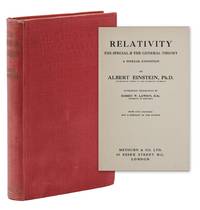
1920rif. 140949340London: Methuen & Co 1920. First Edition. Near Fine. First British edition first printing. xiii 3 138 2 8 pp. Bound in publisher's red cloth lettered in blind on front board and gilt on spine. Near Fine with light wear and fading to covers light foxing to upper textblock edge. Light foxing and offsetting to endpapers bookseller ticket to back pastedown and light toning to contents. Binding starting at pp. 33 and 97. A much nicer copy than normally found. The first British edition of Einstein's seminal work translated by Robert W. Lawson from the third German edition. Einstein's introduction to his revolutionary theory was written to be accessible to the general public. Methuen & Co unknown books
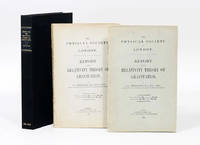
1918rif. 2839London: Fleetway Press 1918. FIRST EDITION. Original wrappers. Fine. THE FIRST INTRODUCTION OF EINSTEIN'S GENERAL RELATIVITY TO THE ENGLISH-SPEAKING WORLD. The groundbreaking first edition 1918 with the second edition 1920 containing the account of Eddington's 1919 expedition proving Einstein's theory both in original wrappers. "Einstein's discovery of the General Theory of Relativity was communicated to the Berlin Academy of Sciences in 1915. Because of the First World War direct communication with physicists in Germany was not possible but the papers were forwarded to Eddington who was then Secretary of the Royal Astronomical Society by Willem de Sitter a personal friend of Eddington's in neutral Holland. The theory is of considerable mathematical complexity but as Einstein stated in the last paragraph of his paper 'scarcely anyone who has fully understood this theory can escape from its magic'. Eddington was the ideal expositor of these ideas in English and within 2 years had written his Report on the Relativity Theory of Gravitation for the Physical Society of London" Malcolm Longair "Bending Space-time". The second edition is notable for containing a new preface that discusses the results of the "eclipse expedition" led by Eddington that verified General Relativity and catapulted Einstein into world-wide fame. This preface precedes Eddington's full report in the Philosophical Transactions. Provenance: Almost certainly Nobel Prize winning physicist's Charles Glover Barkla's copy of the 1918 report with an original 1918 receipt in Barkla's name laid in. Barkla won the 1917 Nobel Prize in Physics "for his discovery of the characteristic Röntgen radiation of the elements". London: Fleetway Press for The Physical Society of London 1918 and 1920. Octavo original wrappers; custom box. General light wear to wrappers. Beautiful copies. RARE. Fleetway Press unknown books
1928rif. 374171928. Weil 161. Offprint from S. preuss. Akad. Wiss. unknown books
1930rif. 10508Boston: Houghton Mifflin 1930. First Edition. Cloth. Near fine/good. First edition of Roosevelt: His Mind in Action by Lewis Einstein in scarce dust jacket. Octavo vii 5 259pp. Maroon buckram cloth title printed on label affixed to cover and spine. Some leaves unopened. Uncut outer edge. No additional printings mentioned on copyright page. Previous ownership inscription on front free endpaper. In publisher's scarce dust jacket $3.00 retail price on front flap long closed tear to front cover large chipping to spine and back panel archival repair to verso bright illustrations. A rare find in the publisher's dust jacket. Houghton Mifflin unknown books
1962rif. 121258Düsseldorf Germany: Galerie Vomel 1962. Softcover. VG. White paper wraps. Unpaginated with 8 pp. and 4 bw plates. Text in German. Includes a bw photo of the artist a list of works in the exhibition held January - February 1962 and a brief essay. Galerie Vomel paperback books
1975rif. 285227New York: Harry N. Abrams Inc 1975. Hardcover. 260p. first edition 12x11 inches; b&w and color plates fore-edge slightly toned small tear between front bottom dj and front panel spine and rear dj heavily toned and slightly soiled minor edgewear and creasing on back dj rear side of spine slightly rubbed else very good. Harry N. Abrams, Inc hardcover books