2978 resultados
1924ref. LFA-126720222Un ouvrage de 57 pages, format 145 x 230 mm, broché, publié en 1924, Mercure de France, bon état, rare
1942ref. 162740London: Allen & Unwin 1942. 1st edition. Nice copy. octavo. hardback in original cloth 335pp. index A collection of 20 essays on the meaning of freedom published in the midst of WW2 Allen & Unwin hardcover
2001ref. 1-3898211681ibidem-Verlag 2001. Paperback. New. 134 pages. German language. 8.11x5.67x0.39 inches. ibidem-Verlag paperback
1946ref. 110238New York: Rudolf Schick Publishing Co 1946. Hardcover. Near Fine. First edition. Modest offsetting from front endpapers from a clipping else near fine without dustwrapper. Rudolf Schick Publishing Co hardcover books
2000ref. x-0312231024Palgrave Macmillan 2000. Hardcover. New. 253 pages. 9.00x5.75x1.00 inches. Palgrave Macmillan hardcover
1999ref. 22986München ; Zürich Diana-Verl.; München, 1999. 428 S. 19 cm, Broschiert ,aus rechtlichen Gründen im Schnitt als Mängelexemplar gekennzeichnet ,
1983ref. 310602San Francisco: Gay Atheist League of America 1983. Magazine. 20p. 5.5x8.5 inches very good digest-size booklet in stapled wraps. Gay and Lesbian Freethought journal. Gay Atheist League of America unknown books
1985BORINGHIERI 1985 SEGNI DEL TEMPO ALLA COPERTINA, VOLUME INTONSO, MAI SFOGLIATO.
1926ref. 39022Berlin: Das Kunstarchiv Verlag 1926. First edition. Softcover. g. Quarto. 36pp. Original printed wrappers. Catalog published on the occasion of an exhibition of paintings and drawings by George Grosz held during the Spring of 1926 in Berlin at the Galerie Alfred Flechtheim. This catalog features 24 duo-tone and b/w photographic reproductions. Includes a poem by Gottfried Benn and four essay on the artist and his work by Carl Einstein Marc Neven Max Herrmann and Florent Fels. Some age-wear and moderate soiling on wrappers. Upper corners bumped thus slightly affecting pages throughout. Text in German gothic script with one of the four essays in French. Wrappers in overall good- to good interior in good to very good condition. Alfred Flechtheim 1878-1937 was a German art dealer art collector journalist and publisher. Flechtheim appeared in the art world shortly after 1900 with a collection of paintings by Vincent van Gogh and Paul Cézanne; French Avant garde early works of Pablo Picasso Georges Braque and André Derain; paintings of Wassily Kandinsky Maurice de Vlaminck Alexej von Jawlensky Gabriele Münter and the Rhein Expressionists Heinrich Campendonk August Macke Heinrich Nauen de and Paul Adolf Seehaus de. Flechtheim opened his first gallery in Düsseldorf in 1913 followed by galleries in Berlin Frankfurt Cologne and Vienna. Flechtheim served in the German Army during World War I but not at the front. His art business collapsed during the war but he re-opened in Düsseldorf in 1919. In 1921 he founded "Der Querschnitt" the Cross Section a cultural magazine. Legendary glamorous parties in Flechtheim's gallery overflowed with the glitterati of the new Berlin: movie stars titans of finance prizefighters and artists of every stripe. As Hitler rose to power in the late 1920s and early 1930s Flechtheim became a bête noire because of the art he espoused and championed. In 1933 Sturmabteilung men broke up an auction of Flechtheim's paintings. The Nazis aryanized Flechtheim's gallery as they would many other Jewish businesses and turned it over to Flechtheim's business manager Alex Vömel. After the war former party member Vömel said he didn't even remember who Flechtheim was. The Nazis seized and sold off Flechtheim's private collection as well as the contents of his gallery. Emigration and Death Six months after the Nazis came to power in 1933 Flechtheim penniless fled to Paris and tried to find work with his former business partner Daniel-Henry Kahnweiler. Flechtheim subsequently organized exhibits in London of the paintings of exiled German artists. In London Flechtheim slipped on a patch of ice was taken to a hospital punctured his leg on a rusty nail in his hospital bed developed septicemia leading to amputation of his leg and died. Das Kunstarchiv Verlag unknown
1926ref. 39022Berlin: Das Kunstarchiv Verlag 1926. First edition. Softcover. g. Quarto. 36pp. Original printed wrappers. Catalog published on the occasion of an exhibition of paintings and drawings by George Grosz held during the Spring of 1926 in Berlin at the Galerie Alfred Flechtheim. This catalog features 24 duo-tone and b/w photographic reproductions. Includes a poem by Gottfried Benn and four essay on the artist and his work by Carl Einstein Marc Neven Max Herrmann and Florent Fels. Some age-wear and moderate soiling on wrappers. Upper corners bumped thus slightly affecting pages throughout. Text in German gothic script with one of the four essays in French. Wrappers in overall good- to good interior in good to very good condition. Alfred Flechtheim 1878-1937 was a German art dealer art collector journalist and publisher. Flechtheim appeared in the art world shortly after 1900 with a collection of paintings by Vincent van Gogh and Paul Cézanne; French Avant garde early works of Pablo Picasso Georges Braque and André Derain; paintings of Wassily Kandinsky Maurice de Vlaminck Alexej von Jawlensky Gabriele Münter and the Rhein Expressionists Heinrich Campendonk August Macke Heinrich Nauen de and Paul Adolf Seehaus de. Flechtheim opened his first gallery in Düsseldorf in 1913 followed by galleries in Berlin Frankfurt Cologne and Vienna. Flechtheim served in the German Army during World War I but not at the front. His art business collapsed during the war but he re-opened in Düsseldorf in 1919. In 1921 he founded "Der Querschnitt" the Cross Section a cultural magazine. Legendary glamorous parties in Flechtheim's gallery overflowed with the glitterati of the new Berlin: movie stars titans of finance prizefighters and artists of every stripe. As Hitler rose to power in the late 1920s and early 1930s Flechtheim became a bête noire because of the art he espoused and championed. In 1933 Sturmabteilung men broke up an auction of Flechtheim's paintings. The Nazis aryanized Flechtheim's gallery as they would many other Jewish businesses and turned it over to Flechtheim's business manager Alex Vömel. After the war former party member Vömel said he didn't even remember who Flechtheim was. The Nazis seized and sold off Flechtheim's private collection as well as the contents of his gallery. Emigration and Death Six months after the Nazis came to power in 1933 Flechtheim penniless fled to Paris and tried to find work with his former business partner Daniel-Henry Kahnweiler. Flechtheim subsequently organized exhibits in London of the paintings of exiled German artists. In London Flechtheim slipped on a patch of ice was taken to a hospital punctured his leg on a rusty nail in his hospital bed developed septicemia leading to amputation of his leg and died. Das Kunstarchiv Verlag unknown books
1994ref. 50826München, Droemersche Verlagsanstalt, Th.KnaurNachf.,, 1994. 687 Seiten , 22 cm, Hardcover/Pappeinband
ref. 298744Independently published, printed in Poland by Amazon Fullfillment, 2020. Originalbroschur. 28 cm
2004ref. 24945Köln : DuMont-Literatur-und-Kunst-Verl., 2004. 1. Aufl. 271 S.; Ill.; graph. Darst. Pp.
1933ref. 015021Bâle Kunsthalle Basel 1933 In-8 carré Broché
ref. 41141Paris, Editions des Chroniques du Jour (coll. "XXe siècle"), 1934. In-4°, 140p. + XCVI planches. Broché, couverture illustrée rempliée.
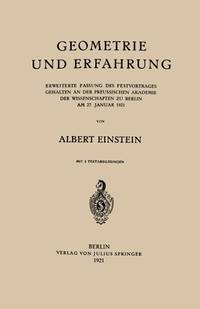
1921ref. 88645Berlin, Julius Springer, 1921, in-8, 20 pp, Broché, couverture crème imprimée de l'éditeur, Première édition de cette conférence prononcée par Einstein (1879-1955) à l'occasion de la séance commémorative de l'Académie prussienne en l'honneur de Frédéric le Grand. Le physicien y résume ses théories sur la géométrisation de la physique et de la relativité, ainsi que sur la relation des mathématiques au monde : "Comment est-il possible que la mathématique, qui est un produit de la pensée humaine et indépendante de toute expérience, puisse s'adapter d'une si admirable manière aux objets de la réalité ? La raison humaine serait-elle donc capable, sans avoir recours à l'expérience, de découvrir par la pensée seule les propriétés des objets réels ?" L'opuscule a été publié l'année où il reçut le prix Nobel. Cachet ex-libris du révolutionnaire Russe et bibliophile Marcel Bekus (1888-1939). Bon exemplaire. Rares rousseurs marginales, agrafes oxydées. Couverture rigide
1921ref. 38642Berlin, Julius Springer, 1921. Uncut in orig. printed wrappers. 20 pp.
1921ref. 46479Berlin, Julius Springer, 1921. Uncut in orig. printed wrappers. 20 pp. Some marks on the 3 last leaves and on backwrapper probably after a rubberband.
1921ref. 5726KBerlin: Verlag der Akademie der Wissenschaften in commission at Walter de Gruyter Reichsdruckerei 3rd February 1921. Near Fine. Imperial 8vo 25 4: 18 2 cm. 8 pages. Letterpress on machine paper in original publisher’s brochure on orange stock with black title printing. First offprint in the original wrappers of Einstein's Celebratory Lecture given at the Prussian Academy on the occasion of the anniversary of King Frederick II it's founder. – Edition: Given in the year when he was awarded the Nobel Prize Einstein in this lecture summarised his views on the geometrization of physics. According to Pais Einstein in present lecture in particular explained why in 1912 he had abandoned Euclidean geometry in favour of Riemannian to proceed successfully with his theory of general relativity. Furthermore Einstein in this lecture presented his view on the place of mathematics in physics. He questioned whether human reasoning even without direct experience could lead to an understanding of the properties of real things merely through thought. Regarding the question of why mathematics should be so well adapted to describing the physical world he concluded 'As far as the laws of mathematics refer to reality they are not certain; and as far as they are certain they do not refer to reality.' – Condition: Mint very probably unread. - Rarity: Very rare. According to Weil early offprints of Einstein’s papers may also be qualified as original and also highly collectable editions however they were printed in a certain but still small print run for commercial use mainly to sell them to fellow natural scientists: „No doubt the first appearance in a periodical is the „original edition“ but I have to leave it open for collectors librarians and others to decide whether these offprints in wrappers mostly with a printed title on them especially in the »Sitzungsberichte der Königlich Preussischen Akademie der Wissenschaften« are also „original editions“. These offprints are printed from the same setting as the text but often with new pagination.“ p. 4 As of March 2nd 2024 no other copy of this offprint is for sale. – Reference: Reference: Boni N.: A bibliographical checklist and index to the published writings of Albert Einstein 136; The Collected Papers of Albert Einstein. Volume 7 52 also referred to as Einstein 1921b; Shields M. C.: Bibliography der Schriften Einsteins. In: Schilpp P. A.: Albert Einstein als Philosoph und Naturforscher 122; Weil E.: Albert Einstein. A bibliography of his scientific papers 1901-1930 114; Pais A.: Subtle is the Lord. The Science and Life of Albert Einstein 2005 ed. p. 214. Verlag der Akademie der Wissenschaften (in commission at Walter de Gruyter [Reichsdruckerei]) unknown
1921ref. 5725K-2Berlin: Springer Mittler 1921. Near Fine. 8vo 22: 14 3 cm. 20 pages. Letterpress on quality machine paper in original publisher’s brochure on cream stock with black title printing incorporating the publisher's emblem. Expanded version of Einstein's Celebratory Lecture given at the Prussian Academy on the occasion of the anniversary of King Frederick II it's founder. – Edition: Given in the year when he was awarded the Nobel Prize Einstein in this lecture summarised his views on the geometrization of physics. According to Pais Einstein in present lecture in particular explained why in 1912 he had abandoned Euclidean geometry in favour of Riemannian to proceed successfully with his theory of general relativity. The original paper was published as a journal issue of »Sitzungsberichte der Preussischen Akademie der Wissenschaften« 1921 part 1 p. 123. – Condition: Wrappers with some little creasing and minor staining staples rusty otherwise well preserved copy printed on white quality paper. – Reference: Boni N.: A bibliographical checklist and index to the published writings of Albert Einstein 122; The Collected Papers of Albert Einstein. Volume 7 52 also referred to as Einstein 1921a; Shields M. C.: Bibliography der Schriften Einsteins. In: Schilpp P. A.: Albert Einstein als Philosoph und Naturforscher 122; Weil E.: Albert Einstein. A bibliography of his scientific papers 1901-1930 115; Pais A.: Subtle is the Lord. The Science and Life of Albert Einstein 2005 ed. p. 214. Springer (Mittler) unknown
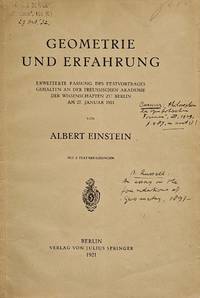
ref. 242042938Berlin Julius Springer. 1921 paper wrappers 20 pp. remarks and underlinings with pen also on frontwrapper else good Erweiterte Fassung des festvortrages Gehalten an der preussischen Akademie der Wissenschaften zu Berlin am 27. Januar 1921. Berlin, Julius Springer unknown
1921ref. 17649Berlin: Verlag Von Julius Springer 1921. First Trade Edition. Wraps. Very good. The first trade edition of Geometrie Und Erfahrung Geometry and Experience by Albert Einstein from the collection of Einstein's English translator Dr. Wilfrid Perrett. Octavo 20pp. Publisher's original wraps bound with two staples. Light soiling and wear on wraps internally clean. Includes two illustrations advertisements on verso of rear flap. Staples showing rust some wear to edges of original wraps. Weil 115 Schlipp-Shields 143 This copy is signed by Wilfrid Perrett on the front cover. This work first appeared in the Sitzungsberichte der Preussischen Akademie der Wissenschaften accompanied by an "author's offprint" which was bound in orange wrappers. Weil 114. This work is the first separate trade edition. The recipient of this copy Dr. Wilfrid Perrett worked with Dr. George Barker Jeffery to translate many of Einstein's most notable works into English. Perrett was a "distinguished German scholar" and would "overlook the literary side of the work" while Jeffery would oversee the mathematical translations. The two worked together on Das Relativitätsprinzip On the Relativity Principle beginning in 1922 and numerous other works by Einstein over his career. Jammer 113-114. Verlag Von Julius Springer unknown
ref. 3642496113.Gpaperback. Good. Access codes and supplements are not guaranteed with used items. May be an ex-library book. paperback