2976 risultati
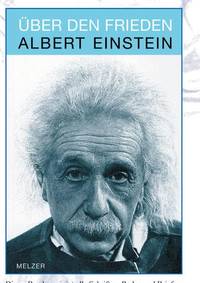
2004rif. L3 box782 b4Albert Einstein: Über den Frieden: Weltordnung oder Weltuntergang German Edition. Herausgegeben von Otto Nathan und Heinz Norden; Vorwort von Bertrand Russell; Ubersetzung der englischen und franzosischen Originale von Will Schaber; Erste deutsche Originalausgabe mit 15 Fotographien und Faksimiles. 2004 Melzer Verlag. Hardcover 675 pp. Melzer Verlag. hardcover
1954rif. 2625423/02/1954. An increasingly uncommon letter of Einstein on the role of religions philosophy peace and the dangers of the atomic age that he helped usher in <img class=""alignnone wp-image-26334 size-post-window"" src=""https://cdn.raabcollection.com/wp-content/uploads/20231204132831/Einstein-Feb-28-1954-1-e1674939062835-1600x216.jpg"" alt="""" width=""1600"" height=""216"" /> Albert Einstein believed that wars stood in the way of human progress and he was a lifelong pacifist though he did not believe in pacifism at any price or in all situations. He was also an active promoter of world peace from the days of World War I right up to his death in 1955. In fact one of his last acts before his death was to add his signature to a statement of nine scientists warning that the world risked universal annihilation unless the institution of war was abolished. Knowing his stance people from all over the world appealed to him to assist various causes consistent with these beliefs and to give statements supporting individuals and groups that did so. Einstein was also not a member or follower of any organized religion. He considered himself a Jew but was not a practicing Jew. And as for the Christian churches he felt that it “since Constantine has always favored the authoritarian State as long as the State allows the Church to baptize and instruct the masses"". Their conduct in the years up to World War II was worse than disappointing he thought as they made the devil’s bargain - the evil compromise - with the Hitler regime. Einstein addressed this saying “Since when can one make a pact with Christ and Satan at the same time"" He added ""The Church has always sold itself to those in power and agreed to any bargain in return for immunity…If I were allowed to give advice to the Churches I would tell them to begin with a conversion among themselves and to stop playing power politics.” This idea of an evil compromise or devil's pact is central to his feelings about organized religion. There was one exception to his criticism of religions - the Quakers. Their community aims at purifying the Christian world and generating social reform by creating direct experience with God without intervention of clergy or other expressions of church. The Quakers greatly influenced science and industry and their community is noted for the pursuit of peace and non-violence. Thus Einstein’s views fit into their belief system. “If I were not a Jew I would be a Quaker” he once wrote. Speaking to a Quaker gathering in 1938 he said ""With admiration and respect I have seen in the course of many years how successfully and selflessly the Society of Friends has worked in the entire world to lessen human suffering and to make the teachings of Christ apply to real life. Everyone who is concerned about a better lot and a more dignified stature for humanity owes deep gratitude to the Society of Friends. This Society is an admirable testimony against the assertion that every organization by its very nature kills the spirit which has called it into life.” <img class=""alignnone wp-image-26335 size-post-window"" src=""https://cdn.raabcollection.com/wp-content/uploads/20231204132818/Einstein-Feb-28-1954-2-e1674939294283-1600x653.jpg"" alt="""" width=""1600"" height=""653"" /> In 1949 the Australian pathologist Alton R. Chapple who was a Quaker wrote to Einstein in the then-current climate of concern regarding the perils of the atomic age for ""a few words of leadership and hope"". Einstein responded stressing the necessity for moral courage by the individual. He said that power is often in the hands of power-loving persons who know very little restrictions when it comes to the realization of their ambitious goals; and answering negatively the question whether self-restraint on what “productive thinkers and explorers” research might not prevent further development of means of mass destruction. He gave three main reasons: 1 The already existing means of destruction are effective enough to bring about total destruction; 2 People really devoted to the progress of knowledge concerning the physical world like Faraday or Rutherford have never worked for practical goals let alone military goals. And nobody could know in advance what kind of application might be developed on the basis of their discoveries; and 3 People of technical skill are so numerous and so dependent economically that they cannot be expected to refuse employment offered them by the state or private industry even if they were able to clearly recognize that their work will lead to disaster on a world-wide scale. He concluded that hope can only be based on the intellectual and moral independence of a sufficient number of people since “honesty and courage of the individual to stand up for his convictions on every occasion is the only essential thing”. Chapple wrote Einstein again in 1954 about the Quakers and a perceived contradiction that Chapple discerned in the 1949 letter thinking that Einstein stated that he does not expect people to refuse to work in research that generates knowledge for the means of mass destruction. Einstein responded to Chapple giving a virtual primer on his world view and opinions on how a religion and religious individuals could live a moral life and contribute something valuable to society and the cause of peace. This he felt the Quakers did. Typed letter signed on his blind-embossed letterhead Princeton February 23 1954 to Alton Chapple in Australia illuminating Einstein’s judgment and standards of conduct. “Thank you for your letter of February 16th. I consider the Society of Friends the religious community which has the highest moral standards. As far as I know they have never made evil compromises and are always guided by their conscience. In international life especially their influence seems to me to be very beneficial and effective. “There seems to me to be no contradiction in my remarks in my former letter to you. The rules applying to a moral elite can not be expected to be followed by the rank and file.” So here Einstein praises those religions with “the highest moral standards”. He especially lays out the need for them and for individuals to avoid “evil” compromises and to always be guided by conscience. If an individual does these things or a dedicated group like the Quakers they will gain influence that is both beneficial and effective. Einstein does stand by his statement in the 1949 letter maintaining that from his experience moral elites lead and that those in rank and file don’t necessarily follow that lead. In a sense he is saying that an ethical elite exercising leadership has the best chance of saving the world. An increasingly uncommon letter of Einstein on philosophy peace the role of religions and religious individuals and the dangers of the atomic age that he helped usher in. <img class=""alignnone wp-image-25018 size-post-window"" src=""https://cdn.raabcollection.com/wp-content/uploads/20231204144051/Folder-site-11-1600x1327.jpg"" alt="""" width=""1600"" height=""1327"" /> unknown
rif. 2034512/12/30. We obtained this photograph directly from the Guard heirs and it has never before been offered for sale In December 1930 Albert Einstein visited America for the second time. It was originally intended as merely a two-month working visit as a research fellow at the California Institute of Technology but Einstein’s popularity made the trip headline news. After arriving in New York City Einstein was taken to various places and events including Chinatown a lunch with the editors of The New York Times and a performance of Carmen at the Metropolitan Opera on December 12 where Einstein an opera buff who revered Mozart Bach and other great composers was cheered by the audience on his arrival. William Guard was engaged by the Manhattan Opera Company as a press representative upon its organization in 1906. Upon the company's dissolution he took a similar position with the Metropolitan Opera remaining with the company until his death in 1932. Einstein met Guard at his office on his visit to the Met. <img class=""alignnone wp-image-26178 size-post-window"" src=""https://cdn.raabcollection.com/wp-content/uploads/20231204133729/Einstein-Opera-1-e1673307039907-1600x1193.jpg"" alt="""" width=""1600"" height=""1193"" /> Newspapers reported on December 14 1930: “Einstein Theory Defined in Sentence”. “At last Prof. Einstein has hit upon a one sentence definition of relativity which anyone can understand. He was chatting recently in the office of William Guard factotum of the Metropolitan Opera. ‘Professor’ said Guard ‘I have a definition of your relativity theory and I would like to know if it is correct.’ The Professor smiled. There are presumed to be only a handful of wise men in the entire world who are able to understand it. ‘My definition is this’ said Guard. ‘There is no hitching post in the universe—so far as we know.’ Einstein laughed and nodded assent vigorously.” A spectacular 8 by 10 inch photograph of Einstein inscribed and presented by the great scientist to Guard on his visit to the Met: ""Mr. William J. Guard / A. Einstein / 12. XII.30.” We obtained this photograph directly from the Guard heirs and it has never before been offered for sale. unknown
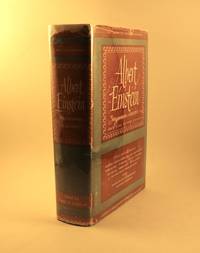
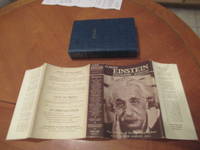
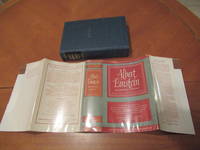
1951rif. 108Book is in good condition. Some darkening evident on ends of pages. Dust jacket is worn but intact and has been wrapped in Mylar for protection. Tudor Publishing Company hardcover
2000rif. Q-0517209845Randon House 2000-01-01. Hardcover. New. In shrink wrap. Looks like an interesting title! Randon House hardcover
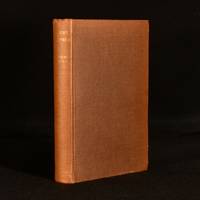
1931rif. 909Z26London: Thornton Butterworth Limited 1931. First edition. Cloth. Very Good Indeed. 8.5" by 5.5". None. The first UK edition later state binding of Anton Reiser's biography on the celebrated theoretical physicist Albert Einstein with a foreword by the incredible scientist himself. The very scarce first UK edition in a variant binding. First published in the U.S in 1930 by Albert & Charles Boni.Illustrated with a monochrome frontispiece. In the publisher's original brown cloth binding.This interesting biography on the noted theoretical physicist Albert Einstein was written by Rudolf Kayser under the pseudonym Anton Reiser. Kayser was the husband of Einstein's stepdaughter. The work also includes a foreword written by Albert Einstein himself. In the publisher's original cloth. Lacking dust wrapper. Externally excellent with fading to the spine a lean and slight bumping. Past owner's signature to the front free endpaper. Internally firmly bound with generally clean and age toned pages with spotting to the title page. Very Good Indeed Thornton Butterworth Limited hardcover
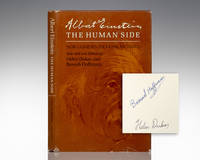
1979rif. 148235New Jersey: Princeton University Press 1979. First edition early printing of this curated collection of Einstein’s writings. Octavo original leather frontispiece. Boldly signed by Helen Dukas and Banesh Hoffman on the front free endpaper. Helen Dukas 1896–1982 was Albert Einstein’s longtime secretary and trusted confidante serving in that role from 1928 until his death in 1955. Deeply involved in preserving and organizing Einstein’s legacy she co-edited several collections of his writings and letters and played a key role in curating the Einstein Archives at the Institute for Advanced Study in Princeton. Banesh Hoffmann 1906–1986 was a physicist and mathematician who collaborated with Albert Einstein and made significant contributions to relativity and quantum mechanics. Near fine in a near fine price-clipped dust jacket. Uncommon signed by both contributors. Albert Einstein: The Human Side 1979 edited by Helen Dukas and Banesh Hoffmann offers a unique perspective on Einstein beyond his scientific achievements by compiling his personal letters reflections and anecdotes. Unlike traditional biographies that focus on his contributions to physics this collection highlights Einstein’s thoughts on philosophy politics ethics and personal relationships revealing his wit humility and deep moral convictions. Through carefully selected writings the book presents Einstein as both a brilliant scientist and a deeply introspective individual who grappled with the social and ethical implications of his work. Princeton University Press hardcover
rif. NATW0902Prag Selbstvlg. 1935. 285 S. mit 1 Titelportr. u. 10 Briefbeigaben im Text OLn. unwes. Gebrauchsspuren Name auf Tit. Prag, Selbstvlg. 1935. unknown
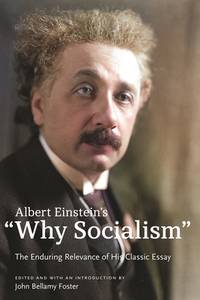
2025rif. SKU1748358Monthly Review Press 2025-05-05. hardcover. New. 5x0x8. New Book Ships with Tracking Monthly Review Press hardcover
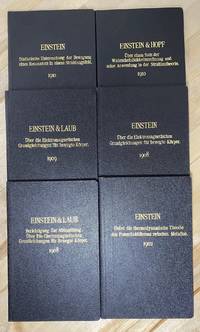
1910rif. 486Leipzig: Verlag von Johann Ambrosius Barth 1910. First Edition. Custom Black Pebbled Cloth/Leatherette. Very Good. ALBERT EINSTEIN - EARLY SCIENTIFIC CORPUS 1902-1910 - Six Extracted and Individually Bound Original Papers from Annalen der Physik Leipzig: Verlag von Johann Ambrosius Barth includes: Extracted from Annalen der Physik Leipzig: Verlag von Johann Ambrosius Barth 1902-1910 various issues 1902 - Annalen Der Physik Band 8 pgs. 798-814 - Ueber die thermodynamische Theorie der Potentialdifferenz zwischen Metallen und vollständig dissociirten Lösungen ihrer Salza und über eine elektrische Methode zur Erforschung der Molecularkräfte "On the Thermodynamic Theory of the Potential Difference Between Metals and Fully Dissociated Salt Solutions and on an Electrical Method for the Investigation of Molecular Forces" 1908 - Annalen Der Physik Band 26 pgs. 532-540 - Über die elektromagnetischen Grundgleichungen für bewegte Körper "On the Electromagnetic Fundamental Equations for Moving Bodies" 1908 - Annalen Der Physik Band 27 pgs. 231-232 - Berichtigung zur Abhandlung: Über die elektromagnetischen Grundgleichungen für bewegte Körper "Correction to the Treatise: On the Electromagnetic Fundamental Equations for Moving Bodies" 1909- Annalen Der Physik Band 28 pgs. 445-448 - Über die elektromagnetischen Grundgleichungen für bewegte Körper "On the Electromagnetic Fundamental Equations for Moving Bodies" 1910- Annalen Der Physik Band 33 pgs. 1096-1104 Über einen Satz der Wahrscheinlichkeitsrechnung und seine Anwendung in der Strahlentheorie "On a Theorem of Probability Theory and Its Application to Radiation Theory" 1910- Annalen Der Physik Band 33 pgs. 1105-1116 Statistische Untersuchung der Bewegung eines Resonators in einem Strahlungsfeld "Statistical Investigation of the Motion of a Resonator in a Radiation Field" Title Page and index are copies while the extract itself is original. This likely means it was extracted from the same volume as the other 1910 listing with the preceding pages. Six volumes octavo. Extracted journal papers individually rebound in institutionally appropriate black leatherette bindings likely mid-20th century archival or library rebinding. Institutional markings present consistent with deaccessioned academic holdings. German-language text throughout. Very good condition overall. Texts are clean and legible with expected light toning to paper consistent with early 20th-century scientific journal stock. Bindings are sound and uniformly presented as a cohesive institutional set. A rare and highly desirable six-volume early Einstein scientific corpus spanning 1902-1910 and documenting foundational developments in electromagnetism statistical mechanics probability theory radiation physics and thermodynamics. These papers originate from Einstein's formative scientific period in Annalen der Physik issued by Verlag von Johann Ambrosius Barth and collectively trace the intellectual evolution preceding and surrounding his Annus Mirabilis work. The included electromagnetism papers demonstrate Einstein's early engagement with moving reference frames and field equations while the statistical and probability-based works reflect his developing approach to radiation theory and molecular physics. The thermodynamic paper extends into electrochemistry and molecular force theory marking an important bridge toward later theoretical syntheses. A coherent and unusually complete early Einstein research sequence representing key stages in the development of modern theoretical physics. The set is of substantial interest to historians of physics Einstein scholars and institutional collectors focused on the evolution of electromagnetic theory and statistical mechanics in the early 20th century. . Verlag von Johann Ambrosius Barth hardcover
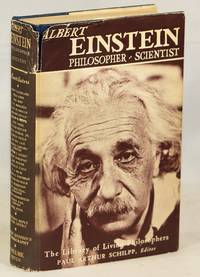
1949rif. 000017063Evanston Illinois: The Library of Living Philosophers Inc 1949. First edition. Hardcover. Very Good/Very Good. Large 8vo. 4 v-xvi 1 2-781 3 pp. Blue cloth with gold lettering on the front board and spine; brown topstain. Price of $8.50 on the front flap of the dust jacket. Illustrated with a frontispiece portrait of Einstein. Edited by Paul Arthur Schilpp. Volume seven of the Library of Living Philosophers. Boni 512. Contains Einstein's autobiography a bibliography of his work twenty-five scholar's discussions of Einstein's work and achievements with Einstein's replies to these various scholars. Includes essays by Bohr Born Reichenbach Pauli and the well-known essay by Godel in which he argues based upon his solutions to the field equations of general relativity in 1949 that Parmenides was right in that change is an illusion based upon our conceptual framework and our sensory perceptions. A fascinating study of the scientist who so profoundly shaped the twentieth century. A small soil spot on the bottom textblock and two small dog-ears; jacket with a closed tear on its spine panel and light edge wear. The Library of Living Philosophers, Inc hardcover
1949rif. 34216Evanston Ill: Library of Living Philosophers 1949. 1st Edition. No Binding. Clamshell As New. 1st Edition. No Binding. Albert Einstein. ALBERT EINSTEIN: PHILOSOPHER-SCIENTIST. Edited by Paul Arthur Schilpp. Evanston Ill.: Library of Living Philosophers 1949. First Trade Edition. Superb Custom Fitted Modern Collector's Clamshell Not A Book HAND-CRAFTED by our conservation team each case features a gilt stamped spine and stamped signature on black leather with cloth sides with black velour interior. An excellent Collector's Custom Case for this uncommon Einstein. Other Einstein Cases are readily available. TBCL Web Site photo/link available for OVER 100 generally in-stock titles. Book definitely NOT included. Custom Craft available. Library of Living Philosophers unknown
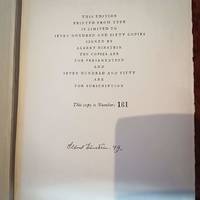
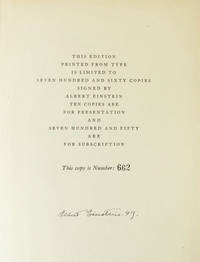
1949rif. 250705Evanston: Library Of Living Philosophers 1949. First Limited edition. Hardcover. fine /no glassine. Karsh frontis photos facs. Octavo publisher's green cloth bevelled edges in a custom-made clamshell cloth box with morocco spine labels Numbered copy 161 of only 760 numbered copies. Autographed: "Albert Einstein 49." Contains Einstein's own "Autobiographical Notes bi-lingual text German & English" and "Remarks to the Essays Appearing in this Collective Volume". Includes a Bibliography of Einstein's writings to 1949. At least 6 of the 25 contributors to this volume were awarded the Nobel Prize in Science. The contributors include Niels Bohr "Discussion with Einstein on Epistemological Problems in Atomic Physics" Kurt Godel F.S.C. Northrop Wolfgang Pauli etc. Illustrated with Yousuf Karsh's frontispiece portrait of Einstein photos facsimiles. Boni BIBLIOGRAPHICAL CHECKLIST 512. Library Of Living Philosophers hardcover
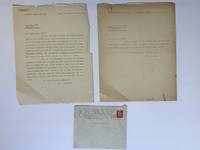
1931rif. 1403337Potsdam Germany 1931. Two letters by Albert Einstein. The first is a single-paged autograph letter signed by Albert Einstein with one horizontal fold and one vertical fold. In Very Good condition . Measuring 22.5 x 28.5 cm. Letter accompanied with mailing envelope both with matching paper-clip rust stain. Letter with some light wear along edges small staining to lower corner. Addressed to G. W. Meyer and dated 8 Oktober 31 in Potsdam the Letter reads in full: "Sehr geehrter Herr! Indem ich Ihnen für die Uebersendung des Buches von Henry George bestens danke sende ich Ihnen anliegend die gewünschte Meinungsäusserung mit der Bitte um Weiterleitung an Mrs. Evans. Mit ausgezeichneter Hochachtung" and signed in ink "A. Einstein". He thanks Meyer for serving as an intermediary in getting a book to him and for forwarding the enclosed letter. The second letter is a typed copy of Einstein's previously enclosed letter presumably made by Meyer before he passed the original on to Evans. Addressed to R. W. Evans and dated 8.10.1931 in Potsdam the letter discusses Henry George's economic theory of poverty and land nationalization compares it to Franz Oppenheimer's work and proposes questions to be asked. Presumably he was sent a copy of Henry George's Progress and Poverty. First published in 1879 it sparked the Progressive Era discussing the paradox of increasing inequality and poverty amid economic and technological progress as well as the economic value of land. Consignment. Shelved Case 3. The Letter reads in full: "Sehr geehrte Mrs. Evans! Ich habe das Buch von Henry George zum grössten Teil mit ausserordentlichem Interesse gelesen und glaube dass es in der Hauptsache einen unanfechtbaren Standpunkt vertritt insbesondere was die Ursache der Armut betrifft. Nie in diesem Buch vertretenen Ansichten stimmen soweit ich es beurteilen kann vollkommen mit den Resultaten des zeitgenössischen Professors Franz Oppenheimer überein der sie offenbar selbständig herausgefunden hat. Nicht einverstanden bin ich mit der Theorie des Zinses. Mit dem vorgeschlagenen Heilmittel der Verstaatlichung des Bodens und der Bodenschätzung scheint mir allerdings mehr ein Problem als eine Lösung gegeben zu sein. Soll z. Beispiel ein Boden Eigentum der Gemeinschaft das darauf hingestellte Haus aber Privateigentum sein Jedenfalls ist es schon von höchster Wichtigkeit dass das Wesen des Uebels klar aufgezeigt ist. Schon darum wäre es wichtig wenn das Buch die ihm gebührende Beachtung fände. Mit ausgezeichneter Hochachtung gez. A. Einstein." 1403337. Shelved Dupont Bookstore. unknown
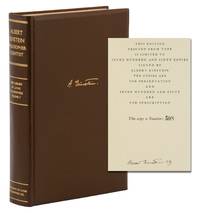
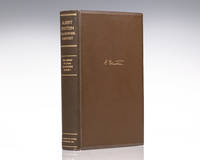
1949rif. 140948474Evanston Illinois: The Library of Living Philosophers Inc 1949. Signed Limited First Edition. Near Fine. First edition. Number 508 of a limited 760 copies signed and dated by Albert Einstein. 777 pp. Bound in publisher's brown leatherette stamped in gilt; top edge gilt; lacking the glassine dust jacket and slipcase. Text in English and German. Near Fine with very faint tidemark to edge of half-title frontisportrait and title page. A collection of critical essays devoted to the theoretical physicist by twenty-five eminent scholars and scientists with Einstein's remarks. Published on Einstein's 70th birthday the work has contributions by noted contemporaries such as Max Born Kurt Godel and Wolfgang Pauli. The Library of Living Philosophers, Inc unknown
1949rif. 148432Evanston: The Library of Living Philosophers Inc. 1949. First edition of Einstein's singular autobiography. Octavo original cloth with gilt titles to the spine top edge gilt frontispiece of Einstein by Yousuf Karsh. Edited by Paul Arthur Schilpp. In near fine condition. Written by the man considered the "Person of the Century" by Time magazine this is not a glimpse into Einstein's personal life but an extension and elaboration into his thinking on science. Two of the great theories of the physical world were created in the early 20th century: the theory of relativity and quantum mechanics. Einstein created the theory of relativity and was also one of the founders of quantum theory. Here Einstein describes the failure of classical mechanics and the rise of the electromagnetic field the theory of relativity and of the quanta. "The greatest physicist of the 20th century" PMM 408. The Library of Living Philosophers, Inc. hardcover
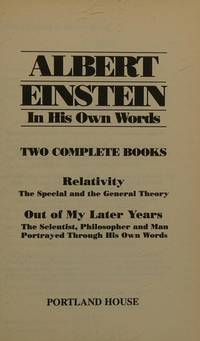
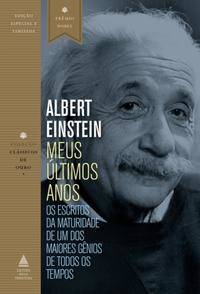
rif. 9788520935415NOVA FRONTEIRA. new. Albert Einstein dispensa apresentaes. Um dos maiores cientistas de todos os tempos o f�sico revelou ao mundo conceitos que revolucionaram a percepo do que era conhecido em sua rea de atuao e em outras como a tica e at mesmo a religio. Meus ltimos anos uma coletnea da produo intelectual do autor na maturidade reunindo temas como racismo educao e relaes sociais. Absolutamente atual Einstein afirma sua crena em um socialismo calcado na liberdade alm de criticar a sociedade de consumo e os regimes totalitrios. Uma obra �mpar que reflete o lado humanista deste pensador premiado com o Nobel de F�sica em 1921. NOVA FRONTEIRA unknown
1949rif. 057965New York: The Library Of Living Philosophers 1949. 1st Edition 1st Printing. Hardcover. Near Fine/Very Good. Xvi 781 Pp. Blue Cloth Gilt. Stated First Edition. First Printing Of Einstein's Autobiography With Text In Both German And English; First Publication Of Major Essays On Einstein And An Important Discussion With Niels Bohr. Near Fine Book Gilt Bright No Marks. Dust Jacket Priced $8.50 Wear Browning Minute Losses At Edges Dust To Rear Panel. The Library Of Living Philosophers hardcover
1994rif. 240218012Modern Library 1994. hardcover. New. 5x1x8. 9780517093801 NEW Inside and Out! Clean & Crisp Pages. E-mail for more info./pics Modern Library hardcover
2003rif. Q-187617563XOcean Press 2003-07-01. Paperback. New. In shrink wrap. Looks like an interesting title! Ocean Press paperback
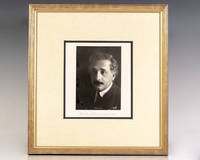
1923rif. 1413011923. Extremely rare original photograph boldly signed "Albert Einstein Jerusalem 1923" during his only trip to Palestine in 1923. Einstein's return voyage from his tour of Japan and China took him via the Red Sea and Suez Canal which allowed him to accept the invitation of Arthur Ruppin the director of the Palestine office of the Zionist Organization in Jaffa to visit the region for twelve days. Einstein arrived in Port Said on February 1 1923 and from there he traveled to Jerusalem Tel Aviv Jaffa and Haifa. The photographer Zvi Oron began his career in Warsaw and the United States before opening a studio in Tel Aviv in 1919. In 1930 he moved to Jerusalem and opened a studio of Jaffa Street working in the service of press clients and the British Government. He was well regarded for his candid images that captured daily life in the British Mandate. The Zionist archive holds over 1300 of his negatives. Double matted and framed the entire piece measures 19.75 inches by 15.5 inches. An exceptional piece. This is the only signed photograph known from his time in Palestine. Albert Einstein developed the general theory of relativity one of the two pillars of modern physics alongside quantum mechanics. Einstein's work is also known for its influence on the philosophy of science. Einstein is best known in popular culture for his mass–energy equivalence formula E = mc2 which has been dubbed "the world's most famous equation". He received the 1921 Nobel Prize in Physics for his "services to theoretical physics" in particular his discovery of the law of the photoelectric effect a pivotal step in the evolution of quantum theory David Bodanis. unknown
1949rif. 38664The Library of Living Philosophers. Very Good in Very Good dust jacket. 1949. First Edition. Hardcover. First edition of Einstein's autobiography. Blue cloth. Bookplate to ffep. Glue darkening along hinges. Book is tight and square. Gilt unfaded. The clipped jacket shows wear along edges and shows general toning. ; The Library of Living Philosophers; Vol. 7; 8vo 8" - 9" tall . The Library of Living Philosophers hardcover
1949rif. 053629New York: The Library Of Living Philosophers 1949. 1st Edition 1st Printing. Hardcover. Near Fine/Near Fine. Xvi 781 Pp. Blue Cloth Gilt. Stated First Edition. First Printing Of Einstein's Autobiography With Text In Both German And English; First Publication Of Major Essays On Einstein And An Important Discussion With Niels Bohr. Book Is Near Fine Gilt Brilliant Lightly Used No Marks. Dust Jacket Priced $8.50 Very Slight Wear 1/2" Closed Tear At Top Of Rear Flap Fold. The Library Of Living Philosophers hardcover
1951rif. 053640New York: Tudor Publishing Company 1951. 2nd Edition 1st Printing. Hardcover. Near Fine/Very Good DJ. Xvi 781 Pp. Blue Cloth Gilt. Second Edition With Bibliography Brought Up To 1951. Contains Einstein's Autobiography With Text In Both German And English; And Major Essays On Einstein Including An Important Discussion With Niels Bohr. Book Is Near Fine Gilt Brilliant Hinges Tight Touch Of Rubbing At Corners No Marks Or Bookplates. Dj With Light Usage Bright And Clean Tudor Publishing Company hardcover
1949rif. 32820623Original brown cloth top edge gilt publisher's slipcase. Very fine with the fragile slipcase in excellent condition. A superb copy. FIRST EDITION. One of 760 numbered copies signed and dated by Einstein. This important volume contains Einstein's autobiography specially written for the book a bibliography of his works twenty-five scientists' discussions of Einstein's work and achievements with Einstein's replies. Contributors of essays include Niels Bohr Max Born Wolfgang Pauli and Kurt Godel. I. I. Rabi's review in Science hailed this as a "most important and significant volume. It is most difficult to get scientists to write simply and clearly about the fundamentals of their science and the leading philosophical ideas that guide them. … In this book there is played out a great scientific drama of the last two decades. … The book starts with an intellectual autobiography by Einstein himself. He satirically calls it his obituary. I know of no other to compare with it. Neither Newton nor Maxwell nor any of the other great giants of physics had his Schilpp the editor to catalyze such an effort. After reading Einstein's article one realizes the great loss this is to scientific culture" Science 21 April 1950. This is an especially fine signed copy of an important book in the Einstein canon Library of Living Philosophers, hardcover