214 résultats
1975réf. 285227New York: Harry N. Abrams Inc 1975. Hardcover. 260p. first edition 12x11 inches; b&w and color plates fore-edge slightly toned small tear between front bottom dj and front panel spine and rear dj heavily toned and slightly soiled minor edgewear and creasing on back dj rear side of spine slightly rubbed else very good. Harry N. Abrams, Inc hardcover books
1920réf. 374021920. Weil 110. Offprint from S. preuss. Akad. Wiss. unknown books
1951réf. 33824London: Cassell 1951. Hardcover. Very Good. Octavo. Boards. 91 pp. Some browning and foxing. Cassell hardcover books
1932réf. 433001932. Offprint from Sitzungsberichte der Preussischen Akademie der Wissenschaften 32 1932. 31pp. 256 x 183 mm. Original printed wrappers a little chipped and darkened small splits in spine. Very good. First edition offprint issue. Einstein's work on semivectors "was stimulated by Ehrenfest's insistence on a better understanding of the relation between single-valued and double-valued representations of the Lorentz group . . . Einstein and Mayer went on to relate semivectors to the Dirac equation and to generalize the formalism to general relativity" Pais Subtle is the Lord pp. 451-452. Weil Albert Einstein Bibliography 186. unknown books
1932réf. 37427Berlin: Akad. Wiss 1932. Akad. Wiss unknown books
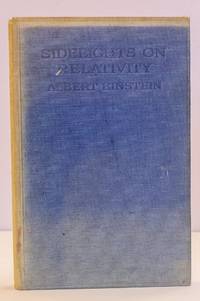
1922réf. 1415530London UK: Methuen & Co 1922. First Edition Thus. Hardcover. Small octavo 60 10 pages. In Good Plus condition. Bound in publisher's blue fabric with gilt lettering on spine. Light general shelfwear. Agetoning to spine and top edge of front board. Small spots of discoloration on back board spine hinges and front board. Mild foxing to text block and paste downs. Pencil marks from previous owner in text block concentrated in first section. Shelved in Case 10. 1415530. Shelved Dupont Bookstore. Methuen & Co hardcover books
1983réf. 556751New York: Dover Publications Inc 1983. Softcover. Very Good. Reprint. 56pp. Pictorial wrappers. Ex-library with a label on the front cover and a stamp on the front fly spine partially unglued from text block faint dampstain in the margin of several pages about very good. Originally published by E.P. Dutton in 1923. Dover Publications Inc unknown books
1983réf. 35229NY: Dover 1983. 8vo pp. 56. Paper wraps. Cover very slightly soiled o/w a nice tight copy. Two addresses: Ether and the theory of relativity 1920 and Geometry and experience 1921. Dover unknown books
1945réf. 1292Princeton: Princeton University Press 1945. Second edition first printing. 1945 LANDMARK SUMMARY OF NOBELIST ALBERT EINSTEIN'S THEORIES THAT ESTABLISHED MODERN PHYSICS--COPY OF NOBELIST CARLETON GAJDUSEK WHO DISCOVERED KURU THE FIRST PRION DISEASE. 8 inches tall hardcover gray cloth binding gilt title to spine decorative bookplate of D. Carleton Gajdusek to front paste-down signature of D. Carleton Gajdusek to front free endpaper vi 135 pp near fine in very good unclipped jacket with faint splash mark to cover light wear to spine ends and corners in protective mylar sleeve. This first printing of the second edition contains an appendix added by the author discussing advances in the theory of relativity since the first edition in 1921. ALBERT EINSTEIN 1879 – 1955 was a German-born theoretical physicist widely acknowledged to be one of the greatest and most influential physicists of all time. Einstein is best known for developing the theory of relativity but he also made important contributions to the development of the theory of quantum mechanics. Relativity and quantum mechanics are together the two pillars of modern physics. In 1922 he was awarded the 1921 Nobel Prize in Physics "for his services to Theoretical Physics and especially for his discovery of the law of the photoelectric effect". The Meaning of Relativity: Four Lectures Delivered at Princeton University May 1921 is a book published by Princeton University Press in 1922 that compiled the 1921 Stafford Little Lectures at Princeton University given by Albert Einstein. The lectures were translated into English by Edwin Plimpton Adams. The lectures and the subsequent book were Einstein's last attempt to provide a comprehensive overview of his theory of relativity and is his only book that provides an accessible overview of the physics and mathematics of general relativity. The book is made of four lectures. The first is titled "Space and Time in Pre-Relativity Physics". The second lecture is titled The Theory of Special Relativity and discusses the special theory of relativity. The third and fourth lectures cover the general theory of relativity in two parts. Einstein added an appendix to update the book for its second edition published in 1945 offered here. PROVENANCE: DANIEL CARLTON GAJDUSEK 1923-2008 was an American medical doctor and researcher who was co-recipient of the Nobel Prize in Physiology or Medicine in 1976 for his work in Kuru the first prion disease. Gajdusek graduated from Harvard Medical school at age 23 served as head of virological and neurological research at the National Institute for Health in 1958; and inducted into the National Academy of sciences in 1974. Gajdusek's best-known work focused on kuru. This disease was rampant among the South Fore people of New Guinea in the 1950s and 1960s. Gajdusek connected the spread of the disease to the practice of funerary cannibalism by the South Fore. With elimination of cannibalism kuru disappeared among the South Fore within a generation. He proved his hypothesis by successfully transmitting the disease to primates and demonstrating that it had an unusually long incubation period of several years. This was the first demonstration of the infectious spread of a noninflammatory degenerative disease in humans. Subsequently additional human agents belonging to the same group were discovered. They include sporadic familial and variant Creutzfeldt–Jakob disease. Gajdusek recognized that diseases like Kuru and Creutzfeldt–Jakob disease were caused by a new infectious agent that had not yet been identified. Princeton University Press hardcover books
1933réf. 13747Los Angeles 1933. Signed by the photographer Aaron Tycko of Los Angeles. Prominently signed “Albert Einstein. 1933” below image. Rarely seen photograph of the famous scientist taken during his last visit to Southern California in January 1933 the month Hitler took power in his native Germany. During the five-month trip Einstein 1879-1955 spent most of his time at the Mount Wilson Observatory and the California Institute of Technology where he was offered a position. Later that year he renounced his German citizenship and accepted a professorship at the Institute for Advanced Studies in Princeton New Jersey. Tycko 1893-1975 was based in Los Angeles and often photographed Einstein along with other Hollywood icons of the early twentieth century including Irving Berlin. At the time this photograph was taken Tycko also shot a well-known photograph of Einstein with his wife Elsa. Interestingly Tycko is mention in Einstein’s FBI files because a Hollywood informant reported that the photographer believed Einstein was a communist. This informant contended that Tycko thought Einstein was “the brain that was setting up Hollywood in the 1930’s for the big Communist push . . . He was one of the most dangerous and powerful figures in what has become the Communist movement.” Jerome The Einstein File: J. Edgar Hoover’s Secret War Against the World’s Most Famous Scientist. unknown books
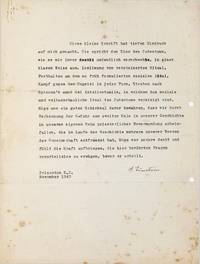
1943réf. 3079Princeton NJ: np 1943. first. Very Good. AN EXTRAORDINARY SIGNED 1943 STATEMENT DEFINING EINSTEIN'S CONCEPTION OF JUDAISM THROUGH REASON AND SPINOZA WHILE WARNING AGAINST "CLERICAL DOMINATION" IN A FUTURE JEWISH HOMELAND. Of course we all know Einstein as the great scientist. From the theoretical physicists among us to those of use who barely survived high school physics we are all captivated by the man and accept his place at the outer limits of human intellectual capacity. Yet it's when Einstein leaves the world of relativity and theoretical physics that we are often most drawn to his never-ending charisma. Especially exciting to so many of us are his deep convictions about human affairs especially politics and religion. Einstein famously was irreligiously religious. Born to a secular Jewish family his upbringing lacked the complex ritual we associate with Orthodox Judaism. He briefly became curious about religiosity as a child but his attempts at following religious ritual and doctrine ended a few years later as he confronted the conflict between scientific ideas and Biblical stories. Yet one still sees a deep spirituality in Einstein who saw a special camaraderie in the 17th-century Dutch Jewish philosopher Baruch Spinoza. Spinoza was a Jewish radical who had little patience for endless ritual. He did not see God as a being intervening in human affairs but as a great rational force who formed the universe using rational methods. We become close to God therefore by trying to understand the natural world not obeying endless rituals. One can easily see Spinoza's approach as appealing to Einstein. In Spinoza's view the scientist is the holyman his work bringing him closer to God's creations. While in 1943 many of Einstein's contemporaries could accept such a view in seventeenth-century Amsterdam it was another matter: Spinoza was formally expelled from his Jewish community. Shikmoni's Pamphlet & Einstein's Views Humanistisches Judentum Humanistic Judaism was not a conventional commercial publication. It was issued privately in Haifa in 1948 "on behalf of a Circle of Friends" with Einstein's contribution prominently advertised on the title page as a "Geleitwort von Prof. Albert Einstein." Shikmoni's short pamphlet aligns closely with Einstein's view of religion. Its central proposition is quite radical: a genuinely renewed Jewish culture must recover what Shikmoni regards as Judaism's original combination of humanism and a rational worldview. He traces that tradition through Moses and the Prophets incorporates Jesus "the Nazarene" and sees it culminating in Spinoza. For Shikmoni as for Einstein Spinoza offered a way of reconciling Jewish intellectual identity with reason and freedom from religious orthodoxy. Shikmoni's devotion to Spinoza extended beyond this pamphlet. In 1950 he founded the Spinoza House Bet Shpinozah or Spinozaeum in Haifa a center devoted to promoting Spinoza's philosophy in the newly established State of Israel. The organization attracted prominent supporters including David Ben-Gurion and Albert Einstein. The Document The typescript we have here was written by Einstein on his Princeton letterhead in November 1943 in response to Shikmoni's pamphet and would eventually be published as Einstein's foreword to the pamphlet. The pamphlet would not appear until 1948 five years after Einstein wrote these words. It is not difficult to understand why Shikmoni's manuscript made such an impression on Einstein. He recognized in it many of his own ideas about Judaism religion and Spinoza. Indeed in the typescript Einstein begins by admitting that Shikmoni had articulated something that he himself had long felt but had struggled to define: "This little work has made a deep impression on me. It expresses in a clear manner the meaning of Judaism as it had always hovered indistinctly before me." What follows is almost a miniature statement of Einstein's own religious philosophy: "liberation from petrified ritual; adherence to the social ideal formulated so early; struggle against the spirit of unreason in every form; striving toward Spinoza's amor dei intellectualis." Like Spinoza Einstein's Judaism is not defined principally by ritual observance but by ethics reason intellectual freedom and the pursuit of understanding. But Einstein then moves from religion to politics. The typescript is dated November 1943 five years before the establishment of Israel. We see Einstein already contemplating the character of a future Jewish homeland and warning against allowing religious authority to dominate it: "May a favorable fate preserve us from failing to recognize the danger and for a second time in our history falling in our own homeland under clerical domination which over the course of history has alienated several of our finest people from the community." The warning brings us directly back to Spinoza. Einstein had just invoked a Jewish thinker who had himself been expelled from his religious community for his unorthodox ideas; in the very next paragraph he warns of religious authority once again alienating "several of our finest people" from the Jewish community. There is another important feature of the present typescript. When Einstein's statement was finally published as the foreword to Shikmoni's pamphlet in 1948 one of its most forceful phrases had disappeared. Einstein's original reads: "Kampf gegen den Ungeist in jeder Form" "struggle against the spirit of unreason in every form". The entire phrase is omitted from the published version. The present signed typescript therefore preserves a substantive passage from Einstein's original statement that did not survive into its eventual publication. Full German Transcription Diese kleine Schrift hat tiefen Eindruck auf mich gemacht. Sie spricht den Sinn des Judentums wie er mir immer dunkel undeutlich vorschwebte in einer klaren Weise aus. Loslösung vom versteinerten Ritual Festhalten an dem so früh formulierten sozialen Ideal Kampf gegen den Ungeist in jeder Form Streben nach Spinoza's amor dei intellectualis in welchem das soziale und weltanschauliche Ideal des Judentums vereinigt sind. Möge uns ein gutes Schicksal davor bewahren dass wir durch Verkennung der Gefahr zum zweiten Male in unserer Geschichte in unserem eigenen Heim priesterlicher Bevormundung anheimfallen die im Laufe der Geschichte mehrere unserer Besten der Gemeinschaft entfremdet hat. Möge wer anders denkt und fühlt die Kraft aufbringen die hier berührten Fragen vorurteilslos zu erwägen bevor er urteilt. Princeton N.J. November 1943 A. Einstein English Translation This little work has made a deep impression on me. It expresses in a clear manner the meaning of Judaism as it had always hovered indistinctly before me: liberation from petrified ritual; adherence to the social ideal formulated so early; struggle against the spirit of unreason in every form; striving toward Spinoza's amor dei intellectualis in which the social and philosophical ideals of Judaism are united. May a favorable fate preserve us from failing to recognize the danger and for a second time in our history falling in our own homeland under clerical domination which over the course of history has alienated several of our finest people from the community. May those who think and feel differently summon the strength to consider without prejudice the questions touched upon here before passing judgment. Princeton N.J. November 1943 A. Einstein In a single page later published in an obscure German pamphlet Einstein brings together some of the convictions that defined his life beyond physics: his Jewish identity his reverence for Spinoza his distrust of religious orthodoxy and his belief that reason humanism and intellectual freedom should prevail over dogma. Typescript on Einstein's Princeton letterhead with his embossed Mercer Street address at top; signed by Einstein "A. Einstein." at bottom right. Princeton New Jersey November 1943. One page approx. 8.5 x 11 in; rust mark from paper clip at top left; scattered foxing; two binder punch holes at right margin. A RARE CLEAR EXPLANATION OF EINSTEIN'S RELIGIOUS BELIEFS AND HIS RELATIONSHIP TO JUDAISM. np unknown books
réf. 50102pamphlet. 11 pages p 1105-1115 FROM: Annalen der Physik fourth series vol. 33. Modern wrappers. Leipzig 1910. unknown books
1916réf. 2364Braunschweig: Druck und Verlag von Friedr Vieweg and Son 1916. First edition. Original wrappers. Very Good. FIRST PRINTING IN ORIGINAL WRAPPERS OF ONE OF EINSTEIN'S MAJOR WORKS: HIS FIRST PAPER ON THE DERIVATION OF PLANK'S LAW AND PROVIDING THE THEORETICAL BASIS FOR THE LASER. "Einstein commended the 'unparalleled boldness' of Planck's derivation of 1900 meaning not only the problem itself but also the fact that it was based on assumptions that were not entirely free of contradictions. Einstein now succeeded in the first of two papers in eliminating that flaw. More interesting than the derivation itself was the general character of his methods. Einstein proceeded from Niels Bohr's basic--and by then well tested--assumption that the electrons within an atom occupy a number of discrete energy states and are able through emission or absorption of radiation to pass from one of those states to another. Added to this was an assumption of thermodynamic equilibrium between radiation field and atom as well as a consideration of the 'classical' limiting case at high temperatures--and there was Planck's formula. This brief argument. also covers emission stimulated by the radiation field; thus the formulas already by implication contain the theory of the laser though it was to take nearly half a century to be realized" Folsing Albert Einstein 389. Weil 85. The "implication" containing the theory of the laser was more fully developed in his companion paper "On the Quantum Theory of Radiation" published a few weeks later. In the first paper Einstein wrestled with the concept that the atomic emission of radiation could be a directed process; in the second paper he convincingly demonstrates that this is indeed the case. IN: Verhandl. D. Deutch. Phys. Ges. Vol 18 pp. 318-323. Braunschweig: Druck und Verlag von Friedr. Vieweg and Son 1916. Octavo original wrappers; housed in custom half leather chemise. One thread literally resewn on wrappers a little creasing and soiling. A beautiful copy. RARE IN ORIGINAL WRAPPERS. Druck und Verlag von Friedr Vieweg and Son unknown books
1931réf. 37424Berlin: Akad. Wiss 1931. Weil 180. Offprint from S. preuss. Akad. Wiss. Akad. Wiss unknown books
1922réf. R5312Berlin: Slovo 1922. Third edition. Paperback. Good. Original wraps; pp. 152 with frontispiece portrait of the author and his preface to the Russian edition. Front cover and endpaper detached but present; cheap paper tanned along the edges and a bit brittle. Slovo paperback books
1944réf. 556012New York: The American Christian Palestine Committee 1944. Softcover. Very Good. First separate edition. Small octavo. 12pp. Stapled self-wrappers. Slight age-toning on the wrappers and very tiny nicks soiling and light wear very good or better. Two articles jointly written by Einstein and Kahler in response to two articles laying out anti-Zionist testimony given by Dr. Philip Hitti of Princeton before the Committee on Foreign Affairs of the House of Representatives. Both of Hitti's articles and the Einstein and Kahler articles were all published in The Princeton Herald. This publication doesn't include the Hitti articles but summarizes them in the Einstein and Kahler rejoinders. Scarce. The American Christian Palestine Committee unknown books
1989réf. 605743New York: Bonanza Books 1989. Hardcover. Fine/Fine. Reprint. Tall octavo. 361pp. Remainder stripe on topedge else fine in fine dust jacket. Published here as part of the "Favorites from The Fireside Books of Baseball" series. Bonanza Books hardcover books
1980réf. 134213New York: Lippincott & Crowell 1980. Hardcover. Very Good/Very Good. Very good in very good dust jacket. Book club. Hardcover and dust jacket lightly rubbed along spine ends and corners. Dustwrapper worn along edges. Lippincott & Crowell hardcover books
1880réf. 24284A unique and important artifact of his childhood. ALBERT EINSTEIN. Ephemera. Set of Anker-Steinbaukasten children's building blocks by F. Ad. Richter & Cie. Rudolstadt Germany c.1880s. Approximately 160 composite quartz sand chalk and linseed oil blocks in red limestone and slate gray in various sizes and shapes together with three or more sets of building plans all contained in two wooden boxes with printed Anker-Steinbaukasten labels. Einstein spent his childhood building "complicated structures" with these Anker-Steinbaukasten blocks. Accepting his later theory that "Imagination is more important than knowledge" the toys that encouraged his imagination became building blocks for the most important scientific theories of the last millennium. His sister Maja Winteler-Einstein describing his childhood recalled that "The games he played … were very characteristic of Albert's capacities. These were mostly puzzles fretsaw work the erection of complicated structures with the well-known Anker building blocks and above all the construction of multi-storied card castles with which he filled his leisure." "Beitrag für sein Lebensbild" in The collected papers of Albert Einstein. ed. John Stachel. Volume 1: The early years. 1879-1902. Princeton University Press 1987 p.lix. Translated from German. Based on the work of German educator Friedrich Froebel who created the concept of kindergarten these composite stone blocks were a popular toy of the 1880s and 1890s. The blocks were designed to help develop childrens' tactile senses and manual dexterity and also to stimulate imagination creativity and three-dimensional perception. Fellow scientist J. Robert Oppenheimer as well as architects Frank Lloyd Wright and Walter Gropius are among the geniuses who are known to have played with Anker blocks. Provenance The set had passed by direct descent from Albert Einstein to the consignor from whom we acquired the blocks at Christie's London on July 13 2016. Condition A few blocks chipped and worn with original instructions and boxes worn soiled and defective. Albert Einstein 1879-1955 was a German-Swiss born theoretical physicist internationally recognized as one of the greatest physicists of all time. He enunciated the general theory of Relativity with law explaining the relationship between the speed of light and its consequence the equivalence of mass and energy E=MC2. For his work in theoretical physics—largely for his 1905 paper on photons and photo-electricity—Einstein was awarded the Nobel Prize for Physics announced in November 1922 retroactive for 1921. Working on a unified field theory he then attempted to explain gravitation and electromagnetism within one set of laws. With the expulsion of Jewish scholars from Germany after Hitler's rise to power Einstein joined the Institute for Advanced Study in Princeton New Jersey 1933 which became the most celebrated research center in the world. In 1939 he signed a letter written to President Franklin Roosevelt warning him of the possibility of Germany developing a nuclear bomb. He urged the U.S. to begin uranium research thus beginning the top secret "Manhattan Project." Later at Princeton he tried to develop a unified field theory and to refute the accepted interpretation of quantum physics both unsuccessfully. Einstein received U.S. citizenship in 1940. books
1964réf. 53342New York: Gold Medal 1964. Softcover. Near Fine. First paperback edition. Near fine in wrappers. Gold Medal unknown books
1938réf. 15852New York: Simon and Schuster 1938. FIRST EDITION THIRD PRINTING. Original cloth; interior clean. A newspaper article pasted onto the paste-down plus the flaps from the dust jacket pasted in. Ownership signature of Charles Schuchert 1858-1942 American paleontologist that was the leader in the development of paleogeography on the fly-leaf. First edition third printing. Intended as an explanation of the totality of Einstein’s accomplishments for the layperson the publication of this extraordinarily successful work was also used in an attempt to find Infeld a university position he eventually ended up in Canada. According to the preface “the book is a simple chat between you and us. You may find it boring or interesting dull or exciting but our aim will be accomplished if these pages give you some idea of the eternal struggle of the inventive human mind for a fuller understanding of the laws governing physical phenomena.” Weil 201. Simon and Schuster unknown books
réf. B34915-SCCambridge University Press. Collectible - Good. Great Britain: Cambridge at the Univ Press 1938. 1st UK 1st issue with gold lettering on spine and both endpapers present. Hardcover 12mo 319 pgs. Medium blue cloth gold gilt on spine. B/w plates and illustrations. Near very good book in a fair dust jacket. Corners and spine ends lightly bumped and worn. Contents clean and binding sound. Bookplate to front endpaper with writing in Latin name of Andrzei Falkiewicz written in and Alberto H R Ball Rectore at bottom edge. Jacket is edgeworn chipped and torn. Rear panel and spine are toned. Orig price 8s 6d on front flap. stem science physics Inquire if you need further information. Cambridge University Press hardcover books
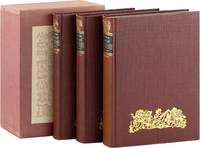
1949réf. 88051Princeton: Princeton University Press 1949. First English Language Edition. Three quarto volumes. Burgundy cloth hardcovers in publisher's slipcase; xvi1-476; 477-8773; x333pp. A fine set in the original cloth bindings; slipcase is mildly rubbed and sunned with small paper loss to open edge still Very Good. Einstein's monumental study was the first scholarly treatise of its kind in any language and remains one of the essential works on early Italian secular music. Volumes I & II provide scholarly background on the history and evolution of madrigal form while the third volume compiles nearly 100 compositions produced between 1470 and 1650 including works by Tromboncino Verdalot De Rare Gabrielli and others. An uncommonly well-preserved set. Princeton University Press unknown books
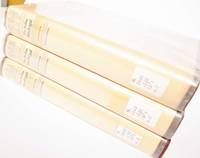
1971réf. 212282Princeton N.J.: Princeton University Press 1971. Hardcover. VG. Jackets and volumes are clean and unmarked. Jackets in mylar. Quarto Hardcover. Three volumes bound in burgundy cloth with gilt spine lettering; tan dust jackets with mylar covers. Illustrated title pages bw illustrations throughout each volume. Text in English songs in Italian with English text translations. Vol. 3 contains "Texts of songs revised and translated by Antonio Illiano and Howard E. Smither" and scores of 97 madrigals. Princeton University Press hardcover books
1971réf. 186152Princeton N.J.: Princeton University Press 1971. Hardcover. Good/Good Ex-library with stamps and labels on spine inside front and rear covers ffep and block. Overall light shelfwear to boards and block. Binding is tight and pages are otherwise clear. Three volumes bound in burgundy cloth with gilt spine lettering; tan dust jackets with mylar covers. Illustrated title pages bw illustrations throughout each volume. Text in English songs in Italian with English text translations. Vol. 3 contains "Texts of songs revised and translated by Antonio Illiano and Howard E. Smither" and scores of 97 madrigals. Princeton University Press hardcover books